
Powerscale 500,000mg/h Dual-Core Ozone Generator
5.0Editor score
500,000 mg/h maximum output
Digital 300-minute timer
90-minute 4,000 sq ft cycle
Removable washable filter
Our expert guide compares 10 best ozone generators for grow rooms, highlighting capacity, coverage, controls, safety guidance, odor removal, and practical use
Ozone generators can help remove persistent odors from an unoccupied grow room, but they are specialized tools rather than ordinary air purifiers. The best models combine useful coverage, adjustable treatment cycles, portable construction, and clearly stated safety procedures for spaces that contain no people, pets, or plants.
This guide compares ten ozone generators on output, stated room coverage, timer functions, odor-control features, portability, maintenance needs, and safety information. It includes compact home models, portable high-output machines, and heavy-duty commercial units, with special attention to the clearance and ventilation required after treatment.
Each pick highlights the features that distinguish it from the alternatives and explains which situations may suit it best. Product listings, availability, and prices can change, so readers should confirm the current details and follow the manufacturer's instructions before purchasing or operating any ozone generator.
5.0Editor score

4.5Editor score

4.7Editor score
The comparison below places all ten machines side by side, focusing on stated ozone output, coverage, controls, and practical considerations for unoccupied grow-room odor treatment.




This 45,000 mg/h ozone generator combines a 4.7 rating with a stated coverage area of up to 2,500 square feet, making it a practical entry point for odor treatment in an unoccupied grow room. Its selling point is straightforward utility: a single-layer ozone plate, a substantial stated lifespan, and only two pre-installed fuses listed as serviceable components.
We may earn a commission when you buy through this link, at no additional cost to you.
The unit is described as useful against household, cooking, pet, and vehicle odors. Its ozone reaction is intended to address odors in the air and on surfaces such as water, fabrics, and walls rather than simply masking them with fragrance. That makes it more relevant to a grow room dealing with damp, musty, smoke, or persistent organic odors than a conventional purifier that only filters particles passing directly through it.
There are trade-offs. The listing does not provide the kind of detailed timer programming offered by several higher-ranked alternatives, and ozone concentration can vary when doors, windows, and ventilation are not controlled. The instructions require treating the odor source first, keeping people and pets away, and ventilating for one hour after treatment. Plants should also remain out of the treated space.
This is a compelling choice for a budget-conscious grower with a small or medium unoccupied room. It is simpler than the feature-heavy models in this list and offers ample stated output for routine odor-control jobs, provided the buyer follows the ventilation requirements and uses realistic cycle settings rather than expecting instant results.
The machine is listed for homes, cars, pet areas, kitchens, bathrooms, basements, and similar enclosed spaces. For a grow room, that versatility means it can address several common odor sources without requiring a specialized fragrance-based deodorizer.
A stated lifespan of up to 35,000 hours and a design without complex replaceable parts make upkeep straightforward. This simplicity can be more useful in a grow room than additional programming features.
We may earn a commission when you buy through this link, at no additional cost to you.
The Enerzen 60,000mg earns a 4.6 rating and presents a straightforward alternative for growers who want a timer-controlled ozone machine without a large collection of operating modes. Its main advantage is a clear operating concept: set the timer, leave the room, allow the generator to finish, and then ventilate for an additional 30 minutes.
We may earn a commission when you buy through this link, at no additional cost to you.
Ozone is used here as an oxidizing odor treatment rather than a conventional filter. The listing says it reacts with odors in air, water, fabrics, and walls, and it does not need air to pass directly through the machine to work. That gives it potential in a grow room where odor molecules may be distributed beyond the immediate path of a purifier's filter.
The main drawback is incomplete information about maximum room size. The product is described as industrial and suitable for cars, boats, dumpsters, kitchens, bathrooms, basements, and areas affected by flood or fire, but no square-foot figure appears in the supplied listing. Buyers must therefore judge the room by output and manufacturer guidance rather than a stated coverage number.
For a grower seeking uncomplicated controls and clear post-treatment instructions, the Enerzen remains a sensible option. It is best suited to smaller, sealed spaces or controlled cycles, and it should not be used while plants remain inside. Its California availability restriction is another reason to verify ordering eligibility before purchase.
A single timer control reduces setup decisions during a scheduled room treatment. The user sets a duration, leaves the space, and waits through the prescribed airing period before returning.
Because the machine does not require odor-bearing air to pass through a filter, ozone can reach odors throughout an enclosed room. This may help with residues on walls, fabrics, and other surfaces.
We may earn a commission when you buy through this link, at no additional cost to you.
This dual-fan ozone machine stands out for its stated 198,000 mg/h output and coverage of up to 6,000 square feet. Its 4.2 rating is lower than those of most machines in the guide, but the specification set suggests a machine aimed at large rooms and demanding odor conditions rather than a compact household deodorizer.
We may earn a commission when you buy through this link, at no additional cost to you.
Front-and-rear turbo fans are intended to move air more quickly and distribute ozone through a room. The listing claims a 60% increase in purification speed and a 50% extension in coverage compared with single-fan models. It also reports a service life of up to 40,000 hours and improved heat dissipation for operation in hot or humid conditions.
Those ambitious specifications require some caution. A 4.2 rating indicates that buyers have not been uniformly satisfied, and no independent test results were supplied to verify the comparative percentage claims. The product still carries clear operating rules: remove people, pets, and plants, use the timer, and ventilate for at least 40 minutes after the machine stops.
This model is most compelling for a large, fully unoccupied grow room where rapid odor distribution is important. It may be excessive for a small tent, and buyers should avoid treating output figures as permission to operate the machine carelessly. The automatic shutoff and strong stated output are positives, while the ventilation requirement and modest rating temper the recommendation.
Opposed turbo fans are designed to improve circulation and distribute ozone more evenly. The arrangement may be helpful in larger or irregularly shaped rooms where a single directional fan is less effective.
The listing emphasizes airflow, heat dissipation, and temperature control for variable conditions. Those attributes suit a grow environment, where heat and humidity can vary throughout the day.
We may earn a commission when you buy through this link, at no additional cost to you.
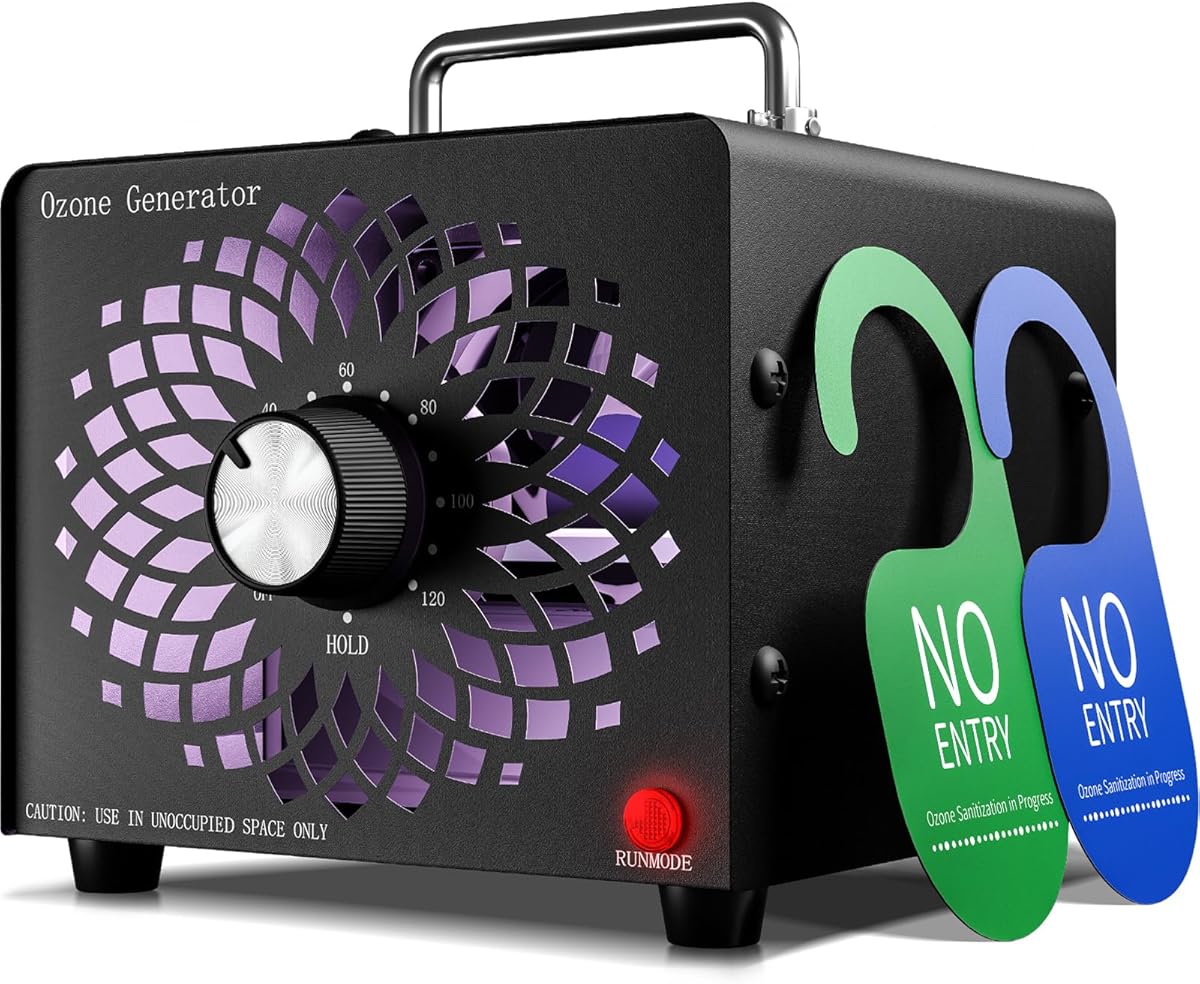
This updated ozone generator combines a 4.5 rating with a stated output of 55,000 mg/h and a claimed coverage area of up to 6,000 square feet. Its most grower-friendly differentiator is the listed operating noise below 30 decibels, which makes it more appropriate for a room where low noise matters than many higher-output alternatives.
We may earn a commission when you buy through this link, at no additional cost to you.
The unit supports a timer of up to 120 minutes and a hold setting for continuous operation. Ozone is described as reacting with odors in air, water, fabrics, and walls instead of merely covering them with fragrance. The controls are intentionally simple, allowing a user to select a duration without navigating a complex display or configuration menu.
The broad room claim should not be separated from the treatment details. Continuous hold mode encourages extended operation, while the instructions specify an enclosed space and 30 to 60 minutes of ventilation after treatment. People, animals, and plants must be kept away while the unit is working. California sale restrictions also apply.
The product is a good fit for a grower who values quiet equipment, simple operation, and ample stated coverage. It may be useful in a ventilated grow-room service area after harvest, or during a complete downtime period when every plant and person can be removed. Its timer makes scheduled use more practical than relying on the hold function.
A stated level below 30 decibels makes this model suitable for areas where equipment noise could otherwise be disruptive. It remains an ozone generator, so quieter operation does not alter the need to keep the space unoccupied.
The 120-minute timer supports controlled treatment cycles, while hold mode offers flexibility for larger jobs. Controlled timing is generally easier to coordinate with ventilation and safe reentry.
We may earn a commission when you buy through this link, at no additional cost to you.
This blue ozone generator pairs a stated 120,000 mg/h output with negative-ion air purification, earning a 4.6 rating among the stronger-reviewed products in the guide. Its two-function design is attractive for growers who want a dedicated odor-treatment cycle and a separate mode for refreshing particulate-laden air.
We may earn a commission when you buy through this link, at no additional cost to you.
The negative-ion mode is intended to attract and absorb fine dust, while the ozone mode addresses difficult odors. A 3200 RPM fan helps distribute ozone, and the product uses four-layer ceramic ozone plates. Its all-metal body, foldable handle, and modest room-coverage figure of up to 2,500 square feet make it look more manageable than some ultra-high-output alternatives.
The main compromise is the relationship between output and coverage. A machine rated at 120,000 mg/h is powerful, but the listing does not claim the 6,000-square-foot coverage found on some competing units. In practice, that means the buyer should not treat a large nominal output as automatic permission to use a short cycle in an oversized room.
This is a strong choice for a medium grow room needing both odor oxidation and basic dust-refresh functionality. Its portable metal design, strong output, and separate purification technologies offer a useful combination, provided the user selects the appropriate mode and allows at least 30 minutes of ventilation after ozone treatment.
Ozone and negative ions serve different purposes in the listing. Keeping the modes distinct allows a grower to use the stronger oxidizing treatment only when a fully cleared room is available.
The foldable handle and all-metal shell support movement between a grow room, vehicle, storage area, or another enclosed space. Portability is useful when treatment windows are limited.
We may earn a commission when you buy through this link, at no additional cost to you.
The OdorFree Villa 3000 is the most established-appearing option in this guide, with a 4.5 rating, a five-year warranty, and a manufacturer description that cites more than 20 years in the ozone industry. Its stated output of 150 to 1,800 mg/h is much lower than the headline figures of newer machines, but its long timer and adjustable output offer a different operating philosophy.
We may earn a commission when you buy through this link, at no additional cost to you.
Instead of promoting a very brief high-output burst, this model supports treatments from one to 12 hours, with manual operation available for longer jobs. It is designed to fill a space with ozone so the gas can oxidize odor molecules at their source. The stated 3,000-square-foot coverage is complemented by included plates and a filter.
Its safety guidance is notably conservative. The listing cites the American Lung Association's recommendation to use ozone only in unoccupied spaces and advises waiting at least two hours before reoccupying a room. That is longer than the 30-to-60-minute windows used by many newer competitors and should be treated as a firm part of the operating procedure.
This machine is best for a grower who values durability, warranty support, and gradual adjustable treatment over a dramatic output number. It may be especially appropriate for a dedicated post-harvest sanitizing room, storage area, or another space where a long downtime window is available. Its output is modest, so the timer should not be mistaken for a reason to skip ventilation.
The five-year warranty and replaceable plates strengthen the appeal for buyers expecting regular use. Long-term support can be more valuable than headline output when a machine will serve in a dedicated treatment area.
The one-to-12-hour timer and adjustable output provide more precise control than a simple fixed cycle. This approach is well suited to spaces that can remain closed and unoccupied for an extended period.
We may earn a commission when you buy through this link, at no additional cost to you.
This 120,000 mg/h machine combines a 4.5 rating with a 6,000-square-foot coverage claim, a four-layer ceramic plate, and a compact 4.4-pound body. The result is one of the strongest combinations of output, portability, and operating flexibility in the guide, which makes it an especially practical all-rounder for a grow room.
We may earn a commission when you buy through this link, at no additional cost to you.
Separate red and green buttons control ozone and negative-ion modes independently. The listing says both can run simultaneously, but it also emphasizes that the space must remain unoccupied and well ventilated. A rotary timer supports cycles up to 120 minutes, while a hold setting offers continuous operation. The unit is positioned for homes, offices, cars, hotels, garbage areas, and post-renovation odor control.
The hold function deserves careful attention. The instructions limit continuous use to unoccupied spaces above 2,500 square feet, recommend powering the unit off after 120 minutes of continuous operation, and advise a 30-minute cooldown before restarting. A smart socket is suggested for remote control, but it is not included, and the guidance still applies when the device is controlled remotely.
This is the pick for a grower who wants more flexibility than a single-mode ozone unit and less bulk than a commercial machine. Its stated 60-plus-minute ventilation requirement is longer than some competitors demand, yet the combination of portable construction, independent modes, and substantial output makes it a convincing all-purpose recommendation.
Dedicated buttons make it easy to select ozone, negative ions, or both. This flexibility is valuable in a grow room where particle refresh and odor oxidation may be handled as separate tasks.
The 4.4-pound weight, folding handle, and metal shell make the unit easier to move than heavier equipment. It can be positioned for a scheduled treatment and returned to storage afterward.
We may earn a commission when you buy through this link, at no additional cost to you.
The Powerscale OZB4 is the clear high-output selection, carrying a 5.0 rating and a stated maximum output of 500,000 mg/h. Rather than driving a single plate assembly aggressively, it uses two independent high-voltage cores and separate plate sets, a design intended to sustain output and reduce the strain associated with single-module operation.
We may earn a commission when you buy through this link, at no additional cost to you.
Its digital timer can be set from zero to 300 minutes and includes an LCD for repeatability. A 10-second startup delay gives the operator time to leave before ozone production begins. The manufacturer ties its coverage claim to a defined 90-minute cycle, stating that the machine can treat up to 4,000 square feet during that period, which is more useful context than an unassociated maximum footprint.
This level of performance is intended for demanding commercial spaces such as restaurants, hotels, warehouses, offices, dealerships, kennels, and boarding facilities. A removable, washable filter is included for repeated professional use, and the product is backed by a one-year protection plan. Even so, a 500,000 mg/h machine is not automatically appropriate for a small indoor garden.
For a large commercial grow operation, a shared warehouse growing area, or a post-harvest room with severe odors, this is the most capable machine in the guide. For a small tent or ordinary spare room, its output is excessive and the setup demands careful control. The 5.0 rating and dual-core design nevertheless make it the premium choice for buyers who need industrial-scale treatment.
Two high-voltage cores and separate plate sets distribute the workload rather than overdriving one module. The manufacturer presents this as a route to steadier operation and longer service life under demanding use.
The LCD timer and 10-second delay improve control and make it easier to leave a room immediately after starting a cycle. The stated coverage figure is tied to a 90-minute treatment, giving buyers a more concrete performance reference.
We may earn a commission when you buy through this link, at no additional cost to you.
The Ivation machine stands apart visually with a cherry wood exterior, stainless steel housing, and a compact cabinet intended to fit into a room rather than resemble industrial equipment. Its 4.3 rating is mid-pack, but the 3,500-square-foot stated coverage and combination of ozone, ionization, and deodorizing make it relevant for enclosed treatment areas.
We may earn a commission when you buy through this link, at no additional cost to you.
Negative ions are promoted for continuous dust control and for helping reduce airborne irritants, while activated oxygen targets tobacco, food, pet, paint, mold, and mildew odors. The listing says customers particularly praise performance against smoke and pet odors. Its quiet operation and movable design are practical for a grow-room office, storage room, or post-harvest area where appearance and noise may matter.
The machine also carries important limitations. It cannot be shipped to California because it does not meet the state's air-cleaner regulation requirements, and the supplied description does not provide the same detailed timer and ventilation specifications found on several other picks. Those omissions make the manual especially important before treatment.
This is the most aesthetically integrated selection in the guide and may appeal to buyers who want odor-control equipment that resembles a household appliance. It is best considered for spaces where dust refresh and odor neutralization are both desired. Users should confirm the current operating and reentry instructions rather than assuming the same schedule applies to every ozone model.
The cherry exterior gives this generator a less industrial appearance than most competitors. That makes it easier to place in a tidy office, storage room, or other visible area during a service window.
Negative ions are positioned as a way to help manage airborne dust and irritants, while ozone addresses tougher odors. Combining both functions reduces the need for separate devices in some secondary spaces.
We may earn a commission when you buy through this link, at no additional cost to you.
This 160,000 mg/h ozone generator is distinguished by a built-in temperature and humidity display, allowing the user to see environmental conditions while a treatment room is closed. It carries a 4.2 rating, offers a stated 5,000-square-foot coverage area, and uses a 120-minute automatic shutoff for controlled cycles.
We may earn a commission when you buy through this link, at no additional cost to you.
The listing attributes efficient ozone production to highly conductive paste and ceramic coating technology. The environmental display may be particularly useful in a grow environment, where temperature and humidity are already important operating considerations. A 120-minute timer also makes the machine straightforward to schedule around a room-clearance window.
The lower rating indicates some inconsistency in buyer satisfaction, and the product is not available for sale in California. The instructions require a 30-to-60-minute ventilation period after treatment and prohibit use around people or animals. Its useful display does not replace these fundamental safety steps.
This model is a good match for a grower who values environmental visibility and automatic shutoff alongside substantial output. It can be used in a dedicated empty room during a scheduled maintenance window, but it is more specialized than a basic consumer unit. Buyers should confirm compatibility with local rules and treat the display as a convenience rather than a safety monitoring system.
The integrated display gives immediate temperature and humidity readings during treatment. This can help a grower understand the conditions in the room, although the readings do not measure ozone concentration.
A selectable timer up to 120 minutes reduces the chance of unintentionally leaving the unit running. After shutdown, the room still needs the prescribed 30-to-60-minute ventilation period.
We may earn a commission when you buy through this link, at no additional cost to you.
The right ozone generator depends on room size, odor severity, treatment duration, portability, and—most importantly—the ability to remove plants, people, and animals while the machine operates.
Start with the grow room's usable floor area and compare it with the manufacturer's stated coverage. Coverage claims are not directly interchangeable because they may assume different cycle lengths, ozone levels, room sealing, and airflow. A unit claiming a large footprint is not automatically appropriate for a small room, particularly when its output is high and the treatment timer is long.
Choose a machine with guidance that fits the actual room and available treatment window. If no square-foot figure is provided, favor a lower-output model and a conservative cycle rather than extrapolating from the headline number.
Ozone output indicates the machine's maximum ozone production, but it does not describe the entire treatment by itself. Duration, room volume, temperature, humidity, airflow, and the location of odor sources all affect performance. Higher output can help a large or heavily contaminated room reach a useful concentration faster, yet it also reinforces the need for strict clearance and ventilation.
Treat unusually large output figures as one specification rather than a guarantee of instant results. Select a machine whose output, timer, and recommended space size form a coherent package for the intended job.
A mechanical dial, digital timer, hold function, and independent mode buttons offer different levels of control. A fixed or limited timer is often easier to coordinate safely, while a digital display can make longer commercial cycles more repeatable. Hold functions require extra care because they can encourage continuous operation beyond a well-defined treatment window.
Look for an automatic shutoff, a clear startup delay if available, and settings that are understandable without complicated software. The best control is the one the operator will use correctly every time.
Some machines combine ozone with negative-ion air purification. Negative ions are presented as a way to help collect fine dust, while ozone is intended to oxidize odor molecules. Independent controls let the user select the appropriate function for a particular treatment rather than running both without a clear purpose.
A two-mode machine is convenient when a grow room or nearby workspace needs both dust refresh and odor removal. It is not essential for every use case, and ozone should still be reserved for periods when the space can be completely cleared.
Every product in this guide requires an unoccupied treatment area, but the stated airing periods differ. Some recommend 30 minutes, others 60 minutes or more, and the OdorFree listing advises waiting at least two hours. Treat the manufacturer's longest applicable guidance as the minimum and allow additional time if any odor is detected on reentry.
A grow room with a closeable door and manageable outside airflow is easier to treat safely. Confirm that the space can be ventilated without exposing neighboring people or animals to ozone drifting outdoors.
Growers may need to move a generator between a growing area, storage room, vehicle, or post-harvest space. A folding handle, light weight, and metal shell improve portability, while a heavier frame may feel more appropriate for commercial work. The correct size depends on how often the machine must be moved and where it will be stored between treatments.
Choose a construction that fits your workflow rather than judging only by appearance. Also consider whether there is enough room to position the unit for airflow while keeping it away from plants and access points.
Long ozone-plate life, simple fuse replacement, included replacement parts, washable filters, and warranties can reduce ownership friction. The listed maintenance structures range from two pre-installed fuses to a removable washable filter, so the amount of upkeep differs significantly across models.
Check what must be cleaned or replaced, whether replacement parts are available, and whether high-output operation generates additional heat. A model with clear maintenance guidance and responsive support is usually more valuable than one with a larger headline figure but little service information.
Several products are explicitly unavailable for sale in California, and one carries an EPA establishment number. Rules and shipping limitations can change, so a shopper should confirm the current listing and local requirements before ordering. Availability restrictions are especially important for a buyer planning a multi-room treatment program.
Review all state, local, building, and workplace requirements. Follow the manufacturer’s instructions rather than relying on generic online guidance, because recommended timer lengths and ventilation periods can differ by model.
Begin by removing the odor source where possible. Clean or dry wet surfaces, remove decaying organic material, empty waste containers, and address dirty fabrics or porous materials. Place the generator on a stable, protected surface, position it for the intended airflow, and make sure the room can be closed during treatment. Confirm that the selected cycle matches the manufacturer's guidance for the room size.
Remove every plant, person, and animal from the room before starting. Do not treat a room that still contains living crops, because ozone can injure foliage even when no unusual smell is noticed. Set the timer, leave immediately, and allow the generator to finish its programmed cycle. Avoid entering while it is operating, and do not use the hold function unless the instructions specifically permit it for the size and conditions of the space.
After shutdown, open doors and windows and ventilate for the full period stated in the manual. The recommended wait ranges from 30 minutes to two hours across these products, so use the model's guidance and allow extra time when conditions warrant it. Return only after the room is well aired, then clean the unit as directed, inspect the ozone plate and filter, and store the generator safely until its next use.
No. Every ozone generator discussed here is intended for unoccupied spaces, and that includes removing plants as well as people and pets. Ozone can damage foliage and other sensitive biological material, even if the room does not smell strongly during the cycle. Treat only after plants have been moved to a safe, ozone-free location.
Follow the instructions for the specific machine, and use the longest stated waiting period if you are uncertain. The products in this guide list airing periods ranging from 30 minutes to as long as two hours. Ventilation can also depend on room size and airflow, so allow additional time and confirm the room is properly aired before anyone reenters.
No. Higher output may help a large or heavily contaminated room reach a useful ozone concentration faster, but it is not automatically more suitable for a small room. Match output, timer, and coverage guidance to the room, and never use excessive output as a reason to shorten the prescribed ventilation period.
It depends on the model. Some combinations in this guide also generate negative ions and claim to help collect fine dust, while other products focus primarily on oxidizing odor molecules. Ozone is not a substitute for a HEPA filter when the main goal is removing airborne particles.
Yes. Several product descriptions specifically advise removing the source of the smell before treatment. Cleaning, drying, and removing decaying material reduces the amount of ozone needed and prevents odors from returning quickly after the room is aired out.
Ozone is described as reacting with odors in air and on surfaces such as water, fabrics, and walls, but every treatment still requires an unoccupied room. Check whether a surface can withstand oxidation, and never place a generator where its output could directly contact plants, electronics, food, or people.
Ozone mode produces ozone to oxidize odor molecules, while negative-ion mode is intended mainly to help collect fine dust and refresh the air. Models such as the 120,000 mg/h selections provide separate controls. Ozone operation still requires full room clearance and ventilation, even when ion mode is also used.
Only if the manufacturer explicitly permits continuous operation for the room size and setup. Some products include a hold function, but one model advises limiting continuous use to unoccupied spaces above 2,500 square feet, powering off after 120 minutes, and allowing a 30-minute cooldown. A timed cycle is usually easier to manage safely.
The Powerscale 500,000mg/h Dual-Core is the leading choice for demanding commercial-scale treatment, offering the highest stated output, digital timing, and a 90-minute coverage reference. The 45,000 mg/h machine is the budget leader, while the portable 120,000 mg/h model with independent negative-ion controls offers the most versatile balance for many grow-room environments.
Prioritize correct sizing, clear timer functions, and safety guidance over the largest output number. Choose a room size and treatment schedule that the manufacturer supports, and make sure the room can be emptied of plants, people, and animals. Plan the ventilation period before the cycle starts, because a safe reentry window is an essential part of effective odor treatment.
Finally, confirm current product availability, local restrictions, included accessories, and maintenance requirements before ordering. Prices and listing details change, so the current purchase page and manufacturer instructions should be treated as the final source of truth. With those checks in place, the right generator can provide a controlled, effective way to address persistent odors in an unoccupied grow room.
