
Klein Tools VDV002-818 Coax Install and Test Kit
4.7Editor score
Complete installation tool set
Tests good, open, or short
Includes crimper and connectors
Our Coaxial Cable Tester guide compares 10 models for coax mapping, fault detection, cable tracing, connector support, portability, and ease of use in 2026.
A coaxial cable tester helps installers, technicians, and homeowners identify cables, verify connections, locate opens or shorts, and confirm whether installed coax runs are correctly terminated. The most useful model depends on whether you need basic continuity checks, remote-based mapping, cable tracing, or support for several connector types.
The products in this guide were compared using their stated capabilities, supported cable types, fault indicators, included accessories, power requirements, portability, and customer ratings. The list covers dedicated coax testers, multi-cable mapping kits, compact toners, and combination tools for coax, Ethernet, voice, and video wiring.
Each review explains the most practical strengths, limitations, and ideal use case so the list can serve different skill levels and project sizes. Ratings reflect the supplied customer feedback, while features and compatibility vary considerably. Current prices and availability change frequently, so compare current listings before making a purchase.
4.7Editor score

4.7Editor score

4.5Editor score
The comparison below highlights the principal connector support, diagnostic method, channel capacity, display style, and portability of each coax tester, helping you narrow the field before reading the full reviews.


The Klein Tools VDV512-101 Explorer 2 Coax Tester Kit combines continuity testing, wire tracing, and coax mapping in a package designed for installers who need to distinguish among several cable runs. Its 4.7 rating reflects a strong balance of useful functions, straightforward controls, and a fairly complete accessory set.
We may earn a commission when you buy through this link, at no additional cost to you.
The standout capability is the ability to map up to four locations. Four color-coded push-on remotes make it possible to identify different cables without repeatedly disconnecting and reconnecting the same equipment. An LED panel reports PASS, OPEN, or SHORT conditions and indicates the corresponding cable location, reducing the amount of guesswork involved in diagnosing an installation.
Operation is based on push buttons, and the results are presented through LEDs rather than a complex display. The removable snap-on holder keeps the remotes and F adapter together, while two replaceable AAA batteries provide convenient power. Compared with a basic continuity tester, this kit requires more setup, but that effort is justified when tracing several installed coax lines.
This is an excellent choice for residential or light-commercial coax work where multiple runs may be present and cable identity matters. It is also a more complete option than the single-remote VDV512-100. Buyers seeking only a quick go/no-go connection check may find a compact toner more convenient, but technicians who regularly map cable runs will appreciate the added organization and diagnostic clarity here.
The four color-coded remotes make simultaneous identification much more practical than testing one run at a time. When a problem is found, the matching remote identifies the responsible cable and its mapped location.
The LED panel communicates PASS, OPEN, and SHORT states directly. This clear visual feedback is particularly helpful in work areas where reading a detailed graph or interpreting complex menus would slow down troubleshooting.
We may earn a commission when you buy through this link, at no additional cost to you.
The Klein Tools VDV512-100 is a coax-focused mapping tool for users who need more than a basic connection check but may not need four remotes immediately. It supports RG59, RG6/6Q, RG7, and RG11, while its 4.6 rating indicates solid customer satisfaction with the core testing experience.
We may earn a commission when you buy through this link, at no additional cost to you.
The tester uses simple push-button operation and an easy-to-read LED panel that identifies PASS, OPEN, or SHORT conditions. A red remote number one is included, and the design can expand to four color-coded push-on remotes if additional cable mapping is required. This makes the basic package flexible without forcing every buyer to carry four remotes from the outset.
A carrying clip improves portability, and two replaceable AAA batteries handle operation. One important limitation is that the tester does not work through cable splitters. Another is that the optional remote kit and F adapter are sold separately, so owners who need the full multi-location arrangement will need to purchase an upgrade.
This model suits installers who work across different coax grades or want room to expand their remote setup. It is less convenient for cable identification than the complete VDV512-101 kit, yet it offers a more focused way to begin mapping cables. It is a sensible middle ground when one included remote is sufficient for the immediate job.
Compatibility with RG59, RG6/6Q, RG7, and RG11 allows the tester to serve a broader mix of installations. Confirm the cable type before testing to ensure the connector and remote arrangement are appropriate.
The included red remote covers basic use, while compatible color-coded remotes can expand the system to four cables. An optional upgrade kit adds a holder, four remotes, and an F adapter for more demanding mapping work.
We may earn a commission when you buy through this link, at no additional cost to you.
The Klein Tools VDV501-851 Scout Pro 3 is the most technically comprehensive tester in this guide because it handles coax, voice, and data wiring through one platform. It combines fault detection, cable-length measurement, wire mapping, and tracing functions, earning a 4.7 rating among users who want more detailed information.
We may earn a commission when you buy through this link, at no additional cost to you.
Its backlit LCD displays cable length, wire map, cable ID, and test results. The tester supports cables up to 2,000 feet and can identify Open, Short, Miswire, or Split-Pair faults. Unlike basic coax toners that mainly indicate whether a connection is present, this unit provides a more structured view of cable conditions.
The voice and data capabilities use RJ11 or RJ12 and RJ45 terminations, while video cables use F connectors. The product is designed for unenergized Ethernet and is not a PoE tester. Cable tracing through its multiple-style tone generator requires the separately sold VDV500-123 analog probe, so that accessory should be considered when tracing is a frequent requirement.
This starter set is best for network installers, AV technicians, and advanced users who regularly move between coax, telephone, and Ethernet systems. It costs more conceptually because of its broader scope, but consolidating those functions can simplify tool selection. For someone who tests only one F-connector coax run, a dedicated mapping tester will usually be more direct.
The LCD and wire-map results reveal information beyond a simple PASS or FAIL result. Cable length, fault type, and cable identification can help narrow the problem before parts are moved or replaced.
Coax, voice, and data support makes this useful for technicians who do not carry separate tools for every media type. The stated testing scope excludes PoE, so live-powered network testing should use an appropriately rated device.
We may earn a commission when you buy through this link, at no additional cost to you.
The Coaxial Pocket Toner is a compact continuity tester designed primarily to identify coaxial cables rather than provide a full suite of fault-mapping functions. Its 4.5 rating suggests that users appreciate its portability, straightforward setup, and ability to trace cables through common building obstacles.
We may earn a commission when you buy through this link, at no additional cost to you.
The system combines a transmitting end, a detachable tone detector, a right-angle barrel connector, and a female push-on connector. Once connected, it produces an audible beep and an LED indication when the correct cable is found. The tone can help locate runs through ceilings, floors, and interior walls without requiring direct access to the entire cable path.
Its right-angle connectors are especially practical in rooms, attics, vehicles, and other confined work areas. The principal drawback is that the product does not include a battery; an AAA battery is required for normal use. Its diagnostic scope is also narrower than that of a multi-remote mapper or LCD-equipped wire mapper.
This tester is a good budget-oriented choice when the immediate task is to identify which coax outlet belongs to which cable. It is also useful for checking a basic connection after installation. Users who need to map several lines simultaneously, distinguish OPEN from SHORT faults, or measure cable length should consider a more specialized tool.
The audio signal provides a practical way to follow a cable through walls, ceilings, and floors. This reduces the need to open finished surfaces merely to establish which line is connected to a particular outlet.
The compact body and right-angle connectors make the tester easier to use where larger instruments are inconvenient. A detachable tone detector also allows the signal component to be positioned near the cable being traced.
We may earn a commission when you buy through this link, at no additional cost to you.
The Coax Cable Tester and Repair Kit is a portable continuity tester intended for identifying RG6, RG59, and CATV coax runs. It provides a combination of sound and LED feedback, while its 4.3 rating places it among the more basic tools in this comparison.
We may earn a commission when you buy through this link, at no additional cost to you.
The principal use is cable identification when several coaxial lines emerge in different rooms or outlets. The transmitter connects to the cable, the appropriate adapter is applied, and the LEDs illuminate while the tester sounds when the cable is connected correctly. The design supports RG6 and RG59 work and is listed for CATV wire tracing.
A built-in AAA battery makes the package ready for use after unpacking, which is a meaningful convenience over designs that require users to supply a battery. The body weighs only 68 grams and has a compact construction intended for small spaces, making it easy to carry between rooms and jobsites.
This model is most suitable for users who need a simple, inexpensive way to identify coax and verify a connection. It does not present the multi-location mapping or detailed fault options found in the Klein Tools products. Even so, the included battery, audible response, and compact form make it a convenient supplementary tool for basic coax work.
The included AAA battery removes a common source of inconvenience with compact testers. Users can focus on connecting and tracing the cable rather than first checking whether a replacement cell is needed.
Sound makes it easier to follow a cable when the LED is out of direct view. The illuminated indicators provide a second confirmation method, helping users avoid relying on audio alone.
We may earn a commission when you buy through this link, at no additional cost to you.
The Klein Tools VDV002-818 is a complete coax installation and test kit rather than only a diagnostic device. It combines a Coax Explorer 2 tester, a two-level radial stripper, a compact crimper, and six universal F connectors, giving it a 4.7 rating and broad appeal for installers.
We may earn a commission when you buy through this link, at no additional cost to you.
The kit covers the basic workflow from preparing a cable to attaching a compression connector and verifying the finished connection. The radial stripper is designed to simplify coax preparation in a single operation, while the crimper supports compression F connectors. Its universal sleeve connectors are listed for RG6/6Q and are intended to support faster installation.
The tester provides clear indications for good, open, or short connections, allowing a newly terminated run to be checked as part of the same process. Rather than making users move between separate tools, the coordinated package keeps preparation, termination, and verification together. That makes it particularly practical for recurring installation work.
Buyers who only need to diagnose a single existing cable may prefer a smaller tester, but this kit is better suited to technicians who also prepare cables and install connectors. Its six included connectors provide a useful starting supply, although larger projects will naturally require additional connectors. For a full workflow, it offers the most complete solution in this list.
The included stripper, crimper, connectors, and tester cover the principal stages of a basic coax installation. This reduces tool switching and helps ensure that the finished cable can be checked immediately after termination.
The tools are intended to withstand frequent use while remaining portable. For technicians who install or repair coax regularly, the coordinated package can be more useful than a low-cost continuity tester with limited accessories.
We may earn a commission when you buy through this link, at no additional cost to you.
The Voltage Protected Coax Cable Tester is a pocket continuity tester and toner for identifying coaxial wiring. It has a 4.5 rating and focuses on straightforward cable tracing through an audible signal and LED, making it similar in purpose to other compact toners in the guide.
We may earn a commission when you buy through this link, at no additional cost to you.
The tester can track coax through ceilings, under floors, and inside walls. Its right-angle barrel connector and female push-on connector are intended to improve access in tight spaces, while the detachable tone detector can be positioned near the cable being followed. The audible alert remains useful when the tester itself is not directly visible.
Voltage protection is part of the product positioning, although the supplied data does not specify detailed safety limits or operating voltages. The tester should therefore be used according to its manufacturer instructions. It also does not include an AAA battery, so a cell must be purchased before use.
This is a practical choice for identifying a coax run in a home, attic, vehicle, or similar environment. It is not designed to replace a multi-remote mapping kit or detailed LCD wire mapper. Its strongest advantages are portability, obstacle tracing, and the combination of audible and visual confirmation.
The LED and beep work together to indicate a successful connection. This dual feedback is convenient when tracing behind inaccessible finishes or working in a space where the display may be difficult to observe.
Right-angle connections reduce the need to position a bulky connector straight into a wall plate or recessed outlet. The detachable detector also separates signal detection from the connector arrangement.
We may earn a commission when you buy through this link, at no additional cost to you.
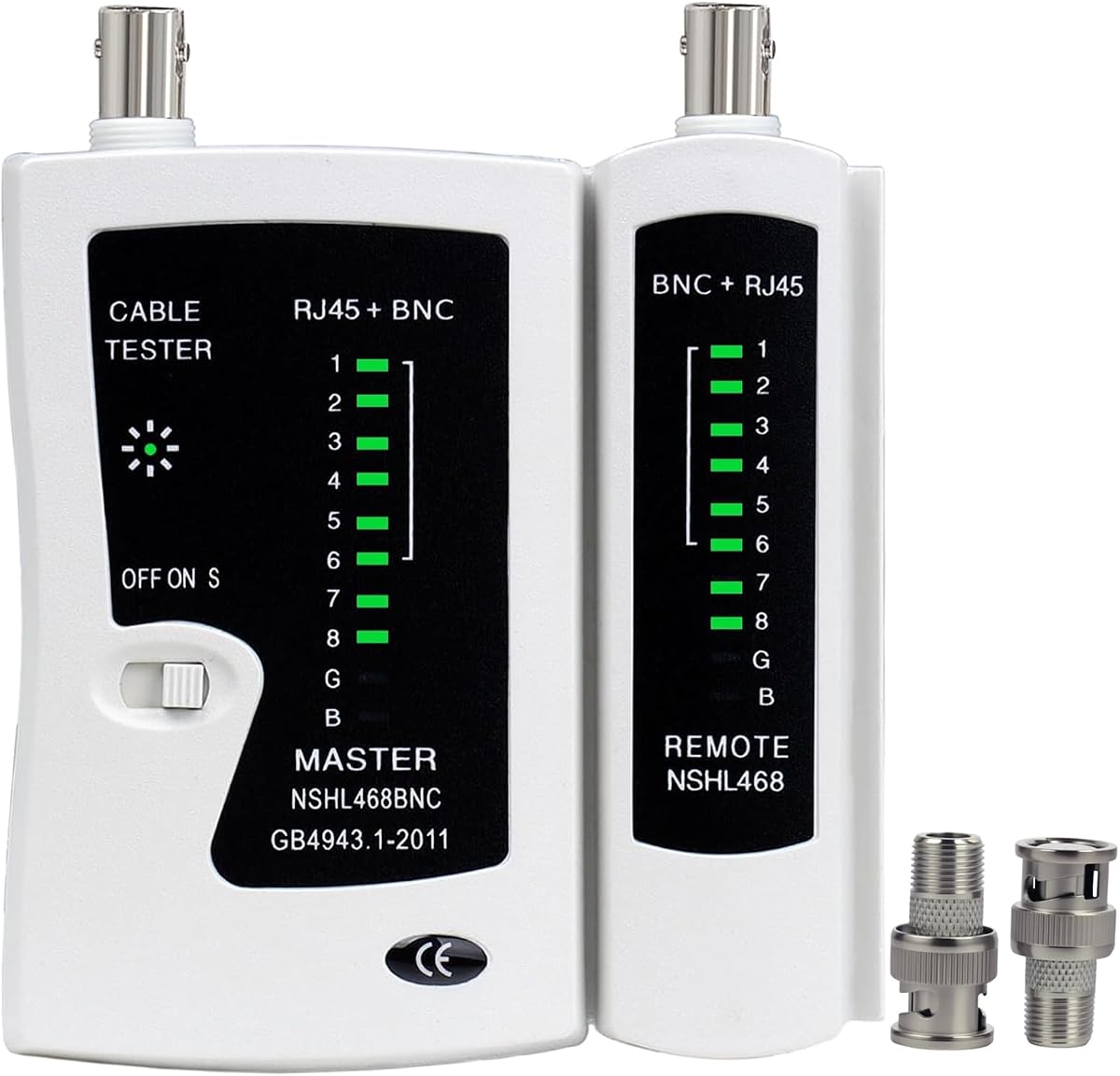
The Portable BNC RJ59 and F-Style Tester is a compact continuity checker for coax and Ethernet wiring. It supports F-style coax, BNC coax, and RJ45 Ethernet terminations, including CAT5 and CAT6 cable, but its 3.7 rating is the lowest among the ten products covered.
We may earn a commission when you buy through this link, at no additional cost to you.
Its detachable remote design allows users to check patch cables or installed runs. For installed cabling, the separate component can be positioned at the far end, making it possible to complete a continuity test across a deployed line. F female adapters are included, adding flexibility for connections that use F-style fittings.
The intended benefits are portability, broad connector compatibility, and the ability to pinpoint cable faults or connectivity problems. However, the supplied information describes these functions generally and does not indicate an LCD, remote mapping count, cable-length measurement, or detailed fault categories. It should therefore be regarded as a basic wire checker rather than an advanced diagnostic platform.
This tester may appeal to field installers who need one compact tool for several coax and Ethernet connector types. The lower rating warrants a closer look at current customer feedback before buying. It is best suited to straightforward continuity checks, while users needing multi-location mapping or in-depth diagnostics should choose a more specialized Klein Tools model.
Support for BNC, F-style, and RJ45 terminations broadens the tester's use beyond a single coax fitting. This can be useful for technicians who work across video, data, and audiovisual wiring.
The removable part is useful for both short patch leads and installed cables. It provides a practical way to place the two ends of a test where the cable is actually installed.
We may earn a commission when you buy through this link, at no additional cost to you.
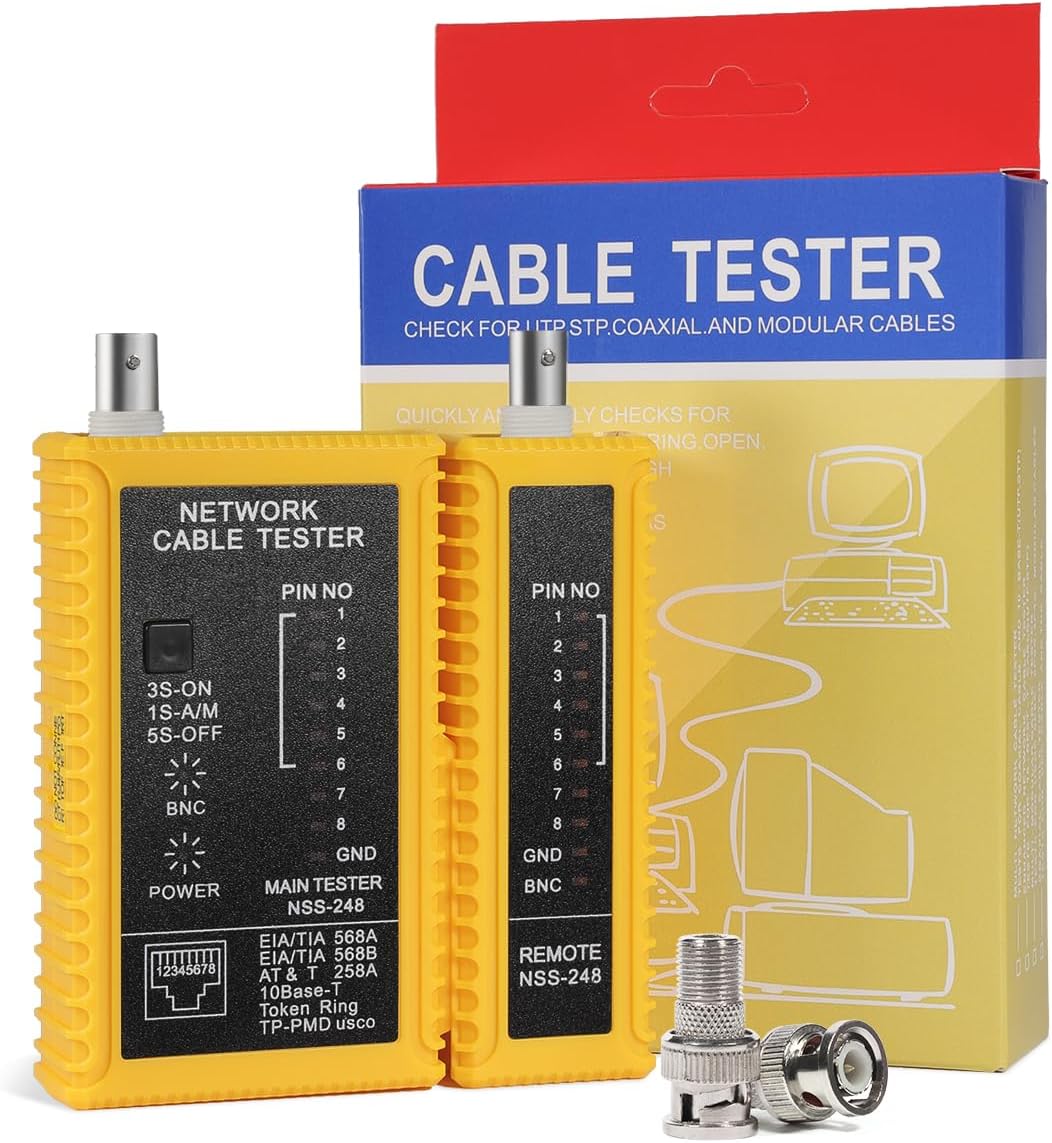
The Portable BNC F-Style RJ45 Tester is a compact continuity checker designed for field work involving coax and Ethernet. It supports BNC and F-style coax connections as well as RJ45 terminations, and its 4.2 rating places it in the middle of the guide's customer feedback range.
We may earn a commission when you buy through this link, at no additional cost to you.
The tool is intended to help identify signal issues, cable faults, and connectivity problems. Supporting both coax and RJ45 makes it applicable to network, audio, video, and security wiring, which is one of its most useful characteristics for technicians who cross different cable categories.
Its portable construction is suited to on-site testing and installation. The supplied data does not list a display type, remote count, measurable cable length, or supported fault indicators beyond continuity checking. That makes it more appropriate as a quick field checker than a comprehensive mapping instrument or a multi-media wire mapper.
Choose this model if a small, versatile checker is more important than detailed diagnostics. It can be particularly useful for confirming common BNC, F-style, or RJ45 cable continuity. Users responsible for identifying several installed coax lines, measuring long runs, or separating open and short faults should select one of the more specialized testers reviewed here.
The combination of BNC, F-style, and RJ45 support allows a single device to check coax and Ethernet wiring. That versatility is useful for service work involving network, audio, video, or security installations.
The portable design is convenient to carry between outlets and work areas. It provides a practical checking option when detailed mapping displays or multiple remotes are unnecessary.
We may earn a commission when you buy through this link, at no additional cost to you.
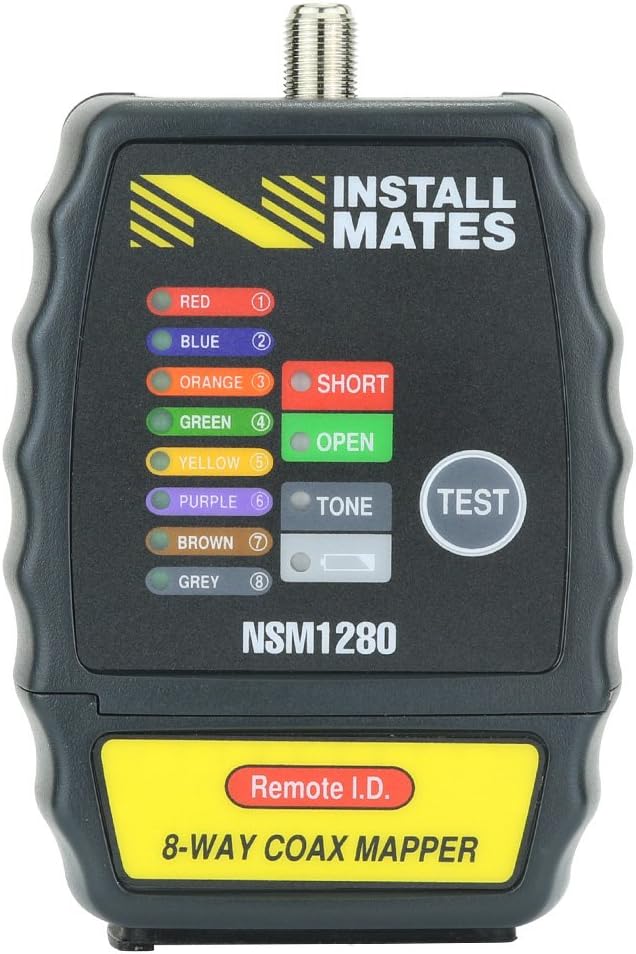
The 8-Way Coax Cable Tester is built for identifying and checking multiple coax leads in a single setup. It can test F-connector or BNC-terminated cables using the included adapter, and its 4.5 rating reflects a practical approach for installers working with several lines.
We may earn a commission when you buy through this link, at no additional cost to you.
Eight color-coded terminators allow up to eight cable leads to be checked at once. The tester displays PASS when no failure is present for a remote, while OPEN and SHORT conditions are detected, displayed, and accompanied by a beep. This gives users more simultaneous mapping capacity than the four-remote Klein Tools Explorer 2 kit.
A storage compartment built into the main unit helps keep the color-coded terminators organized. A mesh case is included for protected transport, and the required 9-volt battery is also included. The system can tone the center pin of a coax cable, adding another way to interact with the line during testing.
This model is a strong fit for technicians who routinely distinguish among numerous coax runs. Its eight labeled terminators are particularly useful when a building contains many service drops or outlets. The larger collection of parts requires more organization than a simple two-piece toner, but it offers greater multi-cable capacity in return.
The eight color-coded terminators provide more mapping positions than most compact alternatives. This is useful in installations where many coax services enter one central location.
The integrated storage compartment and included mesh case help prevent small terminators from being misplaced. A supplied 9-volt battery also means the tester can be put to work without sourcing a separate power source.
We may earn a commission when you buy through this link, at no additional cost to you.
The right coaxial cable tester depends on the cable types you handle, the number of lines you need to identify, the faults you must diagnose, and whether you also install connectors. Compare the core functions rather than choosing solely by the number of buttons or included accessories.
Choose detailed diagnostics when the cable is already installed and physical access is difficult. For routine connection checks, a compact tester or toner may be faster and easier to carry.
More remote capacity helps in buildings with many coax outlets or service drops. Match the number of runs you must identify rather than paying for unnecessary equipment.
Using a tester with the correct connector and cable compatibility prevents avoidable setup problems. Verify the product's stated support and required accessories before ordering.
Tracing is ideal when the cable is hidden, while mapping is better for organizing and diagnosing several known routes. Some jobs benefit from both kinds of feedback.
Select the feedback style that matches your work environment. LEDs and simple buttons are fast for routine service, while an LCD is valuable when you need measurements and detailed records.
Broader compatibility can reduce the number of tools you carry, but it should not replace a dedicated tester when diagnostic depth is your priority.
Match the kit to the work in front of you. Installation tools add value for new runs and repairs, while diagnostic accessories matter more for identifying or troubleshooting existing systems.
Check both battery availability and storage before buying. A tool that is easy to carry but needs an unexpected battery may be less convenient than a slightly larger kit with power included.
Begin by disconnecting the coax line from active service when the manufacturer's instructions call for an unenergized cable. Connect the appropriate remote or tone detector to the far end, match its connector to the cable, and attach the main tester to the near end. For mapping models, assign a different color-coded remote to each route before testing so the LED result remains unambiguous.
Run the test and interpret PASS, OPEN, SHORT, continuity, or wire-map results according to the included guide. A PASS generally confirms continuity through the tested path, while an OPEN suggests a break and a SHORT suggests an unintended connection between conductors. If the result is unexpected, reseat the connectors, confirm that the correct remote is attached, and test again before replacing components.
After use, switch off the tester if it has a power control, remove the batteries for long-term storage, and clean the body and connectors with a dry or lightly damp cloth. Do not immerse the device, and avoid exposing it to moisture beyond its specified operating conditions. Store color-coded remotes in the supplied holder or case so small parts are not lost, and replace a weak battery before beginning the next job.
It depends on the model. The Klein Tools Explorer 2 products explicitly indicate PASS, OPEN, and SHORT conditions, while the Scout Pro 3 detects Open, Short, Miswire, and Split-Pair faults and displays them on its LCD. Basic continuity testers and toners may provide less detailed confirmation, so check the stated diagnostic functions before choosing a tool for fault isolation.
A coax tester checks whether a cable path has continuity or a specific fault condition. A toner generates a signal that can be followed with a detector, helping locate a cable through walls, ceilings, or floors. Some products combine both approaches, while remote-based mappers focus on identifying which of several installed cables is connected.
No. The Klein Tools VDV512-100 is stated to support RG59, RG6/6Q, RG7, and RG11, while several compact toners focus on RG6, RG59, and CATV wiring. Connector support also varies between F, BNC, and other arrangements. Confirm the cable grade and fitting before use.
That depends on the number of included or supported remotes. The VDV512-101 maps up to four locations, the VDV512-100 can expand to four color-coded remotes, and the 8-Way Coax Cable Tester checks up to eight cable leads. A pocket continuity tester is generally used for one cable at a time.
Some can, but many are dedicated to coax. The Klein Tools Scout Pro 3 tests coax F-connector video cables, RJ11 or RJ12 voice lines, and RJ45 data lines. Certain compact continuity checkers also support RJ45, but they generally provide less detailed diagnostics. The Scout Pro 3 is designed for unenergized Ethernet and is not designed to test PoE.
A loose connector, incorrect adapter, active connected equipment, a splitter in the path, or a poorly seated remote can affect the result. The VDV512-100 specifically does not work through cable splitters. Before treating an indicated fault as permanent, disconnect connected equipment, seat every fitting securely, and repeat the test with the proper accessories.
Most of the products in this guide require batteries, although the arrangement differs. The VDV512-101 and VDV512-100 use two replaceable AAA batteries, the 8-Way tester includes a 9-volt battery, the Coax Cable Tester and Repair Kit includes an AAA battery, and the Coaxial Pocket Toner and Voltage Protected Coax Tester require a separately purchased AAA battery.
The Klein Tools VDV002-818 is the most complete installation-oriented package because it includes a tester, radial stripper, crimper, and universal F connectors. If the project involves only identifying or troubleshooting existing lines, one of the compact toners may be more portable, while the VDV512-101 is better suited to mapping several installed locations.
The Klein Tools VDV512-101 Explorer 2 is the strongest all-around choice for mapping up to four coax locations, while the VDV002-818 is the most complete option for users who also prepare cables and install F connectors. The Coaxial Pocket Toner offers a compact, budget-oriented way to identify a cable and trace it through common obstacles.
Prioritize the job you need to perform: use detailed fault diagnostics for difficult installed runs, multiple remotes for identifying several services, and a tracer for locating a hidden line. Also consider whether your work includes Ethernet or voice wiring, whether you need a length measurement, and whether the necessary adapters and power source are included.
Finally, check the current listing, included accessories, warranty information, and available accessories before ordering. Ratings and product availability can change, as can the relative value of a kit when compared with its separate components. Reviewing the current product page ensures that the selected coaxial cable tester matches both your connector requirements and the scope of the project.