
ERICKHILL EMF Meter
4.4Editor score
Electric and magnetic field readings
Sound and light alarm system
Rechargeable battery for portability
Data hold on clear LCD
Our EMF Meter guide compares ten models for electric, magnetic, and RF detection, helping you choose the right features, alerts, range, and display for users.
An EMF meter can make invisible electromagnetic activity easier to investigate by displaying readings from magnetic, electric, and radio-frequency fields. A useful model balances sensitive detection, understandable controls, clear alerts, and practical features for home, office, appliance, and wireless-signal checks.
We compared the ten featured meters using their supplied specifications, including supported field types, frequency coverage, displays, alarm systems, measurement modes, power options, included accessories, and manufacturer support. The list covers basic low-frequency detectors, advanced multi-field instruments, and RF-focused models.
Each pick shows the type of environment and buyer it suits best, along with important limitations to consider. Ratings and product details reflect the supplied information, while prices and availability can change at any time, so confirm the current listing before purchasing.
4.4Editor score

4.6Editor score

4.1Editor score
The table below compares the featured EMF meters by field coverage, detection bandwidth, display and alarm features, and practical extras. It is a quick way to identify the right category of instrument before reading the detailed reviews.




The TF2 EMF Pollution Meter is the strongest all-around choice in this guide, combining magnetic, electric, and RF detection in one instrument. Its supplied rating is 4.6, and its defining advantage is fast updating: bars respond immediately to digital signals, while RF and numeric averages refresh four times per second. That makes it especially useful when working with Wi-Fi routers, cell phones, Bluetooth equipment, and other rapidly changing sources.
We may earn a commission when you buy through this link, at no additional cost to you.
The TF2 uses three-axis magnetic sensing, single-axis electric sensing, and single-axis RF sensing. It provides standard and weighted frequency responses for electric fields while keeping RF readings unweighted. These distinctions matter for buyers who want both raw information and readings that emphasize possible effects on the human body. The listed measurement applications include 4G and 5G cell phones, cell towers, Wi-Fi routers, Bluetooth devices, AC powerlines, and smart meters.
Its RF range extends from 20 MHz to 6 GHz. It can therefore detect most common 5G signals, but it does not cover experimental millimeter-wave frequencies, and it cannot measure radioactivity. The meter is not a laboratory reference instrument in this category, and single-axis electric and RF layouts mean users may need to rotate the device while searching a room. Even so, its fast response, multi-field coverage, and mixture of weighted modes distinguish it from simpler low-frequency-only meters.
This is the best choice for a homeowner, office user, or technically curious buyer who wants one capable instrument for several source types. The package includes the meter, a 9V battery, quick-start card, detailed manual, and soft-shell zipper case. It is manufactured and serviced in the United States by AlphaLab and includes a one-year limited manufacturer warranty along with unlimited consulting. Choose the TF2 when fast RF response and flexible field measurements matter more than compact size or the highest possible RF ceiling.
The four-times-per-second RF and numeric average refresh is particularly valuable around routers, phones, Bluetooth accessories, and other sources whose output can change quickly. Instant bar updates also help distinguish brief peaks from a stable field level.
Standard and weighted electric-field responses give users more context than a single display mode, while three-axis magnetic detection reduces the need to rotate the meter while scanning. The result is a more versatile tool for comparing rooms, wiring, appliances, and wireless equipment.
We may earn a commission when you buy through this link, at no additional cost to you.
The blue ERICKHILL EMF Meter is a practical choice for buyers who mainly want to inspect low-frequency electric and magnetic fields around household appliances and wiring. It carries a supplied rating of 4.4 and focuses on a straightforward digital display, audible alarm, flashing indicator, and rechargeable battery rather than spectrum analysis or advanced RF monitoring.
We may earn a commission when you buy through this link, at no additional cost to you.
Its electric-field range extends from 1 V/m to 1,999 V/m, with an alarm above 40 V/m. Magnetic readings can be shown in either microtesla or milligauss, covering 0.01 to 99.99 microtesla or 0.1 to 999.99 milligauss, with an alert above 0.4 microtesla. The LCD includes a data-hold function for recording values, and the meter automatically powers down after five minutes of inactivity to conserve its battery.
The most important limitation is that this model does not include an RF mode. It therefore cannot show the strength of Wi-Fi, cellular, Bluetooth, or microwave RF emissions in the same way as the multi-field meters elsewhere in this guide. The manufacturer also notes that magnetic readings may show zero when the target device is off or its radiation is below the detection range. Correct positioning near the source is therefore important, particularly for appliances in standby or low-output states.
This ERICKHILL is a sensible pick for home inspections, office equipment checks, and locating stronger low-frequency fields near televisions, computers, induction cookers, refrigerators, microwave ovens, or power lines. Its mute option helps in quiet environments, and the rechargeable design is more convenient than replacing cells. Choose it when accessible readings and prominent alerts matter most, but choose a three-field model if RF coverage is a priority.
The screen changes to red, the indicator flashes, and a buzzer sounds when the selected field exceeds the stated threshold. This combination is easy to interpret during quick room scans, while mute mode prevents disruption in offices or homes.
The top sensor should be placed close to an operating appliance when checking magnetic fields. Keeping the target powered on and moving slowly around suspected sources helps prevent a zero display from being mistaken for a complete absence of electromagnetic activity.
We may earn a commission when you buy through this link, at no additional cost to you.
The GQ EMF-390 Multi-Field Meter is built for buyers who need more than a simple presence indicator. Its supplied rating is 4.6, and it combines detection of power-line fields, smart-meter signals, cell phones, microwave sources, static, and other common electromagnetic activity in a multi-field configuration.
We may earn a commission when you buy through this link, at no additional cost to you.
The major attraction is RF capability through 10 GHz, which exceeds the 6 GHz ceiling of the TF2 and the 8 GHz limits stated for several five-in-one models. A built-in RF spectrum analyzer and the GQ RF Browser support real-time monitoring, helping users inspect signal activity rather than relying exclusively on a single changing value. The specification also identifies 5G network signals as detectable within its stated coverage.
This is not merely a three-mode consumer detector. Spectrum analysis and browser-based monitoring make it more appropriate for a technically engaged buyer, installer, or investigator who wants to distinguish changing RF conditions. That capability also adds a learning curve. A basic meter may be easier for someone who only wants to compare a bedroom with a desk or find the strongest signal near an appliance.
The GQ EMF-390 is best for users who need broad RF reach, source identification, and real-time analysis in one package. It is a strong alternative to the TF2 for 5G and other high-frequency investigation, particularly when identifying signal sources is more important than weighted human-body-oriented readings. Buyers should review the device's software requirements and operating guidance before purchase, but the supplied feature set makes it one of the most technically capable choices in the roundup.
Detection through 10 GHz provides useful headroom for cellular and other modern wireless activity. It is a meaningful advantage when the objective is to monitor higher-frequency sources rather than merely confirm that a signal is present.
The built-in spectrum analyzer and RF Browser can show how signal activity changes in real time. This extra context is more useful for technical investigation than a basic bar graph, especially when several wireless devices may be operating nearby.
We may earn a commission when you buy through this link, at no additional cost to you.
The TEMIRUP 5-in-1 EMF Meter combines electromagnetic measurements with temperature and humidity monitoring in a portable rechargeable package. Its supplied rating is 4.6, and the large color LCD gives it a more informative appearance than a basic monochrome meter while supporting magnetic, electric, and RF modes.
We may earn a commission when you buy through this link, at no additional cost to you.
Magnetic readings can use milligauss or microtesla, electric fields are measured in volts per meter, and RF radiation is displayed in microwatts per square centimeter. The stated RF range extends from 30 MHz to 8 GHz, allowing detection of Wi-Fi, 5G signals, and microwave radiation from appliances such as microwave ovens. The electric and magnetic modes are intended for televisions, induction cookers, rice cookers, refrigerators, computers, and power lines.
Temperature and humidity readings add context that a pure EMF meter cannot provide. During a room assessment, the user can compare electromagnetic readings with environmental conditions, while the temperature and humidity function is also useful for property inspections and general indoor monitoring. The device also offers average or maximum readings, data hold, unit switching, low-battery indication, an audible warning, and a three-color analog display.
This model suits users who want broad field coverage, wireless detection, and environmental readings without carrying several instruments. Its automatic power-off after 15 minutes of inactivity helps preserve battery life, and the included charging cable, carry bag, and manual make it ready to travel. Choose it for flexible household and office checks, while buyers needing deep spectrum analysis or RF coverage through 10 GHz may prefer the GQ EMF-390.
Temperature and humidity readings make it possible to assess more than electromagnetic fields during a room walkthrough. That can be helpful when comparing sleeping areas, workspaces, and rooms in a property.
The large color LCD and tricolor analog warning area make field levels easier to interpret at a glance. Maximum-value and hold functions are useful for recording a peak when moving around a suspected source.
We may earn a commission when you buy through this link, at no additional cost to you.
The POROMETISTO ET01Pro is a five-in-one environmental meter designed to detect radio-frequency, electric, and magnetic fields while also measuring temperature and humidity. It has a supplied rating of 4.5 and covers EF/MF from 40 Hz to 100 kHz and RF from 30 MHz to 8 GHz.
We may earn a commission when you buy through this link, at no additional cost to you.
Its stated wireless coverage includes 5G and Wi-Fi, making it more versatile than meters limited to low-frequency fields. The tricolor analog display uses green, yellow, and red bars, while an audible alarm can be muted for quiet use. Maximum and minimum value displays, data hold, a low-battery warning, and an automatic shutdown that can be canceled make it practical for methodical room surveys.
The product's environmental readings are not merely decorative. When assessing a property, a user can note unusual electromagnetic activity alongside temperature and humidity changes, adding a broader picture of the space. The listed CE and RoHS marks indicate conformity with the stated compliance requirements, though the supplied information does not describe laboratory calibration. The product is therefore better viewed as a practical environmental scanning tool than a certified scientific reference meter.
The kit includes the meter, three AAA batteries, a screwdriver, velvet bag, and manual. It is a strong choice for home, workplace, property, and paranormal-investigation users who value environmental context. A technical RF researcher who needs to view spectrum data should choose the GQ EMF-390 instead. For most other buyers, the ET01Pro offers an accessible combination of field detection, wireless coverage, and indoor-condition monitoring.
The combination of field, temperature, and humidity readings helps users document an entire room rather than isolate one measurement. This makes the ET01Pro useful for renters, homeowners, and workplace evaluators comparing different spaces.
Maximum and minimum tracking reveals the range observed during a scan. Data hold freezes the display for note-taking, while the color bars provide a quick visual indication of whether the current level deserves closer attention.
We may earn a commission when you buy through this link, at no additional cost to you.
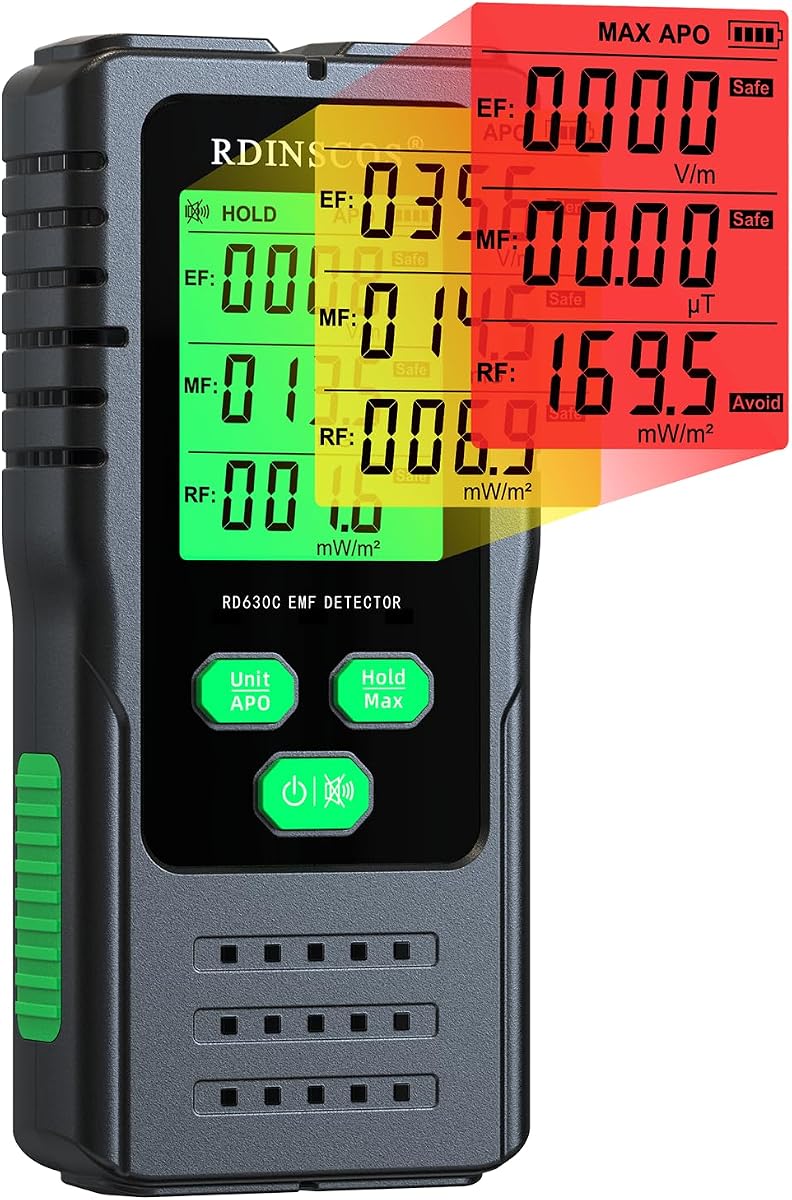
The RDINSCOS RD630 is a compact handheld meter aimed at straightforward home and office checks. Its supplied rating is 4.4, and it detects AC magnetic fields, AC electric fields, and microwave fields. That makes it more capable than a magnetic-only detector while remaining simpler than instruments built around spectrum analysis.
We may earn a commission when you buy through this link, at no additional cost to you.
The tricolor LCD uses green, yellow, and red to communicate relative field levels, and an audible alert sounds when readings exceed the specified levels. Its backlight improves visibility in dim rooms or during nighttime scans. The compact, lightweight enclosure supports one-hand use, making it convenient for moving around furniture, desks, appliances, and wiring.
The product information does not provide detailed frequency limits, calibrated measurement ranges, or RF bandwidth. Buyers therefore should not assume that it has the same 8 GHz or 10 GHz coverage as the RF-focused models in the guide. It is best treated as a comparative screening instrument for identifying areas of higher electromagnetic activity, rather than as a detailed spectrum-analysis platform.
This RD630 is appropriate for users who want a small, uncomplicated meter to locate potentially elevated areas around smart meters, cell towers, home wiring, and electrical equipment. Automatic shutdown after 15 minutes saves battery life, and holding the APO button disables that function for continuous measurement. Choose it for quick household screening; choose a three-field or spectrum meter when precise frequency coverage is central to the task.
The green, yellow, and red display makes it possible to identify changing field levels while moving through a space. The audible warning adds another indication when a stronger reading is encountered.
Its lightweight body and straightforward handheld layout suit quick room-by-room checks. Disabling the automatic power-off when a longer scan is needed avoids interruptions during continuous use.
We may earn a commission when you buy through this link, at no additional cost to you.
The KAIWEETS EMF Detector is a modern three-in-one meter with a supplied rating of 4.5. It measures magnetic, electric, and RF fields, uses a three-axis magnetic sensor, and provides a trend graph that makes changes over time easier to see than a static numerical display alone.
We may earn a commission when you buy through this link, at no additional cost to you.
Stated magnetic coverage is 0.01 to 200 microtesla or 0.1 to 2,000 milligauss, electric-field coverage is 1 to 2,000 volts per meter, and RF coverage is 0.001 to 200 milliwatts per square meter. The product can show all three measurements at once, automatically record peak readings, freeze values with a one-touch hold control, and warn through automatic backlighting and an audible alarm.
The three-axis magnetic sensor is a practical advantage because the user does not need to keep changing the orientation of the meter to locate a stronger reading. The graph and peak memory are also useful for checking whether a level remains steady or briefly spikes. However, the supplied data does not list an RF frequency ceiling, so the meter should not be assumed to cover the same high-frequency range as the TF2, GQ EMF-390, or LATNEX AF-5000.
The manufacturer explicitly describes this as a practical everyday meter rather than lab-grade equipment, which is an important distinction when interpreting results. It is a good choice for homeowners, parents, home inspectors, and ghost-hunting enthusiasts who want quick comparisons around beds, desks, play areas, appliances, and routers. Its rechargeable design, trend display, and peak tracking make it more informative than the simplest screening meters without requiring spectrum-analysis software.
A trend graph helps distinguish a sustained reading from a brief change as the meter moves through a room. This is more informative when comparing a desk with a wireless router nearby or watching a powered appliance.
The three-axis magnetic sensor captures field direction more readily than a single-axis design. Users can scan more naturally and spend less time rotating the meter to locate a stronger signal.
We may earn a commission when you buy through this link, at no additional cost to you.
The LATNEX AF-5000 is the premium option in this roundup, combining RF and microwave detection with low-frequency magnetic and electrical field measurement. Its supplied rating of 4.1 is lower than those of several competing products, but its individually tested and certified construction provides a different kind of buyer appeal for users who value documentation and support.
We may earn a commission when you buy through this link, at no additional cost to you.
RF detection extends through 10 GHz, covering routers, cell towers, smart devices, and 5G networks. The device displays real-time RF strength, while its three-axis magnetic measurement is intended for fields from power lines, wiring, and appliances. Electrical fields can be measured to 2,000 volts per meter at 50 and 60 hertz, covering common household AC frequencies but not static or high-voltage industrial fields.
Each unit includes a dated Certificate of Calibration and is tested by LATNEX before shipment under published specifications and an ISO 9001:2015 quality-management framework. A two-year warranty and direct technical support are also listed. These are meaningful advantages for a buyer who wants a documented instrument rather than an uncalibrated consumer gadget. Nevertheless, calibration documentation should not be confused with proof that every environmental reading is equally precise in every location.
The manufacturer notes that readings can change with distance, angle, and interference from nearby electronics. The AF-5000 is therefore a strong choice for serious comparison work, a technically informed buyer, or anyone who wants broad RF coverage in a certified package. It is less attractive for casual users who need only a simple low-frequency check. Among premium options, however, its calibration certificate, 10 GHz RF range, three-axis sensor, warranty, and support make it the most fully documented pick.
A dated certificate for each individual unit provides a traceable record that the instrument was tested before shipment. That is especially useful for buyers who want more than a general indication of whether a field is present.
Ten-gigahertz RF detection and three-axis magnetic sensing support a wide range of household and wireless investigations. The electrical mode covers 50 and 60 hertz, but users should not apply it to static or high-voltage industrial fields.
We may earn a commission when you buy through this link, at no additional cost to you.
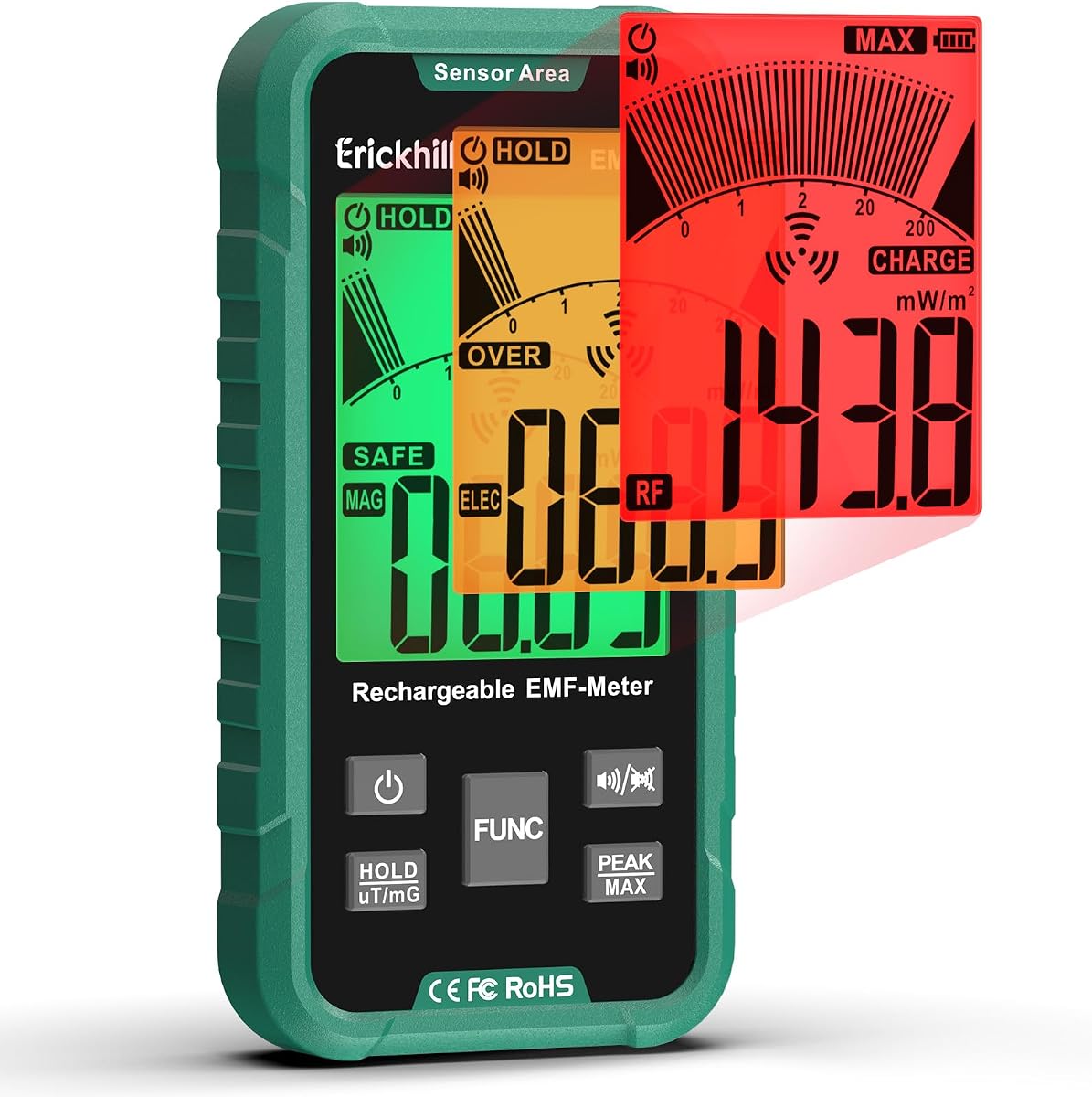
The newer ERICKHILL 3-in-1 detector is a portable option for measuring electric, magnetic, and RF fields with one handheld device. Its supplied rating is 4.4, and it combines a 3.1-inch LCD with a rechargeable battery, Type-C charging, automatic shutdown, low-battery warning, and a three-color backlight.
We may earn a commission when you buy through this link, at no additional cost to you.
The meter measures one field type at a time to avoid interference between modes. Electric fields are intended to cover emissions from household appliances such as microwaves and smart meters, magnetic fields track devices with motors and power tools, and RF mode monitors mobile phones, Wi-Fi routers, and 5G signals. Units include volts per meter, microtesla, milligauss, and milliwatts per square meter.
Its alarm thresholds are listed as 40 volts per meter for electric fields, 0.12 microtesla or 1.2 milligauss for magnetic fields, and 10 milliwatts per square meter for RF. Maximum and peak modes help users retain important values, while the mute function supports quiet operation. The supplied information does not state the RF frequency range, so buyers who need a verified high-frequency ceiling should consider the TF2, TEMIRUP, or GQ instead.
This ERICKHILL is well suited to portable home, office, and ghost-hunting checks where a user wants a compact display with prominent alerts. The package includes the meter, charging cable, manual, and storage case. It is passive and does not transmit RF signals. Choose it for an approachable multi-field tool, particularly if the quieter operation, rechargeable battery, and ability to record maximum or peak values are the priorities.
The Type-C rechargeable battery avoids recurring cell replacement, and the included storage case makes the meter easier to carry between rooms, offices, or investigation locations.
The three-color backlight provides a visual warning while the buzzer confirms a threshold crossing. Muting the sound is useful in quiet environments, and peak and maximum modes preserve notable readings for later comparison.
We may earn a commission when you buy through this link, at no additional cost to you.
The GQ EMF-390 Tri-Field Detector combines high-sensitivity detection of power-line fields, smart meters, cell phones, microwave sources, static, and other common signals with RF monitoring. Its supplied rating is 4.5, and the feature set is particularly relevant to ghost-hunting and technical users who want to observe real-time RF activity rather than only a static level.
We may earn a commission when you buy through this link, at no additional cost to you.
This version of the EMF-390 supports 2G, 3G, 4G, and low-band 5G cell-tower signal levels, along with RF detection through 10 GHz. Its built-in RF spectrum analyzer and GQ RF Browser are designed for real-time monitoring. Data logging adds the ability to record readings for comparison, which can be helpful when a room contains several cell devices, routers, smart meters, or other wireless equipment.
The trade-off is complexity. A spectrum analyzer, browser connection, and data logger offer more investigative depth than a basic three-color meter, but they also require a more deliberate workflow. Users who only need to know whether an appliance produces a stronger field may find a simpler detector more satisfying. The product's technical tools are best used for locating and comparing active RF sources rather than for claiming that every brief fluctuation has a specific cause.
This GQ EMF-390 is an excellent match for paranormal investigators, wireless enthusiasts, and technically curious users who want to monitor changing 5G or other RF signals. It overlaps closely with the other listed GQ EMF-390, but this listing specifically emphasizes low-band 5G detection, data logging, the 2.5 GHz spectrum analyzer, and RF Browser. Choose it over a basic meter when real-time spectrum visibility and recorded RF activity are the main objectives.
The spectrum analyzer and RF Browser make it possible to observe changing signal levels as devices transmit. That can help a user compare a quiet room with one containing active cellular and wireless equipment.
Recorded data is useful when a user needs to revisit a location or compare readings over time. It provides a record of changing RF conditions that a simple instantaneous display may miss.
We may earn a commission when you buy through this link, at no additional cost to you.
The right EMF meter depends on the fields you need to measure, the range of equipment you expect to investigate, and how much interpretive detail you want. Review field coverage, frequency limits, display behavior, alarms, and documentation before choosing.
A broad three-in-one meter can detect AC electric fields, magnetic fields, and radio-frequency radiation. This is the most versatile configuration for home, office, appliance, smart-meter, Wi-Fi, and cellular checks. However, broad coverage does not guarantee equal depth in every mode, so buyers should also examine sensor design, measurement ranges, and stated frequency bandwidth.
Choose a model that covers all three field categories when you want one device for varied environments. Select a low-frequency-only model only if electric and magnetic readings meet a specific need.
RF bandwidth determines which wireless sources a meter can detect. The featured models reach stated ceilings ranging from 6 GHz to 10 GHz. Higher coverage is relevant to 5G and other modern wireless activity, while lower-frequency appliances and older router signals may fall within a narrower range. Some listings specify a clear ceiling, whereas others identify Wi-Fi and 5G functions without providing frequency limits.
Check the published band rather than relying on a broad description. A verified ceiling is preferable when locating high-frequency signals is a central part of your work.
A three-axis magnetic sensor is more convenient because the user can detect a field without repeatedly rotating the meter. Single-axis designs may still work, but scanning can take longer. The TF2 also offers standard and weighted electric-field responses, while other models may provide maximum, peak, average, or hold functions. These modes affect how easily users can identify stable levels and brief spikes.
Favor three-axis sensing for efficient room scanning. Choose additional reading modes when documenting peaks or comparing weighted and unweighted results matters.
A clear LCD should show the active mode, units, numeric value, and relevant status indicators. Tricolor backlights and analog bars can make broad comparisons easier, especially for users who are not familiar with field measurements. Audible and visual alarms are useful when scanning continuously, while mute controls help during quiet work, ghost-hunting sessions, or occupied offices.
Look for both numeric and visual guidance. The number supports comparison, while colors and alarms reveal strong changes during movement.
A basic meter tells you that a reading is changing, but a spectrum analyzer can reveal more about the RF activity producing it. The GQ EMF-390 models add a 2.5 GHz spectrum analyzer, RF Browser, or data logging. These tools are valuable for technical users, paranormal investigators, and anyone who wants to compare a live router or cellular signal over time.
Choose spectrum tools when real-time signal context is important. A straightforward display is usually more convenient for routine household checks.
Rechargeable batteries are convenient for repeated mobile use, while replaceable cells can be helpful when a charger is inconvenient. Automatic power-off protects battery life but may interrupt a continuous scan. Most featured models also include data hold, maximum-value functions, low-battery warnings, and simple one-hand operation. The more advanced displays may provide more menus or companion-software requirements.
Match power management to the intended session. Disable automatic shutdown for long scans, and favor simple controls if the meter will be used casually.
A calibration certificate provides documentation that an individual unit was tested against published specifications. The LATNEX AF-5000 includes a dated certificate and two-year warranty, while other products emphasize manufacturer support, replacement service, or consultation. A warranty does not make every consumer meter a laboratory reference, but it can matter when repeatability and accountability are priorities.
Look for calibration records and credible support when professional consistency matters. For casual screening, a clear warranty and accessible guidance are usually sufficient.
Home and office users may prioritize a readable display, audible alerts, and a rechargeable battery. Paranormal investigators may value peak tracking, trend graphs, muted alarms, and RF monitoring. Property inspectors can benefit from temperature and humidity functions. Included cases, batteries, charging cables, manuals, and pouches influence convenience, especially for travel or repeated field use.
Match the kit to the setting before buying. Useful extras should support the intended type of scan rather than simply add more functions.
Begin by learning the meter, reading its manual, and identifying the correct field mode. Turn on all appliances and wireless equipment that may be part of the investigation, then place the meter near the suspected source with the designated sensor facing toward it. Move slowly and maintain a consistent distance, because readings can change rapidly with angle, distance, and nearby interference.
Record the mode, unit, value, location, and distance for each measurement. Use data hold, maximum, peak, or trend features to capture short-lived changes, and repeat the scan in several positions. A single high reading does not establish the safety of a room or the danger of a source; it is simply a measurement that deserves comparison. The supplied thresholds are device-specific and should not be treated as universal health standards.
For care, keep the meter within its intended operating conditions and avoid moisture, extreme heat, impact, and opening the enclosure unless the manual specifically authorizes it. Replace batteries or recharge according to the instructions, and use the correct charger or cell type. Clean the exterior with a dry or lightly dampened cloth, keep the sensing area unobstructed, and store the device in its case when it is not being used.
An EMF meter measures specific portions of the electromagnetic spectrum, depending on the model. The featured devices cover combinations of low-frequency magnetic fields, low-frequency electric fields, and radio-frequency radiation. A meter that covers all three is more versatile, while models limited to electric and magnetic fields cannot display Wi-Fi, cellular, Bluetooth, or microwave RF strength.
Some models can detect microwave or RF activity from an operating microwave oven, while others measure only low-frequency electric and magnetic fields. The TEMIRUP and several three-field models include RF modes, whereas the ERICKHILL Blue meter does not. Confirm the supported modes and frequency range before using a particular meter for microwave testing.
Not by itself. Readings vary with distance, orientation, surrounding equipment, and the meter's calibration and specifications. Alarm thresholds are useful screening tools, but they are product-specific and are not universal health limits. A careful assessment involves comparing locations, repeating measurements, documenting conditions, and consulting appropriate guidance when evaluating exposure.
A three-axis sensor makes it easier to detect magnetic fields without constantly rotating the meter. It is particularly helpful when scanning a room, desk, or appliance because field direction changes with position. Single-axis meters can still be useful, but they generally require more careful orientation during a search.
Choose a basic meter for routine checks around appliances, wiring, beds, or desks. Choose a model with spectrum analysis when you need to observe real-time RF signals, distinguish changing wireless activity, or log readings over time. Spectrum tools provide more context but are usually less convenient for casual room surveys.
Not always. A meter can show that a level is stronger near a particular router, appliance, cable, or other source, and some spectrum tools can reveal signal characteristics. Even then, multiple devices may contribute to a reading. Switch off or isolate suspected equipment and repeat the measurement to identify the source more reliably.
Start close to the source and then move away in consistent steps while recording the values. Strong fields can fall off quickly with distance, so a reading taken too far away may miss the source. Repeating each measurement at the same distance and orientation improves the consistency of comparisons.
No. EMF meters in this roundup detect combinations of electric, magnetic, and radio-frequency fields, but they are not radiation dosimeters. The TF2 explicitly does not detect radioactivity, and none of the supplied descriptions indicates that any listed model should be used for ionizing-radiation measurement.
The TF2 EMF Pollution Meter is the best overall option because it combines three field types, fast RF response, weighted and unweighted readings, and a complete accessory package. The ERICKHILL Blue is a focused, approachable choice for low-frequency electric and magnetic checks, while the LATNEX AF-5000 stands out for premium documentation, three-axis sensing, and broad RF coverage.
Prioritize the field categories and frequency range needed for your actual investigation. A five-in-one model with temperature and humidity helps for property or environmental monitoring; a spectrum-analyzer model suits live wireless investigation; and a simple rechargeable meter is more convenient for routine scans. Pay attention to sensor orientation, display behavior, alarms, included accessories, and manufacturer support rather than relying on the number of advertised functions alone.
Before purchasing, confirm that the current listing still matches the specifications covered in this guide, check the meter’s measurement ranges, and review the included warranty and support. Prices and availability can change, so compare the current offer and choose the instrument that provides the most relevant coverage for your particular environment.