
Cable Matters 10Gbps Snagless Cat 6 Ethernet Cable
4.8Editor score
550 MHz bandwidth
Supports PoE devices
Snagless gold-plated connectors
25-foot flexible length
Discover the best Ethernet cable for home wiring by comparing length, category, shielding, conductor quality, fire ratings, and installation needs.
Ethernet cable for home wiring gives desktop computers, televisions, game consoles, cameras, and access points a stable, low-latency connection. A suitable cable depends on your building layout, planned network speed, routing method, local fire codes, and whether you need a ready-made patch cable or bulk cable for custom terminations.
The products below were compared using their stated category, bandwidth, conductor material, shielding, jacket rating, length, connector design, and intended installation environment. The guide covers both pre-terminated cables for quick connections and bulk spools for walls, conduit, patch panels, and professionally routed home networks.
Each review explains who the cable is best suited for, the strengths that matter most, and the compromises involved. Ratings and specifications reflect the supplied product information, while availability and prices can change, so readers should confirm current details and the requirements of their own network before purchasing.
4.8Editor score

4.7Editor score

4.8Editor score
This side-by-side comparison highlights the cable format, network capability, conductor construction, jacket type, and ideal installation role represented by each product, helping readers distinguish simple patch leads from bulk wiring and high-bandwidth specialty cables.




The Ultra Clarity Cables Cat6 Ethernet Cable 100 FT combines a generous installation length with a complete, ready-to-connect design. Its 4.7 rating and stated support for networks up to 10Gbps make it a strong all-around option for connecting a router, access point, television, game console, or home-office computer across a larger space. There is no need to purchase connectors or terminate the cable yourself.
We may earn a commission when you buy through this link, at no additional cost to you.
The cable uses eight solid 24 AWG copper conductors organized as four unshielded twisted pairs. That construction is designed to limit crosstalk, while the stated 500 MHz capability gives it enough headroom for 10GBASE-T, Gigabit Ethernet, and Fast Ethernet equipment. Molded strain-relief boots add practical protection at both RJ45 connectors, and the gold-plated contacts are useful for maintaining dependable connections in frequently handled network setups.
Its main compromise is that it is a patch cable rather than bulk wire. That makes it excellent for a single long run but less flexible when several outlets need to be wired from a common wall plate or distribution point. The UTP jacket is not shielded, so it may also be less ideal than a screened option in electrically noisy locations. Even so, the specified CM-grade PVC jacket, ETL verification, RoHS compliance, and compatibility with common home network equipment make it broadly practical.
This is the strongest general recommendation for people who want one cable to solve a long home run without dealing with a spool, keystone jacks, or a patch panel. Choose it when a device is more than 25 feet from the network equipment, when routing around furniture and through doorways would make a short cable inconvenient, or when you simply prefer plug-and-play installation. Its combination of copper construction, long reach, and broad device compatibility makes it the most balanced entry in this guide.
The 100-foot length is the defining advantage for many homes. It can reach a network closet, upstairs office, entertainment center, or rear television without forcing the installer to create several short patch connections.
Solid copper conductors and separated twisted pairs are intended to provide consistent signal transmission and reduced crosstalk, while gold-plated contacts support secure connections at both ends.
We may earn a commission when you buy through this link, at no additional cost to you.
The Cable Matters 10Gbps Snagless Cat 6 Ethernet Cable, 25ft, combines a 4.8 rating with a versatile Cat6 specification. It is a particularly approachable choice for connecting a nearby router, desktop, printer, television, or access point, especially when a 25-foot reach is sufficient. The cable arrives with RJ45 connectors already installed, making it convenient for immediate use.
We may earn a commission when you buy through this link, at no additional cost to you.
Its 24 AWG copper core and stated bandwidth of up to 550 MHz support demanding wired connections, including 10-Gigabit Ethernet over suitable runs. The supplied information also identifies compatibility with Cat5 networks and conformance with the TIA/EIA 568-C.2 standard. PoE, PoE+, and PoE++ support broadens its usefulness for IP cameras, VoIP phones, and wireless access points that receive power and data through the same cable.
The snagless connectors and strain-relief boots are practical details for home offices and media cabinets, where leads are routinely moved or routed through cable managers. The 25-foot length is also easier to manage than a very long cable when the equipment is relatively close. Its limitation is obvious but simple: it cannot cover longer wall routes, and the unshielded construction may be less desirable in an environment with substantial electrical interference.
Choose this cable when you need a dependable, ready-made connection without the complexity of bulk installation. It is a particularly good match for PoE devices, office peripherals, and moderately sized homes where each device is within 25 feet of a router, switch, or wall jack. The strong rating, copper conductors, and broad compatibility make it a sensible starting point for many wired networks.
Support for PoE, PoE+, and PoE++ allows the cable to carry data and power for compatible cameras, phones, and access points, reducing the need for a separate power connection at each endpoint.
The stated 550 MHz bandwidth and backward compatibility allow the cable to be used across Fast Ethernet, Gigabit Ethernet, and 10-Gigabit Ethernet equipment already found in many homes.
We may earn a commission when you buy through this link, at no additional cost to you.
The VIVO Blue Full Copper 250ft Bulk Cat6 Wire is built for installers who want to create permanent cable paths rather than simply connect nearby devices. Its 250-foot length provides ample material for multiple wall runs, while the blue jacket makes the cable easy to distinguish from other low-voltage wiring. The 4.6 rating indicates solid performance for a purpose-built installation cable.
We may earn a commission when you buy through this link, at no additional cost to you.
This is a connector-free spool containing four pairs of 23 AWG solid pure copper conductors in a UTP configuration. The stated TIA/EIA conformity, in-wall CM rating, and support for Fast, Gigabit, and 10-Gigabit Ethernet make it relevant to structured residential cabling. Its easy spool box can also help control the cable during installation and reduce waste when precise cuts are needed.
The primary tradeoff is that this product does not include RJ45 plugs, keystone jacks, a patch panel, or outlet boxes. Someone installing it must terminate the cable correctly and follow local building and electrical requirements. Bulk wire is also less convenient for temporary connections, and it has no shielding to help in high-interference areas. Those limitations are not defects for the intended use; they are simply the cost of creating a cleaner, more flexible finished network.
This cable is a good fit for homeowners or installers wiring multiple rooms, creating a central distribution point, or connecting wall outlets back to a low-voltage enclosure. It is particularly attractive when a finished cable path needs to look organized and professional. If you only need to connect one device and do not plan to open walls, a pre-terminated patch cable will be simpler and more economical.
Bulk cable allows each run to follow the actual path between rooms and outlets, avoiding the visible excess loops and stacked extensions that can occur with a single pre-terminated lead.
The solid pure copper construction and TIA/EIA conformity make the spool suitable for users who want a defined cable specification for in-wall residential network infrastructure.
We may earn a commission when you buy through this link, at no additional cost to you.
The Jadaol Cat6/Cat6A Ethernet Cable 50FT Flat with Clips is designed for homes where appearance matters as much as connection speed. Its flat white cable can run along a baseboard, around a corner, or beneath a carpet without looking like a conventional round patch lead. A 4.7 rating and stated 10Gbps support make it a practical option for modern wired networks.
We may earn a commission when you buy through this link, at no additional cost to you.
The cable uses 30 AWG bare copper conductors in an unshielded twisted-pair construction. It is advertised for 250 MHz operation and compatibility with 10BASE-T, 100BASE-TX, 1000BASE-T, 1000BASE-TX, and 10GBASE-T network standards. The included clips help keep the low-profile cable aligned along walls and edges, reducing the loose, dangling appearance associated with long network leads.
Its main limitation is the relatively thin 30 AWG conductor size and lower stated bandwidth compared with the 23 or 24 AWG products in the list. That does not make it unsuitable for typical internet, streaming, and office connections, but it offers less margin for specialized installations. Because it is not shielded, it also may not be the ideal choice beside unusually noisy equipment or in a demanding professional environment.
Choose the Jadaol flat cable for a home office, media area, gaming corner, or nearly finished room where drilling is undesirable. It is especially useful when the router, television, or game console sits on a different wall from the network connection. For concealed conduit or permanent in-wall outlets, a bulk cable is a better long-term choice, but for clean, visible temporary routing this product has a clear purpose.
The flat profile can be secured along baseboards and corners with the supplied clips, producing a neater appearance than a standard round Ethernet lead while keeping the installation reversible.
At 50 feet, the cable provides more reach than a typical desk lead and can connect equipment in adjacent rooms, around large furniture, or behind a wall-mounted television.
We may earn a commission when you buy through this link, at no additional cost to you.
The Smolink Cat 8 Ethernet Cable, 50ft, is built for users who want substantial bandwidth headroom in a single ready-made run. Its stated support for 40Gbps data transfer and 2000 MHz bandwidth exceeds the requirements of most household internet connections, but it can suit advanced home labs, high-end storage systems, and future-oriented network plans. The product carries a 4.7 rating.
We may earn a commission when you buy through this link, at no additional cost to you.
Each of the four twisted pairs is individually wrapped in aluminum foil, creating a U/FTP arrangement intended to reduce crosstalk, noise, and interference. A nylon braided outer jacket adds abrasion resistance and helps the 50-foot cable remain flexible around desks, gaming rooms, and home offices. Standard RJ45 connectors maintain compatibility with routers, modems, switches, game consoles, smart televisions, laptops, and printers.
The tradeoff is that Cat8 performance is rarely necessary for ordinary web browsing, streaming, or most smart-home control. Cable diameter and connector bulk can also make routing through cable managers or tightly spaced switch ports less convenient. Users should also ensure that the connected equipment actually supports the intended network standard; a higher-category cable cannot independently make a slower device transmit faster.
Choose the Smolink Cat8 when you are building a specialized high-speed network, want shielded long-run protection, or prefer a generous bandwidth margin for future equipment. It is less compelling for a basic single-room connection, where a standard Cat6 patch cable would be simpler. For demanding wired networking without visible bulk, the added shielding and braided construction nevertheless make this a capable option.
The stated 2000 MHz capability provides a large performance reserve for specialized equipment and future upgrades, making the cable more relevant to advanced home labs than ordinary household internet plans.
Individually wrapped twisted pairs are intended to limit crosstalk and noise, which can be useful where cables run near power equipment or alongside other high-traffic data lines.
We may earn a commission when you buy through this link, at no additional cost to you.
The 1000-foot Cat 6 spool is aimed at large homes, additions, and small commercial-style projects where a substantial quantity of bulk cable is needed. It combines a 4.7 rating with a 550 MHz bandwidth specification and support for 10Gbps in short-run applications. The blue jacket and foot markers also make it easier to identify and measure during installation.
We may earn a commission when you buy through this link, at no additional cost to you.
The product uses 23 AWG copper-clad aluminum conductors, which the supplied information presents as a lighter, cost-conscious alternative to pure copper. Its jacket is described as a genuine CMR riser-rated, flame-retardant covering with UV and moisture resistance, making it suitable for conduit and selected exterior or aerial environments when local requirements permit. The easy-pull box is designed to reduce tangles and make long cable movement more manageable.
The main compromise is conductor material. CCA is useful when the priority is a large volume of manageable cable, but it differs meaningfully from solid copper in weight, conductivity, and installation behavior. High-power PoE loads also deserve careful technical review, as the product guidance recommends consulting a technical team for those applications. As bulk cable, it also requires jacks, connectors, and field terminations that are not included.
Choose this spool when you are wiring a complete addition, multiple access points, an extensive surveillance system, or a relatively large office-like network. It is especially useful if the project is budget-conscious and the runs are short enough for the stated 10Gbps capability. For a smaller home or a run where future re-termination and maximum conductor performance matter most, a smaller pure-copper spool may be a more straightforward choice.
The easy-pull packaging, smooth jacket, and continuous measurement markers help installers move a long run through conduit while tracking how much cable has been consumed.
A stated CMR jacket can be appropriate for vertical riser or conduit routes, but building spaces differ. Plenum spaces, horizontal runs, and exterior exposure each have their own requirements that should be checked before installation.
We may earn a commission when you buy through this link, at no additional cost to you.
The 50FT Cat 6 Ethernet Cable combines pure copper construction, a 4.8 rating, and a flexible form factor that suits many home and office routes. It is pre-terminated and ready to connect, making it useful for a router-to-computer, switch-to-access-point, or television connection where the devices are separated by furniture, walls, or a moderate distance.
We may earn a commission when you buy through this link, at no additional cost to you.
Its 26 AWG pure copper conductors and stated support for 550 MHz make it suitable for 10Gbps-oriented Cat6 applications, while ANSI TIA 568.2 D compliance provides a recognized performance reference. The snagless plugs are designed for easier insertion and removal, particularly when routing through cable managers. IEEE 802.3at and 802.3af support means the cable can handle PoE and PoE+ deployments such as access points and network-powered cameras.
Its 26 AWG wire is thinner than the 23 and 24 AWG alternatives in the guide, and the product is unshielded. Those factors make it less attractive for long, heavily loaded runs or electrically noisy installations than higher-gauge or screened cable. Although the listing includes outdoor and indoor language, a patch cable in a jacketed enclosure should not be assumed to be suitable for every exposed outdoor route; direct sun, moisture, and temperature require careful attention.
Choose this cable for flexible, ready-made home connections that need a 50-foot reach, particularly when PoE devices are involved. It is a good middle ground between a short desktop lead and a much larger bulk installation. Home users who need to route around a gaming area, behind a desk, or through several tight bends will appreciate the stated flexibility and snagless connector design.
The use of pure copper and support for PoE and PoE+ make the cable relevant to cameras, VoIP phones, and wireless access points that require both data and electrical power.
Snagless plugs are easier to remove and less likely to catch on cable-management openings, which is useful in furniture-heavy rooms and entertainment centers.
We may earn a commission when you buy through this link, at no additional cost to you.
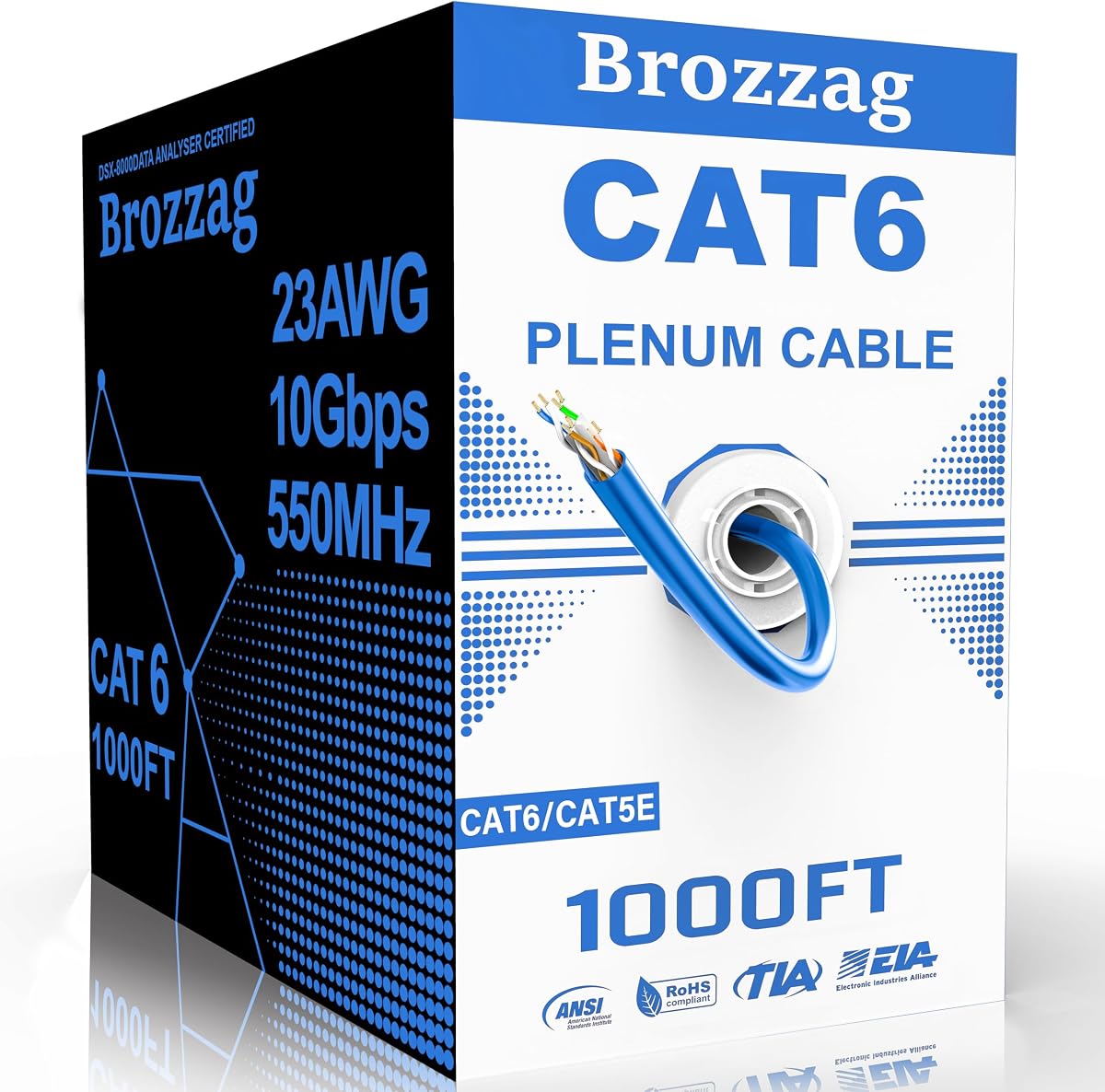
The MONK CABLES CAT6 Plenum Cable 1000ft is built around installation packaging, individual testing, and a jacket intended for plenum spaces. Its 4.4 rating is the lowest in this group, but that should be interpreted alongside the product's specialized bulk format rather than compared directly with the convenience of a finished patch cable. It is intended for users who value a specified fire-rated jacket and disciplined cable handling.
We may earn a commission when you buy through this link, at no additional cost to you.
Each cable is described as individually tested with a DSX-8000 cable certifier, while the stated 23 AWG construction uses a copper and aluminum mix. The cable supports a 550 MHz bandwidth and 10-Gigabit Ethernet, with RoHS, REACH, and ISO 9001:2015 certifications listed in the supplied information. The easy-pull box includes repeated foot markings to help installers measure the run and reduce cutting errors.
The jacket is described as fire-retardant, sunlight-resistant, and weather-proof, with suitability for plenum areas above drop ceilings or below raised floors. Whether that rating is appropriate for a particular residential route depends on local building codes and the actual space. The copper-aluminum construction is also less pure than products using solid copper, and the individual testing claim cannot substitute for checking applicable installation standards.
Choose the MONK CABLES spool for a large installation where a plenum-rated cable, repeatable box markings, and individually tested material are the priority. It may suit a home with multiple ceiling or floor routes, a small office buildout, or a property containing a structured communications enclosure. For a single short room connection, this quantity and installation complexity would be excessive.
Individual certification testing can give professional or careful DIY installers greater confidence that each length conforms to the stated performance category before it is placed within a wall or ceiling.
The stated plenum jacket targets spaces such as above drop ceilings and below raised floors, where cable flame-rating requirements can be more restrictive than those for an ordinary room.
We may earn a commission when you buy through this link, at no additional cost to you.
The Orbram Cat 8 Ethernet Cable 50FT is a high-bandwidth, shielded patch cable with a flat, braided design. Its 4.7 rating and stated support for 40Gbps and 2000 MHz place it among the most performance-oriented products in the guide. It is best understood as an advanced wired-network option rather than a requirement for the average home internet connection.
We may earn a commission when you buy through this link, at no additional cost to you.
The four copper conductors are arranged as shielded foiled twisted pairs in an S/FTP configuration. Individual shielding and improved twisting are intended to limit crosstalk, noise, and interference, while 24K gold-plated RJ45 contacts provide polished connector surfaces. The flat form makes the lead easy to place along walls, under desks, or around furniture without creating a thick cable bundle.
A double braided nylon exterior adds mechanical protection and reduces tangling, while the product description states that the cable can withstand at least 10,000 bends. As with other high-category cables, those capabilities may not be visible in normal residential use. The shielded connectors can also be larger than basic plugs, and older wall outlets or tightly packed switch ports may not provide enough clearance. Actual speed remains limited by both cable length and the devices connected at each end.
Choose the Orbram cable for a high-performance home lab, advanced gaming or storage setup, or a run where shielding and a flat route are important. It also works with a broad range of Cat5, Cat5e, Cat6, and Cat6A equipment, so it can replace an ordinary lead in compatible systems. Most conventional households will find Cat6 more than adequate, but this option provides additional capability when the connected equipment can benefit from it.
The S/FTP arrangement combines individual foil shielding with twisted pairs, providing a useful way to reduce interference in installations that sit near electronics or other data cables.
A flat profile can be tucked along a wall or beneath furniture, while the double braided exterior adds resistance to abrasion and helps the cable remain manageable after repeated handling.
We may earn a commission when you buy through this link, at no additional cost to you.
The Cable Matters UL Listed 10Gbps 23AWG CMR Cat6 Cable, 500ft, is the strongest premium choice for permanent structured wiring. It combines a 4.8 rating with 23 AWG pure copper conductors, a 550 MHz bandwidth target, and a UL Listed CMR riser-rated jacket. These details make it suitable for people building a deliberate home network rather than merely connecting two nearby pieces of equipment.
We may earn a commission when you buy through this link, at no additional cost to you.
The 500-foot spool provides a substantial but more manageable quantity than a 1000-foot box for many homes. Foot markings allow installers to track remaining length, while the easy-pull reel is intended to reduce tangling during deployment. The cable is backward compatible with Gigabit and Fast Ethernet and is designed for 10-Gigabit Ethernet applications, covering the speeds relevant to current home routers, switches, access points, and media equipment.
Pure copper supports the supplied claims for reliable data transfer, PoE, PoE+, and PoE++, and the cable meets or exceeds TIA/EIA 568-C.2 standards. As bulk cable, it does not provide a finished connection; the installer needs compatible jacks, connectors, patch panels, and the correct tools. The CMR jacket is intended for suitable riser routes, but local fire codes and the precise building path should always govern where any cable is installed.
Choose this product for a whole-home network, multiple wall outlets, a dedicated media enclosure, or a professionally planned addition. Its combination of pure copper, a recognized jacket rating, useful length, and a 4.8 rating makes it a premium foundation for installations intended to remain in place. For occasional extension leads, it is excessive, but for long-term infrastructure it offers the most complete balance of physical construction and installation readiness.
Solid pure copper conductors provide a strong foundation for permanent structured cabling, while the foot-marked spool helps installers cut and track material accurately across multiple rooms.
The UL Listed CMR jacket provides a defined fire-performance specification for appropriate riser installation, while 550 MHz bandwidth and broad PoE support leave considerable room for modern network equipment.
We may earn a commission when you buy through this link, at no additional cost to you.
The best Ethernet cable for home wiring depends on how the network will be installed, which devices it must serve, the distance of each run, and the electrical environment around the route. Length, category, conductor construction, shielding, jacket rating, and connector or termination style should be considered together.
Choose based on the network equipment and realistic bandwidth needs rather than the largest advertised number. For ordinary home internet, streaming, gaming, and smart-home use, a properly installed Cat6 cable is generally the more proportionate choice.
Use pure copper when conductor consistency, PoE capability, and long-term flexibility matter most. Consider copper-clad aluminum for large installations where lower material weight and easier spool handling are meaningful priorities.
Use the shortest practical finished run while allowing a little service slack. For wall wiring, bulk cable is usually better than stacking extension leads; for a temporary connection, a ready-made patch cable is simpler.
Select shielding when the route is electrically noisy or when advanced equipment benefits from maximum interference resistance. Choose UTP for easier routing, smaller connectors, and lower-cost standard home installations.
Identify whether the cable enters a wall, ceiling, conduit, crawlspace, or exterior route, and verify the required rating with local requirements. Do not substitute an ordinary jacket simply because it fits the same RJ45 port.
Match the cable to the exact PoE standard used by the network equipment. For high-power devices, verify conductor size and installation guidance rather than assuming every category-rated cable is interchangeable.
Choose a pre-terminated cable for fast or temporary connections. Choose bulk cable when the route needs custom lengths, multiple outlets, or a permanent structured wiring plan.
Match cable shape and flexibility to the route. Use flat or flexible leads for neat surface paths, braided leads for active areas, and suitable bulk cable for concealed permanent installation.
Begin by identifying the source device, destination device, and complete physical path. For a pre-terminated cable, connect one RJ45 plug to the appropriate LAN or network port and the other to the computer, television, game console, access point, camera, or wall outlet. Check the port labels because some routers distinguish LAN, internet, and switched ports, and some devices include only a subset of Ethernet connections.
For a bulk installation, route the appropriate cable through the selected wall, conduit, or ceiling path before terminating it. Keep the cable away from sharp edges, avoid pulling it tightly around corners, and leave a small service loop near each connection. Follow local requirements for fire-rated cable, use compatible jacks and connectors, and test every completed run before closing the wall, trimming excess material, or attaching permanent faceplates.
Inspect connectors and jackets periodically, especially near doors, furniture, power strips, and outdoor entry points. Replace a cable with crushed, sharply bent, or visibly damaged outer jackets rather than relying on intermittent reconnection. Keep connectors dry and dust-free, avoid hanging heavy equipment from a cable, and use clips or cable management to prevent accidental pulls. When moving equipment, unplug the cable rather than yanking it from the port.
Cat6 is usually the better fit for ordinary home networks because it supports common Gigabit Ethernet and 10Gbps use with a compact, economical cable. Cat8 provides a much higher bandwidth ceiling and useful shielding, but most routers, switches, and computers cannot use its full advertised speed. Choose Cat8 for specialized high-speed equipment or additional future headroom, not as a way to increase the speed of an ordinary broadband plan.
Running Ethernet through walls is an effective way to create a permanent, clean network with outlets positioned where devices actually operate. Use bulk cable rated appropriately for the space, plan the route carefully, and terminate it with compatible jacks or a patch panel. Because wall installation can require cutting, drilling, and fire-code compliance, users who are not comfortable with the work should consider a qualified low-voltage installer.
Pure copper is generally preferred for consistent conductivity, familiar PoE behavior, and straightforward termination. Copper-clad aluminum can be a practical way to obtain a large quantity of lighter bulk cable, but its electrical characteristics are different and may be less suitable for demanding or high-power runs. Compare the conductor specification with your network equipment, route length, installation method, and local requirements.
These labels describe the fire-performance and intended installation environment of the outer jacket. CM is commonly associated with general in-wall use, CMR with suitable vertical riser routes, and plenum with spaces such as above drop ceilings or below raised floors. The exact allowed pathway depends on building codes and local inspection requirements, so a cable's product title alone should not determine where it is installed.
Yes, when the cable and both connected devices support the same PoE standard. A PoE-compatible switch or injector sends power through the data conductors, while a PoE camera, phone, or access point receives it. The cable's category, conductor size, length, and installation conditions all matter, especially for higher-power PoE or PoE++ devices.
A cable within its specified length and installation limits should deliver the speed supported by the connected equipment. Actual performance can be affected by excessive length, sharp bends, poor terminations, electrical interference, and lower-quality installations. For 10Gbps networks, use a cable specifically rated for that bandwidth and follow the manufacturer or installer recommendations for the total run.
A flat cable is convenient for neat surface routing along baseboards, beneath carpets, and around furniture. A round braided cable is often easier to bundle, more resistant to visible abrasion, and convenient for active desks or entertainment centers. Both can work well for home networking; route style, handling frequency, and connector clearance should guide the choice.
Ethernet can benefit smart-home components that depend on a stable local network, including wired cameras, smart televisions, game consoles, desktop computers, and some access points. Battery-powered sensors and many simple smart-home devices usually rely on wireless connectivity instead. A structured cable plan can still provide valuable infrastructure for fixed devices while leaving wireless devices to use the same router or access point.
The three leading choices serve different needs. The Cable Matters 25-foot Cat6 cable is the best budget starting point for nearby equipment and PoE-capable devices, the Ultra Clarity 100-foot Cat6 lead is the most balanced choice for a long plug-and-play home run, and the Cable Matters 500-foot CMR Cat6 spool is the best premium foundation for permanent structured wiring.
Before buying, prioritize the route and installation method over headline bandwidth. Choose a patch cable for a simple connection, bulk cable for multiple outlets or concealed permanent paths, pure copper when consistency and PoE are important, and the correct fire-rated jacket for the space. Account for furniture, corners, doorways, and service loops when measuring, and ensure every connected device supports the network speed you expect.
Ratings, specifications, availability, and prices can change, so check the current product listing and seller information before purchasing. Compare the stated category, conductor material, length, jacket rating, shielding, and PoE support with your network design rather than choosing solely by the largest advertised speed or the lowest listed cost.