
XLR Male to RCA Female Adapter Cable
4.8Editor score
Nickel-plated metal shell
Rivet-secured connector connection
Two-piece multipack
Discover the best RCA to XLR adapter options by comparing connector genders, cable design, shielding, channel support, construction, and audio use.
An RCA to XLR adapter bridges the connection between consumer audio hardware and professional equipment that uses three-pin XLR connectors. The right choice depends on connector gender, signal type, channel configuration, shielding, cable length, and whether you need a rigid coupler or a short cable.
This guide compares ten adapters and cable-style converters across the factors that affect compatibility and usability. It includes compact metal couplers, red-and-white channel pairs, longer shielded leads, and Y-style options for routing XLR output into stereo RCA connections.
Each selection demonstrates a different practical use, from connecting a mixer to an amplifier to adapting microphones and home-theater equipment. Ratings and configurations reflect the supplied product information, while prices and availability can change, so confirm the current listing before purchasing.
4.8Editor score

4.7Editor score

4.8Editor score
The comparison covers each adapter's connector arrangement, physical format, channel support, shielding or construction, and primary equipment applications so readers can quickly identify the most suitable option for a specific audio setup.
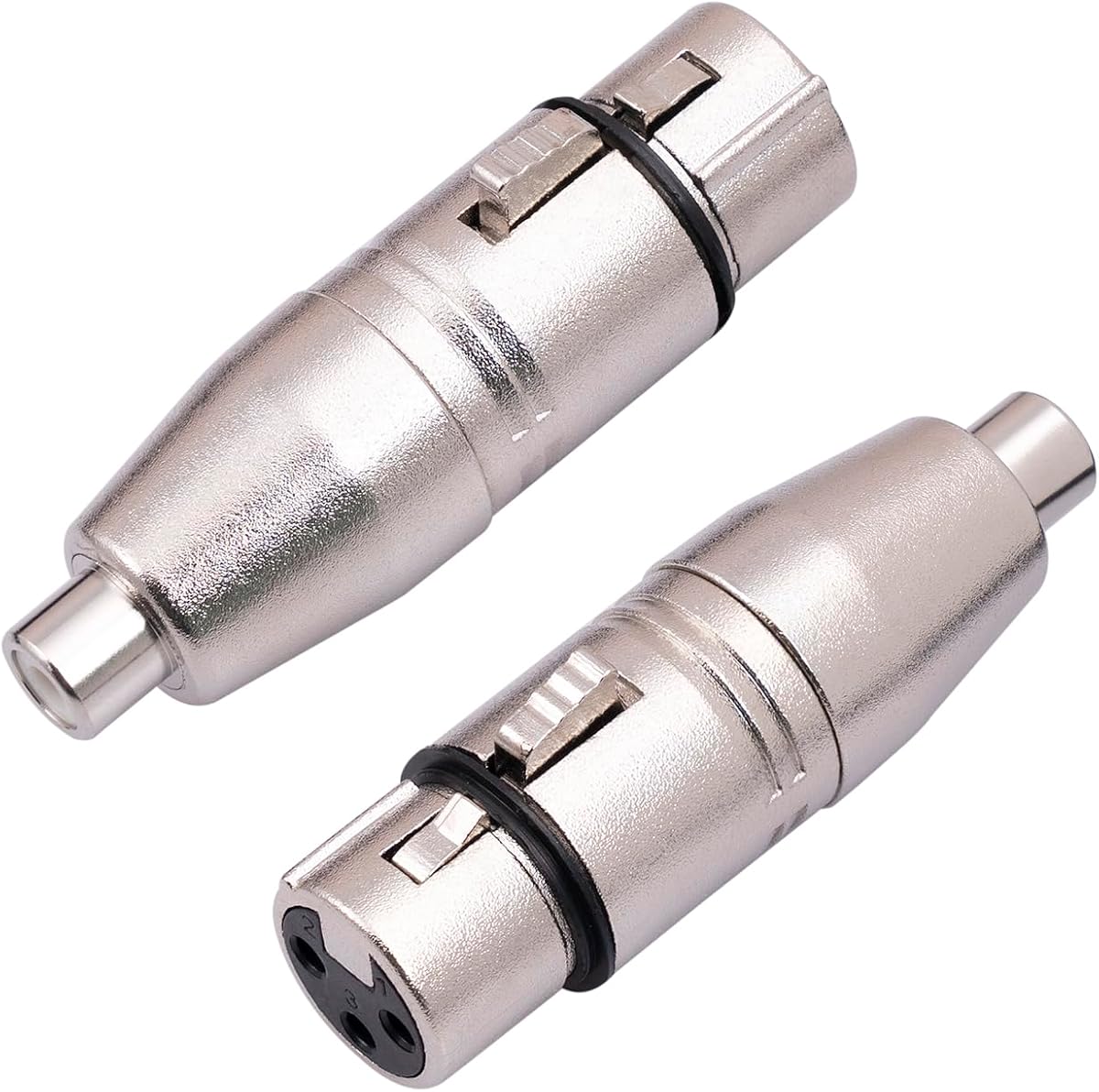


This two-pack connects a male XLR fitting to a female RCA jack, earning a 4.8 customer rating and making it a practical choice for basic interface conversion. Its compact format is useful when a device has an XLR output but the next cable terminates in an RCA plug. The nickel-plated metal shell is designed for repeated use rather than a disposable temporary repair.
We may earn a commission when you buy through this link, at no additional cost to you.
A notable construction detail is the riveted joint between the XLR and RCA sections. That design avoids loose screws and helps preserve a firm connection during transport or repeated setup changes. The supplied information states compatibility with mixers, audio players, power amplifiers, microphones, and other audio devices, giving the adapter broader usefulness than a highly specialized coupler.
The main limitation is its fixed, rigid format. It cannot provide extra distance between components, and its RCA female end requires a matching RCA male cable. It also does not present itself as a stereo color-coded pair, so users working with left and right channels should confirm whether one unit is sufficient for the intended connection.
This is an excellent budget-oriented option for connecting mismatched connector types with minimal fuss. Choose it when a short, secure coupler is all the system needs and you already own suitable cables. For more elaborate installations, a longer cable or explicitly color-coded stereo pair may be easier to manage.
The adapter eliminates the need to replace an entire cable when only the terminal format is wrong. It simply occupies the space between an existing male XLR connector and a female RCA port.
The metal shell and riveted joint suit mobile rigs, rehearsal rooms, and home studios where connections may be unplugged and rebuilt regularly.
We may earn a commission when you buy through this link, at no additional cost to you.
This adapter converts a three-pin female XLR connection to a female RCA connection and carries a 4.6 rating. It is particularly useful when a mixer, recorder, or amplifier offers an XLR female input and the user needs to attach a standard RCA male cable. Unlike a simple cable with fixed ends, it functions as a compact gender-changing coupler.
We may earn a commission when you buy through this link, at no additional cost to you.
The full metal shell contributes to a durable feel, while the electroplated exterior is intended to resist fading and corrosion. Copper-nickel plated contacts are specified for conductivity and stable connections. Rivets secure the connector sections without screws, reducing the number of loose parts that could complicate transport or repeated setup.
Because both ends are female, this option is not as immediate as a male-to-male or male-to-female lead. The user must already have a cable with a male RCA plug or another appropriate mating connector. Its lack of red and white channel markings may also make stereo routing less visually obvious in a crowded rack or behind a desk.
This two-pack is best for users who specifically need two female-to-female transitions. It works well for adapting existing RCA leads to XLR-equipped mixers and recorders, provided the device's connector is female. Check both genders carefully before ordering, since this format will not directly accept a male XLR plug.
Female-to-female construction can turn an existing male-ended RCA cable into a link for a female XLR-equipped device, avoiding an unnecessary cable replacement.
The electroplated shell and plated contacts are designed to handle repeated insertion cycles while limiting corrosion and surface degradation.
We may earn a commission when you buy through this link, at no additional cost to you.
This two-pack provides eight-inch XLR male-to-RCA male cables and holds a 4.6 rating. It converts a balanced XLR signal into an unbalanced RCA signal, making it suitable for links between professional output hardware and consumer audio inputs. The short length is especially useful when equipment sits close together or sits within a rack.
We may earn a commission when you buy through this link, at no additional cost to you.
Its conductors use 4N oxygen-free copper with a 20AWG shielded twisted-pair design. The listing also specifies high-density braid shielding and aluminum-foil shielding to reduce EMI and RFI interference, which can help limit unwanted noise and popping. Gold-plated contacts, rubber strain relief, and a flexible PVC jacket round out the construction-focused specifications.
The fixed gender configuration means users need an XLR female port and RCA female input for a direct connection. The eight-inch length offers little routing flexibility, and any need for a longer run would require a different cable. The balanced-to-unbalanced conversion should also be understood as a format change rather than a source of true balanced operation.
This option is well suited to compact studio and home-theater arrangements where a short, shielded cable is preferred to a rigid adapter. The two-pack provides a spare for another connection or channel. It is less suitable for long cable runs or situations requiring substantial slack between separated components.
An eight-inch lead is convenient for devices mounted close together, while the flexible jacket and strain relief make repeated connection changes manageable.
The combination of dense braid and aluminum-foil shielding is intended to reduce electromagnetic and radio-frequency interference during signal transfer.
We may earn a commission when you buy through this link, at no additional cost to you.
This two-pack bridges a male XLR connection and female RCA jack while earning a 4.7 rating. It combines 24K gold-plated contacts with a solid zinc alloy body, giving it a more refined construction profile than a basic plastic coupler. It is a natural fit for home studios, DJ setups, amplifiers, and interfaces that mix professional and consumer equipment.
We may earn a commission when you buy through this link, at no additional cost to you.
The gold plating is designed to reduce contact resistance and support dependable signal transfer. A zinc alloy shell provides physical strength and electromagnetic shielding, while the listed nickel-locking mechanism is intended to create a tight connection. Oxygen-free copper conductors further support the product's signal-focused construction claims.
Its strongest practical feature is the red-and-white color-coded pair. Identifying left and right channels becomes easier when routing stereo equipment, reducing the chance of reversed connections in a complex setup. The tradeoff is that it remains a rigid adapter with no extra cable length, and its RCA side is designed for unbalanced consumer connections rather than true balanced signal transport.
This is the most versatile general-purpose pick for readers who want a durable pair, straightforward channel identification, and broad compatibility. It works particularly well for connecting XLR-output equipment to an RCA-equipped amplifier, home theater system, or other consumer audio component. Check the required genders before buying, as the product description identifies an XLR male-to-RCA female format.
The distinct red and white finishes make it easier to assign stereo channels consistently, especially in racks with several similar-looking connections.
Gold-plated contacts support low-resistance contact, while the zinc alloy housing provides rigidity and a shield against external interference.
We may earn a commission when you buy through this link, at no additional cost to you.
This four-pack offers male XLR-to-female RCA adapters with a 4.3 rating. It is aimed at users who need more than a single stereo pair, such as setups with multiple mixers, amplifiers, or playback devices. Red and white finishes help organize left and right channels, while the four-unit quantity provides convenient redundancy.
We may earn a commission when you buy through this link, at no additional cost to you.
The adapters use gold-plated contacts and a durable zinc alloy shell. The listed construction is intended to provide a secure fit and resist electromagnetic interference. According to the product information, the zinc body also helps maintain a stable signal path, which can be useful around computers, amplifiers, and other electrical sources.
The product remains an adapter rather than a balanced cable, so the connection should be treated as an unbalanced consumer-audio link. Its fixed length can create cable-management limitations when components are separated, and users may need additional RCA or XLR cables to complete the chain. The four-pack may also be more than necessary for a single connection.
Choose this option when multiple RCA-to-XLR transitions are likely. The quantity and channel colors make it particularly convenient for multi-zone home audio or several compact studio systems. For a single stereo connection, the related two-pack option offers the same core design in a smaller quantity.
Four adapters simplify installations that involve multiple stereo device pairs without requiring each transition to be purchased separately.
The rigid zinc alloy shells are intended to withstand regular plugging, unplugging, transport, and movement around a crowded audio setup.
We may earn a commission when you buy through this link, at no additional cost to you.
This two-pack provides male XLR-to-female RCA adapters for a conventional stereo link and carries a 4.3 rating. It is a straightforward option for connecting a single pair of XLR-output devices to an RCA-equipped receiver, amplifier, or home theater unit. The red and white adapters make channel assignment visually clear.
We may earn a commission when you buy through this link, at no additional cost to you.
Gold-plated contacts are intended to reduce resistance and promote consistent signal transfer. A zinc alloy shell gives the adapters a durable structure, while the metal body is also described as helping shield against external electromagnetic interference. The secure fit is designed to reduce disconnections and associated audio dropouts.
As with other male-to-female adapters, the product does not add cable length and must be used with compatible mating cables. The RCA format is unbalanced, which makes it suitable for consumer audio but not for preserving a fully balanced XLR signal path. Buyers who need a longer run or additional stereo pairs should account for those requirements separately.
This adapter is a sensible middle ground for a single home or studio stereo connection. It offers the same channel coding and metal construction emphasized by the larger four-pack without carrying four units. It works especially well when the source has male XLR outputs and the destination accepts female RCA plugs.
The two-unit format covers a conventional left and right channel without the extra bulk of a larger multipack.
Plated contact surfaces and a zinc alloy housing create a durable option for stationary home audio and regularly used studio systems.
We may earn a commission when you buy through this link, at no additional cost to you.
These Cardas Audio adapters convert a female RCA connection to a male XLR connection and hold a 4.8 rating. They represent the most premium-oriented construction in the group, using non-magnetic eutectic brass, rhodium-over-silver contact surfaces, and a secure locking connection. The pair is made in the USA according to the supplied listing information.
We may earn a commission when you buy through this link, at no additional cost to you.
The material choice serves an audio-focused purpose. Non-magnetic brass and efficient shielding are designed to reject radio-frequency and clock-related interference, while rhodium over silver is used for enhanced contact and signal conductivity. These characteristics make the adapters relevant to discerning listeners and setups where the connection itself is intended to preserve signal integrity.
The required female-to-male orientation is the primary purchasing consideration. A device with a male RCA output and female XLR input may require the opposite arrangement or a different adapter. The product also costs substantially more than the other choices, so its premium materials may offer limited practical value for a temporary or low-demand connection.
For an established high-end audio system where connector quality, locking security, and interference control matter, this is the strongest premium recommendation. It is less compelling for beginners who only need a basic interface conversion. Verify all connector genders and the signal requirements of both devices before ordering.
Eutectic brass, non-magnetic construction, and rhodium-over-silver contacts indicate attention to conductivity, stable contact, and interference rejection.
The locking connection helps maintain a stable physical link in installations where accidental disconnects would interrupt listening or recording.
We may earn a commission when you buy through this link, at no additional cost to you.
This 1.5-meter Y-style cable accepts a three-pin XLR connection and terminates in two phono RCA plugs, earning a 4.7 rating. It solves a different problem from the straight adapters: one XLR source can be divided into two RCA connections, making it useful for certain mixer, recorder, DJ controller, and amplifier arrangements.
We may earn a commission when you buy through this link, at no additional cost to you.
The product information specifically lists connection from mixed consoles, microphones, tape recorders, and amplifier line outputs. It also cites DJ controller connections, home-theater integration, and the conversion of an XLR cable into an RCA run. High-density shielding and aluminum-foil shielding are included to reduce EMI and RFI interference.
Its Y configuration requires careful planning. The audio behavior depends on the pin wiring and output architecture of the connected source, and splitting a balanced XLR signal into two RCA connections does not automatically create an independent stereo pair. Users who only need a one-to-one connection may find the extra branch unnecessary or misleading.
This cable is best for users with a specific one-to-two routing requirement, especially those adapting a single XLR output for dual RCA equipment. Confirm the source's pin configuration and expected channel behavior before installation. For a conventional stereo adapter with clearly coded left and right connections, the rigid two-pack is easier to interpret.
The branching format reaches two RCA connections from one XLR plug, which can simplify integration between differently designed audio components.
The 1.5-meter lead offers more placement flexibility than a rigid coupler, while shielding and strain relief support dependable use.
We may earn a commission when you buy through this link, at no additional cost to you.
This two-pack includes 4.92-foot RCA male-to-XLR male cables and carries a 4.7 rating. It suits users who need a conventional full cable rather than a short rigid adapter. The longer reach can make it easier to connect separated components while maintaining a clean connection between RCA and XLR-equipped equipment.
We may earn a commission when you buy through this link, at no additional cost to you.
The construction combines 4N oxygen-free copper conductors with high-density tinned copper braid, double-layer PVC shielding, and ferrite cores. These features are intended to reduce EMI, RFI, signal loss, and distortion. The 5-micron gold-plated pure copper connectors are specified for corrosion resistance, reliable contact, and smoother repeated insertion.
A heavy-duty nylon braided outer jacket is designed to resist wear, pulling, and bending. It also reduces fraying and makes storage more manageable compared with an easily tangled basic cable. The tradeoff is that a nearly five-foot lead is longer than necessary for tightly arranged desktop equipment, and male-to-male endpoints may not suit every device combination.
This is a strong option for home hi-fi systems, amplifiers, DACs, CD or DVD players, and power amplifiers that use the specified connector arrangement. It combines signal-focused shielding with a durable exterior for longer runs. Confirm that both components accept the required male connectors, and use the included length only if it suits the physical layout.
Tinned copper braid, double-layer PVC shielding, and ferrite cores work together to reduce interference along the cable run.
The braided exterior is intended to withstand pulling, bending, and repeated handling while remaining easier to organize.
We may earn a commission when you buy through this link, at no additional cost to you.
This two-pack provides six-inch RCA male-to-XLR female cables with a 4.5 rating. Its short length and flexible cable format are intended for close-range equipment connections, making it useful when a rigid adapter would place unnecessary strain on an existing cable. The adapters are explicitly designed for unbalanced audio.
We may earn a commission when you buy through this link, at no additional cost to you.
The supplied wiring details state that XLR pin 2 connects to the RCA positive pole, while pins 1 and 3 connect to the RCA negative poles. This information is valuable because it allows users to understand the adapter's electrical configuration before installation. The product is described as suitable for XLR-equipped microphones, equalizers, compressors, decoders, and other compatible audio devices.
It is important not to treat the unbalanced format as equivalent to a fully balanced XLR connection. RCA is an unbalanced interface, and the adapter performs signal conversion for compatibility with RCA circuitry. The six-inch length also limits placement flexibility, so longer custom cable runs may be preferable for equipment arranged farther apart.
This is a helpful compact option for tabletop systems and tightly grouped equipment. It works best when an XLR female-equipped source needs a short RCA male transition. Users should check the listed pin arrangement against their equipment and avoid choosing it when true balanced operation is a requirement.
The stated pin 2 positive connection and shared pin 1 and 3 negative path make the adapter's unbalanced conversion easier to understand.
At six inches, the lead reduces excess cable clutter when a microphone, recorder, or decoder sits close to an RCA-equipped device.
We may earn a commission when you buy through this link, at no additional cost to you.
Connector gender, signal format, and physical setup should guide the decision. The right adapter must physically fit both devices, preserve the intended audio path, and suit the distance, handling, and channel requirements of the installation.
Start by identifying the exact connector on each device or cable. RCA and XLR products are available with male, female, or mixed ends, and even a pair of physically similar adapters can have incompatible orientations. A male-to-female adapter fits a male XLR plug and a female RCA jack, while a female-to-male adapter performs the reverse. Both ends being female can also be useful when changing the gender of an existing cable.
XLR is commonly associated with balanced professional audio, while RCA is generally an unbalanced consumer connection. An adapter between them usually converts the signal into an unbalanced format rather than preserving a fully balanced XLR path. This distinction matters for long runs, electrically noisy environments, and systems where grounding or interference could become noticeable.
Stereo systems usually require two separate paths. Some adapters come in a red-and-white pair so the channels are easy to distinguish, while four-packs provide more flexibility for multiple devices. A Y-style cable creates two RCA branches from one XLR connection, but that arrangement does not necessarily produce independent left and right channels. It should be selected according to the source equipment's actual output design.
Shielding helps reduce electromagnetic and radio-frequency interference that can introduce hiss, static, or popping. Metal adapter shells can offer some shielding, while cables may use dense braid, aluminum foil, PVC shielding, and ferrite cores. Consider these features most seriously for computer-based studios, live audio, home theaters, and runs near power cables or large electronics.
Contact plating can affect corrosion resistance and consistent electrical contact, while the housing material influences durability. Options in this category include nickel-plated metal, copper-nickel contacts, gold-plated contacts, zinc alloy, and non-magnetic eutectic brass. Premium materials are most compelling in permanent systems where frequent handling, secure engagement, and long-term contact stability matter.
Rigid couplers are compact and work well when existing cables provide all necessary reach. Short cable adapters, such as six- or eight-inch versions, add modest flexibility and can reduce strain. Longer leads are more convenient when components are several feet apart. Choose the shortest practical length because excess cable can create clutter, tangles, and extra opportunities for accidental damage.
The adapter's stated compatible devices include mixers, microphones, recorders, amplifiers, players, equalizers, compressors, decoders, DJ controllers, and home-theater equipment. These categories cover many common uses, but the connector arrangement still must be verified. Also consider whether the equipment carries line-level or microphone-level signals, as an adapter does not automatically perform the required level conversion.
For mobile rigs or frequently rearranged systems, look for a compact body, secure locking connection, and strain relief where a cable is used. Rivet-fixed metal couplers can be durable but may be less convenient to reposition than short flexible leads. Store adapters in a small pouch and avoid forcing connectors into ports that do not match the intended gender or configuration.
Begin by disconnecting power from the equipment whenever practical. Identify the output on the source and the input on the destination, then verify that the adapter's male and female ends match those sockets. Connect the XLR side fully without twisting the plug, followed by the RCA side, and confirm that any red and white channel markings correspond to the intended left and right paths.
After connecting the adapter and any required cables, turn on the source and destination at low levels. Confirm the selected input on the amplifier or receiver, raise the volume gradually, and listen for the expected program material. If there is no sound, check the signal level, input selection, channel routing, and connector orientation before assuming the adapter itself is defective.
To preserve contact surfaces, grip the connector body rather than pulling the cable. Keep the adapters away from moisture, excessive heat, and strong magnetic fields, and clean the exterior with a dry or lightly damp cloth. For permanent installations, give the cables enough slack to prevent strain and periodically inspect the connection for looseness, corrosion, or damaged shielding.
Usually not. RCA is an unbalanced interface, so an RCA to XLR adapter generally converts a balanced XLR signal into an unbalanced RCA signal. It can provide compatibility between equipment, but it does not turn the RCA side into a true balanced connection. For long or interference-prone runs, proper grounding, quality cables, and adequate shielding are especially important.
Look at the connector on the source equipment and the connector on the cable you want to use. A male adapter end enters a female port, while a female adapter end accepts a male plug. Write down both genders and the cable types before ordering, because titles can describe either the adapter itself or the combined connection.
A single unbalanced path usually carries one channel or a combined signal, depending on the source wiring. Stereo generally requires two paths, so a red-and-white pair is usually easier to manage. A Y-style adapter creates two RCA plugs from one XLR plug, but that does not automatically create independent left and right channels, so the source output configuration must be checked.
No. Connector adapters solve physical compatibility and, depending on their wiring, may convert between balanced and unbalanced formats. They do not automatically convert a microphone-level signal to line level or perform the gain adjustments required by an amplifier. If levels are wrong, use an appropriate preamp, interface, or mixer channel.
Gold plating can help resist corrosion and maintain low-resistance contact, particularly in frequently handled systems. It is only one part of the overall connection, however, and cable shielding, conductor quality, secure fit, and correct wiring also influence performance. For most basic home audio connections, a well-built nickel-plated option can be sufficient.
A rigid adapter is convenient when existing cables already reach the required devices and you want minimal extra length. A short cable adds flexibility and can reduce strain at the connector. Longer cable options are more useful when components are physically separated, but excess length can create clutter and should be managed carefully.
Possible causes include an incomplete connection, poor shielding, an incorrect channel or pin configuration, a ground-loop problem, or a source operating at an unsuitable level. Check every mating connector and the amplifier's input selection first. Replacing a low-quality adapter may help, but it will not correct underlying grounding or signal-level issues.
Some can, but the microphone's output type matters. A conventional dynamic microphone may use a three-pin XLR male connector, while an XLR female adapter can accept it. The resulting signal remains microphone-level, so the destination must accept microphone input or the signal must pass through a preamp or mixer with proper gain control.
The XLR Male to RCA Female two-pack stands out as the best value for a simple, rigid connection, while the gold-plated two-pack provides a more refined construction and clear red-and-white channel identification. For listeners seeking premium materials and a secure locking connection, the Cardas pair occupies the top premium position.
Before choosing, prioritize exact connector genders, the required number of channels, and the difference between balanced and unbalanced operation. Then consider the physical distance between devices, shielding needs, and the frequency of handling. A compact two-pack is often more practical than a larger collection, while a short or longer cable may be better when the equipment is not directly adjacent.
Ratings, product configurations, and prices can change over time, so review the current listing before making a final purchase. Confirm the endpoint genders, supported equipment, signal level, and included quantity, then choose the adapter that matches the connection rather than one that merely appears to include the right connector names.