Fosi Audio BT20A
4.5Editor score
100W x2 maximum output
Bluetooth and RCA inputs
Bass and treble controls
Compact passive-speaker amplifier
Our Amp for Bookshelf Speakers guide compares 10 compact stereo amplifiers for power, connectivity, sound quality, features, and value in home audio systems.
An amplifier for bookshelf speakers must do more than add volume. It should provide clean power, preserve the detail of smaller drivers, offer practical source options, and fit neatly into the room. The right choice depends on speaker impedance, listening habits, available inputs, and whether you want a simple analog system or a connected streaming setup.
This guide compares 10 compact amplifiers using their stated output power, signal-to-noise specifications, distortion figures, connectivity, control options, and supported speaker loads. It covers traditional mini stereo amplifiers, Bluetooth receivers, tube-style integrated designs, balanced-input models, and network-capable streamers, with practical guidance for each type of listener.
Each pick reveals what its design is best suited to handle, from straightforward passive-speaker amplification to 2.1 systems, home theater, multiroom audio, and hi-fi listening. Product ratings and specifications can change, and pricing varies by retailer and time, so confirm the latest listing, compatibility details, and current cost before purchasing.
The shortlist spans compact designs with very different priorities. Some concentrate on straightforward analog amplification and user-adjustable tone. Others add wireless streaming, balanced inputs, high-pass filtering, pre-out functionality, or app-based control. These distinctions matter because the best amplifier is not always the model with the largest headline output figure; it is the one that matches the speakers, source components, room, and listening habits.
4.5Editor score

4.5Editor score

4.6Editor score
The comparison below highlights each amplifier's core hardware, connectivity, output capability, and practical appeal, making it easier to identify the model that best fits your bookshelf speakers and audio system.


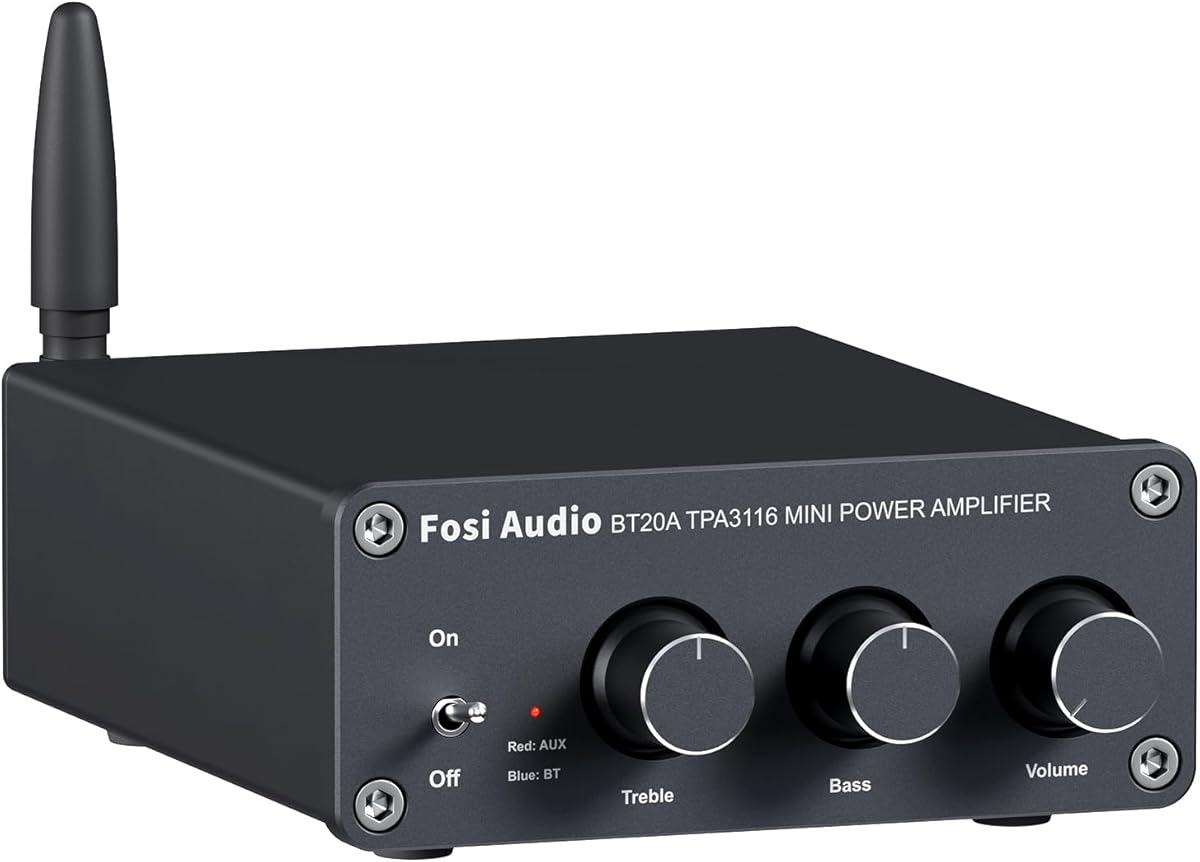
The Fosi Audio BT20A is a straightforward, compact Class D amplifier for passive bookshelf speakers, and its 4.5 rating reflects a generally favorable balance of useful features and ease of use. Its stated maximum output is 100W x2, while Bluetooth and RCA inputs cover the two most common ways listeners connect a phone, streamer, computer, CD player, or other line-level source. It is especially appealing for anyone who wants amplification without a large network receiver or a complicated menu-driven interface.
We may earn a commission when you buy through this link, at no additional cost to you.
The amplifier's strongest qualities are practical rather than exotic. A one-touch power switch, front-panel bass and treble controls, and a compact enclosure make it easy to integrate into a living room, office, bedroom, garage, patio, or another area where shelf space is limited. The integrated design is intended to complement home decor rather than dominate it. Bluetooth adds convenient wireless playback, while RCA connectivity gives users a dependable wired path when they want to use a dedicated source component.
There are important limits to consider. The BT20A does not offer balanced input, a pre-out, HDMI ARC, Wi-Fi streaming, or a high-pass filter, so it is less versatile than several more specialized models in this guide. Its headline power figure is also lower than that of several TPA3255-based alternatives. Buyers should ensure their passive speakers work within the amplifier's capabilities and remain realistic about how much power they actually need in the intended room.
For listeners seeking an uncomplicated way to power passive bookshelf speakers, this remains an excellent entry point. It offers enough flexibility for casual music listening, phone streaming, and compact stereo setups without introducing a large learning curve. It is best suited to budget-conscious buyers who value straightforward operation, a compact enclosure, and physical tone controls more than advanced network features or specialist connectivity.
Bluetooth provides a convenient way to stream from a phone, while the RCA input supports conventional wired sources. This combination covers many everyday listening arrangements without requiring network configuration.
The small housing suits shelves, desks, and side tables, while separate bass and treble controls allow quick tonal adjustments. The understated black finish also makes it easy to blend into most rooms.
We may earn a commission when you buy through this link, at no additional cost to you.
The Fosi Audio MC331 combines a tube-style integrated amplifier, preamplifier, DAC, and headphone amplifier in one compact enclosure. Its 4.4 rating makes it one of the more versatile choices here, while the maximum output of 105W x2 at 4Ω gives it meaningful power for appropriately matched bookshelf speakers. Visually, the visible tubes and VU meter distinguish it from conventional black mini amplifiers and make it particularly appealing as a focal point on a shelf or cabinet.
We may earn a commission when you buy through this link, at no additional cost to you.
Connectivity is the MC331's defining strength. It accepts Bluetooth, USB, coaxial, optical, and RCA input, allowing computers, phones, CD players, and turntables with built-in phono preamps to share the same system. A pre-out and 3.5mm headphone output add further routing options. The included remote control makes source selection and bass or treble adjustment convenient, while replaceable tubes give owners a way to alter the sound signature without replacing the entire amplifier.
The tradeoff is that the MC331 offers fewer of the specialist features found in some Class D models. It does not include balanced input, an adjustable high-pass filter, or HDMI ARC, and its integrated design may feel less attractive to someone seeking a minimalist audio component. Users should also understand that a turntable with a built-in phono preamp is supported, whereas a basic moving-magnet turntable cannot be assumed to work without the necessary phono stage.
This amplifier is a strong recommendation for a listener who wants one box to handle digital and analog sources while retaining an engaging, traditional hi-fi appearance. It is less suited to a television-centered system because HDMI connectivity is absent, but it excel for desktop listening, two-channel music, headphone use, and source-rich bookshelf setups. Its combination of power, DAC functionality, and warm visual design gives it broad appeal.
USB, optical, coaxial, RCA, and Bluetooth inputs make the MC331 adaptable to computers, phones, legacy players, and supported turntables. The integrated DAC also avoids the need for a separate converter in many setups.
Visible tubes and a moving VU meter give the amplifier a retro-inspired presence that differs from the understated look of most mini Class D models. Replaceable tubes offer an additional avenue for personalizing its presentation.
We may earn a commission when you buy through this link, at no additional cost to you.
The Fosi Audio V3 is a performance-focused mini stereo amplifier built around the TPA3255 Class D chip, and its 4.5 rating makes it an attractive option for technically minded listeners. It supports passive speakers from 2 to 8 ohms and is advertised with output up to 600W under certain conditions. More useful for judging real-world suitability are its stated signal measurements: up to 88dB SINAD, up to 110dB SNR, and a stated low noise floor of 140 microvolts.
We may earn a commission when you buy through this link, at no additional cost to you.
Its component selection reinforces the hi-fi positioning. The amplifier uses Japanese NCC, ELNA, and German WIMA capacitors alongside Japanese Sumida inductors. A particularly notable feature is the op-amp rolling design, allowing the supplied NE5532 devices to be exchanged for compatible eight-pin dual op-amps, including several popular choices. The volume control also governs the pre-out level, which can be useful when the amplifier is connected to another power stage or active device.
Thermal design is another strength. Vents on the top and bottom combine with a whole-body heatsink to dissipate heat more effectively than a sealed mini chassis. The main compromises are the absence of built-in Bluetooth, Wi-Fi, HDMI, and streaming functions, plus the very large maximum output figure, which should not be treated as a guarantee of continuous real-world power. Actual output depends on supply voltage, speaker impedance, signal conditions, and manufacturer test parameters.
The V3 is best for listeners who already have a source device and want a compact, feature-rich analog amplifier with strong measured specifications and component-level customization. It works particularly well for passive bookshelf or tower speakers, desktop listening, and home theater use. Those wanting wireless playback can add a Bluetooth streamer, while those seeking the simplest one-box solution may prefer the BT20A.
The stated SINAD, SNR, and noise-floor figures provide useful technical context, while the replaceable op-amp layout offers an approachable upgrade path. Users should match any replacement op-amp to the manufacturer's supported pinout and guidance.
A whole-body heatsink and strategic top and bottom vents improve heat dissipation. The included 48V power supply supports the amplifier's high-power design, although buyers should observe all voltage and polarity requirements.
We may earn a commission when you buy through this link, at no additional cost to you.
The Fosi Audio BT20A Pro combines a TPA3255 Class D amplifier with Bluetooth 5.0 in a compact two-channel enclosure. It carries a 4.4 rating and stands out from simpler wireless amplifiers through its stated 108dB SNR, maximum THD of 0.005%, low idle loss below 2.5W, and replaceable op-amps. Those specifications make it a credible option for listeners who want wireless convenience without giving up a component-style analog amplifier.
We may earn a commission when you buy through this link, at no additional cost to you.
The amplifier includes bass and treble controls that can be set to their center positions for a more neutral presentation. Its Bluetooth pairing can be removed by holding the volume control for five seconds, and a memory function makes subsequent connections easier. The package includes the amplifier, Bluetooth antenna, 32V/5A power adapter, AC cord, and user manual, providing the main items needed to begin a wired or wireless bookshelf-speaker setup.
Users can also replace the two plug-in NE5532 op-amps with compatible alternatives such as LME49720HA, MUSES02, OPA2604AP, OPA2134PA, LM4562, or NJM4556AD. This expands the appeal for listeners interested in component upgrades. However, the BT20A Pro lacks HDMI ARC, Wi-Fi, multiroom functions, and balanced input. It also remains a two-channel design, so creating separate mono zones requires additional equipment and appropriate output configuration.
This is a good recommendation for someone whose priorities are Bluetooth 5.0, replaceable electronics, solid stated signal measurements, and a compact two-channel amplifier. It suits casual music listening, outdoor placement, desktop systems, and traditional passive-speaker setups. It is less appropriate as a television hub or complete network streamer, but it fills the gap between a basic Bluetooth receiver and a more elaborate connected amplifier.
Bluetooth 5.0 supports convenient wireless playback, while the pairing memory reduces the need to repeat setup when the same phone or source is used again. A hold-to-reset function is available when a fresh pairing is needed.
The two plug-in NE5532 op-amps can be replaced with several listed compatible alternatives. This makes the amplifier approachable for experimentation while preserving a compact, conventional stereo layout.
We may earn a commission when you buy through this link, at no additional cost to you.
The Fosi Audio TB10D is a compact two-channel Class D amplifier designed to power passive speakers from 2 to 8 ohms. Its 4.5 rating reflects a versatile package that includes RCA input, passive speaker outputs, bass and treble controls, and support for a bass shaker. The TPA3255 chip forms the heart of the design, with stated maximum output of 600W and a compact form factor suited to home theater, desktop, and multi-room audio arrangements.
We may earn a commission when you buy through this link, at no additional cost to you.
The amplifier's broad source compatibility is one of its most useful characteristics. Its RCA input can accept signals from phones, computers, DVD players, CD players, PCs, laptops, and TVs when those devices provide an appropriate analog output. Adding a subwoofer or bass shaker expands the low-frequency presentation without requiring a full-size receiver. A front-panel power switch and separate tone knobs make everyday adjustments uncomplicated.
As a conventional mini amplifier, the TB10D has limits. It does not provide Bluetooth, Wi-Fi, HDMI ARC, balanced input, or a high-pass filter, so additional components may be needed for modern streaming or television integration. The 600W headline maximum should also be understood as a stated product figure rather than a promise of identical continuous output with every speaker and power supply.
The TB10D is best for buyers building a straightforward analog stereo system, adding low-frequency reinforcement, or seeking a compact amp for passive bookshelf speakers in a game room, studio, dining area, or living room. It offers fewer bells and whistles than the MC331, V3, ZA3, or D1, but that focused design makes setup and operation straightforward.
Bass shaker support gives this amplifier a useful role in compact gaming or home theater setups. It can also serve ordinary passive speakers, making it a practical bridge between simple stereo listening and an expanded low-frequency presentation.
RCA input accepts signals from many common source devices, while passive speaker outputs connect to compatible 2–8 ohm speakers. Physical bass, treble, and power controls reduce the need for software setup.
We may earn a commission when you buy through this link, at no additional cost to you.
The WiiM Amp is the most fully connected amplifier in this roundup, earning a 4.6 rating among the strongest figures shown. It can turn passive bookshelf speakers into a network-capable stereo system, delivering 60W per channel at 8 ohms and 120W per channel at 4 ohms. That output is more modest than the headline maximums of many TPA3255 mini amplifiers, but it is combined with extensive streaming, television, multiroom, and control options.
We may earn a commission when you buy through this link, at no additional cost to you.
Its most important feature is HDMI ARC, which makes it unusually convenient for a living-room system. Connect a television for stereo sound from shows, films, and games, and add a powered subwoofer when deeper bass is desired. The WiiM Home App supports streaming services, volume, speaker synchronization, favorites, alarms, room adjustments, and independent EQ. Voice control through Alexa, Google Assistant, or Siri and the included voice remote add further convenience.
Hi-res streaming is supported up to 24-bit/192 kHz through platforms including Spotify, Amazon Music, TIDAL, Qobuz, and personal libraries. Advanced room correction can help account for the speakers and room, while multiroom integration works with AirPlay 2 speakers, Amazon Echo, Google Home, and other WiiM devices. An important limitation is that the WiiM Amp receives AirPlay streams but cannot transmit its own AirPlay feed to other AirPlay-enabled speakers or devices.
This is the premium pick for listeners who want one compact unit to combine streaming, television audio, room control, and passive-speaker amplification. It is less suitable for someone seeking a highly upgradeable analog component or maximum amplifier output. For a modern connected bookshelf-speaker system, however, its broad software and hardware integration is the strongest package in the list.
HDMI ARC provides a direct route for television audio, while the app and integrated streaming services eliminate the need for a separate streamer in many setups. A powered subwoofer can be added when deeper bass is wanted.
The WiiM Home App centralizes volume, synchronization, favorites, alarms, EQ, and room settings. Compatibility with AirPlay 2, Amazon Echo, Google Home, and other WiiM devices expands the opportunity for multiroom listening.
We may earn a commission when you buy through this link, at no additional cost to you.
The AIYIMA A07 Premium is a traditional compact stereo amplifier centered on the Texas Instruments TPA3255 Class D chip. Its 4.4 rating reflects a capable analog design with a stated maximum output of 300W x2 and support for passive speakers from 2 to 8 ohms. The full metal housing, upgraded internal cooling, and replaceable NE5532 op-amps give it a more enthusiast-oriented character than the simplest mini amplifiers.
We may earn a commission when you buy through this link, at no additional cost to you.
Its 3.5mm AUX pre-out is especially useful because the output is full-range and its level is controlled by the main volume knob. It can feed an active speaker, a power amplifier, or a powered subwoofer amplifier, allowing the A07 to act as the central preamp in a 2.1 system. This is more flexible than a conventional amplifier with no pre-out, and it lets buyers add powered low-frequency equipment without requiring a separate preamplifier.
The op-amp architecture is another point of interest. The supplied NE5532 dual op-amp chips can be replaced with compatible devices from OPA, LM, and MUSES series, giving audiophiles a way to explore different sound characteristics. The amplifier also uses Japanese ELNA capacitors and WIMA capacitors. A DC 32V/5A adapter is included, while an optional higher-output supply is mentioned for those seeking more power.
The A07 is best for an analog-first bookshelf-speaker system, particularly when a pre-out or future subwoofer integration matters. It does not support Wi-Fi, Bluetooth, HDMI, or app control, and buyers must use a correctly specified passive-speaker power adapter rather than an industrial supply. Even with those caveats, it is a flexible and approachable centerpiece for compact hi-fi listening.
The full-range AUX pre-out can feed active speakers, another power amplifier, or a powered subwoofer amplifier. Because the main volume control governs its level, adding low-frequency equipment can remain simple.
Replaceable op-amps and premium filter capacitors make internal experimentation possible, while the full metal case and improved cooling support a more permanent installation. Network features are deliberately absent.
We may earn a commission when you buy through this link, at no additional cost to you.
The Fosi Audio ZA3 is a more specialized compact amplifier aimed at listeners who need balanced connectivity or flexible mono operation. It has a 4.5 rating, a TPA3255 Class D chip, and stated maximum output of 180W in stereo mode or 235W in mono mode. Its balanced input accepts XLR or quarter-inch TRS plugs, and a 12V trigger input allows it to synchronize with other equipment.
We may earn a commission when you buy through this link, at no additional cost to you.
The balance connection is intended to minimize interference and reduce the noise floor. For a two-channel passive-speaker system, the ZA3 can operate in stereo, while mono mode provides a different deployment for subwoofer or single-channel applications. The product information also notes that two units can be paired in a mono configuration to create a larger system, offering a path to greater output without moving to a full-size power amplifier.
Signal quality is supported by stated performance figures of up to 89dB SINAD, up to 106dB SNR, and a low noise floor of 150 microvolts. Japanese NCC, ELNA, and German WIMA capacitors are used alongside Japanese Sumida inductors. The amplifier also provides five swappable op-amp positions covering left and right channels, balanced input, and subwoofer output. Compatible DIP8 devices include the Sparkos SS3602, MUSES02, OPA2604, OPA2134PA, OP249, AD827, RM4558, LM4562, and LME49720HA.
The ZA3 is best for a carefully planned system using balanced source equipment, professional-style components, or subwoofer integration. Its controls and connection options demand more attention than the basic BT20A or TB10D, and it lacks built-in Bluetooth, Wi-Fi, or HDMI. Buyers who value signal-path flexibility and clean measured performance will find that trade-off worthwhile.
The combination XLR and TRS balanced input accepts professional and consumer balanced connections from compatible sources. Its stated design intent is to reduce interference and maintain a lower noise floor.
The ZA3 can switch between stereo and mono modes, and two units may be combined in a mono arrangement. A 12V trigger simplifies coordinated power behavior with other system components.
We may earn a commission when you buy through this link, at no additional cost to you.
The D1 Bluetooth Amplifier is a visually oriented TPA3255 design with a broad collection of control and connectivity features. It carries a 4.4 rating and offers a stated maximum output of 300W x2. Its centerpiece is an OLED display that presents real-time operating and playback information through seven VU styles in classic yellow, blue, or black, giving the unit a distinctive appearance without sacrificing functional feedback.
We may earn a commission when you buy through this link, at no additional cost to you.
The adjustable 30–200Hz high-pass filter is important for bookshelf-speaker owners. It removes low frequencies from the main speaker output, helping small speakers focus on mids and highs and reducing interference from nearby bass sources. The pre-out provides a full-range path for an active subwoofer, amplifier, or active speakers, making the D1 a sensible centerpiece for a carefully configured 2.1 system. A TRS balanced input further expands source options.
Convenience features include Bluetooth 5.2, an infrared remote, one-touch mute, Bluetooth reset, a 12V trigger, and tone control with plus or minus 10dB adjustment. Internal RGB lighting adds another visual element. Plug-in NE5532 op-amps support component experimentation, while the use of PFFB technology, a two-ounce copper PCB, GaN 48V/5A adapter, NJW1194 chip, and SAGAMI inductors reflects an emphasis on signal purity.
The D1 is best for listeners who want a visually engaging desktop or living-room amplifier and appreciate granular system control. The many settings require more deliberate setup than a minimal Bluetooth amp, and it lacks app-based multiroom management. For a bookshelf-speaker-and-subwoofer system, though, the HPF, full-range pre-out, balanced input, and remote control create a particularly compelling combination.
The adjustable high-pass filter lets small bookshelf speakers operate in the mid and high ranges, while the full-range pre-out sends suitable signal to an active subwoofer. This division can make a compact 2.1 system easier to balance.
Seven selectable VU styles and three color choices give the OLED display a classic visual character. Real-time feedback remains useful for confirming level and operating status rather than serving only a decorative purpose.
We may earn a commission when you buy through this link, at no additional cost to you.
The Douk Audio A5 is a compact two-channel TPA3255 amplifier designed for passive bookshelf and tower speakers, and its 4.3 rating makes it a credible lower-cost option for home stereo or theater use. The stated maximum output is 300W x2, with compatibility across common passive-speaker impedances. A 32V power supply is included, and the amplifier's internal layout provides access to replaceable op-amps.
We may earn a commission when you buy through this link, at no additional cost to you.
Its adjustable 30–200Hz high-pass filter is the most functionally important feature for small speakers. Removing unwanted low frequencies can improve clarity and reduce strain or unwanted interaction in a nearfield or small-room setup. The amplifier also uses Post-Filter Feedback technology, a four-layer immersion-gold PCB, and a stated THD of 0.002%. These details position it as a performance-oriented mini power amplifier rather than a basic Bluetooth receiver.
The tempered glass access panel makes op-amp replacement more convenient because the unit does not need to be fully disassembled. Adjustable internal LED lighting and the transparent panel give the A5 a futuristic appearance suited to a living room or studio. The tradeoff is that it provides no built-in Bluetooth, Wi-Fi, HDMI ARC, app control, or remote operation. It is fundamentally an analog component for users who already have a suitable source.
The A5 is best for a compact hi-fi system where a high-pass filter and accessible internal customization matter more than wireless convenience. It can also serve a home theater setup when the source handles television audio. Buyers should pair it with compatible passive speakers and avoid expecting a higher power figure to represent continuous output in every operating condition.
The 30–200Hz high-pass control can reduce low-frequency content sent to the main speakers. In a suitable room, this may improve clarity and help smaller bookshelf models concentrate on the frequency range they reproduce best.
A tempered glass access panel makes plug-and-play op-amp replacement easier than on a conventional sealed chassis. Adjustable internal lighting adds a distinctive visual element for display near a television or stereo setup.
We may earn a commission when you buy through this link, at no additional cost to you.
Choosing an amplifier for bookshelf speakers requires balancing output capability, impedance support, connectivity, system goals, and available space. A well-matched model should drive the speakers cleanly without adding unnecessary complexity, while still supporting the sources and listening features you actually use.
Begin with the manual specifications for your bookshelf speakers, particularly their nominal impedance and recommended amplifier power. Several amplifiers in this guide support 2–8 ohm passive speakers, but that broad range does not mean every speaker will receive the same level of control or output. Match the impedance, observe amplifier limits, and consider room size, speaker sensitivity, and listening distance rather than relying only on a headline wattage figure.
Choose an amplifier whose stated load range includes your speakers, and provide the speakers with enough clean power for the intended volume. Very low-impedance models may also require careful pairing and good ventilation.
Maximum output figures such as 100W x2, 180W, 235W, 300W x2, or 600W can be difficult to compare across manufacturers. Peak, maximum, and rated power may refer to different voltages, impedances, channels, and signal conditions. Treat the headline number as a broad indication of the amplifier's class, then examine noise, distortion, signal-to-noise ratio, cooling, and supply requirements.
For most bookshelf-speaker listening, clean low-distortion output matters more than a dramatic headline difference. Choose specifications that look credible for the speaker and room rather than assuming the largest number is automatically best.
RCA input is the most universal basic option for a line-level source, while Bluetooth handles convenient phone and computer streaming. USB, optical, and coaxial inputs provide digital alternatives, HDMI ARC makes television integration more direct, and XLR or TRS balanced inputs suit compatible professional or high-end source equipment. Match the inputs to the hardware already in your system rather than paying for capabilities you will never use.
A pre-out can also be important when you intend to add a powered subwoofer, active speakers, or another power amplifier. Confirm whether the pre-out is full-range or filtered before designing a 2.1 system.
A pure analog amplifier often provides a simple, stable path for local sources and makes component-level modification easier. A streaming amplifier adds Wi-Fi, app control, services, multiroom functions, and sometimes voice control. These conveniences are substantial for everyday users but introduce network setup and a larger software feature set. Decide whether seamless streaming and whole-home control justify that added complexity.
Remember that a Bluetooth amplifier is not automatically a full network streamer. Features such as AirPlay reception, multiroom synchronization, and service-specific playback vary considerably among models.
A high-pass filter can be valuable with compact bookshelf speakers placed near a wall, on a shared shelf, or in a room with strong low-frequency energy. It lets the main speakers operate in a higher range while a separate subwoofer handles bass. The D1, Douk Audio A5, and some other specialist designs provide adjustable filtering, while the WiiM Amp can add a powered subwoofer through its more integrated television and room-control system.
Check filter range, pre-out behavior, and subwoofer requirements before building a 2.1 arrangement. A subwoofer does not need to be added simply because an amplifier supports one, but the option can be useful if the main speakers struggle to reproduce low bass cleanly.
Bass and treble controls offer quick adjustments but cannot correct every acoustic or recording issue. Room correction in a connected amplifier can address broader placement and frequency problems. Replaceable op-amps provide a more technical customization path for some listeners, enabling changes to amplifier behavior and perceived sound signature. They also introduce compatibility questions and should be changed only with the correct pinout and suitable technical guidance.
Start with the default settings and reliable room placement. Upgradeable circuitry is an appealing bonus, but it should not replace speaker matching, correct gain staging, or sensible source selection.
Compact amplifiers are popular because they fit on shelves, cabinets, desks, and media units, but their size does not eliminate heat management. Models with vented enclosures, heatsinks, and higher-voltage external supplies may generate appreciable heat during sustained high-volume use. Leave the stated clearance around vents and avoid enclosing an operating amplifier in a closed cabinet.
Also consider the power adapter, cable routing, speaker terminals, and the need to change inputs or disconnect headphones frequently. A model that is inconvenient to operate may be less desirable than a slightly larger alternative with more accessible controls.
A visually interesting meter, replaceable tubes, op-amps, RGB lighting, or a large display can add enjoyment to a system, but they do not independently guarantee better sound. Likewise, a large maximum output does not remove the need for speakers with suitable sensitivity and impedance. Prioritize clean amplification, appropriate connectivity, reliable operation, and features you will actually use.
Read the supplied specifications carefully, especially support for speaker loads, source formats, trigger functions, and included accessories. Confirm the final configuration with the manufacturer's instructions before installation.
Begin by confirming speaker impedance, amplifier load requirements, and the correct power supply. Connect the passive speakers to the appropriate left and right outputs, observe polarity, and connect the source through RCA, digital, balanced, Bluetooth, or HDMI as appropriate. Power the amplifier on and begin with a modest volume before setting the tone controls or enabling any high-pass filter.
For a bookshelf-and-subwoofer system, use the adjustable high-pass filter to set the frequency above which the main speakers will operate, then adjust the pre-out and powered subwoofer independently. Take time to listen from the normal seat, make small changes, and avoid pushing the amplifier into clipping at maximum volume. Wireless streaming is simplest after the initial pairing, while balanced connections require compatible source hardware and correctly configured cabling.
Keep the amplifier ventilated, place it on a stable surface, and avoid stacking equipment that blocks its vents or power adapter. Clean the enclosure with a dry or lightly damp cloth, keep liquids away from the connections, and avoid opening models with replaceable internal components unless the power is disconnected and the instructions are understood. Check specifications and pairing procedures again before changing speakers or system layout.
The right power depends on speaker sensitivity, impedance, room size, and how loudly you plan to listen. Match the speakers' nominal impedance to the amplifier's supported load range, and consider the manufacturer's power recommendations rather than choosing solely by the largest wattage figure. An amplifier with more stated capability can provide more useful headroom, but clean delivery and correct matching matter more than an extreme maximum.
Yes, a Class D amplifier can power passive bookshelf speakers when its output rating and load range match those speakers. All ten products discussed are designed for compatible passive-speaker use. Check impedance, power-supply requirements, ventilation, and channel limits before connecting a pair, particularly when using unusually low-impedance models.
Bluetooth generally streams from a nearby phone or computer and is simple to pair, while Wi-Fi enables network-based services, app control, and multiroom features. The WiiM Amp provides the broader connected functionality, whereas several traditional mini amplifiers include Bluetooth but no Wi-Fi. Choose according to the sources and whole-home functions you actually plan to use.
A pre-out is useful when you want to connect a powered subwoofer or active subwoofer amplifier to the main amplifier. The AIYIMA A07 and D1 provide pre-out functionality, while the WiiM Amp also supports adding a powered subwoofer in its connected setup. Confirm that the pre-out is full-range or adjustable so the bass and main speakers work together correctly.
A high-pass filter can help compact bookshelf speakers by reducing low-frequency content they may reproduce less cleanly. It can also reduce interference in small rooms or near a wall. Models such as the D1 and Douk Audio A5 provide adjustable filtering, but the correct setting depends on the speakers, placement, and whether a separate subwoofer is handling the lowest frequencies.
No, they are optional features for listeners who enjoy component-level experimentation. The Fosi Audio MC331 has replaceable tubes, while several TPA3255 models expose replaceable op-amps. Begin with the supplied components, which are designed to work with the amplifier, and only make changes when you understand the correct pinout, electrical requirements, and safe handling procedure.
The WiiM Amp is the most direct option because its HDMI ARC connection is designed for television audio and can support a powered subwoofer. The other amplifiers can work with a television when it provides a suitable analog or digital output, although an external converter may be needed. Check audio format compatibility and avoid using a passive television speaker as if it were an active source.
Follow the manufacturer's clearance and ventilation instructions, particularly for models with a 48V power supply or substantial stated output. Keep top, bottom, or side vents unobstructed, and avoid placing the amplifier inside a fully enclosed cabinet while it is operating. Persistent heat can reduce stability or shorten the life of electronic components.
The Fosi Audio BT20A is the clearest budget choice for uncomplicated Bluetooth and RCA amplification, while the Fosi Audio V3 stands out for strong stated performance specifications, cooling, and replaceable op-amps. The WiiM Amp is the premium pick because it combines passive-speaker power with HDMI ARC, high-resolution streaming, app management, voice control, and multiroom possibilities in a single compact enclosure.
Prioritize compatibility before features. Match the amplifier to your speakers' impedance, confirm the input and pre-out arrangement you need, and choose enough clean output for the room. Analog-focused listeners may prefer the MC331, ZA3, or A5, while anyone wanting a complete connected system will find the WiiM Amp more accommodating. A high-pass filter, balanced input, or replaceable circuitry should remain secondary unless it solves a specific need.
Finally, verify the current listing, included accessories, power-supply details, and latest specifications before ordering. Ratings, firmware behavior, product configurations, and retailer pricing can change over time. Taking a few minutes to confirm compatibility helps ensure that the chosen amplifier integrates smoothly with the bookshelf speakers and the rest of your audio system.
