
Thermal Paste CPU 1.8g
4.7Editor score
Metal-free nonconductive formula
Carbon microparticle heat transfer
Toolkit supports clean application
Our Heatsink Compound guide compares ten formulas for CPUs, GPUs, LEDs, and electronics, focusing on conductivity, stability, insulation, and ease of use.
Heatsink compound fills microscopic gaps between a hot processor and its cooler, improving the contact that ordinary mounting pressure cannot achieve. A good formula should transfer heat efficiently, remain stable under temperature, and avoid introducing electrical or installation problems into the finished system.
The products in this guide were compared using their stated thermal properties, operating ranges, application suitability, durability claims, electrical characteristics, packaging, and customer ratings. The list includes metal-based, carbon-based, ceramic-enhanced, and non-curing silicone options for consumer and industrial uses.
Each pick highlights the attributes that distinguish it from the alternatives, while also identifying practical limitations to consider. Ratings and product details can change over time, and prices fluctuate frequently, so readers should confirm the current listing and technical information before purchasing.
4.7Editor score

4.8Editor score

4.9Editor score
This side-by-side overview compares the ten compounds by formula, stated thermal performance, electrical behavior, working-temperature range, and intended uses, making it easier to identify the right option for a CPU, GPU, LED, or other heat-generating component.



ARCTIC MX-4 is a four-gram thermal paste built around carbon microparticles, and it holds a 4.8 customer rating. Its most useful combination of qualities is unusually balanced: the listing describes rapid heat dissipation, metal-free construction, nonconductive behavior, and an easy-to-apply consistency without separating from the core use case of a desktop CPU or GPU.
We may earn a commission when you buy through this link, at no additional cost to you.
The formula is presented as a high-thermal-conductivity option capable of moving heat away from processors and graphics processors efficiently. Because it is neither metal-based nor electrically conductive, it also reduces the concern associated with conductive paste accidentally bridging exposed contacts. That makes MX-4 a straightforward option for general-purpose enthusiast and everyday computer maintenance.
Durability is another central selling point. ARCTIC states that the paste should remain effective for at least eight years, which is substantially longer than the service life of many computer upgrades themselves. The trade-off is that the 4.8-ounce container is a relatively small package, so builders with many processors, multiple spare systems, or a habit of regular maintenance may eventually want a larger supply.
This is the strongest general recommendation in the guide because it combines useful thermal characteristics with safe application and beginner-friendly handling. Choose it when you want a familiar computer thermal compound without the additional precautions associated with electrically conductive metal formulas. It is particularly suitable for CPU, GPU, and VGA-card installations where reliability and straightforward application matter more than bulk availability.
The metal-free, nonconductive formulation gives installers useful margin when working near exposed processor and card components. Its smooth consistency is also described as easy to spread, making it suitable for first-time paste users and routine cooler replacements.
The claimed eight-year durability makes MX-4 attractive for systems expected to remain assembled for a long time. That supports maintenance planning because a fresh application may not be necessary merely because a computer has been operating for several years.
We may earn a commission when you buy through this link, at no additional cost to you.
Super Lube Silicone Heat Sink Compound is a non-curing silicone thermal compound with a 4.8 rating and a three-ounce tube. Unlike options marketed mainly around maximum processor performance, it emphasizes dependable heat transfer, electrical insulation, and stable behavior across a broad collection of electronic assemblies.
We may earn a commission when you buy through this link, at no additional cost to you.
Its most important feature is the combination of thermal coupling and dielectric protection. The manufacturer identifies CPUs, LEDs, and power diodes as suitable applications, while the high dielectric strength and low-bleed formula are particularly relevant to dense or electrically sensitive assemblies. The paste adheres smoothly, fills surface imperfections, and remains easy to remove during disassembly.
Durability is presented through the stability of the silicone formula. Rather than curing into a rigid layer, it stays flexible and resists hardening, drying, or melting over time. The principal limitation is that the supplied listing does not provide a specific thermal conductivity value, so buyers prioritizing quantified heat-transfer performance may find one of the options with published W/m-k figures more direct.
Super Lube is a compelling choice for builders who want one compound that can address processors, lighting assemblies, power devices, and general electrical equipment. The three-ounce tube provides more material than a typical CPU-paste syringe, while the insulation and low-bleed characteristics justify its premium positioning. It is particularly appropriate when electrical isolation and serviceability matter alongside heat transfer.
The non-curing formula remains flexible instead of becoming rigid as a traditional curing compound can. Its resistance to hardening, drying, and melting supports continued thermal contact during long service periods.
High dielectric strength and low bleed make the compound appealing around LEDs, power diodes, and densely populated electrical assemblies. Those properties help it serve as both a thermal interface and an insulating layer.
We may earn a commission when you buy through this link, at no additional cost to you.
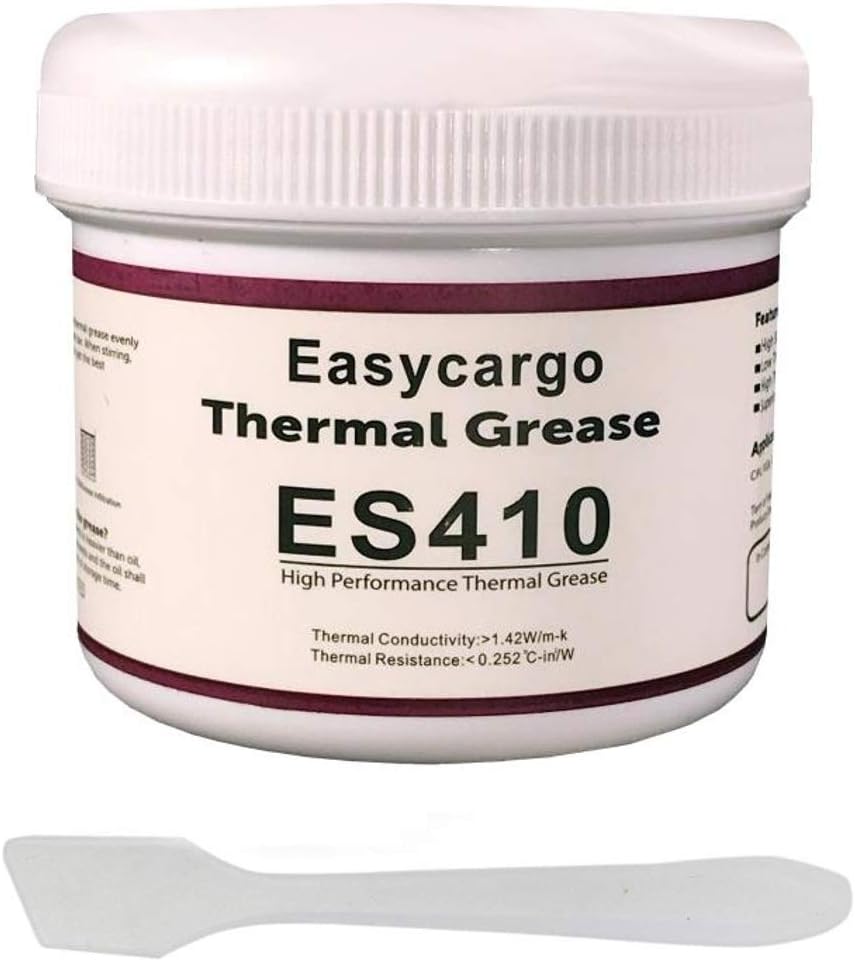
The Easycargo 200gr Thermal Paste Kit is a white silicone carbon compound intended for heat-sink interfaces, and it carries a 4.8 customer rating. Unlike many compact computer pastes, its defining feature is the large 200-gram package, making it a practical choice for technicians, builders, or enthusiasts who regularly service several devices.
We may earn a commission when you buy through this link, at no additional cost to you.
The listing supplies two useful performance figures: thermal conductivity above 1.42 W/m-k and thermal resistance below 0.252 k-in/W. It also gives a working-temperature range of minus 30 to 280 degrees Celsius. The stated applications include LEDs, CPUs, GPUs, IC chips, VGA equipment, and transistors, so the compound is positioned as a general interface material rather than a processor-only product.
The trade-off is that the available product information is less descriptive about chemical composition and long-term behavior than some competing listings. The title combines the word conductive with a white silicone carbon description, while the application bullets focus on thermal function without providing a detailed electrical-safety statement. Buyers who need explicit nonconductive assurances should verify the documentation for their specific application.
Easycargo makes the most sense when quantity and broad component compatibility matter. Its 200-gram format can serve repeated installations without frequent repurchasing, and the published conductivity, resistance, and temperature range allow more informed comparison with alternatives. It is a sensible choice for a workshop, a collection of electronics, or a builder who prefers a multifunctional silicone-carbon compound over a small enthusiast syringe.
A 200-gram container offers considerably more material than a small CPU-paste tube. That makes the kit more convenient for multiple computers, several graphics cards, and other heat-producing electronic components.
Published conductivity and thermal-resistance values make comparison more transparent. Combined with the stated minus 30 to 280-degree-Celsius working range, they provide a useful technical baseline for compatible assemblies.
We may earn a commission when you buy through this link, at no additional cost to you.
Arctic Silver 5 is a 3.5-gram silver-based thermal paste with a 4.8 customer rating. Its formula combines thermally enhanced ceramic particles with three distinct shapes and sizes of pure silver particles, an approach designed to improve physical contact between a processor core and the underside of a heatsink.
We may earn a commission when you buy through this link, at no additional cost to you.
The stated composition is 99.9 percent micronized silver, and the listing cites thermal conductance above 350,000 W/m² degrees Celsius with a 0.001-inch layer. The formula is also described as resistant to separating, running, migrating, or bleeding, which helps maintain a stable interface after installation.
The main practical consideration is that a metal-based compound should be applied carefully around exposed electrical contacts. Although the product is easy to apply and remove according to its listing, the metallic content makes careful placement more important than it would be with a clearly nonconductive paste. The 3.5-gram size is also modest, limiting the number of complete applications it can support.
Arctic Silver 5 suits builders who specifically want a silver formulation and value its published material composition and high stated conductance. It is a strong option for a carefully assembled desktop processor installation, provided the installer follows good handling practices and verifies compatibility with the processor and cooler. Those who prioritize explicitly nonconductive application should choose a metal-free alternative instead.
Using silver particles in three different shapes and sizes is intended to improve the microscopic contact between uneven surfaces. The design targets better conduction through a thin interface layer.
The listing specifically says the paste will not separate, run, migrate, or bleed. Those stability claims make it a familiar choice for users who want a traditional high-conductivity processor compound.
We may earn a commission when you buy through this link, at no additional cost to you.
G107 20g Silver Thermal Paste has a 4.7 rating and combines a silver thermal compound with a 20-gram container. Its stated conductivity above 3.17 W/m-k provides a more concrete performance figure than many general-purpose pastes, while the included spatula improves the basic installation experience.
We may earn a commission when you buy through this link, at no additional cost to you.
The listing identifies CPUs, GPUs, heatsinks, LEDs, ovens, chipsets, and other components as possible uses. It also describes the material as nonconductive, nontoxic, noncorrosive, tasteless, and resistant to high temperatures. Those claims make it versatile for projects beyond a standard desktop CPU, although specific compatibility should always be confirmed before applying an unfamiliar compound.
The main limitation is that no exact working-temperature range is provided, which makes the G107 harder to compare with products that publish both conductivity and temperature limits. Its 4.7 rating is also slightly below the 4.8 and 4.9 ratings attached to several alternatives, although that difference is small and should not be treated as a standalone measure of real-world performance.
G107 is a good middle ground for users who want a larger quantity than a small enthusiast syringe and a clearly stated W/m-k value. The 20-gram container can handle repeated work, while the supplied spatula and broad application list simplify general maintenance. Choose it when a versatile silver paste with a useful conductivity figure is more important than having the most detailed operating-range documentation.
The container size is more substantial than the 3.5-gram Arctic Silver 5 package and the four-gram ARCTIC MX-4 container. That makes G107 easier to stock for repeated installations or a collection of electronic projects.
The listed uses extend beyond processors and graphics cards to LEDs, chipsets, ovens, and other heat-producing parts. Buyers should still verify the manufacturer's guidance for any specialized equipment or sensitive assembly.
We may earn a commission when you buy through this link, at no additional cost to you.
MYQ058-100g is a 100-gram thermal grease with a stated conductivity above 5.8 W/m-k and a 4.6 customer rating. It is formulated with graphite and metal powders and is aimed at demanding heat-transfer applications involving CPUs, GPUs, printed circuit boards, and integrated circuits.
We may earn a commission when you buy through this link, at no additional cost to you.
Its specification sheet is among the most detailed in the group. The compound is stated to withstand more than 10,000 volts, retain low thermal resistance and consistent paste consistency, and operate continuously from minus 20 to 230 degrees Celsius. The listing also gives a transient range of minus 30 to 280 degrees Celsius and states that the product is SGS certified and RoHS compliant.
The concern is not the headline conductivity but the limited detail around some practical aspects. Although the listing presents the compound as providing high-voltage insulation, it also identifies metal powders in the formulation. Users should therefore follow the instructions carefully around exposed circuitry and confirm that the product is appropriate for their specific electrical arrangement. The 4.6 rating is the lowest in this group, though that should not be confused with a direct performance measurement.
MYQ058 is most attractive to technically informed buyers who value a high published conductivity figure, a large quantity, and documented compliance. It may suit experienced computer builders, repair technicians, and users with multiple heat-generating assemblies. Those who prioritize beginner-friendly handling, explicit nonconductive wording, or a shorter ingredient description may prefer one of the specialist pastes elsewhere in the guide.
The stated figure above 5.8 W/m-k leads the numerical conductivity claims in this selection. It is particularly interesting for users comparing large containers intended for processors, circuit boards, and other demanding components.
A continuous operating range of minus 20 to 230 degrees Celsius and a transient range up to 280 degrees Celsius provide useful limits. These figures help buyers assess whether the compound fits ordinary electronics or more demanding environments.
We may earn a commission when you buy through this link, at no additional cost to you.
HY-510-100g is a 100-gram package composed of four 25-gram containers of silicone thermal grease. It has a 4.6 rating, a stated conductivity above 1.93 W/m-k, and an explicitly nonconductive formula, making safety and straightforward installation central to its appeal.
We may earn a commission when you buy through this link, at no additional cost to you.
The compound is described as remaining soft and consistent for a long period, with stable performance from minus 30 to 280 degrees Celsius. Its listed uses include CPUs, GPUs, chipsets, radiators, and PS4 equipment. Being metal-free, it is presented as suitable for all types of heatsinks without the short-circuit concern associated with conductive materials.
Compared with higher-conductivity choices, its published figure is not especially aggressive, and the 4.6 customer rating is tied for the lowest in this selection. Those factors make it less compelling for buyers whose only goal is to maximize the headline number. On the other hand, stability, nonconductive behavior, and a broad temperature range may be more valuable for routine maintenance, repairs, and mixed-component inventories.
HY-510 is a practical choice for a user who values a large total quantity divided into four packs and wants the reassurance of an explicitly metal-free, nonconductive formula. The separate containers are convenient for storage and reduce the chance of unused paste sitting in a large opened container. It is well suited to general PC and console service when reliable installation and broad compatibility matter most.
The four 25-gram containers add convenience to the overall 100-gram quantity. Installers can keep portions sealed until needed, which is useful for occasional repair work or organized electronics maintenance.
An explicitly nonconductive, metal-free formula reduces the risk associated with accidental contact around exposed processor and graphics-card components. This makes installation less dependent on careful masking.
We may earn a commission when you buy through this link, at no additional cost to you.
G104 100g is a white silicone thermal grease with a 4.8 rating, a 100-gram container, and an included spatula. Its stated thermal conductivity above 1.63 W/m-k and thermal resistance below 0.249 degree-Celsius square inches per watt give shoppers useful comparative data at a glance.
We may earn a commission when you buy through this link, at no additional cost to you.
The compound is listed for CPUs, GPUs, heatsinks, ovens, chipsets, Xbox systems, and high-power LEDs. It is also described as high-temperature resistant, nonconductive, nontoxic, noncorrosive, and tasteless. These properties position it as a broad maintenance material for computer hardware and other electronics that generate heat.
The primary drawback is that the stated conductivity is lower than that of several other products in this comparison. The listing also omits a precise working-temperature range, so buyers with extreme-temperature requirements have less information to guide them. Nevertheless, the large quantity, included applicator, and 4.8 rating make G104 a well-rounded option for regular servicing work.
G104 is best for technicians, hobbyists, and owners of several electronic systems who want a generous amount of nonconductive silicone compound in one container. It is less likely to stand out when the objective is maximum published conductivity, but it can be the more practical selection when replacement frequency and application convenience are the priority. Verify compatibility for specialized equipment before use.
The 100-gram container supports repeated maintenance without requiring multiple purchases. It is especially convenient for users who service several computers, consoles, lighting assemblies, or other heat-generating electronics.
A silicone grease format and included spatula support a straightforward installation process. The compound's nonconductive and noncorrosive characteristics also make it less intimidating for routine electronics maintenance.
We may earn a commission when you buy through this link, at no additional cost to you.
Dow Corning 340 is a 142-gram, or five-ounce, white silicone heat-sink compound with a 4.9 rating, the highest customer rating in the selection. It is built for electrically sensitive assemblies and explicitly described as non-flowing, non-curing, low-bleed, and stable at elevated temperatures.
We may earn a commission when you buy through this link, at no additional cost to you.
The product is intended to couple electrical components, printed circuit boards, and heat sinks. Its technical details include thermal conductivity of 0.67 W/m-k, viscosity of 542,000 cP, density of 2.1 grams per cubic centimeter, dielectric strength of 210 volts per mil, and volume resistivity of 2 × 10¹⁵ ohm-centimeters. Those figures make it particularly compelling for industrial electronics, automotive equipment, and IGBT-related thermal interfaces.
Its 0.67 W/m-k conductivity is lower than every other numerical conductivity figure presented in this guide. That is acceptable when the priorities are a non-flowing interface, high insulation, temperature stability, and clean installation without curing, but it would be a poor choice for someone seeking a numerically aggressive computer thermal compound. The dense, high-viscosity silicone may also be less familiar than conventional syringe-applied paste.
Dow Corning 340 is the top choice for industrial, automotive, PCB, and IGBT applications where electrical isolation and predictable non-curing behavior are more important than maximum heat-transfer numbers. It is also a strong option for builders maintaining multiple systems because the five-ounce container is substantial. For ordinary enthusiast CPU cooling, a higher-conductivity noncuring silicone option may offer a more direct performance match.
Because the compound does not cure, it requires no oven or heat-curing step. It remains usable as a reworkable thermal interface, which is valuable for industrial service and repeated component replacement.
The stated dielectric strength, volume resistivity, and insulating silicone base make this compound suitable around sensitive circuitry. It also supports use in IGBT, automotive, compact electronics, and PCB assembly environments.
We may earn a commission when you buy through this link, at no additional cost to you.
Thermal Paste CPU 1.8g with Toolkit is a compact carbon-based compound for CPUs, GPUs, integrated circuits, and heatsinks. It has a 4.7 customer rating and is positioned as an accessible installation package, particularly for DIY builders who want the paste and basic application tools together.
We may earn a commission when you buy through this link, at no additional cost to you.
Its formula uses carbon microparticles and is described as metal-free and nonconductive, reducing the possibility of an accidental short circuit around exposed processor or graphics-card contacts. The listing also claims high thermal conductivity for rapid heat dissipation, although it does not provide a specific W/m-k figure. A stated durability period of at least five years adds a useful service-life expectation.
The 1.8-gram quantity is the clearest limitation. It may be sufficient for a single installation or a modest number of maintenance jobs, but it is not intended for users who repeatedly service multiple systems. The absence of a numerical conductivity specification also makes direct technical comparisons less precise than with compounds that publish measured values.
This paste is a sensible starting point for a first computer build, a routine cooler replacement, or a user who wants an easy-to-handle nonconductive option. The included toolkit reduces the need to source separate application supplies, while the carbon-based formula follows a familiar design used in well-regarded computer pastes. For repeated professional use, a larger container would be more economical.
The included toolkit supports a more organized installation, and the paste's ideal consistency is designed to remain approachable for beginners. These details reduce the learning curve around a basic cooler or processor installation.
The metal-free, nonconductive formula is particularly useful near the exposed contacts found on processors and graphics cards. It provides a sensible alternative to a conductive silver or metal-powder compound for cautious DIY installation.
We may earn a commission when you buy through this link, at no additional cost to you.
The right heatsink compound depends on the component being cooled, the surrounding electrical environment, the required service life, and the amount of material needed. Comparing formula type, published thermal data, stability, and application requirements prevents a purchase based solely on a headline conductivity number.
Thermal conductivity describes how readily the compound transfers heat, while thermal resistance represents the opposition to heat flow through the interface. When both values are available, use them together rather than treating either number as a complete performance verdict. Conductivity figures in this guide are not necessarily produced by identical methods, and application thickness, surface condition, mounting pressure, and cooler design all influence the result. The best option is still the one that creates a thin, complete, and stable interface between the two mating surfaces.
The main formula families include carbon-based pastes, silver and metal-powder compounds, ceramic-enhanced mixtures, and silicone thermal greases. Carbon-based formulas are often chosen for processor and graphics-card work because they can combine strong heat transfer with nonconductive behavior. Silver-based compounds may appeal to builders seeking established high-conductivity characteristics, but they require more careful placement around exposed contacts. Silicone greases prioritize insulation, flexibility, and non-curing service, making them especially relevant to industrial electronics, PCBs, IGBTs, and other electrically sensitive assemblies.
A compound that is explicitly nonconductive reduces the risk of a short circuit if it is placed imperfectly near exposed circuitry. That matters even in familiar desktop installations because CPUs and GPUs have small components and exposed areas around their heat-transfer plates. Metal-containing products can still be used successfully when applied carefully, but they demand more attention to masking and placement. Silicone compounds with published dielectric strength or volume resistivity are especially appropriate for PCBs, electrical devices, power components, and applications where an insulating interface is a core requirement.
A wide working range indicates that the compound is intended to remain functional across both cold and hot operating conditions. It does not guarantee that a product is suitable for every extreme environment, but it provides useful screening information. Industrial electronics, automotive equipment, ovens, power diodes, and other specialized assemblies may require more thermal margin than an ordinary desktop processor. Compare the stated continuous range with transient limits where both are supplied, and check manufacturer instructions before applying any paste outside a normal computer installation.
Thermal compound must remain spreadable, stable, and in full contact over time. Drying, hardening, separation, migration, bleeding, and flowing can all reduce performance. Some products in this guide emphasize remaining flexible, while others claim years of service or resistance to separating and running. Look for stability characteristics that match the planned service interval, and factor in the possibility that a processor or graphics card may be removed for an upgrade. Reusable or non-curing silicone can be convenient in systems that undergo repeated maintenance.
Good compound should spread into a thin, complete layer without excessive force or specialized equipment. A consistent texture, included spatula, and nonconductive formula can make a major difference for first-time installers. The best application method is still a small, controlled amount applied at the center of the mating surface, followed by even pressure from the heatsink. Avoid overapplication, which can make cleanup harder and may not improve transfer. For specialized equipment, follow any supplied instructions regarding surface preparation, curing, and electrical clearance.
Package size should reflect how often you expect to install it. A 1.8-gram or four-gram package is practical for a single build, while 20-gram, 100-gram, 142-gram, and 200-gram options suit technicians, collectors, and owners of multiple systems. Larger containers are not automatically better for every task, because a small sealed tube can remain fresh longer in occasional-use households. Multi-container packs offer a compromise by providing bulk while allowing only the amount needed to remain open. Always keep unused compound sealed, clean, and stored as directed.
Start with the component and environment rather than the paste alone. Processor and GPU users generally need a thin, stable, nonconductive interface; LED and power-device assemblies may place greater emphasis on dielectric protection; PCB and IGBT assemblies can benefit from a non-flowing silicone; and industrial equipment may require a documented temperature range. Heatsink design, mounting hardware, surface finish, and operating load all influence the final result. Review the included compatibility and application instructions rather than assuming every thermal paste is interchangeable in every environment.
Before application, power the system down, disconnect its power source, discharge any residual energy according to the equipment instructions, and remove the cooler. Clean the old compound from both the heat-transfer surface and the heatsink base with a suitable lint-free material and cleaning agent. Allow the surfaces to become completely dry, since residue or moisture can interfere with the thermal interface and make later disassembly more difficult.
Open the compound and inspect it for contamination. For a conventional processor installation, apply a small, pea-sized amount at the center of the heat-transfer plate. Lower the heatsink straight down without twisting it, then secure the mounting hardware evenly and in the manufacturer's recommended sequence so that pressure is distributed across the interface. Avoid touching exposed electrical contacts, and do not add more compound simply because a small amount looks sparse before the cooler is fully seated.
After installation, let the computer run under a controlled load while monitoring CPU or GPU temperatures, but do not interpret a single peak reading as a complete comparison. Record stable temperatures under the same workload and cooling configuration when evaluating a new compound. When servicing the system later, remove the cooler gently, clean away the old material, inspect the mating surfaces, and apply a fresh thin layer if the compound has been disturbed, contaminated, or degraded.
No. A thin, complete layer is usually sufficient because excess paste can squeeze out unevenly and make cleanup harder. The amount should be enough to cover the intended interface after the heatsink is seated, not enough to overflow onto surrounding components. Follow any product-specific instructions when a manufacturer has supplied them.
A compatible general-purpose thermal compound can often be used between a graphics processor and its heatsink. Confirm that the compound is suitable for the component and that it is not electrically conductive if exposed contacts are nearby. Specialized modules such as VRAM chips and power components may have different thermal requirements.
A paste change is not automatically required during every cleaning. It is sensible if the cooler is being removed, the old material appears disturbed or contaminated, or the system is being assembled for the first time. Stable non-curing silicone compounds can be particularly convenient for repeatable maintenance, though all instructions should still be followed.
Nonconductive paste is formulated so it does not create an electrical path, which reduces the risk of a short circuit near exposed contacts. Metal-based compounds can provide strong heat transfer but require more careful placement and cleanup. A compound's formula, application method, and equipment requirements should determine which is appropriate.
Fresh, correctly applied paste can restore the thermal interface, but it cannot overcome a failing fan, blocked radiator, poor cooler mounting, inadequate case airflow, or excessive heat generation. Compare temperatures under a similar workload after checking that the cooling hardware and airflow are also operating correctly.
Silicone thermal compounds can be well suited to industrial, automotive, PCB, and IGBT applications because many formulas remain flexible, do not cure, and provide strong electrical insulation. Verify the operating-temperature range, viscosity, dielectric properties, and device-specific requirements before selecting a product.
Keep the container tightly sealed, clean, and away from prolonged direct sunlight or solvents. Store it in a cool, dry place and observe the stated shelf life. Avoid transferring used material back into the original container, because contamination can impair future applications.
Not always. Conductivity is only one part of the thermal system, and published figures may be measured under different conditions. Heatsink design, contact area, mounting pressure, paste thickness, workload, ambient temperature, and airflow can all have a major effect. The compound still needs to be stable, electrically appropriate, and correctly installed.
ARCTIC MX-4 stands out as the most balanced recommendation for general computer use because it combines carbon-based heat transfer, nonconductive handling, easy application, and a strong durability claim. Thermal Paste CPU 1.8g with Toolkit offers an accessible alternative for first-time builders, while Dow Corning 340 is the premium choice for industrial, automotive, PCB, and IGBT applications that prioritize insulation and stable non-curing behavior.
For a standard CPU or GPU, prioritize a formula that is compatible with the component, thin enough to spread cleanly, stable for the expected service interval, and appropriate around exposed contacts. A published conductivity value is useful, but it should not replace careful application or correct cooler mounting. For specialized electronics, dielectric strength, operating range, viscosity, and non-flowing behavior may matter more than a high general-purpose conductivity number.
Before buying, verify the current product listing, package size, ingredient information, and manufacturer guidance. Ratings, availability, and prices can change, and the right selection may ultimately depend on the number of installations required as much as on the specifications. Use the comparison table to narrow the field, then choose the compound whose thermal and electrical properties match the specific job.