
maxsun GeForce RTX 3050 6GB
4.3Editor score
Slim low-profile construction
6GB GDDR6 video memory
PCI Express 4.0 interface
HDMI 2.1 and DisplayPort
This GPU for Optiplex guide compares 10 compact graphics cards for gaming, professional work, media tasks, and multi-monitor setups.
Finding a GPU for an Optiplex desktop requires more than comparing chip performance. Case dimensions, bracket style, power limits, cooling clearance, display connectors, and the capabilities of the host system all influence whether a card will work comfortably. A compact, low-profile design is especially important in many Optiplex cases.
This guide compares ten qualifying-style graphics cards listed for compact Optiplex applications, covering gaming, design, video, visualization, and general display use. The comparison considers memory, processor architecture, clock speed, output configuration, power requirements, physical design, and relevant professional or media capabilities without implying that every model fits every Optiplex chassis.
Each review explains the most suitable use for the card and calls out the compromises that matter when building or upgrading a compact business system. Ratings reflect the supplied customer feedback, while specifications and compatibility can change with revisions or system configurations. Availability and current pricing should always be checked before ordering.
4.3Editor score

4.7Editor score
4.6Editor score
The table below compares the ten cards by architecture, memory, physical format, display support, and intended workload, making it easier to identify the most appropriate option for a particular Optiplex configuration.


The maxsun GeForce RTX 3050 6GB is a compact NVIDIA gaming card built around the Ampere architecture, and it holds a 4.3 customer rating. Its defining advantage for an Optiplex build is the stated slim low-profile design measuring 6.65 by 2.71 inches. That makes it one of the more compelling options for compact desktop cases where a full-height, multi-fan card would be difficult to install.
We may earn a commission when you buy through this link, at no additional cost to you.
Memory is one of the card's strongest specifications. The 6GB of GDDR6 connected through a 96-bit interface provides a useful balance for 1080p gaming, light content creation, and applications that benefit from more dedicated graphics memory than a basic display card. The listed 1042MHz core clock and 1470MHz boost clock also position it as a mainstream performance card rather than an entry-level display adapter.
Display support is modern for a small system. HDMI 2.1 and DisplayPort 1.4a provide flexible connections for high-resolution monitors, and the supplied information states that the card supports 8K output and multiple monitors. Its PCI Express 4.0 interface can also be useful in Optiplex systems with compatible slots, although the exact physical clearance, auxiliary power needs, and slot arrangement must be confirmed for the particular chassis.
This is the pick for a buyer who wants more gaming capability than an office card without moving to a large dual-fan desktop. It is also a sensible option for a compact Optiplex used for gaming, photo work, or general graphics acceleration. Before buying, check the card length, height, slot width, power requirements, and whether the included bracket matches the case.
The stated 6.65-inch length and low-profile construction directly address the space limitations of many compact Optiplex systems. It remains important to compare those dimensions with the available chassis depth because a low-profile card can still exceed the room available behind the drive cage or other internal components.
The 6GB GDDR6 configuration gives this model a useful foundation for mainstream gaming and graphics applications, while HDMI 2.1 and DisplayPort 1.4a simplify modern monitor connections. The included multi-monitor and high-resolution claims should still be checked against the specific outputs and resolution modes required by the intended display setup.
We may earn a commission when you buy through this link, at no additional cost to you.
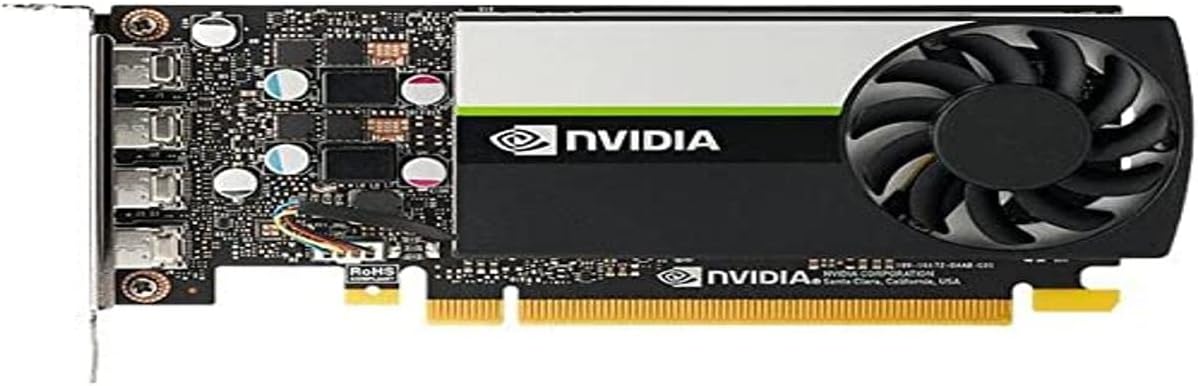
The PNY NVIDIA T600 is a professional graphics card for business visualization, design, media, and large desktop arrangements. Its 4.6 rating reflects a favorable customer reception, while the Turing architecture and professional software support distinguish it from consumer gaming cards. It is particularly attractive when the Optiplex will drive several high-resolution displays rather than a single monitor.
We may earn a commission when you buy through this link, at no additional cost to you.
The supplied specifications state that T600 can support up to four 5K displays or two 8K displays per card. DisplayPort 1.4 is the central output standard, and multiple T600 cards can be combined in suitable systems to create display walls or other immersive environments. That makes the card relevant to digital signage, visualization, CAD, and enterprise display configurations where output density matters more than gaming frame rates.
Media handling is another strong point. Dedicated decode and encode engines operate independently of the graphics and compute pipeline, with support for H.264 and HEVC creation and playback. Compatibility with current OpenGL, DirectX, Vulkan, and CUDA standards, combined with certification across more than 100 professional applications, gives IT departments and creative users more confidence than a purely consumer-oriented card.
Choose T600 for a professional Optiplex that needs reliable multi-display support, certified applications, or dedicated media processing. It is not the logical selection for a gaming-focused build because the product is designed around professional workflows. Confirm card dimensions, bracket arrangement, slot access, and system support before committing to a multi-card configuration.
The ability to drive multiple 5K displays or two 8K displays makes T600 a strong candidate for financial, engineering, media, and signage environments. The exact display configuration depends on the attached monitors, operating system, cables, and whether additional cards are installed.
Separate H.264 and HEVC decode and encode engines can be especially valuable in video-focused business systems. Because those engines are independent of the 3D graphics and compute pipeline, media work can remain efficient while professional graphics applications are also active.
We may earn a commission when you buy through this link, at no additional cost to you.
The PNY Nvidia RTX A400 4GB GDDR6 is the most versatile professional card in this roundup for compact Optiplex systems. It carries a 4.7 rating, uses NVIDIA's Ampere architecture, and provides 768 CUDA cores. More importantly for small machines, the product is explicitly designed as a single-slot, low-profile graphics card with a stated 50W power consumption.
We may earn a commission when you buy through this link, at no additional cost to you.
Its four Mini DisplayPort 1.4a outputs can support as many as four 5120 by 2880 displays at 60Hz, according to the supplied information. That makes it a natural upgrade for professional video editing, 3D modeling, visualization, and business workflows that benefit from multiple high-resolution screens. The single-slot layout is also more convenient in cases where a two-slot cooler would obstruct adjacent expansion slots.
The card provides 4GB of GDDR6 memory and support for AI, ray tracing, modeling, video production, and 3D rendering. Its 50W operating target is a meaningful advantage in business desktops with limited power headroom. Nevertheless, the host system must provide a compatible slot, adequate power delivery, and the correct physical space, including clearance for the cooler and display bracket.
This is the recommendation for a compact professional Optiplex that needs modern graphics capabilities and several displays without moving to a large workstation card. It also works for users who need more modern architecture than older Quadro models provide. The main compromises are the modest 4GB memory capacity and the need for suitable Mini DisplayPort displays or adapters.
Combining a single-slot low-profile design with 768 CUDA cores is particularly useful in compact business desktops. The stated 50W power requirement also helps preserve upgrade headroom, provided the Optiplex power supply and motherboard can support the card.
Four Mini DisplayPort 1.4a connectors provide a strong foundation for multi-monitor professional setups. The supplied specification lists support for four 5120 by 2880 displays at 60Hz, making display adapter quality an important part of the final installation.
We may earn a commission when you buy through this link, at no additional cost to you.
The ASUS Dual GeForce RTX 3050 6GB OC Edition is a two-slot gaming card with a 4.7 rating, giving it one of the strongest customer-feedback results in the list. It uses NVIDIA's Ampere architecture and combines 6GB of GDDR6 memory with a 1500MHz boost clock in OC mode. Its default boost clock is listed at 1470MHz.
We may earn a commission when you buy through this link, at no additional cost to you.
The GPU includes second-generation RT cores, third-generation Tensor cores, and Ampere streaming multiprocessors. The supplied information highlights up to twice the Tensor Core throughput with structural sparsity and advanced AI algorithms such as DLSS. For gaming, these features can improve frame-rate headroom, ray-tracing performance, and image quality depending on the game and settings.
The main Optiplex consideration is physical. Unlike a single-slot or explicitly slim card, this model uses a two-slot design, and the listing does not identify it as low profile. The axial-tech fan design, smaller fan hub, and barrier ring are intended to improve downward airflow and cooling, but the card must have enough slot and depth clearance. A small Optiplex case may require a different model or a larger chassis.
This option is best for a compact-but-not-tiny Optiplex that can accept a two-slot card and prioritizes gaming performance and feature support. It is well suited to users who want DLSS, ray tracing, and 6GB of memory. Verify the card length, height, bracket, and required power before ordering, since the supplied data does not confirm low-profile clearance.
Third-generation Tensor cores provide the hardware foundation for DLSS, while second-generation RT cores improve ray-tracing throughput. These features are most useful in modern games that expose the relevant graphics options and have enough memory and system processing power to take advantage of them.
The axial-tech fan system is intended to move air more effectively through the two-slot cooler. The stainless steel bracket adds rigidity, while the stated IP5X dust-resistance rating provides environmental durability, although neither feature changes the need to verify case clearance.
We may earn a commission when you buy through this link, at no additional cost to you.
The msi Gaming GeForce GT 1030 4GB DDR4 OC is an entry-level card aimed at adding dedicated graphics and multi-monitor capability to a compact office desktop. It has a 4.5 rating, a single-fan low-profile designation, 4GB of DDR4 video memory, and a 1430MHz boost clock. It is better viewed as a display and light-graphics solution than a serious gaming upgrade.
We may earn a commission when you buy through this link, at no additional cost to you.
The memory interface is 64 bits, which is much narrower than the 96-bit interface used by the RTX 3050 cards in this guide. That limitation makes GT 1030 less suitable for demanding 3D games, high-detail rendering, and memory-heavy creative work. It remains useful for office productivity, browser-based content, video playback, and systems that need more than one display when integrated graphics are not sufficient.
Display connectivity is straightforward: one DisplayPort 1.4a and one HDMI 2.0b output. The card also lists HDCP support and DirectX 12 capability. The low-profile model naming is positive for Optiplex compatibility, but buyers should still confirm the exact card length, slot width, bracket style, and whether the power supply can provide a stable auxiliary connection if one is required.
Choose the GT 1030 when the priority is inexpensive graphics output in a small business PC rather than high frame rates. It is a reasonable option for a front-office computer, digital display, or basic workstation that needs dedicated multi-screen support. Gamers should move toward an RTX 3050, while users handling complex professional applications should consider a modern workstation card.
GT 1030 can be useful when an Optiplex relies on integrated graphics but needs dedicated output for a second monitor or a more demanding display application. Its four gigabytes are helpful for desktop textures and general graphics tasks, even though the narrow memory bus limits heavier workloads.
One DisplayPort and one HDMI output make the card straightforward to configure with a typical office monitor arrangement. The user should check whether the system requires any adapters and whether the available outputs satisfy the intended monitor resolutions and refresh rates.
We may earn a commission when you buy through this link, at no additional cost to you.
The GIGABYTE GeForce RTX 3050 WINDFORCE OC V2 6G is a conventional dual-fan gaming card with a 4.6 rating. It combines 6GB of GDDR6 memory with a 96-bit interface and NVIDIA Ampere architecture. That specification places it in the same broad performance class as the other RTX 3050 models, making it a candidate for gaming, streaming, and light creative work.
We may earn a commission when you buy through this link, at no additional cost to you.
The card includes Ampere streaming multiprocessors, second-generation RT cores, and third-generation Tensor cores. These components support the modern RTX feature set, including hardware-assisted AI functions such as DLSS and improved ray-tracing capability in compatible games. The WINDFORCE cooler uses two fans, which can be useful in systems with adequate airflow and a case that accepts a larger graphics card.
Physical fit is the decisive concern for an Optiplex. The supplied product information does not identify the card as low profile or list its dimensions. A dual-fan model may require more depth and slot width than a mini-ITX-style card, and some Optiplex chassis place the power supply or drive cage directly beside the expansion area. A physically larger case with a full-length slot opening is more likely to suit it.
This GPU is a good match for a small-form-factor Optiplex that can accept a conventional dual-fan card, or for a larger Optiplex case where cooling and gaming performance matter. It offers a strong balance of memory, modern graphics features, and favorable customer feedback. Confirm chassis dimensions, auxiliary power, and the correct mounting bracket before purchase.
Second-generation RT cores and third-generation Tensor cores give the card current-generation capabilities for supported games and applications. DLSS can provide additional performance headroom, but results depend on the title, graphics settings, display resolution, and available system resources.
Two WINDFORCE fans can help maintain cooler operating temperatures in a suitably ventilated case. The tradeoff is that the larger thermal assembly is less likely to fit the tightest Optiplex cases, making enclosure dimensions a more important check than with a slim single-fan card.
We may earn a commission when you buy through this link, at no additional cost to you.
The msi Gaming RTX 3050 LP 6G OC combines a low-profile design with 6GB of GDDR6 memory, making it one of the most relevant RTX 3050 choices for a compact Optiplex. It carries a 4.5 rating and operates at a listed 1492MHz boost clock with 14Gbps memory. The 96-bit memory interface matches the broad memory configuration used by several other cards in this comparison.
We may earn a commission when you buy through this link, at no additional cost to you.
Its display configuration includes one DisplayPort 1.4a and two HDMI 2.1a outputs, offering practical flexibility for one, two, or three monitors. The card uses NVIDIA's Ampere architecture, bringing the RTX family into a compact enclosure without moving to the older GT 1030 class. That makes it useful for gaming, general graphics acceleration, and compatible applications that benefit from modern GPU features.
The low-profile designation is the main attraction, but the card still needs to satisfy several installation requirements. Buyers should compare the exact dimensions with the available clearance, determine whether the correct bracket is supplied, and confirm that the power supply can support the card's auxiliary power needs. Low profile describes height, not necessarily how much depth the card consumes.
Choose this model when a compact Optiplex has room for a low-profile RTX 3050 and you want more performance than a basic display adapter. The 6GB memory configuration and three outputs make it well suited to gaming and multi-monitor productivity. For users who need a professional certification or substantially higher multi-display bandwidth, the T600 or RTX A400 may be a better direction.
The low-profile model brings Ampere-based RTX performance into a format intended for smaller cases. It is particularly useful when a system requires a dedicated gaming or graphics card but cannot accept the height of a standard desktop graphics card.
Two HDMI 2.1a ports and one DisplayPort 1.4a output provide enough connectivity for a multi-monitor arrangement. The display adapters in the box, if any, and the exact maximum resolutions should be checked for the planned monitor configuration.
We may earn a commission when you buy through this link, at no additional cost to you.
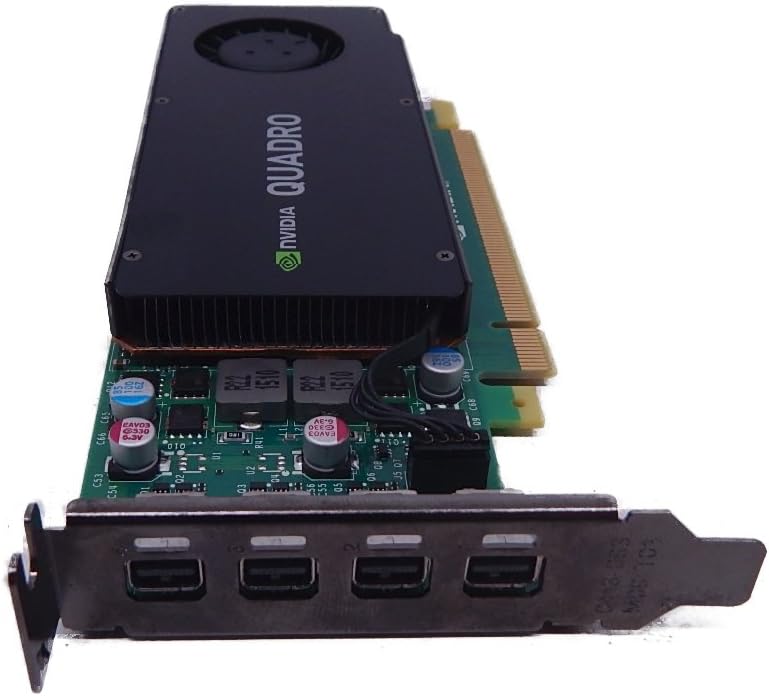
The PNY Quadro K1200 Low Profile is a professional display card for older compact workstations that need multiple outputs and dedicated memory. It has a 4.4 rating, four Mini DisplayPort 1.2 connectors, a low-profile form, and a three-year warranty. Its strengths are compact multi-monitor support and a straightforward professional role rather than modern gaming performance.
We may earn a commission when you buy through this link, at no additional cost to you.
Quadro K1200 is designed for 3D applications and professional workflows, with the supplied information describing it as offering strong compact 3D performance. Four Mini DisplayPort outputs make it attractive for a control room, financial desk, CAD station, or other environment that needs multiple monitors. The 4GB of GDDR5 memory is more substantial than the memory found in many basic display adapters.
The PCI Express 2.0 x16 interface is compatible with many older business systems, which may be valuable when upgrading an Optiplex generation that has limited expansion options. However, the older platform cannot provide the throughput or modern feature set of PCIe 4.0 products. Gaming performance, AI acceleration, and the newest professional rendering features are not the main strengths of this card.
Buy the K1200 when you have an older professional Optiplex, need four Mini DisplayPort outputs, and value a low-profile form. It is less appropriate for a new gaming build or for users needing DLSS, modern ray tracing, or current-generation compute performance. Confirm monitor connector requirements and physical dimensions before ordering.
Four Mini DisplayPort 1.2 connectors provide a high output count without requiring multiple cards. This is useful for compact desks where display space is limited and every monitor connection must be handled by one professional graphics card.
The older PCI Express interface and low-profile construction make this a realistic option for legacy business desktops that cannot use newer workstation cards. Its value comes from dependable professional display functionality rather than high-end 3D performance.
We may earn a commission when you buy through this link, at no additional cost to you.
The NVIDIA Quadro P1000 Professional is a low-profile workstation card that delivers a strong combination of compactness and professional display capability. It has a 4.5 rating, 4GB of GDDR5 memory, and NVIDIA Quadro Pascal architecture. The supplied information describes it as a power-efficient solution for demanding professional applications in small-form-factor workstations.
We may earn a commission when you buy through this link, at no additional cost to you.
Its headline display capability is support for an expansive workspace of up to four 4K displays. The product information also cites 4K and 5K display support and extensive independent software vendor certification. Those characteristics make the P1000 relevant to CAD, design, visualization, and other professional applications where stable driver support and multi-screen operation are more important than consumer gaming features.
The card's low-profile construction is well suited to compact business desktops, but the supplied data does not provide exact length, height, connector count, or auxiliary-power requirements. The buyer should therefore check the standard Quadro P1000 product details and the host chassis before purchasing. Its older Pascal generation also means it lacks the newest Ampere, Ada, and Blackwell features found in more recent professional cards.
This is a worthwhile upgrade for an older Optiplex workstation used for design, engineering, visualization, or multiple 4K monitors. It may be especially attractive where low-profile professional certification matters more than gaming. Users starting from scratch with a modern system may get better longevity from a newer professional card, but this model can extend the useful life of compatible business hardware.
Support for up to four 4K displays makes the P1000 useful for professional workspaces that need detailed information visible across several panels. The exact configuration still depends on the operating system, driver, cables, and the outputs included with the specific card.
The extensive ISV certification highlighted in the product information signals a focus on professional applications rather than general desktop graphics. For organizations that standardize on certified applications and operating systems, that support can be as important as raw performance.
We may earn a commission when you buy through this link, at no additional cost to you.
The NVIDIA Quadro K1200 DVI card is a legacy-oriented professional graphics option for Optiplex systems that use DVI displays. Its 4.2 rating is the lowest among the ten products, but the underlying combination of a Quadro K1200 processor, 4GB of GDDR5 memory, and PCI Express 2.0 x16 remains relevant for specific business environments.
We may earn a commission when you buy through this link, at no additional cost to you.
The principal reason to choose this model over the similarly named Quadro K1200 low-profile card is display compatibility. Its DVI-oriented configuration can be useful with older monitors, projectors, diagnostic displays, or specialized equipment that lacks modern digital inputs. It also provides dedicated graphics memory, which can be preferable to relying entirely on integrated graphics for supported business tasks.
The limitations are substantial for a new build. Quadro K1200 belongs to an older generation, so it does not offer the current RT, Tensor, and DLSS capabilities found in the RTX 3050 options. The card also lacks the multi-display specifications detailed for the PNY Quadro K1200 DP version, and the supplied data does not confirm its exact dimensions or low-profile status.
This card is best for a legacy Optiplex upgrade where DVI is required or an existing professional workstation already uses the Quadro K1200 platform. It is not recommended for modern gaming, AI workloads, or demanding 3D rendering. Before buying, verify bracket style, card height and length, display connectors, power requirements, and operating-system support.
The DVI-focused configuration gives the card a clear purpose in installations that cannot use DisplayPort or HDMI. This is particularly relevant to older offices, labs, and industrial environments where existing display equipment is already installed.
The card provides dedicated Quadro graphics and 4GB of memory for compatible legacy workflows, but modern features and performance are limited. Users who can accommodate contemporary connectors will usually find more flexibility in one of the newer RTX 3050 or professional RTX options.
We may earn a commission when you buy through this link, at no additional cost to you.
The right GPU for an Optiplex depends on chassis clearance, expansion capability, power headroom, display needs, and workload. Use the following factors to narrow the field before checking current listings and exact manufacturer dimensions.
In practice, single-slot and explicitly slim cards offer the safest starting point for the tightest systems. Two-slot dual-fan models require more lateral room and better airflow. Measure the chassis rather than relying only on the model name.
PCI Express 4.0 cards can operate in older compatible PCIe slots, but their available bandwidth may be reduced. The goal is a card that both fits physically and is supported by the host system.
The RTX A400's stated 50W consumption and the low-profile focus of several alternatives can be valuable in business systems. A safe upgrade should match the card to the manufacturer's guidance for the exact Optiplex model.
Choose based on the software and output needs rather than on the product name alone. A certified workstation card can be more appropriate for professional applications even when it offers fewer gaming features.
Avoid judging graphics performance from memory capacity alone. Memory type, bus width, architecture, software, and the intended resolution all influence the result.
Choose enough outputs for the intended arrangement without paying for unused capacity. For a four-monitor professional desk, the Quadro K1200 DP, Quadro P1000, or RTX A400 may be more natural than a two-output gaming card.
Avoid forcing a larger card into a restricted case if it blocks airflow or sits too close to a drive cage. A clean fit and unobstructed cooling path matter more than fan count alone.
A simple compatibility check can prevent expensive problems after installation. Include the system model, Windows or Linux version, target applications, and planned monitors in the purchase decision.
Before installing a GPU, power down the Optiplex, disconnect the power cable, and use the manufacturer's procedures for opening the specific chassis. Remove the expansion-slot covers only after confirming that the card's height, length, and slot arrangement fit. Install the appropriate low-profile or full-height bracket, attach any required auxiliary power cable, and seat the card firmly in the PCIe slot.
After installation, boot the system and install the graphics driver recommended for the card and operating system. Connect monitors to the outputs on the new card rather than the motherboard's integrated graphics port. Use the supplied or validated display adapters, arrange the displays in the operating system's display settings, and confirm the intended native resolution and refresh rate.
For longer service life, keep the card and intake paths free of dust, maintain airflow around the Optiplex, and avoid leaving the system in a confined space where heat cannot escape. For professional or compute-heavy use, follow the application's guidance for driver versions and memory limits. Never open the card or alter its cooler, and avoid using the compact system while a diagnostic light indicates an unresolved installation or power issue.
No. Optiplex cases vary considerably in size, expansion-slot layout, bracket style, and available clearance. A card marked low profile may still be too long for a particularly compact model, while a two-slot dual-fan card may require a larger chassis. Always check the exact Optiplex model, internal dimensions, slot width, and mounting bracket before ordering.
It is strongly recommended for many compact Optiplex systems because full-height cards can encounter the case lid, drive cage, or power supply. A low-profile model solves only the height issue, so depth, slot width, connector position, and power clearance must also be checked. Larger Optiplex towers may accept standard-height cards without difficulty.
It depends on the motherboard, operating system, power supply, and physical case design. PCIe compatibility allows many modern cards to operate in older slots, but older platforms may have limited driver support or power headroom. The manufacturer guidance for the exact system model is the best source for upgrade limitations.
The maxsun and msi RTX 3050 LP models are the most natural starting points because they combine 6GB of GDDR6 with compact or low-profile construction. The ASUS and GIGABYTE RTX 3050 models provide similar memory and modern RTX features, but their two-fan coolers may require more room. Actual performance also depends on the processor and the specific Optiplex generation.
The RTX A400, Quadro K1200 DP, Quadro P1000, and NVIDIA T600 are stronger candidates because their professional positioning and multiple display outputs suit productivity, visualization, and enterprise desks. The T600 supports especially high display configurations, while the RTX A400 combines four Mini DisplayPort outputs with a single-slot low-profile design and a 50W stated power requirement.
Some low-profile cards draw entirely from the motherboard, while others require an auxiliary power connection. The supplied information does not confirm the connector requirement for every model, so check the product listing and manufacturer specifications. Also verify that the Optiplex power supply includes the appropriate cable and has sufficient capacity.
It depends on the selected card and monitor. The Quadro K1200 DVI option is specifically oriented toward legacy DVI equipment, while the DP and Mini DisplayPort professional cards require compatible cables or adapters. Check the output connectors before purchase, and avoid unverified adapters when display resolution, refresh rate, or HDCP behavior is important.
Choose a workstation card when the system runs certified professional applications, requires dependable multi-monitor operation, or benefits from professional driver support. Choose a gaming-oriented RTX 3050 when the main goal is graphics performance, modern gaming features, or a balanced upgrade for mixed personal and business use. Certification and workload should take priority over gaming-oriented specifications.
The PNY Nvidia RTX A400 4GB GDDR6 stands out as the most balanced professional choice because it combines a single-slot low-profile design, four Mini DisplayPort outputs, 768 CUDA cores, and a stated 50W power requirement. The maxsun GeForce RTX 3050 6GB is a compelling compact gaming option, while the PNY NVIDIA T600 is the stronger premium selection for professional multi-display and visualization work.
For tighter cases, the msi GeForce GT 1030 4GB DDR4 OC and msi Gaming RTX 3050 LP 6G OC deserve attention, but the latter delivers the more capable modern architecture. The ASUS and GIGABYTE RTX 3050 models make sense when the Optiplex enclosure can accept a larger two-fan card. The older Quadro products remain relevant for legacy DVI, multi-screen, and certified professional use cases.
Before buying, verify the exact Optiplex model, case dimensions, expansion slots, bracket, power supply, operating-system support, and required display connections. Product availability and current prices change over time, so check the latest listing and manufacturer information at the time of purchase. The right card is the one that fits the enclosure, powers the system safely, supports the required software, and satisfies the monitors.