
BESTEK 300W Car Plug Adapter
4.5Editor score
300W continuous power
Two AC and two USB ports
Compact aluminum housing
Explore the best 300W car power inverter options, comparing power output, ports, safety features, vehicle compatibility, build quality, and ideal travel uses
A 300W car power inverter turns a vehicle’s 12V DC outlet into household-style AC power, making it useful for laptops, cameras, game consoles, small appliances, and other travel electronics. The best models balance clean output, useful ports, dependable protection, portable construction, and compatibility with the power demands of a modern vehicle.
This guide compares ten inverters based on stated continuous output, waveform quality, charging options, safety protections, cooling, connection methods, and portability. It includes models designed for cigarette-lighter sockets as well as options with battery clamps, helping readers distinguish convenient low-draw models from more capable travel power stations.
The selections reveal different strengths: some prioritize pure sine wave output, others offer extensive USB charging, and several focus on compact everyday use. Ratings and specifications reflect the supplied product information, while design details and product availability can change. Check current listings and vehicle requirements before purchasing.
4.5Editor score

4.5Editor score

4.5Editor score
The comparison covers output type, connection method, charging ports, protective features, and physical design, helping you identify the inverter that best matches your vehicle and travel equipment.



The BESTEK 300W Pure Sine Wave PD30W is a well-rounded travel inverter with a 4.5 rating and a strong balance of output quality, charging flexibility, and vehicle compatibility. It converts a vehicle’s 12V system to 110V AC, supplies 300W continuously, and offers 700W of peak power for brief startup surges.
We may earn a commission when you buy through this link, at no additional cost to you.
Its pure sine wave output is the standout feature for sensitive or inductive electronics, while two AC outlets accommodate standard household-style plugs. The USB-C PD30W and USB-A QC18W ports add convenient charging for compatible phones and tablets. An 11–17V input range broadens compatibility beyond traditional 12V vehicles, and the stated 24-inch cable adds placement flexibility.
Thermal management is handled by a fan that adjusts its speed to load and temperature rather than running constantly at maximum speed. A built-in 40-amp fuse and protections for short circuits, excessive voltage, under-voltage, and overheating support dependable operation. The trade-off is that the cigarette lighter and vehicle wiring must remain within their safe current limits.
This is a strong choice for road trips, mobile work, camping, and travelers who want both AC power and modern fast charging. It is especially attractive for users with newer vehicles that may operate above the conventional 12V input level. Buyers who routinely approach the 300W ceiling should account for the connected load rather than treating surge capacity as continuous capacity.
Pure sine wave output is smoother than a basic modified waveform, making this inverter better suited to electronics sensitive to electrical noise. That benefit is especially relevant for audio, measurement, medical, and other precision equipment, although each device should still be checked for power and startup requirements.
The PD30W USB-C and QC18W USB-A outputs let the inverter serve as both an AC adapter and a charging hub. This reduces the number of accessories required for a mobile office or family travel kit while keeping compatible devices connected to the vehicle's electrical system.
We may earn a commission when you buy through this link, at no additional cost to you.
This BESTEK Pure Sine Wave model carries a 4.5 rating and combines a 300W continuous rating with an 11–17V input range. It is designed for users who want smoother AC output and compatibility with vehicles whose accessory systems may not sit at exactly 12V.
We may earn a commission when you buy through this link, at no additional cost to you.
Two AC outlets provide flexibility for simultaneous use, while two intelligent USB-A ports can deliver up to 2.4 amps per port and 4.8 amps in total. The pure sine wave is appropriate for electronics that benefit from a smooth supply, and the stated 700W peak capacity gives connected equipment room for startup transients.
Protection features include a 40-amp fuse along with safeguards for overload, overheating, under-voltage, over-voltage, short circuits, and overcharging. Vent placement and the smart fan aid heat dissipation. Its main limitation is that the older USB-A charging format does not offer the USB-C Power Delivery convenience of several newer competitors.
The inverter is a practical choice for everyday road travel, camping, and extended vehicle-based work. Buyers should keep continuous loads appropriate for the connection method and check the vehicle socket before operating higher-draw equipment. For owners of newer energy vehicles, the broad input range adds meaningful flexibility.
An 11–17V acceptance range is useful because modern vehicles may use higher accessory voltages than older 12V systems. Confirm that the inverter's range covers the output from the exact outlet you plan to use, particularly if accessories behave differently while the engine is running.
Two household-style AC outlets allow a laptop and another powered device to share the inverter when the combined load remains within its continuous capacity. This makes the unit more useful for mobile offices than a single-outlet alternative.
We may earn a commission when you buy through this link, at no additional cost to you.
The BESTEK Compact Car Adapter is an approachable all-purpose option with a 4.5 rating. It delivers 300W continuously and 700W at peak while presenting a compact body intended to fit easily into a travel bag, console, or glove box.
We may earn a commission when you buy through this link, at no additional cost to you.
Two 110V AC outlets support laptops, tablets, and other compatible electronics, and two USB ports provide up to 4.8A for USB devices. Its 11–17V compatibility, 32-inch cable, and broad protection suite make it adaptable to common road-trip and camping routines without adding a large battery bank.
The aluminum housing is designed to withstand ordinary bumps and drops, while a temperature- and load-responsive fan keeps noise lower during lighter operation. A 40-amp fuse and safeguards for overheating, under-voltage, over-voltage, and short circuits add everyday protection. Unlike several higher-ranked models, its output is not described as pure sine wave.
This is a strong selection for users who want essential AC and USB charging in a small package. It works particularly well for mainstream consumer electronics and occasional travel. More delicate electronics or high inductive loads may justify spending more on a pure sine wave inverter.
The compact, lightweight design makes this inverter easy to keep available without consuming much storage. It is a practical addition to a road-trip emergency kit, especially for travelers who need AC power for a laptop or charging hub.
A replaceable 40-amp fuse and multiple electrical safeguards help manage ordinary wiring and load risks. The fan also responds to output above 70W, allowing it to remain quiet when a connected load does not require substantial cooling.
We may earn a commission when you buy through this link, at no additional cost to you.
This BESTEK pure sine wave inverter is built for users who need more flexibility than a basic cigarette-lighter adapter provides. It has a 4.5 rating, 300W continuous output, and the ability to connect through either the included 12V plug or battery clamps.
We may earn a commission when you buy through this link, at no additional cost to you.
The pure sine waveform, low total harmonic distortion, and strong inductive-load capability make it a thoughtful choice for sensitive electronics, audio equipment, and compatible medical or household devices. Two AC outlets provide convenient access, while the battery-clamp method offers a more direct route to the vehicle battery.
Important limitations apply. The manufacturer explicitly notes that most cigarette-lighter circuits should remain around 150W, while the full 300W is intended to be obtained through battery clamps. Intelligent protection covers over-voltage, under-voltage, overheating, overload, reverse polarity, and short circuits, and external replaceable fuses add another layer of serviceability.
The trade-off is added setup complexity and the need to manage battery cables safely. It is best for travelers who understand basic vehicle power, need a full 300W source, or want the option to move between a socket and direct battery connection. Occasional users with smaller loads may prefer a simpler plug-in model.
Use the cigarette lighter for lighter loads and the alligator clips when higher power is required. Confirm polarity, secure both connections, and avoid routing cables where they could be pinched or interfere with driving.
The smooth output and low distortion can suit communications, precision, audio, and inductive devices better than a basic modified waveform. Verify the device's startup behavior and power rating rather than assuming every appliance is appropriate.
We may earn a commission when you buy through this link, at no additional cost to you.
This portable 300W vehicle inverter stands out for its unusually broad selection of outputs and compact dimensions. It has a 4.4 rating, two 110V AC outlets, and four USB-A or USB-C charging ports rated at 24W each.
We may earn a commission when you buy through this link, at no additional cost to you.
Six output connections make it useful for families or mobile offices that need to charge several devices at once. The stated body measures 5.4 by 2.75 by 1.4 inches and weighs 9.17 ounces, making it easy to carry or store. An intelligent cooling fan is designed to operate quietly while supporting longer use sessions.
Its output converts DC 12V to AC 110V and is not intended for high-power equipment such as hair dryers or electric heaters. The supplied guidance also limits it to 12V vehicles, and the waveform is not described as pure sine. The many ports are valuable, but they do not increase the inverter's 300W total AC capacity.
This model is a good match for travelers carrying several phones, tablets, cameras, or other low-power electronics. It is less suitable for sensitive equipment that benefits from pure sine output. Users should plan charging around the vehicle socket and avoid combining several high-draw AC loads at once.
Four dedicated USB connections and two AC outlets let travelers consolidate several charging needs into one adapter. This is especially convenient on family road trips, where each passenger may need a different charging connection.
The lightweight housing is easy to place in a console, backpack, or mobile work bag. Its compact dimensions reduce the chance that the inverter will be forgotten until it is needed.
We may earn a commission when you buy through this link, at no additional cost to you.
The Pro Chaser provides more continuous capacity than the other selections, supplying 400W with an 800W peak output and earning a 4.5 rating. That headroom makes it a useful option for travelers who want more flexibility than a strict 300W unit provides.
We may earn a commission when you buy through this link, at no additional cost to you.
Two 110V AC outlets can support devices such as laptops, breast pumps, DVD players, and bottle warmers, while two 3.1A USB ports handle common travel electronics. A 30-inch cord provides enough placement flexibility to reach devices in the cabin while the cell-phone-sized body remains relatively portable.
Overload, voltage, and overheating protection help manage operational risk, and the smart fan activates at 113°F to assist with cooling. The manufacturer emphasizes use in a cool, dry environment and appropriate handling because the output resembles household AC current.
This inverter is well suited to road trips, camping, and mobile use where a few extra watts prevent an inconvenient shutdown. Users should still calculate the combined draw of connected appliances, especially if they plan to run two AC devices simultaneously. It is also outside the requested 300W class, so its higher capacity is a bonus rather than the primary reason to select it.
A 400W continuous and 800W peak rating gives compatible equipment more headroom than a 300W model. Startup surges vary widely among devices, so the surge figure should not replace careful load planning.
The long cord helps position the unit near a passenger's devices without leaving the inverter awkwardly far from the socket. Secure the housing and keep cables away from footwells and moving controls.
We may earn a commission when you buy through this link, at no additional cost to you.
This BESTEK adapter combines a 4.5 rating with a 300W continuous output and compatibility for 11–17V input. Its stated design specifically addresses 16V accessory sockets found in vehicles such as the Tesla Model Y, making it a relevant choice for owners with higher-voltage outlets.
We may earn a commission when you buy through this link, at no additional cost to you.
Two US-standard AC outlets support conventional plugs, while PD30W USB-C and QC18W USB-A ports offer faster charging for compatible devices. The manufacturer states that suitable Android devices can charge from zero to 80 percent in 30 minutes under the specified QC 3.0 conditions.
The intelligent chip provides short-circuit, overload, over-voltage, and overheating protection, and the metal housing is designed to resist routine impacts. High-efficiency circuitry and improved heat dissipation aim to reduce energy loss and operating noise. Battery clamps are not included, so this is primarily a plug-and-play socket model.
This is a strong pick for owners of compatible modern vehicles who also want fast USB charging in the same unit. It may be less suitable for sensitive electronics because the output is not described as pure sine wave, and users should verify that the vehicle socket remains within the stated input range.
The 11–17V input range separates this model from converters intended only for a conventional 12V socket. It gives owners of compatible newer vehicles a useful way to power standard 110V devices from an accessory outlet.
Separate USB-C and USB-A fast-charging protocols support newer and older mobile devices. The appropriate output depends on the device, cable, and charging protocol, so users should check compatibility before relying on a full-speed charge.
We may earn a commission when you buy through this link, at no additional cost to you.
The GIANDEL 300W Pure Sine inverter has a 4.5 rating and is positioned for efficient, clean vehicle power. It converts 12V DC to 120V AC, supplies two household-style outlets, and includes USB-C PD30W and USB-A QC3.0 charging for compatible electronics.
We may earn a commission when you buy through this link, at no additional cost to you.
Its pure sine waveform is specified at less than 3% total harmonic distortion, which is favorable for sensitive equipment, audio, communications, and compatible Starlink use. Maximum efficiency is listed at 91%, while maximum idle current is 0.3 amps, or 3.6 watts, helping limit standby consumption.
Protection features cover over-voltage, low voltage, overload, short circuits, and overheating, with isolated input and output design. The aluminum alloy housing is intended to withstand drops and bumps, while a cooling fan manages heat. One point to check is the 120V output rating, which differs from many competing products that state 110V.
This is an appealing choice for travelers who need smooth power and low standby draw without giving up modern charging. It may suit Starlink, laptops, tablets, and smartphones, although compatibility with a particular Starlink model or accessory arrangement should be confirmed. Keep the total connected load within the vehicle socket's safe limit.
A maximum idle current of 0.3 amps helps preserve the vehicle battery during periods when the inverter is switched on but not actively powering equipment. Turning it off when it is not needed remains the most efficient practice.
Low total harmonic distortion and an isolated design make the inverter a compelling option for compatible sensitive electronics. The stated 91% peak efficiency also means relatively little input power is lost during favorable operating conditions.
We may earn a commission when you buy through this link, at no additional cost to you.
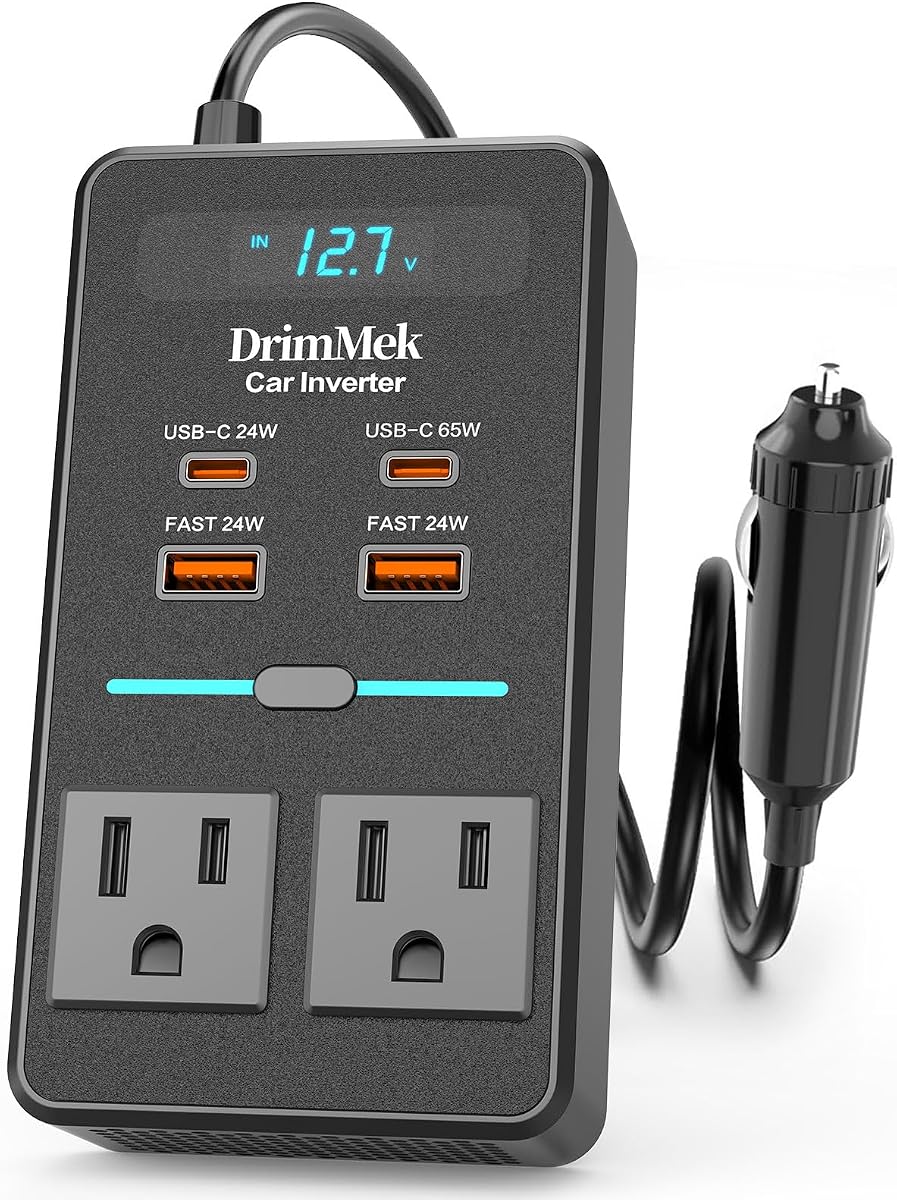
This 300W Multi-Port Car Adapter combines a 4.5 rating with a generous selection of connections. It provides two 110V AC outlets, two 24W USB-C ports, and two 24W USB-A ports, allowing several travel devices to charge from one vehicle adapter.
We may earn a commission when you buy through this link, at no additional cost to you.
One USB-C connection is listed as capable of 65W, making the unit interesting for compatible higher-power devices. Its compact housing is intended to fit in a glove box or center console, and a built-in quiet fan supports operation during extended use. The plug-and-play format requires no permanent installation.
Overload, short-circuit, overheating, and low-voltage protections are included, while the manufacturer offers replacement-only quality coverage and customer support. The output is not described as pure sine wave, and the product is specifically intended for 12V vehicles whose accessory output is compatible.
This is a practical choice for family trips, mobile offices, and emergency kits where several USB devices need charging alongside one or two AC accessories. Check the vehicle's accessory voltage before use and do not assume every USB-C device will accept the available output. Shared power limits still apply across all six ports.
The listed 65W USB-C output offers more headroom for compatible laptops and tablets than basic USB-A charging. Cable quality and device support determine the actual rate, so check both requirements before connecting.
The compact body is easy to keep in a glove box or center console until a road-trip need arises. A quiet cooling fan and plug-in operation make it convenient for intermittent travel use.
We may earn a commission when you buy through this link, at no additional cost to you.
The ALLWEI 300W Car Inverter is a compact travel adapter with a 4.4 rating. It converts 12V DC into 110V AC through two outlets, while a 27W USB-C PD port and 18W USB-A Quick Charge port handle compatible mobile devices.
We may earn a commission when you buy through this link, at no additional cost to you.
A 33-inch cable provides useful reach for passengers in the rear seat and includes fastening tape for keeping the setup organized. The aluminum alloy housing is designed for durability and heat dissipation, and the intelligent chip detects device requirements to reduce the risk of overheating, under-voltage, overcurrent, over-voltage, overload, and short circuits.
The product guidance says battery clips should be used for loads above 180W. This distinction matters because the vehicle's cigarette-lighter circuit may not safely carry the inverter's full 300W continuous output. The USB outputs also share a stated maximum of 3A total, so high-power charging on both ports may reduce individual performance.
This inverter is a straightforward option for road trips, camping, commuting, and emergency preparation. Its long cable and modern USB-C port are useful, while the two AC outlets offer room for additional equipment. Users approaching the upper output range should plan a proper battery connection and carefully control the load.
The 33-inch lead is long enough to make the inverter more accessible to passengers. Secure it properly so it does not become loose equipment or interfere with the vehicle's seating and controls.
A temperature-controlled fan adjusts output as conditions change, helping manage heat without unnecessary noise. Multi-function protection helps guard connected equipment and the vehicle connection when loads or voltages become unsuitable.
We may earn a commission when you buy through this link, at no additional cost to you.
The right inverter depends on waveform quality, connection limits, output ports, protection, and the devices you intend to power. These factors matter more than the headline wattage because a vehicle socket, cable, and individual appliance each impose their own limits.
A pure sine wave output follows the smooth shape of utility AC more closely than a modified waveform. It is generally the safer choice for sensitive electronics, audio equipment, communication devices, medical products, and inductive loads. If the inverter will operate a computer, precision instrument, or motor-driven appliance, clean output can reduce noise, heat, and unwanted wear. A modified inverter may still work for ordinary low-cost electronics, but compatibility becomes more difficult to guarantee.
The continuous rating represents power available for sustained operation, while peak power is intended for short startup surges. Check the normal running draw of every device, then add those figures together. Do not use the peak rating as a budget for a continuously operating appliance. Motors, compressors, and some medical devices can draw substantially more during startup than after they stabilize.
A cigarette-lighter socket is convenient but commonly limited to substantially less than the full 300W output of many inverters. Some products specify that loads should remain around 150W, while others recommend battery clips above 180W. Battery clamps draw directly from the vehicle battery and can support the advertised wattage more effectively, but they require attention to polarity and cable placement. Check the vehicle socket's fuse rating and the inverter's instructions before connecting demanding equipment.
A conventional vehicle electrical system is commonly described as 12V, but accessory outlets can behave differently across models and operating states. An inverter accepting a range such as 11–17V provides more flexibility, especially for certain newer vehicles. The stated range should match the outlet where the inverter will be connected. Using an incompatible input can cause shutdown, unstable output, or damage.
AC outlets support standard household-style plugs, while USB ports make it easier to charge phones, tablets, and other compatible electronics. USB-C Power Delivery is more versatile for modern devices than basic USB-A, and some adapters include Quick Charge for compatible Android products. Check the protocol, rated wattage, and shared output limits of all ports before planning to charge several devices at once.
Look for safeguards against over-voltage, under-voltage, overload, short circuits, and overheating. A fused connection can help isolate the inverter if a fault occurs, while an intelligent fan adjusts to load and temperature. A quiet fan at light load is normal, but persistent high noise, heat, or repeated shutdowns may indicate an unsuitable load or installation problem. Do not operate the inverter in a sealed, hot, or damp environment.
A compact inverter is easier to keep in a vehicle, but a metal housing can add durability and assist with heat dissipation. Consider the cord length, body size, and outlet placement. A longer cord can reach rear-seat passengers, while a compact design is more convenient for glove-box storage. The housing should be stable, vent openings should remain unobstructed, and cables should not cross footwells or interfere with driving.
Before connecting anything, identify the vehicle outlet voltage, inspect the inverter and cable, and read the load instructions. Connect the inverter to the vehicle while it is off if the manufacturer's directions require it. With the engine running, switch the unit on, confirm that the indicator and fan operate normally, and then connect devices one at a time so overload protection is not triggered unexpectedly.
Calculate the combined running wattage of all connected AC and USB loads and keep it below the continuous capacity and wiring limits. Do not use hair dryers, heaters, high-power tools, air conditioners, or similar equipment unless the manufacturer explicitly permits it. Turn the inverter off and unplug loads before changing connections, especially when using battery clamps.
Keep the unit dry, ventilated, and out of direct prolonged sunlight. Do not block vents or place it on soft surfaces. Inspect the plug, cord, and battery connections for wear, and never continue using a damaged cable. Switch the inverter off when it is not needed to reduce standby consumption, and store it in a dry, secure location between trips.
Yes, a 300W inverter can usually run a typical laptop and its charger. Check the laptop's power adapter label to determine its input wattage, then leave room below the inverter's 300W continuous limit for other connected devices. A pure sine wave model is preferable when the laptop or charger is sensitive to power fluctuations.
Vehicle accessory sockets and their fuses are usually designed for less current than the inverter's full continuous rating. Depending on the model, the recommended socket limit may be around 150W or 180W. Battery clamps can provide a more direct connection for heavier loads, but polarity, connections, and battery condition must be handled carefully.
Pure sine wave is generally better for sensitive electronics, audio equipment, communications gear, and some motor-driven loads because it provides smoother AC output. A modified waveform may be adequate for simple chargers and other compatible devices. Choose based on the equipment, not merely on the inverter's advertised wattage.
Use the fuse size specified by the inverter manufacturer and the current rating of the chosen connection path. Some products include a 40-amp fuse, while others use different replaceable fuses depending on whether the unit is connected by socket or battery clamps. Never oversize a fuse or substitute one with a higher rating than specified.
It is possible, but the vehicle battery can drain quickly because it powers both the inverter and connected devices. The amount of time available depends on battery capacity, inverter idle draw, and device consumption. For extended use, an engine-running alternator setup or a portable power station is generally more suitable.
A load-responsive fan often speeds up when the inverter is working hard or the surrounding temperature rises. Loud operation can therefore be normal under a substantial load. Check for blocked vents, an excessive load, a hot environment, or a fan that remains loud after the load has been removed and the unit has cooled.
Many hair dryers and heating devices draw enough power to approach or exceed a 300W inverter's practical limits, and some models explicitly warn against using them. Even when the running wattage is below 300W, high startup demand can create problems. Check the appliance label and the inverter's warnings before connecting it.
Only if the inverter explicitly accepts the outlet voltage. Models with an 11–17V input range are designed to cover a broader range of vehicle accessory systems, including certain newer vehicles. A unit limited to 12V should not be connected to a 16V outlet, so verify the label and vehicle requirements first.
The BESTEK 300W Pure Sine Wave PD30W stands out as the most balanced choice because it combines clean output, modern charging, broad vehicle input compatibility, and extensive protection. The BESTEK Compact Car Adapter delivers a practical mix of AC and USB outputs in a small body, while the GIANDEL 300W Pure Sine model offers low distortion, efficient conversion, fast charging, and a low idle draw.
When choosing, prioritize the needs of your actual equipment. Sensitive electronics favor a pure sine waveform, heavy loads may require battery clamps, newer vehicles may need a wider 11–17V input range, and frequent mobile charging benefits from USB-C Power Delivery. Connection capacity, protection, cooling, and cable length are at least as important as the headline wattage.
Product designs, ratings, and availability can change, so review the current listing and user feedback before ordering. Compare the current specifications, vehicle voltage, connection method, and intended load with the guidance in this guide, and check current prices and warranty terms at the time of purchase.