
AEKE Smart Home Gym System K1
4.1Editor score
17-point skeletal tracking
43-inch 4K touchscreen
Lifetime AI access
Our AI Powered Smart Home Gym Systems guide compares ten connected trainers across resistance, coaching, workouts, tracking, display, and space use.
AI Powered Smart Home Gym Systems combine connected resistance, guided instruction, automatic performance tracking, and personalized programming in a home-friendly format. The strongest systems make daily training easier without removing the control needed for progressive strength, cardio, mobility, or Pilates.
This guide compares ten leading smart gyms using the information available for resistance capacity, exercise variety, artificial-intelligence features, performance metrics, installation, displays, accessories, and household footprint. It covers compact cable systems, folding strength stations, wall-mounted trainers, mirrors, and an adaptive treadmill.
Each review identifies the feature that most distinguishes the system, along with its practical trade-offs and ideal owner. Ratings and specifications can change over time, while retailer availability, promotions, installation terms, and membership conditions should be checked before making a final purchase decision.
4.1Editor score
5.0Editor score

3.7Editor score
The table below compares the featured systems by format, resistance, intelligent features, training breadth, and practical space requirements, making their differences easier to assess before buying.


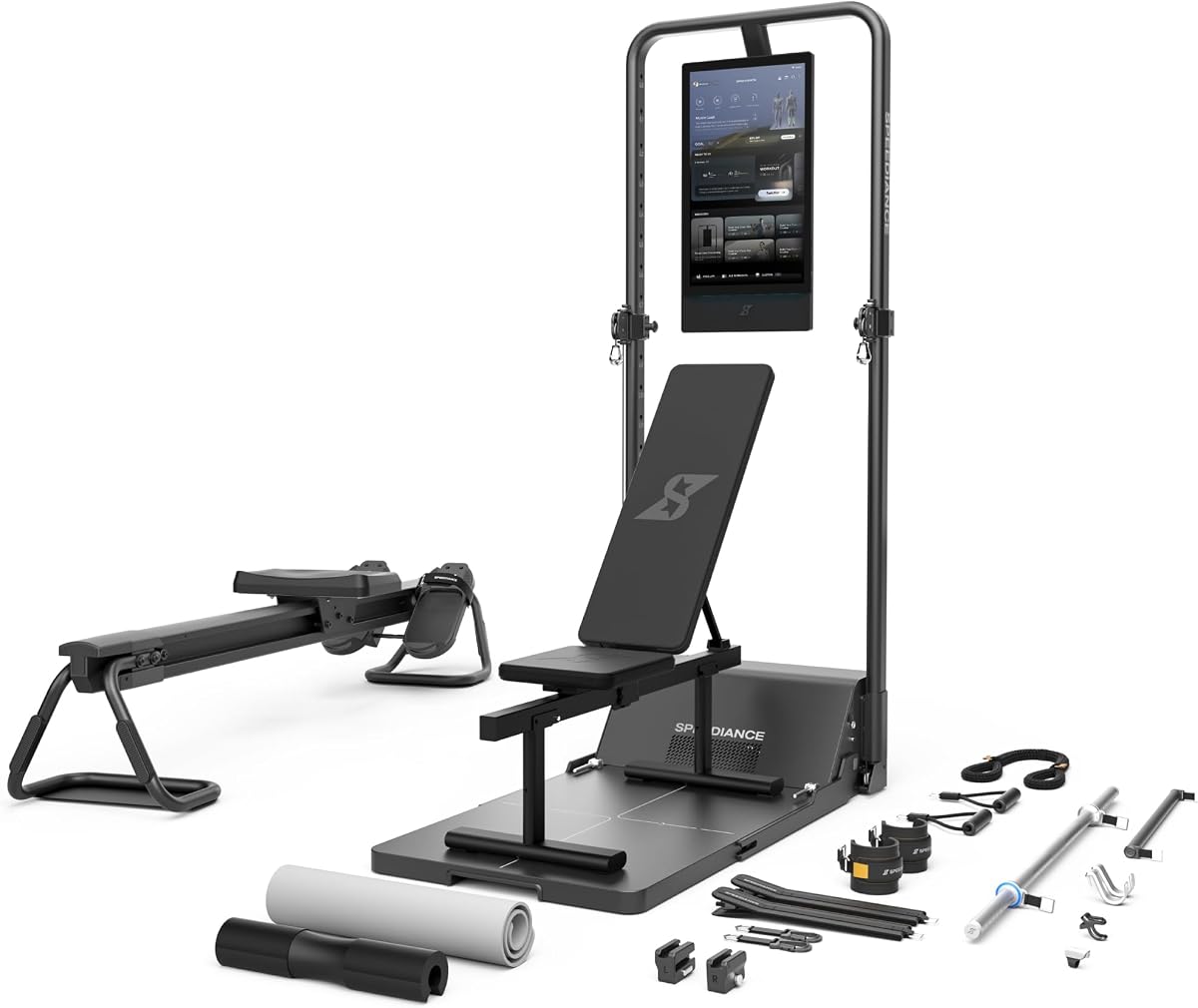
The Speediance Gym Monster 3 combines strength, cardio, Pilates, mobility, and functional training in one freestanding unit. Its listed 5.0 rating is the highest among the featured products, while the combination of up to 220 pounds of digital resistance, four resistance modes, 19 cable positions, and a 23.8-inch HD display makes it a notably complete home-gym proposition.
We may earn a commission when you buy through this link, at no additional cost to you.
The resistance system supports precise one-pound adjustments, which is useful for gradual overload and for household members with different training abilities. Four modes broaden the possibilities beyond a conventional cable machine, and the 19 cable positions allow squats, presses, rows, pulls, and functional movements to be performed from different angles. The built-in 20W 2.1 stereo system and ambient lighting add atmosphere to workouts without changing the underlying training value.
Intelligent coaching is positioned as a central feature, covering assessment, workout planning, guidance, and progress tracking. Voice control is particularly helpful because it lets users change settings without interrupting a set. However, the product information notes that selected AI-powered capabilities may be introduced through future over-the-air updates, so buyers should distinguish what operates immediately from what is planned.
Gym Monster 3 is a strong recommendation for people who want one machine to cover multiple training styles without a permanent wall installation. It uses less than 10.8 square feet and needs no drilling, making it more flexible than wall-mounted alternatives. Those wanting the largest screen in the category or a longer exercise catalog may prefer the AEKE K1, but for balanced capability, intuitive controls, and freestanding versatility, this is the standout pick.
Strength, cardio, Pilates, mobility, and functional workouts are supported within the same frame. That breadth can reduce the need to buy separate machines for each discipline, although the actual course library should be reviewed for the user's preferred activities.
The freestanding, no-drilling design makes Gym Monster 3 easier to position than a wall-mounted trainer. Its relatively compact footprint is still substantial, so users should measure the intended training area and ceiling clearance before delivery.
We may earn a commission when you buy through this link, at no additional cost to you.
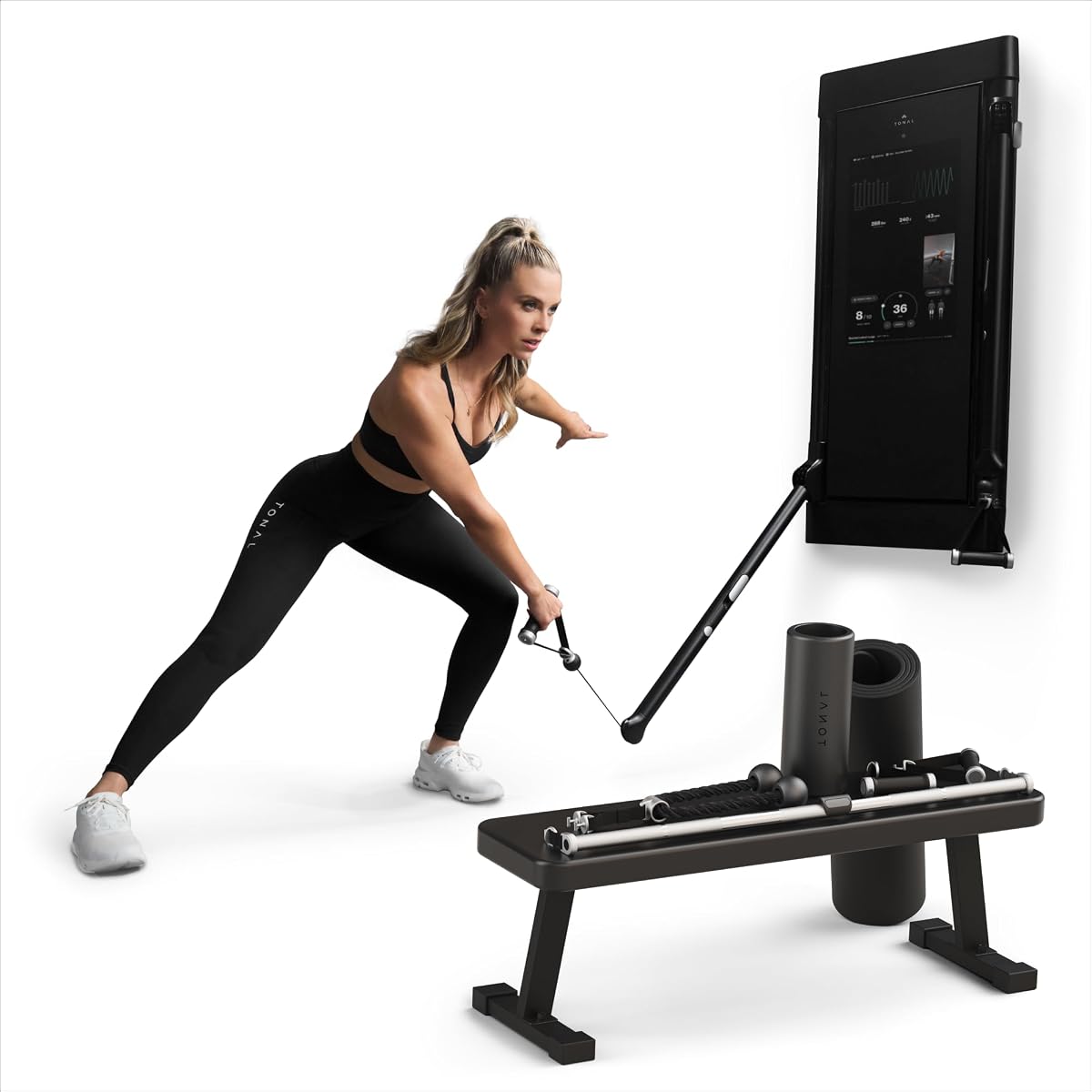
Tonal 2 is a wall-mounted smart cable system designed to replace many pieces of conventional gym equipment with one compact installation. It carries a 4.1 rating and pairs up to 250 pounds of adaptive resistance with a large catalog of expert-led workouts across 15 modalities, including strength, cardio, yoga, mobility, and Aero HIIT.
We may earn a commission when you buy through this link, at no additional cost to you.
Its central advantage is automatic resistance management. Tonal evaluates strength and performance, selects an appropriate load, and raises it in measured increments as the user progresses. This can make progressive training more approachable for beginners while giving experienced users a system that adjusts quickly between sets and exercises. Weekly targets and insights covering strength, power, and volume lifted add practical accountability.
The main compromise is installation. Tonal 2 mounts neatly to a wall, saving floor space, but it is not a casual do-it-yourself purchase. The included process begins with a space survey, followed by professional delivery and installation so the machine can be safely mounted and calibrated. Households that rent, live in a small building, or cannot modify a wall may find that limitation decisive.
Tonal 2 best suits homeowners with a suitable installation surface who value adaptive resistance, expert coaching, and a broad library over portability. Compared with freestanding Speediance systems, it preserves floor space and may feel more like a permanent gym. Buyers should complete the survey before ordering and confirm that the surrounding area can accommodate the wall-mounted design.
The system changes the load according to performance and increases it in precise increments as the user improves. This automation is especially useful for households sharing one machine because it can reduce the manual planning required between exercises.
Wall mounting keeps the floor open and makes the setup visually tidy. The trade-off is reduced flexibility: relocation requires suitable mounting conditions and professional handling rather than simply rolling or unfolding the machine.
We may earn a commission when you buy through this link, at no additional cost to you.
The AEKE S1 Pro is positioned as a premium intelligent cable gym for strength-focused home users. Its 4.1 rating accompanies a 220-pound digital resistance specification, AI coaching, real-time motion tracking, and personalized programming, giving it a feature set close to larger integrated systems without the same emphasis on cardio attachments.
We may earn a commission when you buy through this link, at no additional cost to you.
Its motor-driven resistance is designed to change quickly and smoothly, supporting both explosive power work and controlled muscle-building exercises. Advanced sensors monitor body mechanics and provide feedback intended to improve form. The product information also emphasizes hundreds of exercises and training modes, allowing the system to serve as a complete full-body platform rather than a single-purpose cable attachment.
Unlike systems that emphasize a large entertainment display or a broad mix of cardio, cardio, and strength modes, the S1 Pro's identity centers on strength and intelligent feedback. The supplied information does not give the display size, exact folded footprint, or detailed course counts, so buyers should not assume features simply because another model in the AEKE range includes them. Confirm the final specifications directly before purchase.
This system is a good fit for someone prioritizing digital cable resistance, sensor-based form awareness, and structured strength programming without a recurring membership. It may be less compelling for a household seeking extensive cardio modes or a large touchscreen, but for strength-oriented smart training, the S1 Pro is among the more focused and sophisticated options in this roundup.
The sensor system tracks movement mechanics and offers feedback during exercise. In practice, the value depends on consistent use and on the user responding to cues, but it can make remote strength sessions more structured than following a static chart.
Instant electronic adjustment is particularly convenient when moving between compound and isolation movements. It removes the need to manually change weights on a traditional stack, although users should learn the system before performing unfamiliar high-load exercises.
We may earn a commission when you buy through this link, at no additional cost to you.
Speediance Gym Monster 3 appears twice in this guide because it is the strongest general-purpose recommendation and the leading choice for shoppers who prioritize breadth. The 5.0 rating is accompanied by a feature set that spans strength training, cardio, Pilates, mobility, and functional fitness rather than specializing in a single activity.
We may earn a commission when you buy through this link, at no additional cost to you.
Up to 220 pounds of digitally controlled resistance can be adjusted in one-pound increments. Four resistance modes and 19 cable positions expand training angles, while the touch display, stereo sound, and ambient lighting make guided sessions feel more like a connected fitness studio than a basic machine. Voice control provides a practical hands-free way to adjust the system during exercise.
Its primary caveat concerns the rollout of AI features. The description explicitly says selected AI-powered functions may arrive through future over-the-air updates. This does not negate the current coaching and tracking proposition, but it means buyers should inspect the current interface and understand which intelligent functions are immediately available. The no-drilling design also requires adequate floor and overhead clearance.
Gym Monster 3 is ideal for buyers who want one connected system to support family members with different interests. Strength athletes will appreciate the load range and cable positioning, while users interested in Pilates, mobility, and cardio get more than a traditional resistance machine. It is the broadest all-in-one option here and the most compelling choice for versatile everyday training.
The combination of modalities makes the system useful for more than one household member. Beginners can use guided lower-impact sessions while more experienced users take advantage of the resistance range, modes, and varied cable angles.
Hands-free voice control is useful when the user is holding a cable or moving between exercises. It reduces interruptions, while the screen remains available for deeper review of programs, performance, and progress.
We may earn a commission when you buy through this link, at no additional cost to you.
The Speediance Gym Monster 2 combines a power cage, Smith machine, squat rack, bench rack, cable machine, and pulley system in one folding station. Its 4.2 rating is the second-highest listed score, and the unusually small folded area of 2.69 square feet distinguishes it from conventional all-in-one racks that remain bulky when stored.
We may earn a commission when you buy through this link, at no additional cost to you.
Dual 800W permanent magnet synchronous motors deliver up to 220 pounds of smooth digital resistance. The integrated AI coaching technology tracks performance in real time and recommends weight adjustments after each set, adding a useful layer of guidance to a station that already resembles a traditional strength facility. The multifunction bench and pulley arrangement support exercises for the chest, back, legs, and core.
The extreme fold is impressive, but it is not the same as claiming the machine is invisible while in use. The deployed frame requires enough floor space to squat, press, row, and change cable positions safely. This model also concentrates on strength rather than providing the same explicit cardio range as Gym Monster 3 or the AI treadmill. Buyers should assess which exercises matter most before choosing.
Gym Monster 2 is best for apartment dwellers, home-gym builders, and people who want recognizable rack and cable functions in a machine that can be compressed for storage. The protection package also adds reassurance for long-term ownership. It is a strong choice for strength-first households, provided the available training area is large enough when the system is unfolded.
Combining a squat rack, Smith-style station, bench rack, cables, and pulleys gives the system more conventional training options than a basic all-cable model. Users should still verify compatibility with their preferred barbell exercises and attachments.
Post-set resistance recommendations can make load planning more systematic. The feature is most useful when the user records sets consistently and adjusts recommendations according to actual performance rather than following them blindly.
We may earn a commission when you buy through this link, at no additional cost to you.
The OxeFit XS1 Peak is an ambitious all-in-one machine that combines strength training with rowing, paddling, simulated water and snow sports, and digitally controlled Pilates. Its 2.9 rating is the lowest in the group, but that number alone does not capture the unusually wide range of activities represented by the system.
We may earn a commission when you buy through this link, at no additional cost to you.
OXEAI uses precision analytics to adapt workout protocols to progress, while trainer-led classes and programs support users who prefer structured instruction. Real-time feedback tracks power, velocity, load, and balance, giving the system detailed performance information that can be applied to strength technique, control, and progressive goals.
The major consideration is the membership model. OxeFit membership is activated during account setup, generally before installation, and comes with a 12-month initial commitment billed separately on a monthly or yearly basis. This recurring cost and long initial term create a meaningful commitment. The low rating also warrants checking recent customer feedback for installation, software, and service experiences.
XS1 Peak suits a buyer who values novelty, cross-training, and detailed metrics enough to accept a membership commitment. It may appeal to people who want one machine for strength and conditioning, while other systems offer comparable basics with fewer ongoing obligations. The best approach is to compare the ongoing membership terms, available classes, and space requirements before committing.
Rows, paddles, simulated snow and water sports, and Pilates make this more specialized than a conventional strength station. That variety is attractive for users who want varied movement patterns without purchasing separate cardio equipment.
Power, velocity, load, and balance metrics can reveal more than repetition totals. Users can use the information to identify changes in execution, but only if they learn the meaning of each metric and evaluate feedback in the context of their training history.
We may earn a commission when you buy through this link, at no additional cost to you.
The original Speediance Gym Monster is a freestanding smart gym with a 4.2 rating and a large content library. It combines strength and cardio in one frame, supports up to 220 pounds of adjustable resistance, and lists more than 700 movements and 300 classes, making it particularly attractive to users who want variety from a single device.
We may earn a commission when you buy through this link, at no additional cost to you.
Dual direct-drive engines provide precise weight changes, while the smart touchscreen gives direct control over resistance and visual programs. Free-lifting and partner modes expand the social and functional possibilities. The ski mode, with two handles and ten height settings, adds a distinct cardio experience that separates this model from systems focused almost entirely on strength.
Compared with the newer Gym Monster 3, this system may offer a lower entry point into the Speediance range, but the newer model adds a 23.8-inch HD display, stereo sound, ambient lighting, 19 cable positions, and hands-free voice control. Buyers should compare the complete current feature sets rather than assuming the models are interchangeable, particularly if display size and modern controls are priorities.
The original Gym Monster is a good choice for a household that wants substantial workout variety and integrated ski-style cardio without a wall-mounted design. Its large library makes it easier to maintain a consistent routine, while the touchscreen provides clear control. Those choosing between this and the third-ranked model should prioritize the newer model's updated interface and more detailed specifications.
Ski mode turns the cable frame into a different training experience, which can make a home gym more appealing to users who dislike repetitive resistance exercises. Its ten height settings allow the movement to be adapted across a wider range of sessions.
Hundreds of movements and classes reduce the chance of running out of useful programming. The breadth is particularly helpful for families, where different members can use the same system for separate goals and exercise preferences.
We may earn a commission when you buy through this link, at no additional cost to you.
The Echelon Strength Pro is a commercial-grade, wall-mounted smart trainer built around a 24-inch HD touchscreen and up to 132 pounds of digitally controlled resistance per arm. A numeric rating is not currently supplied, so this review emphasizes documented features rather than assigning a score or implying a level of customer satisfaction that cannot be confirmed.
We may earn a commission when you buy through this link, at no additional cost to you.
The large display supports instructor-led strength, HIIT, yoga, mobility, and recovery sessions. Wi-Fi connectivity provides guided programs, movement libraries, and real-time workout tracking. Built-in bar and grip controls allow resistance changes without leaving the exercise, while four interchangeable attachments support traditional lifts, rotational movements, and floor-based work.
The resistance system includes Normal, Concentric, Eccentric, Progressive, and Isokinetic modes. These options may benefit users who want to focus on a particular phase of a repetition or train toward a specific movement goal. The system also includes four concrete anchors, reinforcing its commercial positioning, but installation must be handled carefully and in a structurally suitable wall.
Echelon Strength Pro is a strong option for a dedicated workout room where a large screen and mounted system will not obstruct daily life. It offers less explicit AI coaching than several competing models, so buyers seeking automated personalization should ask what the software recommends and how it changes programs. For those prioritizing display size, attachments, resistance modes, and wall-mounted durability, it remains a compelling machine.
The 24-inch touchscreen is larger than the display on many connected cable systems and provides room for instructor-led content and clear workout navigation. Its value is greatest in a dedicated room where the screen remains visible throughout each session.
Normal, concentric, eccentric, progressive, and isokinetic modes offer more training options than a single electronic load curve. Users should familiarize themselves with each mode and begin conservatively when using a new pattern.
We may earn a commission when you buy through this link, at no additional cost to you.
The MAXPRO Portable Smart Cable Gym offers a very different proposition from the full-size powered stations in this guide. It weighs less than nine pounds, folds into a small package, and supplies adjustable concentric resistance from 5 to 300 pounds. Its 3.7 rating is moderate, but portability makes it a practical entry point for compact homes, travel, and shared spaces.
We may earn a commission when you buy through this link, at no additional cost to you.
The included SmartConnect uses Bluetooth and onboard sensors with the MAXPRO app to track workouts, monitor progress, and provide data and coaching. Coach-led HIIT, suspension, and strength sessions add structure, while users can also create their own workouts. The included bar, handles, ankle or wrist straps, door brackets, and charger cover the essentials needed to begin training.
The main limitation is the need for a secure anchor point. Door-mount brackets provide a convenient option, but users must confirm that the door and hardware can handle the loads and repeated movement. MAXPRO also lacks the large display, integrated resistance modes, expansive exercise interfaces, and full-frame stability of the premium systems. It is better suited to focused cable work than a conventional rack experience.
MAXPRO is the best choice for anyone who values portability, simple resistance control, and app-based tracking more than entertainment or a permanent gym installation. It is particularly useful for renters, travelers, and people with limited floor space. Those wanting a full multi-station home gym should look to Speediance, while those who can provide a strong anchor may get more versatility from a larger wall-mounted system.
At less than nine pounds, the central unit can be moved between rooms, taken on trips, or stored away when not in use. This flexibility makes maintaining a routine easier for people who cannot commit floor space to a large machine.
The SmartConnect and app turn basic cable equipment into a connected training platform. Users can review workout data and progress while also following coach-led sessions, making the system more useful than a conventional portable resistance band.
We may earn a commission when you buy through this link, at no additional cost to you.
The AI-Adaptive Smart Treadmill provides the most literal interpretation of AI coaching in this roundup. Its 4.7 rating is the second-highest listed score, while the SportMind AI system monitors heart rate and adjusts speed and incline automatically throughout a session. It is a running and walking specialist rather than a multifunction strength gym.
We may earn a commission when you buy through this link, at no additional cost to you.
The treadmill adjusts speed from 0.6 to 9.6 MPH and incline from zero to 10 percent, creating micro-adjustments intended to keep the user in a preferred heart-rate zone. This can make steady cardio more approachable because the machine changes the workload rather than requiring constant manual input. Its 5-horsepower brushless motor and 440-pound capacity also position it as a substantial machine.
The running deck measures 20 by 54 inches and includes a non-slip surface and shock-absorbing technology. Compatibility with Apple Watch and a Fitkol wristband can improve heart-rate input, although users should confirm pairing requirements. Unlike many connected fitness products, the listing highlights lifetime AI membership with no recurring fee, which is a meaningful long-term advantage.
This treadmill is best for runners, walkers, and users focused on cardiovascular conditioning who can allocate floor space to a large machine. It cannot replace the cable stations or strength stations in this guide. Buyers should confirm room dimensions, storage options, power placement, safety clearances, and app compatibility before ordering.
The defining feature is real-time adaptation based on heart rate. Instead of simply reporting performance after a run, the system can alter speed and incline during the session to help keep the effort within the selected zone.
A five-horsepower motor, wide speed range, sizable deck, and shock absorption support everything from walking to intensive running. Users should still check the folded dimensions, storage requirements, and room clearance because no compact footprint is claimed.
We may earn a commission when you buy through this link, at no additional cost to you.
The right connected gym depends on your training style, available space, household needs, and appetite for software or membership commitments. These factors help separate full-size strength systems, compact cable trainers, and cardio-focused equipment.
A cable machine is flexible but depends on correct attachment setup, while a rack-style system may better support barbell and squat variations. A treadmill specializes in running and walking rather than resistance work, and a mirror-style system relies more heavily on visual instruction. Begin with the activities you perform consistently, not with the broadest list of advertised features.
Choose the format that matches your routine. Mixed-training households may favor a freestanding all-in-one, while dedicated runners should consider a treadmill and dedicated strength users may prefer a rack or mounted cable unit.
Resistance capacity should match your current training level and future goals, but maximum load alone is not enough. Look for smooth delivery, useful increment sizes, multiple resistance modes, and the ability to change load quickly. Digital resistance can make transitions effortless, while fixed stacks and mechanical selectors may feel more familiar and direct.
Do not choose only by headline capacity. Test cable travel, adjustment speed, available modes, and the machine's behavior across different exercises before committing to a difficult-to-return system.
AI features range from automatic resistance changes to skeletal tracking, form feedback, workout adaptation, and biometric-driven treadmill controls. Determine which functions currently operate and which depend on future software updates. Useful systems should make recommendations understandable, let users override them, and support progress review without making every workout feel automated.
Prioritize meaningful automation over the number of AI labels. A simple recommendation system that consistently helps with load selection may be more valuable than a large feature list that does not match your preferred training.
Home gym dimensions should include the deployed footprint, overhead clearance, wall space, doorway access, and safe movement zones. Wall-mounted systems save floor area but require a suitable structure and professional installation. Folding models offer storage flexibility, although they can still be large while being used. Treadmills require a dedicated floor area and planned storage strategy.
Measure the room and delivery path before ordering. Check the manufacturer's installation requirements, anchor specifications, and product dimensions rather than estimating from photographs or comparing only the folded area.
Some systems provide lifetime access to coaching and workouts, while others depend on memberships, account activation, or a required initial term. Review what happens after a subscription ends, whether workouts become unavailable, and whether software updates are included. Also determine whether advanced features work without recurring payments.
Treat the software terms as part of the product, not an afterthought. Check current account, renewal, cancellation, and activation conditions directly with the seller before ordering.
A larger display can improve instruction and entertainment, but screen quality, responsiveness, and the information layout matter more than size alone. Consider whether the machine supports hands-free controls, clear progress pages, and useful workout customization. Some users prefer a simple app and minimal hardware, while others want an immersive, screen-led experience.
Choose controls that suit your environment and training style. Verify readability from the exercise position, accessibility of frequently changed settings, and whether audio features improve or distract from guided sessions.
Included bars, handles, straps, benches, anchors, and other attachments can define a system's usefulness. Check whether accessories support the movements you want and whether replacement parts are readily available. A large digital resistance rating is less meaningful if the supplied cable positions or attachments restrict exercise variety.
List your priority exercises and confirm that the machine, included accessories, and available courses support each one. This is especially important for heavy strength training, floor work, sports preparation, and rehabilitation-oriented routines.
Households benefit from separate profiles, automatic load recommendations, adaptable workouts, and accurate tracking for multiple users. A 4.7 rating represents a high score within this group, but ratings and service experiences can change over time. Look for dependable customer support, clear setup documentation, and straightforward account management.
Consider who will use the machine most and how often. A system that serves several goals and family members may provide more value than a specialized model used only occasionally by one person.
Begin with assembly, placement, and a safety inspection. Follow the included instructions, confirm that anchors or wall mounts are secure, and keep cables, bars, straps, and moving components free from obstructions. Before the first demanding workout, identify the correct attachment, cable position, resistance mode, and operating procedure for each exercise.
Set up the connected app or account before beginning, create an individual profile, and enter accurate information where requested. Calibrate motion tracking or heart-rate devices as directed, test volume and connectivity, and learn how to pause or modify a session. Start with a light resistance or comfortable walking pace, then progress gradually while following form cues and the machine's recommendations.
After each workout, wipe the display and touched surfaces, inspect cables and attachments for visible wear, and return the system to its prescribed storage position. Keep ventilation openings unobstructed, follow the manufacturer's cleaning and lubrication guidance, and arrange authorized service if resistance feels irregular or hardware shows damage.
An AI-powered home gym uses sensors, performance data, and software to personalize workouts, recommend load changes, analyze movement, or adjust equipment in real time. The depth of these features varies widely, so buyers should distinguish automatic resistance management from simple repetition tracking. Some systems also receive new coaching features through software updates.
Many are well suited to beginners because automated resistance and guided programs reduce the need to plan every session. New users should still learn the attachments, cable positions, and safe range of motion before using heavy settings. Beginning with a trainer or a reputable instructional resource can improve confidence and reduce avoidable mistakes.
No, because the featured products use different models. The AEKE K1, AEKE S1 Pro, and the AI-Adaptive Smart Treadmill advertise lifetime or no-subscription access, while OxeFit membership includes a separate recurring charge and an initial commitment. Verify the current terms because policies and account packages can change.
Compact options such as the MAXPRO and folding Speediance systems can work well where large equipment is not permitted. Wall-mounted systems need structurally suitable walls and may create noise or installation restrictions, while large treadmills require dedicated floor space. Check building rules, floor capacity, delivery access, and neighbor-friendly operating hours.
A connected system can replace many common machines, but no single system reproduces every specialized barbell, rack, or cardio device. A multifunction station may cover squats, presses, rows, cables, and functional training, while a treadmill is better for running. The right choice depends on the exercise equipment and modalities you actually use.
Required space depends on the format, its deployed dimensions, and the user's movement range. Wall-mounted models preserve floor area but need wall clearance, while freestanding units need room for cables and exercises. Treadmills also require safety space around the deck, and the delivery route should be measured before selection.
Sensors and cameras can identify deviations and provide useful cues, but they are not a substitute for qualified instruction or medical care. Tracking accuracy varies with lighting, clothing, camera placement, exercise complexity, and sensor design. Treat feedback as guidance, avoid sudden load increases based solely on an automatic prompt, and seek professional help when appropriate.
A cable machine is best for adjustable angles, unilateral work, functional movements, and compact storage. A rack-style station is better for users who value squats, presses, barbell movements, and a more traditional strength setup. Consider your technique, preferred programs, available accessories, and the space each format requires before choosing.
The Speediance Gym Monster 3 is the most versatile all-around recommendation because it combines strong digital resistance, multiple cable positions, four resistance modes, intelligent coaching, and several training disciplines. The AEKE K1 stands out for its 17-point skeletal tracking, large 4K screen, extensive movement library, and lifetime access, while the Tonal 2 is compelling for homeowners ready to install a permanent wall-mounted system.
Prioritize the training format and space requirements before focusing on the word AI. A treadmill is ideal for running, the MAXPRO fits mobile and compact setups, and a rack or cable station is better for resistance training. Review what the software currently does, what requires future updates, and whether ongoing membership terms fit your preferences.
Finally, confirm current specifications, ratings, availability, delivery, installation, and membership conditions directly with the seller. These systems are significant purchases, and layouts, software ecosystems, and product packages can change. Measuring the intended space and reviewing the final feature list before ordering will help prevent surprises and support a more satisfying home-training setup.
