
BNC Male Connector Telescopic Antenna
4.5Editor score
Seven-section telescopic design
BNC male connector
Portable 27-inch extension
Compare the best Antenna for Scanner options by frequency range, mounting style, connector type, portability, and reception coverage for listening needs.
A scanner antenna can determine which signals you hear, how clearly they arrive, and how conveniently you can monitor different radio bands. The right choice depends on your radio’s connector, the frequencies you listen to, whether you travel, and whether you need a portable, vehicle-mounted, desktop, or outdoor antenna.
This guide compares ten scanner antennas across frequency coverage, antenna construction, mounting options, cable length, connector type, portability, and practical use cases. It includes flexible whip antennas, telescopic antennas, magnetic and glass mounts, desktop discone designs, and outdoor broadband models for more demanding listening setups.
The selections reveal where each option fits: compact antennas serve handheld scanning, magnetic and glass mounts suit vehicles, and larger discone systems suit fixed installations. Ratings and specifications reflect the available product information, while current prices and availability can change, so readers should verify those details before purchasing.
4.5Editor score

4.5Editor score
4.7Editor score
The comparison below highlights each antenna’s frequency range, mounting approach, connector configuration, and intended listening environment, from compact handheld whips to permanent rooftop discone installations.




This Bingfu antenna earns a 4.2 rating by combining broad 20–1300 MHz frequency coverage with a magnetic mounting system and a three-meter coaxial cable. Its BNC male connector and extensive compatibility list make it a practical choice for scanners, ham radios, walkie-talkies, mobile radios, and other compatible equipment.
We may earn a commission when you buy through this link, at no additional cost to you.
The magnetic base is the standout feature for mobile use. It can be placed on a suitable metal vehicle surface without a permanent installation, while the 10-foot cable allows the radio to remain inside the cabin and gives the installer some freedom in routing. The stated 50-ohm impedance and VSWR below 2.0 also support straightforward operation across the advertised bands.
Compatibility is unusually extensive in the supplied specifications. The antenna lists numerous Uniden Bearcat, Whistler, Radio Shack, and ham-radio models, including handheld scanners and mobile designs. Buyers should still confirm the antenna port and connector on their specific radio, since a BNC connection alone does not guarantee compatibility with every antenna socket.
This is a strong choice for listeners who move between vehicles, want an easy temporary mount, or need a longer cable than a standard handheld whip provides. It is less suitable for someone seeking the smallest possible travel accessory or an installation without any exposed cable.
The magnetic base makes this antenna particularly useful in vehicles, where mounting locations can change with the season. A metal roof or other suitable surface provides a convenient way to improve antenna position while retaining a removable installation.
The listed support for many Uniden, Whistler, and Radio Shack scanners gives buyers a useful compatibility starting point. Always compare the radio’s model number and antenna connector before ordering.
We may earn a commission when you buy through this link, at no additional cost to you.
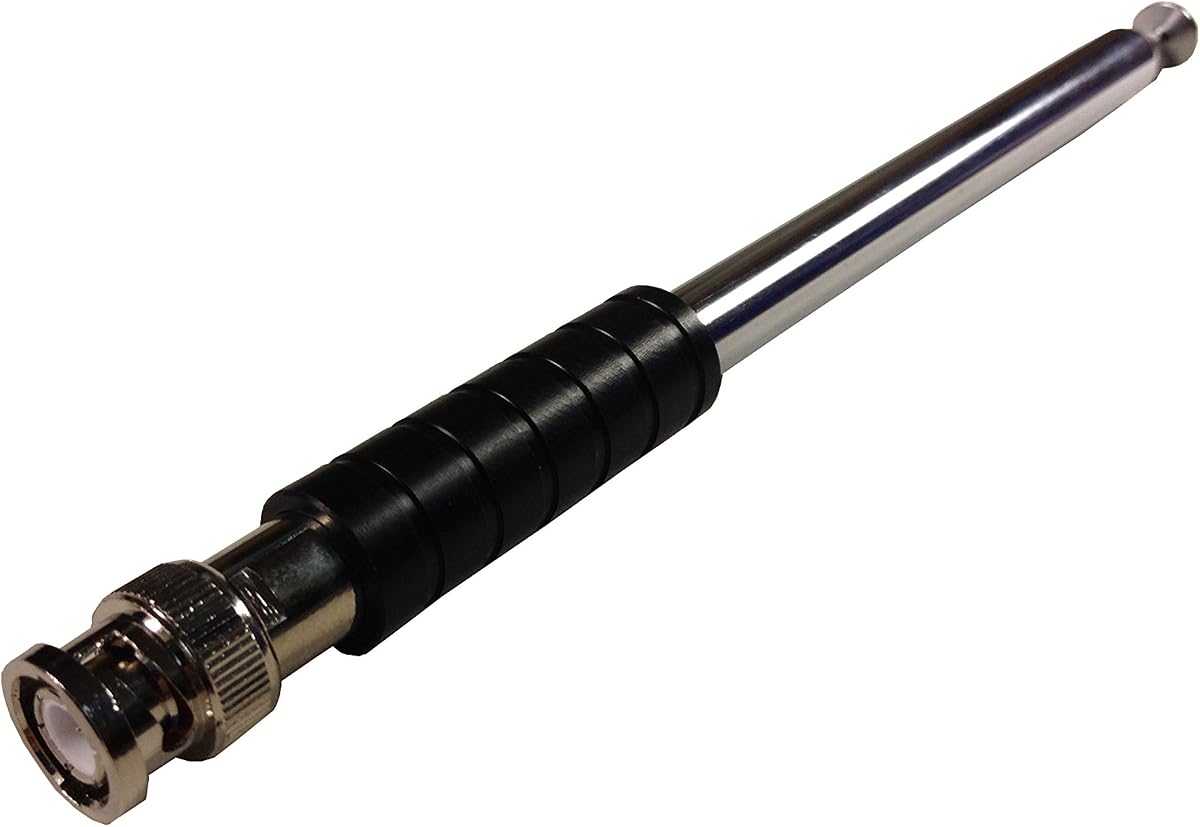
This telescopic BNC antenna carries a 4.5 rating and offers a straightforward way to improve the reach of a compatible scanner or two-way radio without a large fixed installation. Its seven sections extend to 68.5 centimeters, or 27 inches, while the compact design keeps it manageable during travel.
We may earn a commission when you buy through this link, at no additional cost to you.
The stated frequency range of DC through 12.4 GHz is unusually broad for a simple telescopic whip, and the supplied characteristics list includes 50-ohm impedance, low conductor resistance, strong insulation resistance, and low insertion loss. The product is presented for CB radio, scanner, amateur radio, two-way radio, mobile scanner, wireless microphone, and receiver applications.
The principal limitation is that a wide specification does not guarantee equal performance across every band. A telescopic whip’s physical design, extension, placement, and the radio’s own front-end characteristics can all influence real-world reception. The connector must also match the equipment, and the 27-inch maximum length is shorter than many vehicle glass-mount or fixed-position antennas.
It is best for budget-conscious listeners who want a portable replacement or backup antenna, particularly when a BNC socket is available. Users seeking a purpose-built wideband scanner whip or a long external vehicle antenna may prefer the Comet BNC-W100RX or one of the mounted options.
The telescoping construction allows the antenna to collapse to a smaller size for storage in a vehicle, radio bag, or equipment case. It also lets users adjust height according to available space and operating conditions.
The BNC male plug allows quick attachment to compatible equipment without a complicated assembly. Buyers should confirm connector type and any clearance required around the radio’s antenna port.
We may earn a commission when you buy through this link, at no additional cost to you.
The Taurus Desktop 25-2000 MHz Scanner Antenna receives a 4.5 rating for combining wide frequency coverage with a practical discone-style desktop format. Its 25–2000 MHz range is wider than many mobile scanner antennas, making it relevant to listeners who monitor more than conventional public-safety frequencies.
We may earn a commission when you buy through this link, at no additional cost to you.
A 70-centimeter antenna and heavy-duty 125-millimeter magnetic plate give the product a stable base while keeping it less permanent than a mast installation. The four-meter RG58 military-specification coaxial cable offers ample routing flexibility for a desk, shelf, or vehicle, and the BNC male plug is already fitted.
Its discone form is the key technical advantage over a simple whip. Discone designs are built to address broad receive requirements without changing antennas as the user moves among distant VHF, UHF, and higher-frequency signals. Actual results still depend heavily on placement, nearby structures, interference, and the receiving equipment.
This antenna is well suited to users who want a dependable fixed listening station without immediately installing a rooftop system. It also works for stationary vehicle use through the magnetic base. Those needing coverage above 2000 MHz or very high transmit capability should consider the more specialized discone alternatives in the guide.
The heavy magnetic plate anchors the antenna on a suitable desktop or vehicle surface. That makes the design useful for temporary installations that still benefit from a larger antenna than the scanner’s original whip.
The discone-style layout and 25–2000 MHz specification make this model appealing to listeners interested in varied services. Wider coverage can also mean the antenna receives more local noise, so thoughtful placement remains important.
We may earn a commission when you buy through this link, at no additional cost to you.
The Comet BNC-W100RX has a 4.5 rating and is purpose-built for portable scanner reception. Its 25–1300 MHz range covers airband, VHF, and UHF applications, while the six-inch flexible rubber whip makes it easy to carry in a field-monitoring kit.
We may earn a commission when you buy through this link, at no additional cost to you.
This antenna’s construction is designed for regular portable use. The flexible whip resists bending or breaking during transport, and the stated weight of 0.05 pounds and six-inch length make it convenient to keep attached to a scanner or store separately. Its BNC male connector is intended to fit compatible Uniden, Whistler, AOR, and Icom equipment.
The omnidirectional radiation pattern and vertical polarization support reception from multiple directions, which is useful when signals arrive from different locations. Because the antenna is designed for reception rather than high-power transmitting, it should not be treated as a general-purpose transmitting antenna even if a connected radio can transmit.
This is the most balanced handheld choice in the group for a listener who wants improved dedicated wideband reception without carrying a larger mounted system. It is less appropriate for fixed stations, extended rooftop installations, or users who need a long high-gain antenna.
The short flexible whip and low weight reduce bulk during travel. It is a natural fit for emergency-preparedness kits, field monitoring, and listeners who move between locations with the same scanner.
An omnidirectional pattern and vertical polarization suit general-purpose scanning, where signals may originate from different directions. Keeping the whip upright and unobstructed helps it perform as intended.
We may earn a commission when you buy through this link, at no additional cost to you.
This Bingfu dipole antenna earns a 4.2 rating by offering a less visible alternative to a roof-mounted scanner setup. Its adhesive glass mount, 20–1300 MHz coverage, and three-meter cable suit listeners who want better antenna positioning without drilling into a vehicle.
We may earn a commission when you buy through this link, at no additional cost to you.
The three-meter RG58-style lead gives the radio considerable freedom inside the cabin while the external element can be positioned on a window. The antenna terminates in a BNC male connector and shares a broad compatibility list that includes numerous Uniden, Whistler, and Radio Shack scanner models.
Window mounting is a practical convenience, not a guarantee of ideal performance. Glass, vehicle framing, heating elements, tint, and the position of the adhesive element can affect the antenna’s behavior. Users should keep the cable route clear and follow the mounting instructions to maintain a secure attachment.
This is an attractive choice for mobile listeners who want a removable, low-profile installation. Users who frequently move vehicles or require a consistently elevated roof position may prefer a magnetic-base antenna with a longer mounting option.
The adhesive glass mount avoids a permanent roof installation and keeps the external hardware less conspicuous. It is especially useful when preserving a vehicle’s original appearance matters.
The 10-foot cable allows the radio to be positioned comfortably inside the vehicle while the antenna remains outside the cabin. Route the cable away from sharp edges and moving components.
We may earn a commission when you buy through this link, at no additional cost to you.
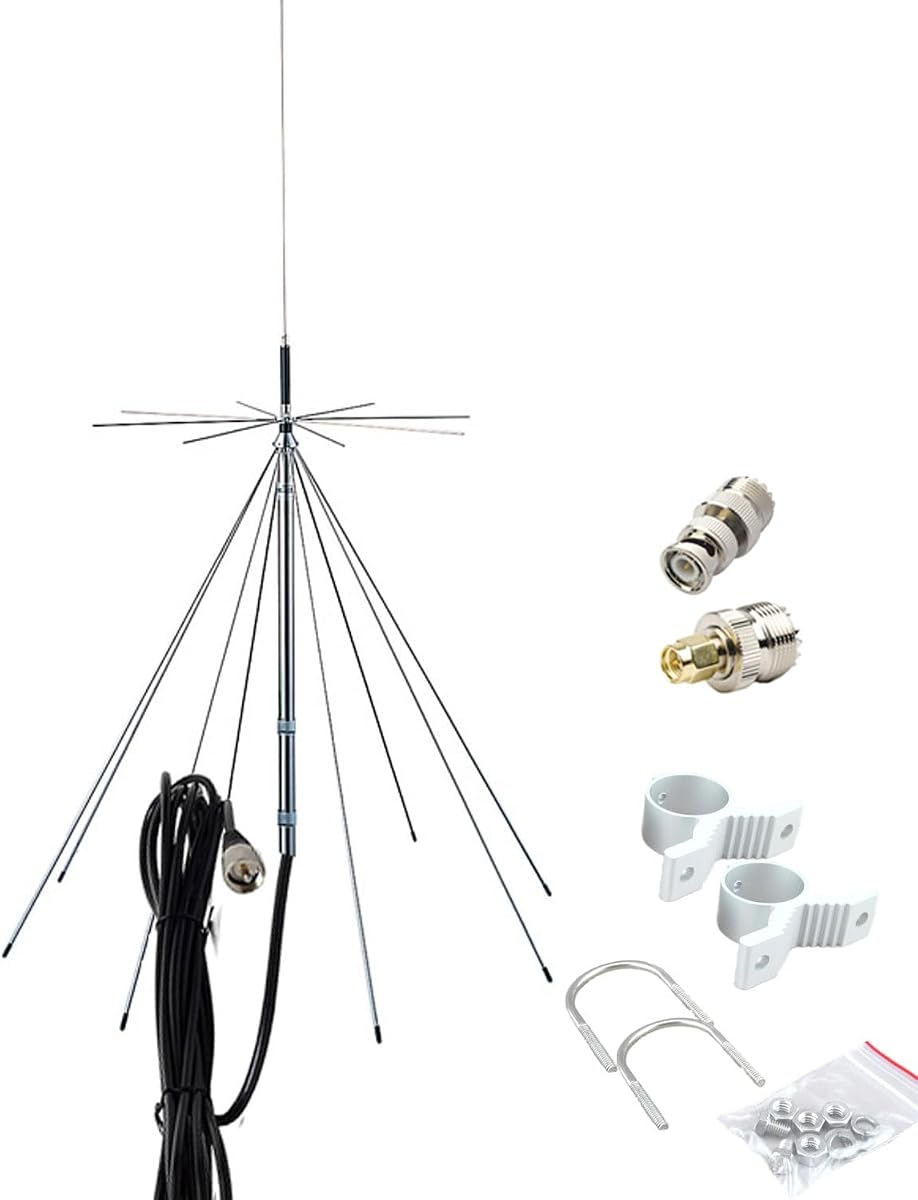
The Discone Antennas D3000 holds the highest rating in this roundup at 4.7, reflecting its ambitious 25–3000 MHz specification and broad application list. It is designed for fixed outdoor installations and supports reception across shortwave, HF, CB, airband, VHF, UHF, FM, FRS, GMRS, and other portions of the radio spectrum.
We may earn a commission when you buy through this link, at no additional cost to you.
Installation is intended for an apartment balcony railing, roof, or mast. The kit includes 10 meters of RG58 wire with a PL-259 or UHF SO-239 connector, along with BNC male and SMA male adapters. This broad connection package helps accommodate scanners, software-defined radios, transceivers, and other equipment using common interfaces.
An important design option is the removable top loading coil. Listeners who do not need 25–50 MHz reception can remove it to make the antenna more compact and lightweight. The breadth of supported services makes the design attractive for users experimenting across many bands rather than concentrating on one public-safety segment.
This system is best for listeners prepared to mount the antenna securely outside and route substantial coaxial cable. It is less convenient as a portable or temporary vehicle solution, and users must ensure their radio, connector, software, and local regulations align with the intended frequency and transmission plans.
The unusually broad frequency range reduces the need to change antennas when moving among HF, airband, VHF, UHF, and other services. It is particularly useful for generalist listeners and SDR users.
Including RG58 cable and common adapters reduces the need to source separate parts. Buyers should still match the final connector and verify cable length against their installation.
We may earn a commission when you buy through this link, at no additional cost to you.
This dual-whip magnetic base antenna receives a 4.5 rating for combining broad frequency coverage with selectable radiators. Its 25–3000 MHz receive range and interchangeable 12-centimeter and 15-centimeter whips allow users to tailor the setup to different applications.
We may earn a commission when you buy through this link, at no additional cost to you.
The short whip is specified for UHF 400–470 MHz, while the longer whip targets VHF 136–174 MHz. This flexibility is helpful for listeners who need one antenna to handle both conventional VHF and UHF traffic. The system is also listed for CB, FM, GMRS, 900 MHz, 1000 MHz, 1090 MHz, 978 MHz, and aviation reception.
A nine-centimeter heavy-duty magnetic base makes the antenna easy to carry and relatively simple to install on a suitable metal surface. The five-meter RG58 cable provides ample positioning freedom, while BNC, SMA, and SO-239 connector options broaden compatibility with different radios and receivers.
This antenna is a good middle ground between a small desktop model and a full outdoor discone installation. It is best for users who want quick placement, interchangeable whips, and broad reception without committing to a mast-mounted system.
Using the longer whip for VHF and the short whip for UHF gives users a simple way to align the antenna with the portion of the spectrum they monitor. The exact choice should follow the equipment and frequency plan.
The magnetic base and long cable make it easy to move between a home desk, outdoor metal surface, or vehicle. Elevating and relocating the antenna can be more valuable than a modest specification difference.
We may earn a commission when you buy through this link, at no additional cost to you.
The TW-999BNC has a 4.5 rating and provides a 20–1300 MHz telescopic antenna for scanner radios and frequency counters. It retracts to 18.6 centimeters and extends to 127 centimeters, giving users control over antenna height without carrying a permanently long whip.
We may earn a commission when you buy through this link, at no additional cost to you.
The stated maximum power of 10 watts adds useful flexibility within the product’s intended role. Its broad frequency range makes it suitable for scanners that monitor conventional services across VHF and UHF, while the BNC connector simplifies attachment to compatible radio equipment.
The supplied information explicitly distinguishes it from a CB antenna and notes that it does not provide a transmit function. That distinction matters for shoppers who see a broad frequency label and assume it is a general transmitting antenna. It is best evaluated as a receiving accessory for compatible scanner and counter applications.
This model suits users who want a compact stored length but need to raise the antenna while scanning. Compared with the seven-section option, it offers a much greater fully extended length, which may be useful in stationary handheld or desktop use.
Extending the whip can improve the position of the radiating element, while retracting it makes storage more convenient. Users can adjust length to suit the radio, location, and available space.
The product is labeled for scanner radios and frequency counters rather than CB service. Its stated 10-watt limit and receive-only note should guide compatibility decisions.
We may earn a commission when you buy through this link, at no additional cost to you.
The Tram 300-Watt Super Discone earns a 4.6 rating for its wideband reception, extensive transmit-band list, and robust stainless-steel construction. It covers 25–1300 MHz for reception and lists 26, 27, 46, 49, 72, 144, 220, 440, 900, and 1290 MHz transmit bands.
We may earn a commission when you buy through this link, at no additional cost to you.
The antenna uses a 55-inch top whip, eight 10.5-inch upper radials, and adjustable lower radials to create a large discone structure. The listed maximum power is 300 watts, with 200 watts specified for CB use. A stated SWR below 1.5:1 is attractive for users who care about efficient transmission across supported bands.
This is a substantial outdoor antenna rather than a compact scanner accessory. Its maximum mast diameter of 1-3/8 inches and rust-free stainless-steel structure point toward permanent or semi-permanent elevated mounting. A suitable mast, roof location, grounding plan, and secure support are essential.
The model is best for experienced radio users who want one broad system for both scanning and supported transmission. Casual listeners who only need reception may find a smaller discone or flexible whip more convenient, but the Tram offers a rare combination of range, power handling, and structural scale.
The listed receive and transmit bands make this antenna relevant to ham-radio users as well as dedicated listeners. Transmit use should follow the manufacturer’s instructions and the radio’s power limits.
The 55-inch whip and multiple radials need adequate clearance and a stable support. Height and unobstructed placement can materially influence the antenna’s practical performance.
We may earn a commission when you buy through this link, at no additional cost to you.
This Tram glass-mount antenna holds a 4.4 rating and provides a traditional mobile upgrade for scanners and CB users. Its 25–1300 MHz center-loaded design and extra-long whip combine broad frequency coverage with a 28-inch installed height.
We may earn a commission when you buy through this link, at no additional cost to you.
The supplied RG58/U cable measures 17 feet, giving users more freedom to position the radio inside the vehicle and route the wiring discreetly. A BNC connector terminates the antenna, allowing connection to compatible scanner equipment without requiring a separate cable assembly.
Glass mounting makes the system attractive to drivers who do not want to drill a roof hole. However, window glass, tint, embedded heating wires, and the chosen pane can affect reception differently. The mounting location should be selected carefully, and the adhesive attachment should be prepared according to the included instructions.
This antenna is best for dedicated mobile listeners who want a longer, higher antenna than a handheld whip and prefer not to remove it for every use. Users seeking a temporary installation should choose a magnetic base instead, while those wanting a compact travel accessory will find the antenna too substantial.
The 28-inch whip and center-loaded construction provide a different operating height from a low window decal or short handheld antenna. Higher placement can help when the vehicle roof would otherwise block signals.
Glass-mount hardware avoids permanent roof drilling and preserves the vehicle’s exterior appearance. The trade-off is a semi-permanent adhesive attachment and the potential influence of the glass itself.
We may earn a commission when you buy through this link, at no additional cost to you.
The most important choices are connector fit, frequency coverage, mounting method, and the environment in which the antenna will operate. A larger or more specialized design is not automatically better if it cannot connect cleanly or suit the intended installation.
Begin with the antenna socket on the scanner or receiver. Many products in this guide use a BNC male plug, but some radios use SMA, SMA female, PL-259, SO-239, or another interface. The connector must match both the socket type and the intended signal requirements. A physically similar plug can still create poor connections, grounding issues, or damage if it does not meet the equipment’s specifications.
Buyers should also look for any adapter included with a kit and confirm that the adapter does not introduce unacceptable loss. When a product is marketed as compatible with many brands, that list is useful, but the exact model number remains the safest basis for a decision.
Choose coverage that includes the services you actually monitor. Most scanner-focused products span approximately 20 or 25 MHz through 1300 MHz, which covers many conventional VHF and UHF services. Broader antennas extend down into shortwave or upward toward 2000–3000 MHz, making them useful for aviation, CB, amateur, SDR, and other specialized listening.
A wide stated range is not the same as equal sensitivity or performance on every band. The antenna design, physical size, matching, and placement all matter. Treat the frequency label as the starting point, then consider whether the form factor suits the bands you use most.
Match the mount to how and where the antenna will be used. Magnetic bases are fast to install and remove, making them ideal for vehicles, temporary setups, and portable operations. Adhesive glass mounts create a more permanent, low-profile vehicle installation. Desktop and rooftop models require a suitable flat surface, mast, roof, balcony, or other elevated support.
A magnetic base needs a firm metal contact area, while an adhesive mount needs clean glass and careful preparation. Larger discone antennas demand proper structural support and clearance. Choose the simplest mounting method that can place the antenna in a strong signal position without creating installation problems.
Longer coaxial cable gives the installer more freedom to place the antenna away from the radio, but it also occupies space and can add losses depending on the cable and connectors. The products here include leads ranging from about three meters to ten meters, with the larger outdoor systems providing substantially more.
Use quality coax with intact insulation, clean connectors, and secure strain relief. Avoid sharp bends, pinched cable, and routing through metal structures. For long installations, properly seated connectors and sound grounding practices are more useful than adding a long lead without considering the signal path.
A flexible whip is easy to carry and quick to deploy, making it suitable for handheld scanning and emergency-preparedness kits. A telescopic antenna adds adjustable height. A discone provides greater physical scale and broad-band capability but requires more space and a more deliberate installation.
The best option is the one that can remain in a sensible receiving position when it is needed. A compact antenna that is easy to place may outperform a larger model in a poor location, while a larger antenna can provide more opportunity for a strong, clear installation when room and support are available.
Many scanner antennas are designed for reception only. The TW-999BNC explicitly notes a receive-only function, while other products list transmit bands and maximum power ratings. Do not infer safe or effective transmission capability merely from a wide frequency range.
If the antenna will be used for transmitting, review the manufacturer’s power limits, impedance, SWR, connector requirements, and any stated operating bands. Use it only for transmission where it is explicitly supported and where local radio regulations apply.
Antenna placement can matter as much as the model. Urban listeners may need to move the antenna away from computers, LED lighting, power supplies, and other sources of electrical noise. Vehicle installations can be affected by glass, roof design, and nearby structures. Outdoor users should seek clearance from metal obstructions where practical.
Try a higher or more open position, compare signals with and without the antenna, and keep the radio and power connections stable. The best-performing setup is often the result of good placement and sound coax, not simply the longest specification on the box.
Review everything included before ordering. Some products arrive as a complete antenna with cable and connector, while the D3000 includes long RG58 wire and multiple adapters. Others are simply a whip or mounted element that must be paired with the radio’s existing cable.
Confirm that the package contains the mounting hardware, adapter, coax, or connector required for the intended setup. Check the manufacturer’s included-parts list as well as the frequency specification so that separate purchases do not become necessary.
Before installation, confirm that the antenna connector matches the scanner, identify whether the design is intended for reception or transmission, and inspect the coax and hardware for damage. Clean the mounting surface, assemble the antenna according to its instructions, and attach the connector without forcing it.
Position the antenna as high and as open as practical. For handheld use, extend the whip fully or follow the stated band recommendation. For vehicle or outdoor models, secure the base, mast, or adhesive mount, protect the coax from moving parts, and avoid sharp bends or pinched sections.
Inspect the setup periodically, especially after travel, severe weather, or a change in vehicle position. Clean adhesive mounts and connectors as directed, tighten appropriate hardware, and replace a damaged cable or element. Test reception in several locations when possible, because small changes in placement can materially affect signal quality.
The correct connector depends on the scanner’s antenna socket. BNC is common in this group, but some radios use SMA, SMA female, PL-259, or other connectors. Check the radio’s model specifications and the antenna’s connector before buying. Adapters can help, but they should be appropriate for the intended signal and should not be used to force an incorrect connection.
No. A wider range is useful when you monitor several kinds of services, but every band still depends on antenna design, matching, placement, and local interference. A properly positioned antenna focused on the bands you need may work better than a larger model installed in a poor location. Consider coverage and practical deployment together.
Only if the manufacturer explicitly rates the antenna for the relevant transmission bands and power levels. Several scanner antennas in this guide are intended only for reception. Even when a wideband antenna supports transmission, the radio’s power, impedance, SWR, connector, and local regulations must also be considered.
It can, but the window and its tint may affect reception. Metalized films, heating elements, and certain types of glass can change the antenna’s behavior. Follow the installation instructions, test signals with and without the antenna, and relocate the mount if coverage is inconsistent.
A good magnetic base can provide a secure temporary mount on a suitable metal surface. Secure the antenna before driving and check it periodically, especially at highway speed or on rough roads. The surface must be clean and metallic, and the coax should be routed so it cannot interfere with doors, windows, or other mechanisms.
A whip is a compact radiating element that is easy to carry or mount and works well for portable scanning. A discone uses a top element and multiple radial elements to cover a much broader range of frequencies. Discone antennas can provide more installation options and band flexibility, but they require more space and a suitable support.
The right amount depends on where the radio can sit and where the antenna needs to be placed. A longer cable improves placement flexibility but adds bulk and may introduce some loss. Use good-quality coax, avoid tight bends, and secure both ends so the connection remains stable.
Antennas respond to their surroundings, including metal structures, concrete, wiring, glass, nearby electronics, and the height of the installation. A higher or more open position can improve line-of-sight access to distant signals, while an electronic device or damaged cable can introduce noise. Testing several positions is often the simplest way to improve results.
The seven-section telescopic antenna is a practical budget choice for portable use, while the Comet BNC-W100RX stands out as a compact, purpose-built handheld scanner antenna. The Taurus offers a balanced desktop format, and the D3000 provides the broadest band and installation flexibility among the selections.
Prioritize connector compatibility, the services you actually monitor, and the environment where the antenna will operate. A compact whip is ideal for a scanner bag, a magnetic or glass mount is useful in a vehicle, and a full discone is most appropriate for a secure elevated installation with room for its cable and radials.
Before purchasing, verify the current specifications, connector, included accessories, and current price with the seller. Inventory and pricing can change, and legal requirements may apply to the frequencies, transmission power, and installation methods a listener intends to use.