
AProX 3-Channel 4K Dash Cam
4.8Editor score
True 4K front and rear
1080P cabin camera
Four infrared cabin lights
Built-in GPS tracking
Dual-band WiFi 6
A dash cam for a tractor trailer must do more than record the road ahead. It should capture multiple angles, tolerate extended operating times, provide usable night footage, and offer dependable evidence when a sudden stop, lane change, loading incident, or low-speed collision occurs.
We compared the ten systems using the supplied specifications, focusing on channel count, resolution, sensor technology, field of view, night vision, GPS, parking surveillance, storage support, power demands, and installation features. The list covers conventional two-camera designs as well as systems built specifically for trucks, trailers, and RVs.
Each review explains the product's strongest attributes and practical trade-offs. The top three recommendations emphasize specialized coverage, multi-camera flexibility, and usable low-light recording, while the remaining models provide alternatives for different budgets and installation needs. Product availability and pricing can change.
4.8Editor score

5.0Editor score

4.5Editor score
As an Amazon Associate we earn from qualifying purchases.
The comparison below shows how each system balances recording channels, resolution, low-light capability, navigation data, wireless access, and parking features. It is a practical way to identify the model that best matches a tractor trailer's wiring, mounting positions, and coverage requirements.
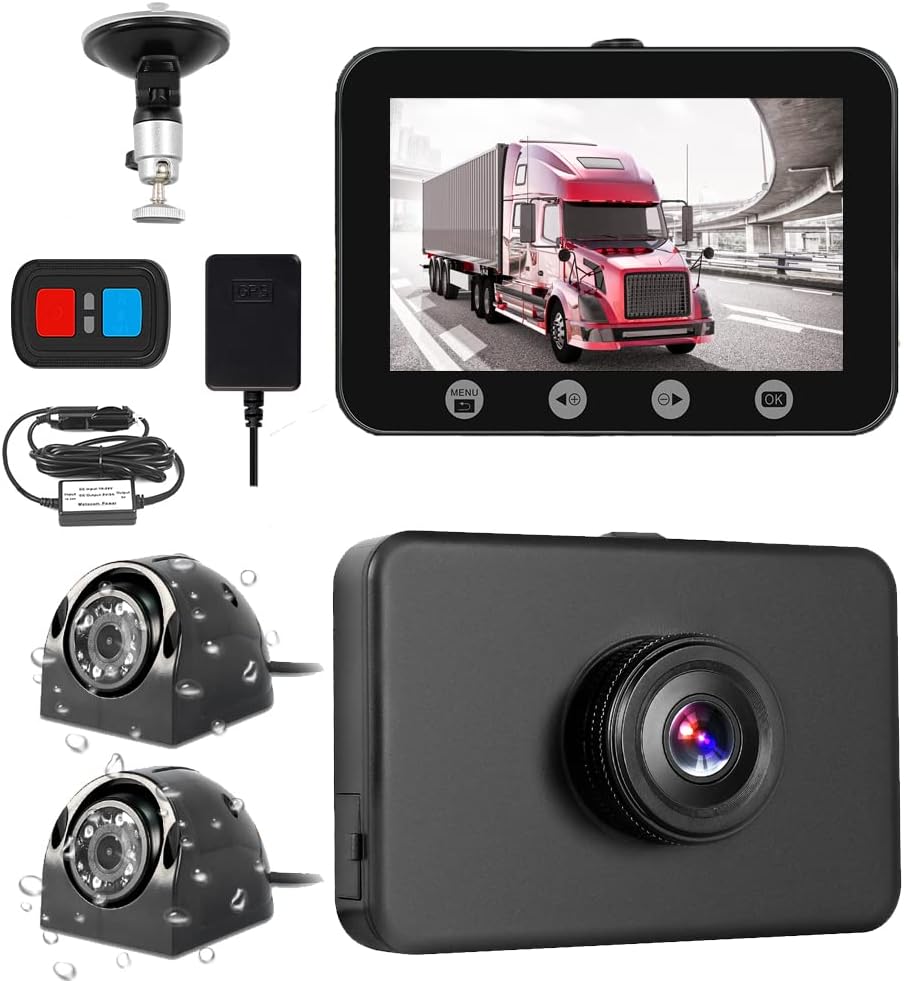


The VSYSTO 3CH WiFi Truck Dash Cam is specifically described for semi trailers, tractors, vans, cars, and recreational vehicles, giving it a stronger use-case fit than a generic passenger-car unit. Its 4.0 rating reflects a practical system built around three angles rather than a single high-resolution front camera. The combination of a 4.5-inch display, integrated GPS, WiFi, infrared illumination, and a G-sensor makes it especially relevant when a driver needs both road context and trailer-side evidence.
We may earn a commission when you buy through this link, at no additional cost to you.
The front camera records at 1080P, while the two separated cameras provide 720P views for the sides or rear. All three can record simultaneously and appear together on the display. Connecting the yellow wire to the corresponding turn-signal power allows the screen to switch automatically to the relevant side camera, effectively creating a digital blind spot aid during a turn or lane change. The separate cameras also use infrared LEDs and an IR cut night-vision feature for low-light recording.
The supplied information does not state that a memory card is included, so buyers should verify the package contents before ordering. A 720P side image is adequate for broad context, but it is not equivalent to the detail of the 1080P front channel. Nevertheless, the system's truck-oriented design, waterproof external cameras, multi-angle recording, and adjustable post-shutdown recording offer meaningful benefits for a tractor-trailer setup.
This is the strongest recommendation for drivers who want a purpose-built three-camera truck system and value blind spot assistance, exterior mounting, GPS, and phone access. It is less suitable for someone whose highest priority is maximum resolution from every angle. For that buyer, the AProX system or the ICESKY S03 may offer a better balance of channel resolution and broader visual coverage.
Recording the front and both separated side or rear positions helps show what happened beyond a single forward-facing view. That context can be valuable during a low-speed parking maneuver, a lane change near another vehicle, or an incident involving a trailer being backed or repositioned.
The automatic power behavior, low-voltage protection, and selectable 2-, 4-, 8-, or 12-hour post-off recording give owners more control over surveillance after ignition is switched off. Low-voltage protection is especially important for a commercial vehicle that may remain connected to a trailer power source for extended periods.
We may earn a commission when you buy through this link, at no additional cost to you.
The ROVE R2-4K Dual combines a 4.5 rating with a strong emphasis on image quality, wireless speed, and useful evidence features. Its front camera captures at 2.5K and then intelligently upscales to 4K, while the rear camera records at 1080P. That distinction matters: the product is not offering native 4K capture, but the described upscaling is intended to produce sharper everyday playback than a standard 1080P unit.
We may earn a commission when you buy through this link, at no additional cost to you.
A Sony STARVIS 2 IMX675 sensor, wide F1.5 front aperture, F1.8 rear aperture, and HDR give the camera a solid foundation for nighttime, tunnel, dusk, and dawn footage. The dual-band WiFi is listed at up to 20MB per second, making it much more convenient to retrieve and share important clips on a phone. Built-in GPS adds speed, compass, route, and location information directly to recordings.
The system includes a 128GB microSD card and supports memory cards up to 1TB. Loop recording, emergency locking, motion detection, and a supercapacitor make it a credible all-around platform. Its main limitation for a tractor trailer is coverage: it records only the front and rear, without dedicated left and right cameras for blind spot awareness. The 24-hour parking mode also requires a hardwire kit that is not included.
This model is a strong choice for a rig owner who prioritizes front-image detail, low-light quality, fast phone access, and route documentation over full side-angle recording. It also works well for drivers seeking a straightforward premium dual-camera system. If lateral visibility is the primary concern, consider the VSYSTO T5 or a four-channel model instead.
The front channel's upscaled 4K output can make nearby vehicles, signs, and lane markings easier to inspect during playback. While it is not native 4K, the higher-resolution workflow remains useful when an operator needs to identify fine visual details without downloading a separate forward camera.
Fast WiFi downloads reduce the need to remove the memory card or physically connect the camera to a computer. That convenience is valuable after an incident because the relevant front and rear clips can be located, saved, and shared through the ROVE app more quickly.
We may earn a commission when you buy through this link, at no additional cost to you.
The REDTIGER F7N TOUCH records 4K UHD through the front camera and 1080P through the rear, pairing high resolution with a 170-degree front field of view. Its 4.3 rating and feature set make it an attractive option for operators who want modern controls without moving to a three- or four-camera system. The front STARVIS 2 sensor, HDR, and WDR are designed to improve detail and balance in difficult light.
We may earn a commission when you buy through this link, at no additional cost to you.
The integrated touchscreen allows the driver to lock an emergency video, enable WiFi, or capture scenery, while voice commands offer a hands-free alternative. Built-in GPS records location, speed, and route, and the REDTIGER Cam app supports 20MB per second downloads. A 128GB card is included, and the G-sensor protects clips associated with detected impacts from normal loop overwriting.
Its limitations are similar to those of other premium dual systems. It provides no dedicated left or right channels for tractor-trailer blind spot coverage, and the parking monitoring function requires a separately installed hardwire kit. Touch controls also deserve careful setup so that accidental inputs do not create distractions on the road.
Choose the F7N TOUCH when front resolution, intuitive controls, GPS, and rapid wireless retrieval matter most. It is especially appealing to drivers who appreciate a visible touchscreen and voice commands. For tighter lateral monitoring around a large trailer, however, a side-camera system will offer more complete situational awareness.
The combination of touch controls, traditional buttons, and voice commands lets the owner choose the most appropriate way to manage recordings. Properly configuring shortcuts and parking functions before departure makes these controls more useful during normal operation.
STARVIS 2 sensitivity, HDR, and WDR work together to improve the handling of bright skies, shaded roads, and nighttime scenes. The broad front lens also helps capture nearby traffic and road edges, although the rear channel remains at 1080P.
We may earn a commission when you buy through this link, at no additional cost to you.
The REDTIGER F7NP offers 4K front and 1080P rear recording in a conventional two-camera arrangement. Its 4.1 rating reflects a capable system built around a STARVIS 2 sensor, F1.5 aperture, and a six-layer optical lens. The 170-degree front and 140-degree rear views are wide enough to document traffic and road surroundings from opposite directions.
We may earn a commission when you buy through this link, at no additional cost to you.
WDR and HDR are included to balance highlights and shadows, while 5.8GHz WiFi supports app-based transfers at up to 20MB per second. Built-in GPS can display route, speed, and location, and seamless loop recording manages storage pressure. A free memory card is included, while the G-sensor locks important event footage. A supercapacitor replaces a lithium battery and is intended to improve heat resistance and service life.
This model does not supply the dedicated left and right views that can be especially useful around a long trailer. Parking mode also needs an optional hardwire kit. These are meaningful limitations for a commercial use case, but the core recording system is straightforward, proven in its feature set, and easy to expand to front-and-rear evidence without a larger display.
The F7NP is a solid alternative for a driver who wants 4K forward detail, reliable rear coverage, and quick smartphone access without a touchscreen. It is especially sensible when the main goals are road recording and incident documentation rather than digital side-mirror functionality. Buyers should use original or officially recommended charging accessories and avoid prolonged exposure to excessive heat.
The large aperture and optical lens stack are paired with exposure technologies intended to maintain visible detail in dim conditions. That combination makes the F7NP useful for overnight routes, early starts, and unlit rural roads where rear and front context matters.
The supercapacitor is one of the more practical details for a tractor-trailer environment. Avoiding a built-in lithium battery can reduce concerns associated with battery swelling and heat, although correct power routing and ventilation remain important.
We may earn a commission when you buy through this link, at no additional cost to you.
The AProX 3-Channel 4K is the only listed model that records true 4K from both the front and rear while also providing a 1080P cabin channel. Its 4.8 rating is the second highest in the group, and the combination of resolution, three angles, and 20MB per second wireless transfers makes it one of the most complete systems examined.
We may earn a commission when you buy through this link, at no additional cost to you.
The front camera has a 170-degree field of view, while the rear and cabin cameras each cover 150 degrees. HD night vision and WDR improve visibility in challenging lighting, and four infrared lights in the cabin camera help illuminate the interior during complete darkness. A laminated 3.18-inch display is designed to reduce reflections, and a screen saver can reduce distraction while driving.
Dual-band WiFi 6 supports 5.8GHz and 2.4GHz connections through the TERUNSOUL app. Integrated GPS stamps speed and location into the video, while loop recording and emergency locking protect relevant clips. The included 128GB card can be replaced with a card up to 512GB. Parking monitoring includes time-lapse and collision detection, but a hardwire kit must be supplied separately.
This is an excellent high-resolution option for a tractor trailer that needs evidence of the road, the area behind the vehicle, and the driver's compartment. Its tradeoff is that it does not record dedicated left and right side views, which may be more critical than cabin coverage for some operators. It is best for owners who value resolution and three-channel flexibility over digital side-mirror assistance.
Recording 4K from both the front and rear is unusually valuable when the closest part of an incident is not directly ahead. It gives the reviewer more pixels to inspect across both camera positions without depending on upscaling to create the final resolution.
The cabin channel's four infrared lights add a useful layer of documentation for nighttime operations. A driver can review not only the road but also the interior environment, which may help clarify movement, loading behavior, or driver actions around the time of an event.
We may earn a commission when you buy through this link, at no additional cost to you.
The REDTIGER F17 combines front, rear, and inside cameras with a 4.4 rating and a useful choice of recording modes. Its front camera uses a STARVIS 2 IMX675 sensor, and the three channels use 150-, 160-, and 155-degree viewing angles. That wide field of view helps reduce blind areas around the vehicle and inside the cabin.
We may earn a commission when you buy through this link, at no additional cost to you.
The system can record the front and inside channels at 2.5K, or the inside camera can be turned off to permit 4K front and 1080P rear recording. WDR and HDR are included for exposure balance and low-light performance. Dual-band WiFi allows app access, simultaneous replay of all three channels, and GPS viewing, while a supercapacitor supports reliability and heat resistance.
Time-lapse and collision-detection parking modes require an extra hardwire kit. The supplied 64GB card may fill quickly with three high-resolution channels, so owners doing extended or frequent driving should consider a higher-capacity card. As with the other three-camera systems, it does not provide dedicated left and right exterior views.
The F17 is best for a tractor trailer that needs rear and interior evidence in addition to a forward view. Its switchable recording modes allow the owner to prioritize front resolution when needed. Drivers seeking left and right visibility should choose a system explicitly designed for those positions, while those who value the included storage should note the lower 64GB capacity.
The ability to switch between a three-channel 2.5K arrangement and a 4K front plus 1080P rear setup gives the owner meaningful control over resolution and storage use. This flexibility is useful when the required evidence changes by trip or operating condition.
The app can replay all three channels together, making it easier to compare the road, cargo-area surroundings, and cabin activity. It reduces the need to open separate files when reconstructing a sequence of events.
We may earn a commission when you buy through this link, at no additional cost to you.
The VSYSTO T5 is the clearest purpose-built match for a tractor trailer in this group. It earns a 5.0 rating and is explicitly designed for trucks, heavy-duty use, RVs, and trailers. Three waterproof cameras cover the front, left, and right at 1920 by 1080, while the five-inch touch screen provides a clear control and viewing interface.
We may earn a commission when you buy through this link, at no additional cost to you.
The yellow trigger wire connects to the turn-signal circuit so the display automatically changes to the relevant side camera when the driver signals a turn. That makes the side cameras function as a digital blind spot assist during lane changes. Each external camera has IP67 protection, secure BMW-style connectors, and flame-retardant cables. The side cameras also include infrared LEDs and 940nm light sensors for dark conditions.
Power compatibility is a major advantage over many passenger-car-oriented products. The system accepts 9 to 30 volts, supports both 12V and 24V vehicles, and provides separate low-voltage thresholds for cars and trucks. A supercapacitor replaces a lithium battery, while H.265 compression and support for cards up to 512GB help control storage demands. A Class U3 card is recommended, but none is included.
The VSYSTO T5 is the top recommendation for a tractor-trailer owner who needs true side coverage, commercial-voltage compatibility, and weather-resistant external hardware. Bluetooth, FM audio, GPS, and a wireless remote add convenience, but the essential case rests on the three-camera arrangement and trailer-specific installation features. It is the most directly aligned system for the keyword.
A 24V tractor-trailer electrical system requires different power expectations from a 12V passenger vehicle. Supporting 9 to 30 volts and offering truck-specific low-voltage thresholds gives installers much more flexibility than treating the unit as a basic windshield camera.
Automatically showing the relevant side camera when a turn signal activates helps a driver check the area beside a long trailer before changing lanes. It adds useful visual context while maintaining a familiar sequence through the vehicle's existing turn-signal wiring.
We may earn a commission when you buy through this link, at no additional cost to you.
The ROVE R2-4K is a front-focused 4K UHD camera with a 4.3 rating, built around an 8MP Sony IMX415 sensor. Its six-glass lens, F1.5 aperture, and Super Night Vision technology target clearer low-light output. A 150-degree A+ wide-angle lens gives the front view broad road coverage, making the unit relevant when a simpler installation is preferred.
We may earn a commission when you buy through this link, at no additional cost to you.
Built-in WiFi 6 permits app-based preview and management, with listed download speeds up to 6MB per second. GPS records driving location and speed, while the app or GPS Player can present route information. The system includes parking mode, motion detection, time-lapse recording, G-sensor event locking, seamless loop recording, and a supercapacitor. It supports cards up to 512GB.
The principal compromises are the lack of included storage and the absence of rear or side cameras. A single front view cannot document a passenger-side collision, a rear loading event, or the blind area created by a long trailer. A basic two-channel model may be a better fit when front-and-rear evidence is important.
This ROVE model is a practical choice for a driver who wants a straightforward 4K forward camera with strong sensor specifications, GPS, and wireless access. It can be installed more simply than a four-camera system, although a trailer owner should compare it with the VSYSTO T5 before finalizing the decision.
The Sony sensor, F1.5 aperture, and multi-element lens are the system's primary strengths. Together they are intended to capture more visible detail during darkness, which is useful on unlit highways and during early-morning or late-evening operations.
For drivers mainly concerned with traffic ahead, a single well-equipped camera reduces mounting, wiring, and storage complexity. The trade-off is that it cannot provide the same 360-degree context as a multi-camera trailer system.
We may earn a commission when you buy through this link, at no additional cost to you.
The ICESKY S03 delivers 4K front video and simultaneous 1080P recording from the rear, inside, left, and right cameras. Its 4.6 rating reflects a well-rounded four-channel design, and 360-degree coverage addresses the blind areas created by the size and geometry of a tractor trailer. The built-in three-inch screen supports a multi-view display.
We may earn a commission when you buy through this link, at no additional cost to you.
WiFi 6 uses both 5.8GHz and 2.4GHz bands, with listed app download speeds up to 20MB per second. Built-in GPS records speed, route, location, and time, while loop recording, impact locking, voice alerts, and a screen saver support daily use. The supplied 128GB card offers immediate storage capacity, and the system supports cards up to 512GB when more room is needed.
Eight infrared lights serve the left and right cameras, and their infrared modes can be controlled independently so one side does not need to be treated exactly like the other. The 24-hour parking mode requires a hardwire kit, which is not included. As with most systems in the roundup, higher-resolution recording across every channel would create greater storage demands than the available card can comfortably sustain.
The S03 is a strong fit for a driver who wants the most complete directional coverage in a compact four-camera arrangement. It is particularly attractive when both side views and an interior view matter. Owners should confirm that the physical camera positions, cable routing, and display placement work within the tractor's cab before installation.
Front, rear, left, and right channels can reveal events that a conventional two-camera setup misses. This is especially useful during side-by-side driving, backing, parking, or a low-speed maneuver involving the trailer's outer edges.
Independent infrared controls for the left and right cameras provide flexibility when one side encounters a different lighting environment. The approach can help maintain usable side evidence without forcing the operator to use the same night setting on both sides.
We may earn a commission when you buy through this link, at no additional cost to you.
The PRUVEEO 4-Channel is a comprehensive 360-degree system built around four 1080P cameras covering the front, rear, left, and right. Its 4.2 rating reflects a broad feature set at a straightforward resolution, and the adjustable lenses allow the installer to refine each camera's view according to the vehicle's geometry.
We may earn a commission when you buy through this link, at no additional cost to you.
GPS records speed, location, and route information, while built-in WiFi provides access to recordings and sharing through iOS or Android devices. Night vision uses an F1.8 cabin lens and four infrared lights. Loop recording overwrites older files when the card is full, and collision footage is locked to prevent accidental deletion. A 128GB card is included.
Time-lapse parking mode can compress 60 minutes into one minute, reducing storage use during extended monitoring. An ACC hardwire kit is sold separately. The system does not include a battery, which avoids battery-related overheating concerns in a hot cab, although hardwired power and proper voltage protection still need careful attention.
Choose the PRUVEEO for broad directional coverage without moving to a higher-resolution four-channel platform. It is a sensible option for a trailer operator who wants front, rear, left, and right evidence, interior night visibility, route data, and wireless retrieval. Its main limitation is that every camera records at 1080P, so the front image does not match the 4K outputs of several competitors.
A tractor trailer does not have the same proportions as a passenger car, so fixed camera angles may not capture the most useful areas. The adjustable front three camera views allow an installer to favor the road, trailer sides, loading area, or another area of concern.
The time-lapse function offers a way to survey long stationary periods without storing every frame at the normal recording rate. Collision locking preserves a more focused record when the G-sensor detects an impact, provided the required hardwire connection is installed.
We may earn a commission when you buy through this link, at no additional cost to you.
The right tractor-trailer dash cam depends on the rig, wiring, and evidence you need most. Channel layout, power compatibility, low-light performance, and installation demands should be evaluated before choosing a model.
A single front camera is simple to install and can provide high-resolution road evidence, but it cannot show what happened beside or behind the tractor. A two-channel front-and-rear setup adds useful context, while three- and four-channel systems can cover the cabin, both trailer sides, or additional exterior positions. For a long rig, side views may be more valuable than cabin coverage, particularly during lane changes, merging, and low-speed maneuvering. The best placement also depends on where the screen, recorder, and cables can be mounted without obstructing the driver's view.
A 4K front channel can make vehicles, signs, and road markings easier to inspect during playback, while 1080P remains a practical resolution for secondary cameras. Resolution alone does not determine clarity, because the sensor, aperture, lens, exposure processing, and lighting also matter. Some listed systems use upscaled rather than native 4K, which should be considered when comparing specifications. Multi-channel 4K systems also create large files, so storage capacity and compression efficiency deserve as much attention as headline resolution.
Tractor-trailer routes frequently include unlit roads, loading yards, tunnels, and poorly illuminated parking areas. STARVIS sensors, larger apertures, HDR, and WDR can improve clarity in these conditions. Exterior side cameras with infrared illumination are particularly valuable for recording both sides of a trailer after dark, while cabin cameras with IR lights can document the driver's environment. Actual performance still depends on correct lens positioning, clean glass, and suitable infrared settings.
Tractor trailers commonly operate on 24-volt electrical systems, while many consumer dash cams are designed around 12-volt power. A compatible unit should specify the correct input range and provide truck-appropriate low-voltage protection. Parking surveillance normally requires a hardwire kit, which may not be included. A supercapacitor is preferable to a lithium battery for hot environments, but proper wiring, ventilation, and voltage limits remain essential for reliable long-term operation.
Continuous multi-channel recording can fill a memory card quickly, especially when several cameras record in 4K. Loop recording prevents the system from stopping when storage is full, while G-sensor locking preserves clips associated with detected impacts. Compare included card capacity with the number of channels and recording resolution. Systems supporting larger cards, H.265 compression, or selectable time-lapse parking can provide more useful recording time without changing hardware.
GPS adds speed, route, location, and compass data that can help establish where an incident occurred. WiFi makes the footage easier to retrieve, preview, and share without removing the memory card, and faster dual-band connections are particularly helpful for large 4K files. App control also provides convenient access to settings, firmware updates, and event locking. Buyers should confirm whether the dash cam connects to a phone through its own WiFi network and whether the associated app supports their mobile operating system.
External cameras are exposed to rain, road spray, dust, vibration, and changing temperatures. IP67-rated cameras and cables offer a meaningful advantage for exterior trailer mounting. Flame-retardant cable and secure locking connectors are also useful in a demanding vehicle installation. The recorder itself should be mounted away from direct sun and heat, while cables should be routed so they cannot interfere with the steering mechanism, pedals, or trailer articulation.
A larger screen can make split views easier to interpret, but a bright or permanently active display may distract the driver. Touchscreens, physical buttons, voice commands, and remote controls offer different ways to manage recordings. A screen saver can reduce visual interference, while turn-signal-triggered side displays can make a blind spot camera more useful. Controls should be configured before departure so that important functions do not require attention while the vehicle is moving.
Start by identifying the correct power source, mounting position, and camera angles. The tractor's 12V or 24V electrical system must match the unit's input requirements. Route cables away from sharp edges, pedals, the steering column, and the trailer's moving components. If turn-signal-assisted side views are used, connect the yellow trigger wire according to the manufacturer's instructions and test both left and right signals before the trip.
Insert a compatible memory card, format it using the dash cam's menu, and confirm that recording, GPS, and WiFi are active. Make a short test drive and review every camera angle, especially the front, sides, rear, and cabin if present. Check date, time, speed display, and route information. Clean the lens and protective glass with a soft cloth, and avoid leaving the recorder in direct sunlight or near an overheated dashboard.
Review footage regularly and transfer important clips before loop recording replaces them. Save collision-locked events, route data, and any footage requested by an insurer or law-enforcement officer. For parking surveillance, use the specified hardwire kit, confirm the low-voltage threshold, and check that the system powers down as intended. Periodically inspect connectors, mounts, cables, and the memory card for looseness, damage, or read errors.
Many tractor trailers use a 24-volt electrical system, so a compatible unit should clearly support the rig's voltage or include an appropriate power converter. The VSYSTO T5 specifically supports 12V and 24V with a 9-30V input range. Before installation, verify the voltage at the intended connection point and confirm that the camera's low-voltage protection is set appropriately for the vehicle.
More channels provide better spatial context, but their usefulness depends on where the cameras are mounted. A three-channel system may cover the front, rear, and cabin, while a four-channel setup can include both sides. A trailer driver who frequently changes lanes may prefer left and right views over cabin coverage. Choose the arrangement that documents the areas where contact is most likely.
Night vision is highly useful for long-haul routes, unlit rural roads, early-morning departures, and nighttime loading. A sensitive sensor, HDR, and WDR improve general visibility, while infrared lights help side or cabin cameras record in darkness. Clean lenses and correct IR settings are essential, and the night footage should be reviewed in advance to confirm that the chosen angles are useful.
Most parking modes require a hardwire connection, and some kits are not included with the camera. Parking features may include motion detection, collision detection, or time-lapse recording. Because a hardwired system draws power continuously, set the correct low-voltage cutoff and confirm that the rig's electrical system can support the selected parking duration.
No. Several products in this roundup include a 128GB card, while others include a 64GB card or list the card as not included. The VSYSTO T5 recommends a Class U3 card but does not include one. Check the package contents carefully and select a card with sufficient capacity and speed for the number and resolution of active channels.
No. A 4K front camera records only the direction in which it is mounted, even when it has a wide field of view. A long trailer creates side blind spots that may require dedicated left and right cameras. The ICESKY S03 and VSYSTO T5 offer side views, while the AProX uses its third channel for the cabin instead.
GPS records speed, location, route, and sometimes compass direction with the video. This information can help establish where an incident occurred and reconstruct the vehicle's movement. It does not replace video evidence, but it adds useful context when reviewing a route, an accident, or a disputed roadside event.
The best location provides a clear view, protects the recorder from heat and obstruction, and allows the side cameras to cover the areas beside the trailer. Windshield placement is common, but a tractor cab may offer a better dashboard or pillar position. Check local regulations and ensure the screen or camera does not block the driver's sightline, airbags, controls, or access to the cab.
The VSYSTO T5 stands out as the most purpose-built choice for a tractor-trailer because it combines front, left, and right cameras with 12V and 24V support, waterproof external hardware, turn-signal-assisted blind spot views, and a supercapacitor. The AProX is the leading high-resolution option, recording 4K from the front and rear plus a 1080P cabin channel, while the ROVE R2-4K Dual is a strong premium choice for front-and-rear evidence and fast wireless review.
The right alternative depends on which evidence matters most. Choose a four-channel system such as the ICESKY S03 or PRUVEEO when both sides must be visible, a REDTIGER three-channel model when cabin coverage is a priority, or the single ROVE R2-4K when installation simplicity is more important than surrounding coverage. Confirm power compatibility, storage requirements, mounting locations, and whether a parking hardwire kit is needed.
Current product pricing and availability can change, so compare the latest package contents and seller information before purchasing. The most important final checks are resolution on the camera facing the likely incident location, the system's voltage rating, whether the memory card is included, and whether all exterior cameras and cables are suitable for the mounting environment.