
2026 Wireless Sleep Earbuds
4.8Editor score
Featherweight 0.08-ounce design
Low-profile side-sleeping shape
Up to thirty-hour playback
Discover the best earbuds for small ears, with expert comparisons of fit, comfort, sound, battery life, calls, and portability.
Earbuds for small ears are not simply smaller versions of conventional models. They need carefully scaled housings, gentle pressure levels, secure shapes, and controls that remain usable without inserting a bulky bud deep into the ear. The right pair should disappear comfortably while still delivering enjoyable sound and dependable everyday performance.
This guide compares ten compact and low-profile models according to the factors that matter most to listeners with smaller ear canals. We examine fit, weight, side-sleeping comfort, sound characteristics, noise control, microphones, battery life, water resistance, portability, and practical features such as displays and app support.
Each review identifies the strongest use case for its product while noting meaningful limitations. The picks range from tiny in-ear sleep earbuds to adjustable clip-on designs and larger models with multiple tip sizes. Product details and availability can change, so readers should confirm the current specifications, fit options, and latest price before purchasing.
4.8Editor score

4.7Editor score

4.3Editor score
The comparison below highlights each model’s defining fit, core feature set, endurance, and ideal listening scenario, making it easier to identify the most suitable option for smaller ears.




The Kinglucky Upgraded Clip-On Earbuds offer an unusual solution to the discomfort many standard earbuds create for smaller ears. Rather than sealing inside the ear canal, these 4.0g units wrap around the outer ear and position their speakers near the canal. That open-ear architecture reduces pressure, works well with glasses and earrings, and earned the product a 4.0 rating.
We may earn a commission when you buy through this link, at no additional cost to you.
Fit customization is the model’s strongest feature. A flexible C-shaped bridge uses Ni-Ti memory wire, allowing listeners to pinch the bridge narrower, widen it, or slide the earbud vertically until the speaker feels naturally placed. The second-generation 12mm dynamic-driver system provides clearer vocals and more balanced mids, while dual-microphone environmental noise cancellation improves calls without abandoning environmental awareness.
Battery life and connectivity are also competitive for an open design. The earbuds provide up to six hours per charge and as many as 40 hours with the case. Bluetooth 6.0 and multipoint make switching among a phone, tablet, and laptop easier. The trade-off is that the open construction cannot create the seal or isolation associated with compact in-ear models, making it less suitable for sleeping or blocking distractions.
This is an excellent choice for commuters, office workers, runners, and anyone who finds conventional buds too intrusive. IP56 protection also suits active use, while the adjustable bridge gives small ears a better chance of finding a stable position. It is the most versatile open-ear selection in this guide, though listeners seeking deep noise isolation should look toward the in-ear alternatives.
Because the earbud does not need to form a tight seal, the adjustable bridge distributes pressure around the outer ear rather than inside the canal. This is especially useful for people with small ears, sensitive ear canals, piercings, or prescription glasses.
Dual-microphone environmental noise cancellation supports clearer calls, while multipoint connection reduces the inconvenience of repeatedly disconnecting and reconnecting two devices. The open acoustic design also keeps nearby environmental sounds perceptible.
We may earn a commission when you buy through this link, at no additional cost to you.
The Yihou Invisible Small Mini Sleep Earbuds prioritize scale and discretion, weighing only 0.08 ounces per earbud. Their peanut-sized shape sits deeply within the ear and is designed to be nearly invisible from the front, making them particularly attractive to office workers who prefer not to advertise their listening habits. The product carries a 4.1 rating.
We may earn a commission when you buy through this link, at no additional cost to you.
Despite their tiny dimensions, the earbuds include Bluetooth 5.3, touch controls, microphones, and support for Siri voice assistance. Separate touch areas can handle calls, mute the microphone, adjust volume, and control playback. The upright tumbler-style charging case adds an LED power display, while four hours of listening per charge and up to 20 additional hours through the case provide useful daily endurance.
The main limitation is that such a compact battery must recharge more often than the larger earbuds in this guide. There is also no active noise cancellation or stated water-resistance rating, so these are better suited to focused office use, short naps, and light everyday listening than demanding travel, workouts, or noisy environments. Call quality should not be expected to match models built around larger microphone arrays.
Choose the Yihou model when size and visual discretion matter more than maximum battery life or noise control. Its light weight can make extended wear comfortable for users with small ears, while the nearly hidden profile offers a distinct advantage in professional settings. It is a practical specialist pick rather than a feature-complete universal earbud.
The tiny housing and deep placement minimize visual bulk from the front. That makes the earbuds especially useful for meetings, open-plan offices, and other situations where a visible earbud might be distracting.
Touch areas support common playback, volume, and call commands, while the upright case doubles as a compact battery indicator. A full case charge is claimed to take about one hour, simplifying routine topping up.
We may earn a commission when you buy through this link, at no additional cost to you.
The Side-Sleeper Sleep Earbuds stand out as the most explicitly designed option for small ear canals in this roundup. Each 3.0g earbud uses a semi-in-ear shape intended to avoid the plugged sensation associated with conventional earbuds. That positioning, combined with a compact body, makes the product a convincing first choice for small ears and side sleepers. Its 4.7 rating reflects strong buyer satisfaction.
We may earn a commission when you buy through this link, at no additional cost to you.
The product listing describes no flashing lights after pairing, so the earbuds remain visually discreet in offices, classrooms, libraries, and at bedtime. Bluetooth 5.4 supports rapid reconnection, and touch controls handle music, calls, and volume. Battery endurance reaches four to five hours per charge and up to 35 to 40 hours with the case, while an LED display makes remaining power easier to monitor.
Comfort is clearly the central priority, and that means the noise-blocking behavior may not be as sophisticated as active noise cancellation on larger models. There is also no mention of an app, extensive EQ controls, or a microphone specification comparable to the premium ANC alternatives. Users who are especially sensitive should avoid pushing the earbuds deeper than their intended semi-in-ear position.
This is the most convincing all-around recommendation for listeners who explicitly need small earbuds. It handles sleep, work, commuting, and daily music while remaining light and discreet. Choose it over conventional earbuds when a low-pressure fit matters most, and consider alternatives with richer active noise cancellation or adjustable sound settings if those features dominate your priorities.
The semi-in-ear profile keeps the housing compact and avoids the deep insertion that can create pressure when a pillow compresses an earbud. The stated 3.0g weight also reduces the sensation of having a device resting in the ear for hours.
The lack of flashing indicators after pairing helps the earbuds blend into daily use. An LED case display still provides battery information, preserving convenience without requiring a visible light on each earbud.
We may earn a commission when you buy through this link, at no additional cost to you.
The Soundcore P30i by Anker offer a broader feature set than most of the tiny models in this guide. They combine active noise cancellation, transparency mode, app support, BassUp-enhanced 10mm drivers, and a charging case that doubles as a phone stand. The product has a 4.3 rating and may suit listeners who want small earbuds but still expect modern ANC features.
We may earn a commission when you buy through this link, at no additional cost to you.
Adaptive noise cancelling can reduce outside noise by as much as 42dB and automatically selects a level suited to the surrounding sound. Transparency mode restores awareness when needed, while four microphones and AI processing support voice pickup. The case reportedly offers up to 45 hours of playback with ANC off, 25 hours with it on, and a ten-minute quick charge supplies two hours of use.
Although the P30i may fit some smaller ears, it is not as specialized as the semi-in-ear and ultra-compact products elsewhere in the list. The conventional earbud form is less suitable for side sleeping, and its noise-isolating approach could feel more intense for people with very small or sensitive canals. Users should also expect a larger footprint than the 3.0g models on this list.
The P30i are a strong all-purpose choice for commuting, focused work, calls, and video viewing. They are especially attractive to buyers who value app-based EQ, firmware updates, adaptive ANC, and a phone stand more than an invisible sleeping profile. For very small ear canals, verifying the included tip fit before committing is advisable.
The active cancellation setting reduces environmental noise, while transparency mode offers a quick way to hear announcements or nearby activity. Adaptive behavior reduces the need to make manual adjustments during changing surroundings.
Opening the rear panel reveals a phone stand, turning the case into a compact entertainment dock. This makes the P30i especially practical for travel, video calls, and streaming on a phone or small tablet.
We may earn a commission when you buy through this link, at no additional cost to you.
The TOZO NC9 are the most flexible conventional-fit option in this guide because they include six replaceable earcap sizes. That selection gives users with small ears a better chance of finding a shallow, stable seal than a fixed-tip design can offer. They also add hybrid active noise cancelling, app-based EQ, an LED case display, and IPX8 water resistance.
We may earn a commission when you buy through this link, at no additional cost to you.
The earbuds use 10mm drivers with OrigX Acoustic 2.0 technology and can reduce outside noise by up to 45dB. Six microphones and environmental noise reduction target clearer calls, while transparency mode restores awareness outdoors. The TOZO app provides 32 EQ options, noise-control adjustments, and sharing features. The product carries a 4.3 rating.
Battery life is a major strength: up to 60 hours with ANC off, 40 hours with ANC on, 14 hours per earbud with ANC off, and 10 hours with it on. The trade-off is size and weight. The earcaps create a deeper seal than the mini sleep products, which may not be comfortable for tiny canals or side sleeping, and the full feature set depends partly on app compatibility.
The NC9 suit users who want several tip sizes, dependable ANC, customization, and long battery life in one package. They are an excellent match for commuting, remote work, exercise, and travel, especially when a secure seal is attainable. For very small ears, the six-size tip selection is the decisive advantage, but users should confirm that even the smallest cap feels comfortable rather than forcing a deep fit.
Replaceable earcaps give small ears several options for controlling insertion depth and seal. A comfortable tip can improve both stability and perceived bass without requiring the largest housing in the category.
The app exposes multiple EQ presets and noise-control settings, while the case display provides a quick battery check. Long total playback and IPX8 protection make the NC9 practical for active, mobile use.
We may earn a commission when you buy through this link, at no additional cost to you.
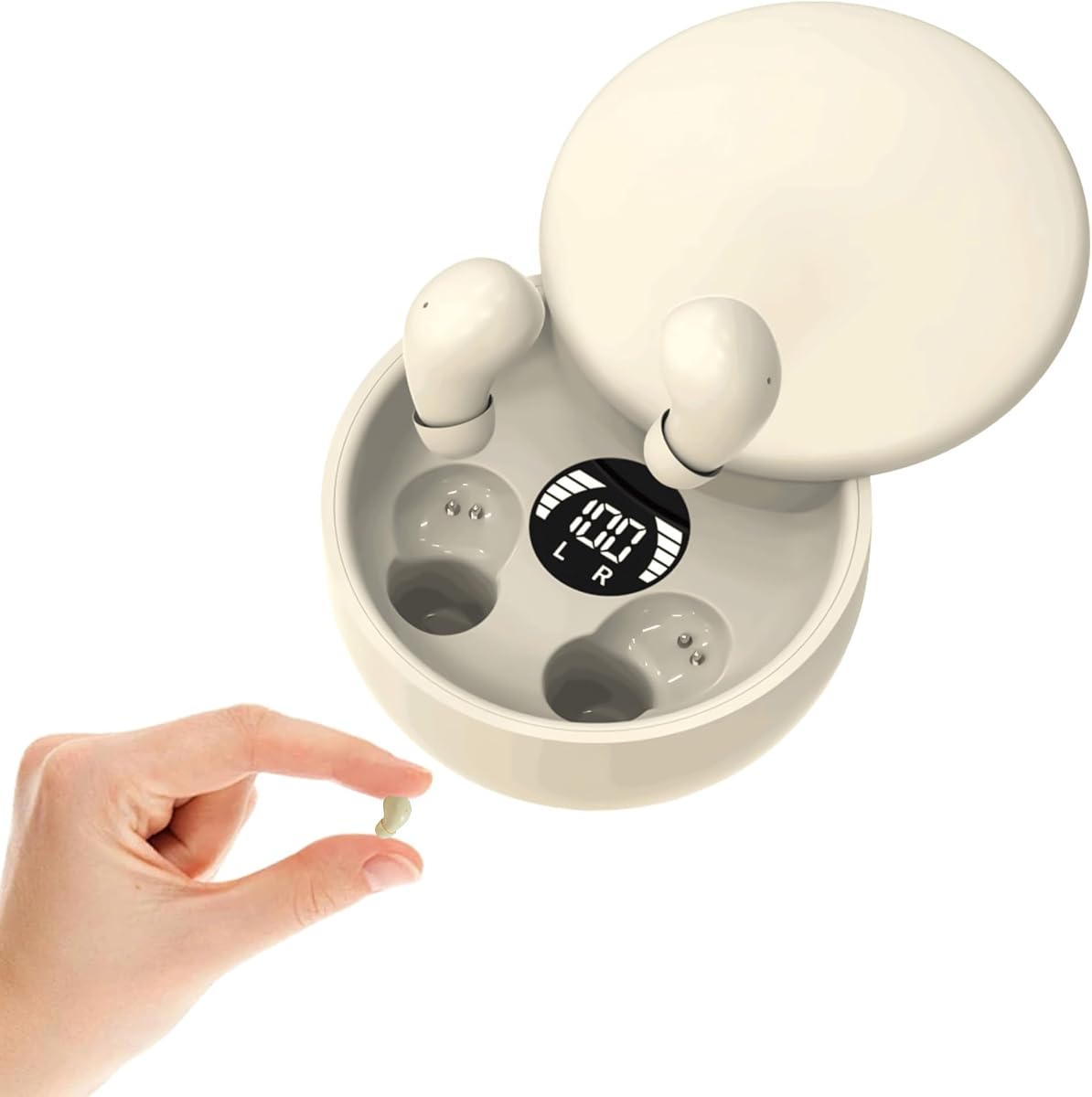
The 2026 Wireless Earbuds for Side Sleepers weigh only 0.08 ounces and use a tiny, low-profile housing intended to sit comfortably in small ear canals. Their discreet appearance works for office use, while the flat shape is designed to remain comfortable when lying on one side. The product has the highest listed rating in this guide at 4.8.
We may earn a commission when you buy through this link, at no additional cost to you.
A full-frequency sound unit and custom moving-coil speaker provide layered audio, while the built-in microphone is designed to reduce background noise and echo during calls. Hall-switch operation enables automatic reconnection after the initial pairing, and touch controls manage music, volume, and calls. The 300mAh charging case extends total endurance to as much as 30 hours, with five to six hours of talk time per charge.
The product is deliberately straightforward. There is no mention of active noise cancellation, app controls, multipoint connectivity, or a formal water-resistance rating. Consequently, it may not be the best choice for demanding workouts, constant outdoor use, or users who want to fine-tune sound through an application. The basic feature set is balanced against exceptional portability and low weight.
This model is a strong pick for sleep, light office listening, short commutes, and anyone who quickly notices conventional earbuds. Its tiny form reduces both visual prominence and the feeling of pressure, while touch controls remain easy to reach. It is especially compelling for side sleepers willing to prioritize a small, simple design over advanced environmental controls.
The shallow, featherweight body avoids the bulky silhouette of conventional earbuds and reduces the chance of creating a noticeable pillow pressure point. It is a sensible option for people who want background audio while resting.
A low-key shape remains unobtrusive in meetings and shared workspaces. After the initial connection, opening the case triggers the hall switch, allowing the earbuds to reconnect without repeated manual pairing.
We may earn a commission when you buy through this link, at no additional cost to you.
Back Bay Audio Mini Earbuds are explicitly designed around small ear canals, combining a slim profile with six tip sizes. That combination makes them one of the most adaptable conventional-style options in the guide. A dedicated extra-bass mode, eight hours of playback per earbud, and IPX7 protection add value beyond simple miniaturization. They hold a 4.3 rating.
We may earn a commission when you buy through this link, at no additional cost to you.
The flush shape is intended to reduce visual bulk while the range of ear tips lets users find a suitable seal and avoid pressure. A control activates stronger bass for workouts, gaming, and energetic music, while the listing states that the earbuds are designed not to distort at high levels. The pocket-sized metal case uses USB-C charging and adds 24 hours to the eight hours available from the earbuds themselves.
Simple Bluetooth pairing works with phones and computers, including Android devices and iPhones, although the product does not claim active noise cancellation, an app, a display, or multipoint connectivity. IPX7 protection handles sweat and rain, but the explicit note excludes swimming. The larger eight-hour battery and sealed tips also make these less suitable for side sleeping than the purpose-built mini sleep models.
These earbuds are a strong choice for buyers with small ears who are willing to experiment with the included tips. They balance portability, battery life, bass, and workout resilience without the complexity of a premium ANC ecosystem. If a small, nearly invisible shape is essential, choose a dedicated sleep model; if a more secure conventional fit and stronger bass are priorities, the Back Bay Audio option is highly competitive.
Six tip sizes reduce the risk of forcing a single tip into a small canal. Users can work toward a secure seal gradually, which can improve bass, stability, and isolation without immediately creating pressure.
An extra-bass mode provides a simple way to add low-end emphasis, while the stated eight-hour single-charge playback supports long commutes and workouts. IPX7 protection adds resistance to sweat and rain, though swimming is excluded.
We may earn a commission when you buy through this link, at no additional cost to you.
Mini Invisible Earbuds for Small Ear Canal emphasize a soft silicone ergonomic fit and a secure, low-profile shape. The rounded in-ear body is designed to reduce pressure in smaller ears while blocking external sound through passive isolation. Its 3.5 rating is lower than the other products in the guide, so prospective buyers should assess the feature set carefully.
We may earn a commission when you buy through this link, at no additional cost to you.
The earbuds use Bluetooth 5.4 with one-step automatic pairing, and the first-time connection process involves searching for “SK26” in a device’s Bluetooth menu. Touch controls handle everyday functions. A slide-type charging case includes a percentage display, while four to five hours of playback per charge extend to as much as 24 hours with the case.
Noise reduction is passive rather than active, meaning the fit does the work instead of electronics canceling sound. The product listing also provides a specific sleep orientation: place the rounded end upward and tilt the touch-sensitive area slightly backward to reduce accidental pillow contact. That guidance is helpful, though it also shows that the low-profile shape requires deliberate positioning for bedtime use.
This model is worth considering for listeners who prioritize soft materials, a discreet profile, and a battery display more than advanced call processing or app controls. It works best for sleep, focused work, and everyday listening in quiet settings. Users who require stronger cancellation, richer specifications, or a more established feature ecosystem may prefer one of the higher-rated alternatives.
Skin-friendly silicone and a rounded shape help avoid hard edges pressing against smaller ear canals. The secure fit supports long wear without relying on a deep or tight seal.
For sleep, the rounded end should face upward and the touch area should tilt slightly backward. Following that positioning can reduce accidental touches and improve the chance that the earbud remains comfortable against a pillow.
We may earn a commission when you buy through this link, at no additional cost to you.
The Small Mini Invisible Earbuds are another extremely compact option, weighing 0.08 ounces and measuring roughly the size of a peanut. Their deep in-ear placement makes them almost invisible from the front, which is useful for office workers or anyone who wants a discreet profile. The earbuds carry a 3.9 rating.
We may earn a commission when you buy through this link, at no additional cost to you.
Bluetooth 5.3 provides a stable true-wireless connection with low-latency performance for media. They can support music, relaxation, exercise, and travel, while the ergonomic shape is designed for secure, natural wear. A digital LED display on the charging case shows remaining power, and four to five hours of playback per charge expand to as much as 30 hours with the case.
Because the housing is so small, battery capacity per earbud is modest, and the case will need more regular recharging than larger models. The listing does not mention active noise cancellation, detailed microphone specifications, app controls, or water resistance. These omissions make the earbuds better for quiet environments and light activity than for harsh outdoor conditions or communication-heavy days.
They are a sensible selection for users who want the smallest possible visual profile and prioritize sleep, office listening, and portability. The secure, low-profile fit may be more comfortable than standard earbuds in small ears. For better battery endurance or stronger environmental controls, consider a slightly larger compact model.
The 0.08-ounce weight and deep placement reduce both visibility and physical awareness. This makes the earbuds appealing for extended office use, study sessions, and sleeping.
The compact case adds multiple recharges and includes a digital power display. Its small footprint makes it easy to carry without the bulk of a conventional earbud charging case.
We may earn a commission when you buy through this link, at no additional cost to you.
Ultra Small Mini Earphones use a slim body that sits deeply inside the ear without protruding. Their low-profile geometry is intended for small ear canals and side sleepers, while the white finish and minimal appearance make them discreet in offices, meetings, libraries, and other shared spaces. The product has a 3.6 rating.
We may earn a commission when you buy through this link, at no additional cost to you.
The ergonomic shape is designed to remain stable without squeezing the ear, and touch controls provide direct access to calls, playback, and track changes. IPX5 protection adds resistance to sweat, splashes, and light rain, making the earbuds suitable for commuting, travel, and light exercise. A stable Bluetooth connection and clear-call capability are also listed among the key features.
The product information provides less detail about total playback, charging-case endurance, microphone configuration, and advanced audio processing than many competing listings. It also does not claim active noise cancellation. Consequently, buyers seeking precise battery figures, EQ controls, multipoint functionality, or a quantified noise-reduction system may need to verify those details before ordering.
This is a useful choice for people whose priority is invisibility and a low-pressure fit. The deep housing should be less noticeable during sleep and work, and IPX5 protection gives it more resilience for everyday activity than an unprotected mini model. Among the products reviewed, it is a viable low-profile option, though the higher-rated sleep earbuds offer more clearly documented battery information.
The flat, slim shape is created to avoid projecting from the ear and pressing awkwardly against a pillow. Its deep position also helps keep the earbud visually understated during work.
An IPX5 rating offers protection against sweat, ordinary splashes, and light rain. That makes the earphones suitable for commuting and lighter workouts, although the rating should not be treated as permission to submerge them.
We may earn a commission when you buy through this link, at no additional cost to you.
The best earbuds for small ears are determined by more than exterior dimensions. Think carefully about insertion depth, housing shape, weight, tip availability, intended activities, and the balance between awareness and isolation before choosing a model.
Small ear canals can react differently to different earbud architectures. Conventional in-ear models sit inside the canal and may need a shallower insertion than expected. Semi-in-ear sleep designs place most of the housing near the entrance, while open-ear clip-ons bypass the canal entirely and rest around the outer ear. Each approach has a different comfort profile, so identify whether you want deep audio isolation, a barely visible sleepbud, or an awareness-friendly open design.
In summary, match the fit type to the activity rather than treating one style as universally best. Use shallow in-ear models for music, semi-in-ear models for sleep, and open-ear models for comfort and awareness.
A small outer earbud does not guarantee a small usable seal. Silicone tips can add width and pressure, while a narrow tip may remain uncomfortable if pushed deeply. Models with several tip sizes offer more room to experiment, and rounded or flattened tips may sit differently than conventional cone-shaped tips. Look for shallow, soft, skin-friendly options and avoid forcing a tip into place when the fit becomes painful.
In summary, prioritize multiple tip sizes and a gentle seal. A comfortable fit should feel stable without producing pressure, even after an hour or more of use.
Lightweight earbuds are easier to forget, particularly during sleep and long work sessions. The mini products in this guide range from approximately 3.0 grams to 0.08 ounces per earbud. Weight alone does not determine comfort, however. Shape, balance, and insertion depth can matter just as much, so read the sizing information and look for a product explicitly designed for small ears.
In summary, lower weight often helps with all-day comfort. Pair it with a low-profile body and shallow placement to minimize pressure.
A sleep-focused buyer may value silence, a dark profile, and a comfortable side-sleeping shape more than sophisticated ANC. Commuters may prefer hybrid noise cancellation, transparency mode, strong microphones, and long battery life. Office users may prioritize discreteness, multipoint connectivity, and comfortable touch controls. The most feature-rich model is not automatically the most comfortable option for a small ear canal.
In summary, prioritize the features used every day. Do not accept a deeper or bulkier fit simply for ANC, app controls, or extra battery life.
Earbud and case endurance should be considered separately because one charge often cannot deliver the maximum total runtime. Very small earbuds commonly provide four to six hours per charge, while conventional models may offer eight to fourteen. Total case runtime can range from approximately 24 to 60 hours across this list. Battery claims also vary with volume, noise cancellation, and use, so treat the largest figure as an upper bound rather than a guarantee.
In summary, check single-charge runtime for long shifts and case runtime for travel. For tiny models, plan on carrying the case when extended listening is required.
Microphone count alone does not reveal real call quality, but it can indicate the manufacturer’s emphasis on voice pickup. The larger models in this guide use multiple microphones, AI processing, and environmental noise reduction, while some tiny models describe only a built-in microphone. Full-range drivers and dedicated bass modes may improve music enjoyment, but open designs generally deliver more environmental awareness and less perceived bass than sealed in-ear earbuds.
In summary, prioritize clear microphones for calls and stable drivers for music. Keep expectations realistic when comparing tiny open or semi-open designs with ANC-equipped conventional earbuds.
Water resistance helps during workouts, commuting, and accidental splashes, but the rating must be interpreted correctly. IPX5 is designed for sweat and light rain, IPX7 offers stronger water protection, and IPX8 indicates a higher level of splash and immersion resistance under the manufacturer’s conditions. Some brands explicitly exclude swimming. Touch controls are convenient, yet the smallest earbuds can be difficult to locate accurately without looking.
In summary, match the protection level to your activity and obey the stated exclusions. Check that touch controls are easy to distinguish before committing to a very small model.
Multipoint and fast automatic reconnection are convenient for people moving between a phone, tablet, and computer. App support can provide EQ modes, noise-control settings, and firmware updates, but it adds complexity and depends on compatible software. Smaller products often skip apps in favor of simple auto pairing and physical touch commands. Decide whether customization or a streamlined experience matters more.
In summary, choose apps and multipoint when they add value to your routine. For sleep, work, or travel, simple one-step pairing may be more useful than extensive settings.
Begin by fully charging the earbuds and their case, then remove each earbud slowly while checking that the silicone tip is seated correctly. For compact in-ear models, place the rounded end naturally in the ear without pushing it deeper than necessary. For open-ear clip-ons, wrap the bridge around the outer ear and adjust its width and vertical position until the speaker rests comfortably near the ear canal.
Pair the device through the Bluetooth menu on the first use. Depending on the model, this may happen automatically after opening the case, or you may need to select the product name from the available-device list. Once connected, learn the touch controls, confirm the expected pairing behavior for a second device, and adjust volume with ANC or transparency disabled when evaluating sound quality.
Clean the earbuds and silicone tips regularly with a soft dry cloth, and use a slightly damp cloth only when the manufacturer permits it. Keep charging contacts free of debris, avoid exposing the earbuds to excessive heat, and allow the case to dry before charging if it has been exposed to moisture. Always follow the specific water-resistance and cleaning instructions supplied with the product.
The Side-Sleeper Sleep Earbuds are the strongest dedicated match because their 3.0g semi-in-ear housings are specifically designed for small canals. The ultra-compact models are also lightweight, while the TOZO NC9 and Back Bay Audio options offer several tip sizes. The best choice depends on whether priority is sleep, bass, adjustable tips, or noise cancelling.
They can be, provided the model has a genuinely low-profile shape and the earbud is not inserted deeply. Products designed for side sleeping are better choices than conventional earbuds because they reduce pressure against a pillow. The Yihou, 2026 Wireless, Mini Invisible, and Ultra Small models are especially relevant for sleep.
Not necessarily. A small in-ear model can create useful passive noise isolation when it forms a comfortable seal, while an open-ear product preserves awareness instead. Active noise cancelling is valuable for commuting and focused work, but it normally involves a larger housing and may feel less natural in a very small canal.
Start with the correct tip size and avoid pushing the earbud deeply. A secure but gentle seal is more reliable than an aggressive insertion. For conventional models, try all available tip sizes, and for clip-on designs, adjust the bridge width and speaker position. Cleaning the earbuds and keeping the case contacts clear can also improve consistent reconnection and charging.
Open-ear models are usually more comfortable for sensitive ears, work well with glasses, and maintain environmental awareness. In-ear models generally provide stronger bass and noise isolation and are easier to use while sleeping because they do not wrap around the outer ear. Your activity and sensitivity should determine which trade-off is preferable.
They can be adequate for short calls in quiet settings, but models with multiple microphones and environmental noise reduction are more dependable in noisy places. The Soundcore P30i and TOZO NC9 offer more elaborate call systems than the ultra-compact sleep models. Microphone placement can still affect performance, so testing in a realistic environment is advisable.
Remove the earbuds from the case and wipe the housings and silicone tips with a soft, dry lint-free cloth. Avoid pushing debris into the speaker openings, and do not immerse the earbuds unless the manufacturer specifically permits it. Let the case remain dry before charging, and follow the product’s cleaning instructions when they differ from general advice.
Open-ear clip-on models are generally the easiest to combine with glasses because nothing needs to enter the ear canal. In-ear mini models may also work, but a bulky tip or high-profile housing can interfere with frames or press against piercings. Users who wear both should compare the earbud position with their glasses before purchasing.
The Side-Sleeper Sleep Earbuds offer the most convincing overall package for small ears, combining a 3.0g semi-in-ear design with a 4.7 rating and extended battery life. The featherweight 2026 Wireless Sleep Earbuds are a strong budget-oriented alternative, while Back Bay Audio Mini Earbuds provide the best premium fit flexibility with six tip sizes.
Prioritize the fit before comparing every feature. A comfortable, stable shape matters more than another layer of noise cancellation, especially for small or sensitive ears. Choose sleep-oriented mini models for side sleeping, open-ear clip-ons for awareness and glasses, and conventional models with multiple tips when bass, app controls, and ANC matter more.
Specifications and availability can change, so check the current listing, included accessories, fit guidance, and latest price before buying. The right earbuds should disappear without creating pressure while still meeting your priorities for sleep, music, commuting, calls, and exercise.