
320×240 Handheld Thermal Imager
4.6Editor score
320×240 infrared screen resolution
Eight-hertz thermal refresh rate
Thirty-degree temperature measurement span
One-hundred-image internal storage
Four-hour continuous battery use
Infrared cameras for ghost hunting are specialized thermal imagers that reveal temperature variations, hotspots, cold spots, and unusual heat patterns in places that may appear ordinary in visible light. A good paranormal-investigation camera should combine a clear display, sensitive thermal sensor, practical battery life, and controls that work well in dim rooms, old buildings, and outdoor locations.
This guide compares ten infrared and thermal-imaging options using the specifications supplied for each model, including display resolution, measured temperature range, thermal sensitivity, field of view, storage, alarms, battery life, and special investigation features. It also distinguishes true thermal cameras from night-vision camcorders, because those devices serve different purposes during a ghost-hunting session.
The selections show which cameras suit beginners, long mobile investigations, budget-conscious paranormal explorers, and users who need advanced scene recognition or detailed computer analysis. Ratings and product configurations can change over time, and prices also fluctuate, so readers should confirm the current listing, included accessories, and warranty before making a purchase.
4.6Editor score

4.4Editor score

4.5Editor score
As an Amazon Associate we earn from qualifying purchases.
The table below compares all ten devices by sensor output, display characteristics, temperature range, battery capability, and investigation-oriented features, making it easier to identify the camera that matches your preferred style of paranormal research.



The TOPDON TC004 Mini is a compact thermal camera with a 4.4 rating and a particularly balanced feature set for paranormal investigators who want detailed imaging without a large professional-style body. TISR technology enhances the base thermal image to a 240×240 effective resolution, while the 25Hz refresh rate helps movement appear smooth. Its 40°x30° field of view is broad enough for scanning rooms, corridors, walls, and outdoor areas without requiring constant repositioning.
We may earn a commission when you buy through this link, at no additional cost to you.
Temperature measurement covers minus 4°F through 842°F with an accuracy error stated as within plus or minus 3.6°F or 2%. The camera automatically identifies the hottest, coldest, and central points, and users can select from five palettes: White Hot, Black Hot, Iron, Rainbow, and Red Hot. Preset temperature warnings provide a useful way to notice a changing thermal pattern, while automatic image capture at an alert can preserve the moment for later comparison.
Its internal 512MB eMMC storage can hold up to 8,000 photos, which is ample for documenting ordinary thermal readings but less generous than the FOXWELL RT280 and HF96. The pocket-friendly shape, 15-hour stated runtime, automatic shutoff choices, and IP54 protection make it practical for extended field sessions. A charging cable is included, although a charging head is not, and the paper manual is replaced by an electronic download.
The TC004 Mini is the strongest all-around recommendation for most ghost-hunting groups. It suits users who want dependable thermal measurements, simple menus, generous battery life, and sufficient image detail without moving into advanced computer-analysis workflows. It will not establish paranormal activity by itself, but it provides a practical instrument for noticing temperature anomalies, documenting changing conditions, and checking whether a suspected area differs from its surroundings.
The combination of 240×240 enhanced output, a 25Hz refresh rate, and five color palettes makes small temperature variations easier to distinguish. That makes the TC004 Mini practical for comparing doors, floors, walls, furniture, and appliances while moving through a location.
The stated 15-hour runtime reduces concern about battery life on long investigations, while automatic alerts and photo capture help users record notable changes without manually operating every function.
We may earn a commission when you buy through this link, at no additional cost to you.
This handheld infrared thermal imager offers an appealing combination of native 320×240 resolution, a 4.6 rating, and straightforward field operation. Its 2.8-inch LCD presents thermal imagery and tracks the maximum, minimum, and center-point temperatures, allowing an investigator to scan an area and immediately identify where the most significant variations are concentrated. An eight-hertz refresh rate supports relatively smooth viewing for this class of compact device.
We may earn a commission when you buy through this link, at no additional cost to you.
The measurement range extends from minus 30°C to 200°C, with stated accuracy of plus or minus 2°C. That span covers many ordinary environmental conditions, including cooler rooms, exterior areas, and moderately warm equipment. Integrated SPI Flash storage holds up to 100 images, and a USB-C connection allows those files to be viewed, downloaded, or analyzed on a compatible computer or mobile device.
Its 3.7-volt lithium-ion battery is rated for up to four hours of continuous use, which is shorter than the 11- to 15-hour figures associated with several larger-capacity competitors. However, the camera supports charging while operating, a valuable feature during stationary surveillance or a multi-location investigation. The FR4 epoxy shell offers basic protection, while the compact and lightweight design is convenient for packing into an investigation kit.
This is the best budget-oriented thermal camera in the group for readers who prioritize resolution, a proper LCD, simple temperature tracking, and file transfer over large storage or long battery life. It is especially suitable for beginners, home investigations, and short outings. Users planning all-night surveillance should account for the shorter runtime, while teams wanting automated scene analysis can consider a more specialized alternative.
Native 320×240 output and center, hot, and cold point tracking provide enough detail for introductory paranormal research. It also gives new users familiar temperature and image functions without the complexity of professional analysis software.
USB-C charging, transfer, and the ability to operate while charging make the camera flexible for short sessions. The four-hour runtime remains the principal limitation for overnight work.
We may earn a commission when you buy through this link, at no additional cost to you.
The ORDRO 4K Night Vision Camcorder is not a thermal imager, but it earns a place in this guide as a complementary recording device for ghost-hunting teams that also want visible-light video and time-lapse documentation. It records at 2880×2160 and 24fps, with additional modes at 2K/30fps, 1080p/60fps, and 720p/120fps. Its 3.1-inch IPS touchscreen and webcam function make it useful for vlogs, livestream-style monitoring, and content recording.
We may earn a commission when you buy through this link, at no additional cost to you.
The camcorder uses a 13-megapixel IMX258 CMOS sensor with Exmor RS technology for improved low-light performance, while a fixed lens begins focusing at more than three feet. Built-in infrared night vision produces black-and-white recording up to 16 feet. The package also includes an external infrared light, which can extend illumination in dark areas and provides a useful second light source for close-range monitoring.
Its accessory list includes a lens hood, handheld stabilizer, remote control, two batteries with a charger, camera bag, strap, 64GB memory card, and USB and HDMI cables. A hot shoe permits compatible external accessories, and recording while charging with pause support can assist longer sessions. Time-lapse is available, with external power recommended for extended captures.
Choose the ORDRO when visible-light evidence, audio-video context, time-lapse monitoring, and content creation matter as much as thermal readings. It should not be confused with an infrared thermal camera: it does not visualize heat gradients or provide the temperature measurements found in the other selections. Pairing it with a dedicated thermal imager creates a more complete documentation kit.
Thermal images can reveal where to look more closely, while 4K video records the surrounding scene, movement, room layout, and environmental context. This camcorder is therefore most valuable as a companion rather than a replacement.
Multiple recording formats, time-lapse, pause while charging, two batteries, and a 64GB card support extended documentation. The external IR light is particularly useful in rooms where visible illumination is limited.
We may earn a commission when you buy through this link, at no additional cost to you.
The GT14S Edge Enhancement Camera combines a 4.6 rating with a high-sensitivity sensor specified below 50mK, making it attractive for investigators looking for subtle rather than dramatic temperature differences. Its center, hot, and cold spot modes track meaningful areas on the thermal image, while thermometer mode offers a direct numerical reading when a point measurement is more useful than a full-screen heatmap.
We may earn a commission when you buy through this link, at no additional cost to you.
A 50-degree field of view enables broad scanning of walls, floors, ceilings, and outdoor spaces. Seven color palettes allow users to adjust visual contrast, and custom high and low alarms can notify them when conditions cross a chosen threshold. Level and span controls are particularly valuable for paranormal work because they can make localized variations easier to examine without changing the underlying measurement.
The stated measurement range is minus 4°F to 1,022°F, and adjustable emissivity and distance settings allow the operator to improve results across different materials. The included 2,500mAh rechargeable battery is stated to provide up to 14 hours of continuous operation. At 240 grams, the camera is light enough for prolonged handheld work, and a non-slip grip supports steadier scanning.
This GT14S is a good choice for mobile investigators who value sensitivity, a broad field of view, long operating time, and straightforward alarms. It may be especially useful when temperature changes are expected to be modest and require careful visual separation. The product description does not emphasize extensive file storage or computer analysis, so users who need those functions should verify the current configuration before buying.
The sensor sensitivity and 0.05°C difference capability are useful when looking for small variations around doors, walls, floors, and objects. Fine control of level and span makes those areas more visually distinct.
The 50-degree field of view helps investigators cover larger spaces quickly. Adjustable alerts can serve as a prompt to stop, center an area, capture evidence, and compare the reading with adjacent surfaces.
We may earn a commission when you buy through this link, at no additional cost to you.
The ultra-light GT14S offers a 4.6 rating, a 240-gram body, and a high-sensitivity thermal sensor for investigators who need to carry a camera through large buildings or outdoor locations. Despite its small size, it supports full-screen thermal imaging, center/hot/cold spot tracking, a numerical thermometer mode, seven color palettes, and adjustable emissivity and distance settings.
We may earn a commission when you buy through this link, at no additional cost to you.
Its thermal sensitivity is specified below 50mK, with the ability to detect differences as small as 0.05°C. The 50-degree field of view allows broad scans, while custom high and low alarms indicate when a surface or object falls outside the range selected by the user. Level and span controls can improve contrast and make subtle patterns easier to examine during repeated sweeps.
The minus 4°F to 1,022°F range suits household, insulation, automotive, kitchen, and general diagnostic tasks. A 2,500mAh rechargeable battery is stated to last up to 14 hours, reducing the need to carry spare power during a long investigation. The balanced shape, non-slip grip, and simple button layout also favor fast operation, which is useful when covering a location with limited time.
This listing is closely related to the preceding GT14S version, so buyers should compare the current pages carefully. Nevertheless, for readers prioritizing low weight, long stated runtime, and sensitive scanning, the ultra-light GT14S is compelling. It is best suited to teams that want straightforward thermal observation and alarms rather than a large photo library or advanced desktop reporting workflow.
The 240-gram weight and non-slip grip reduce fatigue during repeated room sweeps. A long stated runtime also keeps the camera ready for extended mobile work without frequent charging stops.
Full-screen thermal imaging helps reveal patterns, while thermometer mode delivers a direct reading when a precise point measurement is required. Using both modes can make a paranormal survey more methodical.
We may earn a commission when you buy through this link, at no additional cost to you.
The Kanayu kit stands apart because it combines an MLX90640 thermal imager with four light-up interactive cat balls. The camera itself uses a 2.8-inch TFT display at 320×240 and can display and track maximum, minimum, and center temperatures. That combination of thermal observation and flashing props may appeal to paranormal groups that want a ready-made kit for staged investigations or entertaining demonstrations.
We may earn a commission when you buy through this link, at no additional cost to you.
The camera is built with an epoxy resin board, printed circuit board, and FR4 epoxy shell, and it operates without external equipment. SPI Flash storage holds up to 100 images, while a data cable allows images to be copied to a computer or mobile device. Its lithium-ion battery supports up to four hours of use, and operation while charging is available for longer sessions.
The four cat balls flash brightly to attract attention and add a theatrical element to a ghost hunt. They are not thermal sensors, and their value is primarily novelty or engagement rather than evidence collection. The included lights can help direct attention toward a monitored area, but users should avoid confusing their blinking effects with measured thermal anomalies.
The Kanayu package is most appropriate for beginners, paranormal enthusiasts, and groups seeking an all-in-one kit that includes both a camera and light-up accessories. Its 3.8 rating is the second-lowest in this comparison, so prospective buyers should consider the camera on its own specifications rather than relying on the novelty of the bundled toys. For more advanced workflows, the included camera is still capable of basic thermal surveys and stored-image comparison.
The combination of a thermal camera and four illuminated cat balls removes the need to assemble basic props separately. It is a convenient option for casual investigations, demonstrations, and group activities.
The specified sensor and three-point temperature tracking provide meaningful measurement functions. The flashing toys should be treated as atmosphere or attention aids, not as substitutes for controlled thermal comparisons.
We may earn a commission when you buy through this link, at no additional cost to you.
The HF96 is the most analysis-focused camera in the group, with a 4.5 rating, IntellFault AI scene recognition, live super-resolution enhancement, and compatibility with HSF Studio for Windows. The AI function is designed to identify likely water leaks and insulation gaps, although the product information explicitly states that it does not provide moisture readings. It should therefore be understood as automated visual scene detection, not a dedicated moisture meter.
We may earn a commission when you buy through this link, at no additional cost to you.
Thermal images are enhanced to 240×240 during live viewing and photo capture, with a stated thermal sensitivity below 50mK and the ability to detect variations as small as 0.05°C. A 25Hz refresh rate creates smooth motion, and the 50-degree field of view supports broad coverage. The device automatically tracks hot, cold, and center spots, offers custom alarms, and permits manual level and span adjustment for isolating anomalies.
The camera combines a thermometer, thermal imager, and integrated laser pointer. The laser is helpful for pointing out the exact area being examined in dim rooms or confined spaces, while seven palettes support different visual preferences. HSF Studio adds image analysis, screen projection, real-time monitoring, and 3D plotting, giving investigators a much deeper workflow than a basic stand-alone imager.
Storage and durability are additional strengths. The built-in 4GB capacity can hold more than 30,000 images and 14 hours of video, the battery is stated to run for up to 11 hours, and the housing carries a 6.6-foot drop rating and IP54 protection. This is a strong recommendation for investigators who want repeatable comparisons, software-assisted review, and professional-style records, provided they use a compatible Windows computer and configure the firmware correctly.
HSF Studio supports live monitoring, projection, 3D plotting, and image analysis. These functions can help users organize larger collections and examine anomalies more systematically than a simple on-camera review.
The laser pointer identifies the area under examination, and the 25Hz image stream makes moving targets easier to follow. A standard tripod hole also supports fixed monitoring positions.
We may earn a commission when you buy through this link, at no additional cost to you.
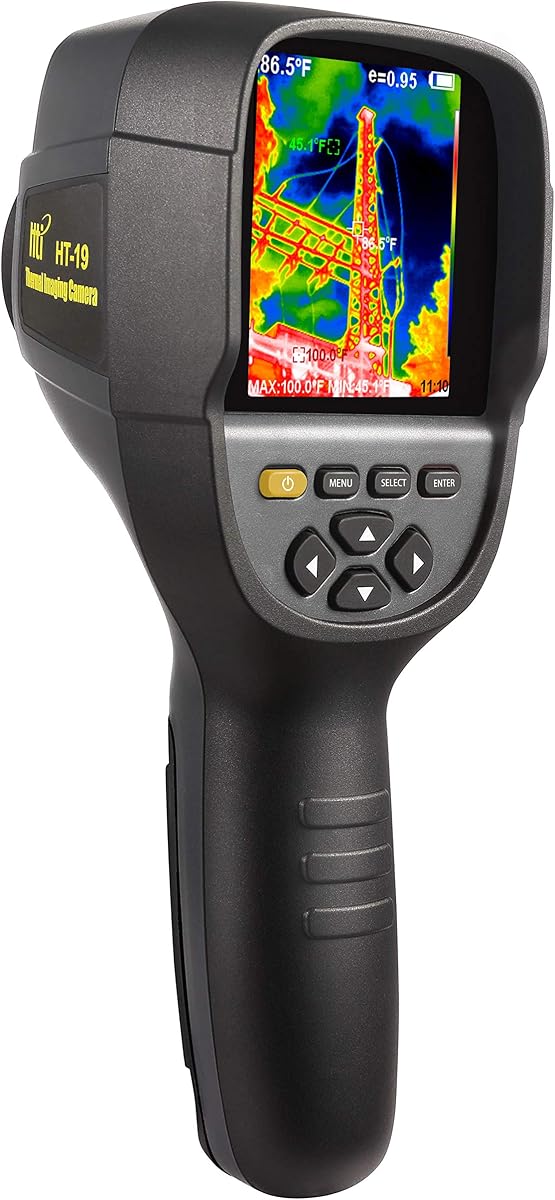
The HTI-19 is a 320×240 infrared thermal imager with a 4.2 rating, a 3.2-inch color screen, and a simple design aimed at users who want readable images without navigating a dense interface. It is marketed for home inspections, firefighting, farming, electronics, traffic study, archaeology, and scientific or hobby applications, which makes its straightforward measurement display equally relevant to paranormal research.
We may earn a commission when you buy through this link, at no additional cost to you.
The camera claims accuracy to 2.5°F and offers five color scales: Rainbow, Iron Red, Cold Color, Black and White, and White and Black. Users can view surface temperature and live thermal imagery together, while push-button operation is designed to make the device accessible without a learning curve. A 3GB built-in memory card is included, and micro-USB provides a connection for laptop or computer viewing.
Its most important limitation is power. The rechargeable battery offers only two to three hours of continuous operation, considerably less than many newer compact models. That makes the HTI-19 more appropriate for focused surveys, short paranormal sessions, or work near an available outlet than for an entire night of roaming investigations. The included travel pouch helps protect the unit during transport and storage.
The HTI-19 is a sensible choice for readers who prioritize a large, readable color display, native resolution, straightforward controls, and established after-sales support. Its three-year warranty, North Carolina-based support branch, and included storage differentiate it from minimalist models. Users planning long nights should prepare spare power or choose a camera with a longer runtime.
The 3.2-inch color screen gives thermal patterns more room to develop, while five palettes let operators select a familiar visualization method. This is useful when explaining observations to a team or recording screen footage.
Push-button controls reduce the learning curve, and the included 3GB card avoids an immediate storage purchase. The three-year warranty adds confidence for buyers who want straightforward support as well as readable results.
We may earn a commission when you buy through this link, at no additional cost to you.
The Mini Handheld Thermal Camera is positioned as a portable paranormal tool with a 3.5 rating, a 2.8-inch TFT display, and straightforward non-contact temperature measurement. It can measure from minus 40°C to 300°C with stated accuracy of plus or minus 2°C, making its measurement span broad relative to its compact size. That range covers cool external environments through warm household and mechanical subjects.
We may earn a commission when you buy through this link, at no additional cost to you.
Thermal resolving power is 24×32, the lowest among the thermal devices in this guide, so it should be regarded as an introductory model rather than a detailed inspection camera. Its primary advantage is portability: the 800mAh rechargeable lithium-ion battery and small body make it easy to carry while checking doors, walls, appliances, outdoor surfaces, and other suspected locations.
Up to 100 captured thermal images can be stored and later examined through a Type-C connection to a computer. This makes basic before-and-after comparison possible without a large internal storage system. The camera is designed for situations where physical contact is undesirable, including moving objects, live electrical circuits, and insulation checks, although safe and appropriate use around energized equipment remains the operator's responsibility.
The lowest rating in the group should be considered carefully, as does the modest image resolution. However, the Mini Paranormal Thermal Camera may still suit a new investigator who wants a small device for occasional checks, simple temperature readings, and stored image review. Buyers needing finer thermal detail or stronger overall performance should favor one of the 320×240-resolution alternatives.
The compact body and rechargeable battery make this camera convenient for quick inspections and a lightweight investigation kit. It is better suited to occasional checks than prolonged, image-heavy documentation.
Storing 100 images and connecting them to a computer provides a simple way to revisit observations. The limited resolution makes side-by-side review less precise than on higher-detail cameras.
We may earn a commission when you buy through this link, at no additional cost to you.
The FOXWELL RT280 is the premium selection in this guide, combining a 4.5 rating with a 2.8-inch 320×240 color LCD, TISR image enhancement, extensive storage, and sophisticated Windows software. TISR increases effective resolution from 120×90 to 240×180, while a 25Hz frame rate and 50°x38° field of view support smooth scanning across broad areas.
We may earn a commission when you buy through this link, at no additional cost to you.
Its analysis software is the major differentiator. Windows users can transfer images for point, line, and area temperature analysis, 2D and 3D thermal views, and automatic report generation. A built-in 8GB eMMC can store more than 20,000 images and videos, making it easier to retain an entire investigation rather than repeatedly selecting and deleting files.
Temperature measurement covers minus 4°F to 1,022°F with stated accuracy of plus or minus 3.6°F or 2%. The camera automatically identifies the highest, lowest, and central temperatures, while high and low alarms provide visual and audible warnings. Nine palettes, a built-in laser pointer, and an LED light assist in dark or confined locations. The software is not compatible with Mac systems, which should be checked before purchase.
Durability is another strength. The housing withstands 6.6-foot drops and carries an IP54 dust and water-resistance rating, while the ergonomic form remains suitable for field use. The RT280 is the strongest option for serious investigators who want professional-style analysis, large storage, and useful low-light tools. Beginners who only need occasional temperature checks may find a simpler camera more convenient.
Point, line, and area measurements allow users to define exactly which region of a thermal image they are evaluating. Automatic reports and 3D views can make findings easier to organize and share.
More than 20,000 stored images and videos reduce the need to transfer files after every outing. That capacity supports repeated comparisons of rooms, devices, entrances, and other monitored areas.
The laser pointer and LED make the camera easier to operate in poorly lit or confined spaces. Its stated drop resistance and IP54 rating also suit locations where equipment may encounter dust or moisture.
We may earn a commission when you buy through this link, at no additional cost to you.
Choosing a paranormal thermal camera involves balancing image detail, sensitivity, battery life, storage, and ease of use. The most useful device is not necessarily the one with the longest specification list, but the one that supports a repeatable investigation while remaining practical in the environments you expect to visit.
Resolution determines how much spatial detail appears in a thermal frame. Devices with native 320×240 output generally provide more usable information than a 24×32 entry model, while TISR enhancement can make lower-resolution sensors appear clearer without creating the same amount of native detail. For ghost hunting, small anomalies such as a narrow cool line around a doorway, a localized temperature pattern behind furniture, or a contrasting patch on a wall may be easier to recognize when the image contains more pixels and the display is sufficiently large.
Thermal sensitivity indicates how small a temperature difference the device can distinguish. A stated NETD below 50mK is useful when the expected anomaly is subtle, while the ability to detect differences around 0.05°C appears across several of the stronger models. Temperature range should also match the environment: a broad span from below freezing to several hundred degrees provides flexibility, but accuracy, emissivity adjustment, and correct readings remain more important than range alone. A camera does not create evidence of a paranormal event; it records thermal conditions that require cautious interpretation.
A wider field of view lets an investigator scan more of a room or exterior area without repeatedly moving the camera. The 40°x30°, 50°, and 50°x38° options in this guide are appropriate for room sweeps, while a higher refresh rate makes live movement appear smoother and reduces eye strain during a prolonged scan. Neither factor replaces good technique: a narrow view may be useful for inspecting a specific object, and a smooth image can still be misinterpreted if the operator changes distance, angle, or emissivity without recording those changes.
Runtime is often more important than a small difference in resolution. Stated operating times range from four hours to 15 hours, with several cameras able to operate while charging. A long-runtime model such as the TOPDON TC004 Mini is convenient for overnight roaming, while a camera that can run while connected to a power source can serve a fixed monitoring station. Check the supplied battery capacity, charging method, and whether a charging head or adapter is included, because some packages provide only a cable.
Image storage determines how many thermal observations can be preserved before transfer. The FOXWELL RT280 supports more than 20,000 images, the HF96 stores more than 30,000 images plus video, and the TOPDON TC004 Mini holds up to 8,000 photos. Smaller 100-image libraries are sufficient for casual checks but may require frequent downloading. USB-C and micro-USB connections make transfer convenient, while computer software can add region measurements, 3D visualization, live projection, and reports. Confirm operating-system compatibility, especially when advanced analysis is available only for Windows.
Color palettes affect how easily temperature patterns can be distinguished. Some investigators prefer rainbow-style gradients for broad contrast, while monochrome palettes can make faint boundaries more apparent. High and low alarms are useful for documenting unusual changes, although they should be configured with reference surfaces and realistic thresholds. AI scene detection may accelerate comparisons involving insulation gaps or suspected leaks, while a laser pointer, LED light, and thermometer mode can help operators direct attention and collect supporting readings.
Old properties, outdoor graveyards, and nighttime locations can involve dust, moisture, uneven floors, and long periods of handheld use. Several cameras in this guide specify IP54 protection and drop resistance, while the TC004 Mini is described as surviving drops up to two meters. Portability also affects user fatigue: a 240-gram device can be easier to carry than a heavier unit, but a larger body may accommodate a larger display and stronger internal storage. The best balance depends on whether the camera will be carried continuously or mounted in one position.
A thermal camera measures infrared energy and displays heat patterns, while a night-vision camcorder records visible detail under low light. These are complementary tools rather than interchangeable ones. The ORDRO 4K camcorder can provide conventional video, time-lapse evidence, and a wide view of the investigation area, while a dedicated thermal camera helps identify environmental temperature differences. The strongest evidence workflow often combines thermal imaging for targeted observation, visible-light recording for context, and a written log of conditions, location, time, and camera settings.
Begin with a controlled baseline rather than pointing the camera at the first suspicious area. Allow the thermal imager to acclimate to the environment, select an appropriate emissivity value for the surface, and record reference readings from ordinary walls, floors, doors, and nearby objects. This establishes what normal conditions look like at that time and helps prevent temperature changes caused by outdoor weather, heating systems, sunlight, appliances, or body heat from being mistaken for unexplained activity.
Move through the location systematically. Scan large areas with a wide field of view, keep a consistent distance and angle, and stop whenever the display shows a significant hotspot, cold spot, or boundary. Capture a reference image first, document the camera settings and surface material, then take a closer image of the anomaly. Repeat the observation from another angle when possible, because reflections, drafts, and changes in surface properties can resemble unusual thermal patterns.
Protect the equipment and keep the record meaningful. Use the stated drop and water-resistance limits as guidance rather than a guarantee, avoid pointing the camera at intense heat sources, keep charging contacts clean, and download important files before clearing storage. Store the device in its pouch or a dry case, update firmware only when the current instructions are available, and maintain a log containing the date, time, location, environmental conditions, reference readings, and any actions taken during the investigation.
No. An infrared thermal camera measures temperature and heat distribution; it cannot verify the existence of a ghost. Any unusual reading should be checked for ordinary causes such as drafts, sunlight, heating systems, electrical equipment, insulation gaps, or recently moved objects. The camera is best used as a documentation and comparison tool rather than a stand-alone paranormal detector.
A native resolution around 320×240 is a strong starting point for distinguishing localized thermal patterns. TISR or similar enhancement can improve clarity, but it does not create the same detail as native pixel data. The most important factors are sensitivity, display quality, stable technique, and taking reference images under consistent conditions.
Thermal cameras are better for detecting and measuring temperature differences, while night-vision cameras are better for recording visible detail in darkness. They answer different questions and work best together. A thermal camera can point investigators toward an unusual area, while a night-vision camcorder can document movement, shape, and broader environmental context.
The reading may change because of the surface being viewed, its emissivity, the camera angle, distance, reflected heat, drafts, or nearby moving people. Different materials can also display misleading apparent temperatures. Record the surface, distance, and settings, and compare the area with nearby reference surfaces before drawing a conclusion.
Allow the camera to stabilize in the environment before making comparative measurements, especially when moving between very different temperatures. Follow the manufacturer's startup guidance and avoid taking important readings immediately after arrival. A consistent acclimation routine makes later comparisons more reliable.
Yes, because stored images allow investigators to compare conditions before, during, and after an event. Capacity ranges from about 100 pictures on smaller units to tens of thousands on larger models. Teams conducting long or multi-location investigations should also verify compatible cables and computer software for transferring, organizing, and analyzing images.
A carrying case, spare batteries, charging cable or power bank, and a device for logging observations can be more useful than decorative accessories. A tripod helps with fixed monitoring, while an LED or laser pointer assists in dark locations. The included cat-ball lights in the Kanayu kit add atmosphere, but they do not collect thermal evidence.
Many can, provided their temperature and ingress-protection limits are respected. The models with IP54 ratings offer stated protection against dust and water, while several support broad temperature ranges. Weather can also create genuine thermal differences, such as sunlight warming walls or ground cooling rapidly, so outdoor readings require especially careful reference measurements.
The TOPDON TC004 Mini is the most balanced overall choice because it combines enhanced 240×240 imaging, a broad field of view, useful alerts, generous storage, and a long stated runtime. The handheld 320×240 thermal imager is the best budget option for readers who want strong native resolution and USB-C convenience in a compact body. The FOXWELL RT280 is the best premium selection because its large storage, advanced Windows analysis, laser pointer, LED, and rugged construction support serious case work.
The remaining models cover distinct needs. The HF96 appeals to users who value AI-assisted scene recognition and sophisticated desktop analysis, while the two GT14S versions emphasize sensitivity, wide scanning, and long battery life. The HTI-19 offers a proven large-display design, the Kanayu package includes both a thermal camera and novelty lights, and the Mini Paranormal Thermal Camera provides a lightweight entry point. The ORDRO camcorder is best understood as a visible-light and time-lapse companion.
Before purchasing, verify the current specifications, package contents, compatibility, warranty, and review feedback. Prices change frequently, and sellers may offer different configurations over time. Prioritize resolution, thermal sensitivity, battery life, and recording method according to your investigation style, and use every image as a measured observation within a controlled comparison rather than as automatic confirmation of paranormal activity.