
Sonilco Internal HD Mini SAS Cable
5.0Editor score
SFF-8643 host connector
Four SATA drive outputs
Compact 1.6-foot length
Twenty-four-month warranty
Our Internal Mini SAS to SATA Cable guide compares ten options for connector fit, drive support, length, routing, RAID compatibility, and build quality.
Internal Mini SAS to SATA cables bridge an SFF-8087 or SFF-8643 controller connection with conventional SATA drives, making them useful for RAID arrays, JBOD storage, and carefully planned workstation or server builds. A dependable cable must match the host connector, provide secure drive connections, and route cleanly around crowded internal components.
We compared all ten products by host-side connector, target-side connections, supported drive count, stated transfer capabilities, cable length, installation features, and RAID-related compatibility. The list includes forward-breakout cables for direct SATA drives as well as one dual-SFF-8087 cable that serves a different role and is included to clarify the category.
Each review identifies the configuration a cable is best suited for, from short and compact installations to longer internal runs. Ratings reflect the supplied product data, while practical recommendations depend on your controller, backplane, drive arrangement, and case layout. Prices and availability change, so check current listing details before ordering.
5.0Editor score

4.8Editor score

4.6Editor score
The table below compares each cable by host connector, target configuration, drive capacity, length, and practical installation details. Connector standards are the most important differentiator because SFF-8087 and SFF-8643 cables are not interchangeable.


The Cable Matters Internal Mini SAS HD to SATA Cable is a forward-breakout assembly designed to connect an SFF-8643 host bus adapter or RAID controller to four individual SATA drives. It carries a supplied rating of 4.7, and its most attractive qualities are the one-meter reach, equal-length branches, flexible routing material, and clearly identified drive connections.
We may earn a commission when you buy through this link, at no additional cost to you.
Its host side uses the 36-pin SFF-8643 interface, while the target side divides into four seven-pin SATA connectors. The product data states support for both 3 Gbps and 6 Gbps SATA devices during migration toward 12 Gbps storage systems. It also mentions compatibility with Adaptec RAID 71605 and 7895 storage controllers, making controller verification especially important before purchase.
Installation features show attention to real chassis work. Acetate cloth tape reinforces the slim ribbon construction, a woven mesh section assists routing, and P1 through P4 markers simplify identification of the drive branches. Low-profile SATA connectors add easy-grip treads and stainless steel latches, which can be valuable where vibration or limited clearance could loosen a connection.
This is a strong general recommendation for a four-drive SFF-8643 installation that needs more routing freedom than a half-meter assembly. It is not appropriate for an SFF-8087 controller or a backplane presenting the wrong SFF-8644 interface. Confirm the connector and planned drive positions, then choose this cable if its one-meter reach and flexible construction suit the chassis layout.
The combination of slim ribbon branches, strain-relief tape, and a partial woven sheath makes this cable more accommodating than a rigid harness. The one-meter length gives installers room to reach widely spaced drive bays while keeping the four target branches equal in length.
P1-to-P4 markers reduce the chance of connecting a SATA branch to the wrong drive after the system is assembled. The numbered layout is especially helpful when the controller manages an array and each physical bay must correspond to a known logical drive.
We may earn a commission when you buy through this link, at no additional cost to you.
This Cable Matters internal Mini SAS to SATA cable is designed for an SFF-8087 RAID or PCIe controller and four discrete SATA drives. Its supplied rating of 4.8 places it among the strongest options in the group, while its compact 1.6-foot format makes it particularly attractive for dense server, NAS, and workstation interiors.
We may earn a commission when you buy through this link, at no additional cost to you.
The multi-lane breakout design can support as many as four SATA devices at up to 6 Gbps per drive. The supplied information also notes that two cables can connect up to eight drives across compatible host bus adapter lanes, which makes cable planning important when building an eight-drive array with a controller that supports the required configuration.
Unlike many dense server harnesses, the slim ribbon branches are intended to minimize interference with airflow. Acetate tape provides strain relief, a woven sheath helps with cable management, and P1-to-P4 markers make branch identification easier. Low-profile SATA plugs use easy-grip treads and stainless steel latches to discourage accidental disconnection.
The principal trade-off is reach. A 1.6-foot harness may be ideal in a compact enclosure but insufficient if the controller and target drives sit far apart in a larger chassis. It also cannot be used with an SFF-8643 controller. For a correctly equipped SFF-8087 system needing four directly attached SATA drives, however, it is one of the most balanced selections here.
Slim ribbon conductors are valuable in systems where every open air path matters. The low-profile connectors and relatively restrained branch construction reduce the chance of a bulky harness obstructing a fan, heat sink, or nearby expansion card.
A forward-breakout cable simplifies the relationship between one controller port and four SATA devices. The numbered branches also help installers maintain an orderly mapping between physical drive bays and the controller's array configuration.
We may earn a commission when you buy through this link, at no additional cost to you.
The StarTech 1m Internal Mini SAS to SATA Cable is a straightforward SFF-8643 breakout cable for connecting a SAS controller to four SATA drives. It has a supplied rating of 4.6 and stands out for its one-meter length, compatibility with 6 Gbps SATA drives, and lifetime warranty.
We may earn a commission when you buy through this link, at no additional cost to you.
Its role is clearly defined: the SFF-8643 end connects to the host, and the four SATA ends connect to individual drives. That makes it a natural option for a RAID controller or host bus adapter where direct-attached SATA storage is required. The generous length can also make it easier to route around motherboard components than a short breakout harness.
The supplied specifications are more concise than those of several competing cables. They do not describe the exact branch routing material, latch construction, or marker system in detail. As a result, buyers should use product photographs and connector labels to verify clearance and orientation rather than assuming every installation feature matches the more elaborately documented alternatives.
This cable earns the premium recommendation because of its established model identity, straightforward use, one-meter reach, and lifetime warranty rather than premium pricing language. Choose it when you own an SFF-8643 controller, need four direct SATA targets, and value long-term manufacturer coverage. Verify that the physical cable path and connector orientation fit your case before ordering.
The meter-long harness provides meaningful placement flexibility in larger cases. It can span controller and drive locations that would strain a half-meter cable while retaining the convenience of one consolidated breakout assembly.
A lifetime warranty makes this model appealing for a system builder who wants a replacement cable to remain available for future maintenance. It also supports confidence in a component that will sit inside a case where replacement can be inconvenient.
We may earn a commission when you buy through this link, at no additional cost to you.
The 10Gtek dual SFF-8087 cable set is not a conventional Mini SAS-to-four-SATA breakout. Both ends are SFF-8087 connectors, making it appropriate for connections involving RAID controllers, host bus adapters, and compatible server backplanes. Its supplied rating is 4.7, and its distinguishing features are shielding, reinforced construction, and a two-cable pack.
We may earn a commission when you buy through this link, at no additional cost to you.
The listing describes 100-ohm twinax copper construction with full electromagnetic interference shielding. This is relevant in compact server and NAS environments where high-speed signals pass near power systems, metal chassis panels, and other storage cabling. Gold-plated contacts and reinforced strain relief are also highlighted for repeated internal deployment.
Its main limitation is categorical rather than a minor defect: it provides no seven-pin SATA connectors. It therefore cannot replace an SFF-8087-to-SATA forward-breakout cable when the goal is attaching four conventional SATA drives directly. Its stated SATA compatibility applies to systems or backplanes that expose SATA signaling through the appropriate connected interfaces, not to a set of direct drive plugs.
This pair is best for builders connecting two SFF-8087-equipped endpoints, particularly a RAID card and compatible backplane. It may be useful in storage enclosures and workstations where short, shielded runs are preferred. Anyone shopping specifically for a Mini SAS-to-SATA cable with four direct drive connectors should select one of the forward-breakout models instead.
The 100-ohm shielded twinax design is aimed at reducing interference and crosstalk in crowded equipment. That makes the cable more relevant to established server and storage infrastructure than to a simple direct-drive desktop installation.
Including two matching cables provides flexibility for a primary connection, a second storage path, or a spare for future service. The short length is particularly useful for backplane-to-controller links inside compact rack servers and NAS enclosures.
We may earn a commission when you buy through this link, at no additional cost to you.
This 10Gtek SFF-8643 forward-breakout cable connects an internal HD Mini SAS host bus adapter or RAID controller to four discrete SATA drives. Its supplied rating is 4.6, and its strongest case is a compact installation that values branch labeling, strain relief, and low-profile SATA connections over a longer cable run.
We may earn a commission when you buy through this link, at no additional cost to you.
The host connector has 36 pins and the target side provides four seven-pin SATA connections. According to the supplied information, it supports 3 Gbps and 6 Gbps devices during a transition toward 12 Gbps storage systems. Its slim ribbon construction is reinforced with acetate cloth tape, while a woven sheath covers part of the harness to assist routing.
P1-to-P4 labels help installers identify the drive branches, and the SATA plugs feature easy-grip treads with stainless steel latches intended to reduce accidental or vibration-related disconnections. These details make the cable practical for a numbered drive bay or a controller setup where maintaining a known port-to-bay mapping matters.
The product data includes a particularly important compatibility warning: the SFF-8643 connection must be available on the motherboard or RAID controller. A backplane with a different Mini SAS orientation, including an SFF-8644 arrangement, will not work with this cable. It is best for compact SFF-8643 systems where 1.6 feet provides enough reach.
The 1.6-foot length helps prevent excess cable from obstructing airflow in a tightly packed workstation or compact storage system. It is also easier to arrange than a long harness when all four target drives occupy nearby bays.
Numbered branches make it easier to document which SATA lead belongs to each physical drive. That is useful when replacing a disk or reviewing an array layout after the machine has been assembled.
We may earn a commission when you buy through this link, at no additional cost to you.
The ADCAUDX Mini SAS to four-SATA package provides two three-foot forward-breakout cables for an SFF-8087 RAID or PCIe controller. It has a supplied rating of 4.8, and the two-cable format can provide enough hardware for two four-drive branches or one configured expansion plus a spare.
We may earn a commission when you buy through this link, at no additional cost to you.
The stated architecture is designed for up to 6 Gbps per SATA drive. Two cables can support as many as eight drives when used with compatible host bus adapters and appropriate controller lanes, allowing an installer to create a larger array without relying on a different cable style for each group of four.
Its three-foot length is useful for larger internal layouts where a short harness cannot reach the intended drive bays. Slim ribbon cables are intended to minimize the effect on airflow, while acetate tape provides strain relief and a woven mesh section assists routing. P1-to-P4 markers and locking SATA connectors support orderly installation.
The supplied title mentions compatibility with PERC H310 controllers, but buyers should still verify the exact controller port and connector orientation. This is an SFF-8087 cable and cannot substitute for an SFF-8643 model. It is a compelling choice when eight-drive expansion is the goal and two equally sized, clearly labeled branches are preferable to a single isolated cable.
Two matched four-way branches create a convenient way to organize an eight-drive installation. The controller, lane support, and backplane requirements still need confirmation, but the cable format keeps the physical SATA connections grouped and traceable.
At three feet, each cable offers additional placement flexibility in full-size workstation and server cases. That reach can reduce the need for sharp folds or improvised adapters near widely separated drive cages.
We may earn a commission when you buy through this link, at no additional cost to you.
The ADCAUDX two-pack contains half-meter SFF-8643 forward-breakout cables for connecting a SAS RAID controller or motherboard to four SATA targets. Its supplied rating is 4.6, and the package is aimed at compact systems that need two ready-to-use four-drive branches with minimal cable bulk.
We may earn a commission when you buy through this link, at no additional cost to you.
The host end uses the HD Mini SAS SFF-8643 interface, including a locking latch, while the target side provides four straight seven-pin SATA connectors. The supplied information describes support for 6 Gbps per drive. Thin SAS conductors and a combination of tape and braided routing material are intended to balance flexibility with strain relief.
The included pair is useful for a controller with two suitable host ports, allowing up to eight SATA devices to be grouped under two branches. That does not guarantee eight-drive array performance by itself; the controller, lane arrangement, and workload determine the outcome. The physical cable should be treated as a connection aid rather than an independent performance upgrade.
A key warning in the product information is that the SFF-8643 connector must be on the RAID controller or motherboard. It will not work with a backplane whose Mini SAS connection has the incompatible orientation. The half-meter length also limits placement, making this pack best for compact chassis with four nearby SATA target positions.
Two identical harnesses are convenient when an eight-drive build can be divided into two four-disk groups. Matching cable construction also makes physical routing and branch mapping more consistent across the system.
Thin conductors and a short length suit systems where space around the controller is limited. The braided section adds some protection and helps identify the cable, although the cable must still be routed without pinching its conductors.
We may earn a commission when you buy through this link, at no additional cost to you.
CableCreation's internal HD Mini SAS cable is a simple four-drive breakout for systems with an SFF-8643 port on a motherboard or RAID controller. It has a supplied rating of 4.6. The design is easy to understand: the SFF-8643 host end connects to the controller, and the target end supplies four connections for SATA drives.
We may earn a commission when you buy through this link, at no additional cost to you.
Its 1.6-foot length suits compact cases and nearby drive bays. The product information explains that SFF-8643 is intended to use less PCB real estate than older Mini SAS arrangements and support greater port density. It also notes that hybrid cable designs can assist transitions between 6 Gbps and 13 Gbps storage environments.
Compared with several rivals, the supplied description gives fewer details about branch markers, strain relief, and locking mechanisms. The absence of those claims should not be treated as proof that the cable lacks protective construction, but it does mean buyers should inspect the product photographs carefully if secure connections in a vibration-prone system are especially important.
The product data explicitly warns that an SFF-8644 arrangement on a backplane will not work with this cable. That distinction is critical because similar connector names are sometimes mistaken for interchangeable parts. This CableCreation model is a practical choice for a known SFF-8643 controller with four nearby SATA drives and straightforward installation needs.
The cable's one host connector and four target connectors create an understandable connection model. This makes it easier to integrate with a controller that presents one SFF-8643 port for a four-disk group.
SFF-8643 was developed to fit more connections into limited PCB and chassis space. A breakout cable built around that interface can therefore be useful in compact systems that cannot accommodate older, larger Mini SAS arrangements.
We may earn a commission when you buy through this link, at no additional cost to you.
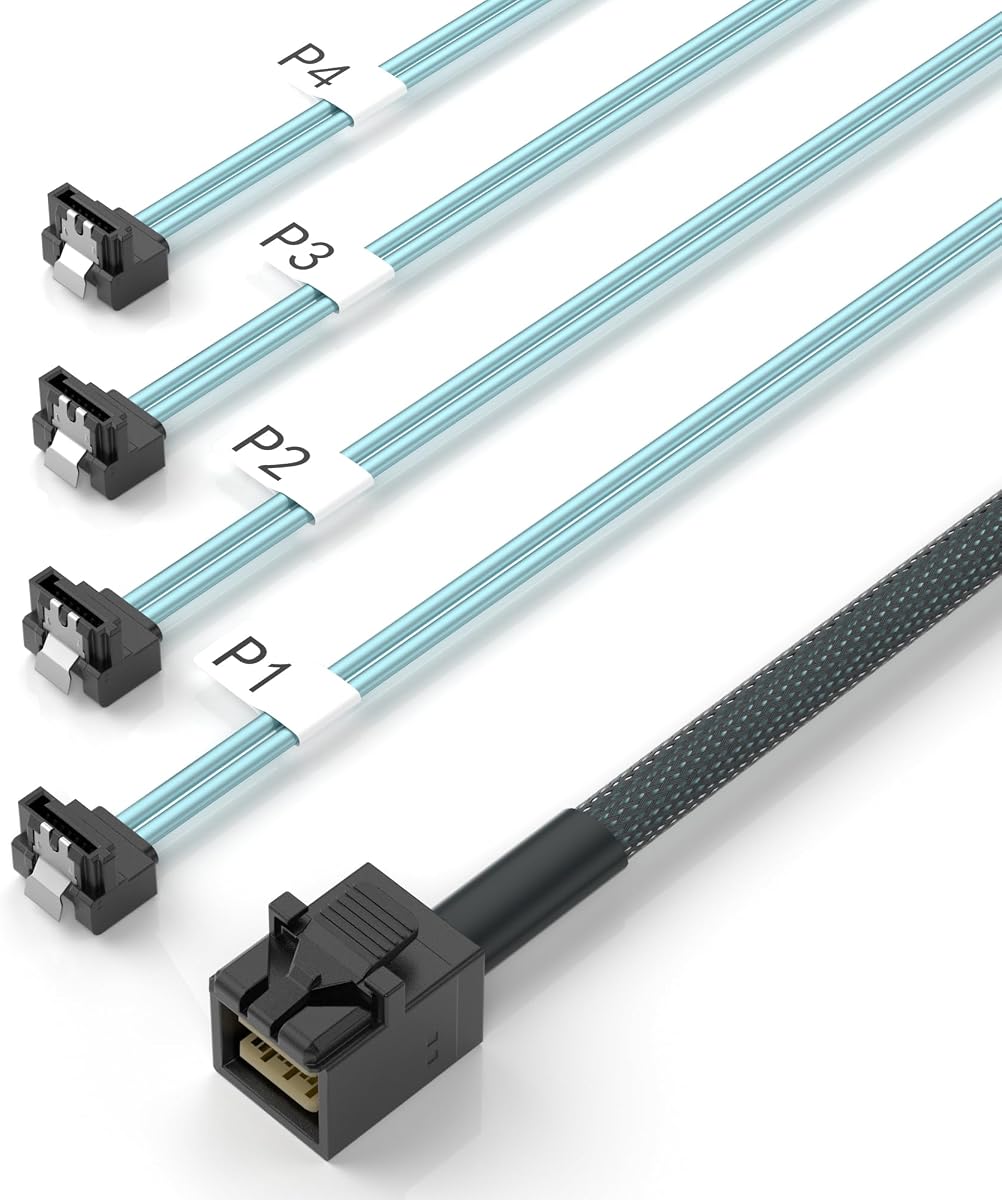
The Sonilco Internal HD Mini SAS Cable is a compact SFF-8643-to-four-SATA assembly with a supplied rating of 5.0. It is a compelling budget-oriented option because it combines the full host-to-four-target layout with a half-meter length and a twenty-four-month warranty.
We may earn a commission when you buy through this link, at no additional cost to you.
The host bus adapter, RAID controller, or motherboard must expose the correct SFF-8643 connector. Four seven-pin SATA connectors then serve individual drives, and the supplied information states support for both 3 Gbps and 6 Gbps devices. It also mentions compatibility with Adaptec RAID 71605 and 7895 storage controllers.
Stainless steel latches are called out for secure, stable connections, an important detail in systems where a loose SATA plug could interrupt a drive. The short length helps limit excess cable inside a compact chassis, while the four-target structure avoids needing a separate SATA lead for each disk.
The trade-offs are straightforward: the package contains one cable, and 0.5 meters may be too short for widely separated drives. It is best for an SFF-8643 controller with a nearby group of four SATA drives. Buyers who need more reach or two complete branches should choose a longer cable or a multi-pack, respectively.
Metal latching connectors help maintain a stable SATA connection under normal movement and vibration. In a small server or workstation, that positive retention can be valuable when drives sit close to fans or other moving components.
One SFF-8643 host connection and four SATA targets create a simple internal storage branch. The result is useful when the controller supports a four-device group and all target bays are within the cable's short reach.
We may earn a commission when you buy through this link, at no additional cost to you.
The 10Gtek MiniSAS HD breakout cable uses an SFF-8643 host connector and four right-angle seven-pin SATA targets. It has a supplied rating of 4.5, the lowest in this group, but it offers a distinctive combination of one-meter reach, flexible construction, and right-angle drive connections for space-conscious installations.
We may earn a commission when you buy through this link, at no additional cost to you.
The supplied information states point data transfer speeds up to 6 Gbps and describes dual-channel aluminum-foil cable construction. The cable is presented as slim, flexible, and tensile resistant, allowing it to be positioned around internal corners. These characteristics are useful in JBOD and storage-tray arrangements where the target drives may sit close to a chassis wall.
Right-angle SATA connectors can reduce the depth required beside a drive, but orientation matters. If a drive's SATA ports face the wrong direction, the cable may approach from an unsuitable side or make the drive harder to remove. Checking the physical orientation of every bay is therefore more important for this model than for a cable with straight plugs.
The host must have an SFF-8643 port on its motherboard or RAID controller, and the product data warns that an SFF-8643 connection on a backplane will not work. This cable is best for a long, flexible route to four right-angle SATA drives in a server or JBOD. Confirm both connector type and bay orientation before purchasing.
Right-angle plugs can preserve clearance beside a drive where a straight connector would project outward. That is useful in tightly packed storage trays, although the selected drive's port direction must support the cable's approach.
The one-meter length and slim, flexible conductors are well suited to reaching a four-drive group positioned away from the controller. The tensile-resistant construction can tolerate careful repositioning during installation without imposing a rigid bend pattern.
We may earn a commission when you buy through this link, at no additional cost to you.
The decisive factors are connector standards, target configuration, cable reach, drive count, and physical routing. A cable cannot bridge mismatched host interfaces or compensate for a controller that lacks the required ports, so identifying the equipment before comparing products is essential.
Begin by inspecting the controller, host bus adapter, or motherboard that will accept the cable. An SFF-8087 host requires an SFF-8087-to-SATA breakout, while an SFF-8643 host requires the higher-density SFF-8643 version. These standards are not interchangeable even though both are commonly called Mini SAS, and a close visual resemblance is not reliable evidence of compatibility.
A connector on the front or rear of a drive backplane is not necessarily the same interface as a controller header, even when it carries an SFF designation. Several listed cables explicitly warn that an SFF-8644 arrangement will not work where an SFF-8643 cable is required. Backplanes also may expect a standard A-side-to-B-side cable or a proprietary forward breakout rather than direct SATA leads.
Most useful forward-breakout cables terminate in four seven-pin SATA connectors for direct attachment to conventional SATA hard drives or SSDs. A dual-SFF-8087 cable has no SATA plugs and serves a different connection task. A cable with four SATA targets is appropriate for a host bus adapter or RAID controller that accepts direct SATA devices, but it cannot substitute for a cable designed to link a specific backplane.
A forward-breakout cable commonly maps one host-side connector to four SATA target connectors. Installing one cable creates a convenient physical group, but the controller determines how those devices participate in an array. Two cables can support up to eight drives according to the supplied descriptions, provided the controller and host bus adapter offer the necessary lanes and the target devices are configured appropriately.
Short half-meter and 1.6-foot assemblies are useful in compact cases, while one-meter or three-foot cables provide more freedom when the controller and drives sit in different parts of the chassis. Longer is not automatically better because excess cable can obstruct airflow, complicate servicing, or create sharp folds. Measure the intended route while allowing enough slack for the controller and drive connectors to seat comfortably.
Slim ribbon conductors, woven mesh sections, and cloth-based strain relief can make a harness easier to route around fans, heatsinks, and expansion cards. Numbered branches help maintain a physical drive mapping, while latches help prevent accidental disconnections. These features are particularly useful in densely packed servers or systems subject to vibration, although connector orientation must still be checked.
Most of the listed forward-breakout cables state support for 3 Gbps and 6 Gbps SATA devices, even when the associated host controller is described as supporting a faster generation. A cable's stated device compatibility does not guarantee that every attached drive will operate at its maximum advertised rate. The SATA generation, controller, backplane, and workload all influence the final result.
Warranty coverage can matter because an internal storage cable may remain in service for years and is inconvenient to reach. The StarTech option includes a lifetime warranty, the Sonilco model carries a twenty-four-month warranty, and another listed breakout includes a lifetime warranty. Warranty duration should support, rather than replace, the more important checks for connector and controller compatibility.
Power down the system completely before connecting or disconnecting the cable. Disconnect the mains supply, use appropriate anti-static precautions, and remove the side panel only after the operating system is fully shut down. Identify the SFF-8087 or SFF-8643 host connector, align its keying with the controller socket, and seat the connector evenly without forcing it.
Connect each SATA target to a seven-pin SATA data port on the intended hard drive or SSD. Follow the P1-to-P4 markers, if present, and record the mapping between each branch and physical drive bay. Do not connect a dual-SFF-8087 cable directly to SATA drives, because it has no SATA target connectors and performs a different role.
After completing the connections, route the cable without sharp bends, pinched conductors, or interference with fans and moving parts. Secure excess slack, verify that every latch is fully engaged, and confirm that the drives are detected by the controller before closing the case. For maintenance, power down before changing any target and avoid repeatedly twisting the branches near their strain-relief points.
No. SFF-8087 and SFF-8643 describe different connector standards, and a cable made for one will not properly mate with the other. Check the controller or host bus adapter marking and the physical port before ordering. Match the host end exactly, then confirm that the target end suits your SATA drives or backplane.
It depends on the exact backplane interface and orientation. Several included products warn that they cannot be used with an SFF-8644 backplane arrangement even when the ports look related. A front-panel backplane may require a different forward-breakout or standard SAS cable, so verify the backplane manual and connector keying before assuming compatibility.
The typical forward-breakout cables in this guide provide four seven-pin SATA target connectors. Some controllers can use two such cables for up to eight drives, but that depends on supported host ports, lane width, controller firmware, and the array configuration. Cable compatibility alone does not guarantee eight-drive operation.
No. The cable only provides the physical data connections between the host controller and SATA drives. RAID creation, drive support, initialization, and performance depend on the RAID controller or host bus adapter, its firmware, and the drives. Confirm that the controller supports the number, SATA generation, and intended array configuration of your devices.
Yes, when the controller and cable configuration support the particular SATA SSDs. The listed cables generally describe compatibility with 3 Gbps and 6 Gbps SATA devices, which covers commonly used SATA drive interfaces. Enterprise SSDs may have additional power, firmware, or controller requirements, so check the drive documentation and controller compatibility list.
A shorter cable can reduce clutter and make it easier to route around fans and heatsinks, but it is only better if it reaches the target drives without strain. A one-meter or three-foot cable may provide necessary placement flexibility in a larger chassis. The best choice balances reach, bend radius, service access, and airflow rather than choosing the shortest option automatically.
It is included to distinguish a backplane or controller-to-controller connection from a direct SATA breakout. Both ends use SFF-8087 connectors, so it does not provide four direct SATA drive plugs. Choose it for a compatible SFF-8087 endpoint connection; choose one of the SFF-8643 or SFF-8087 forward-breakout cables for direct-attached SATA drives.
Confirm that the host connector matches the controller, each SATA target is seated, the branch-to-bay mapping is documented, and the controller recognizes the intended devices. Ensure the cable is not pinched, sharply folded, or positioned near a moving fan. If any connector resists seating, stop and recheck its orientation rather than applying excessive force.
The Cable Matters SFF-8087 model stands out as the editor's choice for compact four-drive systems, while the Sonilco SFF-8643 cable offers a short, well-rated, budget-oriented alternative. For buyers seeking broader routing reach and long-term warranty coverage, the StarTech SAS43SAT1M is the premium-oriented option, subject to correct SFF-8643 host compatibility.
Prioritize the exact host connector, the required target arrangement, and the backplane interface before comparing length or convenience. A half-meter cable can be ideal beside a controller in a small enclosure, whereas a one-meter or three-foot assembly may be necessary in a larger server. Numbered branches, slim construction, reinforced strain relief, and positive latches can improve servicing after the system is built.
Ratings and product details provide a useful starting point, but they do not replace verification of the hardware in front of you. Check the current listing, connector specifications, controller support, and availability before purchasing. Prices and stock can change, so the most economical option at one moment may not be the best practical match once installation requirements are considered.