
TADA 200g/0.2g Mechanical Balance
3.8Editor score
Compact 200g capacity
0.2g measurement precision
Included classroom weight set
Portable lightweight construction
Our Mechanical Balance guide compares ten triple-beam and medical scales, evaluating capacity, readability, damping, construction, and classroom suitability.
A mechanical balance offers a direct, hands-on way to measure mass without batteries, software, or electronic components. The best models combine clear scales, stable pointers, accessible adjustment controls, and enough capacity for the objects being weighed, making them especially useful in classrooms, laboratories, clinics, kitchens, and workshops.
This guide compares ten mechanical balances across capacity, readability, damping, construction, included weights, portability, and intended application. The list includes eight general-purpose triple-beam scales, one traditional 610-gram EISCO model, and one medical beam scale, allowing buyers to compare both laboratory teaching instruments and specialized clinical equipment.
Each review explains the supplied specifications, practical strengths, and relevant limitations so the final recommendation fits a particular need. The top three selections represent a budget option, an editorial choice, and a premium choice, while every other model receives a detailed individual assessment. Product prices can change.
3.8Editor score

4.4Editor score

4.3Editor score
The comparison below places all ten balances by application, capacity, readability, and core mechanical features, revealing the clearest differences between compact classroom models, extended-capacity triple-beam scales, and the specialized medical beam scale.

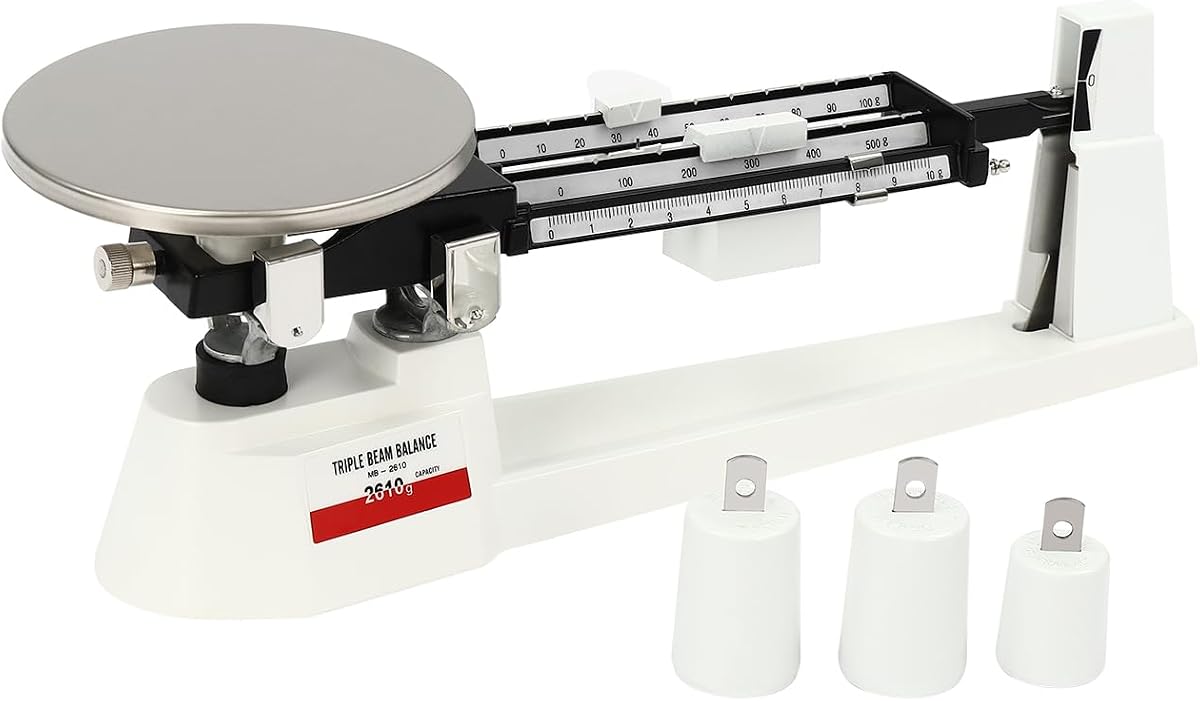


The QWORK Triple Beam Mechanical Balance is a battery-free 2610-gram scale with a stated accuracy of 0.1 gram and a customer rating of 3.7. Its most immediately attractive qualities are the extended capacity, mechanical zero adjustment, and no-power design. The supplied information also identifies magnetic damping, clear graduation marks, and a six-inch platform as practical features for recurring classroom or general weighing tasks.
We may earn a commission when you buy through this link, at no additional cost to you.
This model offers a useful middle ground between a small teaching balance and a larger laboratory instrument. Two 1000-gram weights and one 500-gram weight expand the base range from 610 grams to 2610 grams, giving users more flexibility than a standard classroom triple beam. The zero adjustment knob can reduce systematic error before use, while magnetic damping is intended to settle the pointer quickly and improve workflow.
The most important trade-off appears in the product's own guidance: although the scale is professionally calibrated, transportation can disturb its balance and cause it to lose the zero setting. Buyers should therefore expect to check and potentially recalibrate the scale after delivery or relocation. Its 3.7 rating also suggests that the overall experience may be less consistently satisfying than that of the higher-rated models in this comparison.
Despite those concerns, the QWORK is a sensible choice for a classroom, teaching laboratory, university demonstration, or kitchen where portability, higher capacity, and freedom from batteries matter more than a pristine out-of-box setup. It is less compelling for a facility that cannot tolerate post-transport calibration. Buyers who want the same general format with a higher listed rating and fewer explicit calibration caveats may prefer the third-ranked MB2610.
The combination of 2610-gram capacity, 0.1-gram accuracy, magnetic damping, and a substantial included weight set makes this a flexible mechanical balance for users who regularly move equipment between locations. Confirm that someone in the buying group is comfortable performing the documented zeroing process before purchase.
The included 1000-gram and 500-gram weights lift the usable range to 2610 grams, making the scale more versatile than a conventional 610-gram classroom model. This extra range is valuable for larger samples, grouped teaching materials, or food preparation tasks that would otherwise require several smaller weighing operations.
Operating without a battery simplifies storage, transport, and classroom setup. Because the stated instructions warn that movement can disturb the zero, users should place the scale on a stable surface and inspect its zero before each important measurement rather than assuming its initial calibration remains unchanged.
We may earn a commission when you buy through this link, at no additional cost to you.
The TADA 200g/0.2g Mechanical Balance Scale is a compact educational balance with a customer rating of 3.8. It is designed specifically for classroom teaching and offers a stated maximum of 200 grams with 0.2-gram precision. Its strongest case is simplicity: the scale is lightweight, easy to store, and accompanied by a set of masses for demonstrating measurement principles.
We may earn a commission when you buy through this link, at no additional cost to you.
The included weights consist of 5-gram, 10-gram, two 20-gram, 50-gram, and 100-gram pieces. That assortment gives students enough range to perform a variety of basic exercises without assembling a much larger kit. High-grade materials are specified for frequent educational use, while the compact form makes it straightforward to move from a laboratory cabinet to a classroom bench or demonstration area.
This scale is not the right tool for objects that approach the kilogram range, and its 0.2-gram precision is less exact than the 0.1-gram specification found on most of the 2610-gram models in the list. It is also a basic teaching instrument rather than a fully specified analytical balance. For routine demonstrations involving small samples, however, those limitations may be entirely acceptable.
Choose the TADA when the main goal is to teach mass, balance, or measurement with a dedicated, uncomplicated apparatus. Its portability and included weights make it particularly attractive for schools that need multiple simple balances, shared classroom kits, or an instrument that can be stored in a cabinet without occupying much bench space. For heavier objects or finer readings, choose a higher-capacity triple-beam model instead.
As the budget-oriented top pick, it succeeds by matching the most common needs of introductory science instruction: a manageable capacity, a useful set of masses, straightforward storage, and enough precision for basic learning exercises. Its limitations are clearly defined, making it easier to select confidently when those specifications fit the lesson plan.
The 200-gram limit and 0.2-gram precision position this model for small-object demonstrations rather than industrial work. Teachers can use it to illustrate how counterweights balance, how readings are obtained, and why a level, stable surface is necessary for accurate results.
Its stated lightweight, compact construction supports quick movement between storage and instructional spaces. The included masses reduce the need to purchase additional classroom weights separately, although buyers should confirm that the supplied assortment covers every experiment planned for the course.
We may earn a commission when you buy through this link, at no additional cost to you.
The MB2610 Triple Beam Mechanical Balance Scale has a customer rating of 4.4, the highest listed rating among the general-purpose laboratory models in this guide. It combines a 2610-gram maximum capacity with a stated 0.1-gram resolution. Three sliding beams carrying 10-gram, 500-gram, and 100-gram weights make the instrument versatile without requiring an electronic display.
We may earn a commission when you buy through this link, at no additional cost to you.
A major practical advantage is the included set of two 1000-gram masses and one 500-gram mass, which allows the weighing range to extend from 610 to 2610 grams. The specification also says that two attachment weights can be hung simultaneously. For teachers and laboratory users, that flexibility supports multiple sample sizes while keeping the operating principle visible and easy to explain.
Built-in magnetic damping is designed to stabilize the pointer after minimal swinging, reducing waiting time and helping users obtain repeatable readings. The sturdy base, clear display, and battery-free operation further support repeated use. One point to consider is that the supplied description mentions minimal adjustment needs but does not specifically describe a zero adjustment control, so buyers who require explicit zeroing instructions should examine the product documentation.
This scale is best suited to school laboratories, analytical demonstrations, universities, and other settings where 0.1-gram readings and a broad range are both useful. It may be unnecessary for a small introductory classroom that only handles objects under 200 grams, but it provides considerably more flexibility without moving into a medical specialty product. The 4.4 rating also gives it a stronger customer-feedback signal than most entries in the list.
The MB2610 stands out as the most balanced all-around selection because it joins a respected rating, extended capacity, fine stated resolution, useful damping, and a clear mechanical reading system. For buyers who need one scale to cover many teaching and general weighing tasks, it is a particularly persuasive recommendation.
The 2610-gram range is achieved through the supplied masses while retaining a 610-gram base configuration. That makes the instrument adaptable to small teaching samples and substantially larger objects without changing the balance itself, reducing the need to maintain separate instruments for different mass ranges.
Magnetic damping helps the pointer settle after the sliding weights are positioned, so the user can read the beam more quickly. Clear graduations and the absence of a digital interface make each result visible and demonstrate the mechanical principle more directly than an electronic display would.
We may earn a commission when you buy through this link, at no additional cost to you.
The Stainless Steel Triple Beam Scale is a 2610-gram mechanical balance with a stated 0.1-gram accuracy. Its supplied information does not include a customer rating, so its evaluation here rests on the documented design rather than a numerical review signal. The model emphasizes organization, durable platform construction, clear range marks, and a threaded zero adjustment knob.
We may earn a commission when you buy through this link, at no additional cost to you.
One of its most thoughtful features is the recessed base, which accommodates three weights and reduces the chance of losing or misplacing them after use. The six-inch weighing tray provides a stable place to position samples, while the clear weight-range markings help users understand where masses belong. A threaded zero control is designed to maintain finger position during adjustment and reduce slippage.
The body combines stainless steel, aluminum alloy, zinc alloy, and plastic. This mixed construction may help balance durability and weight, but it also means the user should avoid moisture and impact that could affect the adjustment. The listed dimensions of 18 by 6.7 by 7 inches also make it compact enough for a teacher's desk, kitchen, or mobile teaching setup.
The model is well matched to classrooms, universities, laboratories, agricultural work, and kitchen weighing where a 2610-gram range and 0.1-gram accuracy are needed. Its strongest differentiator is workflow organization: built-in storage, clear markings, magnetic damping, and a secure zero knob support frequent operation. Since no customer rating was provided, prospective buyers should give particular attention to the product's warranty and return terms.
This is a well-specified general-purpose choice rather than a medical or ultra-compact teaching balance. It may be especially attractive to institutions that value a tidy bench and easy access to the included masses, while buyers seeking a more compact instrument should look for a lower-capacity model or compare the listed physical footprint with their available workspace.
Recessed storage directly addresses a common annoyance in teaching laboratories: loose masses that disappear under benches or become mixed with unrelated equipment. Keeping the three included weights associated with the scale supports faster setup between classes and reduces administrative friction.
The threaded adjustment knob is intended to prevent the user's fingers from slipping while setting the zero. Combined with magnetic damping, this supports a controlled workflow: establish zero on a level surface, place the sample, move the riders, and wait for the pointer to stabilize before recording the result.
We may earn a commission when you buy through this link, at no additional cost to you.
The Health o meter Professional 400KL is a mechanical medical beam scale with a 4.4 customer rating, a maximum capacity of 390 pounds, and graduations of one-quarter pound or 100 grams. It is built for clinical and professional use rather than fine laboratory measurement. Its powder-coated alloy steel body, rust protection, and non-slip platform mat are the defining features.
We may earn a commission when you buy through this link, at no additional cost to you.
The wide platform is designed to provide comfort and stability for patients, which is especially important in clinics, hospitals, and other high-use environments. Unlike a compact triple-beam scale with a small sample pan, this model offers a more substantial standing area. That makes it better suited to weighing people while remaining completely mechanical and independent of electrical power.
Optional wheels, listed as item 55000, can improve mobility between rooms. Optional counterweights, listed as item 55090, can increase the capacity to 490 pounds or 210 kilograms. These accessories broaden the scale's utility, but they also need to be purchased separately. The 100-gram increment is appropriate for general body-weight monitoring but much less useful when a laboratory-style 0.1-gram reading is required.
This scale is a strong choice for clinics, physicians' offices, rehabilitation environments, and facilities that value rugged construction and a long warranty. It is not the appropriate instrument for chemical powders, small parts, or classroom experiments demanding fine mass resolution. Buyers should also consider whether the optional mobility and capacity accessories are necessary for the intended workflow.
Its 4.4 rating, protective finish, patient-friendly mat, and ten-year limited warranty distinguish it from general-purpose teaching balances. For a clinical buyer seeking a durable mechanical platform scale, the 400KL offers purpose-built features that the laboratory models in this guide do not attempt to provide.
The broad platform and non-slip mat prioritize comfort and footing over the small sample vessel used in a laboratory balance. This is important because a stable, familiar surface can make repeated weighing easier for patients and staff members alike.
A powder-coated finish applied inside and outside the scale is intended to resist rust in demanding institutional environments. The ten-year limited warranty adds meaningful reassurance for a piece of equipment expected to see frequent use, while optional counterweights support facilities that need to accommodate a broader range of patient sizes.
We may earn a commission when you buy through this link, at no additional cost to you.
The Ohaus 80000012 Specialty Mechanical Triple Beam Balance has a 4.3 customer rating, a 610-gram capacity, and 0.1-gram readability. It offers a traditional laboratory and classroom design in which three sliding weights, tiered beams, and notched positions work together to make results repeatable and relatively easy to read.
We may earn a commission when you buy through this link, at no additional cost to you.
Built-in magnetic damping speeds the weighing process by reducing the time spent waiting for the pointer to settle. A spring-loaded zero compensator allows fine modifications when the instrument needs to be aligned. These controls are thoughtfully designed for repeat use rather than occasional approximation, which is a key reason this model is the premium pick for buyers focused on traditional mechanical quality.
The base and beams are made from metal, adding durability for the classroom or laboratory. A stainless steel plate provides the weighing surface. The 610-gram capacity matches the conventional base range used by several other triple-beam models, so schools that do not need the extra masses supplied with 2610-gram versions can focus on the instrument's construction and adjustment features.
Capacity is the principal limitation. Although 0.1-gram readability sounds precise, the scale cannot accommodate samples above 610 grams without additional equipment, and the product data does not indicate that larger masses are included. For a premium laboratory instrument, buyers may also want to review the availability of replacement parts, calibration guidance, and institutional support before finalizing the selection.
The Ohaus remains the strongest premium recommendation for a 610-gram laboratory balance because its notched beams, sliding weights, damping, zero control, and metal construction form a coherent traditional instrument. It is best for schools, teaching laboratories, and professional users who value precise readability and durable mechanics over extended maximum capacity.
The notched and tiered beam arrangement helps riders settle into defined positions, reducing ambiguity when locating and reading each weight. This familiar system is especially valuable in teaching environments where students should understand how individual masses combine on separate beams.
The spring-loaded zero compensator supports controlled fine corrections rather than relying on a coarse, loosely adjusted control. Buyers should zero the scale on an even, level surface before measurements and confirm the pointer remains aligned when it is not carrying a sample.
We may earn a commission when you buy through this link, at no additional cost to you.
The MB2610 Stainless Steel Balance is a general-purpose triple beam scale with a stated 2610-gram capacity and 0.1-gram accuracy. No customer rating is supplied for this listing, so the available product information is the basis for its assessment. The documented applications extend from school laboratories and universities to electronics, agriculture, textiles, and food-related weighing.
We may earn a commission when you buy through this link, at no additional cost to you.
The scale includes two 1-kilogram weights and one 500-gram weight, allowing the range to extend from 610 to 2610 grams. It also supports two attachment weights simultaneously. A six-inch tray makes sample placement convenient, while clear range markings on the base help users identify the relevant beam positions and organize the instrument.
Construction combines stainless steel, aluminum alloy, zinc alloy, and plastic. The stainless steel tray is practical for routine cleaning and provides a smooth weighing surface, while the other materials contribute to a manageable overall instrument. A zero adjustment knob supports accurate starting conditions, and built-in magnetic damping reduces the time needed for the riders and pointer to stabilize.
This model is appropriate for organizations that use one mechanical balance across several departments or sample types. It offers enough precision for general laboratory and industrial work without demanding the fractional-gram precision of a specialized analytical instrument. Because no rating is available, buyers should pay close attention to calibration instructions, warranty coverage, and the availability of replacement components.
The balance's strongest combination is versatility: extended range, a cleanable stainless steel tray, adjustable zero, magnetic damping, and a broad list of practical applications. It is particularly relevant to buyers who want a larger-capacity mechanical scale but have less need for a specialized clinical platform or the traditional, lower-capacity Ohaus design.
The listed use cases include electronics, agriculture, textiles, food, education, and general laboratory work. That cross-industry positioning is supported by the broad capacity range and 0.1-gram accuracy, although each workflow should still be evaluated against its own tolerance requirements.
The stainless steel tray offers a practical surface for general sample handling and routine cleaning. Clear range marks and an adjustable zero make the operating sequence easier to communicate, particularly when several students or workers share the same balance.
We may earn a commission when you buy through this link, at no additional cost to you.
The Lightweight Triple Beam Balance Scale has a listed customer rating of 5.0, making it the highest-rated product in the group, though the volume of ratings behind that figure is not provided. It delivers a stated 2610-gram capacity, 0.1-gram accuracy, and a six-inch stainless steel weighing platter in a compact format for portable mechanical weighing.
We may earn a commission when you buy through this link, at no additional cost to you.
Two 1-kilogram masses and one 500-gram mass expand the base capacity from 610 to 2610 grams, and the scale can hang two attachment weights at once. The included components therefore make it ready for larger samples rather than only small classroom objects. The balance also uses magnetic damping to shorten rider stabilization time, which can improve throughput during repeated measurements.
The listed dimensions of 18 by 6.7 by 7 inches help explain the emphasis on portability. The instrument can be moved between a laboratory, classroom, university, kitchen, or another work area without requiring a battery or external power. Its materials include stainless steel, aluminum alloy, zinc alloy, and plastic, combining a cleanable platter with a generally manageable body.
A 5.0 rating is encouraging, but it should not be treated as proof that every workflow will suit the scale. Detailed information about adjustment frequency, included beam configuration, and long-term calibration support is limited in the supplied listing. Buyers with strict laboratory tolerances should verify those details and compare them with the more explicitly described Ohaus and MB2610 models.
For portable work that still requires a 2610-gram range, this is a compelling option. It combines a strong customer-rating signal, useful capacity, fine stated accuracy, quick damping, and a cleanable stainless steel platter. It is well suited to teaching demonstrations, general laboratory work, food materials, agricultural samples, textiles, and research tasks that fit within 0.1-gram resolution.
Many compact balances sacrifice capacity to simplify transport, but this model combines an 18-inch listed length with a 2610-gram maximum. That balance of size and range makes it more practical for institutions that move equipment but do not want to limit samples to a few hundred grams.
The 5.0 rating distinguishes this model from products with no supplied rating or a lower aggregate score. It remains important to interpret the figure in context because the number of customer reviews is not stated, and the exact expectations of the buyer remain more important than the score alone.
We may earn a commission when you buy through this link, at no additional cost to you.
The EISCO Triple Beam Mechanical Balance is a classic 610-gram teaching instrument with no customer rating supplied. It is described as a visual and tactile apparatus for demonstrating how mass is determined. Its defining features include three offset beams, a stainless steel pan, a spring-loaded zero adjustment, magnetic damping, and notched resting positions calibrated for the sliding counterweights.
We may earn a commission when you buy through this link, at no additional cost to you.
Offsetting the three beams provides an unobstructed vertical view of the scales. This is especially valuable in a classroom, where students need to see how the rider positions correspond to the final reading. The notches give each mass a defined resting place, helping users move between readings consistently and reducing avoidable placement errors.
Durability comes from the stainless steel pan and coated corrosion-resistant aluminum frame. These materials suit laboratory, classroom, household, and shop environments where the instrument may be moved occasionally but used repeatedly. The spring-loaded zero control and magnetic damping further support stable, accurate operation without an electronic power source.
The main limitation is its 610-gram capacity. It is best for relatively small objects and demonstrations rather than bulk materials or heavier kitchen portions. The listing also provides less detail about included weights than several competing models, so buyers should confirm exactly which masses are supplied and whether the package is intended as a complete classroom kit.
The EISCO deserves consideration when teaching clarity is the priority. It makes the mechanics of a triple-beam scale visible, provides repeatable rider positions, and combines durable materials with a stable pointer system. It is less appropriate when 0.1-gram resolution is needed for larger samples, but the supplied description frames it primarily as an effective visual and tactile teaching apparatus.
The offset beams reduce visual obstruction so students can follow the pointer and each rider from a normal working position. This clear geometry turns weighing from a one-step answer into a visible sequence of balancing, adjustment, and confirmation.
Calibrated notches give the sliding counterweights consistent resting locations. In a busy classroom, this repeatable system can make it easier for students to set, read, and reset the balance without relying solely on a teacher's demonstration.
We may earn a commission when you buy through this link, at no additional cost to you.
The Triple Beam Mechanical Balance with Weights has a 4.0 customer rating, a stated capacity of 2610 grams, and a stated precision of 0.1 gram. The package includes two 1000-gram weights and one 500-gram weight, allowing the base 610-gram range to expand to the full 2610 grams. It is a general laboratory scale designed for solids, liquids, and powders.
We may earn a commission when you buy through this link, at no additional cost to you.
The stainless steel platform is described as corrosion resistant and easy to clean, which makes it practical for a broader mixture of laboratory and kitchen applications. Its six-inch diameter offers a useful surface for small containers or material samples. Magnetic damping stabilizes the pointer after each adjustment, and a clear scale is intended to make each result easy to read.
A built-in zero adjustment knob allows the user to set the instrument before measurement, helping reduce systematic error. Because the balance operates without batteries, it can be placed in a laboratory, classroom, university, kitchen, or industrial workspace without requiring power infrastructure. The stated professional calibration is another reassurance, although routine checks after movement remain sensible.
Its specifications are similar to several other 2610-gram models, so the distinguishing factors are the supplied 4.0 rating, the straightforward package, and the stated range of sample types. Buyers who require detailed information about beam construction, weight storage, dimensions, or included small masses may need to inspect the listing more closely before making a final decision.
This scale is a practical choice for users who need more than 610 grams but do not need a specialty clinical platform. It supports general lab work, educational demonstrations, food preparation, and material weighing with a 0.1-gram stated precision. Its complete set of larger masses reduces the need to source extra weights immediately after purchase.
The included 1000-gram and 500-gram masses immediately unlock the larger 2610-gram configuration. This makes the package practical for buyers who need to weigh items well beyond the standard 610-gram range without purchasing a separate set of large counterweights.
The stainless steel platform is designed to resist corrosion and remain easy to clean, supporting use with food materials, powders, liquids, and general lab samples. Users should still follow a consistent cleaning procedure and avoid exposing the internal balance and adjustment components to excessive moisture.
We may earn a commission when you buy through this link, at no additional cost to you.
The right mechanical balance depends on the mass and type of sample, the precision required, the environment, and how often the instrument will move. Capacity, readability, adjustment controls, damping, platform design, included weights, and construction should be evaluated together rather than treating one specification as a complete buying decision.
Start with the smallest range that comfortably covers your work rather than assuming maximum capacity is always better. Greater capacity can require larger masses, more storage, and a larger work area, while a small model may be sufficient for introductory lessons involving lightweight objects.
Choose a 0.1-gram model for general laboratory demonstrations and small-material work. Use a coarser scale for body weight, basic classroom exercises, or large household quantities where fractional-gram resolution is unnecessary.
Prioritize built-in magnetic damping for frequent work. It does not replace proper leveling or careful placement, but it can make each reading faster and reduce the likelihood of reading at the wrong point during a swing.
Look for a clearly accessible, fine-adjustable zero control and follow the supplied zeroing procedure before each session. Do not assume a factory calibration will remain perfectly unchanged after shipping or heavy movement.
Match the platform to the container and workflow, not only to the balance's capacity. A broad patient platform is valuable in a clinic, but it offers no advantage for a small chemical sample, and a small tray may be inconvenient for a larger container even if the beam capacity is sufficient.
Choose a robust, repairable instrument for frequent institutional use. For lighter teaching or occasional kitchen work, a mixed-material construction can still be appropriate when it provides the needed capacity, portability, and ease of storage.
Verify the complete weight assortment and consider where it will be stored. An organized recess or dedicated case can make a shared balance easier to manage and reduce setup time between users.
Consider how often the balance will move, the available bench area, and whether a dedicated location is possible. Portability is especially valuable for shared teaching programs, while stationary equipment may justify a larger, more substantial design.
Place the balance on a firm, level, vibration-free surface away from drafts, direct sunlight, and heat. Before adding a sample, inspect the pointer and beam, move each rider through its positions, and use the zero adjustment control to align the pointer with the zero mark. Consult the product's zeroing instructions after delivery or after the instrument has been moved, since shipping and relocation can disturb even a professionally calibrated balance.
Choose an appropriate pan or weighing container and ensure it remains within the scale's capacity. If the model uses an adjustable tare-like approach, record that procedure separately; otherwise, avoid placing bulky containers on a compact triple-beam pan. Center the load without touching the beam supports, move the riders incrementally, and wait for magnetic damping to stop the pointer before recording the result.
Clean the platform or platter with an appropriate damp cloth and dry it thoroughly, but do not flood the base, beam pivots, or adjustment mechanism. Store the weights in their designated recess, tray, or case, and cover the instrument when dust is likely to accumulate. For a medical scale, follow facility cleaning procedures, and for laboratory instruments, periodically verify the zero and check the balance against known reference masses.
A mechanical balance uses sliding weights, beams, and a moving pointer to determine mass without batteries or digital circuitry. An electronic scale usually provides a numerical display and may offer automatic functions such as tare. Mechanical models remain useful when power is unavailable, when direct visual demonstration is desired, or when a simple physical instrument is easier to maintain.
A 200-gram scale is often sufficient for small introductory objects and lightweight samples. A 610-gram triple beam offers more flexibility, while a 2610-gram model is better for larger teaching materials, grouped samples, food preparation, and general laboratory work. Choose a range that covers your largest expected object with comfortable headroom.
No. Readability indicates the smallest increment the instrument can display or resolve, while accuracy describes how closely a result may correspond to the true mass. A scale with 0.1-gram readability can still be affected by leveling, vibration, airflow, off-center loading, and improper rider placement. Correct setup and careful technique remain essential.
Zeroing establishes the reference point used to determine the mass of a sample. Small offsets caused by movement, vibration, temperature changes, or the balance not sitting level can otherwise shift every reading. Check zero after transport or relocation, then confirm it again whenever you begin a new measurement session.
It can weigh them when they are contained in a suitable vessel and the total mass remains within the balance's capacity. Use a container large enough to prevent spills and keep the vessel centered on the platform. Because the scale measures total mass, record the container's own mass when the goal is to determine only the sample.
Magnetic damping controls how quickly the pointer stops moving after the riders are adjusted. Zero adjustment changes the balance's reference position so an unloaded pointer aligns with zero. One feature improves reading speed and stability; the other corrects the starting reference needed for accurate results.
That depends on the model and the range you intend to use. The 2610-gram models in this guide generally include two 1000-gram and one 500-gram weight, while the 610-gram and 200-gram versions have different needs. Check the included mass assortment and ensure the beam arrangement can support every mass you plan to use.
A dedicated medical beam scale can be appropriate for routine patient weighing because it offers a stable platform, a non-slip mat, and a capacity designed around adult users. General laboratory triple-beam scales use much smaller platforms and are not substitutes for a patient scale. Facilities should also consider applicable professional requirements and cleaning protocols.
The TADA 200g/0.2g scale is the budget-focused choice for small, portable classroom demonstrations, while the MB2610 is the editorial pick for buyers who want a balanced combination of 2610-gram capacity, 0.1-gram resolution, magnetic damping, and a 4.4 customer rating. The Ohaus 80000012 is the premium traditional instrument, offering a 610-gram capacity, 0.1-gram readability, spring-loaded zero adjustment, and durable metal construction.
For most laboratory and teaching situations, prioritize the required capacity, a clear reading system, damping, and dependable zero adjustment before considering extra features. Choose a 2610-gram model for a wide range of samples, a compact 200-gram model for lightweight introductory work, or the Health o meter 400KL when a stable patient platform and clinical-oriented construction are the priority.
Finally, confirm the current product listing, included weights, dimensions, warranty, and calibration guidance before purchasing. Mechanical balances remain dependable because they operate without power, but a level surface, careful zero check, clean platform, and proper rider placement are still required to obtain consistent results. Product prices and availability can change, so compare the current listing when making a final decision.