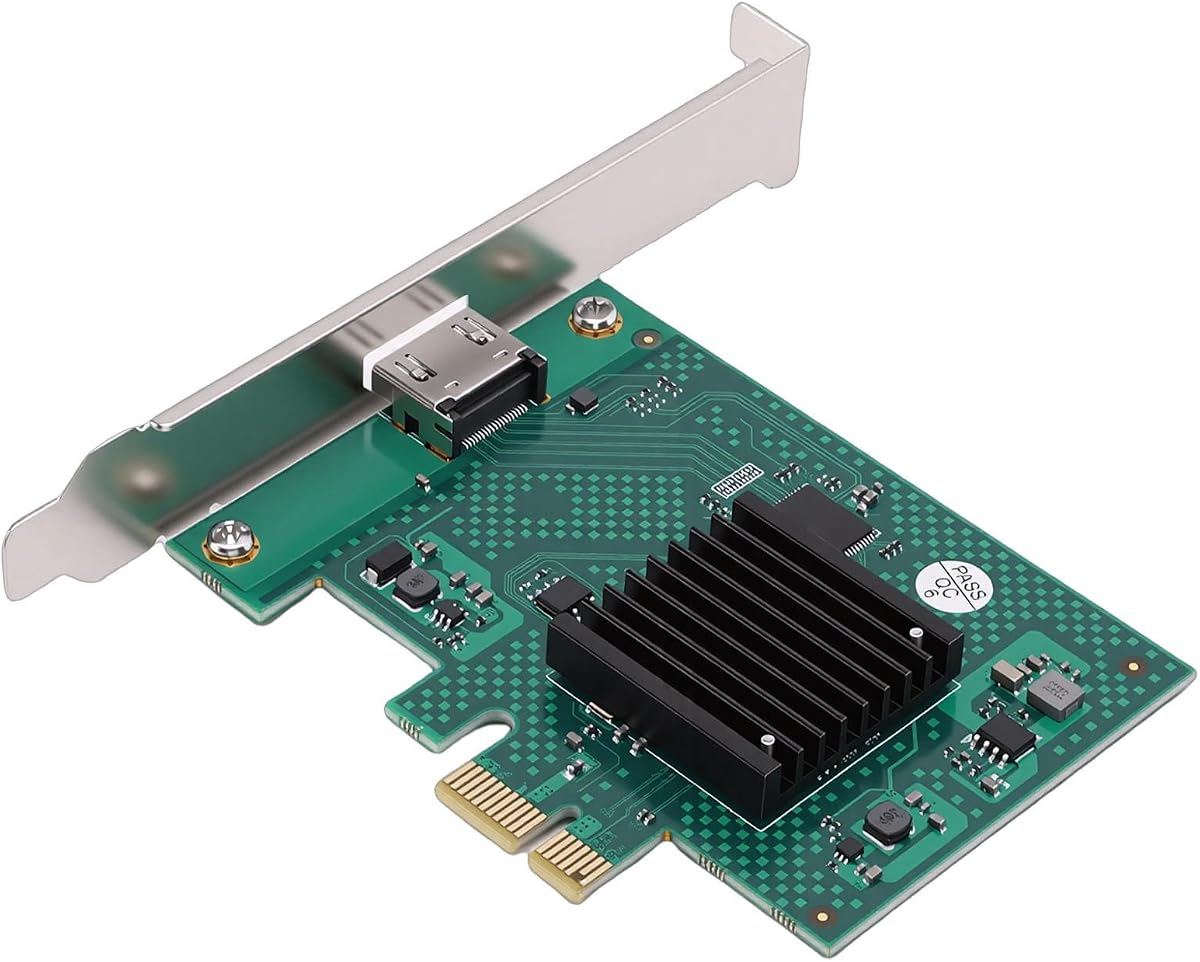
Gugxiom PCIe x1 SM750
PCI Express x1 interface
Single HDMI output
1920×1440 maximum resolution
Wide temperature tolerance
This guide compares the best Pci Express X1 Graphics Card options for industrial, business, POS, display, and general computing use.
A Pci Express X1 graphics card is a compact display adapter designed to add video output to compatible systems without occupying a full-width expansion slot. These cards are especially useful in industrial computers, point-of-sale terminals, medical equipment, thin clients, and legacy business platforms where reliability, low-profile design, and specialized display support matter more than gaming performance.
The products in this guide were compared using the information supplied for each listing, including interface type, display connectors, supported resolution, memory configuration, cooling approach, operating-temperature range, and intended applications. The list includes dedicated PCIe x1 cards as well as conventional graphics cards that may appeal to buyers whose systems have a compatible PCIe slot but do not specifically require an x1 board.
Each review explains the strongest features, practical limitations, and most suitable users. The top selections emphasize the closer fit between the listed interface and the searched category, while the broader comparison helps distinguish specialized 2D accelerators from general-purpose gaming options. Product prices and availability can change, so readers should confirm current listing details before purchasing.

3.5Editor score
This side-by-side comparison covers dedicated PCIe x1 display adapters, professional multi-output cards, and conventional PCIe graphics options, with particular attention to interface fit, connectors, resolution, memory, cooling, and likely use case.


The Gugxiom PCIe x1 SM750 is one of the most direct answers to this guide's search intent. It is explicitly a PCIe x1 graphics accelerator with a single HDMI port, rather than a conventional gaming card that merely happens to fit into a compatible slot. Its listing does not include a numerical customer rating, so the strongest evidence for considering it comes from its stated interface, resolution, 2D acceleration, and broad operating-temperature specification.
We may earn a commission when you buy through this link, at no additional cost to you.
The card supports displays and panels up to 1920×1440 and includes quick image rotation at 90, 180, and 270 degrees. That flexibility is particularly relevant to industrial panels, POS terminals, and embedded displays where portrait or landscape orientation may change. Its stated operating range of minus 40 to plus 85 degrees also separates it from cards designed primarily for room-temperature desktop use.
There are meaningful compromises. Only one HDMI output is listed, and the card is described as a 2D graphics accelerator for business and industrial applications rather than a 3D gaming solution. Compatibility with a particular motherboard, operating system, display connector, and panel controller should therefore be confirmed before purchase. The absence of a published rating also makes independent customer feedback harder to assess.
This is a sensible option for an industrial computer, POS installation, medical platform, or embedded system that specifically requires a PCIe x1 adapter and single-port HDMI output. Buyers seeking several monitors, demanding 3D performance, or needing a conventional gaming card should look elsewhere in the list.
The wide temperature range and 2D acceleration focus make this card most convincing in fixed-purpose systems. Those environments value stable display output and orientation flexibility over gaming features.
Its single HDMI port keeps deployment straightforward when the target system only requires one panel. Check that no adapter, additional display, or high-bandwidth video workflow is needed.
We may earn a commission when you buy through this link, at no additional cost to you.
The PUSOKEI PCIe x1 Graphics Card is a focused industrial display solution with a single HDMI port and a maximum stated resolution of 1920×1440. Like the Gugxiom model, it does not have a supplied numerical rating, so the guide evaluates the documented capabilities rather than implying a tested or customer-validated performance level.
We may earn a commission when you buy through this link, at no additional cost to you.
Its appeal lies in the combination of a dedicated PCIe x1 interface, 2D graphics acceleration, support for video display layers, and an operating range from minus 40 to plus 85 degrees. The listing specifically identifies industrial automation, POS systems, and medical applications as intended markets. Screen-rotation support at common right-angle increments can also simplify the use of rotating or vertically mounted panels.
This is not a general-purpose gaming choice. It has one HDMI connector, and its specifications center on stable 2D presentation rather than accelerated 3D graphics, high-refresh gaming, or advanced ray tracing. System integrators should also verify driver support, bracket dimensions, display timing requirements, and operating-system compatibility because those details are not fully described in the supplied listing information.
The PUSOKEI is best for integrators who need a narrow PCIe x1 display card for an industrial or embedded system and value wide-temperature operation. It is less appropriate for a gaming desktop, a multi-monitor workstation requiring several native outputs, or a buyer who cannot confirm hardware compatibility in advance.
The card's temperature tolerance, 2D acceleration, and panel orientation support align well with equipment that operates continuously in controlled industrial environments.
Quick rotation at 90, 180, and 270 degrees helps accommodate portrait kiosks, operator panels, and other displays whose orientation does not match a standard landscape layout.
We may earn a commission when you buy through this link, at no additional cost to you.
The GOWENIC PCIe Interface Graphics Card is a 2D accelerator intended for industrial computers, POS systems, and multi-display panels. It carries a supplied customer rating of 4.0, providing more visible feedback than the two dedicated x1 listings at the top of the guide, although the rating does not replace checking driver and hardware compatibility.
We may earn a commission when you buy through this link, at no additional cost to you.
The stated maximum resolution is 1920×1440, and the card supports multiple displays and panels. Its 2D graphics accelerator, video display-layer support, image rotation, and minus 40 to plus 85 degree operating range are the most important features. Together, these specifications suggest a display adapter designed to present business interfaces and information rather than render demanding 3D scenes.
The main uncertainty is that the supplied product title says PCIe Interface without clearly confirming an x1 lane configuration. A buyer specifically searching for a card whose physical and electrical interface is x1 should verify the board dimensions, slot keying, power requirements, connector arrangement, and supported drivers. The listing also does not provide enough detail to assume support for multiple simultaneous displays without reviewing the full product documentation.
GOWENIC is a good candidate for industrial panel or POS work when the system needs more flexible display-layer handling than a basic office adapter. It is less suitable for gaming and less certain as a keyword match than the cards explicitly labeled PCIe x1.
Support for multiple displays and display layers can be valuable where operational information must be separated across several panels. Exact output combinations should still be verified before installation.
The emphasis on 2D processing fits transactional interfaces, dashboards, signage, and control panels where smooth text and graphics are more important than 3D rendering.
We may earn a commission when you buy through this link, at no additional cost to you.
The ASUS NVIDIA GeForce GT 730 combines a 4.4 supplied rating with a configuration that is especially useful for display-heavy office and home-theater systems. It offers 2GB of GDDR5 memory, four HDMI outputs, a single-slot design, and passive cooling, making it a useful option when several displays must be driven from one graphics card.
We may earn a commission when you buy through this link, at no additional cost to you.
Its four HDMI ports distinguish it from the single-port industrial cards elsewhere in the guide. Passive cooling also suits quiet media centers, offices, and other settings where fan noise would be undesirable. The listing states that the card can operate without additional power-supply cables, which can simplify installation in compatible systems.
The important caveat is that the card is described as PCI Express 2.0 rather than explicitly as a PCIe x1 board. It also targets basic display and multimedia duties rather than modern gaming, advanced content creation, or GPU computation. Although it can support multiple high-definition displays, buyers should confirm the exact simultaneous resolution and refresh combinations supported by the system and connected monitors.
This card is a strong alternative for a compact build requiring numerous HDMI outputs and silent operation. It is a less literal match for the x1 keyword, but its display connectivity may make it more practical than a specialized one-port accelerator for certain office or media-center installations.
Four HDMI outputs simplify multi-monitor arrangements that would otherwise require multiple adapters. Resolution and refresh support remain dependent on the card, motherboard, and connected displays.
Passive cooling removes fan noise, while the one-slot format leaves more room for other expansion cards in compact business and multimedia systems.
We may earn a commission when you buy through this link, at no additional cost to you.
The NVIDIA NVS 300 by PNY is a conventional professional business graphics board with an explicitly stated PCI Express Gen 2 x1 interface. Its supplied rating is 3.5, and its configuration is clearly dated compared with the newer gaming cards in the guide. That age is not a flaw in every context; it reflects a design aimed at business display workflows rather than modern graphics workloads.
We may earn a commission when you buy through this link, at no additional cost to you.
The card includes 512MB of DDR3 memory, a 64-bit bus, 12.6 GB/s memory bandwidth, and a 400 MHz RAMDAC. Maximum resolution is listed as 2048×1536 at 85Hz. Its DMS-59 connector can feed dual DVI-I or VGA configurations through the appropriate cable, while the low-profile form factor suits compact professional systems.
The trade-offs are substantial for modern use. DDR3 memory and 512MB of capacity are minimal for current games, creative applications, and high-resolution multi-display workloads. The proprietary-looking DMS-59 output also requires the correct breakout cable, and older business graphics drivers may not be supported by every current operating system. Availability of replacement cables or compatible systems can be a concern in legacy environments.
For a vintage workstation, industrial control system, or business PC with a known PCIe x1 slot and DMS-59 arrangement, the NVS 300 is a more traditional and professional x1 option than the newer specialized 2D adapters. It is best treated as a purpose-built legacy display solution rather than a general upgrade for a modern gaming desktop.
The NVS 300 was designed for business systems that value stable multi-display output, low-profile installation, and a narrow expansion interface over modern 3D performance.
A DMS-59 connector can support dual DVI or VGA arrangements when the correct breakout cable is available. Confirm the cable and monitor connectors before ordering.
We may earn a commission when you buy through this link, at no additional cost to you.
The ASUS Dual Radeon RX 9060 XT 16GB GDDR6 White Edition is included as a general PCIe graphics alternative rather than a literal x1 accelerator. It has a supplied rating of 4.6 and represents the most modern high-performance option in this guide, with 16GB of GDDR6 memory, dual axial-tech fans, and OC and default clock configurations.
We may earn a commission when you buy through this link, at no additional cost to you.
Its cooling design uses smaller fan hubs, longer blades, and a barrier ring intended to increase downward air pressure. The card occupies 2.5 slots, which is manageable in many desktop cases but less appropriate for systems with very limited expansion clearance. A dual BIOS switch lets users move between Quiet and Performance profiles, and the 0dB feature supports silent operation during lighter workloads.
None of the supplied specifications identifies the card as PCIe x1, and a modern gaming card generally requires more physical and electrical bandwidth than that category. It is therefore unsuitable for a buyer whose system specifically has only an x1 slot or whose primary need is an industrial 2D display adapter. Its size, power requirements, and performance also exceed what a simple terminal, kiosk, or legacy office display needs.
This is the choice for a modern gaming PC or a performance-oriented build that wants substantial memory capacity and flexible cooling profiles. Buyers focused on the actual x1 keyword should instead prioritize the Gugxiom, PUSOKEI, or NVS 300 models for their explicit interface fit.
The large memory pool provides comfortable headroom for current games and graphics applications. It also makes this card unnecessarily powerful for simple office-display duties.
Quiet and Performance BIOS modes make it easier to prioritize silence or stronger output according to the workload and system acoustics.
We may earn a commission when you buy through this link, at no additional cost to you.
The ASUS GeForce GT 1030 2GB GDDR5 is a compact, passively cooled card aimed at home-theater PCs and multimedia systems. Its supplied rating of 4.6 reflects a generally favorable customer response, and the product is relevant to buyers who need a dedicated display adapter but do not need substantial 3D performance.
We may earn a commission when you buy through this link, at no additional cost to you.
The card uses NVIDIA's Pascal architecture and includes 2GB of GDDR5 memory. Its listed OC-mode boost clock is 1506MHz, and the ASUS heatsink relies on passive cooling for quiet operation. The supplied features also mention DirectX 12 support, GPU monitoring, streaming tools, and components designed for reliability.
The core limitation is that it is not presented as a dedicated PCIe x1 card. Its memory capacity is modest by current standards, and the supplied information does not specify its physical slot width, power connector needs, maximum display resolution, or output configuration. Those omissions make it less predictable for industrial procurement than a card with clearly documented connector and interface specifications.
The GT 1030 is most appropriate for adding or enabling graphics in a quiet compact media system, displaying desktop content, or handling light 3D tasks. It is not the answer for a modern gaming machine, and buyers who require a true x1 board should favor one of the explicitly identified x1 products in the top picks.
Passive cooling is useful in living-room systems, offices, and kiosks where fan noise would be distracting or undesirable.
The 2GB GDDR5 configuration is sufficient for many desktop and multimedia tasks, although it is not designed to satisfy demanding modern game settings.
We may earn a commission when you buy through this link, at no additional cost to you.
The MSI Gaming GeForce GT 1030 4GD4 LP OC is an entry-level graphics card with a supplied rating of 4.5. Its most useful feature set for non-gaming buyers is the inclusion of one DisplayPort 1.4a output and one HDMI 2.0b output, giving users flexibility when connecting a computer to different display types.
We may earn a commission when you buy through this link, at no additional cost to you.
The card contains 4GB of DDR4 video memory across a 64-bit interface, with a stated boost clock of 1430MHz. The model designation includes LP, indicating a low-profile-oriented variant, and the single-fan cooler provides active cooling. HDCP support and DirectX 12 compatibility are also listed.
This remains a general-purpose PCIe card rather than a specific x1 accelerator. The 4GB capacity sounds generous relative to other GT 1030 models, but the underlying DDR4 memory and entry-level processor limit its ability to handle modern games at demanding settings. Users should also check whether the low-profile bracket and card height suit their case before ordering.
Choose this MSI model for an entry-level desktop, office upgrade, or dual-monitor arrangement that benefits from both modern digital outputs. It is less appropriate when a system has only a PCIe x1 slot, when silent operation is essential, or when the intended workload includes serious 3D rendering or contemporary gaming.
DisplayPort 1.4a and HDMI 2.0b cover a broad range of monitors, televisions, and business displays while avoiding legacy VGA dependence.
The LP model name suggests suitability for compact cases, but buyers should still compare physical dimensions, bracket style, and clearance with the exact system.
We may earn a commission when you buy through this link, at no additional cost to you.
The ASUS Dual GeForce RTX 3050 6GB GDDR6 OC Edition is a modern gaming card with a supplied rating of 4.7. It is included to show how a conventional PCIe graphics solution differs from the specialized x1 and industrial 2D products in this guide. Its performance is intended for gaming, accelerated graphics, and ray-tracing-capable applications.
We may earn a commission when you buy through this link, at no additional cost to you.
The card is based on NVIDIA's Ampere architecture and includes second-generation ray-tracing cores, third-generation tensor cores, and improved FP32 throughput. Its listed boost clock is 1500MHz in OC mode and 1470MHz in default mode. The axial-tech fan design, two-slot format, stainless-steel bracket, and IP5X dust-resistance feature support durability and practical installation.
It is much more capable than the display-focused adapters but also much less appropriate for them. The card is not identified as PCIe x1, occupies two slots, and likely requires more power and clearance than a compact industrial system can provide. Users seeking a simple second display, POS interface, or legacy medical panel should not choose it solely because it appears in a list containing x1 products.
For a modern gaming desktop or creator system, the RTX 3050 provides a balanced alternative to the GT 1030-level options in the guide. For the stated keyword, its strongest relevance is as a contrast: it proves that a full graphics card is a different product category rather than a direct substitute for a dedicated PCIe x1 accelerator.
Dedicated RT and tensor cores add hardware support for ray-traced rendering and AI-assisted workloads that basic display adapters do not provide.
The two-slot design balances gaming-oriented cooling with better compatibility than many larger modern graphics cards in constrained desktop cases.
We may earn a commission when you buy through this link, at no additional cost to you.
The ASUS SFF-Ready Prime NVIDIA GeForce RTX 5070 is the most advanced and highest-tier product in the comparison, with a supplied rating of 4.7. It uses PCIe 5.0, 12GB of GDDR7 memory, HDMI and DisplayPort 2.1 support, and NVIDIA's Blackwell architecture. Its inclusion helps distinguish true x1 specialty products from high-end general-purpose graphics cards.
We may earn a commission when you buy through this link, at no additional cost to you.
Cooling is handled with axial-tech fans featuring smaller hubs, longer blades, and barrier rings for additional downward pressure. A phase-change GPU thermal pad supports heat transfer, while a 2.5-slot design and SFF-Ready positioning make it more practical for small-form-factor systems than many full-size enthusiast cards. The card also carries a stated three-year warranty.
None of the supplied information identifies it as a PCIe x1 board, and the product is plainly intended for a modern gaming or performance system. It offers far more processing power, memory bandwidth, and cooling complexity than a POS, medical, or industrial panel requires. Physical size, power requirements, motherboard compatibility, and display capabilities should all be checked in a complete build.
Choose the RTX 5070 when the objective is advanced gaming, graphics performance, or a high-end compact system and PCIe 5.0 hardware is available. For this guide's central purpose, however, it sits outside the x1 niche and should not displace the dedicated cards that actually match that interface.
The Blackwell architecture and DLSS 4 positioning make this card appropriate for current high-end gaming and accelerated graphics rather than simple display extension.
Its SFF-Ready claim, 2.5-slot layout, and phase-change thermal pad show attention to fitting substantial graphics performance into constrained enthusiast systems.
We may earn a commission when you buy through this link, at no additional cost to you.
The right PCIe x1 graphics card depends on physical compatibility, display requirements, operating environment, and the type of graphics workload. Confirming the system constraints before comparing features prevents a technically capable card from becoming an unusable upgrade.
A PCIe x1 card is designed around a narrow serial interface and a correspondingly compact connector footprint. While many full-size graphics cards can physically operate in a slot that supports a wider x16 link, a buyer searching specifically for x1 may need a card that supports the exact lane width, physical dimensions, and power configuration of the target system. Consult the motherboard or expansion-card documentation and verify whether the chassis has a short slot, a full-length slot, or a proprietary riser arrangement.
Choose a card explicitly labeled for the correct interface and form factor. Do not assume that every visually similar short graphics card is electrically and physically compatible.
The output arrangement must correspond to the displays already in use. HDMI, DisplayPort, DVI, and VGA are not interchangeable without suitable cables and active or passive adapters. Multi-output cards can simplify large desks or control rooms, but a single HDMI output may be exactly right for a kiosk or POS terminal. Resolution, refresh rate, color depth, and HDR requirements should also be compared with the display specifications.
List every required connector and count the screens before purchasing. Also verify whether outputs can operate simultaneously at the desired settings.
Industrial panels, POS interfaces, medical displays, and office desktops mainly need reliable 2D rendering, text clarity, and stable refresh behavior. These tasks can be served by dedicated 2D accelerators, making a gaming-oriented card unnecessary. Modern games, 3D modeling, ray tracing, and some content-creation applications require substantially more graphics processing and memory.
Match the card to the workload rather than to the newest specification. A simpler accelerator is often more appropriate for fixed-purpose equipment than an expensive general-purpose GPU.
Maximum resolution is useful, but it is only part of the compatibility picture. The operating system, graphics driver, display adapter, monitor, and graphics card must all agree on supported timings and refresh rates. Industrial systems may also require extended-temperature operation, unusually high panel density, continuous duty cycles, or stable image rotation.
Compare the stated maximum resolution with the target panel and verify refresh-rate support separately. For embedded deployments, review the complete system specification rather than relying only on the card listing.
Memory capacity and bandwidth influence the workloads a card can handle smoothly. The NVS 300's 512MB of DDR3 is appropriate for its legacy professional role, while newer general-purpose cards offer much larger and faster memory pools. A display-only adapter can function well with modest memory because it is not rendering complex 3D scenes. Gaming and creative workloads benefit from considerably more memory and bandwidth.
Choose memory according to the application, not the label alone. For specialized display work, prioritize compatibility and stable drivers; for games or rendering, prioritize capacity, speed, and processing power.
Cooling affects noise, thermals, and long-term reliability. Passive designs are quiet but depend on airflow and are best suited to modest workloads. Single-fan and dual-fan cards provide more active cooling, while high-end models often require more case space and power. The bracket style, card height, slot width, and clearance around the CPU cooler are all important in compact systems.
Measure the available space and consider the system's noise tolerance. A quiet card is advantageous in an office or media center, while a more powerful card may need active cooling in a small enclosure.
Hardware compatibility is only half of a successful installation. The available operating system, its version, and the graphics driver must support the card. Older professional boards may be associated with legacy driver packages, while current gaming cards may require a more recent platform and a modern chipset. Enterprise and industrial deployments also benefit from drivers with predictable update cycles and long-term support.
Check the manufacturer's support pages before ordering. If a system is managed by an organization, include driver validation in the deployment plan rather than assuming the card will install automatically.
A clear warranty provides added confidence, particularly when installing a card in a system that is difficult to service. Manufacturer support, documentation, and the availability of compatible cables or replacement brackets can be as important as the headline graphics specifications. Specialized industrial cards should also be evaluated according to documentation quality and the vendor's ability to support the intended environment.
Prefer products with clear warranty terms and verifiable support resources. Keep the listing documentation and required adapter cables together for future troubleshooting.
Begin by shutting down the computer, disconnecting its power source, and waiting for internal components to cool. Open the case, locate the correct PCIe expansion slot, remove its retention bracket, and check that the card's physical length, slot width, bracket, and connector arrangement match the available space. For a short x1 slot, do not force the card or leave a full-length card projecting into a fan or drive cage.
Insert the card firmly but gently into the expansion slot, secure the bracket, and connect any required display cable or adapter. If the card requires external power, connect the specified cable before startup. Restore the case and power supply, turn on the computer, and install the appropriate graphics driver from the manufacturer's support resources. Then configure the desired resolution, refresh rate, display arrangement, and any rotation or multi-display options in the operating system.
For regular care, keep the card seated firmly and avoid repeated unplugging while the system is running. Use compressed air to remove dust from the cooler and surrounding vents, but disconnect power first and hold fans still so they are not spun by airflow. Monitor temperatures and stability under sustained workloads, and address unusual noise, discoloration, connector movement, or display artifacts. Do not change output settings or update drivers until the system is stable and a backup of relevant configuration data has been made.
Physical compatibility is often possible because a wider PCIe slot can accept a shorter x1 card, but electrical operation depends on the motherboard and the card's supported interface. Some systems negotiate only the x1 link, which is ideal for a display adapter. Confirm the board manual and card specifications, and do not force a card whose physical bracket or height does not fit.
They are generally intended for display output, 2D acceleration, business systems, and industrial panels rather than 3D gaming. Performance also depends on the accelerator, memory, and drivers, so a card explicitly labeled x1 should not be assumed to equal a modern gaming GPU. Choose a gaming card when frame rate, shaders, ray tracing, or 3D rendering are important.
HDMI and DisplayPort are different display interfaces with different connector shapes and feature sets. DisplayPort is common on professional monitors, while HDMI is widespread on televisions and retail displays. The right choice depends on the monitors already in use, their supported resolutions and refresh rates, and whether adapters are acceptable.
Only if the card provides enough outputs and the motherboard, drivers, and displays support the desired simultaneous configuration. The dedicated cards in the top picks list a single HDMI port, whereas the ASUS GT 730 lists four HDMI outputs. Check maximum resolution and refresh rate for each active screen, because output count alone does not guarantee every combination works.
A 2D accelerator is generally well suited to transactional interfaces, text, menus, forms, and fixed panels because those tasks do not require modern 3D rendering. Stability, temperature range, display rotation, driver support, and connector compatibility are usually more important than gaming-oriented performance. The system's processor and software requirements should still be checked.
Industrial equipment may operate in locations with greater temperature variation than a typical office desktop. A card rated for minus 40 to plus 85 degrees is intended to tolerate more demanding ambient conditions. This rating does not replace proper enclosure ventilation, system-level thermal design, or validation by the equipment manufacturer.
Many display-oriented x1 cards are powered entirely through the PCIe slot because they perform less demanding 2D work. Modern gaming cards, including some cards in this comparison, may require additional power. The product listing and the card's power connectors should be checked before installation, and the recommended power supply should be used if a connector is present.
Check the case's available expansion space, the motherboard's slot arrangement, the card's length and slot width, and the position of nearby cooling fans or drive cages. Also compare the bracket type and any required power connection. For unusual industrial systems or proprietary riser cables, consult the system documentation or manufacturer before purchasing.
The strongest keyword-specific choices are the Gugxiom PCIe x1 SM750, PUSOKEI PCIe x1 Graphics Card, and NVIDIA NVS 300 by PNY. The first two are modern 2D display accelerators with HDMI and wide temperature ranges, while the NVS 300 is an older professional board with an explicit PCIe 2.0 x1 interface and a DMS-59 display connector. Each serves a different type of compact or specialized system.
Prioritize the physical interface, output connectors, operating environment, and intended workload before considering broader graphics specifications. Industrial users should pay particular attention to temperature tolerance, rotation, and panel compatibility. General-purpose buyers may find the GT 730, GT 1030, RTX 3050, RX 9060 XT, or RTX 5070 more appropriate when gaming or modern 3D performance is the actual goal.
Finally, confirm the current product listing, system requirements, driver support, warranty, and included accessories before ordering. Product prices and availability change frequently, and a listing that appears suitable may not be compatible with a particular chassis, panel, or operating system. Verification is the final and most important step in selecting the right card.