
LISEN 72W Retractable Car Charger
4.5Editor score
Compact three-device charging
Thirty-watt retractable USB-C
Voltage and safety protections
Thirty-one-and-a-half-inch cable
Our retractable USB C car charger guide compares charging power, cable design, compatibility, safety, and portability to help you choose the right model for
A retractable USB C car charger combines a 12-volt power adapter with cables that extend when needed and disappear back into the housing when they are not. The best models combine useful charging speeds, multiple connection options, compact construction, and stable 180-degree positioning for a cleaner and more convenient cabin.
This guide compares ten retractable USB C car chargers based on their stated power ratings, port configurations, cable lengths, charging protocols, safety features, compatibility, and physical design. It covers options for commuters, families, rideshare drivers, truck operators, and anyone trying to replace loose charging cables with an organized all-in-one setup.
Each review highlights the product's strongest qualities and practical limitations so you can match it to your own devices and vehicle. Ratings and specifications reflect the supplied product information, while prices and promotions can change, so confirm the current listing and fit before buying.
4.5Editor score
4.8Editor score

4.7Editor score
The comparison below highlights total output, device capacity, retractable-cable arrangements, and voltage-system support. These distinctions help separate compact everyday chargers from high-capacity models designed for passengers, multiple USB-C devices, and power-hungry electronics.


The LISEN Retractable Car Charger combines an 84-watt four-output design with two built-in retractable cables, one USB-C and one for older iPhone connections. Its 4.5 rating reflects a versatile approach to mixed-device households. The strongest feature is the combination of a high-output USB-C port, additional USB connections, and cables that can reach into the back seat.
We may earn a commission when you buy through this link, at no additional cost to you.
Its primary USB-C output is listed at up to 45 watts when the vehicle supplies 24 volts, while the maximum under a standard 12-volt socket is 36 watts. Two retractable leads extend as far as 31.5 inches, which is useful when passengers need their own connection. A 12-watt USB-A port and another output add flexibility for phones, tablets, and small electronics.
The main trade-off is compatibility. The integrated older-iPhone cable is useful for legacy devices, but it is not another USB-C lead, and the product does not support CarPlay, Bluetooth, or data transfer. It also relies exclusively on a 12-volt cigarette-lighter socket, so buyers should verify their vehicle before ordering.
This is a sensible choice for families that still use a mix of USB-C and older iPhone hardware or want one charger with both a visible cable and open ports. Drivers who only use modern USB-C equipment may prefer the dual-USB-C LISEN model, while those needing the largest device count should consider the 138-watt option.
The four-output arrangement gives each traveler a realistic chance of finding a suitable connection, while the high-wattage USB-C port is better suited to modern phones and tablets than a basic low-power adapter. Smart power distribution helps manage the load when several devices are connected.
Both integrated cables can be extended only as far as needed and then returned to the housing. This keeps long leads from remaining stretched across cupholders, the console, or the center of the cabin during shorter trips.
We may earn a commission when you buy through this link, at no additional cost to you.
This LISEN model is designed around modern USB-C devices, with two retractable USB-C cables, a 36-watt PD USB-C port, and a USB-A port. The combination supports up to four devices simultaneously. Its 4.5 rating and 84-watt total output make it a practical all-in-one charger for couples, families, and passengers carrying different USB-C equipment.
We may earn a commission when you buy through this link, at no additional cost to you.
The two built-in cables each extend to 31.5 inches, which can bridge the distance between a dashboard-mounted phone and a phone or tablet used in a rear seat. Their practical value is that they remain attached to the charger instead of becoming separate items to find, unplug, or untangle. The lower plug rotates through 180 degrees to help the housing clear the gear selector or sit more comfortably in a recessed socket.
As with many chargers in this category, the 84-watt figure describes aggregate capability rather than 84 watts available from every connection. The distribution depends on the devices and ports in use. It is designed as a charging adapter and should not be treated as a CarPlay or general data-transfer hub.
Choose this charger when you want every built-in cable to be USB-C. It is especially useful for vehicles carrying several modern phones, small tablets, and earbuds. Drivers who need more simultaneous connections should look to the six-port LISEN and SUPERONE models, while those with only one or two USB-C devices may find the LISEN 72W Mini more compact.
Providing two retractable USB-C cables allows two people to charge without sharing a port or searching for a spare cable. The leads remain close to the adapter and return to it after use, supporting a tidier console.
The 180-degree adjustment is particularly valuable in cars where the cigarette-lighter socket is angled or recessed. It gives the installer a way to orient the body and leads without forcing the adapter into an awkward position.
We may earn a commission when you buy through this link, at no additional cost to you.
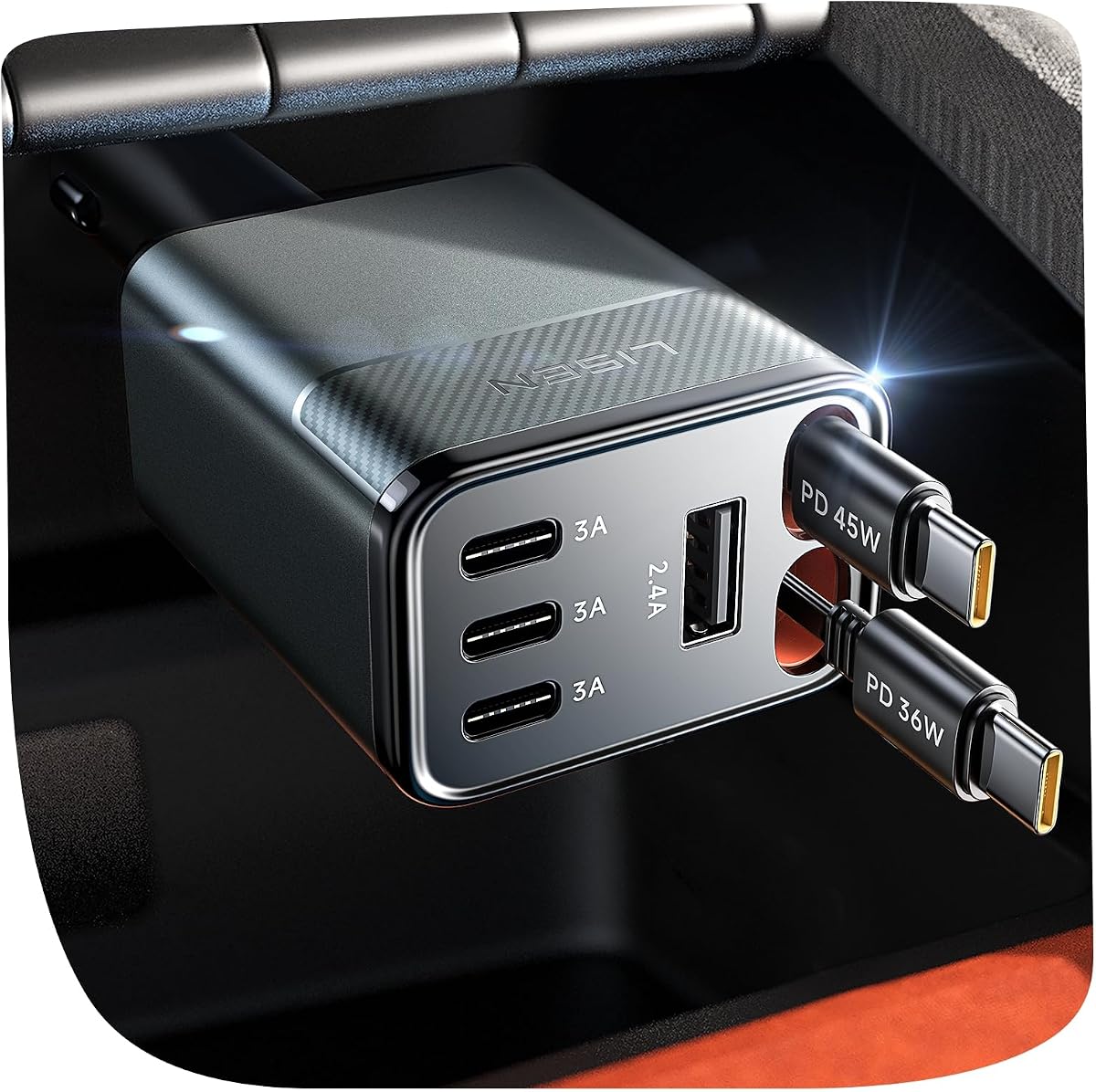
The LISEN 138W Retractable USB C Car Charger is the most versatile charging hub in this group, offering six connections and the highest stated aggregate output. Its 4.8 rating is also the highest among the listed products. Two retractable USB-C cables are joined by three USB-C ports and one USB-A port, allowing a wide range of phones, tablets, and accessories to charge together.
We may earn a commission when you buy through this link, at no additional cost to you.
Power is distributed among a 45-watt USB-C cable, a 36-watt USB-C cable, three 15-watt USB-C ports, and one 12-watt USB-A port. That hierarchy gives faster devices dedicated high-power options while lower-draw accessories can use the remaining ports. Both retractable cables reach 31.5 inches, making rear-seat access straightforward.
The body measures 1.93 by 1.26 by 2.96 inches, which helps offset the complexity of a six-device charger. It also rotates 180 degrees for positioning around a cupholder, shifter, or recessed power socket. Its protections are listed for overcurrent, overvoltage, overheating, and short circuits, adding useful safeguards when several devices are connected.
This is the top choice for shared vehicles, long family trips, and drivers who routinely carry several devices. Its capacity and power ceiling may exceed the requirements of a single phone, but that flexibility is precisely what makes it useful for a busy cabin. Verify the vehicle socket before installation and distribute high-power devices across suitable outputs.
Six charging connections remove much of the need to carry a separate multi-port adapter. Families, rideshare drivers, and mobile workers can keep multiple phones, tablets, and accessories connected without cycling through a single port.
The 45-watt and 36-watt retractable leads target more demanding USB-C devices, while the 15-watt USB-C and 12-watt USB-A connections suit lower-power accessories. This makes the charger more flexible than a unit with identical outputs across every port.
We may earn a commission when you buy through this link, at no additional cost to you.
The SUPERONE 69W Retractable USB C Car Charger uses two retractable cables and two exposed ports to support up to four devices. Its 4.6 rating reflects a balanced feature set, and the listed protocol support includes PD, QC 3.0, AFC, MTK, and FCP. That range makes it suitable for a mixed collection of Apple, Samsung, and other compatible devices.
We may earn a commission when you buy through this link, at no additional cost to you.
The USB-C connection can deliver up to 30 watts, while the USB-A port reaches 18 watts. Both retractable leads are listed as 80 centimeters, providing useful reach without the full 31.5-inch length offered by many competitors. The unit supports 12-volt and 24-volt vehicle systems, a useful characteristic for owners of larger vehicles and commercial equipment.
A voltage display allows the driver to check the vehicle battery while the charger is operating. Safety features include protection from overcharging, overcurrent, overvoltage, temperature extremes, and short circuits. The 180-degree rotating plug and stronger lower clasp are intended to keep the unit secure and properly positioned on rough roads.
This model is a good fit for drivers whose devices use several different fast-charging standards and who need broad compatibility without moving to a six-port design. It does not include an Apple cable, and its charging-only purpose means it should not be selected for CarPlay. The shorter built-in leads may be less convenient for rear-seat passengers than 31.5-inch alternatives.
Supporting PD, QC 3.0, AFC, MTK, and FCP broadens the range of phones and accessories that can negotiate an appropriate charging rate. This is useful in households where device brands and charging standards vary.
Compatibility with both 12-volt and 24-volt systems gives this charger broader vehicle relevance than models restricted to standard passenger-car sockets. Drivers should still confirm the socket specification before installation.
We may earn a commission when you buy through this link, at no additional cost to you.
The LISEN 84W Carbon Black model combines a restrained automotive appearance with four-device charging and a pair of retractable cables. Its 4.5 rating reflects a capable alternative for drivers who still rely on Lightning-equipped iPhones while also wanting a modern USB-C connection.
We may earn a commission when you buy through this link, at no additional cost to you.
The charger provides a 45-watt PD USB-C port, a 12-watt USB-A port, and two additional outputs alongside the built-in leads. Smart power distribution is intended to keep connected devices charging efficiently. Both cables reach 31.5 inches, allowing the charger to serve a driver and a passenger without leaving long leads loose in the cabin.
Its carbon-black finish is designed to blend with a dark interior, while the stated military-grade shockproof structure and 180-degree adjustment support stable use on uneven roads. The LISEN CARE Promise provides a 24-month replacement promise for both individual and business purchasers.
The product is not compatible with Micro-USB devices, CarPlay, Bluetooth, or data transfer, and it uses a 12-volt socket only. Those limitations make it less versatile for newer all-USB-C vehicles. It is most attractive to mixed-device households that value a rugged finish and built-in Lightning cable alongside a fast USB-C connection.
The carbon-black finish gives the charger a more integrated automotive look than a bright or highly decorative adapter. It suits drivers who want the practical benefits of retractable charging without a visually distracting accessory.
The stated shockproof construction and adjustable lower plug are intended to preserve a stable connection over rough roads. The retractable leads also eliminate the need to leave ordinary charging cables stretched between the console and passenger area.
We may earn a commission when you buy through this link, at no additional cost to you.
The DreamBee 108W 6-in-1 is distinctive because it combines three retractable cables with two additional exposed ports. Its 4.6 rating and stated six-device capacity make it a strong option for mixed-device families. Two integrated USB-C cables provide up to 30 watts each, while a retractable iOS cable offers a 5-volt, 2.4-amp output.
We may earn a commission when you buy through this link, at no additional cost to you.
The additional connections are a USB-C port rated at 5 volts and 3 amps and a USB-A port rated at 5 volts and 2.4 amps. Although the charger has a 108-watt power rating, those individual figures clarify that maximum speed depends on the selected connection. It supports PD, QC 3.0, AFC, MTK, and FCP protocols for compatible phones, tablets, and other devices.
A voltage display gives the driver access to vehicle battery information, while a 15-amp fuse, smart chip, and charging protections are listed for overcharging, overheating, and short circuits. The housing combines aluminum alloy and ABS, and the 31.5-inch cable reach is generous for rear-seat use.
This charger makes most sense for a cabin that mixes USB-C and older Lightning devices while still requiring several open connections. It is not intended for CarPlay, and buyers should not treat the 108-watt headline rating as a guarantee that every device receives that amount. For a cleaner modern setup with only USB-C, the LISEN 138W model is easier to recommend.
Two USB-C leads and one iOS lead reduce dependence on separate cables. Because the leads retract into the housing, passengers can borrow a connection and then return it without leaving a loose cord across the console.
The voltage display offers a quick reference for the vehicle battery, and the stated fuse, chip, and thermal protections add several layers of safety. These features are especially relevant when operating multiple connected devices.
We may earn a commission when you buy through this link, at no additional cost to you.
The Lamicall 87W Retractable Car Charger emphasizes material quality and a modern all-USB-C layout. It has two retractable USB-C cables and can charge up to four devices. Its 4.5 rating reflects a balanced design that combines a sturdy anodized aluminum housing with high-output charging and a digital voltage display.
We may earn a commission when you buy through this link, at no additional cost to you.
The built-in fast-charging cable can supply 36 watts in a standard 12-volt passenger car and up to 45 watts in a 24-volt truck or bus. The two cables extend approximately 31.5 inches and use one-handed extension and retraction. Additional USB-C connections support phones, tablets, Google Pixel devices, recent Samsung models, and other compatible USB-C equipment.
Protocol support includes PD 3.0, PPS, QC 3.0, FCP, SCP, and AFC. Protection is listed for overcharging, overcurrent, short circuits, and temperature control, while the digital display reports vehicle battery voltage. The locking base is designed to remain stable on highways and backroads, and the aluminum housing is positioned to dissipate heat and resist scratches.
This is an attractive option for drivers who prioritize a metal, automotive-style finish and want a display. It is not compatible with iPhone models before the 15, and maximum cable output depends on the vehicle electrical system. Verify both the phone connection and the vehicle socket before purchasing.
The anodized aluminum shell provides a more durable feel than a lightweight plastic enclosure and is positioned to manage heat. Its restrained appearance also blends well with modern vehicle interiors.
Support for PD 3.0, PPS, QC 3.0, FCP, SCP, and AFC allows the charger to work with a broad range of modern Android and USB-C devices. Compatibility still depends on the protocol and power limits supported by the connected product.
We may earn a commission when you buy through this link, at no additional cost to you.
The SUPERONE 105W 6-in-1 combines six charging connections with a body designed to occupy less space than bulky retractable chargers. It has a 4.6 rating and is particularly relevant to drivers who need many ports but have limited room around the cigarette-lighter socket or gear controls.
We may earn a commission when you buy through this link, at no additional cost to you.
The connections consist of a 36-watt PD USB-C retractable cable, a 12-watt USB-C retractable cable, three 15-watt USB-C ports, and a 12-watt USB-A port. Both built-in cables extend from zero to 31.5 inches and can stop at different lengths before retracting. Together, the connections support up to six devices.
The lower plug rotates 180 degrees and uses a buckle and anti-slip structure to resist loosening on uneven roads. The manufacturer also lists overcurrent, overvoltage, overheating, overcharge, and short-circuit protections, along with UL, CE, FCC, and RoHS certifications. An 18-month warranty and lifetime technical support are included.
This charger is a strong option for compact vehicles, SUVs, trucks, and older cars where a large multi-port adapter could interfere with nearby controls. It is less necessary for drivers charging only one or two devices, and actual speed depends on the protocol, cable, and connected device. Its six-port layout is the main reason to choose it over simpler models.
The compact approach addresses a common complaint about large multi-port adapters: they can block the gear selector or central controls. This model is designed to retain extensive connectivity while fitting into a tighter socket area.
The rotating lower plug and combined buckle and anti-slip design are intended to preserve contact when the vehicle vibrates. This stability complements the retractable cable system, which reduces the chance of a loose cable becoming tangled or trapped.
We may earn a commission when you buy through this link, at no additional cost to you.
The LISEN 72W Mini is a straightforward three-device charger for drivers who want retractable convenience without a large multi-port body. Its 4.5 rating reflects a capable design at a more modest capacity. The built-in USB-C cable supports up to 30 watts, while a 15-watt USB-C port and 12-watt USB-A port handle additional devices.
We may earn a commission when you buy through this link, at no additional cost to you.
Its 31.5-inch retractable cable can reach the front or back seat, and the small housing is described as 60 percent smaller than the first-generation design. That compact size is intended to reduce interference with the gear lever and make the charger easier to accommodate in varied vehicles. The product is listed for 12-volt systems and does not support iPhone models below the 15 series.
Safety features include intelligent power management with protection against overcurrent, overvoltage, overload, overheating, and short circuits. UL, CE, FCC, and RoHS certifications are also listed. The retractable mechanism requires pulling the cable one additional centimeter and releasing it so that it can return automatically.
This is the best budget-oriented choice for a commuter or couple who need two or three connections, especially when minimizing console clutter matters. It does not offer the device capacity or flexible output hierarchy of a 138-watt six-port charger. Its appeal lies in delivering the core benefit of a built-in cable and open ports in a relatively small package.
Although it is smaller than many retractable chargers, it retains a built-in fast-charging USB-C cable plus two open ports. That balance makes it more useful than a basic single-adapter design while remaining easier to position.
The 30-watt cable, 15-watt USB-C port, and 12-watt USB-A port cover common phones, earbuds, and small accessories. The 31.5-inch lead also allows the charger to serve passengers without requiring another permanently stored cable.
We may earn a commission when you buy through this link, at no additional cost to you.
The Belkin 75W USB C Car Charger offers a more restrained alternative to crowded six-port adapters. It has a 4.7 rating, a 60-watt retractable USB-C cable, and a USB-A port for up to three connected devices. Its principal appeal is a clean combination of high-output charging, a simple layout, and established charger-brand presentation.
We may earn a commission when you buy through this link, at no additional cost to you.
The built-in cable extends to 30 inches, or 2.5 feet, and retracts into the housing to remain tangle-free. Its maximum output is 60 watts, while the complete charger is rated for 75 watts. This makes it relevant for compatible laptops and tablets as well as phones, smartwatches, earbuds, and power banks, provided those devices support USB-C Power Delivery.
Belkin's SmartProtect system includes overvoltage protection and other safety testing. The charger is made from 90 percent eco-friendly post-consumer recycled materials and uses plastic-free packaging, according to the product information. It also comes with two-year coverage and the stated Belkin BoostCharge Pro coverage option.
The shorter 30-inch cable may not reach as far into a large rear seat as 31.5-inch leads, and the three-device capacity is modest for crowded vehicles. Even so, this is the premium pick for a driver who values a refined design, broad Power Delivery support, and a high-output integrated cable without the visual complexity of a six-port charging hub.
A 60-watt retractable connection expands the category beyond basic phone charging. Compatible tablets, ultraportable laptops, and other PD-enabled products can use the cable directly, while the USB-A port handles an additional accessory.
The restrained three-device arrangement avoids the crowded appearance of larger multi-port units. Post-consumer recycled materials and plastic-free packaging add environmental considerations for shoppers who evaluate accessories beyond basic function.
We may earn a commission when you buy through this link, at no additional cost to you.
The most useful charger is one that matches your vehicle, device mix, passenger count, and tolerance for a larger console accessory. Compare electrical output, connector types, physical dimensions, and safety features before deciding.
Total wattage indicates the charging capacity of the entire adapter, while the number of ports determines how many devices can be connected. A six-port model with 105 or 138 watts may suit a family trip, but a three-device charger with 57 to 75 watts can be more appropriate for one or two daily users. Output is shared, so a headline total does not mean every connected device receives the same speed.
Choose based on realistic demand rather than the largest available number. Confirm the output of the individual port or built-in cable that matters most to your phone, tablet, or laptop.
A charger with only retractable USB-C leads is the cleanest choice for newer devices. Mixed-device households may prefer one USB-C lead plus a Lightning lead for older iPhones, while a USB-A port remains useful for accessories that still require that connection. Extra open ports are often more versatile than a third built-in cable because the user can choose the appropriate connector.
Match the built-in cables to the connectors you actually use and use open ports for anything less common. Do not assume that a USB-A port provides the same charging speed as a modern USB-C connection.
Most products in this roundup use a cable that extends to approximately 31.5 inches, while the Belkin model is listed at 30 inches. Longer leads can reach a rear seat or a passenger beyond the center console, while shorter cables are sufficient for the driver and front passenger. Automatic retraction is valuable because it returns the cable to the housing instead of leaving it stretched across storage spaces.
For a crowded back seat, longer reach is usually preferable. For a two-person vehicle, a shorter cable may prevent it from dangling near the shifter or cupholders.
Most passenger cars use a 12-volt cigarette-lighter socket, but trucks, buses, RVs, and other commercial vehicles may use a 24-volt system. Some chargers support both, while others are restricted to 12 volts. Maximum output can also vary by vehicle voltage, as shown by models that reach a higher rating on 24-volt systems but deliver less under 12 volts.
Check the voltage printed near the vehicle socket before ordering. The charger must physically fit the socket and must support its electrical system to operate safely and as intended.
PD is important for modern USB-C phones, tablets, and laptops, but broader compatibility can come from QC 3.0, PPS, AFC, FCP, SCP, or MTK. These protocols allow compatible devices to negotiate a suitable charging rate. Cable type also matters: an older Lightning-equipped iPhone cannot use a USB-C cable, and some older devices are not compatible with certain high-output ports.
Look up the charging standard and connector used by your main devices. A wider protocol list is valuable, but a device still must support the protocol and cable for fast charging to occur.
A retractable charger can be relatively tall and may interfere with a gear selector, parking brake, cupholder, or nearby controls. Compact designs are especially useful in older cars, trucks with crowded dashboards, and center consoles with recessed sockets. A 180-degree rotating lower plug helps orient the housing after insertion and can make the integrated cables easier to reach.
Compare the listed dimensions with the available space around your socket. If possible, look for an adjustable body and a locking or anti-slip lower connection before installation.
Useful safety features include protection against overcurrent, overvoltage, overheating, overcharging, overload, and short circuits. Some models also list a replaceable or integrated fuse, smart power-management chips, temperature monitoring, or recognized UL, CE, FCC, and RoHS certifications. Material matters too: aluminum housings may aid heat dissipation, while shock-resistant construction is helpful in trucks and on rough roads.
Look for multiple stated protections rather than a single general claim. Certification and warranty terms can also provide additional confidence, although they should complement rather than replace compatibility checks.
A voltage display can provide a quick indication of the vehicle battery condition, and smart power distribution can help manage several connected devices. Other extras, such as a more rigid locking base or a carbon-black finish, may matter in particular vehicles. Conversely, some models do not support CarPlay, Bluetooth, or data transfer, and a few exclude older iPhones or Micro-USB devices.
Treat these limitations as part of the purchase decision. A charger that handles every device in your car can be more valuable than one with a higher total wattage but an incompatible connector.
Begin by checking the charger's voltage requirement against the vehicle socket. With the vehicle off, insert the lower plug firmly into the 12-volt or 24-volt accessory socket, then rotate the body until it is accessible and does not interfere with the shifter, cupholders, steering controls, or parking brake. Avoid forcing the adapter into a socket that appears loose, obstructed, or damaged.
Pull each built-in cable out only to the length required by the connected device. On models that use the pull-and-release mechanism, extend the cable approximately one additional centimeter and release it so it can lock or retract. Connect a phone, tablet, or other PD-compatible accessory and confirm that charging begins. Use exposed USB-C and USB-A ports according to the output ratings printed for those specific connections.
When finished, disconnect devices and allow the integrated cables to retract fully. Keep the charger seated in the socket, and avoid pulling sideways on a cable while it is extended. Periodically inspect the socket and charger for looseness, heat, damaged insulation, or a cable that retracts unevenly. Disconnect the charger if a connection becomes unstable or if the vehicle socket feels hot, and let it cool before handling.
Yes, if the model has enough ports and sufficient total output. The products reviewed range from three-device designs to six-device hubs, with two retractable cables available on many models. Actual charging speed is divided among connected devices, and a higher total wattage does not guarantee that every port delivers maximum power.
Approximately 31.5 inches is common in this category and usually reaches from the front socket to a back-seat passenger. The Belkin option listed here measures 30 inches, which remains practical for most front-seat users. Choose based on the distance from your socket to the device and on whether the cable might obstruct the center console.
The listed products are primarily designed for charging, and several explicitly do not support CarPlay. Connecting a phone through one of these adapters should therefore not be assumed to activate vehicle data functions. Check the listing and your vehicle's supported connection method before relying on the charger for navigation or data transfer.
It depends on the vehicle's electrical system and socket. Some chargers support both 12-volt and 24-volt systems, while others are restricted to 12 volts. In addition, some products reach a higher maximum output at 24 volts. Verify the socket voltage, confirm compatibility, and check the physical fit before installation.
Many of the listed chargers require the user to pull the cable slightly beyond the desired stopping point and then release it so the internal mechanism can take up the slack. If retraction remains uneven, inspect for a kink or obstruction and avoid forcing the cable. Stop using the charger if the mechanism is damaged or overheated.
Support depends on the connector and charging standard. Models with a Lightning-style retractable cable may suit older iPhones, while several USB-C-only products state that iPhone models below the 15 are not supported. Android compatibility generally depends on USB-C and protocols such as PD, QC, AFC, or FCP, so check both the connector and protocol list.
No. A higher rating only matters when a connected device can use that power and when the charger supports the relevant protocol. A compact three-port model may be more useful for one commuter, while a six-port high-output hub is better for shared vehicles. Consider port count, connector types, physical fit, and actual device demand together.
Look for protection against overheating, overcurrent, overvoltage, overcharging, overload, and short circuits. A voltage display can also help with vehicle battery monitoring, and listed UL, CE, FCC, or RoHS certifications provide additional quality information. Safety features do not replace checking vehicle compatibility or avoiding a damaged socket or cable.
The LISEN 138W 6-Port stands out as the most flexible option for crowded cabins, offering six connections, dual retractable USB-C cables, and the highest stated total output. The LISEN 72W Mini delivers the core retractable experience with fewer ports and a smaller housing, making it a practical budget-oriented selection. For a more refined three-device setup with broad PD-device support, the Belkin 75W model takes the premium position.
Prioritize the connector types, charging protocols, vehicle voltage, and physical space that match your routine. Families and professional drivers may benefit from six-port capacity, while couples and solo commuters may gain more from a smaller three-device unit. Always check for CarPlay or data limitations, confirm the socket voltage, and ensure the body will not obstruct nearby controls.
Ratings and specifications can change as manufacturers update products, and prices or promotions may also vary over time. Review the current listing, compatibility notes, warranty terms, and vehicle requirements before ordering. The best retractable USB C car charger is ultimately the one that powers your devices safely while keeping the cabin orderly.