
Two-Jar Rosin Flux Set
4.6Editor score
Two 1.2-ounce jars
Semi-solid application
Multiple metal compatibility
Discover the best soldering flux paste for electronics, with 10 expert picks compared for dispensing, residue, compatibility, repair needs, ease of use, and
Soldering flux paste helps heat break down oxidation, improves solder wetting, and makes cleaner, more reliable connections on printed circuit boards. Choosing well requires balancing activation strength, dispensing control, residue, compatibility with leaded and lead-free solder, and the kinds of repairs or components you regularly handle.
The products in this guide were compared using their supplied specifications, including rosin type, application method, package format, residue claims, material compatibility, and intended repair tasks. The list covers jars, syringe dispensers, a dropper bottle, and kits that combine paste with desoldering wick for a broader bench setup.
Each review explains where the product is strongest, where its packaging or formula may be less convenient, and which technician it suits best. The first three entries stand out as the most balanced options for general work, precision repair, and organized desoldering workflows. Availability and pricing can change, so check the current listing before purchasing.
4.6Editor score

4.7Editor score

4.7Editor score
The comparison covers ten rosin-based flux options in paste and liquid formats, with attention to dispensing, compatibility, residue, package quantity, and repair versatility.




SRA Solder 135 is a no-clean rosin paste supplied in a two-ounce jar, and its 4.7 rating reflects a well-established option for electronics work. Its standout quality is the semi-solid, wax-like consistency, which allows a technician to control where flux goes without dealing with a runny liquid or a loose brush applicator.
We may earn a commission when you buy through this link, at no additional cost to you.
The formulation is categorized as type RA, or rosin activated, with a stated active temperature range of 93–315°C. That makes it suitable for soldering and rework across printed circuit boards, copper wire, car audio, computers, RC vehicles, drones, gaming consoles, model railroads, and microcontroller projects. It is also described as compatible with both leaded and lead-free solder.
The main compromise is format. A jar is convenient for wires, larger pads, hobby work, and routine bench replenishment, but it cannot match the pinpoint placement of a syringe on densely populated boards. Users must also keep the container tightly closed and avoid allowing the semi-solid paste to pick up debris. These are manageable issues rather than serious functional drawbacks.
This is the most well-rounded recommendation for a broad audience. Choose it if you want substantial paste quantity, easy dipping, dependable performance across common metals, and one product that can handle both conventional electronics projects and lead-free work. For very fine SMD jobs, keep a precision syringe flux nearby, but for most soldering benches, SRA 135 is the stronger general-purpose choice.
The paste stays where it is placed, which is valuable when tinning a wire or coating a larger connection area. It can be applied with a small brush, applicator, or by briefly dipping the workpiece, reducing the likelihood that flux will run onto unrelated components.
Compatibility with leaded and lead-free alloys means the jar can remain on a mixed bench. Its stated activity range also gives it a useful balance for routine through-hole soldering, rework, and common surface-mount work rather than limiting it to one type of joint.
We may earn a commission when you buy through this link, at no additional cost to you.
This two-jar rosin flux set provides a useful amount of paste for electronics hobbyists and working technicians, and its 4.6 rating reflects a solid practical proposition. Each jar contains 1.2 ounces, creating a total package quantity of 70 grams while also allowing a second jar to remain open at another workstation.
We may earn a commission when you buy through this link, at no additional cost to you.
The semi-solid formula is designed to resist sudden dumping or spreading. That characteristic is helpful on workbenches where liquid flux could travel beyond the intended pad or track. The listing also identifies the material as non-corrosive to metals such as circuit boards when dry, with rosin offering insulation rather than electrical conductivity.
This product is listed for electronics soldering, repair, and rework, with applicability extending to instruments and common metals including gold, copper, tin, and iron. It also provides an oxidation-resistance benefit for the soldering iron tip. Those claims make it a flexible option for mixed hobby and service work, although it is framed primarily around lead-free electronics soldering.
The main limitation is dispensing precision. Neither jar provides the targeted delivery of a syringe, so very small SMD pads may be easier to manage with a separately stored precision flux. Even so, the two-jar format, useful total quantity, and controlled consistency make this an appealing choice for beginners, educators, and technicians who want a dependable second supply.
Keeping one jar at a soldering station and another at a separate repair bench reduces repeated transfers and contamination risk. It also makes the package practical for shared workspaces where two users may need independent access to clean paste.
A paste that stays in place is easier to control on wires and medium-size pads. It offers a middle ground between fully liquid flux, which can spread easily, and a precision syringe, which requires more deliberate placement.
We may earn a commission when you buy through this link, at no additional cost to you.
The four-syringe no-clean flux set is built for detailed electronics repair, and its 4.5 rating makes it a strong candidate for technicians who regularly work with SMD and SMT components. A push-style syringe with two fine tips gives the user much more control over small pads, tight gaps, and closely spaced components than a conventional jar.
We may earn a commission when you buy through this link, at no additional cost to you.
The high-activity rosin formulation is intended to remove oxidation quickly, improve wetting, and help reduce cold joints and poor adhesion. It is described as lead-free, halogen-free, and non-corrosive when used as directed. The paste is also presented as leaving minimal residue, making additional cleaning unnecessary in most standard applications.
Four 10cc syringes provide a useful balance between portability and supply. The caps help protect the contents, and the stated shelf life reaches up to 12 months when stored away from heat and sunlight. One practical caution is that the product can thicken in extremely cold environments, so it should be brought to normal room conditions if its flow becomes difficult.
This is an excellent choice for phone, appliance, instrument, and board-level work where excess flux could complicate a crowded layout. It is less compelling than a jar for tinning wires or large production-style jobs because the syringes require deliberate application. For a precision-focused home lab or professional repair bench, however, the control and redundant packaging are major advantages.
The included tips allow a technician to place a small amount directly beside a solder pad. This helps limit flux migration, keeps the heated region focused, and supports controlled work around closely spaced SMD components.
Four sealed applicators reduce the chance that a single container will be misplaced or contaminated. They also allow separate supplies for different benches or repair categories while maintaining a consistent dispensing format.
We may earn a commission when you buy through this link, at no additional cost to you.
This combination kit pairs ten cc of no-clean soldering flux paste with a ten-foot, 0.1-inch-wide desoldering wick braid. Its 4.7 rating and two-part format make it especially attractive for technicians who both apply solder and need to remove it again during component replacement, board cleanup, or correction work.
We may earn a commission when you buy through this link, at no additional cost to you.
The braid is constructed from copper wires with a precise weave intended to improve capillary action and solder absorption. Combined with flux, that arrangement can help draw molten solder from pads and joints. The product data specifically identifies use on small PCBs, relays, mechanical keyboard switches, old wire, and computer parts such as a motherboard.
The included flux is described as halogen-free, non-corrosive, and capable of good fluidity, helping the wick remove solder without damaging components. Although the 10cc paste container is smaller than a standard jar, the extra ten feet of braid means the package covers both halves of a common rework operation rather than only preparing a joint.
This kit is a strong choice for repairers who want an integrated apply-and-remove setup. It may be unnecessary for someone who already owns wick and expects frequent high-volume flux consumption, but for a new bench, a compact tool kit, or a technician who values coordinated components, the combination is convenient and versatile.
Flux prepares the joint while the copper braid removes excess solder. Keeping both tools in one package helps technicians move efficiently through replacements and corrections without assembling a separate desoldering setup.
The narrow braid is suited to small boards and individual components. Its woven copper structure is intended to draw solder away from the working area, supporting cleaner pad preparation for a subsequent joint.
We may earn a commission when you buy through this link, at no additional cost to you.
This 30ml RMA liquid flux is a fluid alternative to the paste products on this list, and its 4.6 rating reflects a well-rounded formula for electronics soldering. The RMA designation identifies it as rosin mildly activated, positioning it between more active treatment and a minimal-residue general-purpose flux.
We may earn a commission when you buy through this link, at no additional cost to you.
The dropper bottle provides direct liquid placement, which can be useful when coating several points or treating a larger area quickly. The formula is described as effective against oxides on tin-lead, lead-free, gold, silver, and copper alloys. It is also stated to be RoHS certificate compliant, lead-free, zinc chloride-free, ammonium chloride-free, and based on an organic high-purity formulation.
A neutral pH and non-corrosive claim make it suitable for circuit boards and metal surfaces when used as directed. Low volatility and reduced odor are useful for extended bench sessions. Because rosin is not conductive in dry conditions, the product also carries an insulation claim, although liquid flux should still be allowed to dry before a circuit is powered.
The main trade-off is fluidity. Liquid can migrate farther than semi-solid paste, making careful dosing important around sensitive components. For technicians who routinely work with larger service areas, varied metal finishes, or multiple joints at once, that spreading ability can be an advantage. This is a strong liquid option rather than a precision paste, so it complements rather than directly replaces a syringe product.
The bottle lets the user add small drops to individual points or cover a broader area without changing tools. This is useful when several adjacent joints need oxidation treatment during a repair session.
RMA flux is designed to assist wetting while maintaining a relatively modest residue profile. That balance suits recurring electronics service work where stronger cleaning might be inconvenient but reliable solder flow remains important.
We may earn a commission when you buy through this link, at no additional cost to you.
The SRA Solder 135 two-pack offers two separate two-ounce jars of the same no-clean rosin paste, and its 4.7 rating makes it a dependable choice for frequent soldering. The substantial supply is well suited to technicians who regularly tinned wires, serviced circuit boards, or supported a busy hobby practice.
We may earn a commission when you buy through this link, at no additional cost to you.
The semi-solid consistency provides more control than an unrestricted liquid while remaining easy to apply. Users can dip copper electrical wire or place the paste on a PCB before bringing the soldering iron to the joint. It is formulated for tin-lead and lead-free alloys, allowing a mixed bench to use one established product across different solder inventories.
The no-clean claim means routine jobs should not require solvent washing immediately after soldering. The package is also positioned for car audio, computers, RC vehicles, drones, instruments, gaming consoles, model railroads, and Arduino or Raspberry Pi projects. That breadth reflects the product's general-purpose design rather than a narrow specialty application.
For someone who only performs occasional small repairs, two large jars may represent more material than needed, and a precision syringe would be easier to control on tiny pads. For a busy workshop, however, having two jars avoids repeated refilling and permits separate bench placement. This pack is therefore especially attractive to active hobbyists and service technicians who value supply and familiar paste behavior.
A full jar at each bench removes the need to transfer flux between stations. It also limits cross-contamination concerns when different kinds of work are taking place at the same time.
Supporting both leaded and lead-free solder is a practical advantage for mixed inventories. Users do not need to maintain a separate paste for each alloy category when completing common electronics work.
We may earn a commission when you buy through this link, at no additional cost to you.
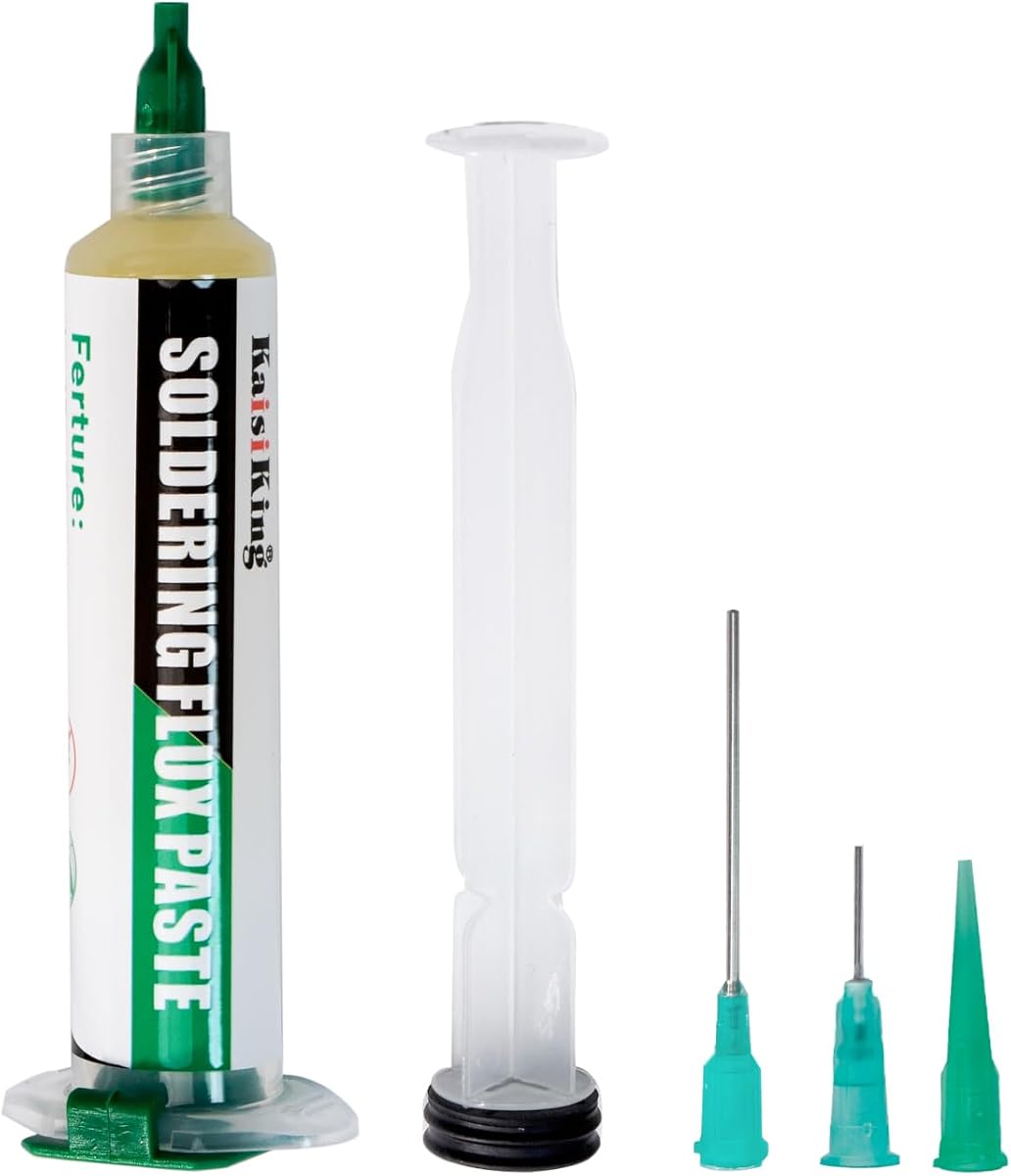
Kaisiking No Clean Soldering Flux Paste is a push-syringe product intended to place rosin flux precisely, and its 4.5 rating makes it a solid choice for controlled electronics soldering. The plunger design releases a small amount gradually, helping the user avoid placing a large blob where only a modest coating is required.
We may earn a commission when you buy through this link, at no additional cost to you.
The formula uses high-purity rosin materials and is described as lead-free, halogen-free, and non-corrosive. It is compatible with both lead-free and lead-based solder, which gives it useful flexibility on a bench where both types are encountered. The product also claims stable performance, low volatility, less smoke, good flow, and effective removal of stubborn oxide layers.
Applicability extends to instruments and metals including gold, copper, tin, and iron. That makes it appropriate for electronic welding, repair, and rework rather than only one narrow class of assembly. The push rod slowly advances the paste, and the included cover can be resealed after use, helping protect the remaining supply from contamination.
Its main limitation is the single-container format and the small-diameter delivery method. While excellent for pads and moderate-size repairs, a syringe can be slower than a jar when coating a large connector or tinning repeated wire ends. It is most attractive to users who value measured dispensing and clean handling over maximum bulk.
The push mechanism lets the user meter the paste as the rod advances. That control is valuable near sensitive components, where an uncontrolled deposit could spread or require additional cleanup.
Replacing the cover after use helps limit exposure to dust and other workshop contaminants. It also supports smoother flow during the next application by reducing the chance of the opening becoming clogged.
We may earn a commission when you buy through this link, at no additional cost to you.
This package includes two piston-style solder flux applicators, with each set containing a ten-milliliter paste container, one plunger, and two dispensing heads. Its 4.6 rating and flexible tips make it a useful choice for technicians who want more control over paste flow without moving to a disposable premixed applicator.
We may earn a commission when you buy through this link, at no additional cost to you.
The interchangeable heads are the defining feature. A wider opening can suit larger pads or routine work, while a narrower tip offers more focused placement for crowded SMD areas. The package describes the formula as environmentally friendly, halogen-free, non-corrosive, and suitable for electronic soldering applications.
The flux is intended for PCBs, SMD and SMT assemblies, manual soldering, desoldering, mobile phones, household appliances, and instrument repair. The rosin is not conductive when dry and is stated to provide insulation, reducing concern about residue completing an unintended electrical path after a repair.
With two applicators, the user can keep supplies at separate locations or use different heads according to the job. The ten-milliliter size is small compared with a jar, though, and users undertaking frequent tinning or large-area coating may exhaust it quickly. Overall, it is a compact and adaptable package for detailed repair benches.
Using a narrow tip for an SMD pad and a broader tip for a larger connection gives the user flexibility within one product format. This reduces the need to switch to a different container when task scale changes.
Keeping an applicator at each of two workstations can reduce interruption during a repair. It also provides a spare if one dispenser is damaged, clogged, or being used with a particularly sensitive material.
We may earn a commission when you buy through this link, at no additional cost to you.
The Crivon kit combines a handy rosin flux syringe with copper solder wick braid, and its 4.6 rating makes it a strong all-in-one option for electronics rework. The paired format reflects a realistic repair sequence: apply flux to improve solder flow, then use wick to remove unwanted solder before finalizing a component or connection.
We may earn a commission when you buy through this link, at no additional cost to you.
The paste is formulated as a no-clean, low-residue rosin flux designed to improve heat transfer from the soldering iron tip to the solder wire and PCB pad. The product description emphasizes smoother flow, better adhesion on pads, traces, and SMD components, and fewer cold joints or uneven bonds during precision work.
Controlled viscosity is another major benefit. The paste is intended to remain stable on PCB traces without spreading broadly, which helps keep application focused. The included wick absorbs excess solder and is positioned as a means of reducing bridges and minimizing pad damage during component replacement and general rework.
This is a good choice for a new repair setup that wants both application and removal supplies, as well as for technicians who want a compact, task-oriented package. Someone who already owns good wick may find the braid redundant, and the product data does not state a storage life for the syringe. Its core appeal is the coordinated, low-residue workflow.
Applying flux and removing solder are complementary steps in rework. Including both in one kit makes it easier to prepare a pad, clear old solder, and install a replacement with a repeatable sequence.
A paste that remains on the intended trace can reduce migration into nearby circuitry. That focus is especially helpful around fine SMD pads, where excess material can complicate heating or leave unnecessary residue.
We may earn a commission when you buy through this link, at no additional cost to you.
SOPAGRE Lead-Free Rosin Soldering Flux Paste is a straightforward two-ounce jar for general PCB repair, and its 4.4 rating still provides a useful set of established features. The paste uses a lead-free, non-corrosive rosin base and is presented as a no-clean product that leaves minimal residue.
We may earn a commission when you buy through this link, at no additional cost to you.
Its high-activity rosin is intended to remove oxidation and improve solder flow, supporting bright, strong joints on copper, tin, and nickel. The product also claims compatibility with both lead-free and leaded solders, making it suitable for a mixed repair bench even though the base formula itself is lead-free.
The compact resealable jar protects the paste from spills and drying while remaining simple to use. A technician can apply it directly to a PCB, use it during desoldering, or incorporate it into rework tasks involving smartphones, laptops, LED lights, and other precision electronics.
The principal drawback is that a jar offers less placement control than a syringe, especially around very small components. Its rating is also lower than the other options in the guide, although that does not negate the useful compatibility and residue claims. It is a straightforward general-purpose choice for technicians who value familiar jar packaging more than ultra-precise dispensing.
The compact container helps protect the paste from drying and reduces the chance of a spill on a crowded workbench. Resealing it after each use also supports consistent flow during the next repair.
Although the paste is lead-free, it is described as usable with both lead-free and leaded solder. That makes it convenient for technicians who service older equipment alongside newer lead-free assemblies.
We may earn a commission when you buy through this link, at no additional cost to you.
The right soldering flux paste depends on joint size, solder alloy, repair volume, dispensing preferences, and the amount of residue your workflow can tolerate. Use the following factors to narrow the field before comparing containers and complete kits.
A rosin-based flux is a sensible general choice for conventional electronics soldering because it assists oxide removal and solder wetting while remaining non-conductive when dry. The products in this guide consistently use rosin or an activated rosin approach, making them more directly relevant to PCB work than a general-purpose soldering aid intended for larger metal assemblies.
Jars and brushable paste suit wires, larger pads, repeated tinning, and general hobby work. Syringes are better for SMD components, tight spaces, and delicate boards because the user can place a small amount directly where heat will be applied. If your work includes both categories, a two-format bench may be more useful than choosing only one.
Some flux products are marketed specifically for lead-free work, while others support both leaded and lead-free alloys. Lead-free solder generally requires more heat and careful temperature control, so a compatible flux can help maintain smooth flow. Older equipment may still contain leaded joints, making a dual-compatible option useful for mixed repair environments.
No-clean flux is formulated to leave a small amount of residue that does not require immediate removal, but low residue does not mean zero residue. Very high-impedance, RF-sensitive, or heavily contaminated assemblies may still need cleaning. Look for non-conductive residue claims and consider whether your process can accommodate occasional cleaning with an appropriate method.
Type RA and RMA products use an activated or mildly activated rosin formulation to provide stronger oxidation removal than minimally active flux. That can be beneficial on aged, oxidized, or previously worked surfaces. It is also important to avoid using a formula outside its stated purpose, since more aggressive chemistry is not automatically better for every clean board.
Semi-solid paste is generally easier to keep in one location than liquid, while a dropper offers rapid coverage and a syringe gives the most targeted delivery. Regardless of format, close the container after use, keep it away from heat and direct sunlight, and prevent debris from entering the opening. Thickening can occur when some paste products are stored in cold conditions.
A desoldering wick removes unwanted solder when heated with flux, making it useful for correcting bridges, lifting components, or cleaning pads. A bundle with paste saves the need to buy both separately and supports a complete apply-and-remove workflow. If you already own suitable braid, a standalone flux may provide better value and more paste per package.
Larger jars suit frequent use, but opened flux can dry, collect debris, or remain open longer than necessary. Some syringe products state a shelf life of up to 12 months when properly stored, while others do not provide a specific period. Match the quantity to your real workload and seal smaller portions when you do not need the entire container immediately.
Begin with a clean, dry work area and make sure the soldering iron is at the appropriate temperature for the solder and board. A small amount of flux is normally enough: place a modest quantity on the joint or pad, or dip the end of a clean wire, then bring the heated iron and solder to the connection. The flux should soften the surface and help molten solder spread into the intended area rather than bead on oxidized copper.
For syringe-applied flux, use a fine tip to deposit a small bead immediately beside the pad. For jar paste, transfer only what is needed to the work with a clean applicator. Avoid spreading residue into connectors, switches, potentiometers, sockets, or other places where future cleaning would be difficult. After soldering, allow the board to cool and inspect the joint for a shiny, smooth fillet and unintended bridges.
Close the flux container immediately after use and remove residue from the rim so it cannot seal against the cap. Store the product away from heat and direct sunlight, and avoid refrigerating it unless the manufacturer specifically instructs otherwise. If a paste becomes unusually thick, allow it to reach room temperature and check for contamination. Clean applicator tips with a method approved for the product, and keep soldering iron oxidation from being mistaken for a lack of flux.
Paste flux is often easier to control on a workbench because it is less likely to spread across the board. Liquid flux can be useful when a technician wants to cover several points quickly or soak a joint more thoroughly. The better choice depends on the board density, dispensing preference, and desired cleanup level rather than on paste or liquid being universally superior.
No-clean flux is formulated to leave minimal residue that does not normally require immediate cleaning. Some sensitive, high-impedance, or heavily serviced assemblies may still benefit from cleaning, depending on the manufacturer and application. Always inspect the finished board and follow the instructions for the device and flux being used.
Only use a paste that explicitly states compatibility with the solder alloy and board material in question. Several options here are described as suitable for lead-free electronics, while others support both leaded and lead-free solder. Lead-free solder often needs a higher working temperature, so good temperature control remains essential even with compatible flux.
A no-clean rosin flux with a syringe or fine dispensing tip is usually the most convenient choice for SMD work. Precise placement helps avoid flux migration and keeps the heat focused on the pad. The flux must also be compatible with the board, component terminations, and solder being used.
Flux assists solder removal, but it does not pull the molten solder away by itself. A desoldering pump, solder sucker, or copper wick braid performs the physical removal. Applying flux under the wick improves transfer and helps the braid absorb solder more effectively.
Use less than you might expect. A thin coating or a small bead beside the pad is usually enough to promote wetting. Excessive flux can spread beyond the joint, complicate cleaning, and create unnecessary residue. With syringe products, dispense gradually and add more only if the solder still fails to flow.
The rosin products in this guide are described as non-corrosive when used as directed, and dry rosin is not electrically conductive. Corrosion or residue problems are more likely when a product is misused, contaminated, left open, or cleaned with an unsuitable chemical. Proper storage, application, and post-solder inspection remain important.
Keep the container tightly sealed, clean around its opening, and store it away from heat and direct sunlight. Some paste products may thicken in very cold environments, so allow them to return to room temperature before judging their flow. Use a clean applicator and avoid returning used material to the original container.
The SRA Solder 135 single jar is the strongest all-around choice because it combines controlled semi-solid application, no-clean handling, and compatibility with leaded and lead-free solder. The two-jar rosin set offers excellent supply for hobbyists and busy technicians, while the flux-and-wick kit is ideal for users who want a complete apply-and-remove repair setup.
For precision work, prioritize a syringe-style product with a fine tip, especially when repairing SMD components, phones, instruments, or densely populated boards. For general through-hole soldering and wire tinning, a jar may be faster and easier to manage. Desoldering wick, mild versus activated rosin, residue expectations, and solder-alloy compatibility should also guide the decision.
Product listings, package contents, customer feedback, and pricing can change over time. Before ordering, verify the current specifications and confirm that the flux is appropriate for your solder, board materials, component types, and cleaning process.