
3M Hi-Strength Spray Adhesive 90
4.5Editor score
High-strength contact bonding
Inverted dispensing can
Adjustable lace-pattern nozzle
Heavy Duty Spray Adhesive guide comparing ten top-rated options for crafts, repairs, upholstery, construction, and demanding multi-surface bonding projects.
Heavy duty spray adhesive is built for jobs that need more holding power and broader material compatibility than ordinary craft glue. The right formula can simplify large-area bonding, repairs, mounting, insulation, upholstery, and decorative projects, but application method and surface compatibility matter as much as the stated bond strength.
We compared all ten products by examining tack, repositioning time, supported substrates, spray control, drying behavior, moisture and heat resistance, intended applications, can size, and any consumer or industrial-use limitations. The list covers craft-oriented, multipurpose, automotive, construction, and professional aerosol formulations without treating any two as interchangeable.
Each review explains the strongest use case, practical advantages, and material-specific trade-offs so you can match the adhesive to your project. Ratings reflect the supplied customer feedback, while formulas and availability can change. Always verify the current label, safety information, and surface compatibility before purchasing or applying a product.
4.5Editor score
4.6Editor score

4.4Editor score
This side-by-side comparison highlights each adhesive's strongest differentiators, from repositioning time and spray control to professional restrictions and intended applications.


Gorilla Heavy Duty Spray Adhesive is the most broadly useful product in this guide, earning a 4.4 rating from buyers. It combines a strong permanent contact bond with a practical repositioning window of up to ten minutes, allowing a misplaced sheet, print, sign, or lightweight material to be adjusted before the bond becomes permanent.
We may earn a commission when you buy through this link, at no additional cost to you.
The wide-pad nozzle produces a controlled fine mist, which is valuable for even coverage on paper, cardboard, fabric, foam, wood, metal, leather, glass, and certain plastics. Its clear, non-yellowing, photo-safe finish is particularly useful for scrapbooks, mounted prints, paper crafts, signs, wreaths, and decor. Moisture resistance also gives it indoor and outdoor project potential.
The main trade-off is that the final bond is designed to be permanent, so mistakes cannot simply be pulled apart. Some plastic applications may also depend on the specific plastic and the product's footnote qualifications. The ten-minute alignment period is useful, but it is shorter than the extended range offered by 3M 94ET and is better suited to moderate-sized projects than unusually complex assemblies.
This is the most practical recommendation for a household user, crafter, hobbyist, or DIY renovator who wants one adhesive for many different materials. Use it when clear appearance, repositionability, broad compatibility, and a dependable final hold are all important. For professional industrial work, a formulation expressly intended for that use may be a better fit.
The nozzle's wide pad and fine mist help distribute adhesive evenly instead of concentrating it in one location. This makes the product easier to control across signs, mounted prints, foam board, fabric, and other medium-to-large surfaces.
Because the formula dries clear and is described as non-yellowing and photo safe, it is well suited to projects where appearance matters. Direct ultraviolet exposure may still affect color, so finished pieces should be protected when prolonged outdoor display is planned.
We may earn a commission when you buy through this link, at no additional cost to you.
3M Hi-Strength Spray Adhesive 90 is a professional-grade contact adhesive with a 4.5 rating and a clear focus on demanding bonding work. Its high-strength, fast-tack formula is intended to join large and small projects across construction, crafts, industrial maintenance, laminates, insulation, and related applications.
We may earn a commission when you buy through this link, at no additional cost to you.
The inverted can is a standout practical feature. Holding the container upside down makes dispensing more consistent during sustained jobs, while the adjustable nozzle allows the applicator to vary the width of the lace-pattern spray. The formula bonds a broad selection of materials, including laminate, wood, concrete, metal, plastic, paper, cardboard, insulation, fabric, melamine, polyethylene, polypropylene, and SBR rubber.
Its fast-drying, contact-type nature makes strong, durable bonding possible, and the stated resistance to moisture and high temperatures suits challenging environments. However, the label explicitly restricts the product to industrial or occupational use and says it is not for consumer use. It also contains 1,1-Difluoroethane, making professional handling, ventilation, and label precautions especially important.
This is the strongest recommendation for installers, fabricators, contractors, and other qualified professionals handling large laminates, wood panels, insulation, or industrial maintenance. A consumer seeking a straightforward home-project adhesive would be better served by a product explicitly sold for consumer applications. The professional restriction should never be overlooked.
The inverted dispensing format reduces the need to repeatedly reposition the can during continuous work. Combined with the adjustable spray width, it helps technicians control coverage across extensive surfaces and detailed applications.
The unusually broad substrate list makes this adhesive useful for fabrication tasks involving mixed assemblies. Users should still confirm that each material is explicitly covered and that surface preparation matches the product instructions.
We may earn a commission when you buy through this link, at no additional cost to you.
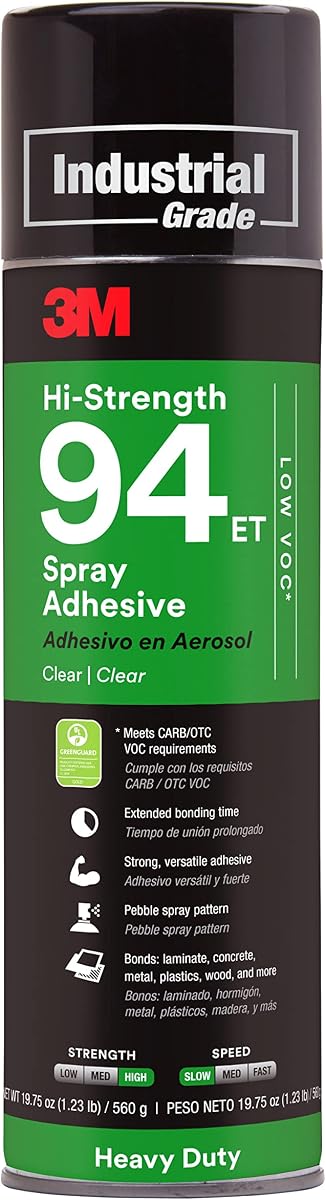
3M Hi-Strength Spray Adhesive 94ET has a 4.6 rating, the highest among the supplied products, and distinguishes itself with a generous sixty-minute bonding range. It provides aggressive initial tack while still allowing repositioning and alignment on large or complex builds, making it especially useful when both speed and correction time matter.
We may earn a commission when you buy through this link, at no additional cost to you.
Its adjustable-width web spray is designed to create controlled, consistent coverage. The formula bonds wood, laminates, metals, select rubbers, carpet, and flooring, while its resistance to elevated temperatures and moisture supports use in demanding environments. The low-VOC formula is certified under GREENGUARD and described as compliant with CARB and OTC VOC requirements, with potential to support LEED credit qualification.
The principal limitation is explicit: this is for industrial or occupational use and not for consumer use. A long bonding range is excellent for arranging multiple pieces, but it is not the same as a long open working time after surfaces have touched. Contact adhesives generally bond quickly once joined, so carefully confirm the layout before pressing components together.
Professionals assembling complex panels, carpets, laminates, or multi-part assemblies will appreciate the balance of fast grab and extended alignment. It is our editorial choice because it combines the strongest customer rating in the list with a technically useful application window. Consumers should choose a clearly consumer-rated product instead.
The sixty-minute range provides room to position several components before finalizing a build. It is a meaningful advantage when a project involves multiple edges, large sheets, or a layout that must be checked more than once.
An adjustable web pattern gives applicators greater control than a fixed narrow stream. The stated GREENGUARD certification and CARB and OTC compliance may also matter in professional settings where documentation and environmental standards influence purchasing decisions.
We may earn a commission when you buy through this link, at no additional cost to you.
Gorilla Ultimate Spray Adhesive is built around instant aggressive tack and carries a 4.5 rating. It is aimed at permanent, high-strength contact bonding for indoor and outdoor projects, with wood, metal, leather, laminate, rubber, plastics, foam, felt, cork, ceramics, canvas, and other materials listed among possible applications.
We may earn a commission when you buy through this link, at no additional cost to you.
One of its most useful features is the three-setting anti-clog nozzle. Low, medium, and high options allow the user to choose a narrower or wider web pattern, which makes it easier to move from detailed work to larger surfaces without changing products. The formula also resists heat and water or moisture, supporting use in exposed or variable conditions.
Its instant grab is also its main drawback. Materials need to be positioned accurately because there is little opportunity to correct the assembly after contact. Unlike the clear Gorilla Heavy Duty formula reviewed earlier, this adhesive is white, which may be noticeable on visible projects. The ability to paint and sand the cured product expands its usefulness for finished builds and repairs.
Choose this adhesive when fast attachment is worth more than an extended adjustment window, particularly for upholstery, foam, cork, canvas, ceramics, car headliners, and home repairs. It is a strong DIY and hobbyist option for experienced users who understand contact-adhesive assembly. For large layouts that require repositioning, one of the longer-window formulas will be more forgiving.
Changing between low, medium, and high spray widths helps balance coverage and precision. Fine control is useful around edges and smaller components, while a broader setting can speed work over larger panels.
The stated paintable and sandable characteristics make the adhesive suitable for assemblies that will receive a later finish. This is useful when the raw adhesive or bonded edges need to blend into a larger project.
We may earn a commission when you buy through this link, at no additional cost to you.
Permatex 27828 is a purpose-built body shop adhesive for detached or loosened automotive interior materials. It has a 4.4 rating and is specifically associated with headliners, carpet, trunk linings, and inside door panels rather than general household crafts.
We may earn a commission when you buy through this link, at no additional cost to you.
Its high-temperature formula maintains strong holding power at temperatures up to 170°F, an important consideration inside vehicles where cabin temperatures can rise substantially. The water-resistant formula is also designed to resist rain, sleet, and snow, making it better suited to exposed vehicle applications than a basic craft adhesive.
Application is designed to be straightforward, and the adhesive dries clear for a neater appearance. Even so, automotive interior work requires careful preparation and alignment because a headliner or carpet is often larger and more awkward to reposition than a small craft component. The specialized formulation also makes this a less obvious choice for general household bonding.
This is the best-matched option for repairing a loose headliner, carpet, trunk liner, or interior panel. It may also serve serious automotive restoration work where a high-temperature, weather-resistant bond is required. If the project is ordinary paper crafting, furniture repair, or mounting rather than vehicle restoration, choose a broader multipurpose formula instead.
The stated performance up to 170°F and water-resistant formulation directly address the temperature swings and moisture exposure found in automotive use. These properties give it a clear advantage over general-purpose glues in a vehicle cabin.
Headliners, carpets, trunk linings, and door panels are named applications, allowing buyers to judge fit before buying. The product is specialized rather than a universal adhesive, which should be considered when planning non-automotive projects.
We may earn a commission when you buy through this link, at no additional cost to you.
Nashua Low VOC Premium Spray Adhesive is a versatile, value-oriented option with a 4.4 rating. It can create either temporary or permanent bonds, giving users flexibility that many aggressively permanent heavy-duty adhesives do not offer.
We may earn a commission when you buy through this link, at no additional cost to you.
The formula provides fast skin, fast grab, and low soak, which are valuable traits for quick assembly work. It is specifically formulated to bond polyethylene to concrete block, wood, and other difficult-to-bond pieces, and it can also bond carpet. Label applications are another named use, so it has relevance beyond a hobby bench.
Because fast grab is central to the formula, it offers less forgiving positioning than adhesives with extended bonding ranges. Users should plan the placement and test the spray pattern before committing full-size components. The supplied information is also less detailed than for several competitors, so following the can's complete directions and testing a small area is especially sensible.
This is a strong budget recommendation for homeowners, crafters, and shop users who need a dependable aerosol adhesive capable of both temporary and permanent work. It is particularly attractive for carpet, labels, and polyethylene-related projects that are difficult to bond with ordinary glues. For extended alignment of large assemblies, opt for a product with a clearly stated longer repositioning window.
The ability to choose the intended bond type is useful for repeated workshop tasks. Temporary applications can support handling or staging, while permanent bonding can be used when a lasting assembly is required.
Polyethylene is among the most challenging plastics to bond, making the stated compatibility a meaningful advantage. The product also has named uses involving carpet and labels, expanding its value for a broad mix of household and workshop tasks.
We may earn a commission when you buy through this link, at no additional cost to you.
Gorilla Heavy Duty Spray Adhesive in the four-pack format is suited to high-volume users, workshops, and repeated large projects. Its 4.2 rating is the lowest among the ten products, but it retains the central qualities that make the single-can version attractive: a permanent bond, repositionability, a non-yellowing finish, and photo safety.
We may earn a commission when you buy through this link, at no additional cost to you.
Each 14-ounce can includes a comfort nozzle with a wide pad and controlled fine mist, promoting even application across sizable surfaces. The formula bonds wood, metal, fabric, foam, plastic, paper, glass, leather, and other materials. It also meets the listed new VOC standard, making it a practical option for users who expect to finish several projects without repeatedly buying a single can.
The pack does not change the fundamental behavior of the adhesive. It still dries to a permanent bond, so alignment matters, and a heavy four-can supply can become costly to store if only one project is planned. The 4.2 rating also suggests somewhat less uniform customer satisfaction than the leading formulas, although it remains a well-established option with clearly documented capabilities.
Buy this format if you routinely handle oversized craft boards, signs, displays, foam, fabric, or multiple household projects and value having several cans on hand. For a single compact job, the single-can version offers the same core formulation with less commitment. It is a quantity-driven choice rather than a different performance tier.
A four-can pack reduces interruptions between large jobs and is convenient for workshops that use spray adhesive regularly. The 14-ounce format also provides more coverage per can than smaller multipack alternatives.
The pack preserves the formula's repositionable, permanent, non-yellowing characteristics. Users should still avoid assuming that repositionability remains possible after the adhesive has fully developed its bond.
We may earn a commission when you buy through this link, at no additional cost to you.
Misty Heavy-Duty Spray Adhesive is offered in a case of twelve 12-ounce containers and carries a 4.4 rating. Its high-solids, nonchlorinated web spray formulation provides fast tack and supports either temporary or permanent bonds across leather, cardboard, most plastics, and cloth.
We may earn a commission when you buy through this link, at no additional cost to you.
The wide-pattern aerosol format is intended to cover larger surfaces efficiently. Fast tack and quick adhesion make it appealing for production work where repeated assemblies and throughput matter. The stated waterproof and non-staining characteristics are useful when appearance and exposure to moisture are both concerns.
Its inventory size is the defining trade-off. A twelve-can case is a substantial commitment for an occasional household project and requires safe, accessible storage. A wide spray pattern also demands careful control to avoid applying more adhesive than necessary, especially in confined spaces. As a contact adhesive, successful placement still depends on arranging the parts before they make contact.
This product is best for professional shops, upholstery operations, production workrooms, or serious hobbyists who consume spray adhesive regularly. The high-solids formula and wide coverage pattern make the case format more logical than for a one-time repair. For occasional crafting, a smaller pack is easier to justify.
The high-solids web formula and wide pattern are oriented toward consistent coverage over larger areas. These traits can reduce the need for repeated passes when the application is performed in a ventilated, well-prepared workspace.
Twelve individual containers suit operations that consistently need adhesive. Because aerosol cans require appropriate storage and ventilation, buyers should consider workspace conditions as well as their ongoing consumption rate.
We may earn a commission when you buy through this link, at no additional cost to you.
The Gorilla Heavy Duty two-pack is a balanced option for users who want more than a single can without committing to a large case. Its 4.4 rating matches the brand's single-can formula, and it preserves the same repositionable, permanent, non-yellowing, and photo-safe characteristics.
We may earn a commission when you buy through this link, at no additional cost to you.
Each 11-ounce can uses a comfort nozzle designed to deliver a wide pad and controlled fine mist. The adhesive is listed for wood, metal, fabric, foam, plastic, paper, glass, leather, and more. That makes the pack a versatile choice for visible crafts, home repairs, mounting, and light fabrication work where an even finish and dependable hold are both needed.
Compared with the four-can pack, the smaller format is more practical for occasional users and easier to store. Compared with the single can, it offers redundancy for a second project or a backup when one nozzle becomes difficult to dispense. The smaller can size means somewhat less coverage per container than the 14-ounce version.
This two-pack is a sensible middle ground for dedicated crafters and homeowners who expect repeated use without needing workshop-scale inventory. It is also attractive for projects that benefit from a fine, controlled mist and some initial repositionability. Industrial users should review professional product restrictions and choose a formulation labeled for that work.
Two cans are easier to justify than a full case while still providing reserve capacity. The 11-ounce size balances useful coverage with more compact storage for home workshops and craft rooms.
The non-yellowing, photo-safe characteristics are useful when displays, photos, paper crafts, and decorative pieces are being assembled. Clear results help the finished project maintain a clean appearance.
We may earn a commission when you buy through this link, at no additional cost to you.
3M Hi-Strength 90 Spray Adhesive has a 4.6 rating and is among the most capable choices for large-area work. It delivers secure adhesion in as little as 15 seconds while allowing up to 30 minutes for repositioning, giving installers a useful balance between fast handling and alignment time.
We may earn a commission when you buy through this link, at no additional cost to you.
Its adjustable nozzle supports precision control, while the formula is noted for excellent coverage on larger surfaces and resistance to seepage. The product is listed for rubber, fabric, glass, metal, wood, cork, flexible foam, plastic, cardboard, fiberglass insulation, drywall, and other materials. Applications range from crafts and household repairs to decorating, construction, acoustic soundproofing, and cosmetic automotive fixes.
The rapid 15-second adhesion means the product is not as forgiving as a slow-set construction adhesive during extensive alignment. Its VOC level is below 40 percent and meets stated California Air Resources Board requirements, though it is less restrictive than the sub-20-percent 94ET formula. Users should consult the actual can and safety documentation for occupational handling requirements.
This adhesive is well suited to users who work on large panels, soundproofing materials, foam, insulation, and mixed-material assemblies where a controlled spray and strong permanent bond are needed. Its customer rating, repositioning range, and material list make it a strong all-around professional-adhesive option. Smaller, highly visible craft projects may favor a clear consumer formula instead.
The combination of secure adhesion beginning in 15 seconds and a 30-minute repositioning period allows quick handling without giving up all layout flexibility. The exact result still depends on temperature, substrate, and application conditions.
The nozzle and high-coverage spray behavior make this adhesive relevant to large panels, drywall, insulation, and soundproofing work. Adjustable spray width helps users balance broad coverage with more focused application.
We may earn a commission when you buy through this link, at no additional cost to you.
The best heavy duty spray adhesive is determined less by a universal strength claim than by the materials, assembly method, environment, and working time required for a specific project. Use the following factors to narrow the field before making a final selection.
Begin by listing every material that will enter the bonded assembly, including trim, liners, fasteners, and any coatings. Products differ dramatically in their ability to bond porous materials such as paper, cardboard, fabric, and foam, as well as difficult plastics such as polyethylene and polypropylene. Some 3M formulations list broad ranges that include plastics, wood, laminates, metals, insulation, carpet, and rubber, while automotive and craft products may emphasize narrower material groups. Compatibility should mean that both surfaces are covered, because a bond can disappoint when one side is porous and the other is nonporous or difficult to wet.
Choose a product that explicitly names your materials whenever possible. Test a small sample when a project combines unfamiliar surfaces, and confirm whether surface cleaning, priming, or additional preparation is required.
Tack determines how quickly the adhesive grabs, while the bonding range determines how long materials can be moved before the bond becomes difficult or impossible to correct. Fast-tack products are useful for production work and small, well-planned assemblies. They can be unforgiving on large layouts because the surfaces may settle into contact before the installer finishes aligning them. Products offering tens of minutes of repositioning are more appropriate for complex panels, signs, and layered builds, although joining the surfaces too early can still create a strong bond before positioning is complete.
Prioritize a window that comfortably exceeds the time needed to arrange your project. Remember that repositioning is an application allowance, not an invitation to repeatedly peel and reposition bonded surfaces.
Aerosol adhesives are easiest to control when the nozzle produces a pattern suited to the workpiece. Fine mists help prevent concentrated deposits on small parts, while wide patterns and web sprays cover broad sheets more efficiently. Adjustable nozzles add flexibility by allowing narrow, medium, and broad settings, and inverted cans can make sustained application more consistent. The correct pattern also helps limit overspray, which is important on finished surfaces, adjacent materials, fabrics, and automotive interiors.
For a large project, choose a formula specifically noted for large-surface coverage. For detailed work, favor a controlled fine mist or adjustable narrow setting. Always practice on scrap material before treating the visible face of a project.
A strong initial grab is only one part of useful durability. Moisture, heat, UV exposure, flexing, and load can affect long-term performance differently depending on the adhesive. Gorilla Heavy Duty is described as moisture resistant for indoor and outdoor use, Gorilla Ultimate resists heat and water, and Permatex is specifically formulated to withstand severe weather and maintain strength at elevated temperatures. The 3M 90 and 94ET products are also described as resistant to heat and moisture. Match those claims to the real conditions rather than assuming a heavy-duty adhesive can handle every environment.
If the finished item will remain in a hot vehicle, exposed porch, workshop, or damp location, look for a product whose named applications and environmental claims directly cover that environment.
The labels make a crucial distinction. Both 3M Hi-Strength 90 and 94ET are explicitly described as for industrial or occupational use and not for consumer use. They are compelling choices for professional fabrication, installation, and maintenance, but their restrictions should be respected rather than treated as minor wording. Products from Gorilla, Nashua, Permatex, and Misty are positioned around craft, DIY, repair, automotive, and workshop tasks, although buyers should still examine safety instructions and ventilation requirements.
Choose a professional formula for professional work and a consumer-labeled formula for home projects. In either case, use the adhesive in a ventilated area, follow the can's directions, and keep it away from heat and ignition sources.
Low-VOC characteristics can matter in enclosed rooms, professional environments, or projects subject to specific building standards. Nashua is identified as a low-VOC product, while 3M 94ET is described as low VOC at under 20 percent and carries stated GREENGUARD, CARB, and OTC compliance claims. The standard 3M 90 listing mentions less than 40 percent VOC emissions, which is still below that threshold but does not offer the same reduced-emissions profile as 94ET. Claims and certifications can differ between formulations and package sizes.
Check the current container for exact VOC content and certification language, especially if documentation, indoor air quality, or a formal purchasing requirement influences the project.
Aerosol capacity and pack quantity should reflect both the surface area and the frequency of use. A 14-ounce can may suit a broad multipurpose project, while smaller 11-ounce cans are more convenient for a craft room. Four-can and twelve-can cases make sense for repeat work, large signs, upholstery, and professional production, but they require more storage and a confident ongoing need. The inverted 3M 90 can is designed for easy dispensing while held upside down, which may improve control during sustained application.
Buy the smallest format that comfortably covers your project unless you routinely use spray adhesive. Avoid underestimating coverage, especially for porous foam, fabric, cardboard, and fibrous materials that can absorb more adhesive than smooth plastic or metal.
Prepare both surfaces according to the product label, removing dust, grease, loose fibers, and old adhesive residue. Test the spray on scrap material and use a controlled pattern that covers the intended bonding area without creating a heavy accumulation. Keep the container upright unless its instructions specifically permit an inverted position, and hold the nozzle at the distance and movement rate specified by the manufacturer.
Allow the adhesive to become tacky as directed before bringing the materials together. Position the assembly within the stated bonding range, then apply firm, even pressure across the bonded region. Do not repeatedly pull surfaces apart to correct alignment, because doing so can disturb the developing bond or damage porous materials. Work in a ventilated area, avoid flames and other ignition sources, and wear suitable protective equipment if called for on the label.
After assembly, allow the adhesive to develop its full bond before loading, flexing, trimming, or exposing the project to moisture or heat. Store cans upright with their nozzles protected from dirt and accidental discharge, and keep them away from extreme temperatures. Dispose of partially emptied containers according to local aerosol and hazardous-material rules rather than puncturing or burning them.
The best choice depends on the materials and conditions. Gorilla Heavy Duty is broadly useful for home projects, while 3M 94ET offers an extended positioning window for professional assemblies. Permatex is purpose-built for automotive interiors, and professional 3M 90 provides high-strength contact bonding for demanding fabrication work. Always confirm that the selected formula lists every substrate in your assembly.
It depends on the formula and how long it has been open. Some products provide a repositioning window ranging from several minutes to an hour, while fast-tack versions offer much less time. Once the surfaces make firm contact and the adhesive develops its bond, attempting to reposition them can damage the assembly or the material.
Many formulations can bond those materials, but coverage and application speed matter. Porous materials may absorb adhesive, so begin with a lighter application and test an offcut. A fine mist or controlled web pattern helps avoid warping, saturation, and visible buildup on paper, fabric, and foam.
The supplied product information for both products states that they are for industrial or occupational use only and not for consumer use. Home users and hobbyists should choose a product explicitly intended for consumer craft, repair, or DIY applications and follow its label instructions.
Both are professional high-strength adhesives, but 94ET emphasizes a sixty-minute bonding range, aggressive initial tack, and a low-VOC formula below 20 percent. The inverted 3M 90 can emphasizes convenient dispensing, fast high-strength contact bonding, and resistance to moisture and high temperatures. Their nozzles, adjustment needs, and application procedures may also differ.
Only choose a product that explicitly states outdoor suitability and offers appropriate resistance to moisture, heat, and weather. Gorilla Heavy Duty is described for indoor and outdoor projects, Gorilla Ultimate is described for indoor and outdoor surfaces, and Permatex is resistant to rain, sleet, and snow. Direct UV exposure can still affect some colors, so verify the finish and exposure conditions.
Work in a ventilated, well-protected area and test the spray pattern on scrap material first. Use the narrowest setting that provides adequate coverage, keep the moving at a consistent rate, and avoid holding the nozzle over one spot. Mask nearby surfaces and allow overspray to settle before bringing the bonded faces together.
Test a small section that includes every important material in the assembly, especially combinations of porous and nonporous surfaces. Check initial tack, alignment time, final grip, appearance, and whether trimming or sanding exposes residue. Allow the test piece to cure under similar temperature and moisture conditions before applying adhesive to the final project.
Gorilla Heavy Duty Spray Adhesive is the most versatile recommendation for home users and hobbyists, combining repositionability, a clear finish, broad material support, and indoor-outdoor positioning. 3M 94ET is the editorial choice for professionals who need aggressive tack and a generous alignment window, while inverted-can 3M 90 stands out for high-strength contact bonding and demanding fabrication work.
Prioritize the factor your project actually needs: a consumer label, sufficient positioning time, compatible substrates, the right spray pattern, and resistance to the expected heat or moisture. Automotive repairs point toward Permatex, polyethylene and carpet work favors Nashua, and high-volume users may get the most value from larger Gorilla, Misty, or 3M packs.
Before ordering, confirm the current container size, label restrictions, listed substrates, repositioning time, and safety requirements. Retail listings and product details can change, so checking the latest manufacturer information and current retailer listing will help ensure the adhesive you select is suitable for the job.