
Hydroponic Tower Planter
4.6Editor score
Eighteen-plant vertical capacity
Remote Wi-Fi monitoring
Quiet water circulation pump
Full-spectrum LED lighting
Compact seventeen-inch footprint
Automated microgreen growing systems combine controlled lighting, moisture delivery, and purpose-built growing surfaces to make indoor harvests more consistent and convenient. The best options range from compact countertop kits to vertical hydroponic gardens, each offering a different balance of capacity, automation, and countertop footprint.
We compared all ten systems by examining their growing methods, lighting, water management, capacity, included components, ease of use, and suitability for microgreens or related crops. The list includes fully automated indoor gardens as well as simpler self-watering and passive sprouting systems that can suit different budgets and experience levels.
Each pick highlights the product’s strongest feature, along with practical limitations that may affect your choice. Ratings reflect the supplied customer feedback, while availability, included accessories, and prices can change, so shoppers should confirm current listing details before making a purchase.
4.6Editor score
4.5Editor score

4.2Editor score
As an Amazon Associate we earn from qualifying purchases.
This side-by-side overview compares growing capacity, automation features, lighting, included supplies, and practical constraints so you can identify the system that best matches your available space and preferred level of hands-on involvement.


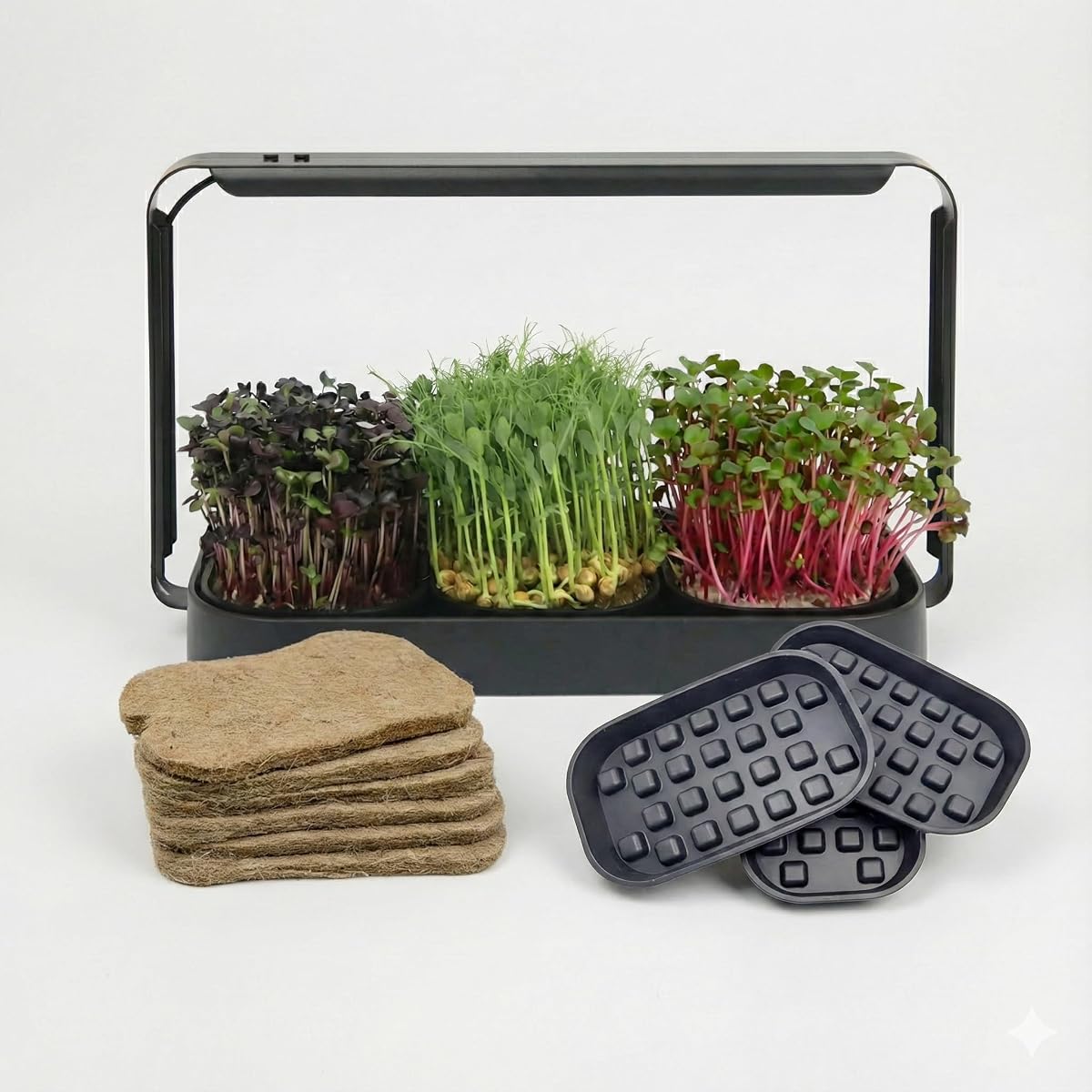
This three-tray indoor growing kit combines an LED spectrum lamp, silicone cultivation trays, jute mats, and blackout lids in a compact countertop system. Its 4.5 rating reflects a generally favorable response, while the kit’s strongest appeal is its organized approach to growing microgreens continuously rather than starting one isolated crop at a time.
We may earn a commission when you buy through this link, at no additional cost to you.
The three-tray arrangement supports succession planting: one batch can germinate under a lid, another can grow beneath the lamp, and a third can be ready to harvest. Proprietary side holes align with empty space in the trays, allowing water levels to be checked without disturbing roots. The viewing holes also make germination and early plant development easier for children to observe.
The tradeoff is that this is a dedicated indoor kit rather than a general outdoor gardening solution. Seeds are not included, so buyers must select their own organic or non-GMO varieties. It also requires a nearby electrical outlet for the integrated lamp and needs more attention to lighting placement and moisture than a completely passive windowsill setup.
It is an excellent choice for households that want regular microgreens, fresh garnishes, and an educational indoor growing activity without soil. The combination of custom trays, jute mats, monitoring features, and a staged harvest design makes it the strongest all-around option in this guide.
The three-tray configuration lets growers keep successive batches at different stages. This reduces the awkward gaps between harvests and makes a dependable countertop routine more achievable.
Side monitoring holes provide a convenient way to check water without lifting mats or disturbing young roots. The breathable silicone trays are intended to maintain a useful balance of moisture and air.
We may earn a commission when you buy through this link, at no additional cost to you.
This vertical hydroponic tower is designed for households that want the largest stated capacity in the group without dedicating a broad countertop or floor area. Its 18 planting positions, 17-by-17-inch footprint, and 38-inch height make it particularly appealing for compact kitchens, apartments, offices, and other indoor growing spaces.
We may earn a commission when you buy through this link, at no additional cost to you.
The most notable feature is Wi-Fi connectivity. Growers can remotely monitor and control watering schedules and lighting, making this one of the most genuinely automated options here. A quiet pump circulates nutrients to the roots, while full-spectrum LEDs support indoor growth. Reusable net cups help reduce disposable plastic use, and many tower components are dishwasher safe.
Compared with a simple tray kit, the tower introduces additional operating considerations. A connected pump, reservoir, lighting, and remote controls require setup and occasional maintenance, and the vertical format may be less convenient if you want to raise and lower individual planting sites. Its broader plant capacity also extends beyond microgreens into herbs and greens.
This tower is best for tech-minded growers who value remote control, substantial capacity, and a space-conscious format. For a small setup focused only on microgreens, one of the simpler tray systems may be more economical and less complicated, but for a versatile premium indoor garden, the feature set is impressive.
Wi-Fi management lets users check the garden and adjust watering or lighting schedules away from the growing area. This convenience is particularly valuable in offices, guest rooms, and other spaces where regular in-person access is inconvenient.
Eighteen planting sites occupy a relatively small footprint. The tower approach makes better use of vertical space while retaining access to individual plants for seeding, watering, and harvesting.
We may earn a commission when you buy through this link, at no additional cost to you.
This kit is built around two ceramic trays sized for a standard kitchen windowsill. It includes coconut coir and premium broccoli seeds, so it is one of the most approachable choices for a first microgreen crop. The 4.4 rating suggests broad appeal, especially among buyers who value simple materials and immediate usability.
We may earn a commission when you buy through this link, at no additional cost to you.
The ceramic trays have no drainage holes because they are intended to retain the appropriate level of moisture. During germination, the trays stack with a small intentional gap that allows air to circulate underneath. Once growth begins, they can be separated, creating a convenient rolling harvest: plant one tray and use the other the following week.
This system has fewer built-in technologies than the LED-equipped and Wi-Fi-controlled products. There is no lamp, pump, timer, or electronic moisture monitor, so light comes from the windowsill and watering remains a manual task. Its simplicity also means fewer components to assemble, though the user must pay closer attention to moisture and light exposure.
It is an excellent match for beginners, minimalist kitchens, and gift buyers seeking a useful gardening project. Choose it when natural light is reliable and hands-on care is welcome rather than a problem.
The supplied coir and seeds remove the need to assemble a separate growing medium and seed selection. Users can follow the basic planting process without investing in a complex powered system.
The two matching trays support a staggered planting schedule. After one crop matures, the second tray can already be underway, helping maintain a steady kitchen harvest.
We may earn a commission when you buy through this link, at no additional cost to you.
This all-in-one seed starter combines a 40-cell tray, humidity dome, LED grow light, heating base, and timer control. It is a strong budget-oriented option for growers who want more environmental control without moving to a complete hydroponic garden. Its 4.2 rating reflects a practical feature package with some mixed experiences.
We may earn a commission when you buy through this link, at no additional cost to you.
Built-in bottom heating delivers warmth directly beneath the growing area and is intended to reduce heat loss compared with a separate heat mat. The lamp and heater can run independently, allowing heat for germination, light for seedling development, or both together. Timer settings from one to 24 hours provide flexibility for different crops and schedules.
As with other multi-function systems, the integrated design requires more initial setup than a basic planting tray. The 40 cells are also more useful for broad seed-starting projects than for maintaining only a few mature microgreen trays. Buyers should account for the energy required by the lamp and heater and confirm that their space supports the complete unit.
This system is best for beginners, apartments, and anyone starting herbs, vegetables, flowers, or microgreens under controlled conditions. It offers the most useful entry point for buyers seeking timers and environmental controls at a relatively accessible entry point.
The integrated base warms the root zone from underneath instead of relying on a separate mat. Independent controls let users adjust the environmental support as plants move beyond germination.
A one-to-24-hour timer makes it possible to create repeatable light cycles. This is useful when varieties have different requirements or when the unit shares a counter with other indoor growing activities.
We may earn a commission when you buy through this link, at no additional cost to you.
This two-pack adapts common wide-mouth mason jars into simple hydroponic sprouting containers. Each lid and tray accepts seeds ranging from large peas and sunflower seeds to smaller varieties such as kale, basil, and bok choy. Its 4.0 rating reflects an uncomplicated product aimed at home growers who already understand basic jar-sprouting methods.
We may earn a commission when you buy through this link, at no additional cost to you.
The trays are designed to work best in 16-ounce through 32-ounce jars, giving users some flexibility in choosing a suitable container. Two complete lid-and-tray units allow different varieties to grow simultaneously, which is useful for comparing flavors or maintaining more than one crop. Operation relies only on water and sunlight.
The system does not include jars, seeds, lighting, a pump, or a timer, so it is not the most automated choice despite its usefulness within the broader category. Growers must rinse and drain seeds, maintain the water level, and provide suitable light. Wide-mouth jars also require careful handling to avoid spills.
Choose this option if you enjoy a hands-on process and want to reuse glass jars for sprouting. It is especially convenient for small kitchens and gardeners who already own compatible containers and prefer a minimal setup over a large powered appliance.
The universal jar format transforms familiar kitchen storage into growing containers. This lowers the need for specialized trays and keeps the setup visually simple.
Two included sprouting units allow separate seed varieties to mature on different schedules. This supports staggered harvests and gives growers more control over weekly preferences.
We may earn a commission when you buy through this link, at no additional cost to you.
This four-tier sprouting kit uses a passive, soil-free design to support germination for beans, alfalfa, small seeds, and grasses. It received a 5.0 rating, the highest listed score among the ten products, although the score should not be interpreted as the result of an individual hands-on assessment in this guide.
We may earn a commission when you buy through this link, at no additional cost to you.
Corrugated growing surfaces help keep seeds from moving, while drainage holes channel excess water into the bottom collection tray. Small openings also provide ventilation and humidity control. The tiers stack vertically when active and can be reversed for compact storage, making the system adaptable to limited counter space.
This is not electrically automated, so growers must provide water, manage moisture, and source suitable light. The material is not dishwasher safe and should be rinsed by hand. Despite those limitations, the straightforward gravity-drainage process can be attractive to people who prefer reusable equipment without pumps or electronic controls.
The kit is best for beginners experimenting with sprouts and anyone who values vertical capacity and easy cleaning. It works particularly well for larger seeds that benefit from being held in place while excess water drains away.
Four tiers create a substantial growing area without requiring four separate trays spread across the counter. Reversing the stack for storage helps preserve that space between growing cycles.
The lower tray collects water passing through the drainage holes. This reduces loose liquid around the growing area and makes the setup easier to manage during frequent rinsing.
We may earn a commission when you buy through this link, at no additional cost to you.
The MG-15 is a 15-pod hydroponic garden designed for more than microgreens alone. Its 4.2 rating reflects a versatile package with a lamp, adjustable stand, quiet pump, water tank, and a broad collection of included accessories. It is well suited to kitchens that want herbs, leafy greens, or decorative plants in one station.
We may earn a commission when you buy through this link, at no additional cost to you.
A 24-watt full-spectrum LED offers separate vegetable and fruit-and-flower modes. The built-in timer runs the light for 16 hours and off for eight, removing the need to switch it manually. The pump cycles every 30 minutes to circulate water and oxygen, while a transparent level window makes tank monitoring more convenient.
The included 5.5-liter tank reduces the frequency of refilling, but it still requires periodic attention and enough counter clearance for the stand and lamp. Claims about rapid growth and specific yield times should be treated as manufacturer statements, since results depend on the crop, variety, starting conditions, and environment.
This is an excellent choice for beginners who want a complete indoor garden with clear controls and many included components. It also suits households interested in a broader mix of crops rather than microgreens alone.
Vegetable mode emphasizes blue, red, and white wavelengths, while fruit-and-flower mode uses a different combination. The switch adds flexibility without requiring a separate lamp for every plant type.
The automatic 30-minute pump cycle circulates water and oxygen around the root zone. This passive circulation reduces the daily intervention required compared with a plain reservoir garden.
We may earn a commission when you buy through this link, at no additional cost to you.
This 15-pod hydroponic garden is centered on an LCD touch panel and intermittent misting technology. It holds a 3.8 rating, the lowest of the group, but its feature set is among the most extensive. The controls make it a compelling option for users who value interface convenience and extensive programming.
We may earn a commission when you buy through this link, at no additional cost to you.
The system offers seedling, vegetable, and bloom light modes, along with one-touch brightness adjustment and automated timers set to 12, 14, or 16 hours. Its six-liter tank has a visible water level and can be removed for cleaning. The listing notes that a 3-liter water level is most suitable, which is an important setup detail to consider.
Its advanced electronics and controls create more potential points of confusion than a simple passive tray. The lowest customer rating in the comparison may reflect fit, reliability, or setup issues that cannot be diagnosed from the supplied information alone. The manufacturer also makes unusually specific claims about germination and oxygen improvements, so buyers should interpret those claims cautiously.
This garden fits tech-oriented users who want touch controls, misting, and flexible lighting in a compact indoor format. It may be less attractive to someone seeking a simple product with fewer settings and no electronic interface.
The LCD interface brings lighting modes, brightness, and timer settings into one place. It is convenient for experienced growers who want to adjust the environment without repeatedly handling separate components.
Intermittent spray delivery keeps the root area moist while introducing oxygen. The removable tank also makes the system easier to inspect, empty, and clean during routine maintenance.
We may earn a commission when you buy through this link, at no additional cost to you.
This four-pack provides four complete growing assemblies, each consisting of a clear humidity dome, inner mesh tray, and bottom reservoir. The 4.4 rating indicates a generally positive reception, and the package is designed for growers who want several small batches rather than one large tray.
We may earn a commission when you buy through this link, at no additional cost to you.
Adjustable vents allow humidity to be reduced as seedlings develop, while 1.2-millimeter holes in the inner tray improve breathability and drainage. The setup can accommodate numerous edible microgreens, including soybean, mung, buckwheat, wheatgrass, radish, alfalfa, broccoli, and Chinese cabbage. It can also be used for cat grass.
This is a passive system with no light, timer, pump, or sensor. Growers must soak, rinse, drain, and monitor the seeds while providing direct sunlight. The bottom reservoir is dishwasher safe, but the humidity domes are not, so cleanup is only partly automated.
The kit is best for small-space growers, seed comparisons, and families that want to cultivate several varieties separately. Its four identical units also make it easy to stagger planting dates and rotate harvests.
The four-pack offers more scheduling freedom than a single tray. Each assembly can hold a different crop or be planted at a different time to maintain successive harvests.
The 1.2-millimeter mesh provides support for tiny seeds while allowing water to drain. Combined with the domes, it creates a controlled environment during germination and early seedling growth.
We may earn a commission when you buy through this link, at no additional cost to you.
The Sproutlet combines three reusable trays, humidity domes, compostable grow mats, and organic microgreen seeds in one package. Its 4.0 rating reflects a straightforward self-watering format aimed at busy households, beginners, and anyone who wants a low-mess indoor growing experience.
We may earn a commission when you buy through this link, at no additional cost to you.
A built-in reservoir delivers consistent moisture without requiring daily watering, while the grow mats contain the crop and reduce spills. The kit can be ready for harvest in as little as seven to ten days under suitable conditions, although actual timing varies with the seed variety and growing environment. Reusable BPA-free, food-safe trays are designed for repeated cycles.
There is no integrated lamp or electronic controller, so the system still depends on suitable light and occasional refilling. The reusable materials and self-watering mechanism add convenience, but buyers should confirm that they are comfortable supplying the appropriate light and monitoring the reservoir.
This kit is best for people who want an almost complete starter package without soil. It is especially practical for busy families, compact kitchens, and anyone who values a tidy countertop setup over sophisticated electronics.
The integrated self-watering mechanism supplies moisture to the grow mats from the tray reservoir. This reduces the frequency of manual watering while keeping the growing surface contained.
Organic seeds, compostable mats, domes, and reusable trays arrive together. New growers can begin without separately selecting a substrate, seed packet, and basic growing containers.
We may earn a commission when you buy through this link, at no additional cost to you.
The right system depends on your available light, countertop area, preferred crop scale, and tolerance for routine care. Compare automation, capacity, growing medium, water access, and included supplies before choosing a model.
True automation can include automatic water circulation, scheduled grow lights, temperature control, remote monitoring, or app-based controls. The Hydroponic Tower Planter, MG-15, and Misting Hydroponic System provide the strongest electronic automation, while the 40 Cells Seed Starter Tray adds a timer, light, and integrated heating. A self-watering or passive tray still reduces labor but does not control every growing variable.
Hydroponic systems circulate nutrient solution around the roots, while tray-based kits use mats, coir, or another moisture-holding medium. The Silicone Microgreens kit uses biodegradable jute mats, the mizuna kit uses coconut coir, and the Sproutlet uses compostable grow mats. Consider cleanup, waste, seed compatibility, and the learning curve associated with each method.
Capacity should reflect both the number of plants you want and your preferred harvest schedule. Multiple trays, such as the three-tray silicone kit and four-pack dome set, make staggered planting easier. The 15-pod and 18-site hydroponic systems offer greater plant diversity but require more space, lighting, and reservoir maintenance. Larger is not necessarily better if crops will be harvested before the remaining sites are used.
An integrated LED removes the need to find a perfectly lit windowsill and provides more consistent light indoors. Look for a timer, selectable modes, and an adjustable height so seedlings and mature plants receive suitable illumination. Passive kits need strong direct light and may produce uneven results when placed near obstructions or seasonal changes in daylight.
Hydroponic gardens use pumps and reservoirs to circulate water and oxygen, reducing frequent manual watering but adding components that need cleaning. Self-watering trays use passive reservoirs, while draining trays collect excess moisture. The silicone kit adds side-level monitoring holes, and the Hydroponic Tower offers remote watering schedules. Match the mechanism to your willingness to refill and sanitize the system.
Compact jar adapters and windowsill trays suit small kitchens, while vertical towers use height more efficiently. Pump-based gardens also need room for the light, stand, reservoir, and clearance around the plants. Check the stated dimensions against your available counter height and ensure that doors, shelves, and nearby walls do not block light or access.
A complete starter may include seeds, growing mats, coir, net cups, domes, nutrient solution, labels, and an adapter. The mizuna kit includes coir and broccoli seeds, the Sproutlet includes organic seeds and mats, and the MG-15 includes sponges, baskets, nutrients, labels, poles, and an adapter. Other systems may require seeds, jars, lighting, or nutrients separately.
Food-grade, BPA-free materials are useful in a kitchen setting, while dishwasher-safe components simplify cleanup. Reusable net cups, silicone trays, and ceramic dishes can support repeated use, but not all plastic parts tolerate dishwashers. Inspect ventilation, drainage, electrical fittings, and removable components to understand how often deep cleaning will be required.
Begin by choosing an appropriate seed variety and reading the complete instructions for your specific system. Clean and dry all reusable components, position the unit where it will receive the specified light, and confirm that water can reach the roots or growing mats without flooding the seed. For hydroponic models, fill the reservoir to the recommended level, add nutrients as directed, and make sure the pump is operating before planting.
Distribute seeds evenly over the mat, coir, mesh, basket, or net cup according to the product design. Use the blackout lid or humidity dome during the appropriate early growth stage, then adjust vents or remove covers when ventilation is needed. Keep the scheduled light cycle consistent, inspect the water level, and avoid overwatering. The supplied mizuna kit notes a harvest window of seven to ten days, while other products list longer crop-specific timelines.
After harvest, remove spent roots and plant material, empty or clean the reservoir as needed, and sanitize components that contact moisture. Rinse passive trays regularly during a crop cycle, and follow the heating and lighting schedules provided for the 40-cell starter. Check filters, pumps, touch controls, timers, and water connections periodically on automated systems, and store unused parts only after they are fully dry.
The Hydroponic Tower Planter offers the broadest connected features, including Wi-Fi monitoring and control of watering schedules and lighting. The MG-15 and Misting Hydroponic System also automate important tasks through pumps, timers, and programmable lighting. If remote access is unnecessary, a self-watering tray can provide useful moisture control with less complexity.
Not all of them do, but reliable illumination is essential for compact, dense microgreen growth. Products with integrated LEDs provide more consistent indoor results than windowsill kits that depend on natural light. If you choose a passive system, place it where it receives strong light and monitor how conditions change through the day and seasons.
Hydroponic systems automate nutrient and water circulation and can support a wider variety of plants, but they also require a reservoir, pump, and more involved cleaning. Mat- or coir-based trays are often simpler for microgreens and use fewer powered components. The better choice depends on whether convenience and capacity outweigh the extra maintenance.
Yes, if the product has sufficient pod or planting capacity. The 15-pod and 18-site systems list support for herbs, leafy greens, flowers, and fruiting crops in addition to microgreens. Tray-based kits can also support sprouts, seedlings, herbs, and cat grass, but their smaller format and harvest method may be less suitable for large fruiting plants.
There is no universal interval because water quality, plant uptake, temperature, and system design all affect it. Follow the included instructions, monitor the visible level, and change the reservoir when the manufacturer recommends or when the water appears cloudy or depleted. Never let the pump run dry, and clean the tank and wetted components between crop cycles as directed.
Many kits are well suited to family projects because seed germination and growth are easy to observe. The silicone kit includes viewing holes and blackout lids for that educational purpose, while the MG-15 is described as suitable for a wide age range. Adults should still supervise watering, electrical use, sharp accessories, and cleanup.
Prioritize the features you actually need rather than the largest advertised capacity. A timer, adequate lighting, reliable drainage, and a clear reservoir can matter more than decorative controls. The 40 Cells Seed Starter Tray offers adjustable timing and integrated heating, while passive stacked and self-watering kits can provide a lower-cost route to frequent harvests.
That depends on the listing. The premium silicone microgreens kit explicitly excludes seeds, while the mizuna kit includes broccoli seeds and the Sproutlet includes organic seed varieties. For any system sold without seeds, confirm that the seed type is compatible with the medium, basket, tray, and expected harvest method before purchasing separately.
The Microgreens Growing Kit Indoor is the strongest overall choice for regular kitchen harvests because its three-tray design, integrated light, water monitoring, and jute mats form a focused microgreen system. The Hydroponic Tower Planter is the premium option for remote control and vertical capacity, while the 40 Cells Seed Starter Tray offers the best budget combination of timed lighting, heat, and environmental control.
Prioritize the growing method and level of automation that match your habits. Choose a connected hydroponic garden if you want remote management and broader crop options; select a passive or self-watering tray if simplicity, compactness, and hands-on care are more important. Also consider available light, counter dimensions, cleanup, and whether multiple trays would make harvest scheduling easier.
Finally, confirm the current listing contents and price before ordering, since included accessories, bundle details, ratings, and availability can change. Check seed inclusion, jar or accessory requirements, electrical needs, and care instructions carefully so the system you select is ready for the way you actually plan to grow.