
Seagate Portable 4TB
4.6Editor score
Four terabytes portable capacity
USB 3.0 plug-and-play design
Compatible with Windows and Mac
Included eighteen-inch USB cable
Hard drives for recording must balance usable capacity, dependable throughput, and a connection method that suits your equipment. Audio sessions and video projects consume space quickly, while sustained writes, cache behavior, and cooling can determine whether a drive responds smoothly under a demanding workflow.
We compared ten internal, portable, NAS, enterprise, and professional recording-storage options. The evaluation focused on stated capacity, rotational speed, interface, cache, recording technology where identified, workload suitability, portability, and practical roles within a larger editing or backup setup.
The list includes straightforward desktop storage, compact external drives, high-capacity archive options, RAID-ready hardware, and a professional Thunderbolt system. Each review explains where the drive fits best, while current prices and availability can change as storage configurations evolve.
4.6Editor score
4.7Editor score

4.4Editor score
As an Amazon Associate we earn from qualifying purchases.
The comparison covers ten hard drives for recording across different storage tiers, from portable consumer models to enterprise and professional RAID systems, with capacity, interface, recording technology, and intended workload treated as the central distinctions.


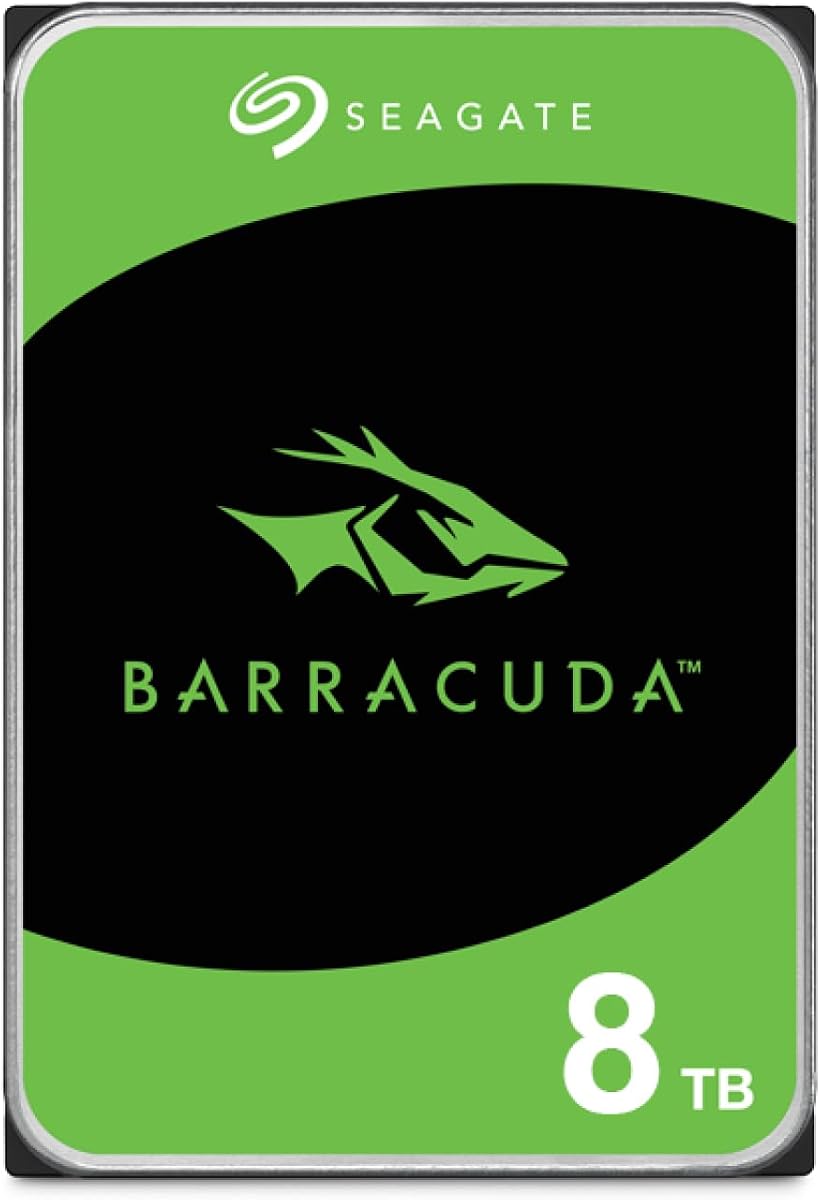
The Seagate 8TB BarraCuda combines a generous recording-storage capacity with a clearly stated sustained transfer rate of 190MB/s. Its 4.7 rating reflects a strong combination of capacity, desktop applicability, and established BarraCuda positioning, making it a practical starting point for audio libraries, project archives, and general editing storage.
We may earn a commission when you buy through this link, at no additional cost to you.
Its main strength is the balance between room to grow and a clearly documented transfer rate. The drive is intended for music, video, photo editing, gaming, and other PC applications, so it can sit comfortably beside an editing workstation rather than serving as an isolated scratch disk. The SATA 6Gb/s interface supports broad desktop compatibility, and the stated sustained performance provides a useful baseline for moving completed media.
There are important trade-offs. This is an internal 3.5-inch drive rather than a portable device, so it needs compatible mounting, power, and data connections. The supplied packaging is described as an anti-static bag without cables or a box, which also means a new drive does not include everything needed for installation. It is best for a fixed recording or editing computer, not for moving sessions directly between locations.
Choose the BarraCuda when you want substantial internal capacity without moving into specialized enterprise or RAID equipment. It is a strong recommendation for producers who keep large libraries, export multiple versions of finished projects, and need a dependable desktop drive for everyday recording-related storage. A separate backup remains essential, but as a primary project repository, this model is especially versatile.
An 8TB allocation gives recording sessions room for source footage, audio tracks, project files, renders, and exported deliverables to coexist. That makes the drive more useful as a working repository than as a temporary drive filled with only a few recent projects.
The SATA 6Gb/s interface and 190MB/s sustained transfer specification suit a desktop PC that must move sizable media files regularly. It is particularly relevant for users who prefer a permanently installed drive over reconnecting a portable enclosure.
We may earn a commission when you buy through this link, at no additional cost to you.
The WD 6TB Elements is notable for combining high capacity with one of the most compact form factors in the guide. Its 2.5-inch portable enclosure can hold photos, videos, music, and documents while remaining easier to transport than a full-size desktop drive. A 4.7 rating makes it one of the strongest all-around choices for a user who records in different locations.
We may earn a commission when you buy through this link, at no additional cost to you.
Its USB 3.2 Gen 1 connection, offered at 5Gbps, provides a modern interface for transferring completed recordings and maintaining an external media library. Plug-and-play readiness reduces setup friction: the drive can be connected to a compatible PC or Mac without a separate installation process. The large capacity is particularly useful for preserving camera files, audio sessions, and project backups away from the main workstation.
The trade-off is that portable does not mean specialized. This model has no RAID array, enterprise workload rating, or integrated SSD acceleration. Its small enclosure may also be less appropriate for a permanently connected, continuously demanding recording environment than a full-size desktop drive. A recording system that writes continuously and benefits from a large internal cache should look beyond this category of product.
The 6TB Elements is an excellent choice for location-based creators, students, and editors who need to carry recordings between computers. It works well as a media archive, a shuttle drive, or a secondary destination for completed projects. For a single desktop seeking its only storage device, a 3.5-inch internal drive may provide a more permanent solution, but for portability this drive is difficult to overlook.
The 2.5-inch enclosure preserves a small physical footprint while offering 6TB of capacity. It can serve as a traveling library for media that should remain connected to the edit rather than stored on a single workstation.
Plug-and-play operation supports a quick workflow when moving between Windows and Mac systems. The USB interface also avoids requiring users to open a desktop case or configure an internal SATA connection.
We may earn a commission when you buy through this link, at no additional cost to you.
The WD Black 10TB is built for users who want more than basic file storage. It combines a 10TB capacity with a 7200 RPM spindle, 512MB cache, and a SATA 6Gb/s interface. Its 4.4 rating reflects a performance-oriented internal drive aimed at gamers, system builders, and creative professionals rather than simple archival duty.
We may earn a commission when you buy through this link, at no additional cost to you.
The large cache and high spindle speed make the specification more interesting for recording workflows than a basic storage drive. WD Black is positioned for performance storage, and the drive can serve as a high-capacity repository beside a faster system drive. StableTrac and Dynamic Cache Technology are intended to optimize performance and support reliability as data is handled during demanding desktop operations.
As a hard drive, it still has the inherent limitations of magnetic storage and a 7200 RPM design. It will not match the random-response speed of an SSD, and the included capacity is consumed by file systems and formatting. Installation requires a compatible 3.5-inch bay, SATA data connectivity, and suitable power. Users should also account for the additional heat and noise often associated with high-speed desktop mechanics.
This is a compelling option for a recording workstation that needs ample storage while benefiting from a performance-oriented mechanical design. It can hold media libraries, source clips, and multiple editing sessions without forcing everything onto a smaller drive. For a video editor seeking maximum responsiveness, it works best as secondary storage alongside an SSD, while a system requiring instantaneous access to active timelines may favor solid-state storage.
A 7200 RPM spindle and 512MB cache distinguish this model from conventional storage-oriented drives. Those specifications are useful in a workstation that regularly transfers larger media files and manages an extensive local library.
Ten terabytes leaves room for source assets, caches, renders, and exported masters on one volume. The drive is best treated as high-capacity workspace storage while an SSD handles the operating system and the most latency-sensitive application tasks.
We may earn a commission when you buy through this link, at no additional cost to you.
The renewed Seagate Exos 26TB is built for large-scale recording archives where capacity and sustained operation matter more than compactness. It offers 26TB, CMR recording, a 7200 RPM spindle, 512MB cache, and a stated 2.5 million-hour MTBF. Its 4.5 rating makes it a strong specialist choice for studios, production teams, and advanced NAS-style storage.
We may earn a commission when you buy through this link, at no additional cost to you.
CMR is particularly relevant when preserving large sets of sequential media, backups, or project archives. Combined with the high spindle speed and enterprise workload positioning, the Exos is intended to handle data-intensive, continuous operation. Its 26TB capacity could hold a large collection of raw video, multitrack audio sessions, and backups without requiring numerous smaller volumes.
The renewed designation deserves careful consideration. Buyers should review the seller's condition terms, warranty coverage, and return provisions closely, particularly for a drive intended to hold irreplaceable material. It is also physically and operationally substantial: users need compatible cooling, power, mounting, and a system suitable for high-capacity enterprise mechanics. Few simple recording setups need this much storage.
Choose the Exos 26TB when maintaining a deep archive is central to the recording operation. It can serve as a repository for completed projects, raw media, and secondary backups, especially for a studio that values CMR and sustained enterprise characteristics. It is less attractive for a laptop user or a small project needing only one portable drive, but for massive storage with a long-term operational role, it makes a compelling case.
A 26TB volume reduces the need to divide large archives across many devices. That simplifies long-term retention of source footage, session backups, and multiple delivery formats while still leaving room for growth.
Conventional Magnetic Recording is identified explicitly for this model. It is a meaningful consideration for a high-volume repository because the recording approach is intended to maintain consistent behavior across sustained workloads.
We may earn a commission when you buy through this link, at no additional cost to you.
The Seagate Portable 4TB delivers a useful mix of capacity, portability, and uncomplicated setup. It connects over USB 3.0, works with Windows or Mac, and is recognized automatically after connection, with no software required for basic use. Its 4.6 rating reflects a straightforward and dependable choice for recording projects that need a separate drive rather than a complex enterprise system.
We may earn a commission when you buy through this link, at no additional cost to you.
The drive's defining benefit is its drag-and-drop workflow. Media can be copied to the portable unit and moved to another compatible computer without navigating a proprietary management system. The included 18-inch USB 3.0 cable makes it ready for use with the supplied package, while 4TB offers enough room for sizeable collections of audio, images, documents, and compressed or completed video projects.
The obvious limitation is scale. Four terabytes is less accommodating than the 8TB, 10TB, and larger options in this guide, particularly for uncompressed source footage or extensive multi-project archives. It is also a conventional external hard drive without RAID, high-end caching, or enterprise workload ratings. Those omissions are rarely problems for a straightforward backup, but they make it less suitable as the only critical production repository.
This is a persuasive choice for a creator who values simplicity over maximum storage. Use it to carry sessions between studio and home, maintain a local backup, or keep an offline copy of important deliverables. It also works for smaller recording studios seeking an uncomplicated media-transfer device. Users with continuously expanding archives should instead consider one of the higher-capacity internal or professional solutions.
Automatic recognition and drag-and-drop operation minimize the time between capturing a session and moving it to another machine. That simplicity makes the drive useful for contributors who do not want to manage complicated storage software.
Four terabytes can comfortably hold many finished recordings, project files, and routine backups. It is a sensible middle ground for users who want more room than a small flash drive without the size of a desktop drive.
We may earn a commission when you buy through this link, at no additional cost to you.
The WD Blue 12TB combines a roomy 12TB capacity with a 7200 RPM spindle, 512MB cache, and a SATA 6Gb/s interface. Described as a reliable everyday computing drive, it is a sensible choice for a recording workstation that needs more local space than a conventional secondary drive typically provides. Its rating of 4.6 reflects a favorable balance of capacity and general-purpose performance.
We may earn a commission when you buy through this link, at no additional cost to you.
For recording users, the 12TB volume can consolidate source media, session files, rendered exports, and backups in a single internal location. The substantial cache and high rotational speed are helpful when moving larger media segments, while SATA connectivity ensures straightforward integration with compatible desktop systems. Acronis True Image WD Edition cloning software is also included, which can assist users migrating data from an older drive.
The drive does not present itself as an enterprise model, so it is less obviously suited to continuous data-center operation than the Exos, Ultrastar, or WD Red Pro options. It also requires the same practical accommodations as any internal 3.5-inch drive: a compatible bay, SATA power, data cabling, airflow, and room in the chassis. As with all mechanical storage, it remains less responsive to random operations than a solid-state drive.
Choose the WD Blue 12TB when your priority is generous, dependable desktop capacity rather than specialized NAS, enterprise, or portable features. It is especially suitable for independent editors, podcast producers, and small studios that want a permanent archive and project store without moving to a multi-drive professional array. Pairing it with an SSD for active applications gives the best balance for a mixed editing workflow.
The capacity is large enough to reduce frequent archive juggling. A studio can group media by client or project while retaining enough space for exports, audio stems, and backup copies.
A 7200 RPM spindle and 512MB cache make the drive appropriate for sustained file-oriented work. It offers a straightforward internal solution without requiring the specialized hardware found in the NAS and professional RAID products.
We may earn a commission when you buy through this link, at no additional cost to you.
The WD Elements 4TB is a compact, user-friendly drive for everyday recording backups and media transport. Its 4TB capacity, portable enclosure, and USB 3.2 Gen 1 connectivity make it easy to carry and connect. The 4.6 rating indicates a well-regarded general-purpose option, particularly for users who do not need specialized RAID or enterprise functionality.
We may earn a commission when you buy through this link, at no additional cost to you.
The small, lightweight design is emphasized as a core benefit, making the drive convenient to store and move between locations. It supports plug-and-play expansion, so adding storage does not require installing it internally or navigating a complex setup. Photos, videos, music, and documents can be kept on the same unit, giving a creator a simple place for both active files and routine backups.
As with the Seagate Portable 4TB, the main limitation is how much the drive can hold before another archive becomes necessary. Raw camera footage can consume space quickly, and copying that material to this drive may not offer the specialized performance or resilience of an enterprise or RAID design. The enclosure should also be protected from impact, and critical files require more than one retained copy.
This Elements model is a strong fit for a student, mobile creator, or small studio that wants an inexpensive-feeling, uncomplicated way to back up projects and carry media. It is particularly useful when portability matters more than maximum capacity. For larger professional libraries, the 6TB Elements or an internal 8TB-class drive offers more room, but for routine projects the 4TB version is neatly balanced.
The lightweight enclosure makes this drive easy to place in a bag and connect at a client site, home office, or editing suite. Plug-and-play behavior keeps the workflow centered on copying files rather than configuring hardware.
The available space is sufficient for many recording projects, photo collections, music libraries, and document sets. It works especially well as a rolling backup destination when a second copy of irreplaceable material is maintained elsewhere.
We may earn a commission when you buy through this link, at no additional cost to you.
The renewed WD Ultrastar DC HC580 is a 24TB enterprise hard drive aimed at demanding server and large-scale storage environments. It combines a 7200 RPM spindle, 512MB cache, SATA 6Gb/s connectivity, 512e formatting, and a stated 2.5 million-hour MTBF. Its 4.6 rating makes it one of the strongest specialist options for sustained recording archives.
We may earn a commission when you buy through this link, at no additional cost to you.
The drive is engineered for 24/7 operation and massive scale-out applications such as data centers, cloud storage, and big-data systems. CMR recording is identified as a means of maintaining consistent and reliable performance across varied workloads. For an organization creating large volumes of high-resolution footage or maintaining replicated media libraries, the 24TB capacity and enterprise durability orientation are highly relevant.
This is not a simple consumer desktop purchase. A compatible server or workstation, appropriate airflow, and familiarity with enterprise storage practices matter. The renewed status requires attention to the seller's warranty, condition, and return terms. Users should also confirm that their equipment supports 512e and that their management software recognizes the drive. Buying a single high-capacity enterprise drive should not be confused with a fault-tolerant RAID system.
Choose the Ultrastar when continuous operation, large capacity, and enterprise features outweigh the simpler installation of a consumer drive. It can serve as a substantial archive for a production facility or as part of an organized storage infrastructure. For a home editor with only a few active projects, it is excessive; for a studio handling extensive ongoing media, it may be exactly the scale of hardware required.
A 24/7 operating design and high MTBF rating indicate an enterprise focus. These characteristics suit facilities that need large volumes of data to remain accessible over long operating periods rather than occasional consumer use.
The drive can provide substantial capacity in a single 3.5-inch unit, but it is not itself a redundancy system. Important material should still be protected through backups, replication, or RAID where appropriate.
We may earn a commission when you buy through this link, at no additional cost to you.
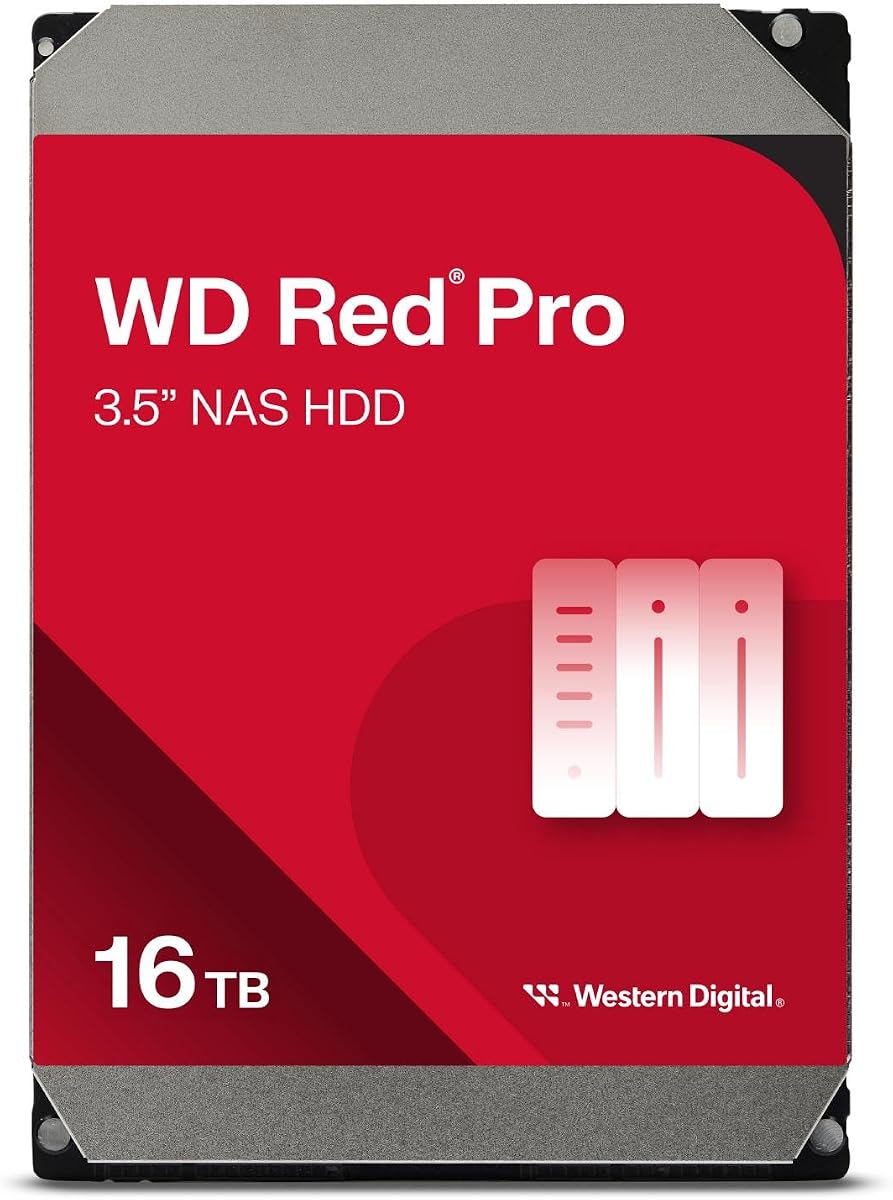
The WD Red Pro 16TB is designed for RAID-optimized NAS systems operating in intensive, multi-user environments. It offers 16TB, a 7200 RPM spindle, 512MB cache, SATA 6Gb/s, and CMR recording. Its 3.9 rating is the lowest among the products reviewed, but its workload-specific specifications make it relevant to a very particular recording and shared-storage use case.
We may earn a commission when you buy through this link, at no additional cost to you.
A stated 550TB annual workload rate is central to this model's value. Multiple editors, producers, or automation systems can access a shared pool of media across multiple bays, creating more pressure than a typical personal computer drive experiences. WD states that the product is designed for 24×7 multi-user NAS environments and that it has been tested with a wide range of NAS vendors, which is valuable when compatibility matters.
A NAS drive cannot deliver its full purpose outside a compatible multi-bay system. Users need an enclosure, appropriate operating system, and a storage configuration that matches their redundancy requirements. The 3.9 rating should prompt buyers to read recent customer feedback and understand the exact configuration, particularly if the drive is purchased as part of a larger array. The model is specialized rather than universally suitable.
Choose the WD Red Pro when a production team needs shared, continuously available recording assets across several users. It is well suited to active project libraries where editors require centralized access to footage, audio, and project files. A small team with independent local workflows may find the simpler 8TB or 12TB desktop drives easier to manage, but a collaborative studio can benefit from this drive's workload rating and NAS orientation.
The 550TB yearly workload rate positions this drive for environments where several users or automated processes regularly access shared media. It is intended for sustained NAS use rather than occasional file transfer.
The drive is optimized for RAID-oriented NAS systems and has been tested with numerous NAS vendors. Buyers should still confirm bay, interface, and software compatibility before adding it to an existing enclosure.
We may earn a commission when you buy through this link, at no additional cost to you.
The SanDisk Professional 52TB G-RAID Project 2 is a purpose-built professional recording and editing system rather than a conventional single drive. It houses two 7200 RPM Ultrastar enterprise hard drives, provides 52TB of maximum capacity, and uses Thunderbolt 3 alongside 10Gbps USB. Its 4.4 rating reflects a specialized product capable of supporting demanding high-resolution workflows.
We may earn a commission when you buy through this link, at no additional cost to you.
The system ships in RAID 0, combining the two hard drives for performance and up to 520MB/s read and 510MB/s write according to the supplied specifications, with a headline maximum read speed of 540MB/s. A PRO-BLADE SSD Mag slot can add solid-state capacity and performance for transfers, editing, and backup. This combination of large HDD storage and optional SSD responsiveness is particularly relevant to post-production teams handling extensive footage.
RAID 0 is the central trade-off. It prioritizes throughput and usable capacity, but it does not provide redundancy; a failure affecting the array can put the recorded data at risk. Buyers must treat external or secondary backups as essential. The system also demands a compatible workstation, appropriate Thunderbolt or USB connection, adequate cooling, and careful cable setup. Color-coded indicators help reduce connection errors, though the system is still more involved than a single desktop drive.
This G-RAID is the clear premium recommendation for professional teams that need substantial capacity, high transfer throughput, and an integrated array in one package. It can act as the central media repository for editing, finishing, and backup rather than a simple file holder. For an individual creator or small studio, a single internal or portable drive is more economical and easier to protect, but a busy post-production facility can benefit from the scale and specialized workflow.
Thunderbolt 3 and the stated sequential speeds make the system suitable for moving large media sets between storage and an editing workstation. Its two 7200 RPM enterprise drives provide the backing capacity for demanding production libraries.
The integrated SSD Mag slot provides a path to add faster solid-state performance without changing the overall workflow. It is useful for active editing tasks, rapid transfers, and backup staging while large files remain on the HDD array.
We may earn a commission when you buy through this link, at no additional cost to you.
The right recording drive depends on the type of media, the amount of space required, the connection available, and the need for portability or shared access. Capacity alone does not determine performance, so workflow demands should guide the choice.
Recording files grow in predictable ways. Uncompressed camera footage consumes substantially more room than compressed deliverables, while multitrack audio may create many small session files that still need room for exports and backups. Estimate the size of an active project, duplicate the amount for temporary renders, and allow space for growth rather than filling the drive completely.
Large internal options such as 8TB, 10TB, 12TB, 16TB, 24TB, and 26TB serve different stages of that requirement. Portable 4TB and 6TB drives are more convenient for transport, while the 52TB G-RAID addresses a much larger professional library. Choose enough space for the next stage of growth, not merely the current session.
A drive advertised with a peak number is not necessarily ideal for continuous media transfer. Look for a stated sustained transfer rate and evaluate it against the size and duration of the files being moved. The BarraCuda lists 190MB/s sustained transfer, while the professional G-RAID provides much higher stated read and write figures for a specialized editing environment.
For most audio workflows, any modern hard drive with sufficient sustained performance can work. High-resolution video, large camera files, and multiple simultaneous streams benefit from more headroom. Allow time for seeks and file-system activity, and keep frequently used project files on a faster solid-state drive when possible.
Internal SATA drives connect through a motherboard SATA interface and require physical mounting and power. USB external models are easier to move between PCs and Macs, while Thunderbolt 3 is intended for high-bandwidth professional editing. A high-capacity NAS drive requires a multi-bay enclosure and compatible management software. Check ports, cables, bays, operating systems, and power requirements before purchasing.
The easiest rule is to match the drive to the workflow. Choose SATA for a fixed workstation, USB for portable backups, NAS for shared multi-user access, and Thunderbolt for an integrated professional editing array. A fast interface cannot compensate for a mismatched host, and a portable drive should not be treated as a permanently installed volume unless the system is designed for that role.
Rotational speed, cache size, and drive architecture influence how smoothly a hard disk handles sustained sequential and mixed workloads. Models here range from the BarraCuda's stated 190MB/s sustained transfer rate to 7200 RPM WD Black, WD Blue, Exos, Ultrastar, and WD Red Pro models with 512MB caches. These figures help distinguish general-purpose and enterprise-oriented designs.
Do not confuse cache with SSD speed. A larger cache can smooth certain workloads, but it cannot change the mechanical limits of random access. For active editing, use solid-state storage for the operating system, cache, and most demanding timeline operations. Choose a hard drive for capacity, sequential transfer, archives, and shared media rather than as the only location for latency-sensitive application data.
CMR appears explicitly on the Exos, Ultrastar, and WD Red Pro models. These drives are positioned for sustained, data-intensive, or multi-user environments where consistent behavior matters. Consumer-oriented models can still record ordinary projects effectively, but they are not described with the same enterprise workload or continuous-operation characteristics.
Match workload expectations to the model class. General desktop storage is suitable for everyday project libraries, enterprise CMR drives suit continuous archives and servers, and NAS-oriented drives target shared RAID systems. The G-RAID uses multiple enterprise-class mechanisms for a professional production environment. Do not use a workload rating as a substitute for backups, and do not assume one drive class is suitable for every infrastructure.
Portable drives are ideal for moving media between a recording location and an edit suite, creating local backups, or keeping an offline copy away from the workstation. The Seagate Portable 4TB and both WD Elements options prioritize plug-and-play use. Internal drives provide a more permanent home in a desktop and avoid repeated connection steps.
Portability adds practical considerations. A portable enclosure can be easier to carry but may be more exposed to impact, and its capacity may be insufficient for a rapidly growing archive. Internal installation requires a compatible bay, cables, cooling, and system configuration. If projects regularly travel, portability should outweigh the convenience of a fixed drive.
A large drive is not automatically a safe archive. The G-RAID's RAID 0 configuration emphasizes capacity and performance rather than redundancy, and a single internal or external disk can fail regardless of its workload rating. RAID, when properly configured, can improve availability, but it still does not replace a separate backup when the data has only one geographic or physical location.
For important recordings, maintain at least one additional copy on separate media and consider an off-site or disconnected copy. Match the backup method to the value of the material. High-capacity enterprise drives can serve as archive components, but a professional array should be paired with deliberate redundancy, tested restore procedures, and a plan for replacing failed hardware.
A high-capacity 3.5-inch drive may fit a storage bay but still need adequate airflow, vibration control, and power. 7200 RPM models and two-drive professional arrays can produce more heat and mechanical noise than lower-activity storage. Portable 2.5-inch designs are more compact, while large enterprise and NAS drives often fit best in purpose-built enclosures with designed cooling.
Plan the whole storage environment rather than selecting a drive in isolation. Check available bays, connector types, operating-system support, enclosure dimensions, and thermal conditions. For a multi-drive NAS or RAID system, consult the enclosure documentation and follow its drive-compatibility requirements. A recording workstation that runs continuously benefits from stable airflow and orderly cabling.
Format a new drive using the file system recommended by the operating system and recording software, then confirm that the computer recognizes its full usable capacity. For an internal drive, shut down the system before installation, secure the mechanism in a compatible bay, connect SATA power and data, and check the enclosure for adequate airflow. For an external drive, use the specified direct cable rather than an unpowered hub when recording or transferring large files.
Create a deliberate folder structure for source media, project files, audio, exports, and backups. Give each recording a unique identifier, and avoid renaming files manually in ways that break links inside editing software. Save active project files to a fast working drive, then copy completed media to a high-capacity hard drive and maintain another backup copy. Safely eject portable drives after transfers and avoid pulling a cable while a recording is being written.
Monitor drive health through the utilities provided by the operating system or storage vendor, and respond to warnings rather than assuming a failing drive will recover. Keep the drive cool, dry, and away from strong magnetic fields, and do not move an active multi-drive array. For critical archives, periodically test restored files and keep at least one copy disconnected from the main workstation.
For most professional audio sessions, a hard drive with reliable sustained transfer performance is sufficient. File size and project complexity matter more than the distinction between ordinary and high-speed models. An internal drive such as the 8TB BarraCuda or 12TB WD Blue is well suited to storing sessions, while an SSD can provide faster access to active project files.
An SSD is generally preferable for the operating system, editing software, and active cache because it offers much lower random latency. A hard drive remains valuable for large media libraries, source footage, completed projects, and archives. The most effective workstation commonly combines both types of storage rather than forcing one drive to perform every role.
Capacity should cover source media, temporary files, project files, exports, and at least one backup copy. Uncompressed and high-resolution footage can consume space quickly, so estimate the largest realistic project and add room for growth. Portable 4TB and 6TB drives suit smaller traveling workflows, while 10TB-class and larger options are better for accumulating archives.
An external drive connects over USB or Thunderbolt and is easier to move between computers. An internal SATA drive installs in a desktop case and provides a permanent workspace without repeated reconnections. External models suit media transport and backups, while internal models are often more convenient for a fixed editing workstation with suitable bays and cabling.
The G-RAID ships in RAID 0, which prioritizes performance and combined capacity but does not provide redundancy. If one drive in a RAID 0 array fails, the combined data can be affected. Important material should therefore also be copied to a separate backup or archive and restored periodically to verify its integrity.
The WD Red Pro is specifically optimized for RAID-oriented NAS systems and high-intensity, multi-user environments. It can be physically used in other compatible systems, but specialized NAS features may not be utilized. A conventional desktop user with a few active projects may gain little practical value from paying for a NAS-oriented workload design.
A renewed drive can make high-capacity enterprise storage more accessible, but the purchase requires additional scrutiny. Review the condition description, warranty period, return policy, and seller support carefully. For irreplaceable recordings, maintain another copy and test the file system and restored data after initial setup.
Yes. RAID can improve availability or performance depending on its configuration, while high capacity only determines how much data fits. Accidental deletion, software failure, enclosure problems, and physical disasters can still threaten recordings. Maintain at least one separate copy, and periodically confirm that important files can be restored.
The Seagate 8TB BarraCuda is the strongest overall choice for a fixed desktop because it combines generous capacity with a stated 190MB/s sustained transfer rate and broad application support. The Seagate Portable 4TB offers a simpler, more economical route for typical mobile projects, while the SanDisk Professional 52TB G-RAID is the premium option for teams that need integrated high-capacity performance and professional connectivity.
Prioritize the role each drive must perform. Choose USB for portable archives, SATA for permanent desktop libraries, NAS hardware for shared multi-user media, and Thunderbolt for an integrated professional array. Keep active editing files on responsive storage when possible, use hard drives for capacity and sequential media work, and avoid treating a large drive or RAID 0 array as a substitute for a separate backup.
Finally, check current pricing, warranty terms, enclosure support, and availability before purchasing, since hard-drive configurations and retailer listings can change. Confirm that the chosen capacity fits the workflow, the interface matches the workstation, and the cooling and mounting arrangements are suitable. With those details verified, the right drive can provide a dependable foundation for years of recorded material.