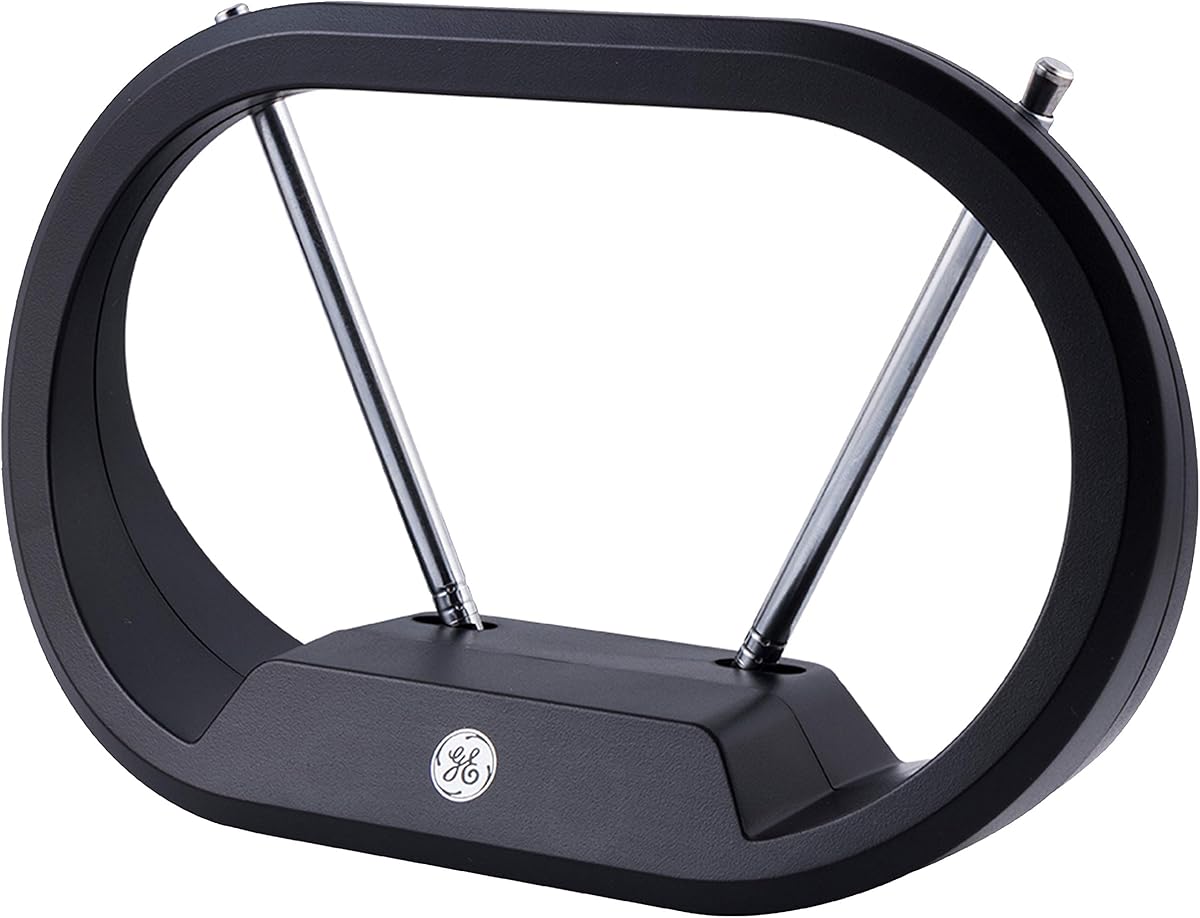
GE Modern Loop Rabbit Ears Indoor TV Antenna
4.1Editor score
Fifteen-inch extendable dipoles
Thirty-mile stated range
NextGen TV compatible
Our expert guide compares the 10 best Rabbit Ears for TV Reception, covering signal range, adjustability, setup, compatibility, resolution support, and design.
Rabbit ears remain a practical way to receive over-the-air television without a cable or satellite subscription. The best models balance adjustable VHF and UHF reception, straightforward setup, compact construction, and compatibility with modern smart TVs, HDTVs, older sets, and converter boxes.
The products in this guide were compared using their published specifications, reception features, supported broadcast standards, installation requirements, physical design, and customer ratings. The list covers conventional dipole antennas, circular-loop models, amplified designs, and small directional options for different indoor spaces.
Each review explains the antenna’s strongest qualities, practical limitations, and ideal placement scenario, while the comparison table makes the main differences easier to scan. Product ratings and market conditions can change, so buyers should verify current specifications, availability, and retailer support before purchasing.
4.1Editor score

4.2Editor score

3.7Editor score
This side-by-side comparison highlights the antennas’ reception design, range claims, broadcast compatibility, installation method, physical dimensions, and customer ratings, helping you identify the model that best matches your television and available over-the-air channels.


The Philips Rabbit Ears Black Indoor TV Antenna is our overall choice because it combines an adjustable dipole with a circular UHF loop in a recognizable, uncomplicated indoor design. Its 4.2 rating reflects generally favorable customer feedback, while its published specifications emphasize both current television standards and uncomplicated use.
We may earn a commission when you buy through this link, at no additional cost to you.
The circular loop is intended to improve UHF reception, an important consideration because many digital broadcast stations appear in that spectrum. Adjustable dipoles handle VHF signals, giving buyers two complementary ways to tune reception without requiring separate antennas. Support for 1080p HD, 4K and 8K-ready television, and ATSC 3.0 where available also makes this model relevant to modern sets.
Setup is refreshingly simple. Place the antenna on a shelf or table, connect the included coaxial cable, select the appropriate television input, and perform a channel scan. The tradeoff is that it does not include a built-in amplifier, so challenging indoor locations may still require careful placement, a higher window-side position, or a more specialized amplified model.
This is the most balanced recommendation for someone who wants flexible tuning, modern broadcast compatibility, and a conventional rabbit-ears form factor. It is also a sensible backup antenna for a second television. Buy it when straightforward reception and easy adjustment matter more than maximum amplification or an unusually small footprint.
Adjustable dipoles and a circular loop let buyers orient the antenna more deliberately than a fixed panel design. Small changes can help when local stations arrive from different directions or when VHF and UHF signals are not equally strong.
The antenna supports 1080p, 4K, 8K-ready operation, and ATSC 3.0 where those standards are available. Compatibility enables the signal to pass through to a compatible television, although the final picture quality still depends on the station’s broadcast and local reception conditions.
We may earn a commission when you buy through this link, at no additional cost to you.
The Philips Indoor TV Antenna Rabbit Ears for Local Channels is a well-rounded option for viewers who want adjustable reception and broad television compatibility. It carries a 4.1 rating, and its published features emphasize support for contemporary and next-generation broadcast formats rather than a specialized amplified design.
We may earn a commission when you buy through this link, at no additional cost to you.
Its modern loop works with adjustable dipoles, giving users a way to tune both VHF and UHF reception. The manufacturer states a range of up to 30 miles, a figure best understood as a maximum rather than a guarantee. Terrain, building materials, tower direction, weather, and indoor obstacles can all affect the stations a particular television can lock onto.
Setup involves placing the antenna on a flat surface, connecting the included four-foot coaxial cable, and scanning the television for available channels. The main limitation is the absence of a stated built-in amplifier. That is not necessarily a problem in a strong market, but it may make this model less forgiving in a large home or an area with weak indoor signals.
Choose this antenna if forward-looking broadcast support and a modern adjustable design are your priorities. It works particularly well for smart TVs and other tuner-equipped sets, while buyers with difficult reception may want to compare it with the Philips Crystal Amplified model before deciding.
Support for 4K, 8K Ultra HD, and ATSC 3.0 where available makes this a practical choice for modern televisions. These capabilities help the antenna remain relevant as broadcast standards and receiver features continue to evolve.
The adjustable loop and dipoles provide useful flexibility, but placement remains just as important as adjustment. Moving the antenna closer to a window and changing its orientation can sometimes improve channel consistency more than leaving it in one fixed position.
We may earn a commission when you buy through this link, at no additional cost to you.
The GE Modern Loop Rabbit Ears Indoor TV Antenna stands out with 15-inch extendable dipoles and a circular loop. Its 4.1 rating and detailed support commitments make it a credible budget-minded choice for households that want physical tuning controls rather than a fixed panel.
We may earn a commission when you buy through this link, at no additional cost to you.
Long dipoles can help with VHF reception, while the loop provides a dedicated UHF element. The stated range reaches up to 30 miles under favorable conditions, but indoor results still depend on proximity to towers and the television’s location. Support for 1080p, 4K, 8K, and ATSC 3.0 where available aligns the antenna with modern displays.
The antenna includes a four-foot coaxial cable and is designed for simple tabletop installation. Its extended elements take up more room than ultra-compact models, and it does not include an amplifier. For someone with limited space, a smaller directional or circular design may be more convenient.
This GE model is an excellent fit for first-time over-the-air viewers, second televisions, and anyone who wants to experiment with reception at home. Choose it when adjustability, recognizable geometry, and helpful support outweigh the need for a signal booster or minimal footprint.
The 15-inch dipoles can be repositioned as channel conditions change. This physical flexibility is useful for separating stronger and weaker stations or matching the antenna more closely to the direction of local transmitters.
GE lists U.S.-based technical support and a limited-lifetime replacement pledge, adding reassurance for buyers who want help with setup and reception. The antenna connects to a television through the included cable and does not require tools.
We may earn a commission when you buy through this link, at no additional cost to you.
This Compact Adjustable Rabbit Ears antenna earns a 5.0 rating and is designed for users who need a small indoor antenna without giving up telescoping reception elements. Its dimensions are listed at 1.28 by 1.28 by 4.75 inches, making it easy to accommodate on a TV stand, shelf, desk, or windowsill.
We may earn a commission when you buy through this link, at no additional cost to you.
The adjustable dipoles are intended to capture VHF and UHF signals, and the product supports smart TVs, HDTVs, older televisions with built-in tuners, and digital converter boxes. That compatibility makes it unusually flexible as a secondary antenna for a bedroom, apartment, dormitory, kitchen, or recreational vehicle.
Installation involves connecting the antenna to the television’s Antenna In or RF In port, selecting the correct input, and initiating a channel scan. The principal drawback is that no specific reception range or amplifier is listed, so buyers should not treat it as a solution for every difficult indoor market.
This is the pick for viewers who prioritize compact size and simple connection to nearly any tuner-equipped television. It is especially attractive as a low-visibility antenna for a smaller room, provided local broadcast signals are strong enough to reach the set without extensive amplification.
The compact body keeps the antenna visually unobtrusive while preserving adjustable reception elements. Compatibility with smart TVs, older tuner-equipped sets, and converter boxes makes it useful across a household with mixed television equipment.
A single coaxial connection and a television-side channel scan are all that is required. Keeping the antenna near a window and changing its position after each move can help maintain a useful channel list.
We may earn a commission when you buy through this link, at no additional cost to you.
The HIDB TV Antenna for Smart TV Indoor is a small, moveable antenna aimed at users who value a discreet setup and straightforward reception. Its 3.8 rating places it below the leading models, but the product’s published features include omni-directional reception and a slim, lightweight enclosure.
We may earn a commission when you buy through this link, at no additional cost to you.
Unlike a long dipole antenna, this design is intended to pick up signals from multiple directions, which can be convenient when towers are not directly aligned with the room. It is made from dual PC soft material described as flame-retardant, with moisture resistance and indoor lightning protection stated by the manufacturer.
The antenna’s primary limitation is the absence of a published range figure or amplified receiving stage. It is a compact digital indoor antenna, not a guaranteed solution for weak signals. Its guidance correctly recommends placing it high, orienting it toward local towers, checking available broadcasts, and rescanning after movement.
Choose this antenna for apartments, dorm rooms, secondary televisions, or other spaces where a small footprint and multi-directional approach matter. Viewers farther from transmitters or dealing with severe building obstructions should first confirm that adequate over-the-air signals reach the room.
The omni-directional approach removes the need to align a long dipole precisely with one transmitter. It may be especially convenient in rooms where the television shares space with multiple walls, furniture, and electronic equipment.
The lightweight body is easy to move between a TV stand, tabletop, or higher location. Because channel availability can change with placement, rescanning after each repositioning is an essential part of getting the best results.
We may earn a commission when you buy through this link, at no additional cost to you.
The HIDB Rabbit Ears TV Antenna is built around a compact directional design and flexible mounting. Its 3.8 rating reflects mixed customer experiences, while its small body, suction cup, and included adhesive make it convenient to position precisely around a television or near a window.
We may earn a commission when you buy through this link, at no additional cost to you.
The manufacturer describes 180-degree directional reception and a range of up to 120 miles. Because that is an unusually broad maximum claim, it should be understood as a best-case figure rather than an expected indoor result. Actual reception depends on terrain, weather, obstacles, and the location of broadcast towers.
The product is listed at 1.25 by 1.25 by 4.75 inches, so it occupies little shelf space. It can connect to a television or digital converter box, and the manufacturer recommends rescanning whenever it is moved. Directional performance works best when the unit is aimed toward transmitters with as few obstructions as possible.
This model is worth considering for a small room, travel-oriented setup, or anyone willing to tune and reposition the antenna. It is less suitable for users expecting a forgiving, all-direction indoor device, but its mounting flexibility can be a meaningful advantage when the correct orientation is known.
A suction cup and double-sided adhesive allow the antenna to sit on windows, walls, metal surfaces, or the top of a television. These options help buyers move the unit without permanently occupying a shelf.
The stated 180-degree field can focus reception toward local transmitters, but the real advantage appears only when the antenna is properly aimed. Users should use local broadcast maps and perform a fresh scan after each major adjustment.
We may earn a commission when you buy through this link, at no additional cost to you.
The GE Flat Panel Indoor HD Digital TV Antenna is a panel-style alternative to traditional rabbit ears. Its 4.1 rating and stated support for reception from as far as 40 miles make it an interesting option for viewers who want a low-profile design but still expect substantial range.
We may earn a commission when you buy through this link, at no additional cost to you.
The panel is optimized for VHF and UHF broadcast signals and supports 1080p, 4K Ultra HD, and ATSC 3.0 where available. An adjustable stand permits horizontal or vertical placement, which can be valuable when the television sits above or below a nearby broadcast direction.
The included coaxial cable makes installation straightforward, and the antenna can serve smart TVs or converter boxes. Because it has fewer mechanically adjustable elements than dipole models, placement and stand angle become the main tuning tools. A 40-mile claim remains a maximum under favorable conditions rather than an indoor guarantee.
This GE antenna is best for buyers who want the appearance of a compact panel, broad modern broadcast compatibility, and a generous range claim. Choose it for a living room where a rabbit-ear silhouette is undesirable, and keep the option of moving it closer to a window if scanning reveals weak stations.
The flat panel avoids the tall, exposed elements of a conventional rabbit-ears antenna. Its vertical or horizontal stand positions allow viewers to experiment with orientation while keeping the unit visually restrained.
Compatibility with 1080p, 4K Ultra HD, and NextGen TV broadcasts where available broadens its usefulness with current television sets. The same signals are still subject to the quality of the originating broadcast and the indoor signal path.
We may earn a commission when you buy through this link, at no additional cost to you.
The Wideskall Universal Indoor Rabbit Ear TV Antenna is a dual-loop design for viewers who want both television and FM reception. Its 3.7 rating is among the lower scores in this guide, and the published specifications are more modest than those of many newer antennas.
We may earn a commission when you buy through this link, at no additional cost to you.
The antenna supports up to 1080i HDTV broadcasts, FM radio broadcasts, and reception through a dual-loop configuration. Its elements extend as far as 24 inches, giving users some positional flexibility without requiring a separate amplified panel or a complex installation process.
The three-foot cable is shorter than the four- and six-foot cables offered by several alternatives, so the television may need to sit fairly close to the antenna. It also lacks a stated range, 4K readiness, or ATSC 3.0 support. Those omissions do not prevent basic television reception, but they make it less forward-looking.
This antenna is most appropriate for a basic indoor setup in a strong broadcast area, especially when FM radio reception is also desirable. For newer televisions, next-generation broadcasts, or greater placement distance, one of the Philips or GE options provides a more complete feature set.
The dual-loop design is unusual among the models reviewed because the manufacturer also lists FM radio support. That makes it a practical addition to a bedroom or kitchen where users may want radio reception as well as local television stations.
The elements extend to 24 inches, offering a reasonable balance between visible antenna size and placement control. Because the included cable is three feet long, users should plan the television and antenna positions together.
We may earn a commission when you buy through this link, at no additional cost to you.
The White Compact Rabbit Ears antenna offers a neutral finish, extendable reception elements, and broad compatibility with tuner-equipped televisions. Its 2.9 rating is the lowest among the products reviewed, making it a less confident recommendation despite the practical design.
We may earn a commission when you buy through this link, at no additional cost to you.
The antenna supports adjustable VHF and UHF reception and is listed as ready for 1080p and 4K television. It can be used with smart TVs, HDTVs, older sets with built-in tuners, and digital converter boxes, while its 1.28 by 1.28 by 4.75-inch dimensions keep it unobtrusive.
The low rating suggests that customer experiences have been inconsistent, although the supplied information does not identify a specific defect or recurring technical issue. No reception range or built-in amplifier is stated, so the product’s effectiveness will depend heavily on the strength and direction of signals in the room.
Choose this antenna for a secondary room, a bright entertainment setup, or a location where matching a white television and accessories is a priority. It is best suited to buyers willing to optimize placement and rescan channels. Those with difficult reception should favor a model with a published range and stronger customer feedback.
The white exterior distinguishes this version from the visually similar black compact model. Its small footprint and light color are useful in bedrooms, kitchens, dorm rooms, and modern entertainment areas where visual clutter matters.
Support for smart TVs, older tuner-equipped televisions, and converter boxes makes the antenna adaptable to several household configurations. The standard Antenna In or RF In connection process remains simple regardless of device age.
We may earn a commission when you buy through this link, at no additional cost to you.
The Philips Crystal Amplified Indoor TV Antenna is the premium pick because its built-in amplifier, extendable dipoles, and 50-mile range claim offer more signal-focused hardware than most conventional rabbit ears. Its 3.7 rating is modest, but it provides a clear technical distinction for buyers facing challenging reception.
We may earn a commission when you buy through this link, at no additional cost to you.
The amplifier is intended to enhance HDTV, VHF, and UHF signals, while noise filtering and the curved housing are designed to improve stability. Support for 1080p and 4K Ultra HD-ready televisions makes it appropriate for modern displays, and the six-foot coaxial cable provides more freedom between the television and antenna.
The additional hardware introduces a trade-off. The antenna must be connected through its adapter to a power source, so it is less convenient than a fully passive model. Amplification can also magnify noise in some conditions, making careful placement and channel rescanning important. The stated range remains dependent on local transmission conditions.
Choose this model for a difficult indoor market, a home with multiple walls between the room and transmitters, or a location where a passive antenna has produced inconsistent results. Users seeking the simplest possible setup may prefer the Philips Rabbit Ears Black, while those wanting a premium dedicated antenna will find the added amplification worthwhile.
The built-in booster can help preserve a usable signal when walls, furniture, and internal electronics weaken reception. It is most useful when the available station list is inconsistent rather than when a strong signal is already available.
The included six-foot cable allows the antenna to sit farther from the television than most competing models. Because the amplifier requires its adapter and a power source, setup takes slightly more effort than a passive rabbit-ears antenna.
We may earn a commission when you buy through this link, at no additional cost to you.
Selecting an indoor rabbit-ears antenna means balancing broadcast compatibility, reception design, physical placement, and television connections. The most important factors are the strength and direction of local signals, the available space, and whether you prefer passive tuning or powered amplification.
Prioritize confirmed local coverage over a generic maximum-distance figure. A large advertised range cannot overcome severe terrain, dense building materials, or poor indoor placement by itself.
Dipoles offer the most hands-on tuning, while loop and panel designs are generally easier to position as a single unit.
Start with a passive model in a strong market; choose amplification when walls, distance, or internal interference justify the added power connection.
Confirm a coaxial connection and a built-in tuner before buying; otherwise, plan to add a compatible digital converter.
Choose modern standard support when available, while remembering that the station’s own broadcast quality determines the final result.
Choose enough cable to experiment with a high or window-side position without creating a hazardous trip path.
Balance footprint, adjustment range, mounting options, and support resources to find a model that fits both the room and the television.
Begin by positioning the television in its normal viewing location, then connect the antenna to the Antenna In or RF In port. If a digital converter is required, connect the antenna to the converter and connect the converter to the television through the appropriate video connection. Select the antenna or air input on the television before beginning the channel scan.
After connecting the antenna, run an automatic channel scan. Review the available stations and their picture stability, then adjust the dipole length, loop position, or antenna angle. Move the unit gradually toward a window, elevate it above nearby electronics, and rotate it toward local broadcast towers. Rescan after every meaningful adjustment because the receiver’s channel list and signal measurements can change with orientation.
Care for the antenna by handling the telescoping elements gently and avoiding sharp bends in the coaxial cable. Keep the unit away from heaters, damp areas, and direct heat. For a powered amplified model, use only the supplied adapter, inspect the connection before powering it, and unplug the adapter when the antenna will not be used for an extended period. Clean the exterior gently with a dry or lightly damp cloth, and avoid getting moisture inside the connector.
No. An indoor antenna can only receive stations whose signals are available and strong enough at the location. Broadcast coverage, terrain, building materials, nearby electronics, and antenna placement all affect results. Check a local channel map before shopping, and rescan whenever the antenna is moved.
Neither design is universally better. Rabbit ears provide more physical adjustment, while flat panels often look more compact and can be easier to position as one unit. The stronger model in a particular room is usually the one that can receive more of the desired stations with stable pictures.
Start near the television and then experiment near a window, at a higher level, and away from electronics or metal objects. Aim the antenna toward local broadcast towers when its design is directional. After each change, run a fresh channel scan to see whether the available stations and their stability improve.
Usually not in an area with strong local coverage. An amplifier is more useful when a passive antenna has already been positioned carefully but still produces weak or inconsistent channels. It requires additional power and can sometimes boost unwanted noise, so it should complement good placement rather than replace it.
They can work if the older television has a built-in digital tuner and a compatible antenna input. If it only supports analog broadcasts, a separate digital converter box may be required. Check the television’s tuner and connector before purchasing the antenna.
Moving an indoor antenna changes signal strength and direction, and the television may still be using a channel list created at the previous position. Perform a complete channel scan after each move. If necessary, try a different height, window position, or antenna orientation before removing channels manually.
No. Resolution readiness means the antenna can carry suitable signals to a compatible television. The actual channel resolution depends on the broadcaster’s feed, local signal conditions, the television, and how the channel is being delivered. Strong reception remains necessary for consistent high-resolution pictures.
The number depends on your location and the television market, not simply on the antenna model. Major networks, public stations, and independent affiliates may all be available, but access varies by address. A channel lookup tool and a current rescan after installation provide the most useful local information.
The Philips Rabbit Ears Black is the strongest all-around recommendation because its adjustable dipole, circular loop, modern broadcast support, and simple installation cover the essential needs of most indoor viewers. The GE Modern Loop Rabbit Ears is a compelling alternative when extended elements and support resources are priorities, while the Philips Crystal Amplified Antenna is the more specialized choice for difficult reception paths.
Whichever model you choose, prioritize the signals actually available in your area, then focus on placement, adjustment, and television compatibility. Compact models suit secondary rooms and unobtrusive setups; larger dipoles and loops provide more tuning freedom; amplified designs add power and complexity that are most useful when passive reception remains weak after careful positioning.
Before making a final decision, verify the current product specifications, local channel coverage, connection requirements, and seller support. Ratings, product designs, and market conditions can change, so checking the latest listing and retailer information helps ensure the selected antenna still matches your television and reception needs.