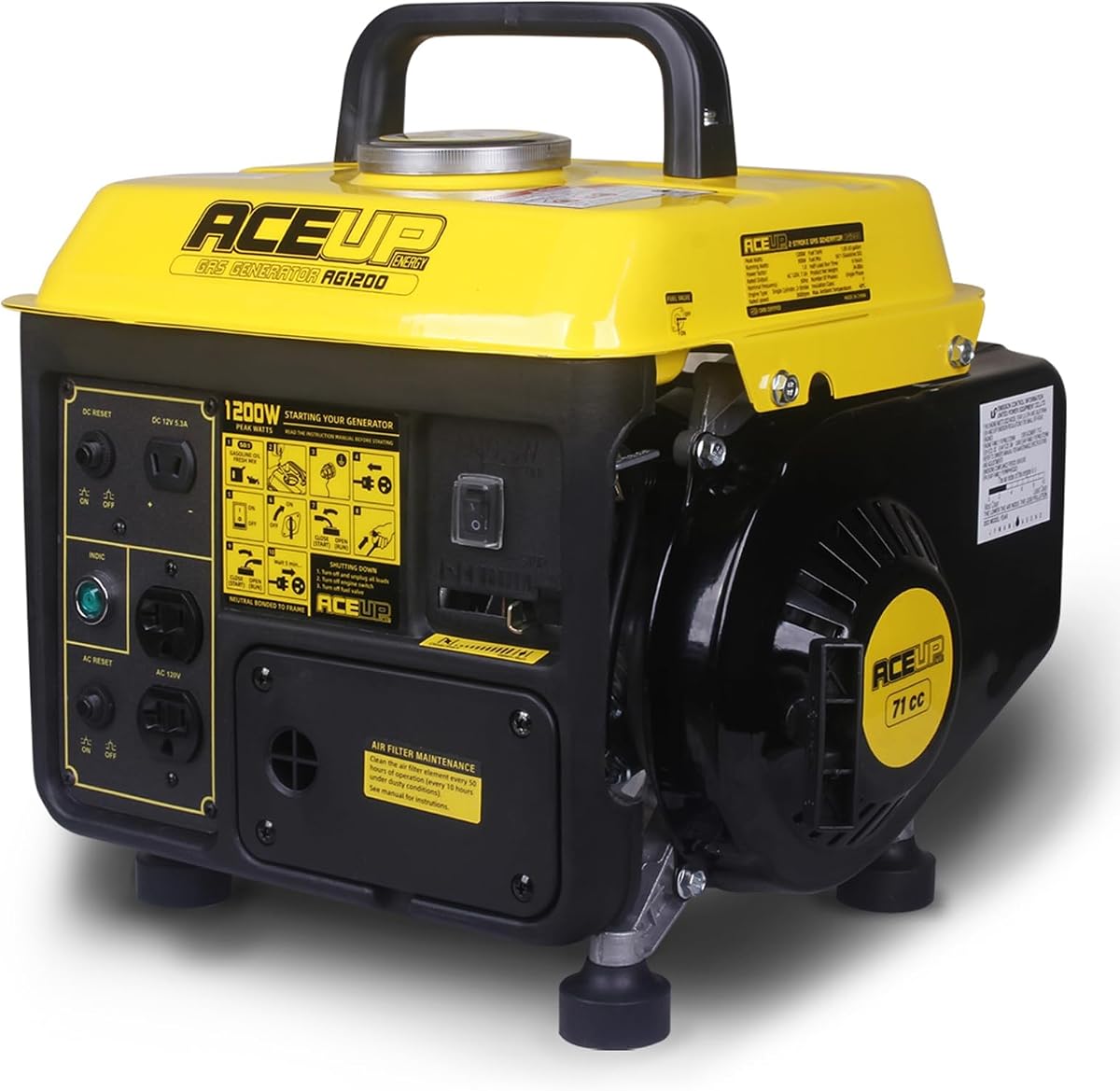
Aceup Energy 1,200W Generator
4.1Editor score
1,200 peak watts
900 running watts
35.3-pound portable design
The best cheap gas generator guide compares output, runtime, noise, fuel flexibility, safety features, and portability for home or camping.
A gas generator can keep essential appliances running during an outage, provide cleaner power for electronics, or make camping and job sites more comfortable. The most useful model balances adequate running power, manageable noise, safe operation, fuel efficiency, and a size you can actually transport.
This guide compares ten inexpensive and midrange gas-powered generators across peak and running output, outlet selection, runtime, weight, operating noise, fuel compatibility, and built-in safety features. It includes compact inverter units for sensitive electronics, open-frame models for more demanding backup needs, and dual- or tri-fuel generators for household use.
Each review explains where the generator is strongest, which compromises buyers should consider, and the situations that suit it best. The top picks represent the strongest options for budget buyers, general-purpose users, and buyers seeking premium capacity, while product details and prices can change over time.
4.1Editor score

4.6Editor score

4.8Editor score
The comparison covers generator output, runtime, portability, noise, and fuel flexibility, making it easy to identify the right balance for emergency power, RV travel, camping, or sensitive electronics.


The Oxseryn 4400-Watt Inverter Generator offers an effective middle ground between lightweight camping machines and larger standby-style units. Its 4.6 rating reflects a favorable buyer experience, while 4,400 peak watts and 3,400 running watts give it enough capacity for many common household needs. It is particularly attractive for RV travel, emergency backup, and outdoor projects requiring more power than a compact inverter provides.
We may earn a commission when you buy through this link, at no additional cost to you.
Output is supplied through two 120-volt AC outlets, a 30-amp RV outlet, and a 12-volt DC port. The inverter design and ECO mode are valuable for reducing fuel consumption and managing engine speed, while overload protection and low-oil shutdown add practical safeguards. A two-gallon tank supports a listed runtime of up to 14 hours at 25 percent load, and the fuel gauge helps users monitor consumption during longer outages.
The open-frame construction and stated 70-plus-decibel operating level make it less suitable for quiet indoor-adjacent settings or refined campsites. Its 56-pound weight is manageable for an adult but not exceptionally light, and the product description warns that factory testing can leave a slight gas smell. That is an appearance issue rather than evidence that the unit is used, but buyers should understand it in advance.
This generator is a strong recommendation for households that need reliable 3,400 watts of running power without moving to a large dual- or tri-fuel machine. It suits people who want an RV outlet, a useful runtime, and simple portable handling. Among the roundup, it offers the most convincing general-purpose balance for emergency use, camping, and light-duty work.
With 3,400 running watts, the generator can support a meaningful collection of essential loads without moving into the weight and complexity of a full home-backup system. Buyers should still add each appliance's running requirement and avoid overloading the unit.
The dedicated 30-amp RV outlet makes this more versatile than many basic portable generators. The 14-hour stated runtime at a 25 percent load adds useful endurance for moderate overnight demand, provided the unit is operated outdoors and away from openings.
We may earn a commission when you buy through this link, at no additional cost to you.
This second Oxseryn 4400-watt model is another compelling all-around option, with a 4.5 rating and the same useful combination of 4,400 peak watts and 3,400 running watts. It is designed for RV camping, emergency home backup, and portable jobs where several conventional household outlets are more useful than maximum compactness.
We may earn a commission when you buy through this link, at no additional cost to you.
The connection panel includes two 120-volt AC outlets, a 12-volt DC outlet, and an RV outlet. ECO mode, a two-gallon tank, and a fuel gauge support extended operation, with a claimed runtime of up to 14 hours at 25 percent load. The stated noise level is under 72 decibels from 23 feet, which is quieter than many open-frame generators but not as restrained as the compact inverter models in this list.
Its 56-pound weight is easy to move for a generator in this output class, and the open-frame format makes the design relatively straightforward to transport. The trade-off is reduced protection from accidental contact and potentially more exposed operating components. As with the leading Oxseryn model, the listing notes that factory testing may produce a slight gas smell upon delivery.
Choose this generator if you want substantial running capacity, a built-in RV outlet, and a fuel gauge without moving to a much larger dual-fuel unit. It is especially fitting for RV owners and households that expect to run a moderate collection of essentials. Compared with the leading model, its clearest advantage is the included fuel gauge, while the other has a slightly higher rating.
A visible fuel gauge makes it easier to estimate remaining operating time during an emergency. That small convenience can be particularly useful when the generator is supplying several loads or running unattended for extended periods.
Two household AC outlets, a DC port, and an RV outlet offer practical connection options. The generous 3,400-watt running capacity gives owners room to choose essential appliances rather than operate only one large device.
We may earn a commission when you buy through this link, at no additional cost to you.
The Aceup Energy 1,200W Gas Powered Generator is the straightforward budget option in this roundup. Its 4.1 rating is lower than those of the leading models, but the product answers a distinct need: portable gas power for light electronics, small tools, and essential household devices without the size or cost of a higher-output inverter generator.
We may earn a commission when you buy through this link, at no additional cost to you.
The unit produces 1,200 peak watts and 900 running watts through an American-style duplex receptacle, with overload protection for both AC and DC outputs. A 12-volt DC supply, indicator light, air-cooled 71cc two-cycle engine, and recoil start cover the basics. Its 1.1-gallon tank provides a stated six hours of operation at half load.
Buyers must account for the 50:1 gasoline-to-oil mixture and the relatively modest running output. It is not designed for refrigerators, space heaters, power tools, or other loads that would quickly exceed 900 watts. The 35.3-pound weight is manageable, and the one-year limited warranty plus lifetime technical guidance offer some reassurance, but the lower rating suggests more variability in overall satisfaction.
This is the best choice for someone who needs a small, uncomplicated gasoline generator for lights, phones, radios, or other low-demand devices. It also makes sense as a secondary generator rather than a whole-home solution. For users who understand its limits, it delivers a useful amount of power in a smaller and less complicated package.
The 900-watt running limit determines where this model is most useful. A list of intended appliances should be checked against their running requirements before purchase to prevent frustration or repeated overload shutdowns.
A recoil start requires no battery, and the premixed gasoline-and-oil arrangement simplifies fuel preparation. Users must follow the specified 50:1 ratio and never assume the generator requires no oil-related maintenance beyond fuel mixing.
We may earn a commission when you buy through this link, at no additional cost to you.
The AIVOLT 1600W Super Quiet Inverter Generator is built around portability, low noise, and clean output. It earns a 4.1 rating and provides 1,600 starting watts with 1,260 running watts, a combination suited to phones, laptops, lights, fans, and smaller appliances. It is a particularly natural fit for campgrounds, quiet outdoor gatherings, and remote work setups.
We may earn a commission when you buy through this link, at no additional cost to you.
Advanced inverter technology is claimed to keep total harmonic distortion below 3 percent, which is a useful characteristic for sensitive electronics. Two 120-volt outlets and two USB ports provide flexible charging options, while three indicator lights and an hour meter offer at-a-glance monitoring. The 60cc four-stroke engine, copper windings, ECO mode, and eight-hour stated runtime at 25 percent load support efficient operation.
At 28 pounds, it is among the easiest units in the roundup to carry. Its listed noise level of 57 decibels at 23 feet is also notably restrained for a gas generator. However, engine oil is not included, the parallel kit is an extra purchase, and the listed operating status excludes California, so buyers in that state need to verify current regulatory requirements before use.
This model is recommended for campers and mobile users who value a quiet, light generator more than high output. It can also support selected household loads during short outages. It is not the right choice for starting large motors or running a high-demand appliance, but within its portable niche it offers an attractive combination of clean power and manageable size.
The stated sub-3-percent THD is the central advantage for charging laptops, phones, cameras, and other sensitive devices. Even so, users should check manufacturer guidance before connecting high-value or medically important equipment.
A 28-pound weight and 57-decibel operating level make the generator more appropriate for occupied campsites than many open-frame alternatives. The tradeoff is a smaller fuel tank and lower output than full-size backup machines.
We may earn a commission when you buy through this link, at no additional cost to you.
The Oxseryn 5000-Watt Portable Inverter Generator is the compact option for users who need more running power than a camping unit can deliver. It has a 4.3 rating, produces 5,000 peak watts and 4,000 rated watts, and is designed for essential household appliances, RV trips, and general outdoor power needs.
We may earn a commission when you buy through this link, at no additional cost to you.
Its inverter output is specified at less than 5 percent total harmonic distortion, which makes it more appropriate for common electronics than a conventional open-frame generator. The outlet panel includes a 30-amp connection, while the two-gallon fuel tank, fuel gauge, and ECO mode help users manage consumption. A claimed six-hour runtime at 50 percent load is credible for a generator of this size, although it is less impressive than quarter-load figures offered by smaller models.
This unit weighs 60 pounds and measures 19 by 15 by 18 inches, so it occupies a clear step above the 56-pound Oxseryn models. Its stated 70-decibel level at 23 feet is suitable for outdoor use but less attractive for quiet campsites. The listing also notes a clean-power requirement of THD below 5 percent, a useful but less stringent specification than the AIVOLT's sub-3-percent claim.
This generator suits households that want to run more essential appliances without moving to a large dual-fuel or tri-fuel unit. It is also appropriate for RV owners who require a 30-amp outlet and more headroom. Buyers should focus on the 4,000 rated watts, not the higher peak figure, when determining which loads the generator can handle.
The 4,000-watt rated output creates useful room for several moderate household loads. Starting requirements still matter, particularly for motors and compressors, so users should avoid combining high-surge appliances with other active equipment.
A fuel gauge and ECO mode make it easier to monitor and control consumption. Compared with the 4400-watt Oxseryn models, this generator trades portability and longer low-load runtime for additional power.
We may earn a commission when you buy through this link, at no additional cost to you.
The Westinghouse 12500 Watt Dual Fuel generator is a serious home-backup unit with a 4.7 rating. On gasoline, it delivers 9,500 running watts and 12,500 peak watts; on propane, it supplies 8,500 running watts and 11,200 peak watts. That capacity is appropriate for owners who want to power a meaningful portion of a home rather than a few small essentials.
We may earn a commission when you buy through this link, at no additional cost to you.
Dual-fuel capability gives users more than one energy source, and the remote key fob adds convenience for starting the unit from outside a home. Electric and recoil starting are both available. The 457cc four-stroke engine includes a cast-iron sleeve, automatic low-oil shutdown, and a digital hour meter, while the VFT display provides voltage, frequency, and lifetime-hour information.
Its outlet selection is extensive: two 20-amp GFCI household receptacles, one 30-amp transfer-switch-ready outlet, and one 50-amp RV-ready connection. The 6.6-gallon tank and fuel gauge support a stated gasoline runtime of up to 12 hours. These are genuine advantages for outage planning, but the larger engine, tank, and 50-amp hardware make the generator a substantial equipment purchase rather than a casual camping choice.
This is an excellent recommendation for households seeking a high-output portable generator with flexible fuel use, remote starting, and transfer-switch support. It is less suitable for users who only need to charge a few devices or require easy one-person transport. Buyers should also plan safe placement, proper load management, and a connection method approved by a qualified electrician.
Gasoline offers high output, while propane provides an alternative when storing and transporting fuel in a particular way suits the household better. Runtime and power figures differ by fuel, so users should plan around the fuel they expect to use most often.
The 30-amp transfer-switch-ready outlet and remote start kit support a more permanent backup setup. Installation should follow local electrical codes and the generator manufacturer's safety instructions.
We may earn a commission when you buy through this link, at no additional cost to you.
The SIOKIUU 2500W Portable Generator combines useful mid-low output with an unusually long claimed runtime. It holds a 4.1 rating and produces 2,500 peak watts and 1,900 running watts, giving it more headroom than the 1,600-watt AIVOLT while remaining substantially smaller than the 4,000-watt-class Oxseryn models.
We may earn a commission when you buy through this link, at no additional cost to you.
Its inverter is specified to produce less than 3 percent total harmonic distortion, making it suitable for laptops, televisions, lights, fans, phones, drones, cameras, and small tools. Two household outlets, parallel capability, and ECO mode broaden its usefulness. The 80cc four-stroke engine and 1.06-gallon fuel tank support a stated 17 hours at 25 percent load or 8.6 hours at 50 percent load.
Noise is listed below 59 decibels at 23 feet, and the 39.46-pound body remains portable enough for one adult to manage. A CO sensor shuts the engine down when carbon monoxide reaches an unsafe level, adding a meaningful protection feature. The parallel function could be useful for expansion, but buyers should verify the required parallel kit and compatibility before buying.
Choose this generator for campers, tailgaters, remote workers, and homeowners who need clean output with long low-load endurance. It bridges the gap between a small recreation generator and a midrange backup unit. It is not appropriate for large appliances or heavy motor-driven equipment, but its 1,900 running watts make it versatile for everyday low-to-moderate demand.
The stated 17-hour quarter-load figure makes the generator attractive for users whose demand is mostly lights, charging, and communications. Actual duration will change with load, altitude, fuel condition, and operating environment.
Sub-3-percent THD and automatic carbon-monoxide shutdown create a useful combination for sensitive and occupied settings. The generator still belongs outdoors, away from doors, windows, and ventilation openings.
We may earn a commission when you buy through this link, at no additional cost to you.
The DuroStar DS13000MXT stands out for flexibility, offering gasoline, propane, and natural gas operation in a 13,000-watt portable generator. Its 4.4 rating makes it one of the stronger high-capacity choices in the roundup, particularly for buyers who want multiple fuel options or the possibility of operating the unit with a home natural-gas supply during an extended outage.
We may earn a commission when you buy through this link, at no additional cost to you.
The 500cc engine and push-button start simplify operation, while a fuel-selection knob lets users switch between the available fuels. Its power panel includes a transfer-switch-ready 50-amp outlet and a wider range of connections than smaller machines. The 13,000-watt figure provides ample headroom for many household tools and appliances when loads are selected properly.
CO Alert is an important feature because it automatically shuts down the engine when harmful carbon-monoxide levels are detected. That protection does not replace correct placement, and a generator should still be operated outdoors according to the manual. The full-size engine, fuel system, and 50-amp hardware also make the DS13000MXT much less convenient for ordinary camping or tailgating than the smaller inverter options.
This generator is recommended for homeowners and experienced users who want high power with three fuel pathways. It can serve as a serious emergency source, but it is best for people prepared to manage fuel connections, outlet selection, and maintenance. The Westinghouse tri-fuel model offers more detailed running and runtime figures, while the DuroStar emphasizes a straightforward fuel-selection control and push-button start.
Operating on gasoline, propane, or natural gas gives owners several contingency paths. Availability, storage rules, hookup requirements, and expected runtime differ, so the selected fuel must match the planned application.
The 50-amp transfer-switch-ready outlet and 13,000-watt peak capacity make the generator relevant to whole-home backup planning. Electrical connection should be handled according to the manual and applicable local codes.
We may earn a commission when you buy through this link, at no additional cost to you.
The WEN DF475T is a 4.4-rated dual-fuel generator that combines moderate household output with the ability to supply both 120 and 240 volts. On gasoline, it provides 3,800 running watts and 4,750 surge watts; on propane, it delivers 3,500 running watts and 4,350 surge watts. That makes it a practical middle tier between camping units and high-capacity home-backup systems.
We may earn a commission when you buy through this link, at no additional cost to you.
A turn of the selection dial changes the operating fuel, while another control allows users to choose 120- or 240-volt output. The 224cc four-stroke engine starts electrically with a key, and the 4-gallon tank provides a claimed 11 hours of half-load runtime. The included wheel and handle kit makes the generator easier to move than its size initially suggests.
Outlet support includes two 20-amp 120-volt GFCI receptacles, a 30-amp 120/240-volt twist-lock outlet, and a 12-volt DC connection. The package also includes oil, a 47-inch LPG connection hose, and a two-year warranty. The open-frame format and relatively high output mean it is less discreet than the quiet inverter generators and may be unsuitable for quiet campsites.
This is a strong choice for buyers who want 240-volt capability and dual-fuel flexibility without moving to the largest machines in the guide. It works well for selected household appliances, larger tools, and backup use where 120-volt-only compact models are insufficient. Users must use the correct outlet and voltage for every connected device.
The 120V/240V switch is the DF475T's defining feature, allowing suitable 240-volt equipment to run without a larger dual-fuel system. Not every household appliance is designed for generator use, so its electrical requirements should be checked first.
Key electric starting removes the effort of pulling a recoil cord, and the wheel-and-handle kit helps users reposition the generator. The supplied propane hose and oil reduce the number of accessories needed for initial setup.
We may earn a commission when you buy through this link, at no additional cost to you.
The Westinghouse 14500 Peak Watt Tri-Fuel generator is the premium home-backup selection in this guide. It has the highest listed rating at 4.8 and substantial output: 14,500 peak and 11,500 running watts on gasoline, 13,500 peak and 10,500 running watts on propane, and 12,000 peak and 9,500 running watts on natural gas.
We may earn a commission when you buy through this link, at no additional cost to you.
The 550cc four-stroke OHV engine uses a durable cast-iron sleeve and can run for up to 19 hours on the 9.5-gallon gasoline tank. It also offers up to seven hours on a 20-pound propane tank. A built-in fuel gauge, remote electric start, and transfer-switch-ready design make the unit more practical for extended household backup than a basic portable generator.
Low total harmonic distortion and durable copper windings are intended to support sensitive electronics while reducing heat and supporting durability. The specification is less precise than the sub-3-percent and sub-5-percent figures stated for two compact inverter models, so buyers focused exclusively on very low distortion may want to examine the manual. The tri-fuel design also requires deliberate fuel-system setup and safe handling of natural gas or propane connections.
This generator is recommended for larger homes, owners preparing for serious outages, and users who value the ability to select among three fuels. Its engine, tank, and likely physical footprint make it a stationary or semi-portable backup appliance rather than a camping product. For buyers who need premium capacity and a comprehensive fuel choice, it is the strongest overall option here.
Gasoline, propane, and natural gas operation gives households multiple contingency options. A larger home may appreciate natural gas for prolonged use, while gasoline remains useful where portable refueling is more practical.
The 11,500-watt gasoline running output substantially exceeds that of every compact model in the guide. It offers more room for household essentials, although load selection, surge requirements, and safe connection remain the user's responsibility.
We may earn a commission when you buy through this link, at no additional cost to you.
Choosing a gas generator means matching output, runtime, noise, fuel type, and safety features to the place where it will be used. The most economical choice is not necessarily the one with the lowest purchase cost, but the one that can run the required loads safely without unnecessary capacity or weight.
Peak or surge watts describe the brief extra capacity available to start motors and compressors, while running watts indicate the sustained load the generator can support. Compare the running requirement of each appliance with the generator's rated output, and allow some headroom. Starting several demanding devices at once can cause an overload even when their combined steady draw appears manageable.
A 900-watt generator is appropriate for lights, phones, and small electronics, while 1,900 to 4,000 running watts can cover a wider range of household essentials and tools. Generators above 9,000 running watts are intended for larger homes, extended backup, and well-selected high-demand appliances. Buying more power than needed adds size, noise, fuel consumption, and purchase cost without improving a small application.
Inverter generators vary engine speed with demand and generally provide cleaner, more stable output, making them preferable for phones, computers, televisions, and other sensitive electronics. The listed models specify total harmonic distortion below 3 percent, below 5 percent, or otherwise describe low-THD operation. Conventional open-frame generators may run at a steadier speed and cost less, but they can be louder and less suitable for sensitive devices.
Runtime depends on the load, so manufacturers often quote the longest figure at 25 percent capacity and a less favorable figure at 50 percent. A small tank may provide good overnight convenience for lights and charging, but larger tanks reduce refueling interruptions during extended outages. Compare runtime at the same load rather than comparing the largest published number in isolation.
Noise ratings are usually measured at a specified distance, commonly 23 feet, and can vary with load and terrain. Compact inverter generators around 57 to 59 decibels are more appropriate for campsites, while 70-decibel open-frame models are better suited to open areas. Every gasoline generator should operate outdoors, away from doors, windows, exhaust vents, and combustible materials.
Gasoline-only models are simple and widely available, dual-fuel generators add propane, and tri-fuel models also support natural gas. Fuel flexibility can be valuable during a prolonged emergency because it lets owners use the most available option. It also introduces storage, connection, switching, and maintenance considerations, so buyers should confirm local fuel availability before choosing a more complex model.
Low-oil shutdown, overload protection, circuit breakers, GFCI outlets, CO monitoring, and automatic shutdown can all improve safe operation. Transfer-switch-ready outlets are useful for properly installed home backup systems, but connection work may require a qualified electrician and compliance with local rules. A transfer-switch-ready label does not mean the generator can safely be connected to household wiring by itself.
Compact models around 28 to 39 pounds are manageable for camping and tailgating, while 4,000-watt-class machines are commonly around 56 to 60 pounds. High-output generators are substantially heavier and may include wheels, remote controls, large tanks, or multiple outlet hardware. Consider whether one person must load and move the unit, and whether it will remain on a storage pad or vehicle when not in use.
Before first use, read the manual, identify the generator's rated and surge output, inspect the fuel and oil systems, and confirm that the outlet type matches each device. Operate the generator outdoors on a stable, dry, level surface with at least as much clearance from buildings and vegetation as the manufacturer requires. Direct exhaust away from doors, windows, and vents, and never use it in a garage, shed, basement, or enclosed vehicle.
Start the engine according to its instructions, let it stabilize, and then connect loads one at a time. Keep total running demand below rated output and avoid starting large motors simultaneously with other equipment. Do not overload the unit, operate it without the prescribed oil, or connect it to household wiring without a suitable transfer switch and qualified installation. Shut it down, allow the engine to cool, and disconnect loads before folding or moving an open-frame unit.
Maintain the generator according to the manufacturer's schedule, including oil checks or changes, air-filter inspection, spark-plug service, fuel-system care, and battery upkeep where applicable. Use fresh fuel appropriate for the engine and never store gasoline in an unsuitable container. Before extended storage, follow the manual's fuel-management procedure, clean the exterior, keep the unit covered in a dry ventilated location, and run it briefly after extended inactivity when the manual calls for it.
The correct size depends on the appliances you plan to run, not just the number of devices. A compact inverter generator may handle lights, communications, and a few smaller electronics, while 3,400 to 4,000 running watts offers more room for essential household loads. Larger homes may need a dual- or tri-fuel system with 9,500 running watts or more. Add up the running watts of the equipment you intend to use and leave sensible headroom for starting loads.
An inverter generator is usually preferable when phones, computers, televisions, medical devices, or other sensitive electronics are involved. Its variable engine speed and lower total harmonic distortion can provide steadier output while reducing noise and fuel use at light loads. A conventional generator can still support emergencies, but buyers should verify compatibility with sensitive equipment and use proper surge management.
Runtime depends on fuel capacity, output class, and the load applied to the engine. The guide lists figures ranging from six hours for the Aceup model at half load to 19 hours for the Westinghouse tri-fuel on gasoline. These are maximum claims under specified conditions, not guarantees. Heavy loads reduce runtime, and refueling should never be attempted while the generator is hot or running.
No. Gasoline engines produce carbon monoxide, which can accumulate rapidly in enclosed or poorly ventilated spaces and cause poisoning or death. Run the generator outdoors, away from doors, windows, and exhaust openings, and follow the clearance instructions in its manual. Even a generator with automatic CO shutdown should not be placed indoors, because the sensor is a backup protection rather than a reason to ignore safe placement.
Running watts indicate the continuous output the generator can sustain, while peak or surge watts indicate short-term starting capacity for motors and compressors. A device may run at 800 watts but require 1,500 watts briefly to start. The generator should be selected according to steady demand, with sufficient surge capacity and room for other loads to prevent an overload.
They can be worthwhile for households that want fuel flexibility during prolonged emergencies. Propane and natural gas can provide alternatives when gasoline transportation or storage becomes inconvenient, while dual- and tri-fuel machines often offer higher output than compact inverter models. The trade-off is a larger engine, additional fuel controls, and more involved operation, so buyers should choose complexity only when it serves a real need.
The AIVOLT 1600W inverter is the lightest model in the roundup at 28 pounds, followed by the Aceup Energy generator at 35.3 pounds and the SIOKIUU 2500W at 39.46 pounds. Weight is only one consideration: noise, fuel capacity, and running watts also matter. For a campsite, a quiet inverter with clean output and a manageable 8-hour quarter-load runtime may be more valuable than a smaller model with fewer features.
A transfer switch is necessary when a generator is intended to supply a home through its normal wiring, because it prevents backfeeding and isolates the utility and generator sources. A transfer-switch-ready outlet simplifies installation, but it does not replace the switch or qualified electrical work. For occasional use, connecting appliances individually through safe outdoor outlets can avoid a whole-home installation.
The Oxseryn 4400-Watt Inverter is the strongest general recommendation because it combines 3,400 running watts, a 30-amp RV outlet, a 14-hour stated quarter-load runtime, and manageable 56-pound weight. The Aceup Energy 1,200W generator is the practical budget pick for light loads, while the Westinghouse 14500 Peak Watt Tri-Fuel represents the premium end for large homes and serious extended-outage preparation.
Prioritize rated running watts before peak output, and match the generator's noise, weight, outlet arrangement, and fuel flexibility to the intended setting. Compact inverter models are best for electronics and camping, open-frame dual-fuel models suit broader household use, and high-output tri-fuel systems require planning, more space, and appropriate installation. A fuel gauge, CO protection, low-oil shutdown, and overload protection add practical value, but none replaces safe outdoor placement.
Product specifications, ratings, availability, and prices can change, so confirm the current listing and manufacturer manual before purchasing. Check each appliance's starting and running requirements, review the generator's clearance and connection instructions, and keep an appropriate fuel reserve. With those details in hand, the roundup makes it easier to identify a cheap gas generator that is genuinely capable for the job rather than simply inexpensive.