
Construction Adhesive Fast-Curing Anchoring Adhesive
4.2Editor score
Fast-curing polyester resin
Extra mixing nozzle
Works without expansion pressure
Optional mesh sleeve support
Our chemical anchors for concrete guide compares ten resin systems for strength, cure time, application conditions, hole compatibility, and professional
Chemical anchors for concrete bond threaded rods, reinforcing bar, and other fasteners directly into base material without relying on expansion mechanics. A strong chemical anchor depends on resin chemistry, hole preparation, embedment depth, and installation quality, so the right product is the one that matches the substrate, load, and working environment.
We compared ten chemical anchoring products across curing speed, adhesive format, supported materials, installation requirements, and intended applications. The list includes two-part epoxies, fast-curing polyester resin, a caulk-style anchoring epoxy, an internally threaded anchor, and a filter accessory that supports specialized injection work.
Each review explains the product's standout characteristics, practical trade-offs, and best-fit installations so you can narrow the field efficiently. Product availability, ratings, formulations, and prices can change, so confirm current listing details and project requirements before purchasing.
4.2Editor score
4.5Editor score

4.1Editor score
This side-by-side comparison organizes all ten products by adhesive type, curing profile, supported base materials, and installation format. It also distinguishes complete anchoring systems from individual anchors and accessories that support a broader professional workflow.






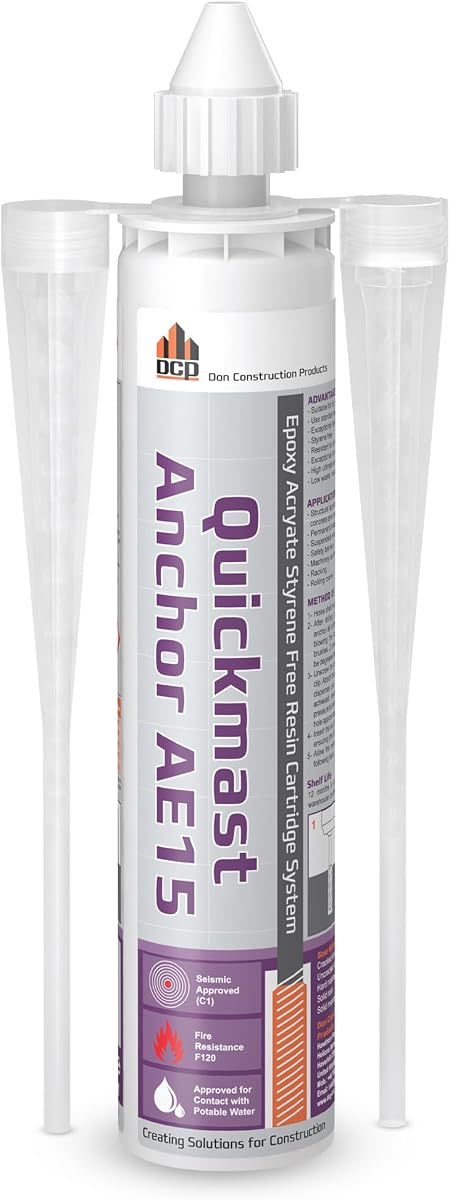
The DCP Quickmast AE15 is a 10.1 fluid-ounce, two-part acrylate epoxy designed to secure rebar, threaded rods, and other fasteners in demanding concrete installations. Its 4.5 rating reflects a strong balance of fast cure times, versatile base-material support, and convenient application. It is particularly attractive when a project needs both a manageable working window and comparatively quick return to full load-bearing capacity.
We may earn a commission when you buy through this link, at no additional cost to you.
The adhesive is designed for concrete, masonry, stone, rock, and other suitable substrates. It can be used in dry, wet, or flooded holes, which makes it more adaptable than formulations intended only for dry drilled concrete. The stated working time ranges from 4 to 10 minutes, while full load-bearing capacity may be reached in 40 to 145 minutes depending on the base-material temperature. That range allows the installer to work during cool conditions without assuming that a warm-weather cure schedule will apply.
A standard caulking gun handles the cartridge, and the two-part system promotes a controlled mix. Proper mixing is still essential: inconsistent ratios can create a weak or poorly cured bond. The relatively compact 10.1 fluid-ounce format is easier to handle than a large dual cartridge and is convenient for scattered installations, repairs, or jobs where fewer holes are needed at once.
This is our leading general-purpose recommendation for installers who need rapid curing, robust base-material compatibility, and straightforward cartridge application. Choose it when the anchor will see meaningful loads, the concrete condition varies, or the project cannot tolerate a multi-day wait before loading. For the highest-volume repeated installations, its cartridge size may require more frequent changes than the larger dual-cartridge alternatives in this list.
The stated 40-to-145-minute full-load window is the AE15's defining advantage for time-sensitive work. The exact schedule varies with base-material temperature, so allow the full published cure time for the actual site conditions before applying load.
Support for wet and flooded holes broadens the AE15's practical value. It is a better fit for exposed concrete, drainage structures, and installations where removing all moisture from the drilled hole would be difficult.
We may earn a commission when you buy through this link, at no additional cost to you.
This construction adhesive is a fast-curing polyester resin for anchoring fasteners into concrete, brick, stone, granite, and other solid base materials. Its 4.2 rating indicates a well-regarded product with broad practical utility. The emphasis is efficient installation: drill, clean, inject the resin, place the fastener, and allow the adhesive to cure without relying on mechanical expansion pressure.
We may earn a commission when you buy through this link, at no additional cost to you.
The included extra mixing nozzle is a small but useful convenience. It allows continued work without pausing to find a replacement nozzle, and it may be especially helpful during repeated anchor installations. Because the product uses resin rather than an expansion mechanism, the installation process focuses on preparing and filling the hole correctly rather than applying the specified torque required by some mechanical anchors.
One of its most useful features is the optional mesh-sleeve method for hollow block, brick, or cavity-wall applications. The sleeve holds the resin in place around the fastener and supports a reliable bond where the back of the drilled hole cannot provide continuous support. This broadens the product beyond solid masonry, although a sleeve is required for those hollow-base situations and is not automatically included according to the supplied listing information.
Choose this adhesive when fast turnover, straightforward application, and economical hole anchoring matter more than a specialized certification discussion. It is well suited to general fastening duties in common construction materials, provided the hole is properly drilled and cleaned. Buyers needing engineered performance for a specific cracked-concrete application or a tightly controlled professional specification should verify the current technical data sheet before relying on it for that design.
The drill-clean-inject-place workflow minimizes the number of components involved in the anchor. That simplicity is valuable when installing numerous bolts or working with limited access to specialized fastening equipment.
The optional mesh-sleeve method gives the product a route for hollow block, brick, and cavity walls. Use the sleeve where the base material cannot support the resin by itself, and follow the specified embedment and filling procedure.
We may earn a commission when you buy through this link, at no additional cost to you.
The Akona Fast-Setting Anchoring Epoxy is designed for concrete floors, walls, driveways, stairs, anchor bolts, dowels, and reinforcement bar. It carries a 4.4 rating and stands out for a 12-minute set time, allowing placed fasteners to become stable relatively quickly. Full drying takes 16 hours, so the distinction between initial set and complete cure is important when planning loading.
We may earn a commission when you buy through this link, at no additional cost to you.
The product is moisture tolerant and resists chemicals and solvents, making it suitable for installations where exposure to damp concrete or aggressive surroundings is a concern. Its gray color also blends with many common concrete and masonry surfaces, reducing the visual interruption that can accompany exposed repairs. The 8.45-ounce tube provides a focused quantity for individual anchors, brackets, dowels, and localized maintenance.
Unlike the dual-cartridge products, this epoxy uses a caulk-style application tube intended to reduce mess and simplify dispensing. That format may be especially approachable for maintenance crews, facility teams, and do-it-yourself users familiar with standard sealant guns. The trade-off is that the supplied information does not describe the same wide range of base materials or code approvals associated with the most specialized professional systems in the list.
This is a strong choice for fast repairs and everyday anchoring tasks where full loading can wait until the following day. It is particularly suitable for securing anchor bolts, dowels, or rebar in concrete and masonry without committing to a long cure schedule. Confirm hole dimensions, embedment requirements, and full cure behavior before installing anything that will be loaded early or subjected to elevated temperatures.
A 12-minute set time helps an installer correct placement while still moving promptly through repair work. The stated 16-hour full-dry period remains the safer threshold for applying significant load.
Moisture tolerance and resistance to chemicals and solvents add resilience in less forgiving environments. These properties do not replace project-specific verification, particularly when a fastener will be continuously exposed to aggressive media.
We may earn a commission when you buy through this link, at no additional cost to you.
The Fischer FIS A Anchor Rod M8 x 130 is a pack of ten threaded rods identified as item 90276. It has a 5.0 rating, the highest numeric score among the listed products, but that score should not be interpreted as a complete evaluation of an adhesive installation because this item is an anchor component rather than a resin cartridge. Its purpose is to provide the threaded fastener for a Fischer chemical anchoring system.
We may earn a commission when you buy through this link, at no additional cost to you.
The specified M8 diameter and 130 millimeter length make the rod useful for projects with a known thread and length requirement. Because each rod is supplied in a group of ten, it is practical for repeat installations such as equipment supports, cable trays, or structural connections where the same dimensions are used throughout. The threaded format also permits nuts and washers to be installed after the resin has cured.
This product is best considered alongside a compatible Fischer injection resin, the correct hole diameter, and an installation depth appropriate to the design. The supplied listing information does not state resin compatibility, cure schedules, performance values, or approved applications, so the broader product ecosystem and current technical documentation are important. A rod dimension that fits the hole does not by itself establish a suitable chemical anchor assembly.
Choose this option if your specification calls for a standard M8 Fischer threaded rod and you already know the intended FIS A resin and installation system. It is less convenient for a complete beginner because the adhesive, mixer, nozzle, and hole preparation requirements must be sourced separately. For projects centered on a complete ready-to-dispense resin system, one of the epoxy cartridges elsewhere in this guide may be a more direct choice.
A pack of ten matching M8 rods is convenient when several anchors share the same design. Standardization simplifies hole preparation, accessory selection, and installation across multiple locations.
The rod is a system component rather than a complete chemical anchor. Confirm the compatible resin, embedment depth, hole diameter, and fastener accessories before treating it as a finished anchoring solution.
We may earn a commission when you buy through this link, at no additional cost to you.
SIKA AnchorFix-2 is a professional-strength epoxy for securing threaded bars into uncracked concrete, solid masonry, steel, and other hard base materials. Its 4.1 rating reflects a solid product with a clear professional use case. Although several other options in this guide offer more dramatic cure-speed figures, AnchorFix-2 stands out for its strong material versatility, controlled dispensing, and solvent- and styrene-free formulation.
We may earn a commission when you buy through this link, at no additional cost to you.
The cartridge fits most applicator guns, and its narrow tip supports more accurate placement of epoxy inside the drilled hole. A static mixer is attached after cutting the cartridge tip. The adhesive is intended to secure the bar in position while curing, reducing the chance that a threaded insert will shift during installation. Its listed drinking-water certification makes it a more specialized choice than a general-purpose resin.
Correct preparation is central to performance. The supplied guidance calls for using a blow pump and bristle brush to remove drilling dust and debris before applying the epoxy. That extra step takes time, but it is a meaningful part of creating a dependable bond. Installers should also control resin placement, mix thoroughly, insert the bar to the required embedment, and avoid disturbing it during the cure.
This is our premium recommendation for professional work where a complete epoxy cartridge, strong base-material range, and controlled application are priorities. It is a particularly thoughtful choice for potable-water-related installations, subject to the current certification details and project requirements. Its full cure schedule is not supplied in the listing information, so consult the current technical documentation before scheduling load-bearing work.
The narrow cartridge tip helps place adhesive precisely in drilled holes, which is useful for deep embedment or restricted access. A suitable applicator gun and static mixer support consistent dispensing.
Certification for use in drinking-water systems distinguishes AnchorFix-2 from many general-purpose anchoring adhesives. Verify the current certification scope and local requirements for the intended installation.
We may earn a commission when you buy through this link, at no additional cost to you.
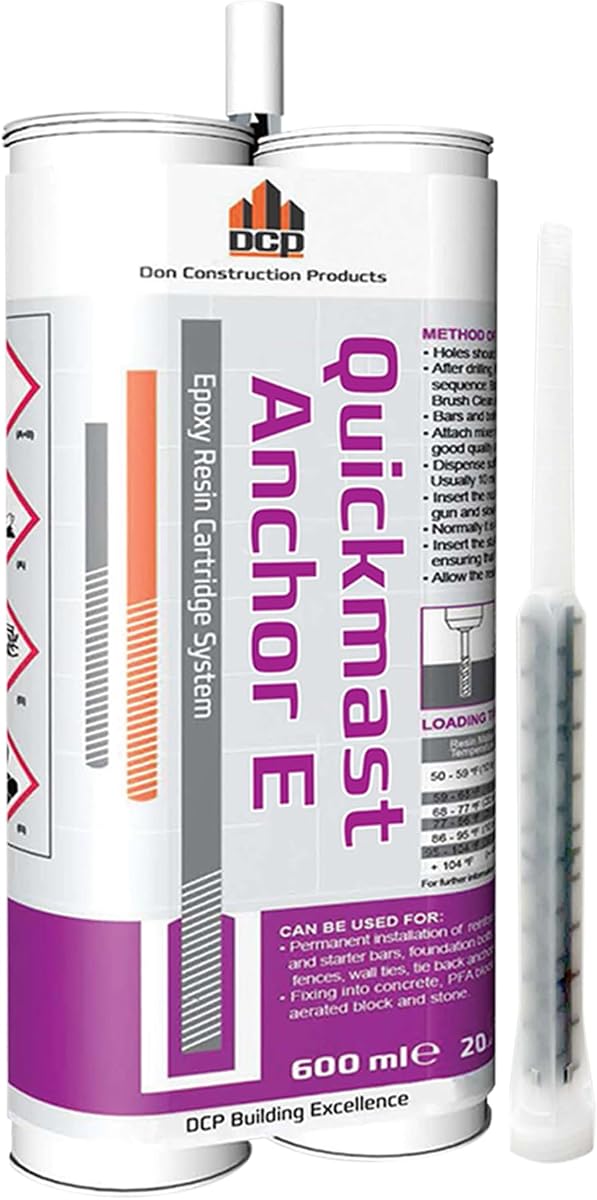
The DCP Quickmast Anchor E is a 20.2 fluid-ounce, two-part epoxy system rated 4.7 in the supplied data. It is marketed for demanding fastening applications ranging from handrails and safety fences to railway tracks and ground anchors. That range makes it a strong candidate for contractors who need one resin to cover several demanding, load-bearing concrete connections.
We may earn a commission when you buy through this link, at no additional cost to you.
Its working time ranges from 3 to 20 minutes, giving the installer more or less placement time depending on conditions. The full-load cure ranges from 3 to 24 hours according to the base-material temperature. These broad windows demonstrate why cure timing should never be treated as a fixed number: warm material accelerates the process, while cooler concrete can extend it considerably. The anchor should remain undisturbed for the full specified interval before loading.
The adhesive supports dry and damp concrete holes and bonds to both concrete and steel surfaces. Its dual-cartridge format uses standard professional application equipment, allowing a controlled mix when the applicator gun is properly maintained. The larger cartridge reduces changeover time on jobs requiring many anchors, although the 20.2 fluid-ounce pack is heavier and less convenient for a single small repair than the 10.1 fluid-ounce AE15.
Choose Quickmast Anchor E for high-strength professional work with a meaningful anchor count, especially where the specification includes rebar, threaded rods, or heavy equipment. The product description also mentions crack repair, but crack conditions and structural applications require careful engineering and product-specific qualification. For repetitive work, proper nozzle changes, consistent dispensing, and organized cartridges are essential to avoid downtime.
The Anchor E system is positioned for applications that range from everyday safety fixtures to heavy anchoring demands. Actual performance still depends on embedment, hole geometry, concrete condition, and installation quality.
At 20.2 fluid ounces, the dual cartridge supports sustained installation work with fewer nozzle changes. The trade-off is greater weight and less maneuverability for isolated holes.
We may earn a commission when you buy through this link, at no additional cost to you.
The Quickmast E 20.2 fluid-ounce Two-Part System includes two cartridges and an epoxy applicator gun. It carries a 5.0 rating and is built around the same broad use cases as the DCP dual-cartridge option: rebar, threaded rods, handrails, safety fences, ground anchors, and other demanding concrete connections. The major difference is that the installation equipment is included in the package.
We may earn a commission when you buy through this link, at no additional cost to you.
The gun is designed for a 1:1 mixed ratio and can handle 20.2 fluid-ounce or 600 milliliter dual cartridges, as well as 22 fluid-ounce or 650 milliliter sizes. Its stated 25:1 thrust ratio is intended to provide smooth dispensing with less mess and better control. A properly matched applicator is useful because the resin components must be mixed consistently to achieve the intended chemical and mechanical performance.
Installation remains temperature sensitive. The system provides approximately 3 to 20 minutes of working time, which is enough to insert rebar or threaded rod after dispensing, but the range suggests that hot conditions can shorten the available placement window. The concrete and steel bonding claims, along with dry and damp hole suitability, make the product relevant to varied job-site conditions.
This is a compelling option for installers who do not already own a suitable dual-cartridge gun. It reduces the need to find one separately and provides a matched dispensing setup from the start. However, buyers who already have a reliable 1:1 applicator may find the included gun redundant. Compare cartridge quantity, gun compatibility, and the storage space required before choosing between the different 20.2 fluid-ounce systems.
The included applicator removes the uncertainty of buying a gun with the wrong ratio or thrust characteristics. A consistent 1:1 mix is essential when using a two-component epoxy system.
The two-cartridge format is convenient for repeated anchoring or a planned project with many holes. It also creates excess material if only a small number of anchors will be installed.
We may earn a commission when you buy through this link, at no additional cost to you.
The Epoxy Grip Internal Threaded Anchor is a ready-made zinc-plated steel anchor with a 5/16-18 internal thread. It is listed for theater and stadium seating, machinery and conveyor-belt vibration, material handling, ductwork, and other applications where a standard internal thread is convenient. Unlike a resin cartridge, this is a complete metal anchor designed to be embedded into concrete.
We may earn a commission when you buy through this link, at no additional cost to you.
The dimensional data is unusually specific. It calls for a 1/2-inch drill size, a 2-3/4-inch minimum hole depth, a 2-5/8-inch minimum embedment, and a 3/4-inch thread depth. The overall length is 2-3/4 inches, while the stated rod diameter is 5/16 inch. Those figures make it easier to prepare compatible holes and select the correct fastener before installation.
The listing describes the anchor as vibration resistant and better suited to close-edge or close installations than some mechanical alternatives. It also states an ultimate tension value of 7,272 pounds in 4,000 PSI concrete. That figure is a specific test condition rather than a universal working load, so it should not be used as the design capacity for a different concrete strength, embedment, cracked substrate, or spacing arrangement.
Choose this anchor when a 5/16-18 internal thread, fixed dimensions, and a ready-to-embed metal component are required. It is useful for installers who want a conventional threaded insert without assembling a separate rod-and-resin combination. Verify the stated dimensions against the actual base material, the required fastener, and the governing project design before installation.
The 5/16-18 internal thread allows a matching bolt to be removed and replaced while leaving the embedded anchor in place. That makes it useful where equipment may require repeated servicing.
The stated drill size, hole depth, and embedment help prevent a mismatch during installation. These dimensions should still be checked against current manufacturer instructions and the conditions of the base material.
We may earn a commission when you buy through this link, at no additional cost to you.
The Fischer Reaction Filters RSB 12 Mini, item 518822, is an accessory for controlled resin injection rather than a standalone chemical anchor. It has a 4.4 rating and belongs in a professional installation kit when resin must be placed accurately into drilled holes. The filter's job is to manage the flow of injection mortar as it exits the cartridge and enters the anchor hole.
We may earn a commission when you buy through this link, at no additional cost to you.
The listed benefits include accommodating two mortar cartridges, which can increase the load level and reduce the number of attachment points required. It is also described as ideal for filled holes and overhead installation. Those features make it relevant to projects where a standard open nozzle would allow resin to escape, drain from a water-filled hole, or fall away during placement.
This is not the chemical resin itself and cannot perform as a complete anchoring system by itself. It must be used with compatible Fischer mortar cartridges, the correct anchor components, and the associated installation instructions. The supplied information also notes economical use through Vorportio lamination and processing capability down to minus 30 degrees Celsius, although the exact meaning and application limits of those terms should be confirmed in current documentation.
Choose the RSB 12 Mini if your installation plan includes overhead anchors, drilled holes containing water, or a professional Fischer injection workflow where controlled resin delivery is important. Skip it for a small, straightforward anchor installation where a standard mixer and nozzle are sufficient. As a specialized accessory, it offers more workflow value when used consistently across multiple demanding holes.
A reaction filter helps direct injection mortar into the anchor hole instead of allowing uncontrolled discharge. That control is particularly useful when the resin must remain around the fastener for the full embedment.
Support for filled holes and overhead mounting is the accessory's clearest advantage. These features make it useful for drainage holes, overhead services, and installations where resin loss would compromise the bond.
We may earn a commission when you buy through this link, at no additional cost to you.
PC-Concrete PRO is a two-component, professional-grade anchoring epoxy from PC Products. Its 4.3 rating and extensive certification information distinguish it from many conventional adhesives in this guide. The product is intended for anchoring threaded rod and reinforcing bar into cracked or uncracked concrete, and the listing specifically states that smooth bore holes can be used without roughening the interior walls.
We may earn a commission when you buy through this link, at no additional cost to you.
The supplied information lists compliance with IAPMO UES ER-632, multiple editions of the IBC and IRC, Florida Building Code editions, AASHTO M235, and ASTM C881-15 for several resin types and grades. Those references can make specification work more straightforward, but they should be matched carefully to the exact grade, class, application, and edition permitted for the project. Certification does not automatically make every anchor configuration acceptable.
Installation conditions are versatile. The product may be used in dry, water-saturated, and water-filled holes with threaded rod or rebar. It can be applied with a standard high-thrust caulking gun for 600 milliliter dual cartridges, while the product itself is a 254 milliliter two-component system. The complete listed workflow also includes hammer drilling or coring and correct resin placement.
This is the strongest specialized recommendation for engineers, contractors, and specifiers who need a product with a substantial code-compliance framework and cracked-concrete support. It is less attractive for a casual household task where documentation is unnecessary. Confirm the current technical data, approved installation parameters, and current listing configuration before purchasing or specifying it.
The product's listed building-code and ASTM references can simplify review by an engineer or authority. Match the exact resin classification and installation parameters to the governing design rather than relying on a general approval statement.
Supporting cracked concrete, saturated holes, and water-filled holes gives PC-Concrete PRO an advantage in demanding conditions. These capabilities are especially relevant to infrastructure, repair, and exposed-site work.
We may earn a commission when you buy through this link, at no additional cost to you.
Choosing a chemical anchor starts with the base material and the design demand, not merely the adhesive's advertised cure time. Compare load requirements, hole conditions, resin format, code status, and installation equipment before selecting a product for a project.
Concrete anchors are formulated for different substrates, and a product advertised for concrete may not be appropriate for masonry, stone, hollow block, or steel. The AE15 supports concrete, masonry, stone, and rock, while PC-Concrete PRO specifically highlights cracked and uncracked concrete, threaded rod, and reinforcing bar. Check whether the material is solid, hollow, cracked, wet, or water filled, and choose an adhesive whose published application list includes that exact condition.
Match the anchor to the base material first. A resin that works well in dense concrete may behave differently in lightweight masonry, natural stone, or a cavity wall.
Working time is the period available to insert and position the anchor after dispensing resin. Full cure is the point at which the anchor should be loaded. These are different numbers: Akona sets in 12 minutes but fully dries in 16 hours, while DCP Anchor E may require 3 to 24 hours for full load depending on base-material temperature. Account for mixing, hole preparation, positioning time, and the possibility of a warm site shortening the window.
Treat initial set as a handling milestone, not permission to apply the intended load. Follow the complete cure schedule for the actual temperature and base condition.
The fastest curing adhesive is not automatically the best choice for the heaviest load. Evaluate embedment depth, concrete strength, edge distance, spacing, cracked-concrete status, and the manufacturer's test or design data. Products such as PC-Concrete PRO provide code-related information, while the Epoxy Grip anchor lists a specific ultimate tension value under a defined concrete condition. Those figures should never be transferred to a different configuration without verification.
Prioritize documented performance over general strength language. The design must be checked by a qualified professional when safety-critical loads are involved.
Two-part epoxies are commonly dispensed from side-by-side dual cartridges, while caulk-style tubes and polyester cartridges suit other applicator systems. Dual cartridges generally provide a controlled component ratio when paired with a suitable gun. Quickmast E includes a 25:1-thrust applicator, DCP Anchor E uses a standard dual-cartridge gun, and PC-Concrete PRO supports high-thrust standard caulking and 600 milliliter dual-cartridge guns.
Select the format around the tools you already own and the number of holes planned. Do not assume a standard sealant gun is appropriate for every two-part epoxy.
Chemical anchoring depends on a clean, correctly sized hole. SIKA specifically calls for a blow pump and bristle brush after drilling, and PC-Concrete PRO allows smooth bore holes without roughening under its stated conditions. Other products may have different diameter and depth requirements. Record the required drill size, hole depth, embedment, and resin volume, and use a hole brush and cleaning method appropriate to the selected resin.
Poorly cleaned holes can undermine an otherwise capable adhesive. Follow the product-specific preparation procedure instead of assuming that compressed air alone is sufficient.
Moisture tolerance is not the same as approval for a flooded hole. AE15 explicitly supports dry, wet, and flooded concrete holes, and PC-Concrete PRO can be used in dry, water-saturated, and water-filled conditions. Akona describes its epoxy as moisture tolerant, while DCP Anchor E supports dry and damp holes. Where standing water is present, also consider a reaction filter or an installation method that prevents resin loss and maintains the proper fill level.
Use a flooded-hole-capable product for a flooded hole, and consider an overhead-compatible delivery accessory. Never assume that damp-hole approval extends to a poorly controlled cavity.
For public, commercial, or engineered work, certification can determine whether a resin is acceptable. PC-Concrete PRO lists several building-code and ASTM references, and SIKA AnchorFix-2 carries a drinking-water certification. Documentation matters because an adhesive can perform well in a test yet fail the specification requirements of a particular jurisdiction, base material, or anchor configuration. Review the current evaluation report and confirm that it covers the intended use.
Ask for documentation before buying when approval is mandatory. Match the document to the exact product, resin grade, application, and code edition.
A complete system may require more than the resin itself. Mesh sleeves support anchoring in hollow block, brick, and cavity walls; a reaction filter improves resin delivery in filled or overhead holes; and a correctly sized applicator gun ensures consistent dual-component mixing. Larger cartridges reduce nozzle changes on busy projects, while smaller tubes are easier for isolated repairs. The Quickmast E package includes a gun, and the fast-curing construction adhesive includes an extra nozzle.
Count the anchors, assess access, and list the required accessories before selecting a package. A system that looks economical on the listing can be inefficient if it causes interruptions or lacks essential equipment.
Begin by confirming that the selected resin is approved for the base material, required hole dimensions, embedment depth, load design, and installation environment. Drill the specified diameter, then remove dust, laitance, and debris with the recommended cleaning tools. The SIKA instructions specifically mention a blow pump and bristle brush, while other products may allow different procedures, so use the method required by your chosen technical data sheet.
Check the resin cartridge, mixer, nozzle, and applicator gun for compatibility. For dual cartridges, verify the correct 1:1 ratio where applicable and purge the mixer until both components flow evenly. Position the anchor before dispensing whenever practical. Inject the resin from the deepest portion of the hole and fill it according to the specified volume and embedment instructions, avoiding voids that can form when resin is placed only at the opening.
Insert the rebar or threaded rod immediately after dispensing, using controlled movement so the resin remains around the full embedment zone. Remove any excess resin as directed by the manufacturer, fit washers and nuts without disturbing the anchor, and allow the assembly to cure for the full time appropriate to the base-material temperature. Do not apply the intended load merely because the resin has reached an initial set; clean tools and store cartridges according to the manufacturer guidance to prevent waste and premature curing.
A chemical anchor bonds a fastener to the base material with injected resin, while an expansion anchor creates force against the sides of the hole. Chemical anchors can offer strong performance in cracked concrete and close-edge locations when designed for those conditions. Expansion anchors may install faster in some simple applications, but resin anchors generally require hole cleaning, dispensing, placement, and curing time.
Some resin systems are specifically approved for wet, water-saturated, or flooded holes. The DCP Quickmast AE15 supports dry, wet, and flooded concrete, while PC-Concrete PRO lists dry, saturated, and water-filled conditions. Water can prevent resin from filling the hole correctly, so select a flooded-hole-capable product and consider a reaction filter when water would otherwise cause resin loss.
Wait for the full cure stated for the exact resin, embedment, base-material temperature, and application. Initial set and full load-bearing capacity are different milestones; Akona, for example, sets in 12 minutes but fully dries in 16 hours. DCP products may also require several hours, and cold concrete can extend the schedule substantially.
It depends on the cartridge format. Dual-component epoxies usually require a suitable dual-cartridge applicator that maintains the correct mixing ratio, while caulk-style products may use a standard sealant gun. The Quickmast E package includes a 1:1-ratio gun, DCP Anchor E is intended for a standard dual-cartridge gun, and PC-Concrete PRO calls for a high-thrust caulking or 600 milliliter dual-cartridge gun.
Many two-part anchoring epoxies support both reinforcing bar and threaded rod, including DCP Quickmast AE15, DCP Anchor E, Quickmast E, SIKA AnchorFix-2, and PC-Concrete PRO. Compatibility still depends on the resin's stated application list, the fastener geometry, embedment, and the project's design requirements.
The drilled hole should match the required diameter and depth and be free of dust and loose debris. Use the cleaning procedure specified by the resin manufacturer, which may include a blow pump, bristle brush, compressed air, or another method. PC-Concrete PRO is notable for allowing smooth bore holes without roughening under its stated conditions, but that does not eliminate the need to remove drilling debris.
Yes, when the product supports a sleeve or another form that retains the resin in the cavity. The fast-curing construction adhesive specifically describes a mesh-sleeve method for hollow block, brick, and cavity walls. The sleeve must be inserted correctly, and the resin must be placed according to the product's instructions so it surrounds the anchor without draining into the void.
No. The strongest or highest-rated product may not match the base material, hole condition, curing window, or installation equipment. A suitable resin with the correct approval and accessible application process can be more dependable for the task. Compare documented performance and project conditions rather than choosing solely from a numerical rating or general strength description.
The DCP Quickmast AE15 is the most versatile all-around recommendation in this guide because it combines a fast working window, rapid load recovery, and support for dry, wet, and flooded holes. The fast-curing construction adhesive is a practical value option for general masonry work, especially with its extra nozzle and optional sleeve system, while SIKA AnchorFix-2 stands out for professional application, a solvent- and styrene-free formulation, and drinking-water certification.
Prioritize the base material, load design, cure schedule, and required equipment over a general claim of high strength. PC-Concrete PRO is particularly relevant when cracked-concrete support and listed code compliance matter. The DCP dual-cartridge products suit heavier project volumes, while specialized accessories such as the Fischer RSB 12 become valuable in filled or overhead holes. Verify the current technical documentation before using any product for a safety-critical design.
Product ratings, availability, formulations, and prices can change over time, so review the current listing and manufacturer information before ordering. Match the resin to the exact application, budget for the necessary gun, mixer, sleeves, or filters, and allow the full cure schedule before loading the finished anchor.


