
U.S Art Supply Three-Color Primer Set
4.2Editor score
Black, white, and gray set
Ready-to-spray acrylic polyurethane
Self-leveling matte surface
Airbrush or brush application
Primer for 3D Prints guide compares ten acrylic primers and finishing sprays for surface prep, adhesion, layer-line reduction, and smooth painted results.
A reliable primer gives a 3D print the stable, paintable surface it needs for clean color, strong adhesion, and a professional finish. The right product can also reduce visible layer lines, reveal whether a part needs more sanding, and create a uniform base that helps colors look their best.
This guide compares ten primers, primer sets, and complementary finishing sprays based on their supplied surface-preparation, airbrushing, color, finish, and material-compatibility details. It covers options made for plastic, resin, metal, miniatures, models, and other craft surfaces rather than judging products by one narrow workflow.
Each listing reveals what distinguishes a product within the roundup, from ready-to-spray polyurethane primers to fast-drying acrylic formulations and gloss coatings that smooth 3D-print textures. The top three selections highlight the strongest combinations of usefulness, versatility, and specialized finishing potential; prices and availability can change.
4.2Editor score

4.8Editor score

5.0Editor score
The comparison below places all ten products side by side by format, primer color, finish, application method, and stated material compatibility. It helps distinguish true priming products from gloss finishing sprays that act as complementary steps in a post-processing workflow.



The Roizefar Airbrush Medium Set earns the Editor's Choice position because it addresses more stages of the painting process than a conventional primer bottle. Its 4.8 rating reflects a favorable customer reception, while its eight-piece format includes white, black, and gray primers, airbrush thinner, flow improver, gloss varnish, and matte varnish.
We may earn a commission when you buy through this link, at no additional cost to you.
The set's main advantage is workflow completeness. Primer creates the foundational color, thinner adjusts consistency, and flow improver helps reduce tip drying and support smoother spraying. After painting, users can select glossy varnish for a reflective finish or matte varnish for a subdued appearance, making the kit relevant to both display models and painted functional pieces.
Its main trade-off is that it does not include the acrylic color paints used between primer and varnish, so it is not completely self-contained for painting a finished piece. It also bundles 120 ml containers for eight liquids, which may be more material than someone needs for a single small print. Even so, the combination offers unusual flexibility for a focused 3D-print finishing kit.
This is the strongest recommendation for a hobbyist who airbrushes 3D prints and wants a coordinated collection of preparation and finishing mediums rather than isolated products. It is also useful for miniatures, models, resin, plastic, and metal projects. Buyers who only need a single black or white primer may find a more focused bottle more economical, while airbrush users gain the most from the complete set.
Unlike products that stop after the base coat, this set continues through paint-performance additives and protective varnishes. That structure simplifies material planning for anyone who wants a consistent airbrush workflow from surface preparation to final protection.
White, black, and gray primers cover common color-selection needs: light bases for dark colors, dark bases for vivid highlights, and neutral middle tones. The neutral options are especially useful when deciding how a print should be prepared before a chosen color scheme is applied.
We may earn a commission when you buy through this link, at no additional cost to you.
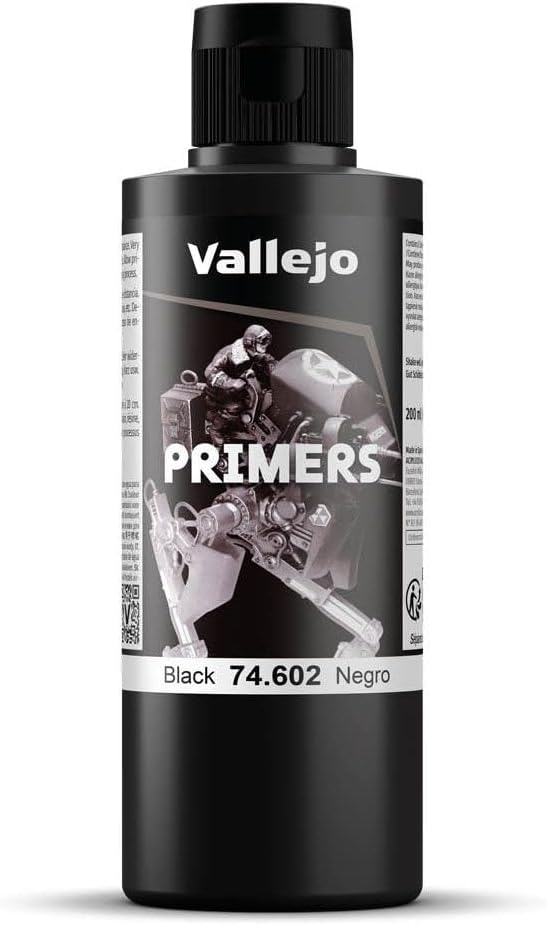
The Vallejo Surface Primer Color in 60 ml is a focused choice for people who want a proven black acrylic primer without purchasing a multi-piece kit. It holds a 4.8 rating and is formulated for airbrushing, with fast drying and a matte finish that creates a uniform dark foundation for subsequent model painting.
We may earn a commission when you buy through this link, at no additional cost to you.
The primer can be applied directly or combined with the separately referenced Vallejo Airbrush Thinner and Flow Improver. Its application guidance recommends successive coats and approximately 15–20 PSI, which gives airbrush users useful starting information for controlling the spray. The resulting film is described as homogeneous, hard, and resistant once dry.
A notable requirement is degreasing the model before application. Washing or otherwise removing release-agent residue is important because oils and contaminants can interfere with adhesion. Some users may also find that a separate thinner or flow improver increases their setup cost or complexity, although the bottle can be used directly.
This primer suits scale models, figurines, miniatures, and 3D-printed parts that will receive a dark base and brighter colors on top. Choose the 60 ml version when managing material use matters more than minimizing refills. For frequent batches or larger collections, the 200 ml bottle in this guide offers the same finish and workflow with less container turnover.
A matte black base is useful for maximizing contrast, revealing surface irregularities, and creating a controlled foundation beneath lighter paint. The product's fast-drying formulation also supports a staged airbrushing process rather than a single heavy application.
Cleaning the print before priming is not an optional aesthetic step in this product's workflow. Removing release agents helps the primer establish the strong, even adhesion the manufacturer describes, reducing the likelihood that later paint will peel unevenly.
We may earn a commission when you buy through this link, at no additional cost to you.
The Vallejo Surface Primer Color 200 ml shares the strong 4.8 rating and core formulation of the smaller black primer but is better suited to regular model painters and larger batches. It delivers a fast-drying, matte acrylic base formulated for airbrushing and designed to support strong subsequent adhesion.
We may earn a commission when you buy through this link, at no additional cost to you.
Its larger format is the decisive difference. Successive coats and a hard, homogeneous film are well matched to collectors, painters, and workshop users who repeatedly prepare miniatures, figurines, scale models, or 3D-printed components. The bottle includes a hinged cap and dropper according to the supplied product information.
The same cautions apply as with the smaller Vallejo bottle. The surface should be degreased to remove release agents, and users may need separate thinner or flow improver for their preferred spraying consistency. A large container also requires mindful storage, especially if it will not be used regularly, because acrylic materials generally benefit from stable storage conditions.
Choose this version for high-volume hobby work or for anyone who dislikes replenishing primer frequently. For a first project on a single small print, the 60 ml bottle is more proportionate. For models that do not need a black base, the light gray Vallejo option or the three-color U.S. Art Supply set offers greater palette flexibility.
A larger bottle reduces the frequency of refills during multi-part models or batch painting. That convenience is most valuable when the same surface preparation process will be repeated across many small components.
The product is intended to be applied in successive coats rather than relying on one thick pass. Thin, controlled applications help create the homogeneous film described by the manufacturer and can make airbrush work more predictable.
We may earn a commission when you buy through this link, at no additional cost to you.
The U.S Art Supply Black, White, Gray Surface Primer Airbrush Paint 3 Color Set is the best budget-oriented palette choice in this roundup. Its 4.2 rating reflects a solid but less exceptional customer reception than the highest-rated products, while the set gives users three useful base colors in separate four-ounce bottles.
We may earn a commission when you buy through this link, at no additional cost to you.
The ready-to-spray water-based acrylic polyurethane formula is self-leveling and intended to create strong adhesion and a durable, hard matte finish. Although designed primarily for airbrush application, it can also be applied by brush. The listed materials include plastics, metals, resin, fiberglass, ceramic, wood, fabric, leather, paper, and canvas.
Its trade-offs are modest bottle size and a rating that does not reach the leading tier. Users working on large, heavily textured prints may need more material than the four-ounce containers provide, and those who already know they need only gray or black may find the trio unnecessary. The broader surface list also does not guarantee that every combination of plastic type, cleaning method, and topcoat will behave identically.
This set makes sense for new painters who want to experiment with base colors, hobbyists who alternate light and dark schemes, and anyone who prefers brush priming for small details. It is also a practical choice for 3D-printed miniatures, toys, and models. Existing users of a preferred primer can still benefit from having all three neutrals available for different color plans.
The major convenience is simply having black, white, and gray without ordering each separately. That allows the color of the base to complement the intended topcoat rather than forcing every project to use the same neutral foundation.
A self-leveling formula can reduce the appearance of brush or airbrush marks during application. The product is still described as a hard matte primer, so it is intended as a preparation layer rather than a decorative gloss finish.
We may earn a commission when you buy through this link, at no additional cost to you.
The Two-Bottle 3D Printer Model Gloss Spray is designed as a quick-drying finishing product rather than a conventional priming layer. It carries a 1.0 rating, so it does not compare favorably with the better-received choices on customer satisfaction. Its strongest stated functions are reducing visible layer lines and adding a smooth high-gloss surface.
We may earn a commission when you buy through this link, at no additional cost to you.
The package includes two 60 ml bottles, which is useful for multiple projects or for keeping a second bottle available while the first is in use. The product is described as easy to carry and suitable for small hobby projects, with an application method intended to coat models evenly without obvious sagging or uneven accumulation.
This makes it better viewed as the final stage after the print has been prepared, painted, or otherwise brought to the desired color. It is not a substitute for a primer that provides a matte bonding layer, and the supplied information gives less detail about chemical compatibility and broad substrate support than several other products in the comparison.
The low rating warrants caution and attention to recent customer feedback before committing to a large project. It may be worth considering for a small display model where a quick gloss topcoat and layer-line reduction are the main objectives. For foundational adhesion, a dedicated acrylic or polyurethane primer should come first.
Two smaller bottles can be convenient for separate pieces or for maintaining a spare during a finishing session. The compact 60 ml containers may also be easier to store than a larger aerosol can in a crowded workshop.
The product's role is to smooth texture and enhance shine, not to establish the adhesion layer. Using it after a dedicated primer preserves a clearer separation between surface preparation and decorative finishing.
We may earn a commission when you buy through this link, at no additional cost to you.
The U.S. Art Supply Gray Surface Primer Airbrush Paint is a straightforward single-color option for users who have established that gray is the right base for their projects. Its 4.2 rating indicates satisfactory customer reception, and the eight-ounce bottle offers a practical capacity for repeated use.
We may earn a commission when you buy through this link, at no additional cost to you.
The water-based acrylic polyurethane formula is ready to spray, self-leveling, and suitable for airbrushes as well as brushes. It is described as producing strong adhesion and a durable, hard matte finish. The stated surface list includes plastics, metals, resin, fiberglass, ceramic, wood, fabric, leather, paper, and canvas, making it broadly applicable to mixed hobby work.
There is a wording inconsistency in the supplied bullet list, which describes the gray product as black primer in one sentence. The product title and remaining details clearly identify this listing as gray surface primer. Buyers should therefore judge the listing by its title and use color selection with caution if packaging details differ from expectations.
This primer is a sensible choice for miniatures, toys, train models, and 3D prints that will receive either light or dark colors over a neutral base. It offers more material than the four-ounce bottles in the three-color set while avoiding unnecessary colors. Those needing white and black alternatives can choose the matching individual bottle or the full set.
Gray is a practical middle tone because it can support both darker and lighter paint schemes. It is also useful for checking the print's surface before committing to a final color, since defects can remain easier to spot than on a similarly colored base.
The same bottle can serve airbrush users and painters who prefer controlled brushwork. That flexibility is useful for small details, recesses, and areas around a print where spraying may be difficult.
We may earn a commission when you buy through this link, at no additional cost to you.
The U.S. Art Supply White Surface Primer Airbrush Paint is intended for users who want a light foundation beneath pale colors. The product has a 4.2 rating and an eight-ounce bottle, while sharing the ready-to-spray, water-based acrylic polyurethane formula used by the other U.S. Art Supply primers in this guide.
We may earn a commission when you buy through this link, at no additional cost to you.
Its self-leveling behavior is intended to promote a smooth application, and the dried result is described as a durable, hard matte finish with strong adhesion. It can be airbrushed or brushed and is listed for plastics, metals, resin, fiberglass, ceramic, wood, fabric, leather, paper, and canvas. This makes it useful for both 3D-printed parts and surrounding model-making materials.
The supplied bullet list mistakenly refers to the white primer as black in its first description, despite the listing title identifying it as white. That inconsistency makes careful package review important. Otherwise, the core features and application guidance closely match the gray and three-color primer options from the same line.
Choose this bottle for pale armor, white vehicles, monochrome displays, or bright color schemes that could look dull over a dark or gray base. It is also a good primer for inspecting whether a model has an even surface. Users who need flexibility across multiple color schemes may prefer the coordinated three-color set instead.
A white base helps light colors retain their intended brightness and purity. It can also make missed areas, uneven sanding, and small print defects easier to identify before fine painting begins.
The listed substrate range means a single primer can be used on several components of a larger project. This is useful for kits and dioramas where 3D-printed resin or plastic parts sit beside painted wood, metal, or ceramic accessories.
We may earn a commission when you buy through this link, at no additional cost to you.
The 3D Printer Model Gloss Spray stands out as the roundup's Best Premium finishing pick because it combines a 5.0 rating with a specifically described 3D-print workflow. Rather than functioning as a base primer, it is intended to transform the appearance of printed models after their surface has been prepared.
We may earn a commission when you buy through this link, at no additional cost to you.
Its clear coating is advertised as reducing visible layer lines and filling micro-gaps, producing a smooth high-shine finish without extensive sanding. It also dries to the touch quickly, supports multiple coats, and leaves a protective layer intended to resist fingerprints and repel dust. These features make it especially relevant to display pieces that are handled regularly.
Material compatibility is another strength. The supplied information lists resin, PLA, ABS, PETG, and other common 3D-print materials, as well as miniatures, prototypes, cosplay props, and functional parts. The important qualification is that this is a gloss finish: buyers seeking a matte bonding layer or subtle natural surface will need to pair it with a dedicated primer or choose a different finish.
This spray is a strong choice for a polished prototype, cosplay accessory, or display model whose layer texture is visually distracting. Its high rating and focused feature set distinguish it from the lower-rated two-bottle alternative, although the limited customer history implied by a new listing may still warrant checking recent feedback. Use it as the final layer rather than a substitute for preparation.
The clear formula is designed to fill small gaps and reduce the visual prominence of layer lines. That can save considerable finishing effort, particularly on curved surfaces where aggressive sanding can be difficult or risk altering the model's shape.
A durable glossy barrier can help keep dust and fingerprints off a finished model. The protective role makes the spray relevant beyond cosmetics, especially for painted miniatures and props that will be transported or displayed.
We may earn a commission when you buy through this link, at no additional cost to you.
The Micro-Mark Gray Acrylic Primer is a 4.5-rated option aimed at model painters who want a neutral foundation with a clear hobby focus. Its eight-ounce bottle is described as professional-grade acrylic primer for models, miniatures, and craft projects, with excellent adhesion and coverage as its central benefits.
We may earn a commission when you buy through this link, at no additional cost to you.
Neutral gray is particularly versatile because it works beneath both light and dark topcoats and can help the user judge whether fewer color layers are needed. The primer is specifically described for plastic, resin, and metal surfaces, which covers the most common materials encountered in 3D-print finishing and traditional scale-model preparation.
Compared with products that provide airbrush pressure guidance, the Micro-Mark listing focuses more generally on adhesion and coverage. That makes it approachable for brush users, but airbrushers may need to determine their own thinning and spray settings. The lack of a stated spray consistency also leaves more room for user adjustment.
This primer suits hobbyists working across mixed printed and traditional model components. Its rating, generous capacity, and neutral tone make it a strong alternative to the similarly sized gray U.S. Art Supply bottle. Choose Micro-Mark when model coverage and a neutral base are priorities, and compare application details carefully if a specific airbrushing setup is essential.
A gray base gives painters a flexible middle value beneath nearly any color scheme. It can also help reduce the number of topcoat layers required when the primer tone already supports the intended final appearance.
The listed use on plastic, resin, and metal makes this a practical common denominator for projects that combine 3D-printed parts with conventional kits. Consistent primer selection can simplify the appearance of a mixed-material display.
We may earn a commission when you buy through this link, at no additional cost to you.
The Vallejo USN Light Ghost Grey Acrylic Primer combines a 4.8 rating with detailed airbrushing guidance, making it one of the strongest technical choices in the guide. Its light gray tone gives painters a pale neutral base while retaining enough contrast to make surface irregularities visible before color is applied.
We may earn a commission when you buy through this link, at no additional cost to you.
The 200 ml bottle contains a fast-drying acrylic primer intended for successive coats. The supplied guidance gives a recommended compressor range of approximately 15–20 PSI and notes that the primer can be used directly or diluted with Vallejo Airbrush Thinner or Flow Improver. Once dry, it is described as forming a homogeneous, hard, resistant film.
A useful safety-oriented detail is that the primer is not flammable and does not contain solvents. That does not eliminate the need for sensible ventilation, dust control, or careful handling of airborne spray, but it distinguishes the formulation from products described as solvent-based. The surface should still be degreased to remove release agents before application.
This primer is a good choice for advanced airbrush users, large model collections, and anyone who wants a light gray base with established spray settings. It also works for 3D prints destined for pale colors. Users wanting darker foundations may prefer black primer, while those requiring multiple base colors will get more flexibility from a coordinated primer set.
The recommended pressure range gives beginners a concrete place to begin. Actual results will still depend on the airbrush, spray distance, technique, and the consistency achieved during application.
Light ghost grey is useful for finding sanding marks, gaps, and uneven areas before topcoating. A visible neutral base can prevent small surface problems from being locked beneath a darker or more saturated finish.
We may earn a commission when you buy through this link, at no additional cost to you.
The right primer depends on the print material, surface condition, chosen color scheme, application equipment, and desired final texture. Comparing those factors helps separate true surface primers from clear finishing sprays and prevents a product from being asked to perform a stage it was not designed for.
A primer establishes the prepared base color and promotes adhesion between the printed plastic or resin and later paint. A clear gloss spray instead fills micro-texture, smooths visible layer lines, adds shine, and may protect a finished surface from dust or fingerprints. Products such as the Roizefar set explicitly combine both roles, while the 3D Printer Model Gloss Spray focuses on the finishing stage. A good primer is usually matte or semi-matte so that users can judge coverage and identify missed areas before committing to final color.
Look for stated compatibility with the exact material of the print. PLA, PETG, ABS, and resin are common 3D-print materials, but their surfaces can behave differently, and some products explicitly cover plastics, metals, resin, fiberglass, ceramic, wood, paper, fabric, leather, and canvas. The U.S. Art Supply products have the broadest listed material range in this roundup, while Micro-Mark focuses on plastic, resin, and metal. Compatibility does not guarantee identical results on every filament formulation, so cleaning and testing remain important.
The primer color influences the appearance and efficiency of later coats. Black creates strong contrast and highlights bright colors, white preserves the brightness of pale shades, and gray provides a flexible middle tone that supports both light and dark palettes. Some painters also choose a base close to the intended finish to reduce the number of layers. The three-color U.S. Art Supply set offers the broadest palette choice, while Vallejo offers black and light ghost gray options in this comparison.
Consider whether you will spray or brush the primer. Several products support both methods, while airbrush-focused options may provide pressure and thinning guidance. Vallejo recommends roughly 15–20 PSI and allows dilution with its Airbrush Thinner or Flow Improver. The Roizefar set includes both types of additive, giving users direct control over paint consistency and spray flow. For small prints or recessed details, a brush-compatible primer may be more practical than a product designed primarily for spraying.
A useful primer should cover the print uniformly while revealing defects rather than hiding them. Self-leveling products are intended to settle into small irregularities, while matte finishes make missed areas and texture easier to identify. Check the stated coat strategy as well: Vallejo is intended for successive coats, which can produce a more controlled film than one heavy application. For highly visible layer lines, primer alone may not remove them; sanding, filler, or a clear finishing spray may be needed.
Fast drying is valuable when moving from primer to color or varnish, especially for multi-part models and small-batch work. Vallejo primers are described as drying quickly, and the gloss sprays in the comparison are positioned as quick-drying coatings. Faster drying can improve workflow, but the time needed to handle or overcoat the product should still be confirmed rather than assumed from the marketing term. A controlled, fully prepared surface is more important than rushing into the next layer.
If the goal is a polished display piece, the final finish may matter as much as the primer. A clear gloss coating can reduce the appearance of print lines, fill small gaps, add shine, and provide some resistance to fingerprints and dust. A matte varnish is better for projects that need subdued highlights, while a hard matte primer leaves a more traditional model-painting surface. Decide whether the final model should look glossy, satin, or matte before building the full coating sequence.
Container size should reflect how often you paint and how large your prints are. The 18 ml dropper bottles are suited to tiny details and occasional use, 60 ml bottles offer a middle ground, and 200 ml bottles reduce refills for regular painters. The U.S. Art Supply gray and white options use eight-ounce bottles, while the three-color set uses four-ounce bottles. Buying the smallest option can minimize waste, while high-volume use may justify a larger bottle for uninterrupted workflow.
Begin by cleaning the printed part thoroughly. Release agents, oils, dust, and handling residue can reduce adhesion, so degreasing is particularly important before priming. Remove or smooth sharp edges and address major gaps with suitable print-smoothing work. If a gloss finisher will be used later, remember that it reduces visible texture rather than replacing primer, and inspect the dried surface for pits, scratches, or missed zones before color application.
Shake or stir the primer according to its instructions, then apply it in thin, controlled coats. Airbrush users should start with the manufacturer's recommended settings and add thinner or flow improver only as needed. Brush users should avoid flooding details and can use a fine, even application to reach recesses. Allow each coat to dry as directed before adding another, because rapid layering can create uneven buildup, trapped moisture, or unwanted texture.
Once the primer is ready, paint with light, controlled layers and let each color establish itself before moving on. Add a gloss spray or varnish only after the underlying color has dried adequately, using several thin passes rather than one saturated coat. Work in a ventilated, dust-controlled area, wear appropriate eye protection, avoid inhaling spray, and allow the model to cure fully before frequent handling. Clean tools separately and store primers tightly sealed according to the label instructions.
Primer is not mandatory for every display-only print, but it is highly useful whenever a model will be painted, handled, or given a refined finish. It can improve adhesion, establish a uniform base color, reveal surface defects, and make later color application more predictable. For a PLA print with no visible layer lines that will remain unpainted, additional coating may offer little practical benefit.
The products in this guide include several that explicitly state compatibility with plastic, resin, or metal, while Micro-Mark identifies plastic, resin, and metal surfaces. You should still clean each print and follow its material-specific care instructions. Test a small area first, particularly on glossy plastics or resin pieces, because the print's surface finish and the topcoat can affect the final result.
Primer can soften the visual effect of layer lines by creating a more uniform surface, but it does not physically remove them. Heavy or prominent lines may still require sanding, filling, or other mechanical finishing. A clear gloss spray is specifically positioned in this roundup to fill micro-gaps and reduce the appearance of print texture.
Black provides strong contrast and can make bright colors appear more vivid. White is best when preserving the brightness and purity of pale colors. Gray is a versatile middle tone that works with both light and dark schemes and can help reveal defects. Choose the base color based on your intended topcoats rather than on the print color alone.
No. The U.S. Art Supply primers are primarily intended for airbrushing but are also compatible with brush application, and several Vallejo options can be used with either approach. The airbrush-related guidance simply helps users control coverage more precisely. For very small parts or deep recesses, a brush may be easier than forcing spray into inaccessible areas.
Vallejo explicitly states that its primers can be used directly or diluted with its Airbrush Thinner and Flow Improver. The Roizefar kit also includes both types of medium. Add these additives gradually, mixing between applications, because overly thin primer may reduce coverage or create a less stable film on vertical surfaces.
Light sanding can reduce prominent layer lines and help primer or finishing coats adhere more smoothly, but aggressive sanding can remove fine details. Sanding is not always necessary if the print has a smooth finish or the visible texture is acceptable. Use a progression of finer abrasives and avoid flattening features that give the model its shape.
Yes, and doing so is often a sensible workflow when a model needs both adhesion and a polished appearance. Apply and dry the primer first, paint the model, then use the clear gloss product as a finishing layer. The Roizefar set offers primers and varnishes in one coordinated package, while dedicated gloss sprays can add shine and reduce visible texture.
The Roizefar Airbrush Medium Set is the most complete option for hobbyists who want primers, flow-control mediums, and protective varnishes in one coordinated kit. The U.S Art Supply three-color set is the most practical palette-focused choice, while the 3D Printer Model Gloss Spray is the standout specialized finisher for smoothing and polishing 3D-print surfaces.
For most painting workflows, prioritize surface cleaning, a primer color that complements the topcoat, even coverage, and compatibility with the actual print material. Black and light gray Vallejo options suit focused airbrush projects, while gray Micro-Mark provides a versatile hobby-model foundation. If visible layer lines are the main issue, pair careful surface preparation with a dedicated clear gloss coating.
Finally, check current product listings, customer feedback, application instructions, and availability before purchasing, since formulations and seller details can change. Prime a small test area when possible and allow each coat to dry properly. A well-chosen primer may not erase every print artifact, but it can create the stable, uniform foundation that makes the rest of the finishing process far easier.