
hohem iSteady MT3 Pro
4.5Editor score
Built-in AI tracking camera
Detachable 1.4-inch touchscreen
2.5kg maximum payload
A gimbal for mountaineering should steady action footage without slowing down a climber, burdening a pack, or failing when the route turns wet and cold. The right choice depends on whether you carry a phone, action camera, compact camera, or mirrorless body, as well as how much stabilization and tracking control the terrain demands.
This guide compares ten gimbals using their stated specifications, compatibility, stabilization systems, controls, runtime, tracking features, and suitability for outdoor recording. It covers phone-only models, action-camera stabilizers, and adaptable camera gimbals designed for travel, hiking, climbing, and remote filming.
Each review identifies the circumstances where that model makes the most sense, from lightweight summit videos to demanding movement footage. Product ratings and listed features reflect the supplied information, while prices and availability can change, so confirm current details before purchasing.
4.5Editor score

4.9Editor score
4.2Editor score
As an Amazon Associate we earn from qualifying purchases.
The comparison below highlights the most important differences in device compatibility, stabilization, tracking, power, and portability, helping mountain creators match a gimbal to their camera kit and route conditions.


The DJI Osmo Mobile 8 combines phone stabilization, subject tracking, lighting, audio reception, and an extension rod in a portable package. It carries a 4.4 rating and stands out as a flexible all-in-one option for mountaineers who want to create polished route footage without assembling a large camera rig.
We may earn a commission when you buy through this link, at no additional cost to you.
Its robust three-axis stabilization is particularly relevant when walking across uneven ground, scrambling over rock, or following a climbing partner. Intelligent tracking and 360-degree horizontal pan rotation reduce the need to manually reposition the phone during moving shots. The direct phone connection also simplifies the transition from carrying the gimbal to filming.
The built-in tripod allows stable compositions on a ledge, while the extension rod helps with group selfies and wider landscape views. A ten-hour operating time and phone-charging function reduce concerns about losing power during long filming days. The Multifunctional Module also adds tracking, lighting, and compatible wireless microphone reception.
There are trade-offs. The model is designed around a phone rather than a larger interchangeable-lens camera, and no formal weather-resistance rating is listed for the gimbal. The supplied information also notes that DJI Mimo has been removed from Google Play because of platform compatibility issues, requiring users to obtain the latest version through DJI's official website. For a feature-rich phone-based mountain setup, the Osmo Mobile 8 remains an excellent recommendation.
Buyers should confirm that their phone fits the magnetic clamp and that the selected apps and accessories work with their device before setting out. Once connected, the gimbal's tracking, low-angle support, extension rod, and tripod make it particularly useful for solo hikers, climbing partners, and travel filmmakers working in changeable alpine environments.
Three-axis stabilization helps separate intentional camera movement from bumps caused by footfalls and rocky terrain. This makes the Osmo Mobile 8 useful for walking shots, crag-side interviews, and follow shots where the camera operator cannot plant their feet.
Intelligent tracking, a 360-degree pan range, the extension rod, and the integrated tripod cover several common mountain filming needs. These features let one operator frame a climber, a summit vista, and a hands-free group shot without carrying separate support accessories.
We may earn a commission when you buy through this link, at no additional cost to you.
The DJI Osmo Mobile 7 is a lightweight phone gimbal with a 4.4 rating and a stated weight of 300 grams. Its compact, foldable form makes it appealing for mountaineers who must minimize equipment weight but still want smooth movement footage and intelligent subject tracking.
We may earn a commission when you buy through this link, at no additional cost to you.
Three-axis stabilization helps control movement while walking or filming beside a moving climber. ActiveTrack 7.0 can maintain a subject through varied action, while dual-lens tracking uses the phone's cameras for smarter focus and steadier following. The integrated foldable tripod creates a convenient platform for summit panoramas or static route footage.
Battery endurance is another useful feature for mountain days. The gimbal can operate for up to ten hours and charge a connected phone through USB-C. That makes it easier to keep filming through a long approach without carrying a separate charging solution, although actual endurance depends on usage and conditions.
The model does not include the optional DJI OM 7 Series Tracking Kit, and no weather-resistance specification is provided. As with the newer Osmo Mobile models, the product information notes that DJI Mimo is unavailable through Google Play and directs users to the official DJI website. These are considerations for buyers who need dependable app access in the field.
This is a strong recommendation for a hiker who primarily uses a phone, values low weight, and wants tracking without a large camera body. The combination of a 300-gram design, built-in tripod, three-axis stabilization, and ten-hour operating time makes the Osmo Mobile 7 a practical companion for route documentation and travel storytelling.
At a listed 300 grams, the Osmo Mobile 7 reduces the burden of carrying a conventional motorized gimbal. Its foldable design also conserves pack space, making it easier to keep the unit available throughout an ascent rather than leaving it behind to save weight.
ActiveTrack 7.0 and dual-lens enhanced tracking are useful when following a teammate on a ridge or documenting movement from a distance. These features complement the mechanical stabilization and reduce the operator's need to make constant manual corrections.
We may earn a commission when you buy through this link, at no additional cost to you.
The Hohem iSteady Pro 4 is designed for action cameras and receives a 4.1 rating. Its most relevant feature for mountaineering is an IPX4 splash-resistance rating, which offers protection against water splashes from multiple directions during rainy, snowy, or misty conditions.
We may earn a commission when you buy through this link, at no additional cost to you.
The three-axis brushless-motor system and iSteady 5.0 anti-shake algorithm are intended to produce smooth footage during running and dynamic movement. Bluetooth control allows compatible GoPro cameras to be operated from the gimbal, while low-energy Bluetooth use is stated to extend battery efficiency compared with the earlier Wi-Fi connection.
Compatibility spans numerous GoPro Hero generations, DJI OSMO Action, Insta360 ONE R, and similarly sized action cameras. There are important limitations: GoPro Hero 7 White and Silver models are excluded, and while the gimbal stabilizes DJI OSMO Action and Insta360 ONE R, it cannot control their shutter or recording functions.
The stated 14-hour runtime is substantial for mountain filming, and the unit can serve as a power bank to charge the action camera while shooting. That does not eliminate the need to monitor actual battery levels in cold conditions, where power performance can differ. The device also cannot accept a phone, so it is reserved for creators using a supported action camera.
Choose this model for wet alpine routes, scrambling footage, and action-camera sequences where splash resistance and long endurance matter. Its broad camera support and straightforward button interface make it a versatile option for users who want stable movement footage without investing in a full camera gimbal.
The IPX4 rating means the gimbal resists water splashes from any direction. It should still be protected during immersion or severe weather, but it offers more reassurance than an entirely non-rated stabilizer on a damp mountain route.
With a stated 14-hour operating time and the ability to charge a mounted camera while shooting, the Pro 4 is well suited to full-day documentation. Its usefulness depends on selecting a compatible camera and understanding which models support remote shutter control.
We may earn a commission when you buy through this link, at no additional cost to you.
This Hohem iSteady Pro 4 listing emphasizes a spring-loaded quick-release clip that mounts or detaches an action camera in three seconds. That rapid mounting system is useful on a mountain trail, where changing batteries, lenses, or cameras should not consume valuable daylight.
We may earn a commission when you buy through this link, at no additional cost to you.
The 4.2-rated gimbal uses three-axis stabilization and the iSteady 5.0 algorithm to smooth running and other intense movement. Its 600-degree rotational Inception mode adds a creative option for spins and transitions, while the physical controls make operating modes easier to understand through gloves or changing light.
Bluetooth shutter control works with the listed GoPro HERO models, and the product also references cable control. As with other versions of the Pro 4, DJI OSMO Action and Insta360 ONE R can be stabilized but not fully controlled through the gimbal. The broad stated compatibility list therefore includes important distinctions that buyers should check against their own camera.
Its IPX4 splash-proof rating supports outdoor use where rain, melting snow, or spray may reach the device. The 14-hour battery figure and power-bank function add endurance, making it suitable for extended action-camera sessions. As with any electronic equipment, it should be stored dry and protected from immersion.
This model fits creators who shoot primarily with GoPro or a similar action camera and value quick mounting, weather tolerance, and simple operation. It is less suitable for someone wanting to alternate among phones, compact cameras, and mirrorless bodies, but within the action-camera category it offers a compelling combination of speed and endurance.
The three-second quick release can save time when a filmmaker needs to switch between a wide action camera setup and another camera orientation. It also reduces the handling involved in checking framing before every important shot.
The 600-degree inception mode supports rotating transitions, while IPX4 splash resistance adds confidence in damp weather. This combination serves both action-focused and more experimental mountain filmmakers.
We may earn a commission when you buy through this link, at no additional cost to you.
The hohem iSteady X3 SE is a lightweight phone gimbal that weighs a listed 0.79 pounds and folds into a pocket-sized form. Its 4.2 rating, 11-hour operating time, and detachable remote make it an appealing budget-oriented choice for hikers and beginner mountain filmmakers.
We may earn a commission when you buy through this link, at no additional cost to you.
The upgraded iSteady 8.0 three-axis system is designed to smooth footage while jogging, jumping, or moving through uneven terrain. A magnetic remote provides control from up to 32.81 feet away, allowing the operator to place the gimbal near a route, summit marker, or camp and still manage selfies and video recording.
The Hohem Joy app adds AI tracking, gesture control, and creative templates. This expands the creative toolkit without requiring separate camera hardware. Horizontal and vertical switching is straightforward, which is valuable for creators producing both landscape adventure clips and vertical social posts from the same trip.
The gimbal supports smartphones up to a stated payload of 0.66 pounds, allowing many larger-screen phones to be mounted securely. It can also operate for up to 11 hours on a stated two-hour charge. Buyers should not treat it as a mirrorless-camera solution, however, and no formal weather-resistance rating is included.
For mobile creators who want smooth footage, remote operation, and long battery life without carrying a full camera rig, the iSteady X3 SE is an excellent recommendation. Its compact format makes it especially practical for fast-moving hikes, where every unnecessary gram and cubic inch can matter.
The foldable body and low stated weight make the X3 SE easy to carry between trailhead and summit. It remains accessible during spontaneous filming opportunities rather than being reserved for staged shots in camp.
The magnetic remote extends the practical shooting distance to as much as 32.81 feet. This is particularly useful for solo creators who want to include themselves in the frame while the gimbal remains on stable ground.
We may earn a commission when you buy through this link, at no additional cost to you.
The DJI Osmo Mobile 7P pairs a foldable phone gimbal with a Multifunctional Module that combines intelligent tracking, DJI Mic 2 or DJI Mic Mini reception, and lighting. Its 4.5 rating reflects a well-rounded package for mountain creators who want more than basic stabilization.
We may earn a commission when you buy through this link, at no additional cost to you.
Three-axis stabilization supports smooth footage, and the module adds native tracking features without requiring a separate tracking unit. Dual-lens enhanced tracking can help a subject remain in focus as it moves, which is useful for following climbers, skiers, or hikers at varying distances.
The built-in extension rod and tripod expand framing options without requiring separate accessories. The magnetic clamp makes phone installation straightforward, while the stated ten-hour operating time supports long recording days. When the Multifunctional Module operates as a microphone receiver, the gimbal can also deliver extra power to the connected phone.
Users should account for platform limitations before relying on the gimbal in the field. The supplied information states that DJI Mimo has been removed from Google Play and directs users to download the latest version from DJI's official website. The model also has no listed formal weather-resistance rating, so protective handling remains important around rain and snow.
The Osmo Mobile 7P is a strong all-in-one choice for a phone filmmaker who values tracking, lighting, and microphone-receiver support. The added module makes it more versatile than a basic stabilizer, while the extension rod and tripod simplify solo filming at scenic mountain locations.
Combining tracking, compatible microphone reception, and lighting reduces the number of separate accessories needed for polished vlogs. That consolidation can be valuable when pack space and setup time are limited.
Magnetic mounting and automatic Mimo app launch after unfolding help creators begin filming with minimal setup. A ten-hour stated runtime and phone charging add endurance for extended outdoor recording.
We may earn a commission when you buy through this link, at no additional cost to you.
The DJI RS 3 Mini is a compact gimbal for Canon, Sony, Nikon, Fujifilm, and other compatible cameras. At a listed 795 grams, it is designed to offer mirrorless-camera stabilization without the bulk associated with many larger three-axis systems, making it relevant for high-quality mountain filmmaking.
We may earn a commission when you buy through this link, at no additional cost to you.
High-torque motors support a maximum payload of 2 kilograms, enough for a wide range of camera and lens combinations. The third-generation RS stabilization algorithm is intended to produce professional-looking movement footage during low-angle shots and flashlight-mode recording, both of which can add drama to mountain scenes.
A 1.4-inch full-color touchscreen provides direct access to settings without requiring a phone screen. Bluetooth shutter control makes starting and stopping recording more convenient, and native vertical shooting is enabled by repositioning the quick-release plate, which helps creators produce content for vertical platforms.
Compared with a phone gimbal, the RS 3 Mini demands more careful balancing and adds the weight of a camera body and lens. There is no listed weather-resistance rating, so precipitation requires caution. The supplied information also notes that the DJI Ronin app has been removed from Google Play and should be obtained from DJI's official website.
This model is best for a filmmaker whose image quality requirements justify carrying a mirrorless camera. It combines a relatively small frame, useful controls, broad payload support, and native vertical capture, making it a strong upgrade over a phone-only setup for climbers who want more creative control.
The listed 795-gram body is small relative to its 2-kilogram payload capability. It offers a middle ground for creators who need mirrorless-camera image quality but want to avoid the largest professional gimbal systems.
Bluetooth shutter control reduces the need to touch the camera while recording, while the full-color touchscreen offers a more direct workflow. Native vertical support is especially useful for short-form mountain content.
We may earn a commission when you buy through this link, at no additional cost to you.
The DJI Osmo Pocket 3 is not a conventional accessory gimbal; it is a compact vlogging camera with built-in three-axis mechanical stabilization. Its 4.5 rating, one-inch CMOS sensor, and 4K recording at 120fps make it especially appealing to mountain filmmakers who want high image quality in a self-contained device.
We may earn a commission when you buy through this link, at no additional cost to you.
The rotating two-inch touchscreen supports both horizontal and vertical compositions, while the mechanical gimbal stabilizes movement during hiking, dancing, pet-chasing, or similar activity. ActiveTrack 6.0 can keep a person centered even when the camera is placed on a tripod and the subject jumps, spins, or changes position.
Fast and accurate focusing helps maintain detail across changing mountain scenes. D-Log M and 10-bit color depth provide room for post-production grading, which is valuable when sunrise, sunset, snow, and deep valley shadows produce challenging lighting. Stereo recording improves the basic audio of solo travel stories.
The Pocket 3 can connect directly to two DJI Mic 2 or DJI Mic Mini transmitters for higher-quality audio in vlogs, interviews, and livestreams. This integrated audio path is more convenient than assembling a phone gimbal, camera, and separate receiver. The included handle has a 1/4-inch thread, and the package also includes a protective cover and wrist strap.
As an integrated camera, the Pocket 3 cannot accept the heavier camera-and-lens combinations supported by full gimbals. No formal weather-resistance rating is listed. Nevertheless, it offers a compelling balance for a solo mountaineer who values immediate recording, mechanical stabilization, strong sensor capability, and minimal setup.
Combining the camera, stabilizer, screen, controls, and microphone connectivity in one compact device removes the need to assemble a phone-based rig. That simplicity is valuable for solo creators moving quickly between locations.
The one-inch CMOS sensor, D-Log M, and 10-bit color depth provide tools for capturing and grading scenes with dramatic contrast. The rotating screen also makes it straightforward to frame the camera for yourself or the landscape.
We may earn a commission when you buy through this link, at no additional cost to you.
The FeiyuTech SCORP Mini-3-Pro has a 4.9 rating, the highest among the ten listed products. It combines a 2-kilogram payload with support for mirrorless, compact, and action cameras as well as iPhone and Android devices, making it one of the most adaptable choices for mixed mountain shooting.
We may earn a commission when you buy through this link, at no additional cost to you.
Its standout feature is built-in AI tracking that operates without an external sensor or required app. The system can follow people, pets, or vehicles, offers 360-degree infinite follow, and supports gesture activation. A stated response time of 0.003 seconds and tracking distance up to 18 meters make the system particularly compelling for solo creators working around a campsite or on an open trail.
The detachable handle doubles as a wireless remote, enabling distance and low-angle shots without adding another device. Stabilisation 10.0 smooths walking, running, and action footage, while a built-in phone cooling fan helps manage heat during extended recording and livestreaming. A 1.3-inch touchscreen and precision control wheel provide direct camera adjustments.
The stated 14-hour battery life and approximately three-hour fast charging make the unit suitable for full-day work. One consideration is that no formal weather-resistance rating is provided. Creators should therefore protect it from direct rain and immersion, particularly when moving between wet alpine environments.
Choose the SCORP Mini-3-Pro when tracking reliability, device flexibility, and remote operation are priorities. It is an excellent recommendation for advanced smartphone users, action-camera filmmakers, and solo creators who want meaningful AI tracking without depending on an external tracker or complicated app-based setup.
Built-in AI tracking removes a common source of setup friction and allows the gimbal to follow a subject independently. Gesture controls and the stated 18-meter range make it practical for wide shots on trails, beaches, and open summits.
Support for mirrorless, compact, action cameras, and phones means a creator can adapt the rig without changing gimbal systems. The detachable remote and phone cooling function make the package more versatile for long recording sessions.
We may earn a commission when you buy through this link, at no additional cost to you.
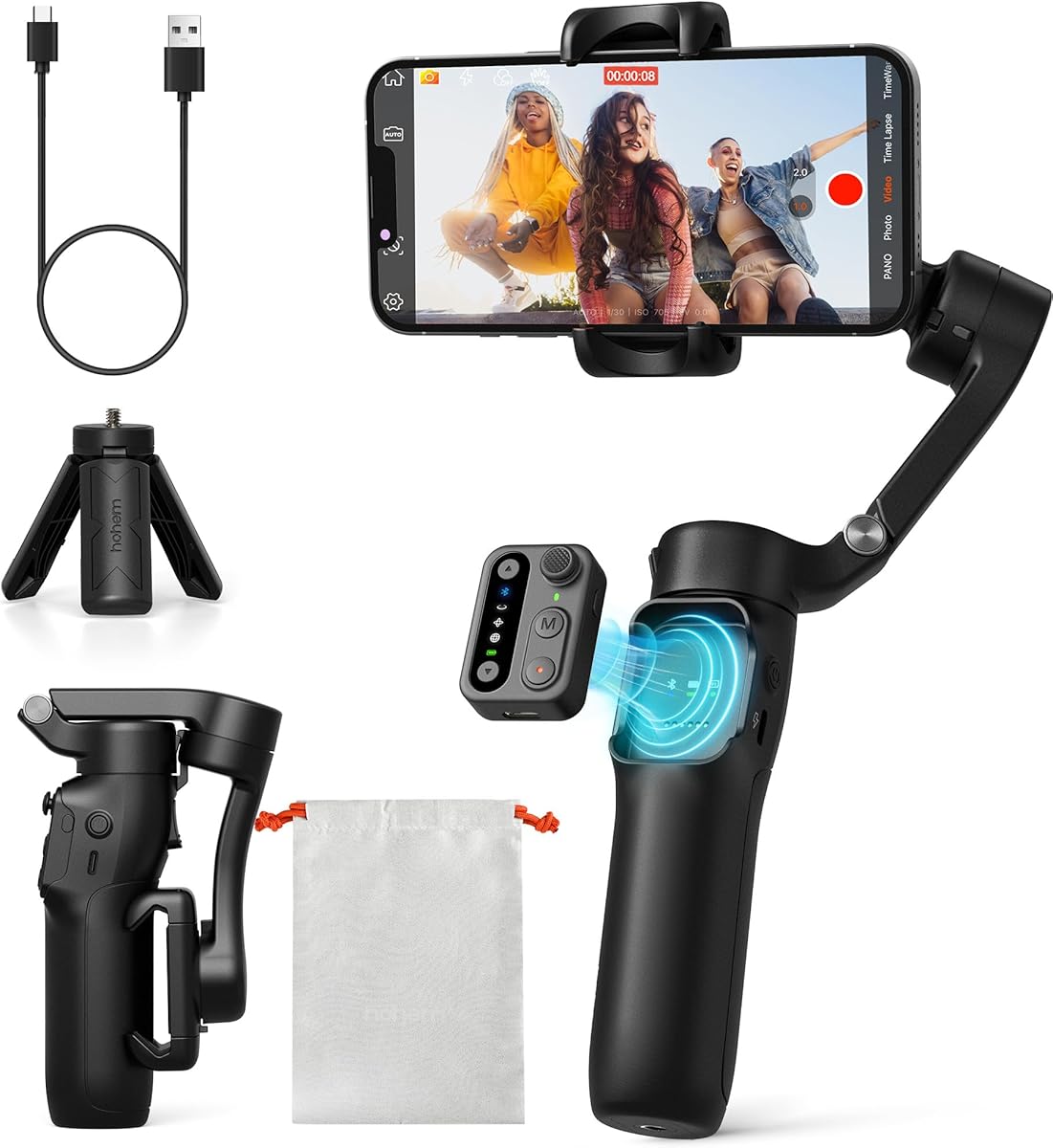
The hohem iSteady MT3 Pro is the most feature-rich model in this comparison, combining mirrorless, compact, action-camera, and smartphone support with a 2.5-kilogram payload. Its 4.5 rating reflects a premium package designed for filmmakers who want extensive control without assembling separate tracking and remote-control equipment.
We may earn a commission when you buy through this link, at no additional cost to you.
A built-in 2-megapixel AI camera can track humans, pets, and vehicles, beginning in one second through touch, button, or gesture control. This system is useful when filming dynamic mountain activities or capturing subjects at a distance. The iSteady 10.0 algorithm and stated 40% motor-torque increase support stable movement at higher payloads and with longer focal-length lenses.
The detachable 1.4-inch touchscreen remote provides a live feed with up to 10 meters of wireless range. Creators can frame distant selfies, group shots, or complex camera movements while keeping their hands on the remote. A second-generation fast vertical switch also reduces the need to rebalance when moving between landscape and vertical formats.
Power is another major strength. The 4350mAh battery is listed to deliver up to 20 hours of continuous operation, while a 30-minute fast charge adds five hours. At a listed 1,070 grams, it remains travel-friendly for its payload, although it is heavier than a dedicated phone stabilizer. No formal weather-resistance rating is listed.
The MT3 Pro is the premium recommendation for creators who alternate among camera types or need extensive tracking and remote-control features. It is best suited to organized shoots where payload capacity, battery endurance, and precise framing justify carrying a larger system. For simpler mountain phone videos, a smaller gimbal may be more convenient.
The 2.5-kilogram capacity supports most mirrorless cameras, zoom lenses, and mounted accessories according to the supplied information. A listed weight of 1,070 grams keeps the system manageable while providing more capability than basic phone and action-camera gimbals.
The detachable touchscreen gives operators direct monitoring away from the mounted camera. Its stated 10-meter range supports distant framing and more deliberate camera movements without requiring a separate monitor.
A stated 20-hour operating time provides ample margin for long recording sessions. The fast-charge feature is particularly helpful when only a short break is available between filming blocks.
We may earn a commission when you buy through this link, at no additional cost to you.
The best gimbal for mountaineering balances stabilization with portability, durability, device compatibility, power, and reliable controls. The right priorities depend on your camera, the severity of the terrain, and whether you film alone or with a partner.
Begin with the camera you already own and expect to carry. Phone gimbals such as the DJI Osmo Mobile models and Hohem iSteady X3 SE are compact and convenient, while the Hohem Pro 4 targets action cameras. The FeiyuTech SCORP Mini-3-Pro and Hohem iSteady MT3 Pro support several device categories, and the DJI RS 3 Mini is built for compatible mirrorless cameras and lenses. The DJI Osmo Pocket 3 is different because the camera and stabilizer are permanently integrated. Check the exact model, dimensions, and weight against the manufacturer compatibility list before purchasing.
A phone gimbal can weigh less than a compact camera gimbal, while a full mirrorless setup adds the camera and lens to the total load. Mountain filmmakers should compare the complete carrying burden rather than looking only at the stabilizer's listed weight. Folding designs, built-in tripods, extension rods, and integrated remotes can eliminate separate accessories. For long approaches, the lightest functional setup may be more useful than a more advanced gimbal that adds bulk to every climb.
Three-axis stabilization is a common feature across this field and is valuable when walking on rocks, scrambling, following a climber, or filming in wind. The DJI Osmo models emphasize robust phone stabilization, the Hohem action-camera models use iSteady 5.0, and the premium Hohem MT3 Pro uses iSteady 10.0. Stabilization cannot replace careful footing or safe filming practices, but it can make otherwise usable movement footage substantially smoother.
The Hohem iSteady Pro 4 models list an IPX4 splash-resistance rating, making them the clearest choices for wet or snowy conditions among the supplied products. Splash resistance is not the same as waterproofing and does not justify submerging the gimbal. Other models do not list formal weather ratings, so users should keep them inside a waterproof bag, avoid direct rain, dry condensation carefully, and use a protective cover whenever possible.
Stated runtimes range from ten hours on several DJI phone gimbals to 20 hours on the Hohem iSteady MT3 Pro. The Hohem action-camera and FeiyuTech models are listed at 14 hours, while the X3 SE is listed at 11 hours. Cold weather can reduce battery performance, and recording features, wireless connections, displays, and camera charging also affect consumption. Bring spare batteries where the model supports them and avoid relying on a full stated runtime for a remote expedition.
Tracking helps a solo creator follow a climber, teammate, pet, or vehicle while the camera remains at a distance. The Osmo Mobile 7 offers ActiveTrack 7.0, the Osmo Mobile 8 and 7P provide intelligent tracking options, and the X3 SE supports AI tracking through the Hohem Joy app. The SCORP Mini-3-Pro and MT3 Pro use built-in AI tracking cameras, reducing reliance on apps or external sensors. Choose based on how consistently you shoot and how willing you are to configure software before the trip.
Mountaineering footage frequently benefits from remote operation. The X3 SE includes a magnetic remote with a stated range of 32.81 feet, the SCORP Mini-3-Pro has a detachable handle, and the MT3 Pro includes a detachable 1.4-inch live-feed touchscreen. Built-in tripods on the Osmo phone models allow static compositions, while extension rods help with group shots. These features are particularly valuable when nobody else is available to operate the camera.
Several products depend on companion apps, and the supplied information notes that DJI Mimo and DJI Ronin have been removed from Google Play because of compatibility issues. Users are directed to obtain the latest versions from DJI's official website. Confirm app availability, account requirements, device compatibility, and offline operation before traveling. A gimbal with excellent hardware can still present a workflow problem if its software cannot be installed or accessed where the shoot takes place.
Prepare the gimbal before leaving the trailhead by installing the required app, updating firmware, charging the gimbal and camera, and confirming that the mounted device is securely supported. Balance the rig according to the manufacturer's instructions. For folding phone models, expand the arms and tripod in the prescribed sequence, and for camera gimbals, adjust the horizontal and vertical axes until the camera remains stationary without drifting.
On the mountain, start conservatively with slow walking movements before attempting rapid pans, low-angle passes, or spinning transitions. Keep the gimbal balanced throughout the shot and avoid exceeding its payload rating. Use the built-in tripod or another stable surface for static compositions, and use the remote when filming yourself from a distance. Rain, snow, and spray require extra caution even with a splash-resistant model; waterproofing the entire camera-and-gimbal assembly is safer than relying on one sealed component.
After filming, power down the device before disconnecting the phone or camera. Remove condensation, wipe away moisture and dirt, and inspect the mount for grit or damage. Keep the gimbal in its case during transport and avoid leaving it in a hot vehicle or freezing conditions. When battery power drops, recharge according to the manufacturer's guidance rather than relying on a depleted cell to remain stable on the trail.
Yes. A gimbal can reduce the visible shake caused by footfalls, uneven ground, and hand movement while walking. It is particularly useful for follow shots, moving landscapes, and videos recorded while the operator is walking rather than standing still. It cannot correct every bump, so filmmakers should still move carefully and prioritize safe footing over aggressive camera movements.
A phone gimbal is usually lighter and simpler when your phone provides adequate image quality. An action-camera gimbal is often more rugged in concept and easier to position for climbing sequences, especially when using a compatible action camera. Compare device support, weather resistance, control functions, battery life, and the total size of the complete recording setup.
Formal waterproofing is not necessary for every trip, but protection from rain and snow is important. The Hohem iSteady Pro 4 models list IPX4 splash resistance, while the other products in this guide do not list formal weather ratings. Even with splash-resistant models, keep the camera and connections dry and never treat the rating as permission for immersion.
Some multi-device models can, including the FeiyuTech SCORP Mini-3-Pro and Hohem iSteady MT3 Pro. You must still install the appropriate mounting hardware, confirm that the payload is sufficient, and rebalance the gimbal for every camera change. Using a heavy camera near the payload limit can reduce stability or strain the motors.
The listed maximum runtimes range from ten to 20 hours, but actual performance varies with temperature, recording mode, wireless functions, and camera charging. Cold conditions can reduce available power. Treat maximum runtime as a laboratory-style figure and carry backup batteries or a verified charging plan for long routes and remote filming.
Tracking can be very useful when you want to film yourself or follow a partner without another person behind the camera. App-based options such as ActiveTrack 7.0 and Hohem Joy tracking require advance setup, while built-in AI systems offer more field-oriented operation. Test tracking in a safe, open area before relying on it near exposed terrain.
Yes. Any change in camera position, lens, phone orientation, or accessory weight can alter balance. Follow the manufacturer's instructions for the horizontal and vertical axes and check for drifting before recording. A balanced gimbal consumes less motor effort and produces more consistent stabilization.
Use a weatherproof bag or cover whenever possible, even with a splash-resistant model. Keep ports and mounting surfaces dry, avoid sudden temperature changes that can create condensation, and dry the unit before storing it. If it becomes wet, power it down and follow the manufacturer's care instructions rather than repeatedly switching it on.
The DJI Osmo Mobile 8 is the strongest all-around phone option, combining robust stabilization, tracking, a 360-degree pan range, an extension rod, a tripod, and a ten-hour stated runtime. The Hohem iSteady X3 SE stands out as the best budget-oriented choice for creators who prioritize low weight and remote operation, while the FeiyuTech SCORP Mini-3-Pro offers the most advanced built-in tracking and broad device compatibility.
At the premium end, the Hohem iSteady MT3 Pro stands out with a 2.5-kilogram payload, detachable live-feed touchscreen, built-in AI tracking, and a stated 20-hour runtime. Creators using a mirrorless camera should consider the DJI RS 3 Mini, action-camera users can compare the two Hohem iSteady Pro 4 listings, and the DJI Osmo Pocket 3 offers a different route through an integrated camera with a one-inch sensor and mechanical stabilization.
Prioritize the device you will actually carry, the complete weight of the setup, stabilization performance, weather protection, and reliable power rather than selecting on feature count alone. Verify app access, compatibility, payload, and balance before the trip. Prices and product availability can change, so check current listings and manufacturer instructions before making a final purchase.