
WSDCAM 4-in-1 HD CCTV Tester
5.0Editor score
4.3-inch non-touch display
CVI, TVI, AHD, CVBS support
UTP and PTZ testing
A CCTV test monitor is a portable diagnostic tool for installing, servicing, and verifying security camera systems. The best model should make it easy to identify camera signals, configure IP addresses, control PTZ units, measure cables, and supply temporary power when a normal outlet is unavailable.
We compared these ten monitors by examining their stated screen specifications, supported camera formats, network utilities, PoE and DC power capabilities, cable-testing functions, portability, and battery information. The list includes compact analog-only units, touchscreen IP camera testers, professional models with SFP ports, and feature-rich all-in-one troubleshooting devices.
Each pick highlights the environment and technician it suits best, along with any meaningful compromises in the supplied specifications. Product details and availability can change over time, and prices fluctuate, so readers should confirm current specifications and compare the complete listing before purchasing.
5.0Editor score

4.4Editor score

4.5Editor score
As an Amazon Associate we earn from qualifying purchases.
The comparison below places the ten monitors side by side, emphasizing display type, camera compatibility, networking capabilities, power output, and cable diagnostics so technicians can quickly identify the most suitable tool for a given installation.


The WANLUTECH IPC-9800CADH Pro combines a 7-inch touchscreen with support for IP, TVI, CVI, AHD, and CVBS cameras. Its stated capabilities extend to maximum 8K and 32MP IP camera testing, while the 90W PoE output can provide temporary power to compatible high-power devices. With a 4.4 rating, it presents a particularly balanced feature set for technicians who work across modern and legacy surveillance systems.
We may earn a commission when you buy through this link, at no additional cost to you.
Its strongest advantage is coverage. The Auto HD application can recognize TVI, CVI, AHD, and CVBS signals and show resolution and frame rate. IP tools include IPC Test, IP Discovery, Rapid Video, RTSP Play, Quick OVIF, and functions for batch activation and configuration of Hikvision and Dahua cameras. A 90W PoE port, DC12V, DC24V, and DC5V outputs, dual Gigabit Ethernet ports, and a gigabit SFP optical module port make it suitable for commissioning network-based installations as well as coaxial systems.
Cable diagnostics are unusually thorough for this category. The RJ45 TDR test evaluates pair status, length, attenuation, reflectivity, impedance, and skew. A UTP tester identifies connection problems and can pinpoint faults near the connector, mid-run, or at the far end. The tracer searches for BNC, network, telephone, and shielded cables, while the HDMI and VGA connections allow the unit to be used with recorders or other video sources.
This is the strongest all-purpose recommendation for a professional carrying one device across diverse jobs. The main trade-off is its size and the depth of its menus: technicians new to multifunction testers may need time to learn the available applications. Even so, the combination of camera coverage, high-output PoE, SFP support, network utilities, and cable analysis makes it the most complete overall choice in this roundup.
Supporting IP, TVI, CVI, AHD, and CVBS reduces the need to carry separate analog and network test equipment. Auto HD recognition and camera-brand utilities further improve speed during commissioning and troubleshooting.
The combination of dual Gigabit Ethernet, SFP optical testing, IP discovery, link monitoring, DHCP functions, and detailed RJ45 TDR measurements gives installers a useful way to isolate network-related installation problems.
We may earn a commission when you buy through this link, at no additional cost to you.
The Rsrteng IPC-9800ADHS Pro is a high-specification professional monitor with a 7-inch IPS touchscreen running Android 11.0. It supports IP cameras up to 8K and 32MP, as well as TVI, AHD, CVI, SDI, and CVBS coaxial cameras up to the stated 8MP limit. Its 4.5 rating is the highest among the products listed here, and the specification sheet indicates a broad, mature feature set.
We may earn a commission when you buy through this link, at no additional cost to you.
A major attraction is the 90W PoE++ output based on IEEE 802.3af, 802.3at, and 802.3bt protocols. This allows the tester to temporarily power compatible high-power PTZ speed-dome cameras without relying on a separate supply. The Gigabit SFP interface supports optical-fiber network testing when an appropriate module is inserted, making the unit relevant for installations that extend beyond ordinary copper Ethernet.
The Rsrteng device also supports Rapid Video, IP Discovery, IPC Test, RTSP playback, and built-in tools for Hikvision, Dahua, and other camera brands. Its RJ45 TDR measurement range is stated at 180 meters, with pair status, length, attenuation, reflectivity, impedance, and skew measurements. Additional features include power monitoring, a trace route function, link monitor, DHCP server, port flashing, Ping, UTP testing, RS485, audio input and output, HDMI, VGA, WiFi, and an LED lamp.
For professional integrators who regularly handle high-resolution cameras, powered PTZ equipment, and fiber-backed networks, this is a compelling premium tool. The trade-off is its larger physical footprint and more involved power needs compared with compact analog monitors. Its broad connectivity and expandable Android environment, however, make it especially useful for technicians who want one device to perform across network, fiber, and coaxial tasks.
The 90W PoE++ output is the standout feature for technicians working with compatible high-power PTZ equipment. It can reduce dependence on temporary power adapters during bench and installation testing.
The Gigabit SFP interface extends the tester beyond standard copper-network checks. Installers familiar with optical modules can use it when troubleshooting or commissioning fiber-connected surveillance infrastructure.
We may earn a commission when you buy through this link, at no additional cost to you.
The WANLUTECH E88 stands out for its 8-inch touchscreen, making it the largest display among the selected CCTV test monitors. It supports IP cameras up to 4K and 12MP, analog camera testing, 90W PoE power output, and a gigabit SFP optical module port. Its 4.4 rating reflects a well-equipped device aimed at technicians who prefer a large working area.
We may earn a commission when you buy through this link, at no additional cost to you.
The device provides IP Discovery, Quick OVIF, IPC Test, Rapid Video, automatic video viewing, and testing-report creation. It also supports batch activation of Hikvision and Dahua cameras and modification of IP addresses, passwords, channel names, and factory settings. HDMI and VGA inputs broaden its use beyond directly testing camera outputs, while WiFi analysis and hotspot creation help diagnose wireless conditions.
Its cable tools are extensive. RJ45 TDR testing checks pair status, length, attenuation, reflectivity, impedance, and skew. The UTP tester identifies connection faults and their approximate location, while cable-length measurement covers open-circuit BNC, RJ45, and RJ11 runs up to a stated maximum of 3,000 meters. Power management displays voltage and power across PoE, DC12V, DC24V, and DC15V connections.
This monitor is ideal for users who regularly review camera feeds, navigate configuration menus, or work in environments where a larger display improves visibility. Its size is the main limitation, and the Android interface exposes more functions than a quick-start user may need. For a professional who values screen space and extensive diagnostics in a single unit, however, it is a strong alternative to the smaller alternatives.
The 8-inch display provides a generous area for camera menus, network tools, reports, and live feeds. That extra space can be valuable during extended commissioning sessions or when an installer is troubleshooting several parameters at once.
In addition to 90W PoE, the unit lists DC12V, DC24V, and DC5V outputs. Multiple output levels make it more adaptable than a tester limited to a single auxiliary voltage.
We may earn a commission when you buy through this link, at no additional cost to you.
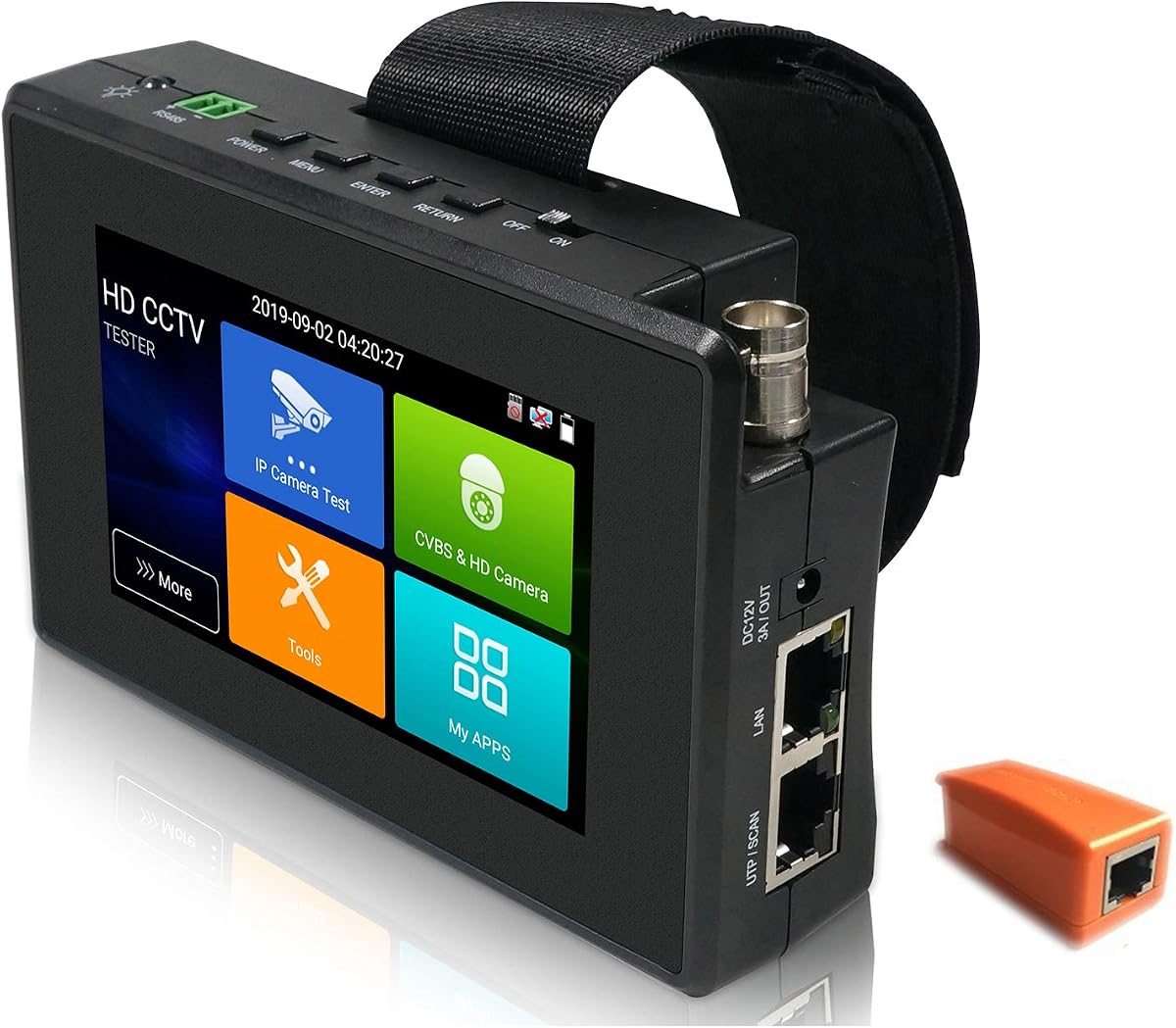
The WANLUTECH IPC-1800ADH Plus packages IP and coaxial camera testing into a 4-inch touchscreen format. It supports CVBS, TVI, CVI, and AHD cameras up to 8MP, along with IP discovery, Quick ONVIF, IPC Test, RTSP playback, and a client APK. Its 4.4 rating and broad PTZ compatibility make it a practical choice for technicians who need more capability than an analog-only monitor without carrying a large professional model.
We may earn a commission when you buy through this link, at no additional cost to you.
The standout technical feature is its support for more than 30 PTZ protocols across a 600–115200-baud range. It also supports UTC control, calls to the camera OSD menu, and batch activation of Hikvision and Dahua cameras. IP addresses, passwords, and channel names can be modified, and the tester can create reports after automatic video viewing.
Network and cable functions make it useful beyond basic signal checks. Ping, IP scanning, port flashing, and DHCP server functions are included, while RJ45 TDR testing evaluates pair status, length, attenuation, reflectivity, impedance, and skew. The UTP tester reports cable connection status and can save results. Its maximum PoE output is 30W, with an additional DC12V 3A output.
Buyers should choose this model for mobility and broad camera compatibility rather than maximum power. The 4-inch screen is compact, and 30W may not suit every high-power PTZ camera. For routine installation work involving standard PoE or non-PoE cameras, however, it offers a useful balance of size, touch controls, PTZ functionality, and diagnostic capability.
The four-inch touchscreen is easier to carry than larger professional units, yet the device still handles major IP and coax formats, PTZ protocols, and camera-brand configuration workflows.
Ping, IP scanning, DHCP functions, RJ45 TDR measurements, and temporary camera power address common problems encountered during installation without requiring a full-size diagnostic station.
We may earn a commission when you buy through this link, at no additional cost to you.
The Triplett 8150 CamView IP Pro 5 is designed as a compact, lightweight security camera tester with HDMI, BNC, and RJ45 connections. It handles IP and analog cameras as well as TVI, CVI, and AHD systems, including 4K H.264 and H.265 streams. Its 4.1 rating is the lowest in the roundup, but the core functions remain well aligned with field installation and maintenance.
We may earn a commission when you buy through this link, at no additional cost to you.
Automatic recognition of high-definition coax camera type and resolution reduces the need to configure the signal manually. For network devices, the tester can connect to WiFi cameras, create a WiFi hotspot, and perform an Ookla speed test. Its 24W PoE output and 12V 3A DC output cover common temporary-power needs, although they do not extend to the 90W output of the premium models.
Cable diagnostics include an RJ45 TDR test and cable quality test. The UTP function can identify opens, shorts, and miswires, helping technicians determine whether a network connection problem lies in the cable. HDMI output adds flexibility for displaying the test interface or working with compatible equipment.
This is a balanced choice for technicians who want a portable device covering both modern IP and legacy coax installations. The lower rating and limited PoE output are considerations when comparing it with larger models, but its light construction, broad format support, WiFi tools, and straightforward diagnostics make it a sensible general-purpose field tester.
The CamView IP Pro 5 combines network-camera and analog-coax testing in a compact enclosure. Automatic coax recognition helps technicians move quickly between different camera technologies on a mixed installation.
TDR measurements and UTP checks for opens, shorts, and miswires provide actionable information when a camera appears offline or a network link is unstable.
We may earn a commission when you buy through this link, at no additional cost to you.
The Anpviz 5-Inch 4-in-1 Tester focuses on coaxial surveillance testing rather than IP networks. Its 5-inch TFT-LCD displays TVI signals up to 8MP and includes PTZ control, UTP cable testing, audio surveillance testing, power output, and HDMI and VGA inputs. The 4.3 rating indicates generally favorable reception, while its compact form and stated battery life make it appealing for mobile technicians.
We may earn a commission when you buy through this link, at no additional cost to you.
A built-in 18650 battery is rated at 2600mA, with the listing stating that three to four hours of charging provides up to 11 hours of working time. That is one of the stronger stated endurance figures in this selection. The device is designed for quick field use and can also serve as a display while debugging DVR or NVR recorders through its digital inputs.
Its limitation is clear: IP cameras are not supported. It also uses a non-touch 800×480 screen, so it is best suited to direct signal viewing, PTZ operation, and physical cable checks rather than extended menu-based IP configuration. Users must remove the battery-protecting film before use.
Choose the Anpviz model when your work centers on analog, CVBS, and TVI installations and you value endurance over touchscreen convenience. It is less appropriate for modern PoE camera commissioning, but for a technician maintaining legacy coaxial systems, the focused tool set can be more practical than carrying a larger all-purpose unit.
The stated battery runtime of up to 11 hours gives the unit an advantage for long service days where charging opportunities may be limited. Its compact body also makes it easier to carry from one camera location to another.
TVI compatibility, a built-in PTZ controller, UTP testing, and audio surveillance checks cover several common jobs for technicians servicing older coax-based surveillance systems without unnecessary IP complexity.
We may earn a commission when you buy through this link, at no additional cost to you.
The EVERSECU 7-Inch Touchscreen Tester combines camera testing with a wider collection of electrical and network tools. It supports up to 8K IP cameras, 8MP high-definition coax systems, and CVBS analog cameras on a 7-inch 1280×800 IPS touchscreen. Its 4.4 rating reflects a well-rounded specification, and the stated 5400mAh battery offers up to 10 hours of working time.
We may earn a commission when you buy through this link, at no additional cost to you.
Unlike many camera-focused competitors, it includes a digital multimeter, optical power meter, and visual fault locator in addition to TDR cable testing. Video recording, playback, snapshots with four-times zoom, PTZ control, and HDMI input and output extend its usefulness. The Ethernet support covers network-state and traffic display, Ping, IP scanning, and port blinking.
Its built-in Android environment allows app installation, although the product information specifically advises installing apps only on cameras for system stability. Compatibility information lists Hikvision, Dahua, and Axis cameras. The tester also supports H.264 and H.265, mainstream 4K video, a WiFi hotspot, and a 10/100M LAN port.
This is the pick for a technician who wants more than camera diagnostics. The optical power meter and visual fault locator are especially relevant to network or fiber work, while the touchscreen and recording features aid documentation. Its main limitation is a 24W PoE ceiling, meaning it may not power high-demand PTZ equipment. For standard cameras and mixed troubleshooting tasks, however, its tool breadth is impressive.
The built-in digital multimeter, optical power meter, visual fault locator, and TDR functions make this more than a simple monitor. It can help investigate the cable and signal infrastructure surrounding a camera.
Video recording, playback, and snapshots allow technicians to capture evidence of a camera feed or a configuration issue. Four-times zoom can help inspect image details during a site review.
We may earn a commission when you buy through this link, at no additional cost to you.
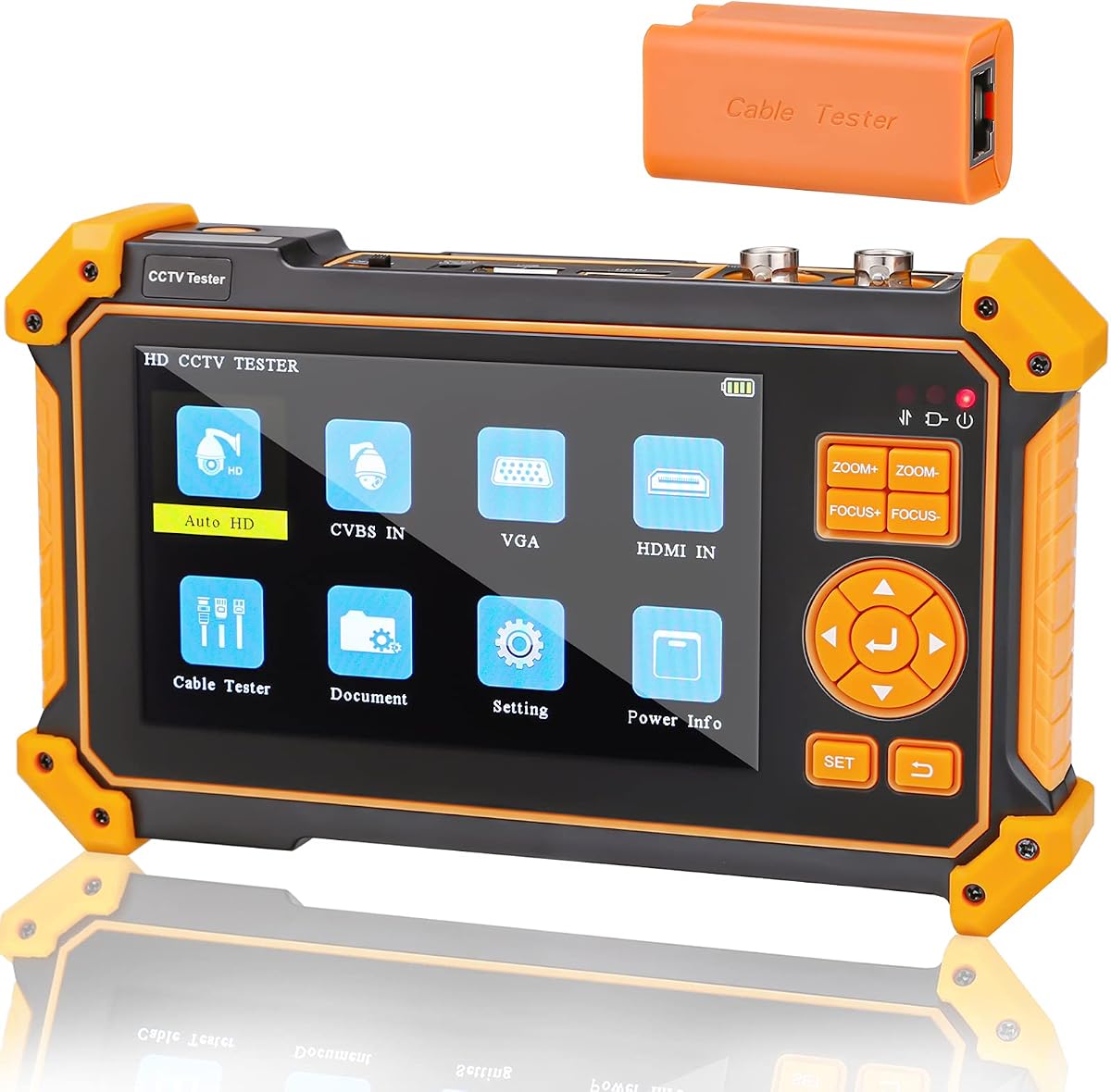
The WSDCAM 4-in-1 HD Tester is a focused and economical choice for coaxial camera work. It supports TVI, CVI, AHD, and CVBS cameras up to 8MP on a 4.3-inch TFT-LCD screen. Its listed rating is 5, the highest among these products, while the feature set centers on the functions technicians need for installing and maintaining conventional surveillance systems.
We may earn a commission when you buy through this link, at no additional cost to you.
The Auto HD application recognizes the coaxial camera type and displays the image, camera type, and frame information. PTZ control uses RS485 at baud rates from 600 to 115200 and supports more than 30 protocols, including PELCO-D/P, Samsung, and Panasonic. The tester can call the camera OSD menu, perform UTC control, and include an audio input for checking pickup devices.
Its updated cable tester includes a dedicated UTP port. It checks network-cable connection status, identifies RJ45 connector fault points, and measures cable length from 0.1 meters to 3 kilometers according to the stated specifications. A bright LED light assists work in dark locations, and a DC12V 1A output can temporarily power a camera.
The trade-off is that IP cameras are not supported, so this should not be chosen for modern PoE commissioning. Its 480×272 screen is also less detailed than the larger displays on professional models. Within its intended coaxial niche, however, it offers a strong rating, automatic signal recognition, broad PTZ compatibility, and practical cable diagnostics in a compact package.
Auto HD identifies the camera standard and presents the relevant frame information automatically. This reduces manual setup when working across mixed TVI, CVI, AHD, and CVBS equipment.
The dedicated cable tester reports connection status, pin or connector fault points, and cable length. These features make the unit more than a basic camera monitor despite its compact screen.
We may earn a commission when you buy through this link, at no additional cost to you.
The WSDCAM 3200-Plus is a 5-inch CCTV monitor with broad coaxial-camera support. It handles 8MP TVI, CVI, AHD, EX-SDI, HD-SDI, and 3G-SDI signals, as well as CVBS analog video with automatic PAL and NTSC adaptation. Its 4.3 rating indicates favorable reception, and the supplied information positions it as a portable maintenance tool with PTZ, cable, audio, and display capabilities.
We may earn a commission when you buy through this link, at no additional cost to you.
The 800×480 TFT-LCD is not touch-enabled, but that limitation is offset by a straightforward physical-button workflow. Auto HD recognizes coaxial camera type and resolution, while the integrated PTZ tester and controller help technicians operate installed cameras. Audio surveillance testing and DC12V power output add further field functions.
The recorder and monitor capabilities are notable. HDMI input supports 4K at 30 frames per second, while VGA input supports 1920×1200 at 60 frames per second. That means the unit can also be used to debug compatible DVR or NVR installations and act as a portable display when a technician needs to inspect a video source.
A 5200mAh rechargeable battery is stated to provide six hours of operating time, and the listing mentions an included strap and tool bag. This model is a good choice for legacy and mixed coax systems needing SDI coverage, but it is not suitable for IP camera testing. Buyers who prioritize compactness and simple controls will appreciate its design.
Support for EX-SDI, HD-SDI, 3G-SDI, TVI, CVI, AHD, and CVBS gives the monitor a wide range of compatibility with coaxial and professional video equipment.
HDMI and VGA inputs let technicians inspect compatible DVR or NVR output. The 4K HDMI input is particularly useful for reviewing high-resolution recorder channels during installation and maintenance.
We may earn a commission when you buy through this link, at no additional cost to you.
The EVERSECU 5-in-1 Tester offers a four-inch touchscreen and broad support for IP, analog, TVI, CVI, and AHD cameras. It handles mainstream 4K H.264 and H.265 streams, along with camera resolutions from 720P through 5MP. Its 4.4 rating reflects a well-rounded product that is approachable for installers moving from simple monitors into more capable testing equipment.
We may earn a commission when you buy through this link, at no additional cost to you.
Network management is a major strength. IP discovery scans the network segment and adjusts the tester's IP to match detected cameras. Ping, Ethernet bandwidth testing, DHCP server, and trace route functions help identify connectivity and configuration issues. ONVIF PTZ and analog PTZ control are supported, allowing the unit to handle camera positioning as well as signal verification.
Temporary power options include 25.5W PoE at 48V and DC12V 3A output. Cable diagnostics cover RJ45 pair status, length, attenuation, reflectivity, impedance, and skew, while the UTP tester checks connection status. An optional cable tracer can locate cables in crowded bundles, which is useful when tracing an unidentified network run.
This model is well suited to smaller-scale installers and field technicians who want touchscreen operation without carrying a large professional monitor. Its 800×480 display is modest, and 25.5W PoE will not cover every high-power camera. The 180-degree rotation, customizable interface, and broad camera support improve daily usability, making it a convincing entry-level all-in-one option.
Automatic network-segment discovery and matching the tester's IP address to detected cameras reduce the configuration steps required to bring an IP camera onto the network.
The 180-degree screen rotation improves visibility when LAN cables connect at the bottom. That practical design detail can reduce awkward positioning during routine field work.
We may earn a commission when you buy through this link, at no additional cost to you.
The right CCTV test monitor depends on the camera technologies, power requirements, cable types, and diagnostic workflow encountered on the job. Reviewing these factors before buying prevents a unit that looks capable from falling short where it matters.
Begin by matching the monitor to every format used in your work. Some products handle modern IP cameras and common analog or coax standards, while others focus exclusively on TVI, CVI, AHD, CVBS, or SDI. IP compatibility should include the discovery, ONVIF or Quick OVIF utilities, RTSP playback, and batch configuration functions relevant to the brands you install. Coax testers should identify the required standards and confirm whether they support SDI, loop testing, color bars, OSD menu access, and UTC control.
Choose a monitor that covers the actual camera mix rather than paying for unused capabilities. If the job involves only legacy coax systems, an IP model may add unnecessary complexity, while a network installer should avoid a device that explicitly excludes IP cameras.
Screen size affects menu navigation, image inspection, and overall comfort. Compact 4-inch and 4.3-inch screens are easier to carry, whereas 7-inch and 8-inch touchscreens offer more room for live views, reports, network tools, and camera configuration. Consider whether the display is touch-enabled. Touch controls can speed up IP setup, but physical controls and a non-touch display may feel more direct for coax testing and field work.
In general, choose a 5-inch model for portability, a 7-inch touchscreen for frequent configuration, or an 8-inch model when maximum visible workspace is the priority. Also note the stated resolution, since screen size alone does not guarantee a sharp interface.
Temporary camera power is one of the most useful features on a field monitor. PoE output can energize a compatible IP camera without a nearby outlet, while DC outputs can support temporary operation of devices with other power requirements. The range in this roundup runs from 24W and 25.5W to 30W and as high as 90W PoE or PoE++.
Match the output to the camera rather than simply choosing the highest figure. Standard fixed IP cameras may work with lower-output units, whereas high-power PTZ speed domes may require a 90W-capable tester. Confirm the supported PoE standard, connector arrangement, voltage, and auxiliary DC output before purchasing.
IP camera troubleshooting frequently involves network discovery, subnet matching, Ping, DHCP, port flashing, and link monitoring. A monitor with these tools can locate cameras, verify address configuration, and help distinguish a camera issue from a network problem. Models with dual Gigabit Ethernet ports are better suited to network-aware workflows, while WiFi analysis and hotspot functions are valuable for wireless camera setup.
If installations include optical fiber, look for an SFP module interface. This provides greater flexibility than a copper-only tester, although a compatible module may be required. Confirm whether the listed Ethernet and SFP specifications apply to the exact model and functions you intend to use.
RJ45 TDR testing can reveal pair status, length, attenuation, reflectivity, impedance, and skew. A UTP tester adds visible connection results and may identify the approximate location of a fault. Cable-tracing functions are especially useful when several network, telephone, or coaxial cables run through the same conduit. Coax-oriented products may also support cable-length measurement for open-circuit BNC, RJ45, or RJ11 runs.
Decide whether full electrical measurements are required or whether basic continuity and fault-location results will suffice. Higher-end models tend to provide more parameters, while simpler monitors focus on connection status and length. Consider the maximum distance stated for each cable type as well.
Field technicians carry monitors between camera locations, often through ladders, ceilings, equipment rooms, and outdoor installations. A compact body is useful for one-handed work and limited tool bags, while larger screens and additional ports may make a device less convenient for mobile use. Check the stated device dimensions and weight where available, along with whether a strap or carrying bag is supplied.
Battery capacity and claimed runtime deserve equal attention. Stated figures range from about seven hours on the compact WSDCAM model to ten or eleven hours on models such as the EVERSECU 7-inch and Anpviz 5-inch testers. Charging time, removable-battery design, and battery protection instructions should also be considered for a typical working day.
PTZ support often includes serial control through RS485, compatible baud rates, and multiple protocols such as PELCO-D/P, Samsung, or Panasonic. ONVIF PTZ control is important for compatible network cameras. A tester with OSD menu access can save time by adjusting lens settings, image controls, and camera options without using a separate laptop or monitor.
For technicians who regularly work with recorders, HDMI and VGA inputs can turn the monitor into a portable display for compatible DVR or NVR output. Check supported input resolution and frame rate. These connections are valuable for verifying recorded channels and menu configuration, but they do not automatically imply that the tester can configure every recorder function.
Some Android-based monitors support additional applications, while others provide specific utilities for optical power measurement, digital multimeter work, visual fault location, power monitoring, or live traffic analysis. These specialty tools can reduce the number of separate instruments required, but they also make the interface more complex and may require deliberate charging and app-installation planning.
Read the full feature list rather than judging by screen size or camera resolution alone. A focused analog tester may be ideal for routine coax service, while a professional all-in-one model earns its extra size through networking, power, measurement, and recording capabilities. Favor functions that match your recurring work rather than adding complexity for occasional tasks.
Before using the tester, inspect the case, leads, ports, and charging accessories for visible damage. Read the product instructions and remove any battery-isolating paper or protective film identified by the manufacturer. Charge the unit fully before a job, confirm that the selected power output matches the camera requirement, and connect the correct signal or data lead rather than forcing an incompatible connector.
For a camera check, connect the coax, HDMI, VGA, Ethernet, or optical interface as appropriate. For an IP camera, join the same network segment, use IP Discovery to locate the device, match the tester's address to the camera network, and then open the live view or RTSP stream. When a camera does not appear, check power, link lights, addressing, and the relevant cable before changing camera settings.
After testing, disconnect cameras and auxiliary power leads before storing the unit. Remove dirt from ports with a dry, nonabrasive method, avoid pushing objects into RJ45, BNC, HDMI, SFP, or RS485 openings, and keep liquids away from the display and electronics. Store the monitor in a padded, dry location, use the supplied strap or bag where available, and recharge it periodically according to the battery guidance.
A CCTV test monitor lets technicians verify camera video, identify signals, control PTZ units, configure network addresses, and troubleshoot installation problems on site. Depending on the model, it may also supply temporary PoE or DC power, test network cables, trace wiring, and act as a display for a DVR or NVR. It consolidates several common diagnostic tasks into a portable device.
A touchscreen is usually more convenient for IP camera configuration, network tools, and on-screen menus. A non-touch model can be simpler, less distracting, and effective for direct analog or coax signal checks. The better choice depends on the technician's workflow, familiarity with the interface, and how often network configuration is needed.
No. Several models in this roundup explicitly support only coax and analog standards, including TVI, CVI, AHD, CVBS, or SDI. Products described as IP camera testers include functions such as IP discovery, ONVIF tools, RTSP playback, batch camera activation, and network scanning. Verify the listing carefully to avoid choosing an analog-only unit for a PoE installation.
The correct output depends on the camera and the PoE standard it requires. A unit offering 24W to 30W may suit many ordinary fixed cameras, while a 90W PoE++ tester is more appropriate for certain high-power PTZ speed domes. Confirm the camera's power class, connector type, and voltage before selecting a tester.
RJ45 TDR testing can report cable pair status, length, attenuation, reflectivity, impedance, and skew, depending on the model. These measurements help locate wiring faults and assess whether a network cable is likely to carry a camera feed reliably. UTP testing can also identify opens, shorts, miswires, or a fault near a connector.
Not necessarily. Only some advanced models include a digital multimeter, optical power meter, or visual fault locator. Basic camera monitors are better for video, PTZ, network configuration, and temporary power. Technicians needing comprehensive electrical measurements may still require separate instruments for voltage checks, fiber power, and wire tracing.
Models with HDMI or VGA input can be used with compatible recorders and other video sources. The Anpviz 5-Inch 4-in-1 Tester and WSDCAM 3200-Plus both list HDMI and VGA inputs for this purpose. Check the stated input resolution and frame rate, because display compatibility varies by model.
Charge the battery fully, carry the leads and accessories appropriate to the camera types in use, and verify power-output requirements before leaving. Keep the device in a padded case and avoid moisture or impacts. If the manufacturer specifies a battery-isolating sheet or protective film, remove it only in accordance with the product instructions before operating the tester.
The WANLUTECH IPC-9800CADH Pro is the most balanced overall recommendation because it combines a 7-inch touchscreen with broad IP and coax support, 90W PoE, SFP testing, network tools, and detailed cable diagnostics. The Rsrteng IPC-9800ADHS Pro is the premium alternative for technicians who prioritize 90W PoE++, 8K and 32MP testing, and a professional Android-based platform.
For a lower-cost coaxial workflow, the WSDCAM 4-in-1 HD Tester offers the most focused budget choice, while the Anpviz and WSDCAM 3200-Plus suit users who want extended mobile operation or broad coax and SDI support. The compact EVERSECU and WANLUTECH options are better for mixed IP and legacy installations where portability matters more than maximum physical size.
Before buying, list the camera brands, signal formats, PoE classes, cable types, and network services you actually use. Confirm the current specification and included accessories in the product listing, as details can change. Prices and availability also fluctuate, so compare current offers and choose the monitor whose tools match your daily installation work.