
HANYCONY US to Japan Plug Adapter
4.7Editor score
Four AC outlets and four USB ports
Two USB-C charging connections
Compact 2500-watt rated design
Japan to Usa Plug Adapter guide compares 10 travel adapters for plug fit, charging ports, compactness, safety, and compatibility for trips to Japan and beyond.
A Japan to USA plug adapter lets travelers connect devices designed for one country’s outlets to a different electrical standard without replacing the original charger. The right adapter depends on plug shape, grounding, supported voltage, outlet capacity, and whether you need a simple converter or a multi-port charging hub.
The ten products in this guide cover both directions of travel: several convert US-style plugs for use in Japan, while others accept international plugs for use in the United States. We compared their connector types, AC outlets, USB options, load limits, physical dimensions, certifications, and stated compatibility to identify the most useful choices.
Each review highlights the product’s strongest feature, practical limitations, and ideal traveler. Ratings and product details reflect the supplied listings, while availability and manufacturer specifications can change. Always verify plug type, voltage, and grounding before departure.
4.7Editor score

4.9Editor score
4.6Editor score
The comparison covers simple plug converters, multi-outlet travel adapters, and universal world-to-US models, making it easier to identify the right format for devices, trip length, and charging demands.




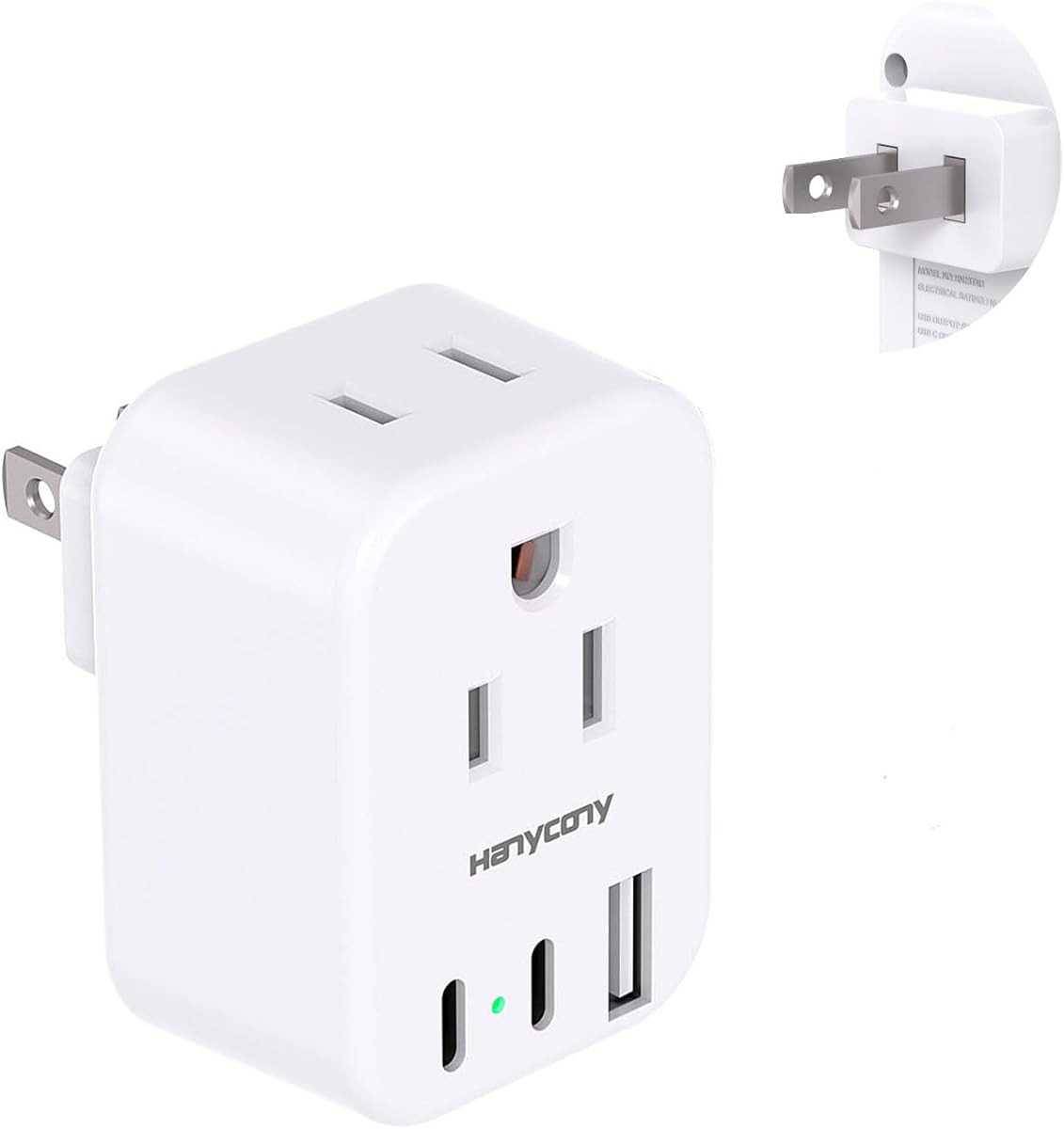
This HANYCONY travel adapter combines a Type A plug with two US-style AC outlets and three USB ports, including two USB-C connections. Its 4.6 rating reflects a generally favorable balance of useful capacity and portability. The adapter is especially convenient for travelers carrying several small electronics who want to avoid packing a full-size power strip.
We may earn a commission when you buy through this link, at no additional cost to you.
The AC section supports loads up to 2500 watts at a maximum of 250 volts and 10 amps. Its USB setup includes USB-A connections rated up to 5V/2.4A, while the USB-C connections can supply up to 5V/3A. The stated combined USB output is 5V/3.1A, or 15.5 watts, with automatic device detection intended to improve charging efficiency.
There are important limitations. This is a plug-format adapter, not a transformer, so it cannot make a 110-volt-only appliance safe on a 100-volt supply. It also has no surge protection, which is a relevant consideration when several high-draw devices are connected. A final detail worth noting is that some destination sockets, particularly in Thailand and Peru, may only accept part of the plug, so regional compatibility should not be assumed.
This is a strong choice for a traveler who needs both AC outlets and USB charging in a compact package. It works especially well for phones, tablets, power banks, and other dual-voltage electronics. Travelers should check every appliance’s voltage label and avoid using high-wattage single-voltage tools with this adapter.
The mixture of two USB-C and one USB-A connection makes it easier to charge newer phones, tablets, and accessories alongside devices that still use USB-A. The shared 15.5-watt output means the adapter is most useful for normal travel charging rather than powering laptops or other demanding devices.
At 2.2 by 1.1 by 1.5 inches and 2.4 ounces, the adapter is designed to fit into a carry-on without taking up much room. A power indicator provides a quick visual confirmation that the outlet is active.
We may earn a commission when you buy through this link, at no additional cost to you.
The TESSAN 2-Pack provides four American-style outlets, one USB-C port, and two USB-A ports, allowing up to seven devices to charge from one wall plug. It carries a 4.6 rating and is aimed at travelers who need a shared charging station rather than a minimal plug converter. The included second adapter also allows one to remain in a carry-on while another stays with luggage.
We may earn a commission when you buy through this link, at no additional cost to you.
Its four-sided body is a practical feature because larger wall-plug charger bricks may fit without blocking neighboring sockets. The AC rating reaches 1875 watts, while the USB-C connection supports up to 3 amps and a maximum output of 20 watts. The USB-A connections support up to 2.4 amps, making the adapter appropriate for phones, earbuds, and other common travel accessories.
The tradeoff is size and the absence of surge protection. Its stated dimensions are 3.15 by 2.24 by 2.25 inches, which remains portable but is not as discreet as a basic Type A plug. The 1875-watt AC limit is also lower than the 2500-watt rating offered by some competing multi-port designs in this roundup.
This adapter is best for groups, families, or business travelers with several devices to recharge at once. The four-outlet layout provides greater flexibility, while the two-pack format is convenient for dividing travel accessories between bags. It is less appropriate for someone seeking a tiny single-purpose plug.
Four AC outlets reduce the need to rotate a single charger among several devices. The seven-connection total is particularly helpful in hotel rooms where travelers need to charge multiple phones, tablets, and headphones before bedtime.
The symmetrical body reduces the chance that a large charger will crowd adjacent wall outlets. It remains a useful feature in crowded hotel, airport, and office power arrangements.
We may earn a commission when you buy through this link, at no additional cost to you.
The Ceptics CT-6 is a small Type A adapter sold as a three-pack, making it a straightforward solution for travelers who need to match a US plug to Japanese or Philippine outlets. Its 4.5 rating reflects a dependable, no-frills approach. Each unit provides one grounded three-prong American outlet and one non-grounded two-prong outlet.
We may earn a commission when you buy through this link, at no additional cost to you.
The adapter accepts both polarized and unpolarized US plugs, which means it can serve two-prong chargers as well as grounded three-prong devices. Its Type A, NEMA 1-15 configuration supports up to 10 amps and 250 volts. At only 1.6 by 1.6 by 1.9 inches and 1.07 ounces, it is one of the smallest options considered.
Its limitations are equally clear: there are no USB ports, and each adapter provides only one grounded outlet. Travelers who depend on wall charging for several devices may need to carry a separate charging hub. Like the other plug adapters here, it does not convert voltage, so the electronics must be compatible with the 100–240-volt range.
This is an excellent choice for a light-travel kit consisting only of the original chargers for a phone, camera, or tablet. The three-pack allows distribution among separate bags or travel companions. It is less suitable for a modern traveler who expects the adapter itself to provide USB charging.
The combination of a grounded outlet and a two-prong outlet increases compatibility with different US charger designs. Polarized plugs fit without forcing users to modify the original charger.
At 1.07 ounces per adapter, the CT-6 is easy to distribute across a carry-on, personal bag, and checked luggage. Its simple construction also avoids unnecessary cords and bulky outlet blocks.
We may earn a commission when you buy through this link, at no additional cost to you.
The BESTEK adapter is a compact grounded Type A solution designed for US, Japanese, Chinese, and other compatible outlets. It has a 4.3 rating and is sold as a three-pack, offering a simple way to equip several travel bags. The plug accepts standard flat-pin North American connectors rather than relying on a crowded universal socket.
We may earn a commission when you buy through this link, at no additional cost to you.
Its dimensions are just 1.37 by 1.37 by 0.98 inches, making it well suited to minimalist packing. The maximum load is 10 amps at 250 volts, and the stated country list includes Japan, China, the Philippines, Mexico, Canada, Thailand, Vietnam, and other locations using Type A-style outlets. That makes it a versatile choice for multiple destinations beyond Japan.
The main limitation is that it is purely a plug adapter. It does not offer a pass-through AC outlet or any USB ports, so users cannot charge several accessories from a single wall socket. The product information also emphasizes use with dual-voltage electronics rather than providing voltage conversion.
BESTEK is most useful for travelers who carry a few standard wall chargers and want a small grounded adapter for each bag. It suits a simple, organized travel kit better than users who require a built-in charging station. Checking the outlet type and appliance voltage remains essential.
The three-pack can cover a personal bag, suitcase, and travel companion without requiring a separate purchase for each. Each compact adapter is ready to connect a compatible US charger to a Type A outlet.
Unlike an ungrounded two-prong converter, the grounded design is appropriate for suitable three-prong North American plugs. This is useful for devices and chargers that require grounding.
We may earn a commission when you buy through this link, at no additional cost to you.
This two-pack combines a US-to-Japan plug format with two AC outlets and four USB connections, including two USB-C ports. The 4.7 rating makes it one of the stronger all-around options in the group. It is designed for travelers who want to charge several accessories from a single Type A wall outlet.
We may earn a commission when you buy through this link, at no additional cost to you.
The AC outlets support a maximum load of 1875 watts at 125 volts and 15 amps. The four USB ports share a total output of 5V/3.1A, with USB-C connections reaching up to 3 amps and USB-A connections up to 2.4 amps. Smart detection is intended to deliver suitable charging speeds for recognized devices.
The USB-C ports should not be treated as full Quick Charge 3.0 outputs, since devices requiring 9 to 22 volts are not supported. There is also no surge protection. The two adapters measure 3 by 2.4 by 1.6 inches, so they are bulkier than simple plug converters, although the cordless design remains practical for travel.
This is a good choice for a traveler carrying several phones, tablets, earbuds, and power banks. The two-piece set makes it easy to place one adapter in each bag. Travelers who need specialized fast-charging protocols or surge suppression should consider a different model.
Two AC outlets and four USB connections allow as many as seven devices to draw power at once. That makes the adapter useful in hotel rooms where travelers otherwise have only one wall socket available.
The stated flame-resistant material and blue power indicator are practical quality-of-life details. The housing is designed for repeated travel use without adding cords or detachable components.
We may earn a commission when you buy through this link, at no additional cost to you.
The HANYCONY 8-in-1 adapter is one of the most connection-rich options here, combining four US-style AC outlets with four USB ports. Its 4.7 rating and two-pack configuration make it a strong premium choice for families, shared accommodations, or anyone traveling with a substantial collection of electronics.
We may earn a commission when you buy through this link, at no additional cost to you.
The AC section handles up to 2500 watts at 250 volts and 10 amps. USB-A ports support up to 5V/2.4A, while the two USB-C ports support up to 5V/3A. Combined USB output is stated at 5V/3.1A, or 15.5 watts, with smart charging technology intended to detect connected devices. Four AC outlets create a convenient centralized charging point.
The adapter is not a voltage converter, and high-wattage appliances such as hair dryers or straighteners should be used only if their labels confirm broad voltage support. It also lacks surge protection. Another limitation is the shared USB power budget: the total output is not the sum of each port’s maximum, so charging many devices simultaneously may reduce available output.
This model is ideal for travelers who value connection count more than minimal size. At 2.75 by 2.2 by 1.5 inches and 2.4 ounces, it remains reasonably compact, while the two-pack allows convenient placement in separate bags. It is a particularly useful choice for a group sharing one hotel outlet.
The four AC outlets and four USB ports cover a wide range of travel devices. This makes the unit more versatile than a basic converter while remaining far smaller than a conventional full-length power strip.
Two adapters allow one to remain in a personal bag and the other in checked luggage. The matching design also provides a backup if one unit is occupied or left at an accommodation.
We may earn a commission when you buy through this link, at no additional cost to you.
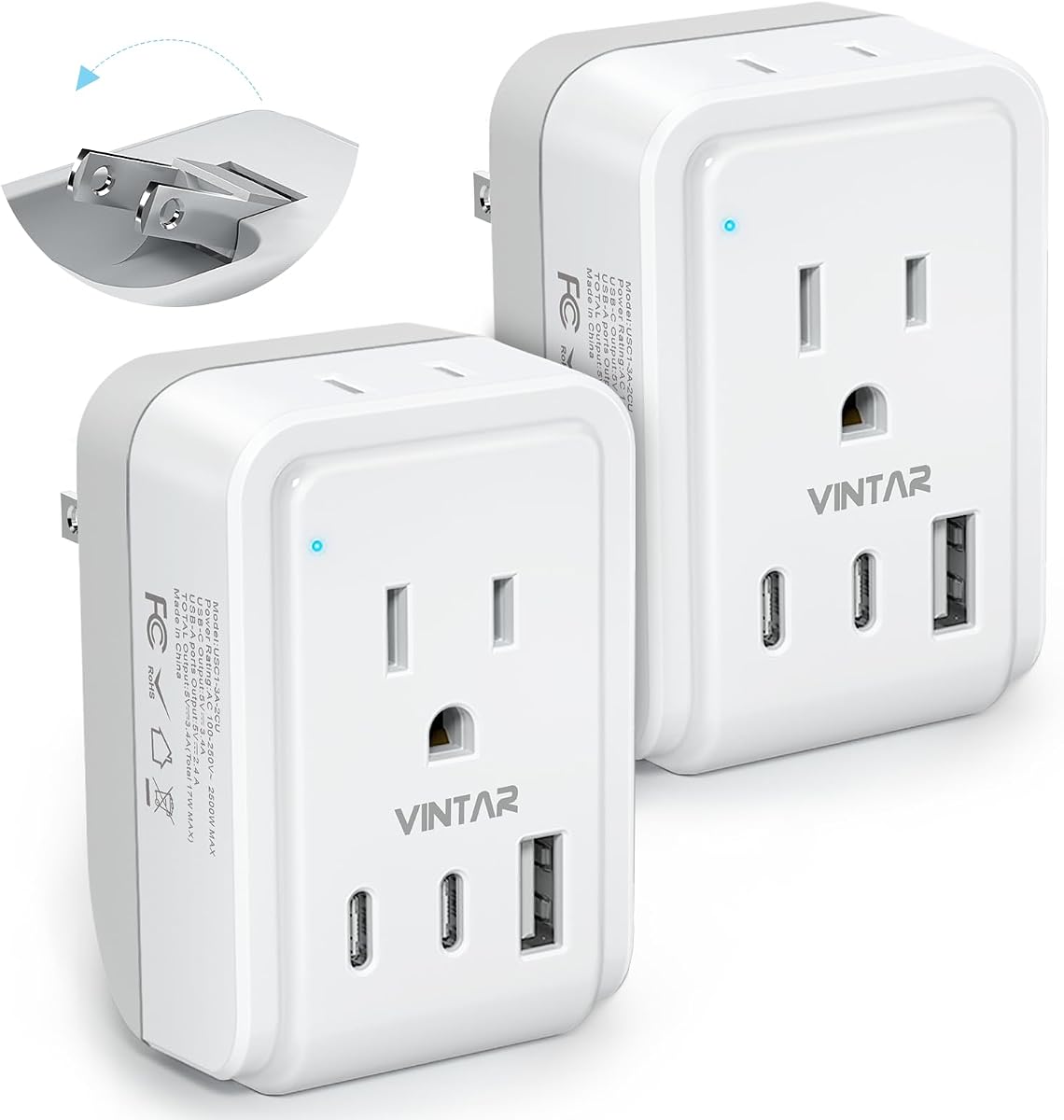
The VINTAR two-pack distinguishes itself with foldable Type A plugs that rotate 90 degrees, reducing the chance of damage and helping the adapter sit more neatly against a wall. It has a 4.7 rating, two AC outlets, and three USB connections, making it a balanced option for travelers who want both charging flexibility and compact construction.
We may earn a commission when you buy through this link, at no additional cost to you.
The USB setup includes two USB-C ports and one USB-A port. USB-C output can reach 17 watts, while the ports are described as faster than standard travel-adapter alternatives. The adapter also works as a two-prong-to-three-prong arrangement in American outlets and supports a broad list of Type A destinations, including Japan, the Philippines, China, Thailand, and Peru.
The USB-C ports do not support Quick Charge 3.0 or devices that need 9 to 22 volts. It is also not a voltage converter, so appliances marked for only one voltage should not be connected. The 2.9 by 1.9 by 1.7-inch body is larger than the simplest adapters even though the foldable prongs improve packing convenience.
VINTAR is a good match for travelers who want the adapter to protect its prongs during transit. It is also suitable for anyone who wants USB-C charging without carrying a separate wall charger. The two-pack provides a useful backup and allows distribution across multiple bags.
The 90-degree fold helps prevent the exposed plug pins from catching on clothing or being bent inside a crowded bag. It can also keep the adapter close to the wall when only a narrow space is available.
Two USB-C connections support the charging needs of modern phones, earbuds, and compatible accessories. The stated 17-watt USB-C output is useful for everyday travel charging.
We may earn a commission when you buy through this link, at no additional cost to you.
The Cable Matters Universal Travel Adapter is specifically designed for travelers bringing devices into the United States from many parts of the world. Its 4.9 rating is the highest among the ten products and reflects broad compatibility, a 10-amp rating, and support for common dual-voltage electronics.
We may earn a commission when you buy through this link, at no additional cost to you.
Its international input accepts Type A, C, G, I, N, L, and J plugs. That covers common connectors used in Japan, Mexico, Canada, the United Kingdom, Singapore, Australia, Brazil, Switzerland, Italy, and other destinations. The output is a standard US Type B plug rated from 100 to 250 volts, up to 10 amps and 2500 watts.
The adapter does not support Type D, E, or F plugs associated with certain countries, including India, France, and Germany, so its broad compatibility still has exceptions. It is not a voltage converter and must not be used with 220-volt-only appliances such as hair dryers. The included storage bag helps protect the adapter while it is packed.
This is the strongest choice for a traveler moving from Japan or another international destination to the United States, especially when luggage contains chargers with different plug formats. Its universal input reduces the need to carry several separate country adapters, while the 2500-watt capacity handles many common travel electronics.
The range of accepted input plug types is broader than that of the basic Type A and Type B converters in this guide. It is particularly useful for frequent travelers whose equipment was charged in several countries.
Phones, tablets, laptops, power banks, and cameras are explicitly included among the supported dual-voltage devices. Users should still inspect each device’s voltage and current markings before connecting it.
We may earn a commission when you buy through this link, at no additional cost to you.
The Cellet CNFPIN2 two-pack adapts numerous international connector styles to a flat US-pin output. It is a useful option for travelers moving from Japan, Canada, Mexico, China, the United Kingdom, Europe, Korea, and Australia into an American outlet. Its 4.4 rating and broad device compatibility make it a flexible travel accessory.
We may earn a commission when you buy through this link, at no additional cost to you.
The universal input accepts polarized and grounded three-prong US plugs as well as European, UK, Australian, and Indian connector standards, except for the large South African plug. A grounded three-prong UK-style output is also described in the product information. Internal metal interfaces are intended to improve conductivity, and the set includes two adapters for separate travel bags.
This product does not convert voltage, so it cannot make a single-voltage appliance suitable for a different country’s supply. The universal input is also more mechanically complex than a dedicated Type A or Type B adapter, which can make it less convenient for the common direction of this guide. Users must confirm that the output configuration matches their destination.
Cellet is a practical choice for an international traveler carrying chargers acquired in multiple countries. Its universal socket and flat US output are especially useful when returning to the United States. The two-pack is convenient for keeping one adapter in a carry-on and another in a suitcase.
The universal socket accepts a broad range of common plugs, reducing the need to identify and pack a separate adapter for every country visited. The large South African plug remains outside the stated compatibility range.
The matching pair can be split between different bags. This is useful for travelers who move between hotel rooms, airports, offices, and other locations where charging access may be limited.
We may earn a commission when you buy through this link, at no additional cost to you.
The UGREEN adapter is a safety-focused solution for using supported international plugs with US Type B outlets. Its 4.6 rating reflects a well-specified design with TÜV certification, a UL94 V-0 flame-retardant housing, and multiple electrical protections. It accepts Type A, B, C, G, and I plugs.
We may earn a commission when you buy through this link, at no additional cost to you.
Protections listed for the product include over-voltage, over-current, over-temperature, overload, and short-circuit prevention. A built-in child safety shutter adds another layer of physical protection. The adapter measures 2.58 by 2.44 by 2.56 inches and weighs 3.65 ounces, giving it a compact but not ultra-thin profile.
It is not a voltage converter, and high-draw appliances such as hair dryers, straighteners, and curling irons should only be connected if they explicitly support dual voltage. There are no USB ports, so the adapter does not replace a charging hub. Its principal advantage is electrical protection rather than multi-device convenience.
UGREEN is a strong choice for a safety-conscious traveler who wants one adapter for several international plug formats. It is particularly appropriate for phones, laptops, shavers, and other compatible daily electronics. Those needing USB ports should carry a separate charging hub.
Over-voltage, over-current, over-temperature, overload, and short-circuit protections provide a comprehensive safeguard list. These features are especially reassuring for users who travel with expensive, portable electronics.
The TÜV certification and UL94 V-0 flame-retardant shell provide a clearer safety-focused proposition than many basic travel plugs. The child safety shutter also helps protect unused receptacles.
We may earn a commission when you buy through this link, at no additional cost to you.
The right travel adapter depends on the direction of travel, the shape of your device plug, grounding requirements, voltage support, and the number of devices you expect to charge. These factors help prevent an otherwise simple purchase from becoming an unusable travel accessory.
The phrase Japan to USA can describe either a traveler heading from Japan to the United States or a person searching for a Japan-compatible adapter for US equipment. A world-to-US model should provide a US Type B output and accept Type A connectors from Japan. A US-to-Japan model works in the opposite direction, presenting a Type A plug for Japanese outlets while exposing familiar US-style sockets.
Always visualize the entire connection: wall outlet, adapter plug, adapter sockets, device charger, and finally the device. The adapter sits in the middle and must satisfy both ends of the chain.
Japan and the United States mainly use flat-pin Type A and Type B connector styles, but the broader destination can involve Type C, G, I, or other shapes. A dedicated Type A adapter is usually more compact and predictable than a universal model. A universal adapter is more useful for frequent international travelers who encounter several connector types.
Check whether the adapter supports grounded three-prong plugs, polarized two-prong plugs, or both. This is especially important for laptops, cameras, and other chargers that use three-prong connectors.
Nearly every product in this guide is a plug adapter rather than a voltage converter. It changes the physical connection but does not transform the electrical supply. Most modern phone, tablet, camera, and laptop chargers support a broad input range, but single-voltage hair dryers, straighteners, shavers, and some other appliances may not.
Read the small voltage label on the charger and look for a range such as 100–240 volts. If the device only accepts one voltage, use an appropriate transformer in addition to the plug adapter.
Simple adapters usually provide one or two AC outlets and no USB connections. Multi-port models can provide four AC outlets alongside USB-A and USB-C charging. The right choice depends on the number of people traveling and whether chargers are already built into the devices.
More ports do not necessarily mean faster charging. Check the aggregate USB output, the maximum output of each USB-C port, and whether any ports support specialized fast-charging protocols.
AC capacity is expressed in watts, amps, and volts. Higher maximum ratings give travelers more room to connect demanding equipment, provided the equipment’s own voltage requirements are met. The options in this guide range from 1875 watts to 2500 watts for their stated AC outputs.
A multi-outlet adapter should not be treated as a guarantee that every connected appliance can run simultaneously. Check each device’s power draw, avoid overloading the adapter, and remember that a 10-amp rating still requires appropriate circuit conditions.
Travel adapters are judged partly by how much room they consume. Ultra-compact plug converters weigh around one ounce, while multi-outlet models can be wider and heavier. Folding prongs reduce tangling, accidental bending, and contact with other items in a bag.
A practical approach is to choose the smallest design that supports your required connections. A small but overengineered adapter is unnecessary for two chargers, while a bulky single-outlet plug may be inadequate for a group.
Certification, flame-retardant housing, temperature protection, and child safety shutters can distinguish a well-designed adapter from a bare plug. Some models in this roundup explicitly include surge protection, while others state that they do not. The absence of surge protection does not make a product unusable, but it should inform the decision for expensive electronics.
Look for clear manufacturer specifications and recognized certification marks. Avoid using visibly damaged adapters, and discontinue use if a unit becomes unusually hot, discolored, or loose.
Compatibility lists often group many countries together even when their outlets differ. A Type A plug may fit fully in one location but only partially in another, as noted for Thailand and Peru with one product. Universal adapters also have exclusions, including Type D, E, and F connectors for the Cable Matters model.
Consult a current outlet guide for each destination and inspect photos of the actual socket when uncertain. Regional compatibility should be verified before relying on an adapter in a critical location.
Begin by confirming that the adapter’s output matches the wall outlet in your destination and that the device charger fits the adapter’s receptacle. Check the voltage and current markings on the charger before insertion. For a US-to-Japan adapter, the Type A plug goes into the Japanese wall outlet and the original US charger connects to the exposed US-style socket.
Connect the adapter to the wall before attaching devices, then switch on any indicator to confirm power where applicable. Avoid exceeding the adapter’s stated wattage or amperage, and do not connect multiple high-wattage appliances unless the capacity and voltage are appropriate. A plug adapter does not make a single-voltage appliance safe to use in another country.
Store the adapter in its supplied pouch or in a protected section of luggage. Retract folding prongs before packing, and do not leave the adapter hanging from an outlet by a heavy charger. Inspect the body and pins periodically, unplug it before cleaning, and keep it dry. Replace the adapter if the housing cracks, contacts loosen, discoloration appears, or it becomes unusually hot during normal use.
Most Japanese plugs use the flat-pin Type A format, so a world-to-US adapter with an international input that accepts Type A is usually appropriate. Look for a US Type B output, confirm the adapter’s current and voltage ratings, and make sure your device charger supports the local supply. A dedicated Type A-to-Type B adapter may be simpler and smaller than a universal model.
No. A plug adapter only changes the physical connector so a charger can fit an outlet. It does not change the voltage supplied to the device. Most listed products support 100–250V or 100–240V, but you must verify that the actual charger and appliance have compatible input ratings.
Only if the appliance explicitly supports the voltage available in Japan. Many hair dryers, straighteners, and curling irons are designed for one voltage region even when their plug can be physically adapted. A separate voltage transformer may be necessary, and some high-wattage appliances should not be used with certain travel adapters.
Grounding support is useful when your charger has a three-prong plug or when the manufacturer specifies a grounded connection. A grounded Type A adapter can accommodate suitable three-prong North American plugs, while a two-prong model may be limited to compatible unpolarized or polarized plugs. Match the adapter to the connector on your actual charger.
USB-A is the older, wider rectangular charging connection, while USB-C is smaller and used by many current phones, tablets, earbuds, and accessories. A model with both can serve a wider collection of devices. Check the stated maximum wattage, because a port that physically fits does not guarantee fast or full-speed charging.
They can be suitable when the laptop charger is within the adapter’s stated electrical limits and supports the destination voltage. Do not assume the full AC wattage rating can be divided among every connected device. A simple adapter may be better for one laptop, while a multi-port model is more useful for several lower-power accessories.
Only if the product is explicitly reversible or has a universal input. Many Type A adapters are designed to fit a Japanese outlet while providing US sockets, which is the opposite direction from a traveler leaving Japan. Universal world-to-US models are more likely to work in both directions, but the voltage requirements of the device still apply.
Pack the adapter, the original device chargers, and a suitable charging cable for each device. A compact multi-port adapter can reduce the number of wall chargers needed, but it does not replace the cables. It is also wise to carry a backup adapter and confirm the outlet type at every destination.
The Cable Matters Universal Travel Adapter stands out for broad international input support and a 2500-watt AC rating, making it an excellent choice for travelers bringing equipment into the United States. The HANYCONY 8-in-1 and VINTAR foldable models are strong alternatives for people who want a high connection count, USB-C charging, and organized packing.
Prioritize direction first: use a world-to-US design when traveling from Japan to America, and choose a Type A output for US equipment used in Japan. Then match grounding, voltage, outlet count, USB standards, and portability to the trip. Carrying only one simple converter may be enough for a couple of phone chargers, while a group or a heavy device load benefits from a multi-port model.
Before departure, inspect the adapter and every device charger, confirm local outlet types, and check current product listings for the latest specifications and availability. Keeping these details in mind produces a safer, simpler travel setup and avoids discovering an electrical mismatch after arrival.