
22MP Film & Slide Scanner
4.3Editor score
Five-inch LCD preview
22MP interpolated output
No computer required
A 35mm slide scanner can preserve fragile family photographs that still exist only as mounted transparencies, negatives, prints, and small-format film. The right device should combine broad media support, accurate color, useful editing controls, and a straightforward workflow that does not require advanced photography or computer skills.
We compared ten scanners based on their stated resolutions, supported film formats, display sizes, storage options, editing features, and connectivity. The list covers premium touchscreen models, practical scanners with large screens, standalone units for beginners, and more compact options for digitizing a modest collection.
Each review explains what stands out, where compromises appear, and which type of user may prefer that model. Ratings reflect the supplied product data, while output quality can vary with the age, exposure, fading, and physical condition of the original film. Prices and availability change over time.
4.3Editor score

5.0Editor score
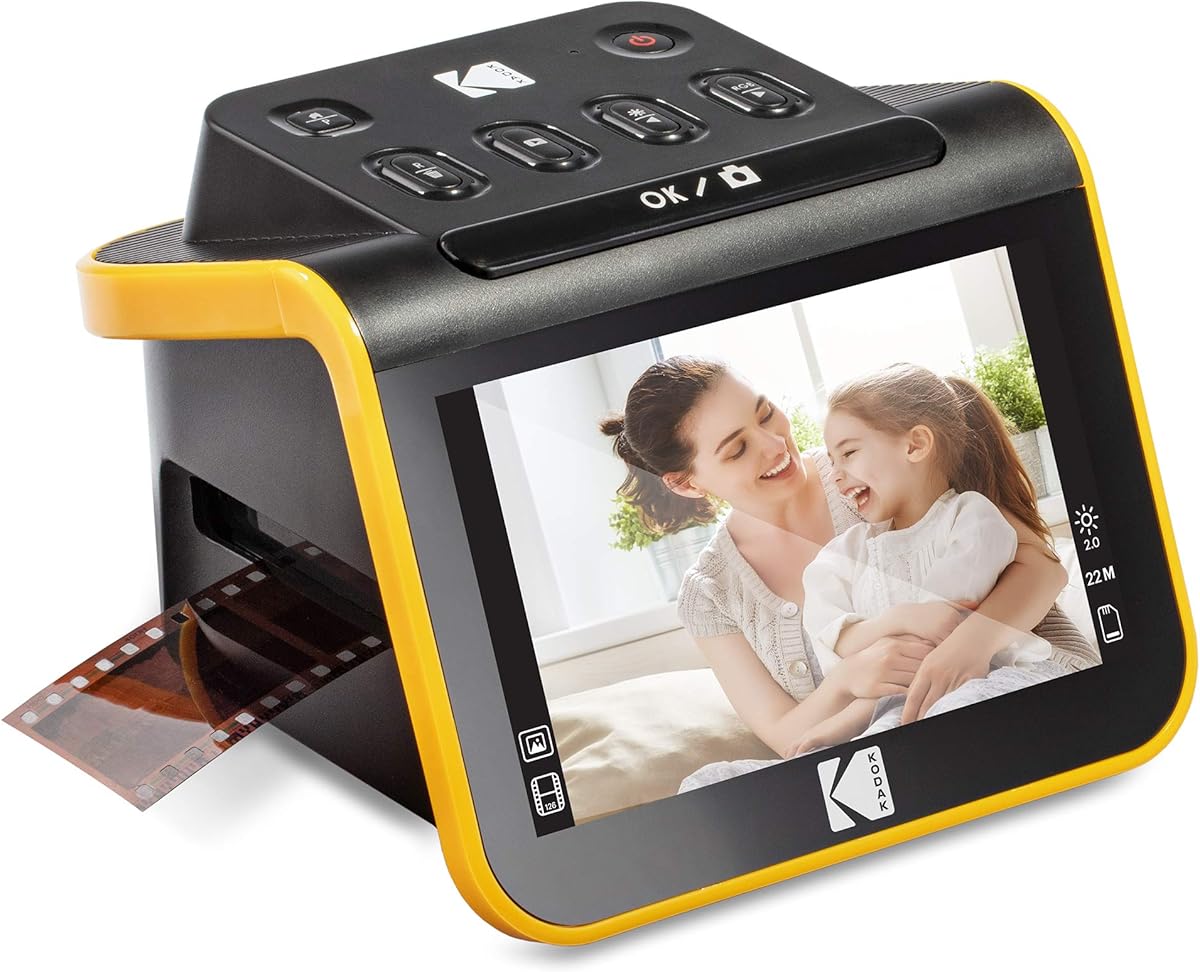
4.3Editor score
As an Amazon Associate we earn from qualifying purchases.
This side-by-side comparison highlights display size, output resolution, supported media, and practical connectivity across all ten scanners, helping you identify the model that best matches your collection and workflow.


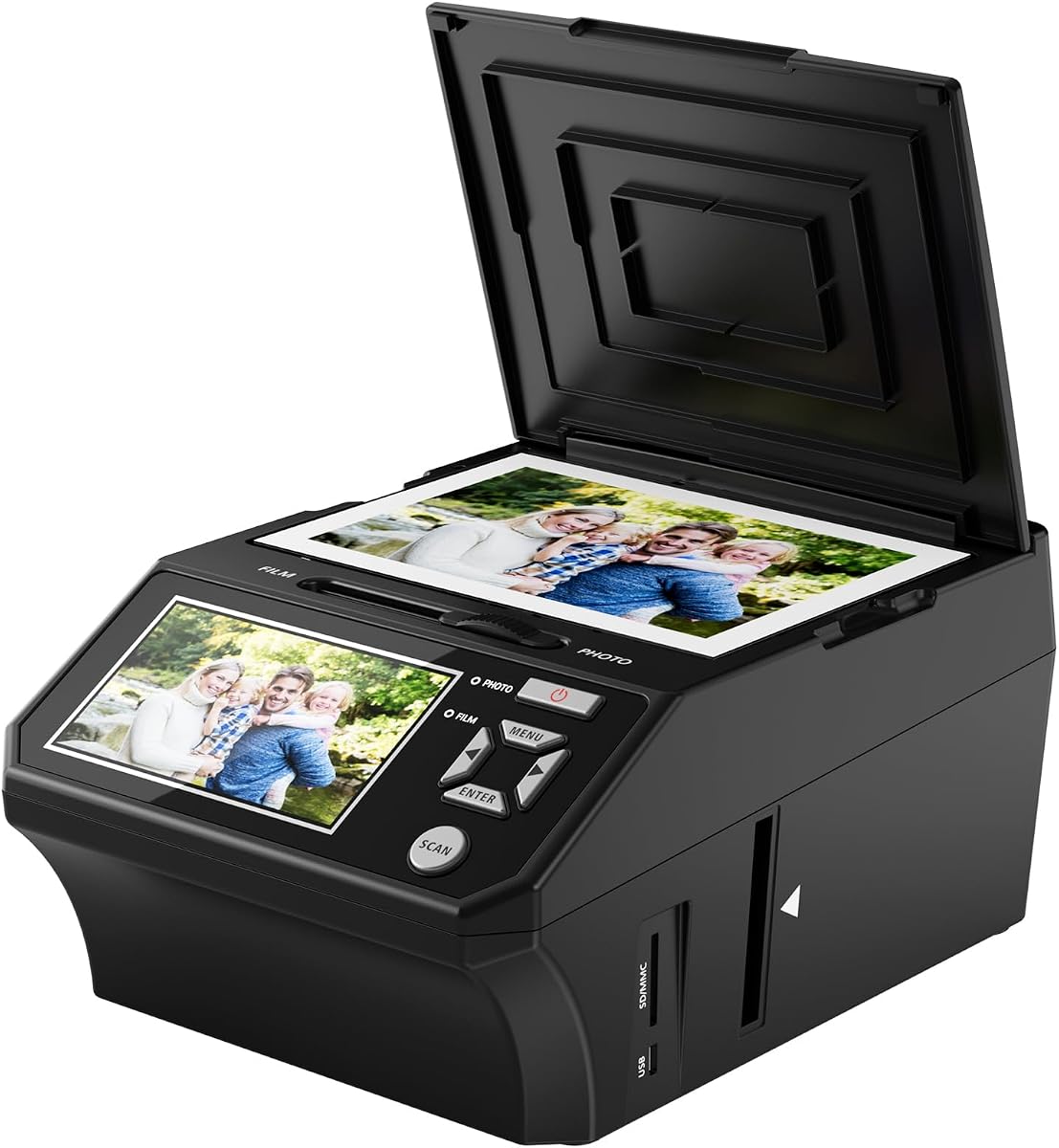

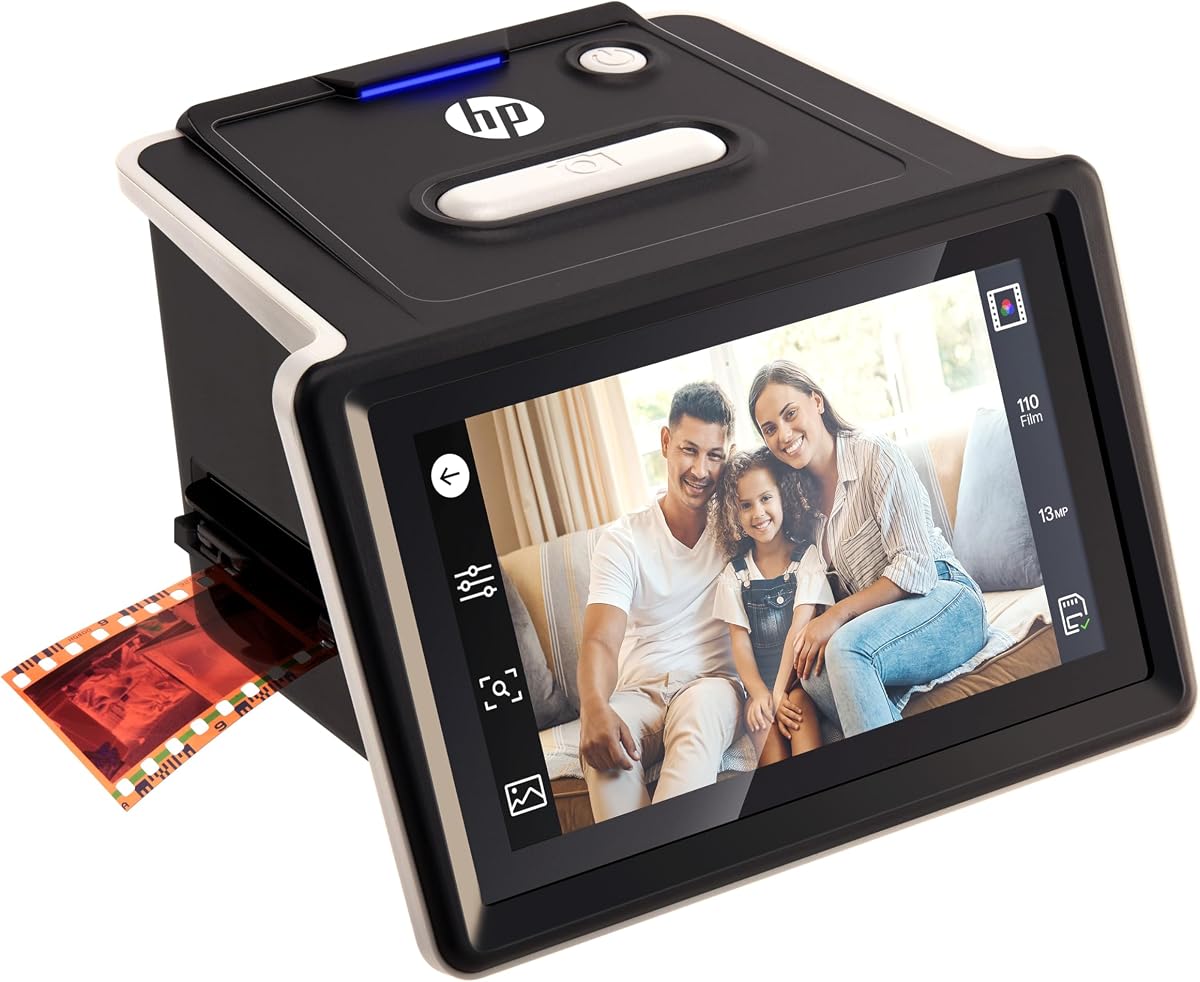


The KODAK Slide N Scan combines a polished tabletop design with a five-inch display and 22MP output, earning a 4.3 rating in the supplied data. Its central appeal is the balance between visual appeal and straightforward operation. Rather than presenting a dense technical interface, it emphasizes previewing, editing, and saving old photographs with minimal setup.
We may earn a commission when you buy through this link, at no additional cost to you.
Media compatibility is one of its strongest features. It handles 135, 110, and 126mm negatives along with 50mm slides, giving collectors with mixed conventional film collections a useful range of support. The supplied quick-loading inserts, cleaning brush, USB cable, and HDMI cable make it relatively complete for a home archiving setup, although a compatible memory card must be added separately.
Its single-touch scan control, film-type selection, color and brightness adjustments, and date assignment reduce the learning curve. The wide-angle LCD can also function as a digital frame, which is helpful for reviewing images before an archive is transferred. The principal trade-off is that SD or SDHC storage is limited to 32GB, so larger collections require frequent transfers and careful organization.
This scanner is a strong choice for someone who values appearance, simple controls, and broad support for familiar film formats. It is particularly appropriate when the main goal is preserving family negatives and slides into attractive digital files. Those wanting a larger touchscreen or higher stated storage capacity should compare the HP FilmScan 7 and ClearScan T7 before deciding.
The five-inch screen, gallery mode, and one-touch editing workflow make the scanner approachable for relatives who may not be comfortable with desktop image software. Previewing a scan before saving also makes it easier to correct orientation, brightness, and color in a single session.
Support for 135, 110, 126, and 50mm media makes this more versatile than many basic film scanners. The included holders are designed to stabilize different formats and reduce the risk of scratching or feeding fragile material incorrectly.
We may earn a commission when you buy through this link, at no additional cost to you.
The Magnasonic FS71 stands out for combining 24MP output, a five-inch display, and support for several common film and slide formats. Its 4.3 rating reflects a versatile package for users who want to digitize more than a single type of original. The scanner is particularly relevant to families holding 35mm, 126, 110, or Super 8 material.
We may earn a commission when you buy through this link, at no additional cost to you.
The device can produce JPEG files without requiring a computer, while direct controls handle brightness, RGB color correction, flipping, and mirroring. SD card support up to 128GB gives it more practical capacity for substantial collections than several smaller-capacity alternatives. The fast-loading trays and claimed scan time of less than five seconds per image also support an efficient batch workflow.
An HDMI connection allows images to be shown on a television or monitor, although the cable is not supplied. That omission is minor when the scanner is primarily used for archiving, but it adds a small setup requirement for users planning regular slideshows. Buyers also need to provide their own SD card, as none is included.
The FS71 is best suited to households with mixed media and a desire for larger files. It offers an effective balance of image resolution, storage capacity, and format support. People who prioritize touch navigation may favor a touchscreen model, while those focused only on standard 35mm slides can find a less expensive option elsewhere in this list.
The mixture of still-film formats, Super 8, and common slide sizes gives the FS71 value for collectors with mixed boxes. It is a practical choice when a single dedicated slide-only model would leave other material unaddressed.
Built-in brightness and RGB controls let users correct common scan issues before files are transferred. This reduces reliance on complicated software and keeps the primary workflow on the device itself.
We may earn a commission when you buy through this link, at no additional cost to you.
The KODAK Slide N Scan Max offers a smooth-moving tray and one-touch workflow in a 4.2-rated package. Its 13MP CMOS sensor is listed with 22MP interpolation, producing files up to 4208 by 3120 pixels. That distinction is useful for buyers who understand that interpolated resolution differs from the sensor's native capture resolution.
We may earn a commission when you buy through this link, at no additional cost to you.
The scanner supports 135, 110, and 126mm formats, including color and black-and-white negatives, and can save directly to SD or SDHC cards without a computer. The streamlined tray is intended to reduce repeated repositioning while moving through a collection, while single-touch software handles resizing, conversion, and image adjustments.
Its main limitation is the 32GB card ceiling, which is modest for anyone digitizing hundreds of negatives. The supplied information also does not highlight an HDMI output, although its direct-saving and computer-independent operation remain convenient. Buyers who want a larger display or TV connection may find other options more flexible.
This model is a good match for a focused home archiving project involving standard small-format film. It emphasizes smooth handling and uncomplicated operation rather than premium extras. Ensure you have enough storage capacity available and plan to transfer and back up files regularly.
The moving tray is designed to keep film feeding steadily without constant repositioning. That makes the scanner appealing for families working through organized boxes of 135, 110, or 126mm negatives.
A 13MP sensor is listed alongside 22MP interpolation. Buyers seeking the largest file dimensions may notice this distinction, while those focused on practical archival copies may find the output more than sufficient.
We may earn a commission when you buy through this link, at no additional cost to you.
This Photo, Slide & Negative Scanner has a 4.4 rating and distinguishes itself by supporting slides, negatives, printed photographs, business cards, and other physical media. Its five-inch high-definition LCD provides a generous preview area, while the standalone design removes the need to install software, apps, or drivers.
We may earn a commission when you buy through this link, at no additional cost to you.
Beyond 35mm slides and 135 and 110 film negatives, the included photo trays can handle 3R, 4R, and 5R prints. This makes the device a broader home digitization tool rather than a dedicated slide converter. Scanning is described as fast, and files save directly to the included 8GB SD card before being transferred to a PC or Mac through USB.
The supplied 8GB card, film and slide holders, photo trays, cleaning brush, power adapter, and USB cable make the package particularly complete. A three-year warranty also adds reassurance. The main ambiguity is that no specific pixel resolution is stated, so buyers prioritizing numerical output specifications may need to compare it with models that publish sensor and interpolation details.
Choose this scanner when your archive includes printed photos as well as slides and negatives. It is a user-friendly option for families, especially anyone who appreciates a complete bundle and a longer warranty. For large collections, plan additional storage because the included card has a limited capacity.
The ability to scan common print sizes and business cards makes this useful for mixed archives. Instead of relegating physical photographs to a separate device, one workflow can cover several important family keepsakes.
The included SD card, cables, holders, trays, power adapter, and cleaning brush reduce setup friction. The three-year warranty adds an additional layer of support for a device intended for long-term preservation work.
We may earn a commission when you buy through this link, at no additional cost to you.
The 22MP Film & Slide Scanner offers a 4.3 rating and a feature set that is unusually generous for a value-focused model. A five-inch wide-angle LCD, 22MP output, built-in memory, and support for several film formats give it more capability than a minimal film converter. It can also function as a digital picture frame.
We may earn a commission when you buy through this link, at no additional cost to you.
The scanner accepts color and black-and-white 35mm or 135, 110, and 126 negatives, 50mm slides, and Super 8 film. Images can save to 128MB of built-in memory or an external FAT32 or EXFAT card up to 64GB. One-touch scanning and built-in color, brightness, and date/time adjustments keep the process approachable.
Type-C USB transfers files to a computer, and an included HDMI cable supports television or monitor viewing. A cleaning brush, holders for 135, 110, 126, and Super 8, power adapter, and user manual round out the package. The external card is not included, and the 64GB ceiling is lower than some competing models.
This is a strong budget recommendation for a household that wants modern conveniences without moving to a premium touchscreen. It is particularly useful for people who want to preview scans on a large display, adjust them without a computer, and connect them to a television. Users with extensive archives should account for the storage limit.
The five-inch screen is more useful for checking framing, color, and orientation than the small preview displays found on basic scanners. Its gallery function adds a convenient way to revisit completed images.
Built-in controls and memory allow the scanner to function without a computer. USB and HDMI connectivity then make it easy to move files to a larger display or transfer them for backup and sharing.
We may earn a commission when you buy through this link, at no additional cost to you.
The HP FilmScan 7 centers on a large seven-inch color touchscreen, offering more room for previewing, editing, and displaying photographs than most competing devices. Its 4.0 rating is the lowest among the ten products here, but the core feature set is aimed at buyers who want a large, interactive control surface.
We may earn a commission when you buy through this link, at no additional cost to you.
A 13MP color CMOS sensor captures color and black-and-white negatives, while the quick-feed tray and 50mm adapter support 135, 126, and 110 formats. Built-in tools allow users to crop and adjust scans directly on the display without additional software. Gallery mode can continuously present the digitized images as a digital frame.
USB provides a route to computer transfer, while HDMI supports slideshows on a television. The seven-inch interface should make framing and correcting less cramped, though it may also add complexity for users who prefer large physical buttons or a simpler menu structure. The supplied 4.0 rating suggests some buyers may have found aspects less satisfactory than they expected.
This scanner makes sense for a user who prioritizes screen size and direct touchscreen editing over having the highest rated model. It is a good choice for mixed-format collections and for people who want to view and edit images before transferring them. Compare it with the ClearScan T7, which also offers a seven-inch screen but a higher stated rating and SD card inclusion.
A seven-inch display gives users a more detailed view of framing, orientation, and color than smaller screens. It is particularly useful when the quality of an original is uneven and each image may need attention.
On-device crop and adjustment tools keep preliminary editing close to the scanning process. This can make the initial workflow more cohesive and reduce the need for immediate computer intervention.
We may earn a commission when you buy through this link, at no additional cost to you.
The HP FilmScan 5 combines a five-inch all-angle touchscreen with a 13MP CMOS sensor and 22MP interpolation, earning a 4.3 rating. It offers a more interactive interface than a conventional button-driven film scanner while remaining smaller than the HP FilmScan 7's display.
We may earn a commission when you buy through this link, at no additional cost to you.
The quick-load tray accepts 135, 126, and 110 negative strips as well as positive slides. Users can preview and edit images directly on the touchscreen, and gallery mode turns the scanner into a picture frame. Files save to an SD card, allowing organized folders to be created outside the device before archival storage elsewhere.
USB-C power can come from a computer or an external 5V adapter, offering convenient connection options. The supplied information does not highlight HDMI output, so this model may be less suitable for users whose main goal is presenting slideshows on a television without a computer. The exact memory card requirements should also be checked before purchasing.
The HP FilmScan 5 is a balanced choice for users who want touch controls and direct editing without moving to a seven-inch model. It is well suited to mixed collections of slides and standard negatives, particularly when a compact five-inch display is preferred. It may be less compelling than the ClearScan T7 for buyers who prioritize included storage and broader Super 8 support.
The five-inch all-angle display creates a more visual scanning experience than a tiny status screen or fixed set of buttons. It allows users to inspect and correct images directly while processing the originals.
Saving directly to an SD card supports a computer-light workflow, while USB-C can be powered by a PC or external 5V adapter. The result is a versatile setup for home, office, or travel archiving sessions.
We may earn a commission when you buy through this link, at no additional cost to you.
The KODAK SCANZA is a 4.2-rated scanner distinguished by support for 35mm, 126, 110, Super 8, and 8mm negatives. Its 14MP native resolution and 22MP interpolation provide large file dimensions, while the built-in 3.5-inch tiltable TFT LCD offers adjustable brightness and a practical viewing angle.
We may earn a commission when you buy through this link, at no additional cost to you.
Multiple inserts and adapters accommodate different media, and large one-touch buttons simplify scanning and saving. Users can edit RGB and resolution settings, browse a gallery, and work through a straightforward interface. The supplied information specifically notes that formats outside the listed film types are not supported, so buyers should verify their originals before purchasing.
Mac and PC compatibility, USB power, HDMI, an AC adapter, video cable, and a cleaning brush are included. The memory card is not supplied, and SD support extends to 128GB. Compared with five- and seven-inch models, the SCANZA's 3.5-inch display is less spacious, making it better suited to users who value format coverage and physical controls.
Choose the SCANZA for a varied archive that includes motion-picture film formats or several generations of still film. Its accessory selection and familiar button-led interface make it a practical option for straightforward batch digitization. Users prioritizing a large preview screen should choose one of the newer touchscreen models instead.
The unusually broad list of supported formats makes the SCANZA valuable for boxes containing more than standard 35mm negatives. Confirming media compatibility before work begins helps prevent the frustration of discovering an unsupported format later.
Large one-touch buttons and an adjustable tilt display offer an operation style that may appeal to users who find touchscreens less familiar. RGB and resolution adjustments provide useful preliminary control before files are saved.
We may earn a commission when you buy through this link, at no additional cost to you.
The DigitConvert scanner is the most compact option in this group, pairing a 2.4-inch color LCD with one-click JPEG capture. Its 3.9 rating is the lowest in the list, but the device remains a direct and inexpensive entry point for people who want to begin converting standard 35mm film and slides.
We may earn a commission when you buy through this link, at no additional cost to you.
The built-in screen provides immediate preview, brightness adjustment, and color correction without requiring a computer. Fast-load adapters are included for 35mm negatives and slides, and their stated purpose is to keep film stable during batch scanning. Images save to an SD card, with support listed for capacities up to 128GB.
USB and TV-out connections allow files to be transferred or shown on a larger display, and compatibility with both Mac and PC broadens the audience. The tradeoff is the 2.4-inch screen, which offers less room for evaluating focus, framing, and color than every other scanner here. No specific output resolution is stated in the supplied information.
This model makes sense for a small collection, occasional use, or buyers who prioritize a compact, computer-free process. It is less suitable for extensive professional archiving where screen size, exact output specifications, and premium handling features are important. Include a suitable SD card and verify original film types before purchasing.
One-click capture and built-in adjustments provide a short path from physical slide to JPEG file. No software or driver installation is required, making the scanner approachable for occasional family archiving.
Purpose-built adapters are intended to keep standard film stable while it moves through the scanner. This focus on consistent handling is especially relevant to older negatives that may be brittle or prone to shifting.
We may earn a commission when you buy through this link, at no additional cost to you.
The ClearScan T7 carries a 5.0 rating in the supplied data and offers the most modern-looking workflow among these scanners. Its seven-inch touchscreen is designed for previewing, adjusting, scanning, and saving without a succession of physical buttons, while 24MP output provides large JPEG files suitable for archiving and sharing.
We may earn a commission when you buy through this link, at no additional cost to you.
Compatibility extends to 35mm, 135, 126, 110, and Super 8 negatives and slides. No computer is needed for the main process, and the included 16GB SD card allows users to begin immediately. The touch interface is also presented as a simpler option for parents, grandparents, and first-time users who may be uncomfortable with dense physical controls.
A seven-inch canvas makes orientation, framing, and color adjustments easier to judge, and the product is positioned as both a scanner and a straightforward family archiving tool. Scan quality will still depend on the age, exposure, fading, and condition of each original, so the stated 24MP output cannot guarantee equally strong results from every slide or negative. The supplied information does not list HDMI support.
The ClearScan T7 is the most attractive choice for a large, modern display, immediate usability, and included storage. It also offers broad format support and the highest rating among the listed scanners. It is particularly suitable for families beginning a preservation project, although professional archives with extensive media should first confirm every required format and connection.
The seven-inch touchscreen consolidates preview, adjustment, capture, and saving into a visual workflow. Its larger controls can reduce uncertainty for first-time users and relatives helping with a family archive.
The included 16GB SD card removes the need to source storage before the first session. Combined with computer-free operation, this makes the scanner convenient for users who want to preserve memories without building a complicated software setup.
We may earn a commission when you buy through this link, at no additional cost to you.
The best choice depends on the formats in your archive, the size of the collection, your comfort with technology, and how much display space you want for reviewing scans. Resolution, storage, editing controls, and media handling should be evaluated together rather than by a single specification.
Begin by identifying every format you need to scan. Common devices support 35mm or 135mm negatives, 110 and 126 formats, and 50mm slides, while some also handle Super 8 or 8mm motion-picture film. A scanner marketed for slides is not automatically a comprehensive negative converter. Review the supported media list carefully and account for unusual formats, mounted slides, strips, and individual loose transparencies that may require different holders.
Choose a model that explicitly covers your archive rather than assuming a broad film label covers everything. Broad compatibility is valuable for mixed collections, while a dedicated standard-slide scanner may be sufficient for a small, uniform box.
A scanner's native sensor resolution determines the detail it captures, while interpolation estimates additional pixels. High interpolated numbers can produce large files, but they do not create source detail that the sensor did not record. For archival use, consider both the stated native resolution and final output dimensions, along with how the lens and optics preserve fine texture in small 35mm frames.
Prioritize clarity and accurate reproduction over the largest number alone. A well-focused 13MP capture may produce a more satisfying result than aggressive interpolation, particularly for slides with fine details.
The display is your main workspace for checking framing, orientation, brightness, and color. A five-inch screen is more practical than a compact preview, while seven-inch touchscreen models provide room for touch-based editing and clearer inspection of fragile or irregular originals. Button-based systems can feel more familiar and may offer faster repeated actions.
Match the interface to the user. Families sharing a scanner may prefer intuitive touch controls, while an experienced archivist may favor physical buttons, quick access, and adjustable menus.
Check whether the scanner saves to SD cards, built-in memory, a computer, or some combination. Maximum card capacity matters for large collections: models supporting 64GB or 128GB reduce the need for frequent transfers. Remember that a memory card may not be included, and low-capacity cards can slow or interrupt a long session depending on the device.
Look for a workflow that makes backups straightforward. Direct saving is convenient, but a reliable process should still include transferring files to multiple locations and organizing them before the original film is removed from the archive.
Built-in brightness, color, RGB, flip, mirror, crop, resize, and date controls can handle basic corrections without installing software. These tools are particularly helpful for faded negatives whose color and exposure need adjustment. They do not necessarily replace advanced photo editing, but they can make the first pass much more usable.
Favor scanners whose controls are clearly organized and whose one-touch workflow is easy to understand. A model that remains confusing after a few attempts can slow down a large archive significantly.
USB or USB-C transfer is essential for moving images to a computer for backup, organization, and sharing. HDMI or TV-out can be useful for reviewing a collection on a television with family, although some products do not include the cable. Confirm the connector type and whether an external adapter is required.
The best archiving setup still needs a dependable computer backup. Connectivity is a convenience for transfer and viewing, not a substitute for maintaining more than one digital copy.
Old film can scratch, fade, curl, or stick together, so holders, feed trays, and cleaning accessories matter. Look for included film-specific inserts and quick-loading mechanisms that hold the material steady. A cleaning brush can help remove dust from the scanner's light box and reduce specks in digital files.
Handle originals gently, keep them away from moisture and direct heat, and test the scanner's holder on less fragile material first. A faster feed is helpful, but stability and careful placement should take priority.
Some scanners include an SD card, cleaning brush, holders, power adapter, and cables, while others require the buyer to supply storage separately. A complete bundle can be convenient, but included accessories should not replace compatibility and image-quality considerations. A meaningful warranty and accessible support can add confidence for an unfamiliar device.
Check what is actually in the box before ordering. Make sure the necessary adapters, memory card, and connection cables are either included or available for the formats and devices you intend to use.
Prepare the scanner on a clean, level surface away from direct sunlight. Connect the correct power supply, insert a compatible memory card if the model uses one, and install the holder that matches your media. Before loading originals, clean the scanner's light box with the supplied brush and inspect the holder for dust or scratches. A short test with a familiar slide helps confirm orientation, brightness, and color before processing an entire collection.
Handle each original by its edges and work in small batches. Place the film or slide into the appropriate holder, keep your fingers away from the image surface, and feed it only as directed. Preview the image, confirm that the frame is centered, adjust brightness or color when necessary, and use the scan or capture control. Give each file a descriptive name as it is saved so the digital archive remains understandable.
After scanning, copy the files to a computer or external drive and make a second backup before deleting them from the memory card. Keep the original slides and negatives in labeled, archival storage away from heat, humidity, and direct light. Periodically inspect both the physical collection and digital files, and clean the scanner regularly so dust does not repeatedly reduce image quality.
Many models can scan both 35mm or 135mm negatives and standard 50mm slides, often using separate holders. Compatibility varies, so check the supported formats before purchasing. Some devices also support 110, 126, Super 8, and 8mm material, while dedicated slide-only products may omit negative formats entirely.
Not for every model. Most scanners in this guide can preview, adjust, and save images without a computer, using an SD card or built-in memory. A computer or external drive is still strongly recommended for organizing files, creating backups, sharing images, and performing more advanced editing.
No. A higher interpolated resolution can create larger files, but it does not add genuine detail beyond the native sensor capture. Lens quality, focus, film condition, exposure, and color accuracy can affect the result more than the headline resolution. Compare native sensor specifications as well as final output dimensions.
Use a card that matches the scanner's stated capacity, format, and speed requirements, and confirm that memory cards are not already included. Larger capacities can be useful for extensive archives, but the maximum supported size differs among models. A reliable card also reduces the risk of interrupted transfers during a long session.
Built-in brightness and color controls can help correct faded color and exposure, but they cannot restore missing information or physical damage. Adjust each image before saving, then make more detailed corrections in photo-editing software if necessary. Avoid overprocessing, which can exaggerate noise, scratches, and unnatural color.
A 35mm slide is typically a single still transparency mounted in a cardboard or plastic frame. Super 8 is a small motion-picture film format that can contain many frames on a strip. A scanner supporting both must include the appropriate carrier and scanning method for each type, so verify both media support and included holders.
Dust on the original can produce spots that cannot be distinguished from defects in the scan. Use a suitable soft cleaning method and handle the slide by its edges. Also clean the scanner's light box with the included brush, as dust inside the device can affect every image.
Copy every scan to at least two separate storage locations, such as a computer and an external drive, and organize files with descriptive names. Keep the physical originals in labeled archival sleeves or boxes away from heat, moisture, and direct sunlight. Digital backups should be checked occasionally because storage devices and file structures can also fail over time.
The ClearScan T7 is the leading all-around recommendation for its seven-inch touchscreen, 24MP output, broad format support, and included 16GB SD card. The 22MP Film & Slide Scanner offers a compelling value-focused alternative with a five-inch display and extensive connectivity, while the KODAK Slide N Scan stands out for its polished design, gallery features, and support for several negative formats.
Prioritize the media you actually own, the stability of the supplied holders, and a workflow that the person using the scanner will understand. A large display and simple controls can matter more during a long family project than a headline resolution, but a computer backup remains essential. For large archives, check memory limits and plan transfers in manageable batches.
Product availability, promotional offers, and prices change over time, so review the current listing and included accessories before placing an order. Verify the supported formats, storage requirements, and supplied holders against your collection. With that preparation, the right scanner can make the move from fragile physical photographs to a organized digital archive straightforward and rewarding.
