
Callsun N-Type 16BB 400 Watt Solar Panel
4.5Editor score
Up to 25% efficiency
Four 100W modules
Low heat-loss coefficient
Our guide compares the 10 best 400 Watt Solar Panels for Rvs, covering efficiency, durability, portability, compatibility, and installation for RV setups.
A 400 watt solar panel can give an RV a substantial renewable charging upgrade, but the best choice depends on the available roof area, battery voltage, portable power station, and tolerance for a fixed or foldable design. Good panels balance usable output, weather resistance, manageable weight, and straightforward electrical connections.
This guide compares ten 400 watt solar panel options using the information supplied for each product. It covers rigid roof panels, bifacial modules, multi-panel sets, and foldable power-station chargers, with particular attention to efficiency, physical dimensions, mounting needs, connector support, and RV suitability.
Each review identifies the product's most useful qualities and its practical trade-offs, helping you narrow the field before comparing current listings. The top picks represent especially balanced choices for different priorities, while availability and prices can change, so confirm the latest details before purchasing.
4.5Editor score

4.8Editor score
4.5Editor score
This side-by-side comparison covers the 10 featured 400 watt solar panel products, highlighting their form factor, power configuration, efficiency claims, and RV-focused installation considerations.



The DOKIO 400W 31V Monocrystalline Solar Panel is a rigid, roof-oriented option for RV owners who want a high nominal rating in a single panel. Its 4.1 rating reflects its broader appeal, while the standout specifications include support for both 12V and 24V systems, extended MC4 leads, and a mounting design suited to common RV hardware.
We may earn a commission when you buy through this link, at no additional cost to you.
The 400-watt figure is a standard-test-condition rating rather than a promise of continuous real-world output. Sunlight, temperature, shade, cable length, cable gauge, and charge-controller behavior all affect energy transfer. The product information particularly recommends an MPPT controller, which can help optimize charging when used with compatible battery and system voltages.
A major practical advantage is the pair of built-in 3-meter, or 9.84-foot, MC4 leads. That reach can reduce the need for extension cables and extra connectors, which is valuable on an RV roof where every additional junction represents another potential point of failure. The tempered glass, aluminum frame, and sealed junction box also make the construction appropriate for exposed outdoor installations.
This panel is best for travelers with a usable roof area who prefer one high-power rigid module over several smaller units. It may be less attractive for users seeking a foldable charger, a battery-ready kit, or a panel designed to capture reflected light from both sides. Confirm charge-controller compatibility and system voltage before ordering.
Long factory-attached MC4 leads can shorten the wiring path from the roof to the controller, reducing added connections and the need for separate extension cables.
Support for 12V and 24V installations broadens its usefulness, provided the selected controller and battery configuration are electrically compatible.
We may earn a commission when you buy through this link, at no additional cost to you.
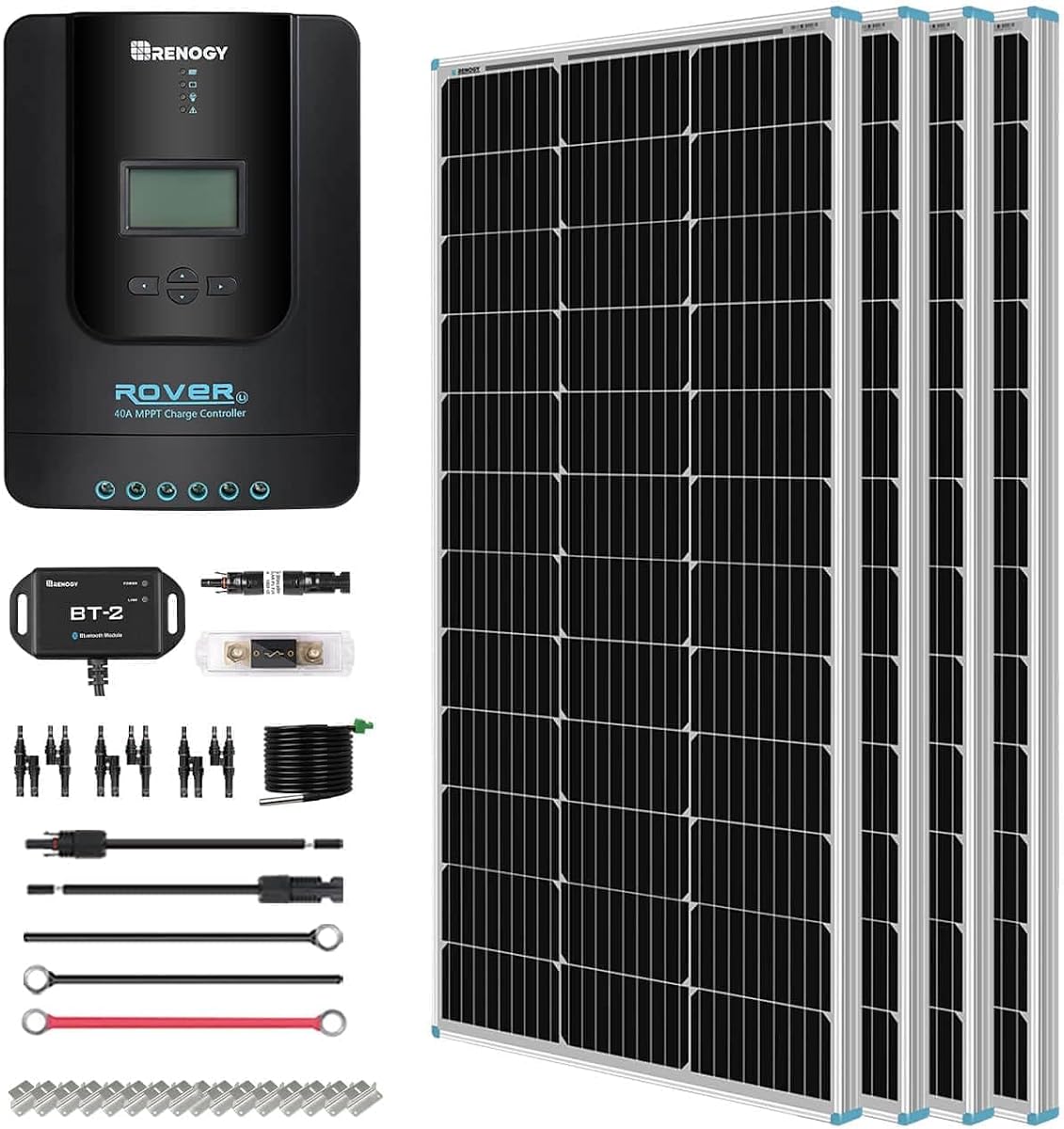
The Renogy 400Watt Premium Solar Kit with 40A MPPT Charge Controller is a complete-oriented choice for RV owners who want the panel and controller as part of one system. Its 4.5 rating is among the stronger results in this guide, and the inclusion of a 40A MPPT controller is the defining feature for buyers who prefer fewer separate purchases.
We may earn a commission when you buy through this link, at no additional cost to you.
An MPPT controller is especially relevant to a larger 400-watt installation because it is designed to optimize the energy transferred from a solar panel to a battery system. The stated maximum battery voltage of 32V adds an important compatibility checkpoint. RV electrical systems are often built around 12V, 24V, or 48V nominal batteries, so the battery bank's actual configuration and controller requirements must be confirmed before installation.
The main appeal is convenience. Rather than comparing a bare panel with a separately sourced controller, this kit gives buyers a more integrated starting point. That can simplify planning and reduce the chance that a required component is overlooked. It does not, however, replace checking the full package for cables, mounting hardware, adapters, and installation accessories.
Choose this kit when you are building a permanent 400-watt RV solar installation and want a recognized controller pairing within the package. It is less suitable for travelers who only need a temporary foldable panel or for anyone whose battery system falls outside the listed 32V maximum. Review the current package contents and electrical requirements before purchase.
The included 40A MPPT controller provides a clear system-building center, helping reduce the need to source and match a separate charge controller.
The listed 32V maximum battery voltage should be checked against your battery bank before installation to avoid an incompatible configuration.
We may earn a commission when you buy through this link, at no additional cost to you.
The JJN 400W Bifacial Solar Panel two-pack combines two 200W modules in a configuration that gives RV owners more placement flexibility than one large rigid panel. It carries a 4.6 rating, and its combination of 23% efficiency, compact dimensions, and bifacial construction makes it particularly interesting for smaller RVs, campervans, and boats.
We may earn a commission when you buy through this link, at no additional cost to you.
Bifacial cells collect light from the front and rear, allowing some of the reflected light beneath the panel to contribute to output. The supplied information estimates rear-side gains of about 5–10% over grass, 15–25% over sand or gravel, and up to 30% over a highly reflective white surface. Those figures are context-dependent, and a dark or textured roof surface will not create the same result.
Each module measures 970 by 576 by 30 millimeters, or approximately 38.19 by 22.68 by 1.18 inches, which helps when the roof space is limited. The package also specifies a black corrosion-resistant aluminum frame, 2400Pa wind resistance, 5400Pa snow-load capability, an IP65 junction box, and IP67 connectors. These features support outdoor use, although installation quality remains essential.
This two-pack is a strong option for owners who want bifacial performance without committing to a single long panel. It is particularly attractive where two mounting areas work better than one. Choose it when your roof and wiring layout can accommodate two modules, and expect the greatest bifacial benefit when the rear side receives meaningful reflected light.
Bifacial performance can improve when the rear surface receives reflected light, so the underlying material and airflow are important parts of the installation.
Separating the 400-watt total into two 200W panels can make it easier to fit an RV roof around vents, racks, air conditioners, or other obstacles.
We may earn a commission when you buy through this link, at no additional cost to you.
The CTOLITY 400W Portable Solar Panel is designed for travelers who want substantial charging capacity without permanently dedicating roof space to a rigid module. Its 4.4 rating, 23% conversion rate, and stated compatibility with Jackery and EcoFlow power stations make it a relevant option for portable RV power setups.
We may earn a commission when you buy through this link, at no additional cost to you.
The folding format is the product's main convenience. Instead of carrying a full-size rigid panel and separate mounting hardware, users can unfold the panel when sunlight is available, deploy its kickstand, and connect it to a compatible power station. The waterproof Oxford cloth and PET lamination are intended to improve resistance to dust and water splashing during camping and travel.
Its intelligent chip is described as protecting against over-current, over-voltage, and short-circuit conditions, while an auto-reboot feature responds as light conditions change. These features add convenience, but they do not eliminate the need to confirm the power station's input rating and connector type. A nominal 400-watt panel may also be limited by the power station's maximum solar-input acceptance.
This panel is well suited to mobile RV users, campers, and emergency-prepared households that rely on portable power stations. It is not the natural choice for someone seeking a permanently mounted roof array with a conventional RV charge controller. Use it as a supplementary charging source and verify electrical compatibility before travel.
The foldable design fits more easily into storage compartments than a rigid 400-watt roof panel and can be deployed only when needed.
Even when the panel is rated at 400 watts, the connected power station may have a lower solar-input limit that determines the practical charging rate.
We may earn a commission when you buy through this link, at no additional cost to you.
The Greenmagic Portable 400 Watt Solar Panel is a foldable 39V charger aimed at RV campers and portable-power users who want broad compatibility. Its 4.6 rating is among the highest in the group, while support for both parallel and series wiring, built-in MC4 cabling, and compatibility with numerous power-station brands strengthen its appeal.
We may earn a commission when you buy through this link, at no additional cost to you.
The product information lists compatibility with power stations from Jackery, Goal-Zero, EcoFlow, Bluetti, Anker, and others. That breadth is useful, though the connected device still needs to support the panel's 39V configuration and accept the available input current. The built-in cable reduces setup time, while four adjustable kickstands let the panel face the sun without a permanent roof mount.
Four hanging loops around the edges also allow the panel to be secured along an RV side or other suitable support. It folds to approximately 32.09 by 31.30 by 1.97 inches and weighs 21.5 pounds, making it portable but still substantial enough to require careful handling. Its laminated surface, waterproof film, and 840D Oxford outer layer add durability, while the IP65 rating applies to the panel rather than the non-waterproof junction box.
This is a good option for campers who regularly move between campsites or want one panel to work across different power stations. It is less appropriate for wet climates or installations requiring a fully weather-sealed junction enclosure. Keep the panel out of direct heavy rain and soakage, and verify the power station's input specifications before use.
Broad power-station compatibility makes this useful for travelers who own more than one portable generator or regularly change equipment.
Four kickstands and four edge loops provide both ground placement and hanging options for adaptable RV setups.
We may earn a commission when you buy through this link, at no additional cost to you.
The E-POWO 400W Portable Solar Panel is a rugged foldable charger with an emphasis on connector choice and outdoor durability. Its 4.3 rating is supported by a stated conversion efficiency of up to 23.5%, ETFE coating, IP67 module protection, and a 7-in-1 cable designed to cover many popular power-station connections.
We may earn a commission when you buy through this link, at no additional cost to you.
Connector versatility is a major selling point. The supplied information lists solar, Anderson, XT60, DC7909, DC5521, DC8020, DC5525, and DC35135 connection options. This can make it easier to use the panel with different portable power stations without searching for a separate adapter. The package includes the panel, a 7-in-1 cable, and a user manual, along with an 18-month warranty.
The panel weighs 15.57 kilograms, or about 34.3 pounds, and folds to 37.76 by 24.96 by 1.3 inches. Its kickstands offer 40-, 50-, and 60-degree positions, while reinforced grommets support RV or tent attachment. These are useful features, but a high weight means lifting it onto a roof or moving it around camp can require care.
Choose this option if you own a power station with one of the listed connectors and want a durable foldable panel with generous angle adjustment. It is less compelling for users wanting an ultralight option or a fixed rooftop array. Remember that clouds, shade, and obstacles can reduce charging efficiency even when the panel has a high rated capacity.
The included multi-connector cable covers a wide range of power-station ports, which can simplify the connection process during travel.
ETFE lamination, an IP67 module rating, and fiberglass construction are intended to protect the cells in demanding outdoor environments.
We may earn a commission when you buy through this link, at no additional cost to you.
The N-Type 25% 400W set is a high-efficiency 12V solar option built around 18BB N-Type cells. Its 4.4 rating and claimed efficiency of up to 25% make it attractive for RV owners seeking strong conversion performance, while the reverse-current blocking design adds a useful nighttime safety feature.
We may earn a commission when you buy through this link, at no additional cost to you.
Its junction box is filled with polyurethane polymer and rated IP68 for dust and water resistance. The aluminum alloy frame is specified to withstand 2400Pa wind pressure and 5400Pa snow loads, supporting use in exposed RV installations. The enhanced MC4 connector uses galvanized copper and PPO engineering plastic, while the 11 AWG oxygen-free copper wire is rated to handle currents up to 25 amps.
One complication is that the supplied product information repeatedly refers to a 200W solar panel even though the title identifies a 400-watt offering. It also does not provide a clear breakdown of the individual panel count or total shipping dimensions. Buyers should verify the package configuration and mounting footprint before ordering, particularly if roof space is limited.
This product makes sense for a 12V installation that values high cell efficiency, robust connectors, and strong environmental ratings. It may be less attractive for a 24V system or for buyers who need exact module dimensions and a clearly stated four-panel layout. Confirming the actual contents with the listing is the most important step before purchase.
The 18BB N-Type construction and claimed 25% efficiency target greater energy conversion in a compact panel footprint.
Reverse-current blocking helps prevent the photovoltaic system from drawing or behaving inappropriately when the panel is not generating useful daytime power.
We may earn a commission when you buy through this link, at no additional cost to you.
The Callsun N-Type 16BB 400W Bifacial Solar Panel is the strongest all-around recommendation in this guide, combining the highest product rating with advanced shade handling and compact Class B van dimensions. Its two 200W modules use N-Type monocrystalline cells and 16BB busbars to achieve up to 25.6% conversion efficiency.
We may earn a commission when you buy through this link, at no additional cost to you.
TwinCell Anti-Shade Technology divides the module into two independently operating halves. If one area is shaded by a tree, building, or another obstruction, the other can continue generating electricity. That makes the product especially well suited to RV roofs, where vents, racks, satellite equipment, and passing shadows may prevent a conventional monolithic panel from operating at its full potential.
The transparent backsheet also captures reflected light from below. The stated maximum rear-side benefit is up to 30% when installed over a reflective surface such as gravel or snow, although the gain will vary with the roof material, mounting height, and available reflected light. Each panel measures 51.3 by 30.3 by 1.4 inches and weighs 23.8 pounds, with pre-drilled holes compatible with standard Z-brackets and universal solar rails.
Weather protection includes 3.2mm fully tempered glass, a corrosion-resistant aluminum frame, an IP68-rated junction box, 2400Pa wind capability, and 5400Pa snow-load resistance. The product also carries a 25-year performance warranty for at least 84.5% output and 10-year materials and workmanship coverage. This is a compelling choice for Class B vans and other RVs that need compact modules with resilient performance.
The two independently generating sections reduce the impact of localized shadows, a valuable advantage when roof equipment interrupts direct sunlight.
The 51.3-inch panel length and 23.8-pound weight are designed with smaller Class B vans in mind, where every roof inch can matter.
We may earn a commission when you buy through this link, at no additional cost to you.
The Callsun N-Type 16BB 400 Watt Solar Panel divides the total output into four 100W modules, making it one of the most flexible rigid-panel arrangements in the guide. Its 4.5 rating, claimed 25% efficiency, and 31.1 by 22.7-inch module dimensions are particularly useful for RV roofs where a single full-size panel would be difficult to position.
We may earn a commission when you buy through this link, at no additional cost to you.
N-Type monocrystalline cells and 16 busbars are designed to improve light absorption, reduce hot spots, and limit micro-cracks. The stated temperature coefficient of -0.3% per degree Celsius also targets stronger performance in hot climates and desert travel, where elevated panel temperature can otherwise reduce output. Each module weighs 11.4 pounds and has pre-drilled holes for quick mounting.
Durability features include 3.2mm low-iron tempered glass, corrosion-resistant aluminum alloy frames, IP68 waterproof protection, reinforced corner guards, and resistance to 2400Pa wind and 5400Pa snow loads. The supplied information also states 10 years of materials and workmanship support and a 25-year guarantee of 84.5% output. Those coverage details make this set appealing to buyers who prioritize long-term support.
The main trade-off is installation complexity. Four separate modules mean more brackets, more wiring, and more panel space than one large rigid panel. This set is best for Class B vans, trucks, boats, or larger RVs with several usable mounting zones. It is a particularly sensible value-oriented choice when placement flexibility and compact module size matter more than a single-panel setup.
Four smaller modules can be distributed around roof racks, vents, and other obstacles, making better use of fragmented mounting space.
The low stated temperature coefficient is intended to reduce output losses as cell temperatures rise in hot, sunny environments.
We may earn a commission when you buy through this link, at no additional cost to you.
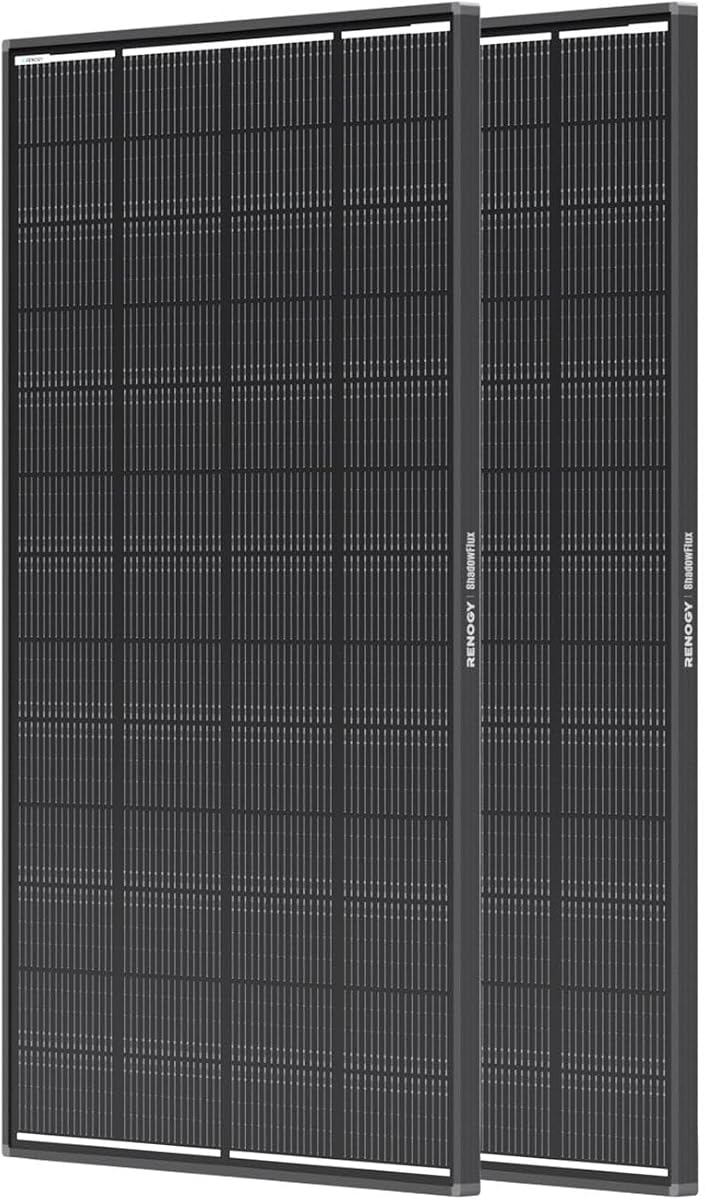
The Renogy ShadowFlux Solar Panel 400 Watt is a premium rigid panel centered on anti-shading performance. Its 4.5 rating, N-Type cells, 16BB technology, and ShadowFlux design make it a strong candidate for RV roofs where small shadows can otherwise have an outsized effect on conventional panels.
We may earn a commission when you buy through this link, at no additional cost to you.
Renogy says the anti-shading technology reduces hot-spot risk and supports more reliable output when buildings, plants, stains, or other objects partially shade the cells. The N-Type construction also aims to reduce micro-cracks and maintain performance over time. These features distinguish it from a standard 400-watt panel with only a general efficiency specification.
The panel is described as 7% smaller and 10% more compact than PERC solar panels, which is valuable on space-constrained RV roofs. An IP67 rating and enhanced vapor-resistant encapsulation are intended to help it endure rain, snow, and small hail. The stated support includes five years for materials and craftsmanship plus a 25-year output guarantee for 80% power.
The supplied information does not give exact dimensions or clearly define whether the title refers to one panel or a multi-panel configuration, so buyers should verify the current package layout. This is a compelling premium choice for owners who prioritize shade resilience, compact construction, and long-term coverage. It is best for a permanent roof installation with compatible mounting and charge-control equipment.
ShadowFlux technology targets the hot-spot and output-loss problems that commonly occur when trees, buildings, or roof fixtures cast partial shadows.
A compact design can free valuable roof area on an RV while preserving the benefits associated with a 400-watt nominal panel.
We may earn a commission when you buy through this link, at no additional cost to you.
The right 400 watt solar panel for an RV depends on electrical compatibility, usable space, charging behavior, and how often the vehicle travels. These factors help separate permanent roof systems from portable power-station chargers and multi-module arrays.
Begin with the voltage and chemistry of your RV battery bank. A panel marketed for 12V systems may not be appropriate for a 24V or 48V installation, and a nominal wattage alone does not guarantee that a controller can accept the panel's voltage and current. The Renogy kit states a 32V maximum battery voltage, while the DOKIO panel supports 12V and 24V systems. Check the current specification sheet for the exact model, and use a charge controller appropriate for both the battery type and the panel's operating characteristics.
Choose a controller and panel whose electrical limits work together, rather than relying only on the shared 400-watt description.
Measure the usable roof area before shopping, including the length and width of each open section, required clearance, cable routing space, and the area needed to tilt or fold a portable panel. Rigid models range from compact two-module layouts to larger single-panel designs. The JJN modules are approximately 38.19 inches long, Callsun's smaller 100W modules are 31.1 inches long, and the bifacial Callsun modules are 51.3 inches long. These differences can determine whether a panel fits between existing equipment.
Measure the actual mounting zone and leave room for secure brackets, ventilation, maintenance access, and cable movement.
A foldable panel is best when portability, storage flexibility, and compatibility with a portable power station matter most. A rigid panel is better suited to a permanent roof installation with a conventional battery bank and charge controller. The CTOLITY, Greenmagic, and E-POWO options are designed around foldable power-station use, while the DOKIO and Callsun products emphasize fixed RV mounting. Consider how often you move campsites and whether you want one panel to support a stationary solar system or several portable devices.
Choose a permanent system for consistent unattended charging and a foldable model for flexible travel-oriented use.
Efficiency ratings show how effectively a panel converts incident light, but they do not tell you the watts your RV will receive at a specific time. The featured products range from stated efficiencies of 21.5–23.5% for portable models to as much as 25% or 25.6% for N-Type rigid panels. Sun angle, clouds, heat, shade, cable losses, and controller performance affect actual charging. Bifacial modules may add rear-side output, but only when the surface below reflects enough light.
Prioritize efficient cells and good shade behavior, but estimate realistic daily energy from your own travel conditions.
RV roofs often contain air conditioners, vents, antennas, luggage, and other objects that cast intermittent shadows. The Callsun bifacial panel uses a two-section parallel design so one shaded area does not disable the entire module, while the Renogy ShadowFlux focuses on reducing hot spots in shaded conditions. These technologies can be more valuable than a small efficiency difference in a partially obstructed location. For portable panels, position the kickstands carefully and avoid placing the unit where a small object will cover an entire active section.
Favor partial-shade tolerance when roof obstructions cannot be removed or relocated.
Outdoor RV panels must tolerate rain, splashes, dust, wind, and seasonal temperature changes. The listed junction-box ratings range from IP65 to IP68 among the rigid products, while the E-POWO portable panel is described as IP67 at the module level. Those figures apply to specific components and should not be treated as permission to submerge a panel. The Greenmagic listing explicitly states that its junction box is not waterproof and advises against leaving the panel in heavy rain or soaking it.
Match the product's environmental limits to the mounting location and local weather rather than assuming every surface is equally protected.
Connector standards and supplied cable length can determine how much modification an installation requires. MC4 is common among the rigid panels and helps create consistent, repeatable connections, while the Greenmagic and E-POWO foldables emphasize broad power-station support. The DOKIO panel's 3-meter leads can shorten roof-to-controller cable runs, whereas shorter leads may require extensions and additional connectors. Plan the cable path before mounting so that it avoids sharp edges, moving roof components, pinch points, and unnecessary exposed joints.
Prefer fewer connections, secure cable strain relief, and a route that protects wiring from UV exposure and physical damage.
A nominal 400-watt panel can be physically demanding even when it folds. The E-POWO unit weighs 15.57 kilograms, the Greenmagic panel weighs 21.5 pounds, and each Callsun 200W bifacial module weighs 23.8 pounds. Fixed panels require safe access during installation and may also affect the vehicle's roof-loading considerations. Foldables are easier to store but still need to be moved to and from the sun. Choose a weight you can safely lift and a design you can deploy without repeatedly repositioning it.
Account for both installation strength and the effort of handling the panel throughout the trip.
Before installation, identify your battery-bank voltage, confirm the panel's electrical limits, and select a charge controller designed for the battery chemistry and system voltage. Map the mounting area around roof equipment, then position the panel where it receives the clearest available sun. Rigid panels should be attached with suitable brackets and mechanically secured rather than relying on sealant alone, while portable panels should be placed on stable ground or firmly supported at the intended angle.
Route the cables from the panel to the controller with protection from sharp edges, abrasion, UV exposure, and movement. Use compatible MC4 connectors or the supplied power-station cable, inspect every plug, and avoid leaving unnecessary joints in the charging path. For a portable setup, unfold the panel completely, deploy the kickstands or hanging loops, and orient it toward direct sunlight. Always follow the power station's input limits and the controller's configuration instructions.
Clean the surface periodically with a soft, damp cloth and remove dust, leaves, bird droppings, or snow that could block light. Never use a high-pressure washer, harsh chemicals, or a sharp tool that could scratch the laminate. Check brackets, fasteners, connectors, and cable strain relief after long drives, and inspect rigid panels for cracks, corrosion, or water entering the junction box. Store foldable panels fully dry in a ventilated, protected compartment when they are not in use.
A 400 watt solar panel should normally connect through a charge controller rather than charging a battery bank directly. The controller regulates the energy transfer and protects the batteries from inappropriate voltage and current. Verify the panel's operating voltage, the controller's input range, and the battery bank's nominal voltage before connecting anything.
They can be, provided the available roof space and weight are appropriate. The Callsun bifacial set is specifically described as fitting Class B van dimensions, while smaller four-panel configurations may be easier to place around roof obstacles. Measure the open roof area and account for brackets, wiring, and ventilation before choosing a rigid model.
Rigid panels are generally intended for permanent rooftop installations and connect to a battery bank through a suitable charge controller. Foldable panels are designed for portability and often connect to portable power stations using included cables. Rigid systems suit consistent off-grid charging, while foldables are convenient for temporary charging at a campsite.
Not necessarily. The power station may have a lower maximum solar-input wattage or voltage limit than the panel, which can reduce the charging rate. Connector type also matters. Check both devices' input specifications and ensure the power station accepts the panel's voltage and current under real operating conditions.
No. Bifacial panels can collect reflected light from the rear, but the gain depends on the surface below, mounting height, surrounding environment, and available reflected light. The Callsun listing mentions up to 30% additional output over reflective surfaces such as gravel or snow, while darker or rougher RV roof materials will produce less rear-side contribution.
Space depends on the product format. A foldable panel may measure roughly 32 to 38 inches when closed, while rigid modules in these selections range from about 31 inches to more than 51 inches in length. Two 200W modules and four 100W modules can be easier to fit around obstacles, but they require more total mounting positions and wiring.
Parallel wiring can be appropriate for a compatible 12V system because the panels share the same voltage and their currents combine. The DOKIO information specifically recommends parallel wiring for smoother 12V charging, while series use calls for a controller with a suitable high-input voltage. Confirm the panel specifications and controller limits before deciding on a series or parallel layout.
Let the panel dry fully before folding it, then store it in a clean, ventilated area away from sharp tools and heavy objects. Do not leave water, sand, or debris trapped against the cells. Protect the cable and connectors, and periodically inspect the folds and fabric for wear that could affect the panel's construction.
The Callsun N-Type 16BB 400W Bifacial set stands out as the most complete option because it combines the guide's highest rating, excellent partial-shade tolerance, compact Class B van dimensions, and bifacial rear-side collection. The four-module Callsun set is a strong budget-oriented choice for owners who need flexible placement, while the Renogy ShadowFlux model offers premium anti-shading technology and long-term output coverage.
Your priority should determine the format. Use a rigid roof array for dependable permanent charging, a multi-module set when roof obstacles require distributed placement, and a foldable panel when portability and power-station compatibility are more important than a fixed installation. Above all, match panel voltage, controller limits, battery-bank configuration, roof space, and connector type before deciding.
Finally, review current listings, package contents, dimensions, warranty documents, and electrical specifications before purchasing. Product configurations can change, and prices fluctuate, so the details available today should guide the final choice. Use this guide to narrow the options, then confirm that the selected model is truly compatible with your RV's electrical and physical requirements.