
JR-3 Clip-On Acoustic Guitar Pickup
4.5Editor score
Battery-free clip-on installation
Ten-foot output cable included
Fits common steel-string soundholes
This guide compares the best soundhole acoustic guitar pickup options for sound, installation, wireless control, noise reduction, and compatibility.
A soundhole acoustic guitar pickup can turn a traditional acoustic instrument into a practical amplified or recording tool without permanently modifying the guitar. The right model should capture tonal detail, reject unwanted noise, fit the instrument properly, and connect cleanly to the equipment you already use.
We compared ten magnetic, passive, active, dual-sensor, and wireless pickups using the information supplied for each product. The list considers soundhole compatibility, installation requirements, cable or battery needs, control options, feedback resistance, and suitability for steel-string versus nylon-string guitars.
Each review identifies the product's strongest features, practical limitations, and most suitable audience. The comparison covers simple clip-on designs, established magnetic pickups, microphone-and-magnetic systems, and rechargeable wireless models; prices and availability can change, so confirm current details before purchasing.
4.5Editor score

4.5Editor score

4.4Editor score
The table below compares all ten pickups by transducer design, power requirements, installation approach, and notable controls or output features, making it easier to identify the right system for a particular guitar and setup.


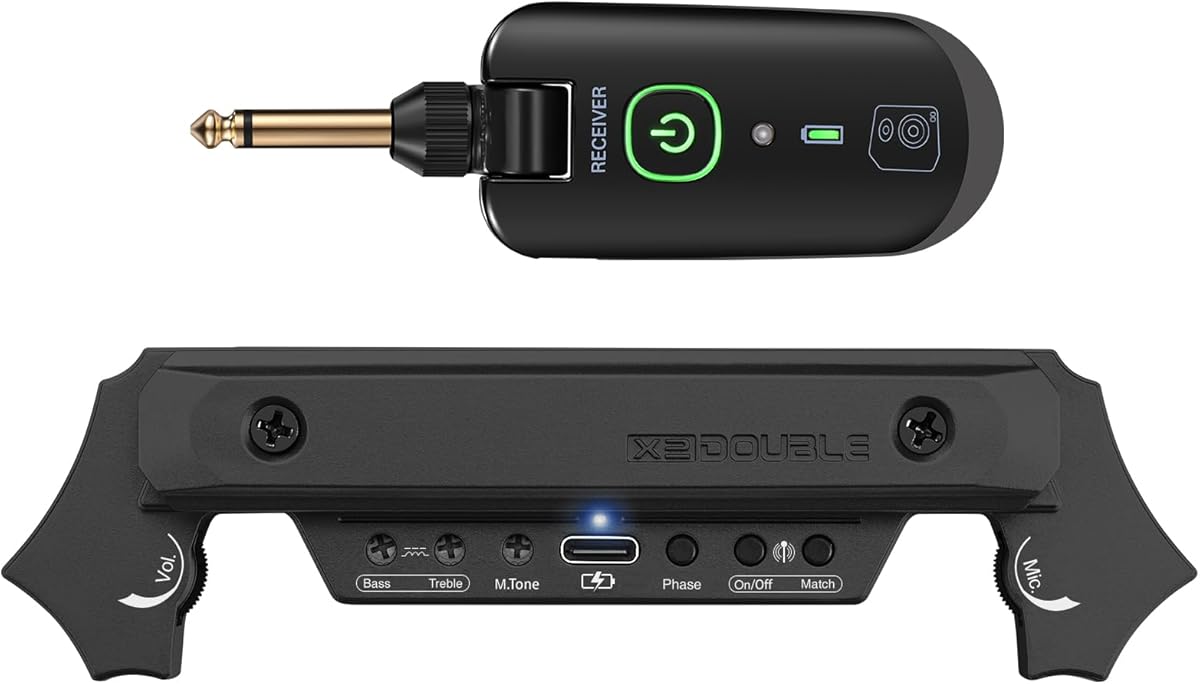


The Wireless Wood Grain Pickup receives a 4.3 rating and stands out as the most feature-rich system in this guide. It combines a magnetic coil with a built-in microphone, giving the player two signal sources in one soundhole unit. Its wireless receiver, 30-meter stated range, and wired option make it unusually adaptable for rehearsal, recording, and small performance environments.
We may earn a commission when you buy through this link, at no additional cost to you.
The controls are the main attraction. Separate microphone and output volume controls, adjustable microphone timbre, EQ, a phase switch, and a battery indicator allow meaningful changes to the captured sound without relying entirely on an external amplifier. The phase control is particularly useful when addressing howling, while the microphone and magnetic channels can preserve details from more than just the strings.
There are practical compromises. Wireless operation depends on a rechargeable battery, and the receiver is stated to last about eight hours in wireless mode. The package does include a USB charging cable, and the wired mode is stated to run for more than 100 hours after a full charge. It is also explicitly intended for steel-string acoustics, not ukuleles or classical guitars.
This is a strong choice for a guitarist who wants more control than a basic magnetic pickup provides and values the option to move around without a long instrument cable. It may feel over-equipped for simple home amplification, but for rehearsals, recording sessions, and wireless performance, the combination of sensors and controls is unusually capable.
The magnetic coil and built-in microphone can be blended to preserve both string detail and the acoustic body's broader character. This makes the system relevant to players who want more than the focused output of a purely magnetic transducer.
The included receiver supports wireless operation across a stated 30-meter range, while the retained 3.5mm output path allows a conventional wired setup. That flexibility suits rehearsals and performances where cable management or mobility matters.
We may earn a commission when you buy through this link, at no additional cost to you.
The Seymour Duncan Woody HC Maple carries a 4.4 rating and offers a focused alternative to the multi-control wireless system. It is a passive, magnetic, hum-cancelling pickup designed for soundhole placement. The quarter-inch male output and straightforward design make it practical for players who want a conventional amplified-acoustic signal without batteries or complex setup.
We may earn a commission when you buy through this link, at no additional cost to you.
The hum-cancelling construction is the defining feature, helping reduce unwanted electrical interference that can be particularly noticeable in amplified and recording environments. A magnetic pickup also isolates the string output more effectively than an ambient microphone, which can be useful in rooms where stage noise or other instruments might otherwise be captured.
Its limitations are equally clear. The listed specifications do not include onboard volume, EQ, or phase controls, so some of the final shaping will happen in an amplifier, mixer, or direct box. Because it uses magnetic transduction, it is intended for steel-string acoustic guitars and will not work with nylon-string instruments such as classical guitars.
Choose this model if your priority is a clean, recognizable magnetic signal and straightforward operation. It is especially appropriate for performers who already understand their amplifier and want the pickup to provide a stable starting point rather than handle every tone decision internally.
A magnetic pickup responds primarily to the strings, which can make a performance easier to control than an open microphone. It is a practical choice for amplification when ambient room sound would be distracting.
Because the pickup does not require battery power, setup remains straightforward. Connect the quarter-inch output to an amplifier, PA, or direct box and use the receiving equipment to set the final balance.
We may earn a commission when you buy through this link, at no additional cost to you.
The Passive Humbucker Soundhole Pickup has a 4.3 rating and delivers a useful combination of simple construction and onboard control. Its magnetic humbucker design needs no batteries, while separate knobs adjust output volume and timbre. That gives users more immediate control than a completely passive pickup without adding charging or wireless complexity.
We may earn a commission when you buy through this link, at no additional cost to you.
The pickup is described as producing a warm, balanced tone and is particularly suited to fingerstyle players. It installs inside the soundhole using a water chestnut-style support, allowing it to be inserted or removed without altering the guitar body. The stated 85–100mm soundhole range and 39–41-inch guitar compatibility make fit the most important check before purchase.
The humbucker configuration is the main reason to consider this model over a simple single-coil. It can help reduce unwanted hum in amplified setups, while the two knobs provide practical changes during a session. It does not, however, offer a built-in microphone, EQ, phase switch, or wireless transmission.
This is a compelling pick for a guitarist who wants battery-free operation and physical tone controls on a modest budget. It suits players of standard-sized steel-string acoustics who value a warm character and want to adjust volume and timbre without navigating an amplifier's menu.
One control sets pickup level while the other changes timbre, allowing fast changes without leaving the guitar. The magnetic signal is presented as warm and balanced, making it useful for fingerstyle and light amplification.
The support sits within the soundhole and avoids permanent changes to the instrument. Verify the soundhole diameter first, as the stated range is narrower than that offered by some wireless systems.
We may earn a commission when you buy through this link, at no additional cost to you.
This black-finished wireless pickup shares the same broad feature set as the first-ranked wood-grain model and also holds a 4.3 rating. It combines a magnetic coil and built-in microphone, with independent volume control and support for several acoustic playing techniques. Wireless and wired modes give performers flexibility between unrestricted movement and a conventional fixed setup.
We may earn a commission when you buy through this link, at no additional cost to you.
The included preamp section provides microphone volume, microphone timbre, output volume, EQ, phase adjustment, and a battery indicator. The phase switch can help reduce howling, while the two-sensor design is intended to reveal more detail and layering than a single capture method. A 30-meter transmission distance supports use in rehearsal rooms, studios, and modest performance spaces.
As with other rechargeable systems, the receiver's stated eight-hour wireless runtime requires planning. The wired mode is stated to exceed 100 hours after a full charge, and the supplied Type-C cable supports recharging. The instructions note that a lower-current charger should be used, and the product is not intended for classical guitars or ukuleles.
For a mobile musician, this system is hard to dismiss. It is more elaborate than a standard magnetic pickup, yet it also offers the freedom to walk around without a long cable. Players who only need a basic amplified signal may find the controls and charging requirement more than necessary.
Wireless operation allows the guitarist to move without managing a long instrument cable. The stated range is appropriate for many rehearsal and small-stage environments where dependable local coverage is needed.
The one-key phase adjustment is designed to reduce howling, and EQ and separate levels provide additional control. These features help shape the signal before it reaches an amplifier, mixer, or PA.
We may earn a commission when you buy through this link, at no additional cost to you.
The KQ-3 has a 4.0 rating and focuses on convenience above sophisticated onboard features. It is a compact clip-on pickup measuring 5 by 1 by 0.3 inches, supplied with a ten-foot cable. The design converts a compatible steel-string acoustic into an amplified instrument without batteries, permanent holes, or complicated internal mounting.
We may earn a commission when you buy through this link, at no additional cost to you.
Installation involves placing the pickup in the soundhole, securing the fixed and adjustable sides, and connecting the cable to an amplifier or speaker. A soft padded clip is intended to hold the unit firmly while avoiding scratches. Its quarter-inch connection is familiar to anyone using a standard amplified-acoustic setup.
The principal constraints are soundhole size and string type. The stated fit is 3.5 to 4 inches, which covers many 34–41-inch steel-string guitars, but not every instrument. The product also lacks onboard preamp, EQ, phase, and microphone controls, so the receiving amplifier performs more of the tonal work.
The KQ-3 makes sense for a beginner, songwriter, or casual performer who wants immediate amplification with minimal installation effort. It is less suited to a player who requires precise tone shaping, sophisticated feedback control, or the ability to use a nylon-string instrument.
The pickup can be placed and secured in seconds, then removed whenever the guitar is used acoustically. That makes it practical for players who switch between amplified and unamplified performances.
The soft-padded clip is designed to hold the pickup without scratching the finish. Its ten-foot cable also gives the player freedom to position an amplifier without moving the instrument itself.
We may earn a commission when you buy through this link, at no additional cost to you.
The JR-3 earns a 4.5 rating, making it the highest-rated product in this roundup and a leading choice for simple clip-on amplification. It uses a compact pickup body with a ten-foot cable and requires neither batteries nor permanent drilling. A guitar can be converted for amplified use and returned to its acoustic configuration quickly.
We may earn a commission when you buy through this link, at no additional cost to you.
The installation method is straightforward. The unit sits in the soundhole, one side clips into position, and an adjustable clamp secures the other side. A padded contact helps protect the instrument's finish. The quarter-inch output works with amplifiers or speakers, making it familiar to players who already use amplified acoustic equipment.
Its simplicity is also its limitation. There are no onboard controls for volume, EQ, phase, or microphone blending, so the final sound depends largely on the amplifier or sound system. The stated soundhole range of 3.5 to 4 inches covers many common steel-string acoustics but excludes unusual sizes and nylon-string instruments.
The JR-3 is ideal for anyone who values quick setup, minimal hardware, and dependable physical construction. It is particularly well suited to rehearsals, lessons, and informal performances where rich onboard tone shaping is less important than immediate amplified output.
A clip-on body, one cable, and a familiar output connection remove most installation decisions. This makes the JR-3 approachable for a first-time acoustic amplification setup.
The stated 3.5–4-inch soundhole range covers most 34–41-inch steel-string guitars. Measuring the soundhole before ordering helps prevent an avoidable compatibility issue.
We may earn a commission when you buy through this link, at no additional cost to you.
The Woody HC Walnut carries a 4.4 rating and is a refined passive option for steel-string acoustics. It is described as a noiseless, hum-cancelling magnetic soundhole pickup with a warm and rich character. Its hum-cancelling design produces a fuller, more compressed signal than Seymour Duncan's single-coil SC version.
We may earn a commission when you buy through this link, at no additional cost to you.
Feedback resistance is supported by double-potted construction, which helps the pickup remain stable when used with amplification. The included 14-foot low-capacitance coaxial cable can connect directly to an amplifier, PA, direct box, or console, providing ample reach while reducing unwanted signal loss.
The pickup is designed for standard soundholes measuring 3.75 to 4 inches, or 94 to 100 millimeters. It mounts in the soundhole without modification and can be removed quickly, making it practical for players who use one guitar across amplified and acoustic settings. It does not work with nylon-string instruments.
Choose the Walnut version when a warm, substantial magnetic tone and feedback resistance are priorities. It is well suited to gigs and recording where a controlled, compressed string signal can work effectively, while players seeking microphone realism or extensive onboard controls should look elsewhere.
Double potting and hum-cancelling circuitry make this a practical choice for amplified performance. These qualities are particularly useful when the guitar shares a stage or recording environment with other sound sources.
The 14-foot low-capacitance cable offers flexibility around amplifiers, direct boxes, and consoles. It reduces the need to remain close to the equipment while preserving a straightforward connection.
We may earn a commission when you buy through this link, at no additional cost to you.
The Fishman Neo D has a 4.3 rating and is positioned as a straightforward, battery-free magnetic pickup. It emphasizes string-to-string balance and acoustic clarity, with a low-profile, high-impedance design that needs no external power. Installation requires no alteration to the guitar, and the plug-and-play format keeps setup simple.
We may earn a commission when you buy through this link, at no additional cost to you.
Its passive single-coil design is best suited to players who want a clear, responsive representation of the strings. The soundhole format preserves the guitar's familiar playing position and can be removed when amplified output is unnecessary. A dark brown housing also gives the unit a traditional appearance that is less conspicuous during a performance.
Compared with a humbucker or the hum-cancelling Woody HC, the single-coil arrangement may be more exposed to mains hum and other electromagnetic interference. The supplied information does not list onboard volume, EQ, or phase controls, so the connected amplifier or direct box must handle final tone shaping and gain staging.
The Neo D is a good fit for home practice, recording, and straightforward stage use where simplicity and acoustic clarity matter. Guitarists working in electrically noisy venues or those requiring onboard feedback management may benefit from a hum-cancelling alternative.
The pickup is specifically described as offering strong string-to-string balance and acoustic clarity. That makes it attractive to fingerstyle players and anyone who wants the output to remain consistent across the instrument.
Its high-impedance passive design eliminates battery charging and power switches. Players can install it without altering the instrument and connect it to compatible amplification or recording equipment.
We may earn a commission when you buy through this link, at no additional cost to you.
The Rechargeable Wood Grain Pickup has a 4.3 rating and combines an active preamp with both microphone and magnetic sensors. It is designed to restore the layered character of an acoustic guitar while providing a clearer, brighter signal. The result is aimed at players who want more internal control than a basic passive pickup can offer.
We may earn a commission when you buy through this link, at no additional cost to you.
Microphone volume, microphone timbre, master output volume, EQ, and phase adjustment are all built into the system. A battery indicator shows the remaining charge, and the stated operating time reaches 100 hours in the appropriate mode after a full charge. The soft-pad mounting holds the pickup in the soundhole while reducing contact with the instrument's finish.
Unlike the two wireless models in the guide, this system does not include a receiver, so it operates as a wired active pickup. The rechargeable design still adds a charging requirement, and the package includes a USB charge cord, screwdriver, leather sheath, cable clamps, and instructions. It is specifically for steel-string guitars and not for nylon-string models.
This is a sensible option for a player who wants microphone detail and active tone shaping without a wireless system. It is especially useful for home recording and controlled amplification, where adjusting the blend, EQ, and phase can produce a more satisfying acoustic signal.
Independent microphone level and timbre controls let the player balance body resonance against the magnetic string signal. That flexibility can make the pickup useful across different playing styles and amplification environments.
The built-in preamp removes the need for external preamp control in many basic setups. A long stated battery life supports frequent use, although regular charging remains necessary for uninterrupted operation.
We may earn a commission when you buy through this link, at no additional cost to you.
The EMG ACS Acoustic Soundhole Pickup has a 4.5 rating and offers a polished active alternative to the lower-cost reusable pickups. Its defining feature is the onboard preamp, which gives the player a self-contained signal path designed for acoustic amplification. Installation is performed at the soundhole rather than through permanent body modifications.
We may earn a commission when you buy through this link, at no additional cost to you.
The active format is appropriate for players who want a predictable amplified-acoustic signal without relying on additional preamp hardware. That can simplify a rehearsal, recording, or stage setup while keeping the guitar's natural appearance and removable pickup format. The black housing gives the unit a discreet, functional appearance.
The supplied product information is concise, so detailed control options, exact soundhole dimensions, and connector format are not stated. Those details should be confirmed with the seller and against the player's guitar before buying. The absence of a microphone in the description also suggests that buyers seeking ambient or vocal capture should look at the dual-sensor systems instead.
The EMG ACS is recommended for a guitarist who values an established active design, onboard preamp convenience, and straightforward soundhole installation. It is especially attractive to users who want more consistency than a minimal clip-on unit without the feature bulk of a wireless system.
The integrated preamp gives the pickup a more complete amplification path than a basic passive transducer. This can reduce reliance on extra equipment during practice and performance.
A soundhole-mounted system preserves the original guitar and can be removed when amplified output is not required. Confirm fit and connection details before purchase because the supplied listing does not specify them.
We may earn a commission when you buy through this link, at no additional cost to you.
The right soundhole pickup depends on your instrument, amplification environment, and desired control. Consider sensor type, fit, power, connection method, and tone requirements before choosing a model.
Soundhole diameter is the most concrete compatibility requirement. The listed systems range from 85–100mm and 94–100mm for specific magnetic models to 80–120mm for the two wireless units, while the clip-on pickups fit soundholes from 3.5 to 4 inches. Measure across the opening at its narrowest point and compare that number with the seller's stated range before ordering. A snug fit matters because the pickup must remain stable during playing.
Choose a model whose published range comfortably contains your guitar's measurement. Do not rely on visual similarity, and account for the mounting method as well as the stated maximum size.
Most magnetic soundhole pickups are intended for steel-string acoustics. A magnetic sensor can struggle to capture nylon strings effectively because their lower magnetic response differs from steel strings. The Seymour Duncan Woody HC and Fishman Neo D are specifically identified as magnetic steel-string products, while several dual-sensor systems explicitly exclude classical guitars.
If your instrument is a classical guitar, a nylon-string acoustic, or an ukulele, do not select a model based solely on its shape. Confirm compatibility for that exact instrument type before making a purchase.
A magnetic pickup isolates the strings and usually gives a clearer, more repeatable amplified signal. A microphone captures more of the guitar's body resonance and room character, while a hybrid system lets the player blend both approaches. The microphone-and-magnetic products in this guide provide separate volume and timbre controls for greater flexibility, but they are more involved than a simple magnetic model.
Match the sensor format to the recording or performance environment. A focused magnetic signal is often easier to control on a busy stage, while a hybrid can offer a more dimensional acoustic presentation.
Passive pickups need no power and are generally simple to connect. Active pickups use a built-in preamp and may provide a more consistently level signal, but they require power, which can mean batteries, a rechargeable cell, or an external supply. The EMG ACS is identified as active with an onboard preamp, while the Fishman Neo D and the basic Seymour Duncan options are passive.
Consider the equipment already in your setup. A passive magnetic model can be direct and uncomplicated, whereas an active system may integrate more smoothly with a particular amplifier or recording chain.
Onboard controls can make a pickup much easier to use in live or recording situations. Look for separate microphone and master volume, adjustable microphone timbre, EQ, battery indication, and phase control. The phase function is particularly relevant when the microphone and magnetic sensors are blended, as it can help reduce howling. A system with fewer controls may produce a good raw signal but require more adjustment in an amplifier or mixer.
Prioritize the controls you genuinely expect to use. A complex preamp is valuable for flexible tone shaping, but it is not automatically better than a simple model for a player who wants a straightforward plug-and-play setup.
Wireless freedom is useful for rehearsals, teaching, and performances where a long cable would restrict movement. The featured wireless systems state a 30-meter transmission range and include receivers, with approximately eight hours of stated receiver use in wireless mode. Wired operation remains available and is stated to last much longer after charging. Fully wired options avoid range concerns and often simplify signal routing.
Choose wireless capability when mobility has tangible value. Otherwise, a wired pickup may provide fewer charging and reception concerns while still meeting the player's amplification needs.
The connection method must match the amplifier, PA, recording interface, or direct box. Several products use a quarter-inch output, while the wireless and active systems also mention 3.5mm connections or supplied cables. A standard connector is not enough if the device expects a different input, so inspect both ends of the included lead and the intended destination equipment before buying.
Also consider where controls live. If an external preamp or mixer already provides EQ and gain control, a simpler passive pickup may prevent duplicated functionality and make operation more predictable.
Begin by measuring the soundhole and confirming that the guitar is a compatible steel-string model. Set the guitar on a stable surface, protect the finish, and install the pickup according to its instructions. Clip-on models secure inside the soundhole, while fixed-mount systems use their support or mounting mechanism. Connect the output to the amplifier or recording device only after the pickup is stable.
Begin with conservative amplifier volume and a moderate tone setting. Magnetic pickups often benefit from starting with lower gain, while microphone-and-magnetic systems may need the phase control adjusted if feedback appears. Raise output levels gradually and listen from the player's position as well as the audience's position, since an acoustic pickup can sound different across the room.
For battery-powered models, recharge the unit according to the supplied guidance and avoid using an incompatible charger. Clean removable parts with a soft, dry cloth rather than moisture or harsh cleaners, and never spray liquid near the electronics. Store the pickup in its case or away from moisture and direct heat, inspect cables for damage, and remove the system before transporting the guitar in a tight case.
No, compatibility depends on both string type and soundhole size. Most of the listed models are intended for steel-string guitars, and several explicitly exclude classical guitars and ukuleles. Measure the soundhole and compare it with the published fit range before ordering.
A properly sized soundhole pickup is designed for removable installation and should not require permanent drilling or body modification. Secure the mounting support correctly and avoid forcing a unit into a soundhole that is too small. Padded clip-on designs can also help protect the finish.
Magnetic pickups provide a focused string signal and are usually easier to control in a live environment. Microphones capture more body and room resonance, while hybrid systems combine both and offer greater tonal flexibility. The best choice depends on the level of realism and control you need.
Wireless pickups can be practical for rehearsals, teaching, and performances when the receiver is charged and the area is within the stated transmission range. The featured systems list 30-meter transmission and about eight hours of wireless receiver use. Wired operation remains a useful backup and may be preferable in crowded RF environments.
It depends on the model and the connected equipment. Products with an onboard preamp can provide substantial shaping before reaching an amplifier, while basic passive units may benefit from amplifier or mixer gain and EQ. Check the pickup's stated controls before adding unnecessary hardware.
Start with moderate amplifier volume, keep the pickup securely mounted, and experiment with the pickup's phase control if it has one. Dual-sensor systems provide the most direct phase adjustment, while separate microphone volume can help prevent a microphone from overpowering the magnetic signal.
Yes. A passive magnetic model can feed a suitable audio interface or direct box, while an active model may provide a more convenient level and onboard tone shaping. For a balanced acoustic recording, compare the raw pickup signal with a close microphone and adjust the blend according to the desired result.
The JR-3 is the strongest simple option for quick, battery-free amplification, while the EMG ACS stands out as a high-rated active system with an onboard preamp. The Seymour Duncan Woody HC Walnut offers a premium traditional approach based on a warm, hum-cancelling magnetic signal, and the rechargeable wood-grain model provides detailed microphone-and-magnetic control without wireless reception.
Prioritize soundhole fit and string compatibility before any feature. Among compatible instruments, choose a passive model for simplicity, a hum-cancelling magnetic design for stable amplified use, a dual-sensor system for richer control, or a wireless model when mobility is important. Check connectors and required power carefully, and use the amplifier or recording interface to complete the signal chain.
Ratings, product details, and prices can change over time, so verify the current listing before purchasing. Measure the soundhole, confirm that the model suits the guitar's strings, and review the included accessories and connection requirements. With those checks completed, the right pickup can make an acoustic guitar far more useful onstage, in rehearsal, or during recording.