
Criss Cross Legged Office Chair with Wheels
4.1Editor score
Thick high-density foam cushion
Height-adjustable supporting footrest
Five-star wheeled base
Explore the best Adhd Office Chair options for 2026, comparing support, adjustability, posture versatility, materials, mobility, and user comfort.
An ADHD office chair should make changing positions feel natural rather than forcing the body into one rigid shape. The strongest options combine supportive backs, adjustable heights, flexible footrests, and stable wheeled bases to suit work, study, meditation, gaming, and periods of restless movement.
We compared ten cross-legged and active-sitting chairs using the information supplied for each product. The review covers seat width, lumbar support, height and tilt adjustments, armrest movement, footrest positioning, upholstery, caster design, weight capacity, storage, and the range of supported sitting postures.
Each pick below reveals which chair is best suited to a particular routine, whether that means focused desk work, frequent movement, shared family spaces, or a compact home office. Ratings reflect the supplied customer feedback, while prices and availability can change, so confirm current listing details before buying.
4.1Editor score

4.6Editor score

4.8Editor score
The comparison highlights each chair's most consequential differences, including supported postures, seat dimensions, back support, adjustment systems, upholstery, base construction, and mobility features.





The DUMOS ADHD Meditation Chair combines a highly rated 4.6 feedback score with an unusually adaptable seating system. Its nearly four-inch-thick cushion, adjustable backrest, rotating seat, and rotating footrest allow users to move among standard, cross-legged, squatting, and kneeling positions without repeatedly replacing the entire chair.
We may earn a commission when you buy through this link, at no additional cost to you.
The most useful feature is the relationship between the independently rotating seat and footstool. The footstool measures nearly 30 by 16 inches and can be repositioned to support the feet, knees, or ankles as the user's posture changes. The backrest also adjusts with a knob while seated, allowing lumbar support to be fine-tuned without getting up. A height range from zero to 4.7 inches adds further flexibility around different desk and table arrangements.
There are some trade-offs. This model does not list adjustable armrests, so desk users who need forearm support must find another way to maintain alignment. Assembly is also required, although the open frame and straightforward construction should make routine cleaning easier. Buyers should also note that the supplied listing describes two material options, so the finish shown in the image may not correspond to every available variation.
This is a strong all-around choice for someone who wants a chair that genuinely supports active work rather than merely describing itself as an ADHD chair. It works well for typing, studying, meditation, yoga breaks, and periods when shifting position is necessary. For buyers seeking the most balanced combination of cushioning, posture support, footrest versatility, and rotational movement, it is the leading recommendation.
A broad seat, low adjustable height, and movable footstool let the chair accommodate several postures. That flexibility is especially useful when the user needs to alternate between focused typing, relaxed cross-legged sitting, and a brief kneeling or squatting position.
The knob-adjustable backrest is more useful than a fixed lumbar panel because the amount of support can change with the posture. Combined with the thick cushion and rotating footrest, it creates a more individualized setup than a basic meditation stool.
We may earn a commission when you buy through this link, at no additional cost to you.
The Pinmoco ADHD Cross Legged Office Chair is a straightforward active-sitting chair with a 4.0 rating. Its defining feature is the high-density memory foam cushion, which is designed to contour around the body and provide pressure relief across the hips and legs while the user works, studies, or relaxes.
We may earn a commission when you buy through this link, at no additional cost to you.
Fully adjustable height and tilt provide the main ergonomic controls. Those adjustments should make it easier to find a comfortable relationship between the seat, desk, and lower legs, particularly when moving from standard sitting into a cross-legged position. The chair also incorporates ergonomic contours for back, leg, and hip support, while the modern shape is intended to fit into both home-office and office environments.
The lower rating means buyers should consider the supplied feedback carefully, even though the product specifications present a coherent comfort-focused design. The description does not provide detailed information about footrest movement, armrests, base construction, or maximum weight, making it harder to compare this model with feature-rich alternatives. Fabric is durable and easy to clean, but it lacks the specific spill-resistance details provided for several PU leather options.
This chair is best for a buyer who prioritizes a generous memory foam feel, simple height and tilt adjustments, and a clean appearance. It may be particularly appealing in a shared home space or pet-friendly room where a wipe-clean finish is not essential. It is a sensible alternative to more mechanically complex chairs when the priority is soft support and easy posture changes.
High-density memory foam is intended to distribute pressure rather than creating one concentrated contact point. That makes this model appealing for users who prefer a softer seat and expect to spend time working or studying in several positions.
Height and tilt controls make it possible to adapt the chair to different users and tasks. Those adjustments are especially helpful when transitioning between conventional desk posture and the cross-legged positions the product is designed to support.
We may earn a commission when you buy through this link, at no additional cost to you.
The HOMRELEXA Cross Legged Office Chair earns a 4.2 rating and focuses on a soft seat, supportive backrest, and uncomplicated setup. It supports cross-legged, kneeling, meditation, and standard sitting, making it a flexible choice for workers and gamers who regularly change position.
We may earn a commission when you buy through this link, at no additional cost to you.
Its extra-wide cushion is intended to ease pressure around the hips during extended work or gaming sessions, while the extended backrest helps maintain spinal alignment. The PU leather surface is described as waterproof and stain-resistant, with added resistance to cracking, making it practical for desks where drinks, snacks, or pet hair are common. A steel base and durable casters provide the rolling foundation.
The main limitation is the absence of listed armrests, which could matter during long typing sessions. Although the chair has a height-adjustable seat, the supplied information does not state the exact range, so buyers should verify whether it reaches a comfortable relationship with their desk. The stated tool-free assembly process and approximately fifteen-minute setup time are meaningful advantages for anyone reluctant to assemble complex furniture.
This is a good fit for buyers who want a wide, soft chair that can move among work, gaming, and meditation positions without a complicated adjustment system. It is particularly attractive in homes where easy cleaning and straightforward assembly matter more than premium arm support.
The extra-wide, cloud-soft cushion is the product's defining comfort feature. It distributes the contact area across a broader region, which may feel more comfortable than a narrow conventional seat during extended work or gaming.
Waterproof, stain-resistant PU leather can be wiped clean, while the included hardware and no-extra-tools assembly simplify setup. These details make the chair more approachable for a first-time furniture assembler.
We may earn a commission when you buy through this link, at no additional cost to you.
The Cross Legged Office Chair with Arms has a 4.5 rating and a strong focus on space-efficient active sitting. Its 19.68-inch-wide seat, flip-up armrests, and 360-degree rotating footrest allow the chair to adapt to cross-legged, tucked-leg, kneeling, and relaxed working positions.
We may earn a commission when you buy through this link, at no additional cost to you.
The wide seat is the standout feature because it gives the user room to reposition without immediately feeling confined. Flip-up arms create additional clearance when the user wants to sit cross-legged or slide the chair beneath a desk. The rotating footrest can move with the legs rather than requiring the entire chair to be dragged into a new position, and the height-adjustable swivel base helps match the chair to the user's body.
One uncertainty is the lack of a published weight capacity in the supplied data, which matters when comparing it with chairs that explicitly state a limit. The listing also does not describe independent lumbar adjustment or a specific armrest height range, so those functions should not be assumed. Nevertheless, the rated feedback and clear emphasis on movement make it a credible option for users who dislike restrictive seating.
This chair is especially well suited to compact home offices, studio apartments, and shared workspaces where floor footprint matters. It also suits creative professionals, gamers, and remote workers who want to shift position during the day. For those seeking generous legroom and movable arm supports rather than a minimal meditation-seat design, it is a particularly strong option.
The 19.68-inch seat provides a noticeably generous area for the hips and legs. That space allows users to tuck one leg under, cross both legs, or stretch out without using a separate footstool immediately.
Flip-up armrests and a rotating footrest preserve useful clearance beneath a desk. This makes the chair more practical in tight rooms where a conventional wide office chair would be difficult to maneuver.
We may earn a commission when you buy through this link, at no additional cost to you.
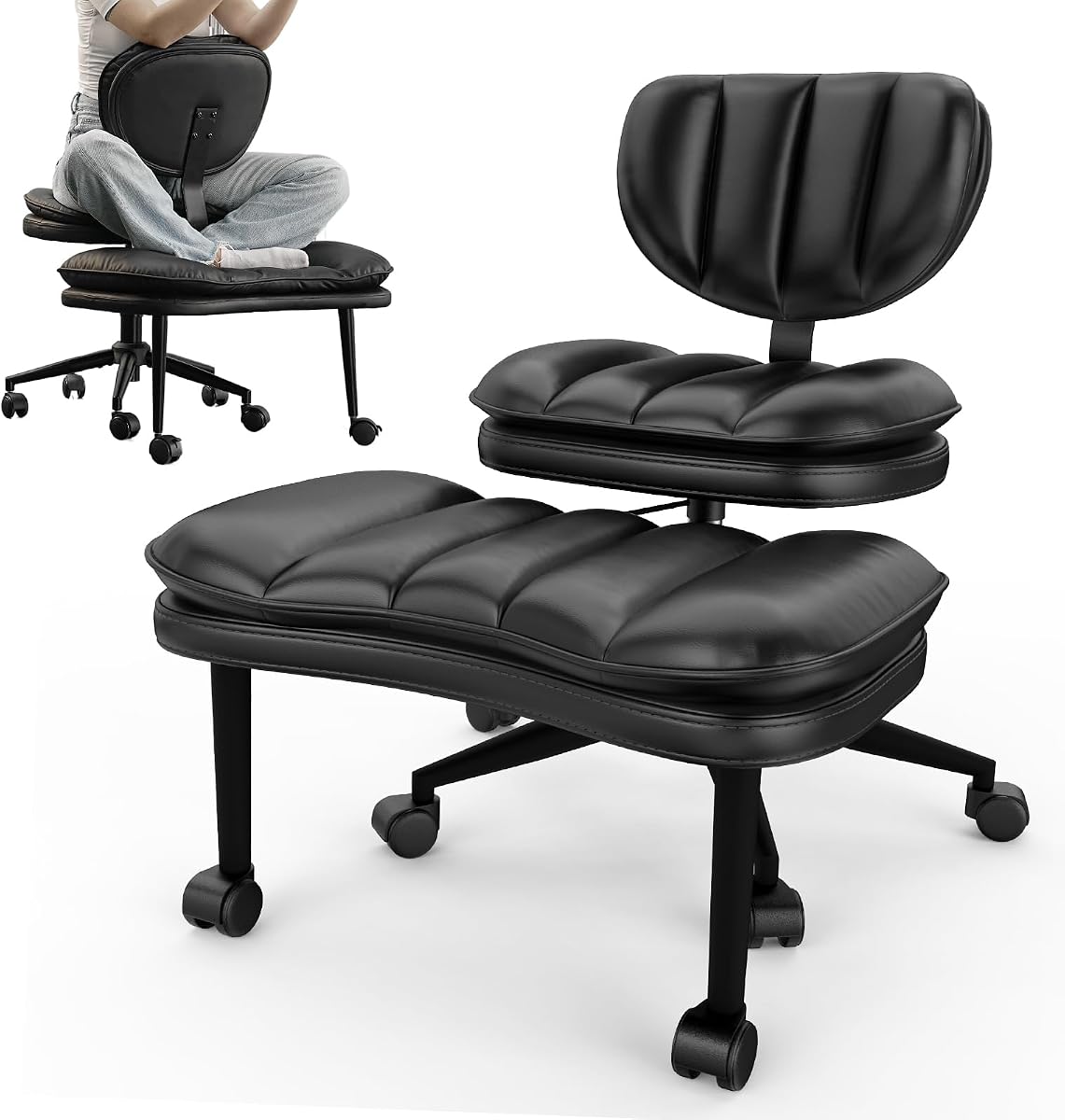
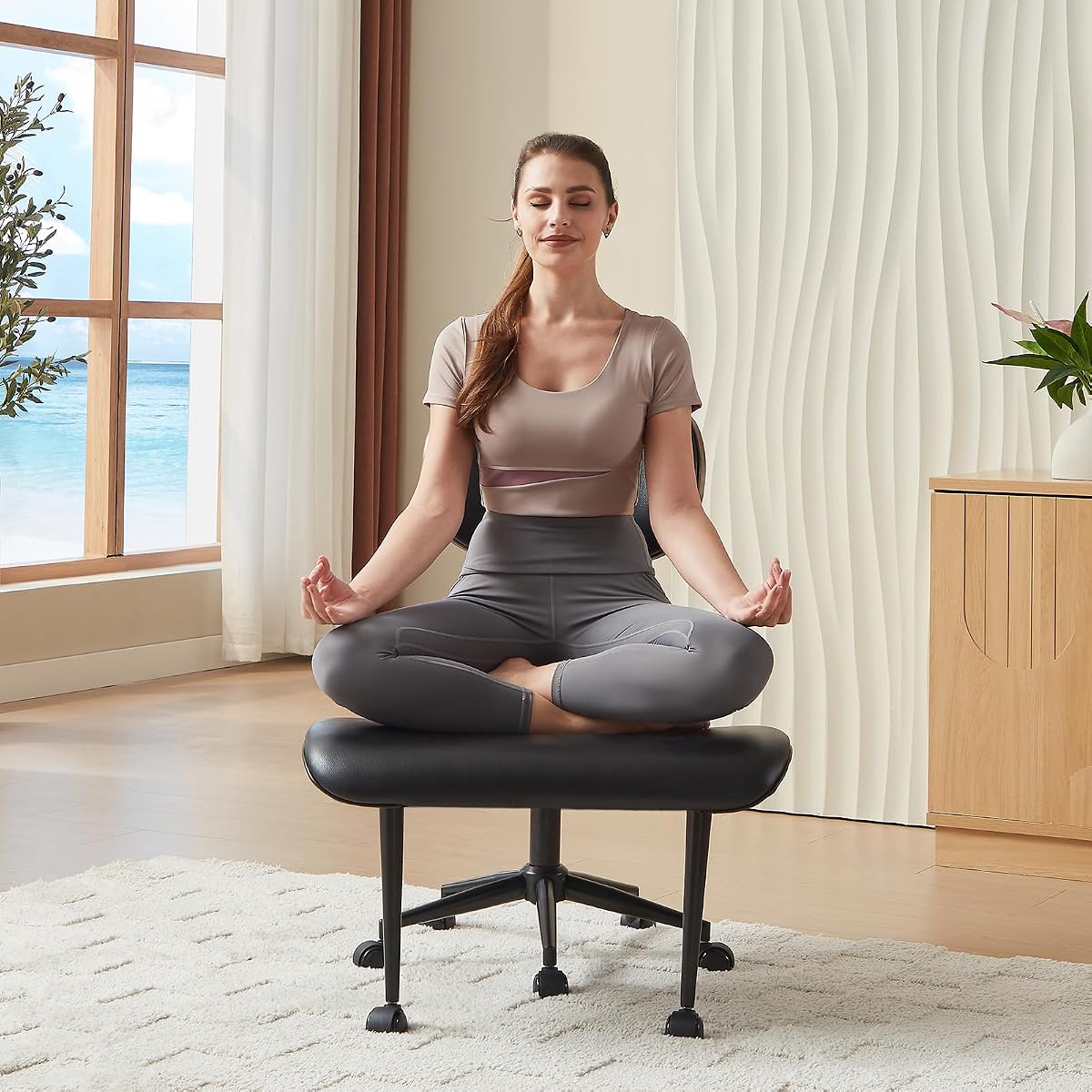
The Criss Cross Legged Office Chair with Wheels offers the most budget-oriented way to enter the active-sitting category. It has a 4.1 rating and supports cross-legged, kneeling, squatting, and relaxed sitting, while a high-density foam cushion supplies the primary layer of comfort.
We may earn a commission when you buy through this link, at no additional cost to you.
Its adjustable footrest can be moved closer or farther away and raised to fit different leg angles, offering more support than a fixed stool. The description also states that the footrest can support the feet while the user sits cross-legged. A five-star base and silent casters provide smooth movement, and the listed capacity of up to 300 pounds is a useful, clearly stated specification for buyers concerned with stability.
The chair lacks listed armrests, and the supplied information does not highlight a dedicated lumbar mechanism, so it is less suitable for buyers seeking highly adjustable forearm or lower-back support. The PU leather is described as soft and spill-proof, and the cushion is intended to resist flattening, though the more extravagant wording in the listing should be evaluated alongside the more moderate 4.1 feedback score.
This is a compelling choice for a home office, gaming setup, or meditation area where flexible positioning matters more than a luxury finish. It is particularly suitable for active users who want a supportive footrest and stable rolling base without paying for a more mechanically elaborate premium model.
The footrest can be adjusted in both depth and height, allowing the user to change lower-leg support as the posture changes. It therefore serves as a functional component of the chair rather than a small decorative attachment.
Silent casters and a five-star base let the user move between a desk, a reading area, and a meditation space. The stated 300-pound capacity also gives this budget model a useful measure of structural confidence.
We may earn a commission when you buy through this link, at no additional cost to you.
This DUMOS listing shares the same core design as the top-ranked chair and also holds a 4.6 rating. It provides a height-adjustable backrest, a nearly four-inch-thick seat, a nearly 30-by-16-inch rotating footstool, and a 360-degree rotating seat and base.
We may earn a commission when you buy through this link, at no additional cost to you.
Its versatility is the principal attraction. The seat height can move from zero to 4.7 inches, while the rotating footstool can follow the user's knees, ankles, or feet. The chair supports cross-legged, squatting, kneeling, meditation, and conventional desk positions. An open design makes it easier to reach beneath the seat for cleaning, which is particularly useful in a home office or shared living area.
The SGS-certified hydraulic cylinder, steel base, and heavy-duty casters suggest attention to durability, but the supplied information does not state a maximum weight capacity. As with the related DUMOS model, there are no listed armrests, which may limit ergonomic support for continuous typing. The listing also mentions teddy bear fabric and easy-clean PU leather options, so finish availability should be checked carefully.
This version is best for buyers who value the proven comfort rating, broad seat, and rotating support components. It suits a user who alternates between work and meditation and wants a relatively open, cleanable design. It also works well for a study area where a low chair can support several floor-oriented postures.
A nearly four-inch cushion gives the hips a substantial landing area and allows the user to sit more deeply than on a thin folding meditation stool. That makes it a more practical office-adjacent option for extended work periods.
The open construction leaves fewer deep crevices around the base and seat. That design can make everyday cleaning faster, particularly in spaces where the chair will also be used for eating, meditation, or other activities.
We may earn a commission when you buy through this link, at no additional cost to you.
The Criss Cross Office Chair is the most feature-rich option in this comparison and carries the highest customer feedback rating at 4.8. Its defining upgrades are a 21-inch-wide seat, a four-inch-thick leather cushion, dual lumbar support, six-direction 3D armrests, and a retractable padded footrest.
We may earn a commission when you buy through this link, at no additional cost to you.
The armrests can move up, down, forward, backward, left, and right, allowing the user to reposition them around the body when moving from typing to cross-legged sitting. Flip-up placement also helps the chair slide under a desk. Dual back support is intended to preserve the spine's natural curvature, while the low front edge reduces pressure behind the knees when the user kneels or tucks the legs underneath. The retractable footrest adds support without forcing a separate stool into the workspace.
The chair supports standard, cross-legged, kneeling, and squatting positions, making it genuinely multi-use. Its five silent casters move smoothly, while the SGS-certified gas lift and steel base support up to 200 pounds. That capacity is lower than the 300-pound figure listed for the budget model, so buyers should check their needs carefully. The larger adjustment system also adds more moving parts and a more complex setup than a basic chair.
This is the premium recommendation for a user who spends serious time at a desk but needs frequent posture changes. It is particularly well suited to a dedicated home office where arm support, lumbar support, and foot placement can all be customized. For buyers seeking the broadest feature set and highest supplied rating, it is the most complete option.
The 21-inch seat is the largest stated width in the group and creates substantial room for tucking, crossing, or repositioning the legs. Its low front edge also makes kneeling more comfortable than it would be on a squared-off conventional seat.
Dual back support, a thick cushion, movable armrests, and a padded retractable footrest address the main support areas at once. That coordinated approach is the key reason this model stands above simpler cross-legged chairs.
We may earn a commission when you buy through this link, at no additional cost to you.
The Bestier Cross Legged Office Chair combines a 4.2 rating with a distinct two-layer seat designed for cross-legged, squatting, and kneeling positions. Its modern black PU leather finish and curved backrest are intended to fit into a home office without looking like a specialized meditation stool.
We may earn a commission when you buy through this link, at no additional cost to you.
The two-level height mechanism changes the seat setup rather than offering a continuous range. Five rotating casters let the chair glide between a desk and other areas, while the spacious base and 360-degree swivel support active movement. The backrest and seat are shaped to follow the spine's natural curve, and the wide seat provides legroom for the posture changes this category is designed to enable.
PU leather is described as waterproof and wear-resistant, making cleanup straightforward. However, the product information does not provide a maximum weight capacity, detailed armrest arrangement, or a specific footrest adjustment range. The two-level height control is also less granular than the continuous adjustment found on several competitors, so prospective buyers should ensure the available positions suit their desk.
This chair is a good option for users who prioritize mobility, visual simplicity, and the ability to rock or swivel while working. It suits flexible workspaces, game areas, and homes where the chair will need to move between tasks. It is a practical middle ground for active sitters who want broad posture support without a highly complex armrest system.
The two-layer design changes the available leg space, allowing the user to move between conventional and floor-oriented postures. It gives active sitters options without requiring separate chairs for work and meditation.
The PU leather surface is easy to wipe clean, and five casters make it easy to move between work areas. These practical qualities suit shared rooms and busy home offices where furniture must be flexible.
We may earn a commission when you buy through this link, at no additional cost to you.
The YFO Ergonomic Cross Legged Office Chair has a 4.7 rating, making it one of the strongest performers by customer feedback. It is designed for adults who want to use the same chair for work, yoga, meditation, and active sitting, with a retractable footrest and 360-degree swivel at the center of its design.
We may earn a commission when you buy through this link, at no additional cost to you.
Rubber wheels are specified as suitable for wood floors, carpets, and marble floors, while also operating quietly. This makes the chair a practical choice for a home that combines several surfaces. The retractable footrest can support crossed legs or extended legs without permanently taking up floor space, and adjustable height works with the swivel base to create a range of positions.
A scratch-resistant, easy-to-maintain surface and a storage pocket in the back add convenience, particularly for users who keep a phone, tablet, or other small items nearby. On the other hand, no armrests or detailed lumbar mechanism are specified, and the supplied data does not state a maximum weight capacity. Those omissions make it less suitable for buyers who require extensive forearm adjustment or published load specifications.
This is a strong recommendation for a multi-surface home, meditation area, or flexible workspace. The 4.7 feedback score suggests broad satisfaction, while the retractable footrest and storage pocket improve everyday practicality. It is especially appealing to users who want to move around their environment without creating noise or damaging delicate floors.
Rubber wheels offer a useful combination of quiet operation and floor compatibility. The chair can move between carpet, wood, or marble without relying on hard casters that may be noisy or abrasive.
The backrest pocket keeps small personal items close without adding another piece of furniture. Combined with the retractable footrest, it improves convenience without permanently enlarging the chair's footprint.
We may earn a commission when you buy through this link, at no additional cost to you.
The AtHope Cross Legged Office Chair has a 4.2 rating and focuses on a wide, fully rotating footrest for people who alternate among cross-legged, squatting, and kneeling positions. The chair is marketed for home, office, and gaming use, making it a broadly relevant active-sitting option.
We may earn a commission when you buy through this link, at no additional cost to you.
The 360-degree footrest can be redirected without moving the entire chair, which helps the user maintain support while changing position. A fixed backrest provides consistent lumbar support during work or meditation, while the steel base and durable casters create a stable rolling structure. The cushion frame uses FSC-certified wood, adding a clearly stated material credential that is not present in most competing descriptions.
The PU leather seat is water-resistant and described as stain-proof, making it practical for everyday spills and simpler maintenance. However, the backrest is fixed rather than listed as adjustable, and the exact dimensions of the wider footrest are not provided. There is also no listed weight capacity, armrest system, or detailed seat-height range, so buyers should verify those points against current product information.
This chair is best for a user who prioritizes foot support and wants the ability to redirect the footrest independently. It is suitable for gaming rooms, home offices, and meditation spaces where a stable back and easy-clean upholstery are more important than extensive arm or lumbar adjustment.
A full-circle footrest follows the legs in different directions, reducing the need to twist or relocate the whole chair. It is particularly useful for cross-legged and kneeling users who want their feet and ankles supported.
The FSC-certified cushion frame and water-resistant PU leather combine sourcing information with practical maintenance. The result is a chair that is straightforward to clean and suitable for frequent daily use.
We may earn a commission when you buy through this link, at no additional cost to you.
The most useful ADHD office chair is not defined by a marketing label alone. Compare the range of supported postures, how well each adjustment follows body movement, the quality of lumbar and arm support, and whether the base and wheels suit the intended room.
An ADHD office chair should accommodate more than one way of sitting. The strongest models support standard, cross-legged, kneeling, and squatting positions, while some add a low front edge for shin pressure or a two-layer structure for additional legroom. A broad seat is useful because it lets the hips and knees move without forcing a constant edge-of-seat perch. Check whether the advertised posture is truly supported by the chair's geometry rather than simply naming a style in the product title.
Back support is critical because a low cross-legged seat places the spine at a different angle than a standard desk chair. A curved backrest can provide a general ergonomic shape, while a knob-adjustable lumbar support or dual back system allows the user to tune the contact point. A fixed backrest may be adequate for relaxed work, but it cannot accommodate every change in posture. Buyers who spend long periods typing should prioritize a backrest that remains supportive when the arms and shoulders move forward.
A properly positioned footrest prevents the legs and ankles from hanging while the user crosses or tucks the legs. The best options adjust for height and depth, retract to save space, or rotate through 360 degrees so support can follow the legs. A large foot platform is especially useful during cross-legged sitting because the user's feet and shins still need somewhere to rest. Buyers should also confirm whether the footrest moves independently or only turns as part of the chair.
Height adjustment helps align the chair with a desk, while tilt encourages subtle movement during focused work. Continuous adjustment is more precise than a two-level mechanism, although the latter may be adequate for one user and one desk. Armrests deserve equal attention: flip-up arms preserve cross-legged space, and 3D or multi-direction arms can move with the elbows as posture changes. A chair with no armrests may feel minimal, but it offers fewer support options during typing.
Thick foam or memory foam can reduce pressure during long sessions, but cushion density and seat width also influence how the chair feels. Wide seats distribute pressure more broadly, while a low front edge can make kneeling more comfortable. PU leather is easy to wipe clean and resists spills, making it practical for family offices and gaming areas. Fabric may feel more breathable, but it can require more attention when cleaning. The stated material options and maintenance requirements should be checked before ordering.
A five-star base and smooth casters make it easier to move between tasks, while a solid central column and gas lift support repeated height changes. Buyers should look for a stated weight capacity where possible, especially for a wide cross-legged chair. Rubber wheels are attractive in homes with wood or marble floors because they are described as quiet and less likely to scratch. Wide bases can also reduce tipping risk when the chair is moved into a cross-legged position.
The best active chair is one the user will actually enjoy setting up and maintaining. Some listings include all hardware and describe a tool-free or approximately fifteen-minute assembly, while others require the user to follow a more involved manual. A retractable footrest and back storage pocket can reduce visual clutter. For upholstery, waterproof or stain-resistant surfaces are easiest to maintain, while open frames are more accessible during cleaning. Consider the available space, the assembly process, and the surfaces in the room together.
Begin by matching the chair to your desk and primary posture. Set the seat to a comfortable low or mid-range height, place the backrest where it supports the natural curve of the spine, and adjust the armrests before settling into a long task. Use the footrest to support the feet, ankles, or shins while keeping the legs from dangling. A brief adjustment whenever posture changes is more useful than trying to find one perfect position for the entire day.
Move through postures as needed. Cross-legged sitting can provide a break from conventional desk work, while kneeling or squatting should be used only when comfortable and appropriate for the user's body. The rotating seat and footrest can make transitions easier, but users should avoid extending beyond the chair's listed capacity or making abrupt movements while the chair is extended. Users with back, knee, hip, or other physical concerns should consult a qualified health professional before adopting a new posture.
Wipe PU leather with a soft, damp cloth and clean the moving base periodically. Do not soak the cushion, hydraulic cylinder, or adjustable mechanisms, and avoid harsh chemical cleaners unless the manufacturer explicitly approves them. Check casters, footrest joints, height controls, and fasteners for looseness over time. For wood or marble floors, use the appropriate rubber wheels and avoid dragging the chair unnecessarily.
A suitable chair supports frequent position changes without forcing the body into one rigid posture. Adjustable height, a movable footrest, a wide seat, a supportive backrest, and smooth swiveling can make it easier to alternate among standard, cross-legged, kneeling, and relaxed positions. No chair guarantees improved focus, so comfort and fit remain individual.
It can, provided it meets the user's desk, support, and mobility needs. Some models provide armrests and continuous height adjustment for conventional typing, while others are better suited to relaxed or low-position work. A buyer who spends the entire day at a conventional desk should prioritize lumbar and forearm support before considering posture flexibility.
It can be useful when the user changes posture throughout the day, but laptop work should not automatically be done cross-legged. A stable screen and keyboard position, external equipment when needed, and frequent posture changes can make the setup more comfortable. The chair should never be treated as a substitute for a properly designed workstation.
Choose a height that lets the user work comfortably in the intended posture without the legs hanging or the knees being forced sharply upward. For standard desk use, the feet should be able to rest with the leg angle comfortable, often with the footstool available as needed. For cross-legged sitting, the seat should be low enough to open the hip angle without creating pressure behind the knees.
Assembly varies by model. Several products in this guide state that all required hardware is included and that setup can be completed in about fifteen minutes, while others do not provide a detailed assembly time. Follow the included manual, check that all parts are present before tightening components, and do not fully tighten fasteners until the chair is correctly aligned.
Generally, yes. PU leather is usually easier to wipe clean than fabric, and several of the listed chairs are specifically described as waterproof or stain-resistant. Spills should still be removed promptly, and harsh solvents should be avoided because they can damage the finish. The cushion, frame, and mechanisms should never be soaked.
Capacity differs substantially between models. One chair in this guide states support up to 300 pounds, while another states up to 200 pounds, and several listings do not publish a figure. Buyers should check the current product information and choose a model with a stated capacity comfortably above their own weight rather than assuming every wide active chair has the same limit.
They may help some users feel more comfortable and capable of changing position, which can make a focused task easier to sustain. That is different from treating ADHD or guaranteeing a specific level of productivity. A supportive environment, planned breaks, and an appropriate work routine remain important alongside the chair choice.
The DUMOS ADHD Meditation Chair is the best overall choice because it combines a strong 4.6 rating with an adjustable lumbar backrest, thick cushion, rotating seat, and independently rotating footstool. The Criss Cross Legged Chair with Wheels is the best budget option, while the feature-rich Criss Cross Office Chair stands out as the best premium pick with dual support, 3D armrests, and the broadest seat.
Prioritize the features that match your actual routine. A multi-surface home may benefit most from the YFO chair's quiet rubber wheels, a compact room may favor the flip-up arms and rotating footrest of the Cross Legged Chair with Arms, and conventional typing may require the premium model's forearm support. The right chair should accommodate natural movement while remaining stable, comfortable, and easy to maintain.
Finally, verify the current listing, specifications, customer feedback, and availability before ordering. Chair designs, finishes, adjustment ranges, and other product details can change over time, and prices fluctuate as well. Comparing the latest information against the strengths in this guide will help narrow the field without sacrificing the features that matter most to your work style.
