
Grandstream HT802 V2
4.5Editor score
Dual FXS analog ports
Encrypted SIP communications
Automated provisioning support
Analog Telephone Adapter guide comparing ten options for port count, SIP features, security, fax support, network connectivity, and practical office use.
An analog telephone adapter, or ATA, lets traditional phones, fax machines, and paging equipment connect to VoIP or SIP-based networks. The most useful model balances port capacity, provisioning, call quality, security, and administrative flexibility while fitting the scale and complexity of your particular installation.
We compared all ten adapters using their stated specifications, supported protocols, network interfaces, and user ratings. The guide covers compact single-port units, two-port business adapters, Cisco enterprise models, and a feature-rich Grandstream gateway for installations requiring more analog connections.
Each review explains the adapter's strongest capabilities, practical limitations, and most suitable users. The top selections highlight particularly balanced choices, while the complete ranking helps offices, integrators, and remote teams match equipment to their networking and telephony requirements. Prices can change.
4.5Editor score

4.5Editor score

4.2Editor score
The following side-by-side comparison highlights each adapter's port capacity, network connection, security features, and specialized functions to help you identify the right model for a particular analog-to-IP deployment.




The Grandstream HT802 V2 is a two-port analog telephone adapter built for offices that need to retain conventional phones while moving call traffic to SIP. Its 4.5 rating reflects a favorable balance of useful capabilities, including two FXS ports, two SIP profiles, encrypted communications, and a compact design suited to small deployments.
We may earn a commission when you buy through this link, at no additional cost to you.
The adapter supports 10/100Mbps Ethernet, TLS, and SRTP, providing a practical foundation for VoIP security. Automated TR-069 and XML configuration options simplify administration, while a three-way voice conferencing function, wide caller ID format support, and automatic failover to a secondary SIP server make it more versatile than a minimal converter.
Its main limitation is the 10/100Mbps Ethernet interface, which may be less attractive for installations that want a gigabit uplink. Grandstream also strongly recommends upgrading every HT802 V2 to firmware version 1.0.19.11 or the latest available release. Buyers should factor that recommendation into deployment planning rather than treating it as an optional refinement.
This is a strong selection for small offices, branch locations, and service providers needing two analog endpoints with reliable SIP functionality. Choose it when value, provisioning, failover, and fax support matter more than a gigabit network port or the additional routing capabilities of the HT812 V2.
Two FXS ports allow two analog devices to register against two SIP profiles, making the adapter useful for a small office, reception desk, or legacy equipment room. This provides more flexibility than a single-port unit without moving into a larger gateway category.
TR-069 and XML file provisioning support remote configuration, while automatic SIP server failover adds operational resilience. Together, these features make the adapter easier to deploy and maintain across multiple sites.
We may earn a commission when you buy through this link, at no additional cost to you.
The Grandstream HandyTone 801 is designed for users who need to connect one traditional telephone to a SIP network. It has a 4.1 rating and offers a focused feature set with one FXS port, one SIP profile, one 10/100Mbps Ethernet connection, encrypted communication, and three-way voice conferencing.
We may earn a commission when you buy through this link, at no additional cost to you.
Its most attractive quality is straightforwardness. A single analog endpoint can be introduced without deploying a multi-port gateway, and automated TR-069 or XML file provisioning supports centralized management. TLS and SRTP add important protections for SIP signaling and media, while the compact corded black unit should fit comfortably into a home office, small business, or branch location.
The obvious limitation is scalability. A single FXS port cannot accommodate a desk, phone, fax machine, and paging terminal simultaneously, and the 10/100Mbps Ethernet port is not intended for demanding high-bandwidth networking. Users who may add more analog endpoints soon should consider a two-port model instead.
The HandyTone 801 makes the most sense for one user, a temporary branch endpoint, or a dedicated fax line where a straightforward adapter is sufficient. It is also a practical option for anyone who wants to preserve one existing phone while gradually moving communications to VoIP.
The single FXS port gives an existing analog telephone direct access to a SIP account or trunk. This is ideal when only one legacy device needs to remain in service and additional capacity is not anticipated.
TLS and SRTP support protect communications, while TR-069 and XML provisioning allow administrators to maintain consistent settings. These are meaningful features in a device intended to reduce analog telephone infrastructure.
We may earn a commission when you buy through this link, at no additional cost to you.
The original Grandstream HT802 is a two-FXS-port adapter that provides a straightforward path from analog telephones to SIP services. Its 4.3 rating and long-standing place in the Grandstream product line make it a practical option for users who value a familiar platform and uncomplicated expansion.
We may earn a commission when you buy through this link, at no additional cost to you.
The unit supports two SIP profiles, two analog ports, and one 10/100Mbps Ethernet connection. TLS and SRTP are included for encrypted communications, while TR-069 and XML file provisioning support administrators handling multiple locations. Its focused design is especially effective for a reception area, small office, or pair of legacy extensions.
Compared with the HT802 V2, this model has a less extensive published feature list. The newer V2 explicitly includes indicators, failover, fax support, three-way conferencing, and additional caller ID capabilities, so buyers prioritizing the latest feature set should compare them carefully. The older model remains relevant when a familiar configuration and two-port simplicity are the main requirements.
This HT802 is best for small businesses seeking two analog endpoints with core SIP security and remote provisioning. It suits users who do not need a high-performance router, extensive fax functions, or the additional management options highlighted by the V2 model.
Each FXS port can be associated with its own SIP profile, allowing a compact adapter to support two separate analog extensions. That is a more useful capacity than a single-line unit for offices with multiple users.
TR-069 and XML configuration options make the HT802 suitable for staged or distributed rollouts. The result is a device that covers the essential VoIP conversion functions without requiring a larger gateway.
We may earn a commission when you buy through this link, at no additional cost to you.
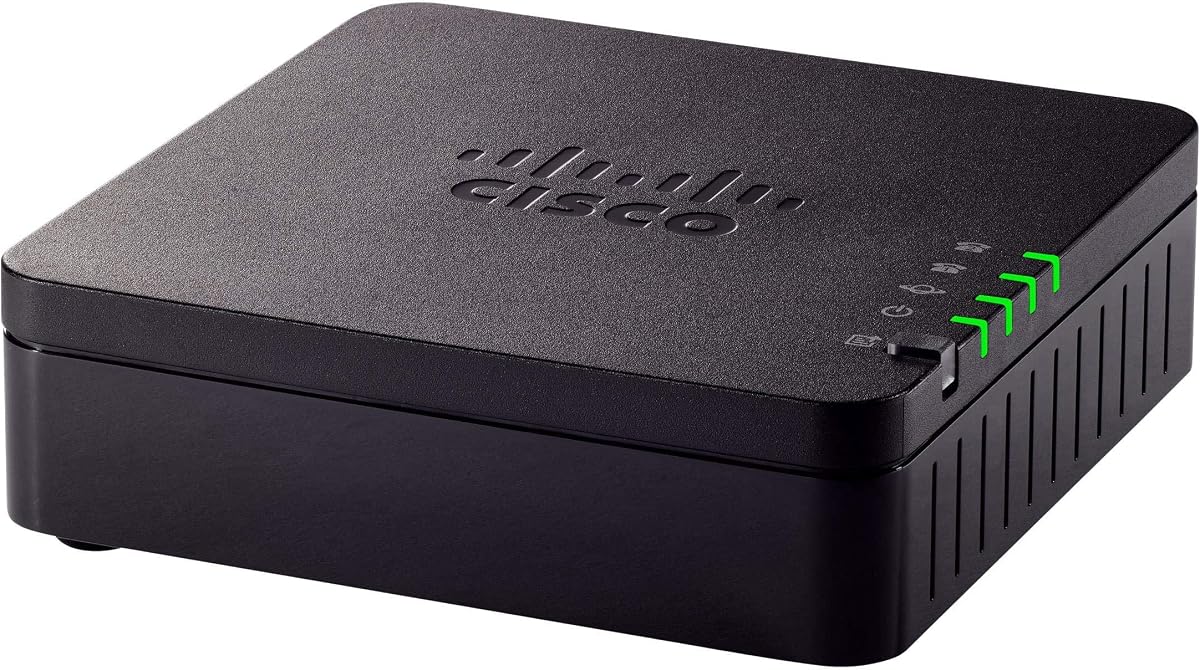
The Cisco ATA 191 is a two-port analog telephone adapter aimed at organizations that place a premium on call handling and enterprise-oriented security. It carries a 4.2 rating and provides two RJ-11 FXS ports, one 10/100Mbps RJ-45 Ethernet port, and a one-year limited hardware warranty.
We may earn a commission when you buy through this link, at no additional cost to you.
Its standout feature is voice processing. Advanced preprocessing, high-performance echo cancellation, voice activity detection, and comfort noise generation are designed to produce clear, natural-sounding conversations. These capabilities are particularly relevant where analog desk phones sit at a distance from callers, hands-free use is common, or call quality is a visible part of the business service.
Security is another strength. The adapter supports TLS, SHA-2, and newer SRTP cipher suites, giving administrators access to contemporary protection for signaling and media. These features make the ATA 191 well suited to managed enterprise networks, although it has no built-in Wi-Fi, routing capability, or fax emphasis.
The ATA 191 is best for enterprises, service providers, and business environments that value robust voice quality and strong protocol security over the convenience of a wireless network. Organizations replacing equipment gradually also gain from its ability to preserve existing analog investments while transitioning them onto IP infrastructure.
Echo cancellation, voice activity detection, preprocessing, and comfort noise work together to improve the real-world clarity of analog calls. These features distinguish the ATA 191 from basic converters focused mainly on registration and call routing.
Support for TLS, SHA-2, and modern SRTP cipher suites makes the adapter appropriate for managed communications environments. Administrators can align it with existing security policies and modern VoIP infrastructure.
We may earn a commission when you buy through this link, at no additional cost to you.
The FLYINGVOICE FWR8101 combines a one-port analog telephone adapter with 2.4GHz 300Mbps Wi-Fi, access point functionality, and repeater mode. Its 3.1 rating is the lowest in this group, but its unusual combination of features targets mobile professionals, temporary offices, and technical users who need both analog calling and local wireless access.
We may earn a commission when you buy through this link, at no additional cost to you.
The single FXS port connects a traditional phone to a SIP line, while AP mode can create a local network in a hotel, coworking space, or field office. Repeater mode can extend available wireless coverage, and T.30 and T.38 support covers fax-over-SIP applications when the required PBX or ISP registration is available.
This is not a casual plug-and-play consumer phone. The supplied information specifically describes it as a business-grade adapter requiring PBX or SIP services, making it better suited to IT professionals, system integrators, and enterprise buyers. Its 2.4GHz-only Wi-Fi also provides less flexibility than a dual-band or gigabit-oriented design.
The FWR8101 is worth considering when analog calling and temporary Wi-Fi must be supported by one compact device. It is less attractive for a standard office with reliable wired Ethernet, and the lower rating suggests buyers should carefully validate the complete configuration before committing to a broader deployment.
AP mode turns the adapter into a temporary local network, while repeater mode can extend wireless coverage. This makes it useful for mobile professionals and consultants who need a practical connection method away from a conventional wired network.
T.30 and T.38 fax support is relevant to healthcare, legal, and government workflows that may still rely on analog fax equipment. PBX or ISP registration is required, so compatibility should be confirmed before installation.
We may earn a commission when you buy through this link, at no additional cost to you.
The renewed Cisco ATA 192 is a two-port adapter designed to bring traditional telephones, fax machines, and overhead paging equipment onto IP networks. It has a 4.1 rating and is presented as a practical transition tool for enterprise networks, small offices, and cloud-based unified communications services.
We may earn a commission when you buy through this link, at no additional cost to you.
Its primary benefit is continuity. Existing analog equipment can remain in service while voice traffic moves to an IP-based environment, reducing the need for an immediate wholesale replacement of phones and peripherals. The two-port format is more useful than a one-line converter for reception desks, administrative areas, or businesses maintaining multiple analog functions.
The renewed condition is the most important consideration. Buyers should review the listing's warranty and condition details carefully, particularly for equipment expected to remain in service continuously. The supplied description is less detailed than that of the ATA 191, so exact interface and protocol expectations should be confirmed with the seller before deployment.
This adapter is a sensible choice for organizations that already depend on Cisco-oriented infrastructure or need to preserve analog equipment during a phased move to UCaaS. It is especially attractive where budget and equipment continuity matter, provided the condition meets the buyer's operational standards.
The ATA 192 allows offices to transition individual analog endpoints rather than replace every device at once. That flexibility is valuable when a facility must modernize communications gradually.
Designed for enterprise networks, small offices, and cloud UCaaS environments, the adapter can bridge existing hardware into modern communication workflows. Compatibility with the intended service and network should always be verified.
We may earn a commission when you buy through this link, at no additional cost to you.
The renewed Cisco ATA 191 combines a two-port analog interface with enterprise-focused voice processing and security. Its 4.3 rating is among the stronger results in the roundup, making this renewed option attractive for organizations that want ATA 191 capabilities at a more acquisition-conscious level.
We may earn a commission when you buy through this link, at no additional cost to you.
The adapter includes advanced preprocessing, high-performance echo cancellation, voice activity detection, and comfort noise generation to support clear calls. Two RJ-11 FXS ports allow existing analog devices to operate on the IP network, while TLS, SHA-2, and newer SRTP cipher suites address modern signaling and media security needs.
As with any renewed product, appearance, wear, and remaining operational life may vary. The Ethernet interface is limited to 10/100Mbps, which is generally adequate for voice but may not match the capacity of newer network infrastructure. Buyers should also confirm that the provider's provisioning options and service expectations fit the deployment.
This renewed ATA 191 suits cost-conscious enterprises, branch offices, and system integrators that value Cisco's voice and security feature set. It is a compelling alternative when a new unit is unnecessary but the buyer still wants a capable two-port adapter for legacy phones or fax equipment.
Echo cancellation and voice activity detection help preserve clarity on analog endpoints, while comfort noise can make silence feel more natural. These processing features are especially valuable for business desks and shared office spaces.
Two FXS ports support more than one analog device, while TLS, SHA-2, and SRTP suites protect communications. That combination suits organizations balancing legacy hardware with contemporary security requirements.
We may earn a commission when you buy through this link, at no additional cost to you.
The ATA 187 is a refurbished analog telephone adapter with a 4.5 rating, placing it among the most positively reviewed products in this guide. Its supplied specifications are limited, describing one RJ-45 connection as well as ROHS and WEEE compliance, so the appeal lies in a simple, economical bridge for appropriate legacy equipment.
We may earn a commission when you buy through this link, at no additional cost to you.
For organizations that already understand the ATA 187 and need a replacement unit, preserving compatibility with established infrastructure can outweigh the appeal of a more extensively specified new model. The RJ-45 connection is the key physical link between the analog side of the system and an IP network, allowing existing telephone equipment to remain in use.
The limited documentation is a meaningful drawback. Buyers cannot assess port count, voice codecs, encryption, provisioning, or fax support from the information provided, and refurbished condition introduces additional uncertainty. Compatibility with the intended SIP provider, PBX, and analog peripherals should be confirmed before purchase.
The ATA 187 is best for a technically informed buyer replacing matching legacy equipment or operating within an already standardized installation. For a new project where detailed capabilities must be evaluated, a product with more published specifications will usually be easier to justify.
A refurbished adapter can extend the useful life of established analog equipment and reduce the need for unnecessary replacement. It is most practical when compatibility is already proven and condition is acceptable.
The stated ROHS and WEEE compliance indicates attention to restricted-material and electronic-waste requirements. These attributes can matter for organizations with formal procurement and environmental policies.
We may earn a commission when you buy through this link, at no additional cost to you.
The Grandstream 8-Port FXS Gateway is the highest-capacity conventional adapter in this roundup, with a 5.0 rating and eight analog FXS connections. It is designed for offices that need to preserve numerous traditional endpoints while using an IP-based voice infrastructure.
We may earn a commission when you buy through this link, at no additional cost to you.
Two RJ-45 connections and Gigabit Ethernet distinguish this model from the compact ATAs that use a single 10/100Mbps port. Its integrated Gigabit NAT router can serve as part of the network design, making it more appropriate for a small branch or centralized analog termination point rather than a single desk.
Because the supplied product information is brief, buyers should verify SIP account limits, codecs, provisioning methods, and management options before finalizing a purchase. The device is also physically and functionally more substantial than a one- or two-port adapter, so it would be inefficient for a home office with only one analog phone.
This gateway is best for schools, clinics, hotels, small enterprises, and other organizations with a sizable collection of analog phones, fax machines, or paging devices. It provides the clearest route to retaining multiple legacy endpoints without deploying several separate two-port adapters.
Eight FXS ports consolidate multiple traditional devices into one gateway. This is a major operational advantage for facilities where deploying a separate adapter for every endpoint would be inconvenient and costly.
Gigabit Ethernet and an integrated NAT router provide more network headroom than the 10/100Mbps compact adapters. The gateway can therefore participate in a more complete small-office routing arrangement.
We may earn a commission when you buy through this link, at no additional cost to you.
The Grandstream HT812 V2 is a feature-rich two-port VoIP ATA with a 4.5 rating. It combines two FXS connections and two SIP profiles with encrypted communications, T.38 fax support, three-way voice conferencing per port, wideband HD codec support, and a high-performance NAT router.
We may earn a commission when you buy through this link, at no additional cost to you.
Its broad feature set makes it particularly attractive for small offices that need more than a basic analog-to-SIP bridge. T.38 support is useful for Fax-over-IP, while the NAT router can assist with network routing. Per-port conferencing expands call-handling options, and wideband HD codec support targets improved voice quality.
The adapter remains limited to two analog ports, so it is not suitable for a facility with a large legacy phone inventory. Its router and advanced feature set also make it more complex than the HT801, which may be unnecessary for a user connecting only one basic phone. Encryption certificate and SIP configuration should be handled carefully during setup.
The HT812 V2 is an excellent choice for small businesses, integrators, and branch offices that want two analog lines plus useful enterprise-style features without moving to an eight-port gateway. It is our Editor's Choice for buyers who prioritize a broad, practical feature set in a compact two-port format.
T.38 fax, per-port three-way conferencing, and wideband HD codecs make the HT812 V2 more versatile than a minimal line converter. It is better suited to active business workflows that still involve multiple analog functions.
AES encryption and a unique security certificate per unit support protected deployment, while the high-performance NAT router handles local network routing. These capabilities are valuable in managed branch and small-office environments.
We may earn a commission when you buy through this link, at no additional cost to you.
The right analog telephone adapter depends on endpoint count, SIP environment, voice quality requirements, management needs, and the types of legacy equipment that must remain online. Reviewing these factors before purchasing can prevent costly compatibility problems.
An FXS port provides the analog line interface used by traditional phones, fax machines, and paging devices. Single-port adapters are appropriate when there is exactly one legacy endpoint, while two-port models are more practical for reception desks, paired extensions, or separate phone and fax lines. An eight-port gateway is designed for larger offices with many analog devices. Counting the equipment that must remain connected is the essential first step, because adding ports later can complicate network layout, cabling, and provisioning.
Choose the smallest model that comfortably covers current and foreseeable endpoint needs. Avoid paying for unnecessary capacity, but leave room for at least one additional line if the installation is likely to expand.
An ATA converts between analog voice equipment and a SIP signaling environment, but it is not automatically compatible with every provider or PBX. Confirm support for the required SIP account format, registrar settings, codecs, and extension model. Some products are explicitly positioned for PBX or SIP registration, while others may assume an established multiplatform provisioning system. Fax, paging, and special call-handling features can impose additional compatibility requirements.
Ask the provider for a supported equipment list and obtain the configuration parameters before ordering. A technically capable adapter will not provide reliable service if its provisioning method or signaling behavior differs from the platform it must join.
Basic connectivity does not guarantee a good calling experience. Look for echo cancellation, voice activity detection, comfort noise, and suitable codec support, especially for shared offices, reception areas, or hands-free use. The Cisco ATA 191 stands out for its documented processing features, while the Grandstream HT812 V2 supports a wideband HD codec. Existing analog phones and the quality of the local telephone lines can also affect the final result.
Prioritize adapters with active call-quality processing when users will depend on the system for daily business calls. In all cases, test the intended phones and network path because analog noise, cabling, and SIP endpoint settings can affect performance.
VoIP signaling and media travel across an IP network, so encryption support should be treated as a core requirement rather than an optional refinement. TLS protects signaling sessions, while SRTP protects real-time media. Some products add SHA-2 or AES and provide a security certificate for each unit. The correct choices depend on the organization's security policy and the capabilities of the SIP server or hosted service.
Select an adapter that supports the encryption methods accepted by your telephony platform. Confirm that certificates, keys, and credentials can be deployed securely and maintained over the adapter's expected service life.
Facilities that still rely on analog fax equipment need an adapter with explicit T.38 support for reliable Fax-over-IP. The Grandstream HT802 V2, HT812 V2, and FLYINGVOICE FWR8101 advertise fax capabilities, with the FLYINGVOICE also supporting T.30. Overhead paging and other specialized devices may have different line, ring, or power requirements that should be checked before installation.
Verify every legacy peripheral rather than assuming that a working telephone will work on the same port configuration. Fax compatibility also depends on the PBX, ISP, and fax provider correctly handling the required protocols.
Most compact ATAs use a single 10/100Mbps Ethernet connection because ordinary voice traffic has modest bandwidth requirements. Larger gateways may offer Gigabit Ethernet and integrated NAT routing, which can simplify a branch network. The FWR8101 adds 2.4GHz Wi-Fi with AP and repeater modes for temporary offices, though it is intended more for business deployments than casual home use. The network interface should match the site without making the adapter unnecessarily complicated.
Wired Ethernet is generally preferable for a permanent installation because it is stable and straightforward to manage. Consider integrated routing only when it solves a real network-design requirement and is supported by the wider environment.
ATAs are most useful when they can be configured consistently across many sites. TR-069 and XML file provisioning, cited by multiple Grandstream models, allow administrators to automate configuration and update devices. Zero-configuration support with compatible UCM systems can further simplify operations. Other platforms may use their own management methods, so administrators should determine whether standalone setup is required or remote fleet management is the priority.
For a handful of devices, manual configuration may be sufficient. For distributed installations, automated provisioning is usually the difference between quick deployment and ongoing administrative work.
New and renewed adapters should be evaluated on more than their specifications. Renewed Cisco models can provide excellent value, but their physical wear, warranty coverage, and remaining service life vary. The ATA 191 includes a one-year limited hardware warranty, and the renewed ATA 191 listing states the same. Check the listed condition, included accessories, firmware availability, and seller support before choosing refurbished equipment.
For a critical office installation, warranty and support may outweigh a small acquisition-cost difference. For a secondary endpoint or a proven compatibility requirement, a renewed unit can be a sensible choice after those conditions are understood.
Begin by identifying the SIP or PBX configuration details, including server addresses, account credentials, transport requirements, codecs, and any provisioning instructions. Connect the adapter to the network, update its firmware when applicable, and configure the number of SIP profiles to match the available FXS ports. Only then connect the analog telephone, fax machine, or paging device to the appropriate analog port.
Test one endpoint at a time with an outbound call, an inbound call, transfer, hold, and conferencing function. Confirm that the caller ID appears correctly, that voice is clear, and that echo or delay are acceptable. For fax deployments, verify both transmission and reception, and for repeater or access-point modes, confirm that the selected wireless configuration matches the site's network plan.
Keep the adapter in a ventilated, dry location with the cables routed to prevent strain or accidental disconnection. Record its configuration, protect access to provisioning and SIP credentials, and schedule periodic checks of firmware, service status, and call quality. If a device performs inconsistently, save the settings, review the logs where available, and test a known-good phone or network path before replacing the adapter.
An FXS port emulates a telephone exchange line and lets an analog telephone receive a dial tone and place or receive calls through the adapter. An FXO port instead connects the adapter to an analog line from a telephone company or another provider. Most adapters in this guide provide FXS ports because their purpose is to connect legacy handsets to VoIP.
Yes, provided the hosted provider supports the adapter and supplies compatible SIP account information. Some providers publish approved device lists or offer specific provisioning instructions. You should confirm SIP registration requirements, supported codecs, number of channels, and any service restrictions before installing a generic adapter.
The number depends on the number of FXS ports: the HandyTone 801 supports one, most two-port models support two, and the Grandstream eight-port gateway supports eight. Each connected device may also require its own SIP account or channel. A multi-device PBX can sometimes handle registration details differently, so its capacity must be confirmed.
Some do, but the fax protocols must be supported end to end. T.38 provides reliable Fax-over-IP, while T.30 is also supported by the FLYINGVOICE FWR8101. The PBX, SIP provider, fax service, and analog fax machine must all be compatible for successful transmission and reception.
It can be a sensible purchase when the device is well known, the condition is accurately described, and adequate warranty coverage is offered. Review the seller's condition notes and return terms, and confirm compatibility with the intended SIP platform. Renewed equipment is most attractive for secondary endpoints or organizations that already know the model.
Usually not. Most compact ATAs are designed to connect to an existing Ethernet network and obtain addressing and routing from it. An integrated NAT router can be useful for a branch deployment, but it also introduces additional configuration and security responsibilities. Choose routing features only when they solve a defined network requirement.
Use quality telephone cabling, avoid sharing susceptible lines with unnecessary interference, and keep the adapter's firmware current. Adapters with echo cancellation, voice activity detection, and comfort noise can improve conversations, but the quality of the analog phone and local line also matters. Test the complete path to determine whether a problem originates in the endpoint or the network.
Choose one port for a single legacy phone, two ports for a typical small office with multiple analog endpoints, and eight ports for a facility with a large analog inventory. Count the devices that need service, consider likely expansion, and select the least complicated model that provides sufficient capacity.
The Grandstream HT802 V2 stands out as the best overall value because it combines two FXS ports, encrypted SIP communications, automated provisioning, failover, and fax support. The Grandstream HT812 V2 offers an even broader feature set with NAT routing, wideband codecs, and T.38 support, while the Cisco ATA 191 is the premium choice for advanced voice processing and enterprise security.
Prioritize the factors that directly affect your installation: match the FXS port count to the number of legacy devices, confirm SIP and PBX compatibility, and verify fax or paging requirements. Voice processing matters for daily business calls, while provisioning becomes increasingly important as the number of sites grows. A wired gigabit gateway is appropriate for larger deployments, whereas a single-port adapter is sufficient for one isolated endpoint.
Finally, check current product details, availability, and prices before ordering, since commercial listings and prices can change. The correct adapter is not merely the one with the most features; it is the one that connects your existing equipment securely, manages it reliably, and fits the way your organization will actually use VoIP.