
Gideal Dual-Sided Yellow Sticky Traps
4.2Editor score
Twenty dual-sided plant traps
Twist ties and stands included
Waterproof outdoor construction
Our Aphid Traps guide compares ten plant-safe sticky traps for houseplants and gardens, highlighting coverage, placement, durability, and effectiveness for
Aphid traps provide a practical way to monitor and reduce flying plant pests without relying on a pesticide spray. The best options use bright surfaces, reliable adhesive, and flexible placement methods suited to pots, garden beds, greenhouses, and windowsills. Effective results depend on choosing the right design for the plants and locations being protected.
We compared ten yellow sticky-trap products based on their stated pest coverage, trap quantity, mounting options, adhesive construction, environmental resistance, and suitability for indoor or outdoor plants. The list includes flat cards, stake-style traps, and hanging designs, giving readers alternatives for different collections, growing spaces, and pest-control routines.
Each pick highlights a specific strength, from broad multi-plant coverage to discreet houseplant placement and long-lasting outdoor use. Product ratings and availability can change over time, so shoppers should compare current listing details, confirm the included hardware, and recheck pricing before making a purchase.
4.2Editor score
4.5Editor score

4.5Editor score
The following side-by-side comparison shows the trap format, quantity, mounting approach, and intended growing environment for each option, making it easier to select a product for houseplants, gardens, or greenhouses.


Gideal's 20-pack is a straightforward, versatile option for shoppers seeking inexpensive yellow traps for several kinds of flying plant insects. It has a 4.2 rating, and its strongest qualities are the 6-by-8-inch format, adhesive on both sides, and included twist ties and stands. The listed targets include aphids, whiteflies, fungus gnats, leafminers, thrips, fruit flies, and midges.
We may earn a commission when you buy through this link, at no additional cost to you.
The 20 traps can be placed around pots, tied near branches, or mounted in bright outdoor locations. Bright yellow is an important functional detail because the traps are intended to attract susceptible insects, while the waterproof construction allows use in changing conditions. The product description also states that the traps withstand temperature fluctuations, making them more broadly useful than a basic indoor card.
The main limitation is the number of traps relative to options with 40, 64, 72, or 100 units. Twenty cards may be less effective when spread across a large garden, greenhouse, or collection containing many infested plants. The product is also intended for plant-associated flying insects rather than mosquitoes, so buyers should not treat it as a general household mosquito-control solution.
This is a sensible budget pick for houseplants, balcony pots, windowsills, and small garden areas. Buy it when affordability and included mounting accessories matter more than maximum coverage. For a larger growing operation, choose a higher-count pack or purchase enough traps to create meaningful interception zones around affected plants.
The included twist ties and two stands make it possible to suspend a trap or hold it in a growing area. This flexibility helps shoppers position cards near infested foliage without permanently attaching them to a plant.
The adhesive surface targets several common flying plant pests rather than only aphids. That makes the pack practical for gardeners who have not yet identified every insect present in the affected area.
We may earn a commission when you buy through this link, at no additional cost to you.
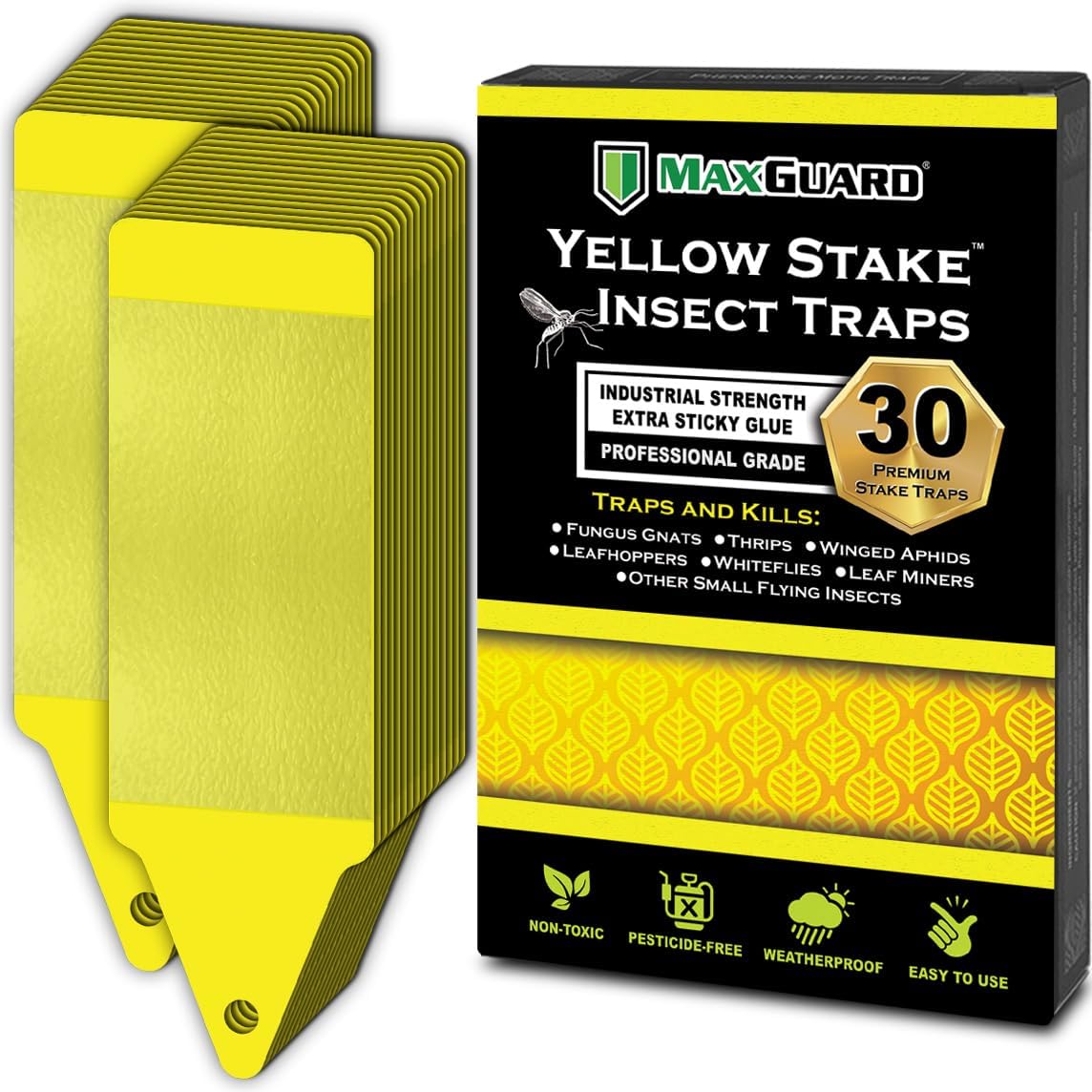
MAXGUARD's 30-pack combines a stake format with hanging capability, making it one of the most adaptable products in the comparison. Its 4.5 rating reflects a well-rounded offering with a three-times-thicker glue layer than standard traps, a simple plant-mounted design, and coverage for fungus gnats, whiteflies, aphids, leafminers, mosquitoes, and other flying insects.
We may earn a commission when you buy through this link, at no additional cost to you.
The garden-themed stake is designed to blend more naturally with potted plants than a conspicuous card. Buyers can insert it directly into soil or use the provided twist ties to hang it near branches. The industrial-grade adhesive is described as remaining effective through rain or sunshine, while the manufacturer states that a trap can remain useful for up to six months if it is not filled.
The trade-offs are mostly practical. A stake works best where there is soil or another support surface into which it can be secured, while hanging may be preferable near greenhouse racks or larger plants. Users must remove the backing paper to activate the adhesive, and traps should be replaced when full rather than on a fixed schedule. No pesticide or insecticide is included, so this is a physical trapping method rather than a treatment that kills insects through ingestion.
This is an excellent choice for houseplant collections, greenhouses, patios, and mixed outdoor gardens. Its flexible mounting, substantial adhesive, and 30-trap count make it a strong all-around recommendation. Select it when you want an easy-to-position trap that can be inserted near plant growth or suspended where flying insects are active.
Unlike fixed-format cards, this trap can be inserted into a pot or hung with a twist tie. That versatility makes it easier to adapt to changing plant locations and pest activity.
The manufacturer describes the glue layer as three times thicker than standard traps. This is especially relevant for outdoor installations exposed to heat, rain, and repeated watering cycles.
We may earn a commission when you buy through this link, at no additional cost to you.
LFSYS offers the highest customer rating in this group, with 4.6 stars, alongside a substantial 64-trap count. Its strongest appeal is the balance between broad coverage and a simple soil-insertion format. The yellow double-sided cards are advertised for mosquitoes, fruit flies, aphids, and other pests in gardens, kitchens, greenhouses, and potted plants.
We may earn a commission when you buy through this link, at no additional cost to you.
The product data describes the adhesive as chemical-free, strong, and free from odors. That feature may appeal to households looking for physical pest monitoring around food-producing plants or in living spaces. Because the traps can be inserted directly into soil, they are particularly convenient for a large group of container plants that need individual monitoring points.
One placement detail deserves attention: the manufacturer recommends cooling the cards before using them in warmer weather. This could add a small preparation step during hot conditions. The listed pest coverage also emphasizes fruit flies and mosquitoes alongside aphids, so buyers should confirm that the physical trap style is appropriate for their specific problem. As with all adhesive traps, performance depends on positioning and regular inspection.
This is the top choice for shoppers who want many traps and a high customer rating without moving to a specialized hanging design. It is especially attractive for greenhouses, indoor plant rooms, and gardens with numerous pots. Choose it when quantity, discreet chemical-free construction, and quick soil placement are your primary priorities.
Sixty-four cards provide more interception points than smaller packs. This is useful when monitoring multiple pots, greenhouse benches, or several separate areas around a property.
The cards use an adhesive that the manufacturer describes as chemical-free and odorless. They are designed to catch pests on contact without releasing a scent or insecticide into the growing area.
We may earn a commission when you buy through this link, at no additional cost to you.
This 40-pack combines functional yellow sticky traps with a decorative leaf-and-arrow silhouette, giving it a more finished appearance around houseplants. It carries a 4.4 rating and targets fruit flies, gnats, whiteflies, aphids, midges, and other small flying pests. The double-sided adhesive works from both directions, increasing the available interception area.
We may earn a commission when you buy through this link, at no additional cost to you.
Setup is straightforward: remove the protective film, insert the trap into soil, or hang it using the included wire. Its waterproof construction is intended to preserve function across indoor and outdoor conditions, including patio pots, windowsill herbs, houseplants, and greenhouses. The design is especially relevant to people who dislike the utilitarian appearance of plain rectangular cards.
Appearance should not be confused with exceptional capture performance. Like other passive traps, it works best when placed near pest activity, and insects covered by the adhesive can make the surface less effective over time. The product should also be checked periodically for dirt, debris, or captured insects. Outdoor placement near strong sunlight or exposed weather may shorten the useful life compared with a protected indoor placement.
This is a strong pick for aesthetically minded houseplant owners who want pest monitoring without conspicuous industrial-looking cards. It also offers enough units for a meaningful group of pots. Choose it when decorative compatibility and straightforward wire-stake placement matter alongside dependable double-sided adhesive.
The leaf-and-arrow outline is intended to blend into plant decor. That makes the traps more suitable for living rooms, shelves, and other spaces where visible pest equipment could be undesirable.
Each trap can be inserted into potting soil or suspended with its wire. This allows users to respond to plant growth and place monitoring cards where flying insects are most likely to contact them.
We may earn a commission when you buy through this link, at no additional cost to you.
Catchmaster GRO is built for broad coverage, with 72 double-sided cards and a 4.5 rating. Its listed uses span homes, farms, gardens, hydroponics, greenhouses, aeroponics, houseplants, and outdoor growing areas. The product also targets a wide collection of plant pests, including aphids, whiteflies, thrips, leafminers, fruit flies, fungus gnats, and other crawling or flying insects.
We may earn a commission when you buy through this link, at no additional cost to you.
The mounting flexibility is a major advantage. Traps can be placed against walls, positioned along paths, staked in the ground, or tied around live plants and trees. The manufacturer recommends using them in three vertical zones: below the canopy, within the middle of the canopy, and above it. This layered strategy is more useful for thorough monitoring than placing every card at soil level.
The stated lifespan of up to one year is conditional: the surface must remain clean, and the environmental conditions will affect the result. A large 72-pack may also be excessive for a single windowsill or a few indoor pots. Shoppers should consider storage requirements and whether they can deploy enough traps effectively rather than simply accumulating unused cards.
This product is a strong fit for serious gardeners, greenhouse operators, farmers, and hydroponic growers who need broad, structured coverage. It is less compelling for a tiny collection of houseplants, but its 72-count, three-zone placement guidance, and compatibility with numerous growing systems make it one of the most versatile options reviewed.
Positioning traps below, within, and above the plant canopy covers several flight paths. This layered arrangement is particularly useful in gardens and greenhouses where insects may approach from different heights.
The traps are suitable for soil-grown plants, greenhouses, hydroponics, aeroponics, and outdoor areas. Their water- and UV-resistant construction supports use in varied growing environments.
We may earn a commission when you buy through this link, at no additional cost to you.
MaxGuard's 20-pack is designed around an integrated hanging hook, providing a straightforward alternative to cards that must be staked into soil. It has a 4.0 rating and is marketed for fungus gnats, whiteflies, mosquitoes, aphids, leafminers, and other flying insects around indoor potted plants, greenhouses, and outdoor trees.
We may earn a commission when you buy through this link, at no additional cost to you.
The adhesive is described as four times thicker than other yellow sticky traps, and both sides are coated. Installation requires grasping the trap near the hook, removing the backing from both faces, and hanging it. This design avoids the need for clips or twist ties, which can make setup faster in greenhouse racks, around larger plants, or in locations where a ground stake is impractical.
Its biggest constraint is the requirement for a suitable suspension point. A hook, branch, rail, or other support must be available, and the trap must hang where insects can contact the adhesive. The 20-unit count is also smaller than packs offering 40, 64, 72, or 100 traps, so extensive monitoring coverage may require additional units. The stated six-month period assumes the trap remains effective and is replaced when full.
Choose this option for greenhouse users, indoor plant collectors with hanging fixtures, and gardeners who prefer suspended traps over soil-mounted stakes. Its easy hook and substantial adhesive are the defining benefits, while the lower count makes it more suitable for targeted placement than broad, high-density coverage.
The built-in hook removes the need to attach separate ties. Users only need to expose both adhesive surfaces and place the trap on a suitable support.
Hanging placement is useful near greenhouse racks, fruit trees, and larger plants. It also avoids inserting a stake into potting soil, which can be inconvenient in densely planted containers.
We may earn a commission when you buy through this link, at no additional cost to you.
Garutom offers a 20-pack of 6-by-8-inch, double-sided yellow traps designed for flying plant insects. Its 4.1 rating reflects a straightforward card system with included twist ties, wire ties, and two plastic holders. The listed targets include fruit flies, whiteflies, fungus gnats, black flies, aphids, leafminers, thrips, and midges.
We may earn a commission when you buy through this link, at no additional cost to you.
The product data emphasizes thicker PVC material, waterproof and heat-resistant construction, and UV-resistant adhesive that is not intended to dry out quickly. These properties make the cards suitable for crops and plants across changing seasons. The included holders offer an alternative to tying each card directly to a branch, which may be useful for patio containers or garden beds.
Like other passive traps, Garutom's effectiveness depends on correct placement. The manufacturer specifically advises putting the trap in a bright area because the yellow surface is part of the attraction mechanism. The smaller 20-count pack can also become depleted quickly in a greenhouse or densely planted garden. Users should replace a trap once it is covered with insects or dust, as a dirty adhesive surface will not intercept pests effectively.
This is a practical pick for seasonal gardeners seeking durable cards and multiple mounting accessories. It suits outdoor plants particularly well because of the stated weather and temperature resistance. Buyers should favor it when a straightforward flat-card format, bright placement, and flexible tying or holding options are preferred over integrated stakes or hooks.
The stated UV, waterproof, and heat-resistant characteristics support use through changing outdoor conditions. These traits are relevant for crops, patio plants, and garden beds exposed to sun and weather.
Wire ties and two plastic holders provide more than one way to position the cards. Users can select whichever method best fits the plant, container, or growing area.
We may earn a commission when you buy through this link, at no additional cost to you.
Safer Brand's SH5026 is purpose-built for indoor houseplants and offers 16 small sticky stakes. It has a 4.3 rating and targets aphids, whiteflies, fruit flies, fungus gnats, and other insects that shelter within houseplants. The product's narrow focus makes it a natural option for apartment growers, plant shelves, and homes where a full-size garden trap would be awkward.
We may earn a commission when you buy through this link, at no additional cost to you.
The stake design inserts directly into potting soil, and the small size allows leaves to conceal much of the trap. Assembly is simple: adjust the stake to the preferred length, attach the sticky element, and push it into the soil. Because the traps use physical adhesion rather than chemical insecticides, they are positioned as a straightforward monitoring and trapping method for indoor plant care.
The 16-trap count is the largest limitation compared with the much larger packs in this guide. A household with many houseplants or a broad infestation may need multiple sets. The product is also less useful outdoors because its discreet stake format is designed around indoor containers. A trap should be discarded when full and replaced with a fresh stake, and placement near the plant's stems and foliage can improve contact opportunities.
This is a strong choice for indoor-only shoppers who value a clean, unobtrusive appearance. It is particularly suitable for decorative plant collections where larger yellow cards would be visually intrusive. Choose it when houseplant-specific sizing, concealed placement, and simple soil insertion are more important than covering a large outdoor garden.
The compact stakes are designed to fit into houseplant containers and disappear partly beneath the foliage. This makes the system more visually appropriate for living rooms and plant displays.
Users can set the stake to the desired length before insertion. That flexibility allows the trap to be placed at different levels within the pot and close to vulnerable foliage.
We may earn a commission when you buy through this link, at no additional cost to you.
The 58-pack of green gnat traps stands apart visually from conventional yellow cards. It has a 4.4 rating and is designed for fungus gnats, fruit flies, whiteflies, aphids, thrips, and midges. Each set contains flower-and-cloud or sunflower-and-butterfly shapes, giving the traps a decorative look intended to blend into plant arrangements.
We may earn a commission when you buy through this link, at no additional cost to you.
Both sides carry adhesive, and no bait, batteries, scent, or chemical attractant is used. The traps are odorless and intended to intercept pests on contact. The manufacturer states that the construction is waterproof and UV resistant, allowing use in houseplants, kitchens, patios, garden beds, and greenhouses. A 58-unit count provides substantial coverage for households with many containers or a mixed indoor and outdoor collection.
The random shape assortment means buyers cannot guarantee a particular decorative design within a set. The insertion instructions also recommend slightly watering compact, rocky, or chunky soil first, or making a pilot hole, to prevent the pointed stake from bending. Although the green color is less conspicuous than yellow, it may be less visible at a distance or in dense foliage, so placement should still be intentional.
This product is ideal for design-conscious plant owners who want traps to blend into natural-looking displays. It also works for outdoor gardeners who dislike bright cards but need broad pest coverage. Choose it when discretion, a high trap count, and indoor-outdoor flexibility are the main requirements.
The natural green color is intended to read as part of the plant rather than as obvious pest-control equipment. This can make the traps more acceptable in decorative indoor displays.
The double-sided adhesive captures pests when they land, without bait, batteries, scent, or a released chemical. That makes the system straightforward to deploy and suitable around occupied spaces.
We may earn a commission when you buy through this link, at no additional cost to you.
This 100-pack is the highest-count option in the comparison and is suited to extensive monitoring across numerous plants and locations. It has a 4.4 rating, with double-sided yellow cards designed to capture fruit flies, fungus gnats, and other flying insects around indoor and outdoor plants. The adhesive is described as safe, odorless, non-toxic, and made without chemicals.
We may earn a commission when you buy through this link, at no additional cost to you.
The traps are intended for greenhouses, orchards, tea gardens, and backyard gardens, as well as pots and windowsills. The manufacturer describes the adhesive as thickened, UV resistant, and waterproof. Setup involves removing the protective covers from both sides and inserting the trap into soil. Because the entire double-sided surface should be exposed, removing both liners is an essential step rather than an optional detail.
One hundred traps may be excessive for a household with only a few houseplants, and shoppers should consider storage and deployment rather than buying solely for the headline count. Passive traps also do not eliminate every aphid, particularly aphids that remain tightly attached to stems or leaves. They work best as part of a broader monitoring and pest-management routine, with traps checked and replaced when covered.
This is a compelling high-volume choice for large greenhouses, orchards, container gardens, or growers managing many separate points. It is less necessary for a small indoor collection. Select it when maximum coverage, odorless construction, and durable outdoor materials are more important than compact packaging or a discreet appearance.
A hundred cards can be distributed across numerous pots, beds, or greenhouse zones. The count is especially useful when each plant or growing area needs its own monitoring point.
The stated waterproof and UV-resistant construction supports use in orchards, greenhouses, and garden beds. Exposed outdoor cards should still be checked for dirt or loss of tack over time.
We may earn a commission when you buy through this link, at no additional cost to you.
The most useful aphid trap is one that can be positioned where aphids are active, exposed enough for insects to reach it, and maintained without contaminating the plant or surrounding area. Consider trap format, surface area, coverage, durability, and the specific growing space before choosing.
Aphid traps come in flat cards, pointed soil stakes, and hanging designs. Flat cards are economical and easy to hang or mount, while stake traps are convenient for houseplants because they remain upright near the soil. Hanging traps work well near greenhouse racks, branches, and larger plants. Choose the format that matches the available support surfaces and the part of the plant where pest activity is concentrated.
Prioritize a product that can be placed directly beside or within the canopy rather than relying on a distant location. The Catchmaster GRO guidance illustrates the value of using multiple vertical positions around a plant.
Double-sided adhesive gives the trap usable surface on both faces and allows it to intercept insects arriving from different directions. Some listings also describe thicker glue layers, and MAXGUARD and MaxGuard emphasize the thickness of their constructions. Weather resistance, UV resistance, and waterproof materials are particularly important for outdoor use because heat, rain, and sunlight can degrade an exposed card.
Look for a trap that remains sticky under the environmental conditions where it will be used. Also consider whether the adhesive could contact leaves, stems, or other surfaces and whether the product needs a protective layer during storage.
Pack count is important because a single card cannot monitor a large collection effectively. Packs in this comparison range from 16 traps to 100. Larger counts are useful for greenhouses, orchards, multiple potted plants, and gardens with several growing zones, while smaller packs make more sense for a handful of indoor plants. Calculate the number of monitoring points rather than judging a product only by its unit count.
A larger pack can improve coverage but may also produce visual clutter and require more storage. Choose enough traps to surround affected plants and rotate them as surfaces become dirty or filled.
Indoor traps should be small, discreet, and easy to conceal among leaves. Outdoor traps need stronger environmental resistance and may benefit from a bright, unobstructed position. Products such as Gideal, Garutom, Catchmaster, and the 100-pack are explicitly described for indoor and outdoor use. Smaller houseplant stakes may be less suitable for exposed garden conditions.
Match the trap to the environment rather than assuming a universal design. Check whether the included wire, stake, stand, or hook can withstand the location and whether the adhesive can remain exposed without collecting damaging dust.
Aphids are the primary target, but many traps also catch whiteflies, fungus gnats, fruit flies, thrips, leafminers, and other flying insects. Broader coverage is useful when pest identification is uncertain or when a growing area has several recurring problems. Some packages explicitly warn that they are not intended for mosquitoes, so shoppers should not substitute a plant trap for a dedicated household insect solution.
Check the target list before buying and confirm that the product is intended for the specific insect and plant setting. Passive physical traps are most appropriate when they are combined with regular plant inspection and other management practices.
Hardware can make a significant difference in placement. Twist ties and stands support flat cards, wire stakes simplify soil insertion, and integrated hooks allow fast hanging. A complete selection of mounting options is especially convenient when managing both indoor pots and outdoor plants. The Gideal and Garutom packs include twist ties and holders, while the 40-trap product provides wire stakes and the hanging MaxGuard set incorporates its own hook.
Confirm what is included before ordering, especially if you already own compatible stakes or ties. Hardware that suits the growing space can be more useful than a larger count of traps that cannot be positioned conveniently.
Bright yellow is the traditional choice for many flying-insect traps, but appearance still matters in a living room or decorative plant collection. Compact green stakes and flower, cloud, sunflower, or butterfly shapes are designed to blend with foliage. Flat yellow cards can be more noticeable, although their larger area may provide a conspicuous visual signal when monitoring a pest problem.
Balance visibility with placement needs. A less visible trap is useful indoors, while a high-visibility surface may be easier to place and maintain outdoors. Also ensure that the trap does not damage stems or block important plant surfaces when inserted.
Begin by identifying the infested plants and inspecting stems, new growth, and the undersides of leaves. Wear gloves if direct contact with pests is unpleasant, and avoid shaking the plant directly over other plants because aphids and debris can spread. Place traps near the affected foliage without burying the adhesive surface against leaves, stems, or pot walls.
For stake-style traps, remove every protective liner before inserting the pointed stake into potting soil. For hanging or flat-card traps, expose both adhesive sides and use the included wire, tie, stand, or hook. Position cards where flying insects will contact them, and space multiple traps around a plant or growing area instead of clustering them in one visible location.
Inspect traps regularly, especially when new pests appear. Replace a card when the adhesive is covered with insects, coated with dust, or no longer tacky, and remove any trap that could touch a growing stem. Outdoor traps may need closer attention after heavy rain, while indoor traps should be checked during routine plant care. Physical traps work best as part of an integrated routine that also includes manual removal, sanitation, and monitoring for new infestations.
Yes, but they work best when placed where flying or wandering aphids will contact the adhesive. Aphids are commonly described as weak fliers, so cards placed directly beside affected foliage can be more useful than traps positioned far away. Sticky traps also help reveal where pest activity is occurring and should be combined with inspection and physical removal for a serious infestation.
Use several heights when coverage is important. A lower trap near the canopy base can intercept insects moving around lower growth, while a higher trap may catch pests moving among upper leaves or flying between plants. The Catchmaster GRO product specifically recommends below-canopy, middle-canopy, and above-canopy placement, which is a useful model for thorough monitoring.
Replace a trap when the surface is full, dirty, or no longer sticky, rather than waiting for insects to disappear. Some products state useful lives of up to six months or even one year, but those periods assume favorable conditions and a clean adhesive surface. Traps in dusty, wet, sunny, or heavily infested locations may need much more frequent inspection.
Many options in this comparison use physical, odorless, or non-toxic adhesives and contain no spray or insecticide. Nevertheless, traps should be kept out of reach, stored away from curious hands and animals, and positioned so they do not contact edible portions of a plant. Follow the manufacturer's handling and disposal instructions for the specific product.
Most of the reviewed traps target a broad mixture of small flying plant pests, including fungus gnats and whiteflies. The specific insects a trap attracts or intercepts can vary, so check the product listing and choose one that explicitly names the target pest. Correct placement remains important because a trap will not work effectively if it is away from the insects' activity.
The trap may be too small, too far from the plant, hidden against foliage, or surrounded by dust. Aphids often move slowly and may spend much of their time on stems and leaf undersides, so place traps close to those areas and use multiple positions. Also check that both protective liners were removed and that the adhesive remains clean and tacky.
Yellow traps are traditional and highly visible, while green traps may blend more discreetly into decorative plant arrangements. Visibility is not the only consideration: the trap still needs to be positioned where pests can contact it. A discreet green stake is often convenient indoors, while a larger yellow card can be useful when a conspicuous monitoring signal is acceptable.
Not always. Traps can catch flying and wandering insects, but many aphids remain attached to plant tissue, where a nearby card may not reach them. They are most effective as part of an integrated approach that includes regular inspection, removal of visible colonies, plant isolation, sanitation, and appropriate use of other controls when the infestation remains severe.
The MAXGUARD stake pack is the strongest all-around choice because it combines 30 traps, thick dual-sided adhesive, and both soil-stake and hanging placement. LFSYS stands out for its 4.6 rating and 64-trap quantity, while Catchmaster GRO offers the broadest package and sophisticated coverage for large gardens, greenhouses, farms, and hydroponic systems.
Choose according to the growing space rather than the trap count alone. Indoor plant owners may prefer the discreet Safer Brand stakes or decorative green traps, while flat yellow cards work well for a mix of houseplants and outdoor pots. Larger collections benefit from packs with enough cards to place at several heights and around multiple affected plants.
Before purchasing, confirm the current listing, included mounting hardware, target insects, and environmental specifications. Prices and availability change over time, so shoppers should compare the current product page and verify that the chosen design matches both the plants and the locations where the traps will be deployed.