
Fosi Audio ZD3
4.6Editor score
Fully balanced signal path
ES9039Q2M conversion chip
HDMI ARC and remote control
Our audiophile DACs guide compares 10 high-resolution desktop, portable, and Bluetooth converters for sound quality, connectivity, and ease of use.
Audiophile DACs convert digital audio into analog signals that headphones, amplifiers, powered speakers, and traditional stereo systems can use. The right model can reveal cleaner detail, improve noise performance, and unlock higher-resolution formats, but the most useful choice depends on your source, outputs, room, and preferred listening style.
This guide compares ten DACs across portable adapters, compact desktop converters, balanced preamps, headphone amplifiers, and Bluetooth receivers. We evaluated the supplied specifications, supported formats, input and output options, amplification capability, decoding features, and practical usability without claiming to have personally tested every unit.
Each review identifies the product's strongest benefits and honest limitations, while the comparison table makes the technical differences easier to scan. The list covers everything from a simple USB-C adapter to elaborate desktop systems; availability and pricing can change, so confirm current product details before purchasing.
The best audiophile DAC is not necessarily the model with the largest specification sheet. It is the converter that integrates cleanly with your sources, provides the outputs your equipment requires, and makes the listening experience more engaging without adding unnecessary complexity.
4.6Editor score

4.7Editor score
4.4Editor score
This side-by-side comparison highlights each converter's core role, supported formats, connectivity, and output capability, helping you narrow the field before choosing a DAC for headphones, speakers, or a traditional stereo system.


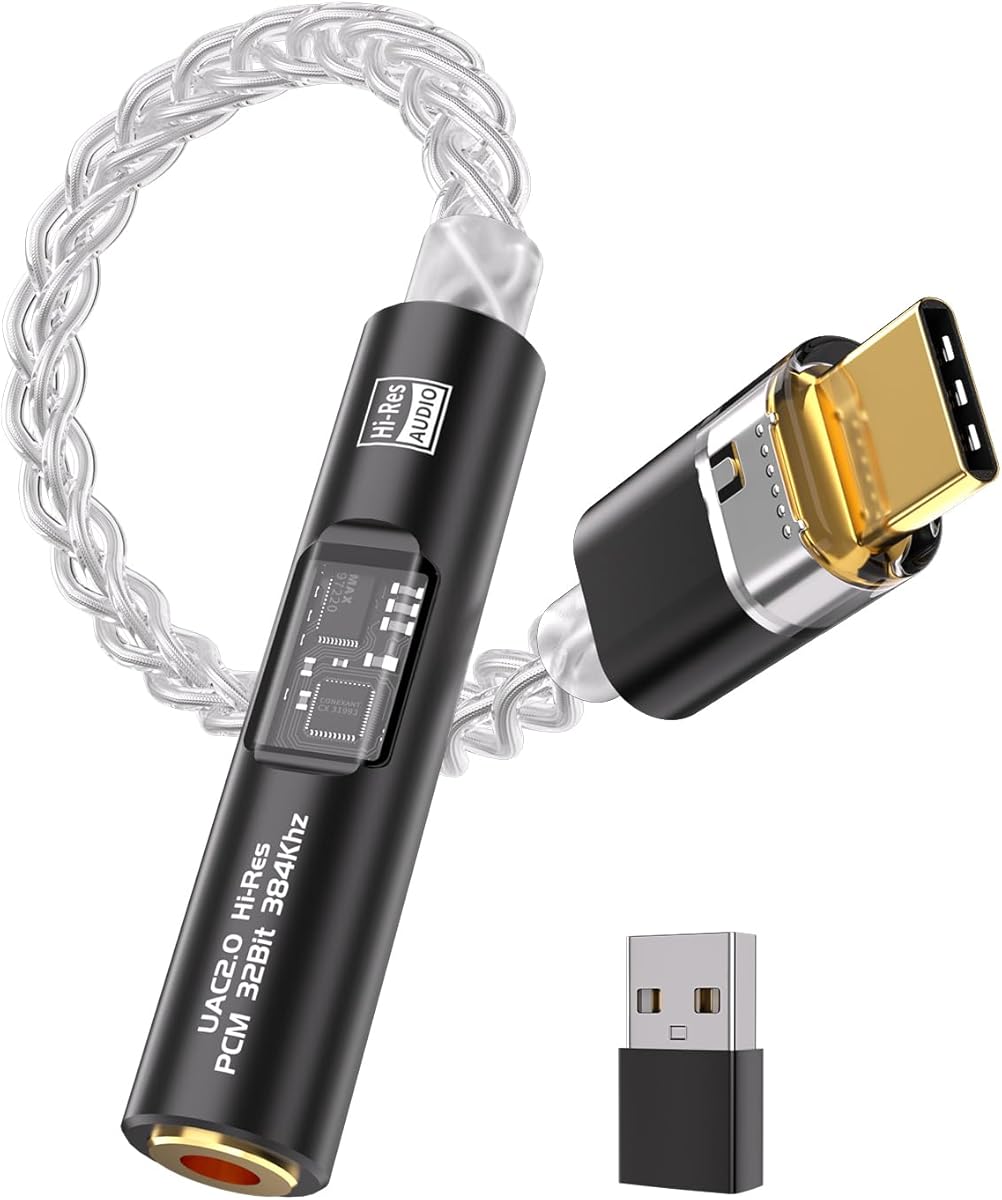
The BZINK USB-C to 3.5mm Audio Adapter is a compact way to improve the audio path from a compatible phone, tablet, or computer. Its 4.4 rating reflects a well-received product, while the combination of CX31993 and MAX97220 chips distinguishes it from basic passive adapters that merely route an analog signal.
We may earn a commission when you buy through this link, at no additional cost to you.
The adapter supports up to 32-bit/384kHz PCM decoding and uses an eight-strand, 4N copper-and-silver-plated cable construction. Its aviation-grade aluminum housing adds protection, while the supplied USB-A interface broadens compatibility with laptops and devices that lack USB-C. Hi-Res Gold certification further supports its positioning for listeners seeking a portable digital upgrade.
The main limitation is the single 3.5mm connection. It cannot offer balanced output, hardware volume control, channel controls, or a display, and its performance will still depend on the source device and the quality of the connected headphones. Those restrictions are reasonable for a travel-oriented adapter, but less suitable for a permanent high-end desktop system.
Choose this model when you want a simple improvement over a computer or phone headphone output and value portability more than expansive connectivity. For balanced desktop listening, the Fosi Audio K7 provides a more complete solution, while the FiiO K13 R2R is better suited to enthusiasts who want refinement and extensive configuration.
This adapter removes the need for a full desktop converter when your main requirement is mobile listening. Its included USB-A adapter also reduces the chance that an older computer will be the limiting factor.
The DAC and amplifier stages decode the source digitally before presenting the analog signal to your headphones, offering a more purposeful upgrade than a passive connector.
We may earn a commission when you buy through this link, at no additional cost to you.
The Fosi Audio K7 is a high-output desktop DAC, headphone amplifier, and analog preamp that combines an AK4493S converter, XMOS XU208 USB processor, and TPA6120 amplification stages. Its 4.7 rating is the highest among the products in this guide, reflecting a particularly strong proposition for listeners who want one box to handle several source types and output connections.
We may earn a commission when you buy through this link, at no additional cost to you.
It supports PCM 384kHz/32-bit and DSD256, with output power reaching 2100mW under the stated conditions. USB-C, coaxial, optical, Bluetooth with aptX HD and aptX Low Latency, and 3.5mm microphone inputs cover music, gaming, and communication. Outputs include 4.4mm balanced, 3.5mm single-ended, and RCA, giving it uncommon flexibility for a compact unit.
Its fully balanced design is attractive, although the specification sheet does not indicate that every input or output is balanced. The K7 also needs space on a desk, and the display and multiple controls add more complexity than a portable adapter. Users focused only on a simple line-level converter may also find that some of its headphone and gaming features are unnecessary.
The K7 is our top overall choice for broad desktop use. It is especially attractive for demanding headphones, games consoles, computers, and traditional stereo equipment, while the high-resolution display and large controls make daily operation straightforward. Buyers seeking a purer minimalist converter can consider the Fosi Audio Q6, but the K7 offers more paths to one useful endpoint.
The unusually broad input selection allows computers, game consoles, optical sources, and wireless devices to share the same conversion and amplification path, reducing the need for separate desktop components.
With up to 2100mW of output and both balanced and single-ended headphone connections, the K7 is better suited to power-hungry headphones than compact adapters that provide only a modest output stage.
We may earn a commission when you buy through this link, at no additional cost to you.
The Fosi Audio Q6 is a compact line-level DAC aimed at streamers, computers, CD players, televisions, and other digital sources. It pairs an AK4493S DAC with an XMOS XU316 processor and OPA1612 op-amp, then offers a subwoofer output alongside conventional RCA stereo outputs.
We may earn a commission when you buy through this link, at no additional cost to you.
Maximum support for PCM 32-bit/768kHz and DSD512 makes it a technically ambitious compact converter. Its listed signal-to-noise ratio of at least 121dB and total harmonic distortion below 0.00012% are especially useful for listeners concerned about signal purity. Optical, coaxial, and USB-C inputs give it more flexibility than many adapters of similar size.
The essential caveat is that the Q6 cannot directly drive headphones or passive speakers. It must feed an amplifier, powered speaker, or headphone amplifier. For someone building a clean two-channel system, that is not a weakness; for a listener expecting a headphone connection, it means an additional component is required.
This is a strong choice for a small stereo or media setup where line-level conversion matters but integrated headphone amplification does not. The ZD3 is the more elaborate balanced option, while the K7 is easier to recommend for direct headphone listening. Within a minimalist amplifier-based setup, however, the Q6 offers high-resolution conversion in a particularly tidy package.
The Q6 prioritizes accurate line-level conversion, including a dedicated subwoofer output, making it particularly useful when the next component is an amplifier or powered speaker.
Its aluminum alloy construction and small footprint suit a desktop, shelf, or media cabinet where a full-size network player or preamp would be disproportionate.
We may earn a commission when you buy through this link, at no additional cost to you.
The Fosi Audio ZD3 is a fully balanced DAC preamp designed for serious home stereo systems. Its ES9039Q2M conversion chip is combined with XMOS XU316, QCC3031, and LME49720 circuitry, while the specification supports PCM 32-bit/768kHz and DSD512 playback.
We may earn a commission when you buy through this link, at no additional cost to you.
HDMI ARC input is the standout feature because it allows a television to feed the DAC before the signal reaches the amplifier or powered speakers. USB, optical, coaxial, and Bluetooth inputs cover other sources, while balanced XLR and RCA outputs accommodate different amplifier inputs. A 1.5-inch OLED display and remote control improve operation from a listening position.
Preamp bypass and 12V trigger input and output can simplify integration with existing equipment. These features are more relevant to a carefully assembled home system than to a basic computer setup. Like the Q6, the ZD3 lacks a direct headphone amplifier, and its balanced preamp outputs do not make every downstream component balanced in terms of gain.
The ZD3 is the most complete choice here for a multi-source home stereo where HDMI, balanced connections, remote operation, and system control matter. It also pairs naturally with the Fosi ZA3 amplifier mentioned in the supplied information. Listeners wanting an all-in-one headphone solution should look to the K7 or ZH3 instead.
HDMI ARC input lets the ZD3 combine television sound with dedicated music sources, making it easier to create one useful stereo path for movies and music.
Remote operation, a display, preamp bypass, and 12V trigger interfaces support the kind of integration expected from a dedicated home audio preamp.
We may earn a commission when you buy through this link, at no additional cost to you.
The black FiiO K13 R2R combines a self-developed fully differential 24-bit R2R DAC with substantial headphone amplification and extensive configuration options. Its 4.6 rating reflects a feature-rich enthusiast product, and the use of 192 ultra-precise 0.1% thin-film resistors gives the conversion stage a clear technical identity.
We may earn a commission when you buy through this link, at no additional cost to you.
Two listening modes provide meaningful choice. NOS mode preserves the original sampling rate for a purer, more natural presentation, while OS mode upsamples to 384kHz for different measured performance and perceived clarity. The K13 supports PCM 384kHz/32-bit and DSD256, with balanced XLR, dual RCA, 4.4mm balanced, and 6.35mm single-ended outputs.
Its 10-band parametric EQ, app control, web interface, Auto EQ, and shareable profiles offer more personalization than a conventional hardware DAC. However, this feature density can feel excessive for listeners who simply want to connect a source and begin listening. The listed connectivity also emphasizes USB and Bluetooth rather than multiple legacy digital inputs.
Choose the black K13 when R2R character, headphone power, balanced output, and deep EQ control are central to your system. It is particularly compelling for headphone enthusiasts who enjoy tuning their system. If physical source selection is more important, the Fosi Audio K7 or ZH3 may integrate more smoothly into a multi-device setup.
NOS and oversampling modes allow listeners to compare two approaches without changing the rest of the system, which is unusual in a compact desktop DAC.
Ten adjustable EQ bands, Auto EQ functions, and software-based presets make the K13 more than a converter, particularly for listeners who use different headphones for different genres.
We may earn a commission when you buy through this link, at no additional cost to you.
The blafili B3 is designed to add Bluetooth and USB audio reception to an existing sound system rather than replace an amplifier. It receives audio from phones, tablets, and computers, then provides analog and digital outputs for amplifiers, powered speakers, mixers, preamps, and other processing equipment.
We may earn a commission when you buy through this link, at no additional cost to you.
A Qualcomm QCC5125 Bluetooth chipset and ESS ES9018K2M DAC support LDAC, aptX HD, aptX Low Latency, aptX, SBC, and AAC. Outputs include RCA, balanced XLR, optical, and coaxial, and the listed capability allows them to operate simultaneously. The receiver also works as a plug-and-play USB DAC for computers at up to 16-bit/48kHz.
Its 4.7 rating is among the highest in this guide, but the B3's role should be understood precisely. It cannot drive passive speakers, and it does not transmit television or stereo audio to Bluetooth headphones. Bluetooth takes priority over USB when both inputs are active, while the USB format ceiling is modest compared with the dedicated high-resolution desktop converters in this list.
The B3 is best suited to venues, offices, classrooms, or home systems where wireless playback into wired equipment is the priority. A removable RP-SMA antenna, stated reception range of up to 33 meters, silent pairing, and customizable broadcast names are especially practical in professional environments. For direct headphone use, choose a converter with an appropriate headphone output instead.
The simultaneous analog and digital outputs make the B3 useful in professional and semi-professional installations where different downstream devices require different connection types.
Custom broadcast names, an optional passcode, silent pairing tones, and an external antenna make the receiver more adaptable to schools, hotels, gyms, and other shared environments.
We may earn a commission when you buy through this link, at no additional cost to you.
The SMSL SU-1 is a desktop digital decoder centered on high-resolution conversion and MQA support. It uses an AK4493S DAC and supports PCM 32-bit/768kHz plus DSD512, while USB compatibility extends across Windows, macOS, Linux, Android, and iOS, with driver requirements varying by operating system.
We may earn a commission when you buy through this link, at no additional cost to you.
Its defining feature is MQA decoding. The description states that MQA can clean up a recording and encapsulate the sound, while MQA-CD mode can receive the digital output of an MQA-enabled CD player through optical or coaxial connections and restore the original high-resolution studio presentation with authentication confirmation.
The 4.2 rating indicates solid but not universally exceptional reception. MQA remains an important consideration because its usefulness depends on the content being decoded and whether the source material was properly encoded. Buyers without access to MQA files or an MQA-CD source may see less immediate value than the headline format support suggests.
The SU-1 makes the most sense for listeners whose library or CD playback workflow specifically uses MQA. For broader desktop headphone use, the Fosi K7 adds amplification and wireless connectivity. For a simple modern digital source, the SMSL D1 or Fosi Q6 may provide a more immediately relevant feature set.
MQA and MQA-CD support distinguishes the SU-1 for listeners who actively source MQA-encoded content rather than merely needing a general-purpose converter.
Support for major desktop and mobile operating systems gives the decoder flexibility, although Windows installations may require the appropriate driver.
We may earn a commission when you buy through this link, at no additional cost to you.
The SMSL D1 is a compact desktop DAC built around ROHM's BD34352EKV conversion chip and the latest XMOS XU-316 firmware. It supports PCM 32-bit/768kHz and DSD512, with a listed signal-to-noise ratio of 126dB and total harmonic distortion plus noise of 0.00038%.
We may earn a commission when you buy through this link, at no additional cost to you.
Dual USB, optical, and coaxial inputs accommodate computers, televisions, optical disc players, and other digital sources. The included USB-A-to-C data cable permits direct computer use, with macOS and Linux described as driverless while Windows requires a driver. Touch controls and a CNC-machined anodized aluminum unibody chassis keep the design neat and responsive.
Its RCA-only output limits compatibility with balanced-only amplifiers and excludes direct headphone use. The 4.2 rating also sits below the strongest products in the guide, suggesting that while the measured specifications are impressive, some buyers may prioritize connectivity or integrated amplification more than raw line-level conversion.
The D1 is a sensible choice for a clean two-channel setup where an amplifier or powered speakers provide the final output stage. It works particularly well when USB, optical, and coax sources need to share one RCA-equipped system. If balanced output is essential, the ZD3 is the more appropriate choice; if headphones must be powered directly, consider the K7 or ZH3.
The listed 126dB signal-to-noise ratio and 0.00038% THD+N make the D1 appealing for listeners seeking a clean line-level signal before amplification.
USB, optical, and coaxial inputs cover the most common digital source categories, while touch controls help the compact chassis remain visually uncluttered.
We may earn a commission when you buy through this link, at no additional cost to you.
The silver FiiO K13 R2R offers the same advanced headphone and digital architecture as the black edition in a different finish. It is a substantial desktop hub for listeners who prioritize an R2R presentation, balanced output, extensive equalization, and wireless high-resolution streaming.
We may earn a commission when you buy through this link, at no additional cost to you.
Its proprietary four-channel fully differential complementary 24-bit R2R DAC uses 192 thin-film resistors with 0.1% precision and low temperature drift. NOS and oversampling modes offer different approaches, while the output stage supports 2400mW and includes balanced XLR, dual RCA, 4.4mm balanced, and 6.35mm single-ended connections.
Ten-band PEQ, Auto EQ, app and web control, and Bluetooth 5.4 with LDAC make this a flexible centerpiece. The tradeoff is that the feature set is less approachable than that of a straightforward desktop DAC, and the supplied information does not list optical or coaxial inputs. Listeners with several legacy sources may need to route them through another converter first.
The silver K13 is best recommended for headphone-focused desktop systems where sound tuning and balanced power matter more than legacy input breadth. The Fosi K7 provides more source inputs and a display, while the Fosi ZH3 offers balanced preamp outputs and a broad input selection. For listeners already invested in the K13 platform, the finish choice comes down to personal preference.
The fully differential R2R architecture is paired with substantial balanced and single-ended headphone outputs, giving the listener several ways to connect high-performance headphones.
Bluetooth 5.4 support for LDAC, AAC, and SBC allows compatible phones and computers to stream wirelessly without giving up access to higher-quality codec options.
We may earn a commission when you buy through this link, at no additional cost to you.
The Fosi Audio ZH3 is an all-in-one desktop DAC, headphone amplifier, and fully balanced preamp. It combines an AKM4493SEQ DAC, XMOS XU316 processor, and four OPA1612 amplifiers, supporting PCM 32-bit/768kHz and DSD512 while using a dual-power balanced circuit intended to maintain low noise.
We may earn a commission when you buy through this link, at no additional cost to you.
Its headline capability is balanced headphone output up to 2570mW at 32 ohms, alongside 640mW single-ended output. A three-level gain switch covers headphones from 16 to 300 ohms. Coaxial, optical, USB, and RCA inputs feed 4.4mm, 6.35mm, RCA, and XLR outputs, allowing the ZH3 to function as a converter, preamp, or headphone amplifier.
The custom sound controls include bass and treble adjustment, six filter choices, bypass mode, and two swappable op-amps. This gives serious listeners a high degree of control, but it also means the ZH3 demands more setup and source-level awareness. The supplied note specifically warns that RCA and XLR output levels differ significantly, and that EQ applies only to the headphone outputs.
The ZH3 is best for listeners who want extensive headphone power, balanced connectivity, and hands-on tuning in a desktop system. It is more elaborate than the K7, although the K7 offers a clearer control layout and Bluetooth Low Latency support. The FiiO K13 R2R may be preferable for deep parametric EQ and R2R-specific character, while the ZH3 excels in output flexibility and interchangeable amplification stages.
The balanced output reaches 2570mW at 32 ohms, and the selectable gain ranges cover a broad collection of in-ear, over-ear, and high-impedance headphones.
Six filter modes, bypass, tone controls, and two swappable op-amps let listeners adjust the character of the headphone output rather than treating the DAC as a fixed conversion box.
We may earn a commission when you buy through this link, at no additional cost to you.
A useful audiophile DAC decision begins with the equipment you already own. Source connections, output formats, headphone impedance, channel balance, system control, and room placement matter more than headline resolution figures alone.
Begin by listing every digital device you expect to connect. USB-C is common for computers and modern phones, while optical and coaxial connections remain useful for televisions, disc players, streamers, and game consoles. RCA input can accept an existing analog source, and the Fosi Audio ZH3 also supports a 12V trigger input. The supplied products range from the portable adapter's USB-C and USB-A arrangement to the ZD3's unusually broad HDMI ARC, Bluetooth, optical, coaxial, and USB selection.
Buy for the sources you will actually use rather than paying for unused formats. The Fosi K7 stands out for many source types, the Q6 covers USB, optical, and coaxial cleanly, and the K13 R2R models emphasize USB and Bluetooth. Confirm the physical connector on your equipment and any adapter requirements before ordering.
Your downstream system determines the output you need. RCA is the most broadly compatible single-ended stereo connection, while balanced XLR and 4.4mm outputs can suit compatible amplifiers, preamps, and headphones. A 3.5mm output is convenient for wired headphones but does not provide balanced connectivity. Some models also offer optical or coaxial digital outputs for receivers and digital processors.
Do not assume that a balanced output will automatically improve every system, but it is worth considering when your amplifier and headphones support it. The ZD3 is designed around balanced preamp outputs, the K7 offers both 4.4mm and 3.5mm headphone connections, and the K13 includes XLR, RCA, 4.4mm, and 6.35mm outputs.
A DAC converts a digital signal to analog audio, while a headphone amplifier supplies the voltage and current needed to drive headphones effectively. Some desktop units combine both functions, whereas line-level converters such as the Q6 and ZD3 require an external amplifier. The B3 is different again: it receives Bluetooth or USB audio and acts as a receiver and converter, but it cannot directly drive passive speakers.
If you already own a capable integrated amplifier or headphone amplifier, a focused DAC may provide a cleaner and more economical route. If your headphones have high impedance or demand substantial voltage, an integrated model such as the K7, ZH3, or K13 may be more practical. Check impedance requirements and output power before connecting any headphone directly.
Maximum sampling-rate figures are useful only when the source, playback software, operating system, and output chain can supply the relevant files. PCM 768kHz/32-bit and DSD512 appear on several models, while the K7 and K13 support PCM 384kHz/32-bit and DSD256. Even when a converter accepts a format, the source material must have been recorded and processed at an appropriate quality.
Operating-system support also matters. Some products require a Windows driver, while macOS and Linux can work more directly. MQA support on the SMSL SU-1 is valuable only when you use suitable encoded content. Focus on a reliable path from file to amplifier rather than assuming the largest number translates directly into better everyday sound.
Balanced conversion is designed to carry two signal paths in a way that can reduce interference and channel differences. The ZD3 has a fully balanced architecture and XLR outputs, while the ZH3 combines balanced XLR and 4.4mm outputs with single-ended RCA and 6.35mm connections. The K7 likewise supports balanced headphones and RCA line-level output.
The benefit depends on the entire chain. A balanced DAC feeding only single-ended equipment does not create a fully balanced system, and software volume controls behave differently from hardware attenuation. Confirm that your amplifier accepts the voltage and connection type you intend to use, and read the output-level notes supplied with the ZH3 before integration.
Signal-to-noise ratio and total harmonic distortion provide a useful starting point for comparing conversion quality. The Q6 lists a signal-to-noise ratio of at least 121dB and THD below 0.00012%, while the D1 lists 126dB SNR and 0.00038% THD+N. The SU-1 states distortion below 0.00013%. These figures are specifications rather than guarantees of a particular perceived advantage.
System gain matching and connection quality can matter just as much. Avoid placing a converter where noise from power supplies or other electronics is easily picked up, and use properly shielded cables for balanced or long runs. A clean, noise-free result should also come from a stable power source and a compatible software configuration.
The simplest choice is a portable USB adapter with a single headphone output. The Q6 offers streamlined line-level conversion, while the K7 adds a display, large knobs, shortcut buttons, and many inputs. More specialized options include the K13's ten-band parametric EQ, the ZH3's swappable op-amps and filters, and the ZD3's preamp bypass, remote, and trigger controls.
Extra controls can improve system integration, but they can also increase setup time. A display and shortcut buttons may be helpful for daily use, whereas deep EQ software is valuable only if you enjoy tuning different headphones. Choose the level of interaction that you will use, not the number of settings on the panel.
Bluetooth support can make a system more convenient, particularly when switching between a desktop and a phone. The K7 supports aptX HD and aptX Low Latency, the K13 uses Bluetooth 5.4 with LDAC, and the B3 supports an extensive codec list for receiving audio into wired equipment. Wireless quality still depends on the sending device, codec availability, and interference.
Physical design includes footprint, chassis materials, controls, display visibility, and cable management. The B3's removable antenna and status display suit an installed receiver, while the portable BZINK adapter is designed to travel. The K7 and ZH3 use substantial desktop enclosures, and the ZD3's remote control is particularly relevant when the unit is positioned away from the listening position.
Begin by identifying the roles in your chain. The digital source should connect to the appropriate DAC input, the DAC output should connect to an amplifier, powered speakers, or compatible headphones, and the power supply should use a reliable outlet or the specified USB power source. Before connecting expensive headphones, set the DAC or amplifier to a moderate output level and confirm the correct input and output.
For computer sources, select the DAC as the playback device in the operating system and choose the native sample rate supported by the converter. Install the required Windows driver where applicable, keep sample-rate changes consistent, and avoid resizing or recompressing high-resolution files unless a specific playback workflow calls for it. For optical or coaxial sources, use a correctly wired digital cable rather than an analog cable with matching connectors.
Maintain the converter by keeping the ventilation path unobstructed, placing it on a stable surface away from heat and vibration, and cleaning the enclosure with a dry or lightly dampened soft cloth. Do not push cables sideways against ports, expose the unit to moisture, or open a chassis that uses an external power supply. Test new headphones at moderate volume, verify the selected impedance or gain setting, and reconnect cables only when the system is powered down.
It depends on your source, equipment, and listening environment. A modern phone or computer may provide adequate performance for casual listening, but a dedicated DAC can improve the available output path, add balanced connectivity, provide stronger headphone amplification, or unlock formats and source switching that the original device does not offer. The improvement is most relevant when the rest of the system is also carefully matched.
No. A higher sample rate matters only when the source file contains meaningful information at that resolution and the full playback chain can preserve it. Forcing a lower-resolution recording to a higher rate does not restore missing detail. More practical priorities include clean power, compatible software, proper gain, a good source, and suitable cables and headphones.
Only if its output power, impedance range, and connection type suit the headphones. Low-impedance earbuds may work with a small adapter, while high-impedance or demanding full-size headphones can require the stronger output of the K7, ZH3, or K13. Line-level DACs such as the Q6 and ZD3 need a separate headphone amplifier.
A DAC converts digital audio into an analog signal. A Bluetooth receiver adds wireless reception and typically includes conversion circuitry, but it still needs an amplifier or powered speakers to produce sound through conventional speakers. The blafili B3 is a receiver and converter rather than a speaker amplifier, while several desktop DACs in this guide also include headphone amplification.
Balanced outputs are worth considering when your amplifier and headphones both support the appropriate balanced connection. They can reduce channel interference and provide a cleaner channel relationship, but they do not automatically make the entire system superior. If your equipment only supports RCA or 3.5mm connections, a single-ended output is the practical choice.
Both architectures can deliver excellent results, and listener preference is subjective. The FiiO K13 R2R is specifically designed around a fully differential R2R conversion stage and offers NOS and oversampling modes for comparison. Other products in the guide use different chip architectures, so the better approach is to evaluate the complete implementation, supported formats, outputs, and features alongside your own listening preferences.
It can, but only when the source, playback software, DAC, and downstream hardware all support the relevant DSD route. Many listeners primarily use lossless PCM files, lossless streaming, Bluetooth, CD, or television audio and may never need DSD. Native PCM compatibility and reliable USB operation are often more important for everyday use.
Compare the intended connections and the output settings, because line-level and headphone outputs behave differently. The ZH3 specifically notes that its RCA and XLR output levels differ significantly, so the receiving amplifier should be set appropriately. Start with conservative levels, use the converter's attenuation or preamp controls when available, and avoid clipping before reaching your preferred listening volume.
The Fosi Audio K7 is the most versatile general recommendation in this guide, combining high-resolution conversion, meaningful headphone power, modern wireless support, and a broad collection of inputs and outputs. The Fosi ZD3 stands out for balanced home-system integration, particularly when HDMI ARC and preamp control are important, while the BZINK adapter offers the most portable and accessible route to improved headphone audio.
Prioritize compatibility before specifications. Confirm which sources you need, whether your amplifier is single-ended or balanced, whether you want direct headphone amplification, and how much physical or software control you will actually use. Compact line-level converters suit existing amplifiers, dedicated headphone hubs serve demanding personal listening, and wireless receivers are best when sending audio into an existing wired system.
Finally, confirm the latest specifications, included accessories, driver requirements, and current product availability before purchasing. Audiophile equipment should improve access to your music and fit the way you listen, while prices and configurations can change over time.