
TroyStudio 12-Pack Bass Traps
4.5Editor score
Twelve four-by-four panels
Lightweight dense polyurethane
Cuttable for custom placement
Explore the best bass traps for recording rooms, comparing corner coverage, depth, density, fire resistance, mounting, and overall value.
Bass traps are among the most important acoustic treatments for a recording room because low-frequency energy naturally collects where walls, ceilings, and floors meet. A useful trap combines sufficient depth, dense open-cell foam, effective corner placement, and secure mounting to reduce boomy buildup and improve recording and monitoring clarity.
This guide compares ten bass trap options by examining their dimensions, pack quantity, shape, intended corner placement, material density, fire-resistance information, installation requirements, and suitability for studios, podcast rooms, rehearsal spaces, home theaters, and other treated environments.
Each entry reveals how the trap differs in coverage and practicality, from compact column foam to deep triangular and super-chunk designs. Ratings reflect the supplied customer feedback, while product details and availability can change, so buyers should confirm specifications before ordering.
4.5Editor score

4.1Editor score

4.0Editor score
This side-by-side comparison highlights each trap's geometry, depth, quantity, corner application, and practical treatment role, helping you choose a compact, modular, or full-scale corner solution.





This eight-pack of black corner bass traps holds a 4.1 customer rating and offers a practical balance of coverage, shape, and acoustic function. Each 8-by-8-by-12-inch trap is made from high-density acoustic foam and intended to absorb low-frequency standing waves that accumulate along corners and ceiling junctions.
We may earn a commission when you buy through this link, at no additional cost to you.
Its main strength is the balance between quantity and treatment depth. The twelve-inch dimension gives the foam useful reach into a corner, while the eight-piece pack can be distributed among several low-frequency trouble spots. The product information also identifies CA117 testing and B1 fire-retardant performance, which adds useful reassurance for installation in recording studios, offices, theaters, and rehearsal rooms.
There are a few trade-offs. The traps arrive compressed, so they need to expand in a ventilated area for 24 to 48 hours before mounting. Adhesive is also not included, although the manufacturer recommends double-sided tape or spray adhesive. The 4.1 rating is respectable but not the highest in this guide, and buyers seeking a simple triangular shape may prefer another option.
This is a strong recommendation for home studios and recording rooms that need flexible corner coverage without moving to a large modular trap system. It is especially useful for owners who want to place several panels around a room, experiment with coverage, and retain a simple black studio appearance.
The twelve-inch depth lets the panels project meaningfully into a room corner, where low-frequency energy naturally collects. That geometry gives the traps a more useful low-frequency role than ordinary thin wall panels.
With eight units in the package, installers can address several corners or create repeated treatment columns. The manufacturer suggests mounting from the bottom toward the ceiling or grouping three traps in a ceiling corner.
We may earn a commission when you buy through this link, at no additional cost to you.
These Foroomaco triangular pyramid bass traps have a 4.0 rating and are designed around a specific acoustic junction: the point where two walls meet the ceiling. Their triangular profile fills that trihedral space, placing deep porous foam where low-frequency buildup can otherwise interfere with recording, mixing, and critical listening.
We may earn a commission when you buy through this link, at no additional cost to you.
Each trap measures 16.5 inches across the face and extends 12 inches into the corner. That depth differentiates the set from flat wall absorbers, while the four-piece quantity can cover up to four upper corners. Their vertical orientation also leaves usable floor space and keeps wall corners available for separate stackable bass traps.
The limitation is specialization. These are primarily upper-corner pieces rather than versatile wall treatments, and four units may not be enough for a larger room with multiple low-frequency problems. The 4.0 rating reflects a solid but unexceptional customer response, and the supplied information does not specify included mounting hardware.
The set is best for a room whose most obvious problems occur where the ceiling meets the walls. It works particularly well as one part of a broader treatment plan that also includes reflection-point panels and deep vertical-corner traps.
The triangular shape fits the three-surface junction created by two walls and a ceiling. That makes the set more immediately purposeful than a set of rectangular strips that must be carefully arranged.
The traps are designed to work alongside wall panels and vertical-corner Delta traps. That makes them useful for building a balanced system rather than expecting one product shape to handle every acoustic reflection.
We may earn a commission when you buy through this link, at no additional cost to you.
The TroyStudio 12-pack earns a 4.5 rating, making it one of the strongest-reviewed products in this roundup. Its 4-by-4-by-12-inch high-density polyurethane panels are tailored for low-frequency absorption, with the long dimension allowing the foam to extend into corners and ceiling-to-wall junctions.
We may earn a commission when you buy through this link, at no additional cost to you.
The biggest advantage is the amount of treatment supplied in a relatively compact format. Twelve panels can be distributed between multiple corners, arranged vertically, or fitted around a smaller studio. Each panel weighs only 0.07 pounds, so installation is manageable even when the owner must work overhead. The foam can also be cut to accommodate tighter spaces and different installation plans.
The product does not include the recommended foam spray adhesive, double-sided tape, screws, or T-pins. That means buyers need to account for installation supplies separately. Its narrow four-inch face also means that good coverage requires several units, and its 4.5 rating should not be interpreted as a measured laboratory performance claim.
This is an excellent choice for budget-conscious home studio owners who want meaningful corner depth and a generous panel count. It is particularly suitable for vocal booths, podcast rooms, bedrooms, rehearsal spaces, and small recording studios that need multiple treatment locations.
Its 4.5 rating is the second-highest listed among these ten products. Combined with the dense polyurethane construction, that makes this set stand out for buyers who prioritize customer response alongside practical coverage.
The narrow panels can be cut and mounted in corners, floors, or ceilings. Foam spray adhesive, double-sided tape, small screws, or T-pins are suggested, giving installers several practical attachment methods.
We may earn a commission when you buy through this link, at no additional cost to you.
These Foroomaco Delta bass traps hold a 4.0 rating and bring substantial depth to the vertical junction where two walls meet. Their 16.5-by-15.8-by-12-inch bodies are much more imposing than standard wall panels, creating a porous treatment volume in an area where low-frequency buildup commonly occurs.
We may earn a commission when you buy through this link, at no additional cost to you.
The defining feature is modular scalability. Flat top and bottom surfaces allow multiple traps to stack into a continuous column, making it possible to adapt coverage to a partial-height or floor-to-ceiling corner. A pair can be used for targeted treatment, while additional packs can extend the columns when a room needs more coverage.
Only two traps are included, which limits immediate coverage. Their large volume also requires more careful handling and positioning than narrow column foam. The supplied information does not list specific included mounting accessories, and the 4.0 rating sits in the middle of the field.
The Delta traps are a strong premium option for serious home studios, control rooms, and rehearsal spaces where vertical corners are a priority. They are particularly attractive to buyers who want treatment that can grow vertically as their acoustic requirements become more demanding.
The Delta profile is tailored to the narrow, tall space between two walls. Its deep body reaches into a common source of low-frequency buildup without spreading broadly across the wall.
Flat stacking surfaces make repeated pairs easy to align as a column. This gives installers a straightforward way to increase treatment height without changing the basic unit.
We may earn a commission when you buy through this link, at no additional cost to you.
The JBER 16-pack has a 4.2 rating and offers one of the largest panel counts in this guide. Its column wedge construction is intended for studio walls and office spaces, where it can reduce reverb, flutter echoes, undesirable reflections, and unwanted noise in small to medium rooms.
We may earn a commission when you buy through this link, at no additional cost to you.
The set is especially useful when a recording space needs several visible treatment points rather than treatment at only one or two deep corners. Sixteen units can complete wall runs, frame a listening area, or supplement dedicated bass traps. The fire-retardant specification also makes the set relevant to professional studios, churches, theaters, and offices.
The foam ships compressed and needs approximately 24 to 48 hours in a ventilated location, or longer, before installation. Although the product is called a corner bass trap, its wedge form is less exclusively shaped for deep vertical corners than the Foroomaco Delta design. It should therefore be viewed as part of a broader acoustic treatment strategy.
This set suits recording studios and offices that want broad reflection control with a clean column aesthetic. It is a good companion to deeper corner traps, particularly when early reflections and flutter echo also need attention.
Sixteen small column panels can fill multiple positions across a room. That makes the set more versatile when the goal is broad wall treatment instead of a small number of concentrated corner installations.
The wedge profile creates a clean studio look, while the documented recovery process allows compressed foam to regain its shape before mounting. Owners should allow adequate expansion time for the best presentation.
We may earn a commission when you buy through this link, at no additional cost to you.
This 24-piece TroyStudio set carries a 4.0 rating and offers the largest quantity among the listed traps. Its high-density polyurethane panels measure 4 by 4 by 12 inches and are designed to attenuate low-pitched sound while also reducing echoes, reverb, and overlapping audio.
We may earn a commission when you buy through this link, at no additional cost to you.
Quantity makes this set stand apart. Twenty-four narrow, lightweight panels can create extensive treatment in a larger home studio, distribute evenly across several rooms, or form multiple tall corner columns. At 0.07 pounds each, the pieces are easy to move and position, including in ceiling corners where bulkier traps can be cumbersome.
As with the 12-pack version, installation accessories are sold separately. The narrow profile also means that substantial room coverage requires many units, and the 4.0 rating does not suggest universal satisfaction. Users should consider whether the available wall and corner area can accommodate the footprint before committing to such a large set.
This product is a strong option for an ambitious home studio, music classroom, rehearsal room, or larger project space. It offers particularly good flexibility for owners who want to experiment with placement or treat more than one area of a building.
Twenty-four panels allow repeated coverage across multiple corners and walls. The large count can help create a consistent treatment pattern in rooms where isolated traps would leave major low-frequency gaps.
The low individual weight makes overhead and corner installation easier. Because the panels can also be cut, users can adapt their dimensions to uneven walls, ceilings, and confined studio layouts.
We may earn a commission when you buy through this link, at no additional cost to you.
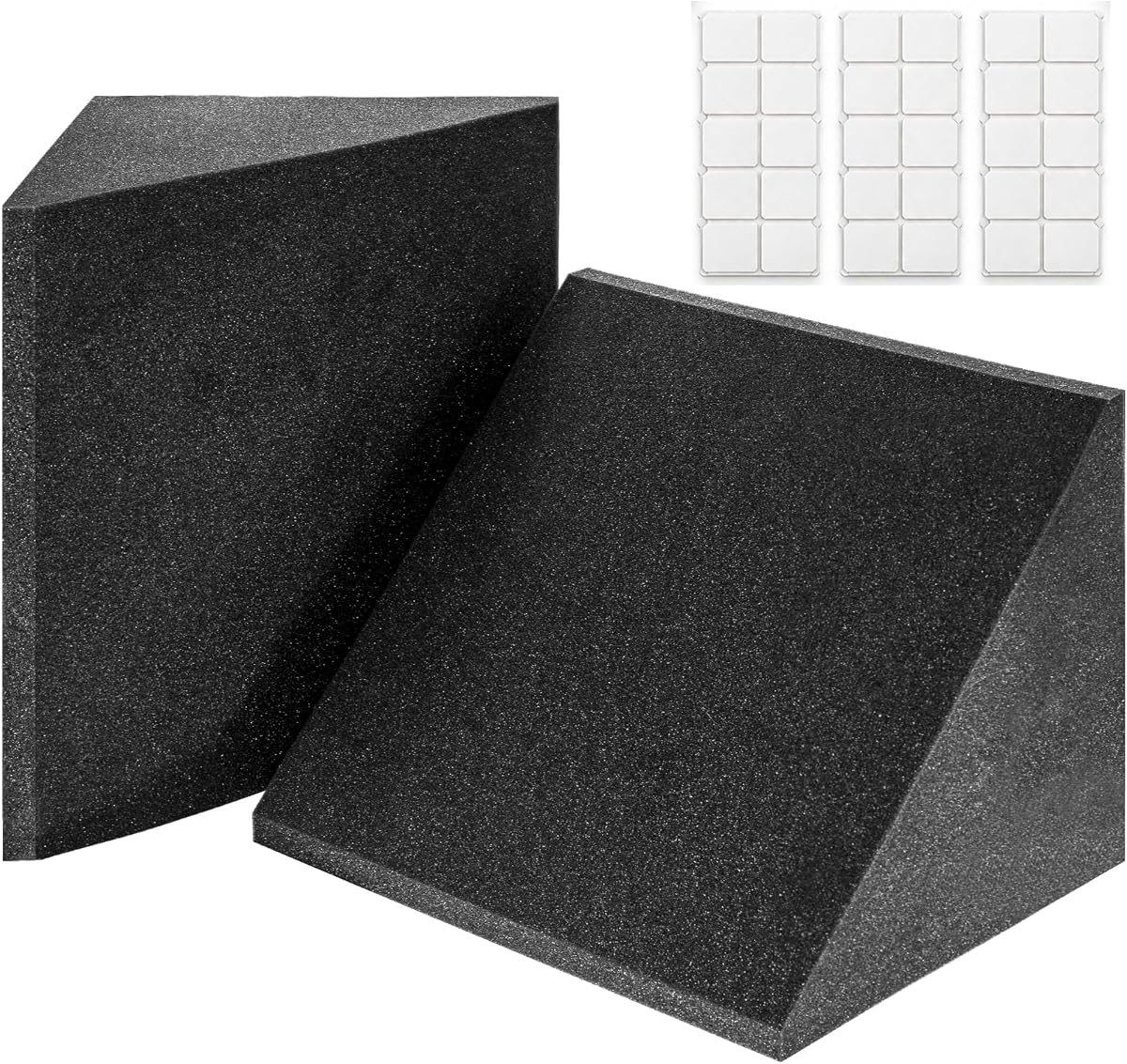
This four-pack of triangular corner bass traps has a 5.0 rating, the highest customer rating in the selection. Each trap is 16.5 inches wide and 12 inches deep, with a triangular profile designed to fit wall corners and add more treatment depth than a flat wall panel.
We may earn a commission when you buy through this link, at no additional cost to you.
Installation is one of its clearest advantages. Double-sided adhesive dots are included, removing the need to source basic mounting materials for each trap. The lightweight construction also allows quick setup in recording studios, podcast rooms, gaming rooms, rehearsal spaces, music rooms, and home cinemas.
A five-point rating should be considered alongside the limited amount of feedback it represents, rather than as a guarantee of laboratory performance. Adhesive dots may also be less suitable for surfaces that need to remain unmarked, and four traps may not cover a large number of corners.
This set is best for a small room or for focused treatment at selected wall corners. It is particularly attractive for users who prioritize straightforward installation, a clean triangular profile, and strong customer feedback over large panel quantity.
The wedge-shaped body fills a wall corner while extending 12 inches into the space. That geometry supports deeper low-frequency treatment without the footprint of a broad rectangular wall panel.
Double-sided adhesive dots allow installers to begin without purchasing tape or spray adhesive. This simplifies setup in a home studio, podcast room, or home theater where convenience is important.
We may earn a commission when you buy through this link, at no additional cost to you.
The JBER four-pack has a 4.2 rating and offers compact acoustic treatment for studios, podcasts, home cinemas, and living spaces. These corner blocks are intended to absorb low and mid frequencies, helping flatten room response and produce a clearer, more balanced presentation.
We may earn a commission when you buy through this link, at no additional cost to you.
Their simple shape makes them flexible. Although designed for the junction between walls and ceilings, they can also be mounted horizontally on a wall. That versatility makes them useful when the room's worst acoustic behavior is not confined neatly to the upper corners, or when a temporary treatment position is needed.
Four pieces are not enough for extensive treatment in a large professional control room, and the product information does not specify a particular included fastener. Installation can use glue, double-sided tape, or nails, giving owners flexibility but requiring them to choose a suitable method for the surface.
This set is a practical choice for small home studios, media rooms, and other compact spaces. Buyers who need more wall coverage or deeper treatment in several corners should consider a larger pack or a product with deeper dimensions.
The blocks are explicitly designed to address low and mid frequencies rather than only high-frequency reflections. That makes them a useful targeted component in a balanced room-treatment plan.
Vertical corner mounting and horizontal wall placement give users more options than a fixed triangular product. The compact format is particularly helpful in rooms where permanent floor area must remain available.
We may earn a commission when you buy through this link, at no additional cost to you.
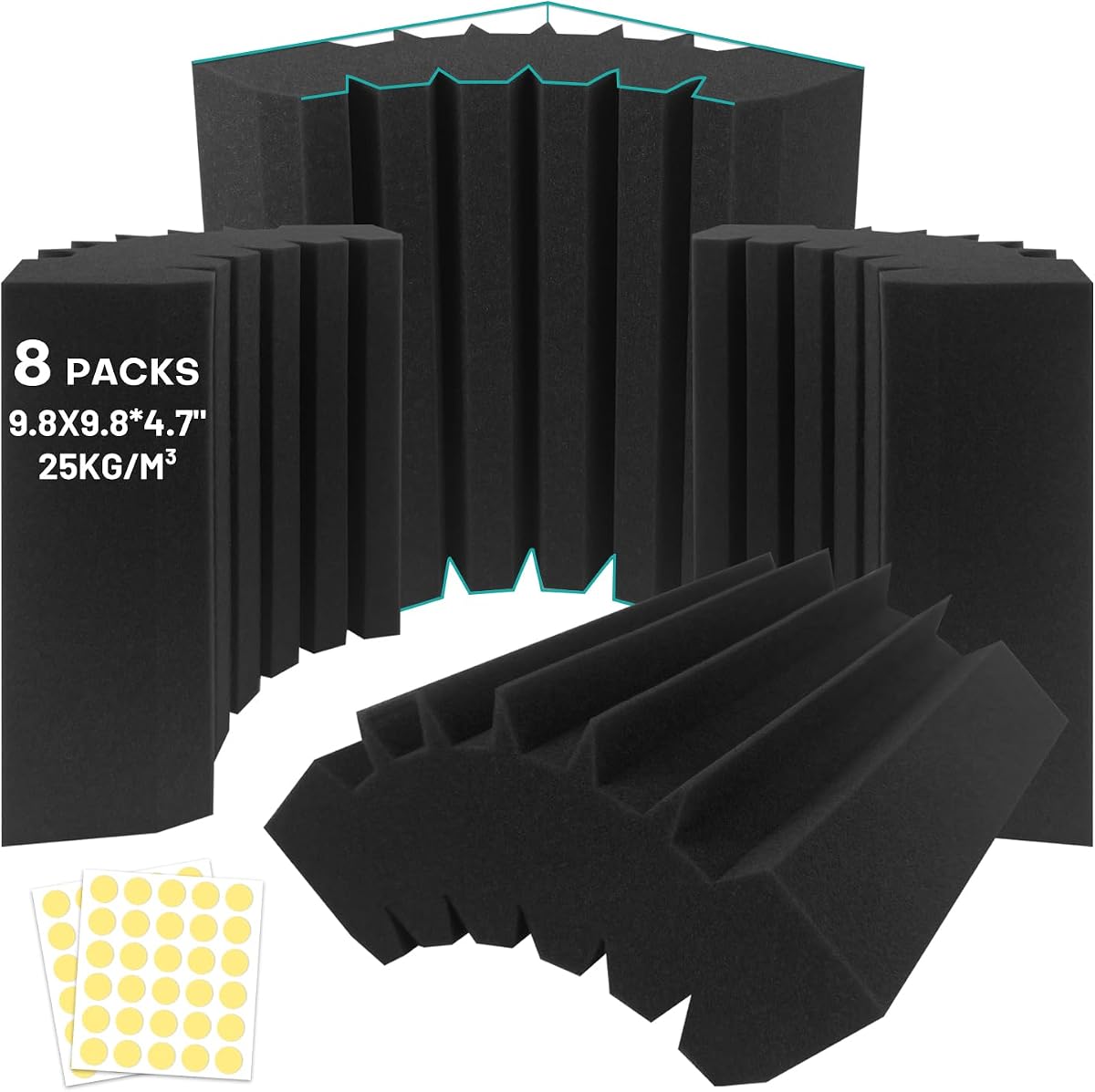
This compact eight-pack has a 3.9 rating and provides a smaller alternative for corners where a deep super-chunk would intrude too far into the room. Each 9.8-by-9.8-by-4.7-inch trap is made from high-density acoustic foam and is intended to address low-frequency standing waves and corner buildup.
We may earn a commission when you buy through this link, at no additional cost to you.
Its principal advantage is efficient use of space. The 4.7-inch depth still allows the panels to project into a corner, but it is easier to accommodate in compact studios, podcast rooms, offices, and home theaters than a 12-inch trap. The manufacturer lists CA117 testing and B1 fire-retardant performance for the foam.
The 3.9 rating is the lowest in this roundup, and the shallow depth is the set's clearest technical limitation. Compared with the twelve-inch products, these traps may make less visual and physical impact on the longest low-frequency modes. The foam also arrives compressed, requiring 24 to 48 hours of expansion, and the supplied information warns that flame-retardant foam may have a noticeable odor that should be aired out.
This set is best for small rooms or supplemental treatment where space is the deciding constraint. It can also work alongside deeper bass traps when the goal is to cover several locations without overwhelming the usable interior.
The 4.7-inch depth offers a more compact treatment footprint than the twelve-inch traps in this guide. That makes the set easier to place in smaller rooms while still reaching into the corner.
The compressed panels should be left in a ventilated area until they recover their shape. Airing them also helps dissipate the strong odor that can accompany flame-retardant foam before mounting.
We may earn a commission when you buy through this link, at no additional cost to you.
The two-pack of large super-chunk bass traps carries a 4.4 rating and offers the greatest face dimensions in this guide. At 19.5 by 16.5 by 12 inches, each trap provides substantial porous volume intended to absorb low-frequency sound, echoes, and reverberation.
We may earn a commission when you buy through this link, at no additional cost to you.
The large geometry gives owners a concentrated treatment tool for important corners. Because the foam is designed to address a broad frequency range, it can contribute beyond bass control while helping reduce echoes and improve recording clarity. The product information also describes the traps as lightweight and compact enough to move, despite their visually substantial size.
Only two units are included, so this is a targeted solution rather than a complete room package. Their size requires accurate positioning, and the 4.4 rating is strong but still based on customer feedback rather than disclosed laboratory measurements. No specific mounting hardware is listed.
This pair is best for a recording room with one or two especially problematic corners or for use as a strong supplement to a larger acoustic setup. Buyers prioritizing depth and maximum treatment volume should give it serious consideration.
The 19.5-by-16.5-inch face and 12-inch depth create a large acoustic volume. That makes each unit well suited to a corner where low-frequency buildup is concentrated.
The foam is described as absorbing from low through high frequencies. Although bass traps primarily complement wider treatment, that range can help reduce echoes and reverberation around the treated corners.
We may earn a commission when you buy through this link, at no additional cost to you.
Choosing a bass trap requires balancing low-frequency depth, corner geometry, room size, coverage quantity, installation needs, and construction quality. The best option is the one that fits the room's actual acoustic problems and can be installed securely.
Depth is one of the most important factors because low-frequency sound has long wavelengths and ordinary thin wall panels cannot capture it as effectively. Products in this guide range from 4.7-inch compact traps to substantial 12-inch super chunks. A deeper unit generally creates more porous volume in the corner, but it also occupies more space and may be heavier or more visually dominant.
Choose depth according to the room and the treatment area. Compact panels suit small rooms and supplemental applications, while 12-inch traps are more appropriate for focused treatment of troublesome corners. Measure the available corner space before purchasing.
Bass traps work best when their shape matches the junction they occupy. Triangular pieces fit upper corners where two walls meet the ceiling, while rectangular or column foam can be arranged along vertical and horizontal corners. Deep super chunks provide a large treatment volume but require more careful alignment.
Match the product to the room's structure. Upper-corner traps are particularly useful for ceiling junctions, stackable rectangular traps suit vertical corners, and wedge panels can provide broader wall coverage. Avoid using one shape everywhere if it forces foam away from the actual junction.
High-density acoustic foam provides more material within the trap's volume and can improve low-frequency absorption compared with thin, decorative foam. The strongest options in this guide specify dense or deep open-cell polyurethane. The material should be resilient enough to recover after compression and maintain its shape once installed.
Prioritize dense, purpose-built acoustic foam over generic padding with similar dimensions. Look for clear information about material, density, depth, and intended low-frequency use. Thick construction is generally preferable when the goal is controlling bass rather than only softening visible reflections.
A recording room rarely develops bass problems at only one junction. Pack quantity determines how many corners, walls, and ceiling areas can be treated at once. Four-piece sets are well suited to focused treatment, while eight- and twelve-piece packs offer broader distribution. The 24-piece set can support extensive coverage across a larger studio or multiple rooms.
Count the corners that need attention before selecting a set. Remember that a narrow panel may need several units to cover one area effectively. Look for combinations of deep traps, upper-corner pieces, and wall panels that work together instead of choosing quantity alone.
Acoustic foam is used in occupied rooms where flame behavior and material safety deserve attention. Several products in this guide state that they comply with California Technical Bulletin 117 or achieve B1 fire-retardant performance. Those claims make the products more relevant to professional studios, offices, schools, theaters, and public rehearsal spaces.
Verify the stated certification and keep documentation available when the building or insurer requires it. Also consider ventilation and odor. Flame-retardant foam may have a noticeable smell when unpacked, so allowing it to air out before installation is a sensible precaution.
Installation requirements vary considerably. Some sets include double-sided adhesive dots, while others recommend spray adhesive, double-sided tape, small screws, or T-pins. The most convenient option depends on the wall or ceiling material and whether the traps need to be removed later.
Check whether mounting materials are included before installation. Adhesive methods are convenient but may be difficult to reposition. Mechanical fasteners can offer stronger retention, though they require suitable surfaces and careful placement. Never assume a product's recommended fastener will work on every wall construction.
Bass traps form one part of a complete acoustic system. In a small voice-over booth, a few corner traps may be sufficient, while a music studio with powerful monitors may need substantial corner coverage plus reflection-point panels and bass traps. Home theaters can also benefit from deep upper-corner treatment combined with broader wall absorption.
Assess the room's dimensions, speaker power, listener position, and existing panels before buying. Very deep units can help with corner buildup but will not replace broadband reflection control. A balanced room usually needs both focused low-frequency treatment and strategically placed absorption.
Weight, shape, and visual consistency can affect installation. The slim TroyStudio panels are exceptionally light, while large super chunks require more care even if they are described as portable. Black foam creates a conventional studio appearance, and triangular or column profiles can help the installation look deliberate.
Choose a design you can safely install, particularly overhead in ceiling corners. Consider whether the traps will interfere with lighting, ventilation, cable routes, or access. If appearance matters, compare the profile from normal viewing angles and plan a consistent placement pattern.
Begin by mapping the room's low-frequency problem areas. Listen from the normal recording or listening position for boomy bass, uneven response, and excessive buildup near corners or the rear wall. Treat those areas first, using traps that fit the junction geometry and leave normal movement, ventilation, and equipment access unobstructed.
Allow compressed foam to expand fully before mounting. Most compressed products in this guide call for approximately 24 to 48 hours of ventilation, although the JBER set notes that recovery may take longer. Keep the material away from moisture during this period, and air it well if it carries a strong flame-retardant foam odor.
Install the traps securely with the recommended adhesive or mechanical method. Clean the surface, align the foam so it reaches into the corner rather than sitting in front of it, and check the fit before adhesion sets. For stacked traps, align flat surfaces to create a continuous column, and periodically inspect the attachment points for looseness or wall damage.
Bass traps absorb low-frequency energy that accumulates in room corners and along ceiling junctions. This can reduce boomy bass, uneven monitoring, and acoustic buildup that is difficult to control with thin wall panels. They are usually most effective when combined with broader absorption at reflection points.
Greater depth usually gives bass traps more porous volume and can make them more effective against demanding low-frequency problems. However, room size, corner geometry, placement, and the rest of the treatment system all matter. A compact trap may be more practical in a small room, while a deep unit is useful when space permits.
Place them where low-frequency buildup is strongest, usually at vertical corners and upper wall-to-ceiling junctions. Treat front, rear, and side corners consistently when possible, then adjust coverage based on listening tests. Avoid positioning the traps so far forward that they obstruct speakers, access, or ventilation.
No. Bass traps are primarily designed for focused low-frequency treatment, while conventional acoustic panels address reflections, reverb, and flutter echo. Recording rooms generally perform better with deep corner traps, reflection-point panels, and suitable first-reflection control used together.
Unpack them and leave them in a ventilated area until they recover their normal shape. Most of the listed products recommend approximately 24 to 48 hours, while some may require longer. Expansion should occur away from moisture and direct damage before the foam is mounted.
It depends on the product. Some sets include double-sided adhesive dots, while others recommend spray adhesive, double-sided tape, screws, or T-pins that must be obtained separately. Check the included components and select an attachment method that is suitable for the wall or ceiling surface.
Yes, if their depth and geometry suit the space. Deep triangular or super-chunk traps can help with home theater bass buildup, while narrow column foam may be more convenient for podcast and voice rooms. Consider the room dimensions, wall surfaces, and amount of space lost to the installation.
No. Bass traps improve absorption within the room and help control internal acoustic behavior. They do not create a complete soundproof barrier, block all sound transmission, or replace isolation, sealing, and structural treatments when those are required.
The eight-pack corner traps offer a versatile all-around option, while the TroyStudio 12-pack stands out for strong customer feedback, light weight, and broad placement flexibility. For buyers seeking greater low-frequency depth, the Foroomaco Delta traps provide a premium, stackable solution for vertical corners.
Prioritize depth, correct corner geometry, sufficient quantity, and secure mounting over appearance alone. A recording room benefits from a coordinated plan: deep traps at major low-frequency junctions, conventional panels at reflection points, and enough coverage to avoid leaving untreated corners that undermine the rest of the treatment.
Before ordering, verify current dimensions, included components, fire-resistance information, and room fit. Product configurations and customer feedback can change, so checking the latest listing details will help ensure that the selected bass traps suit your recording space.
