
Tapo Smart Plug P110M
4.4Editor score
Matter-certified compatibility
Energy bill estimation
Automatic overload shutoff
Our guide compares the best smart plug with energy monitor options, covering accuracy, app controls, safety, Matter support, scheduling, and compatibility.
A smart plug with an energy monitor combines remote outlet control with useful information about how much power a connected device consumes. The best models make it easy to identify standby waste, automate shutdowns, schedule high-draw appliances, and monitor unusual consumption from a phone or voice assistant.
We compared all ten options across energy-tracking features, app usability, scheduling, voice-control support, connectivity, safety features, electrical ratings, and smart-home compatibility. The list includes Tapo, Govee, Emporia, Kasa, meross, TOPELER, and other models designed for 120-volt household use.
Each review explains the plug's standout strengths, limitations, and ideal buyer, while the comparison table makes key differences easier to scan. Product configurations, app behavior, and availability can change, so readers should verify current specifications and compare prices before making a final purchase.
4.4Editor score

4.6Editor score

4.3Editor score
This side-by-side comparison highlights the most important differences among the ten plugs, including monitoring depth, connectivity options, safety protections, maximum load, and compatibility with Matter and popular voice-control ecosystems.



The Govee Smart Plug with Energy Monitoring earns a 4.6 rating, the highest among the ten products considered. It stands out for combining real-time power, current, and voltage readings with a reporting history that can extend from daily and weekly views to as much as one year. That makes it a strong choice for users who want more than a simple on-and-off remote.
We may earn a commission when you buy through this link, at no additional cost to you.
Its monitoring history is particularly useful for identifying standby consumption, comparing daily routines, and noticing when a connected appliance behaves differently than expected. The Govee Home App also supports detailed timers and group control, allowing multiple plugs to be managed together. WiFi and Bluetooth connectivity add setup flexibility, while voice commands through Alexa and Google Assistant cover common everyday control tasks.
The plug is rated for 15A at 120V and is described as suitable for high-power appliances such as coffee makers. It also carries FCC and ETL certification and uses fire-resistant materials. The trade-offs are that it connects only to 2.4GHz WiFi, and the supplied information does not identify Matter support, so buyers already invested heavily in Matter ecosystems may prefer a certified alternative.
This is an excellent choice for households that want detailed energy history, flexible timers, and broad app-based control across several rooms. It is particularly compelling for users tracking multiple plug-in appliances. Buyers should confirm that their router provides a 2.4GHz network and should match the plug's electrical rating to the connected device before installation.
Daily, weekly, monthly, and long-term views make it possible to spot standby waste and recurring consumption patterns. Tracking the same appliance over time gives the data more context than a momentary wattage reading alone.
Minute-level timers, group controls, and remote app access are useful for repeated routines. Alexa and Google Assistant support adds hands-free switching without replacing the more detailed Govee Home App controls.
We may earn a commission when you buy through this link, at no additional cost to you.
The Tapo P110M carries a 4.4 rating and is the strongest premium option for shoppers who want Matter certification alongside sophisticated energy management. It supports major smart-home platforms, including Amazon Alexa, Apple HomeKit, Google Home, and Samsung SmartThings, while retaining Tapo's familiar app-based control.
We may earn a commission when you buy through this link, at no additional cost to you.
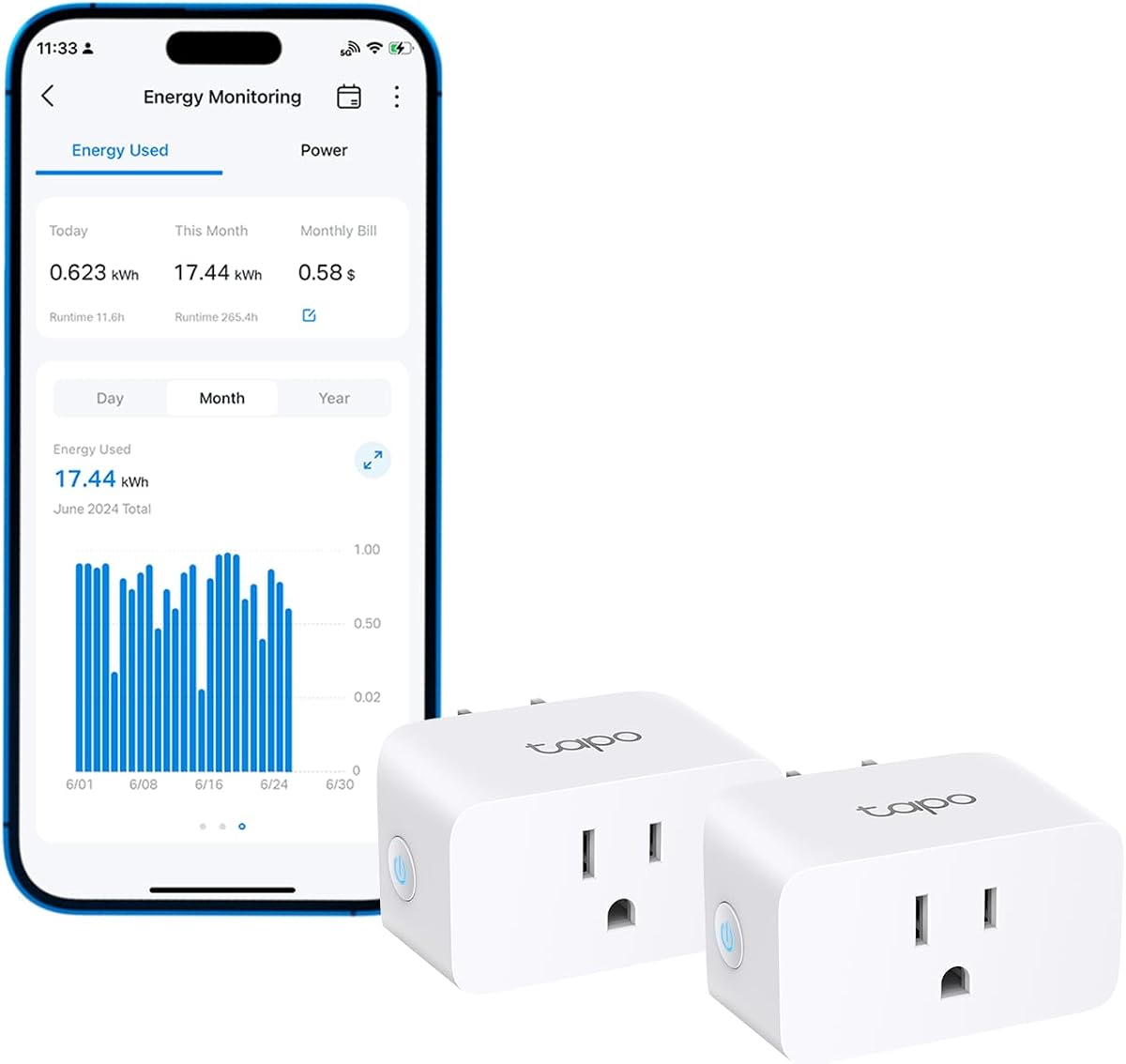
Its in-depth statistics and clear visualizations go beyond showing current power. The ability to integrate with billing systems provides single and periodic cost views, which is helpful when estimating how much an individual appliance contributes to a household bill. Scheduling can also move high-consumption devices to periods associated with lower electricity rates, adding another layer of practical automation.
The P110M includes user-defined thresholds and durations for power management. It can cut power when a connected device reaches a charging limit and shut off if consumption exceeds a configured level, helping reduce overcharging and unnecessary waste. The limitation is that this model must work with a compatible platform, while voice-assistant support is specifically listed for Alexa and Google Assistant rather than the entire Matter ecosystem.
The Tapo P110M is best for users who want detailed cost context, robust automated protections, and a future-facing smart-home setup. It is also suitable for households that want to move several high-consumption appliances between operating periods. Buyers should confirm their platform's Matter implementation and review how Tapo's charging and overload thresholds correspond to their devices.
Bill integration turns energy history into estimated cost information for individual and periodic readings. This can make it easier to evaluate whether scheduling a device during a lower-rate period offers meaningful savings.
User-set charging limits and overload thresholds let the plug act on defined conditions. These protections are most relevant for rechargeable devices and appliances whose normal consumption the homeowner understands.
We may earn a commission when you buy through this link, at no additional cost to you.
The Emporia Energy Monitoring Smart Plug has a 4.0 rating and offers a practical way to monitor individual appliances, reduce standby consumption, and automate switching. It is particularly relevant for lights, fans, lamps, humidifiers, and smaller household electronics that do not require a high continuous load.
We may earn a commission when you buy through this link, at no additional cost to you.
The app provides real-time status, remote on-and-off control, and scheduling for recurring routines. Alexa and Google Home compatibility broadens the control options, while the four-pack format makes it convenient to monitor several devices at once. Its energy-focused purpose is straightforward: identify devices left on unnecessarily and use schedules to prevent avoidable consumption.
The most important specification is its load limitation. Emporia lists a 10A maximum continuous load and a 15A maximum peak load for up to one hour per day. That makes the outlet suitable for many ordinary appliances, but it is less appropriate than the best 15A continuous models for high-draw equipment. The plug also requires a 2.4GHz WiFi network and does not support 5GHz.
Emporia is a practical recommendation for users who mainly want to understand standby use and automate smaller appliances. Its four-pack provides broad coverage, but users should carefully check an appliance's current and surge requirements. The lower continuous rating is acceptable for the listed use cases but may limit the model's flexibility.
Monitoring individual devices makes otherwise invisible standby consumption easier to identify. Users can compare readings and decide which appliances benefit from automatic shutdowns or scheduled operation.
Built-in on-and-off schedules can start coffee preparation or lighting routines at set times. Remote status checks add a convenient fallback when a schedule needs adjustment.
We may earn a commission when you buy through this link, at no additional cost to you.
The AiSeek Smart Plug Outlet with Energy Monitoring earns a 4.3 rating and combines real-time power tracking with a compact four-pack format. It is designed for users who want the outlet to take up less space while still supporting timers, schedules, remote control, and voice-assistant integration.
We may earn a commission when you buy through this link, at no additional cost to you.
Its integrated energy meter reports real-time power for connected devices. The SmartLife app supports automatic shutdown after a set time, daily schedules, and group control across multiple plugs. Alexa and Google Assistant are supported, although users must first connect the plug to SmartLife and link the services through the app rather than pairing directly with Alexa.
Safety features include FCC certification, fire-resistant materials, short-circuit protection, and overload protection. The stated capacity is 15A and 1800W, which is suitable for many household appliances. As with several competing products, it requires a 2.4GHz WiFi network, and no hub is needed, reducing installation complexity.
This option is best for users who prioritize compactness, scheduling, and multi-plug convenience. It may be particularly useful for lamps, fans, lightbulbs, humidifiers, and other scheduled devices. The SmartLife dependence is the main consideration, as buyers who prefer Tapo, Kasa, Govee, or Matter-specific ecosystems may find those applications more cohesive.
A compact enclosure can reduce outlet crowding, which is useful in desks, nightstands, and entertainment areas. Four plugs also make it practical to standardize automation across several small appliances.
Timers can turn devices off after a specified interval, while recurring schedules support predictable routines. Group control reduces the effort of managing multiple outlets individually.
We may earn a commission when you buy through this link, at no additional cost to you.
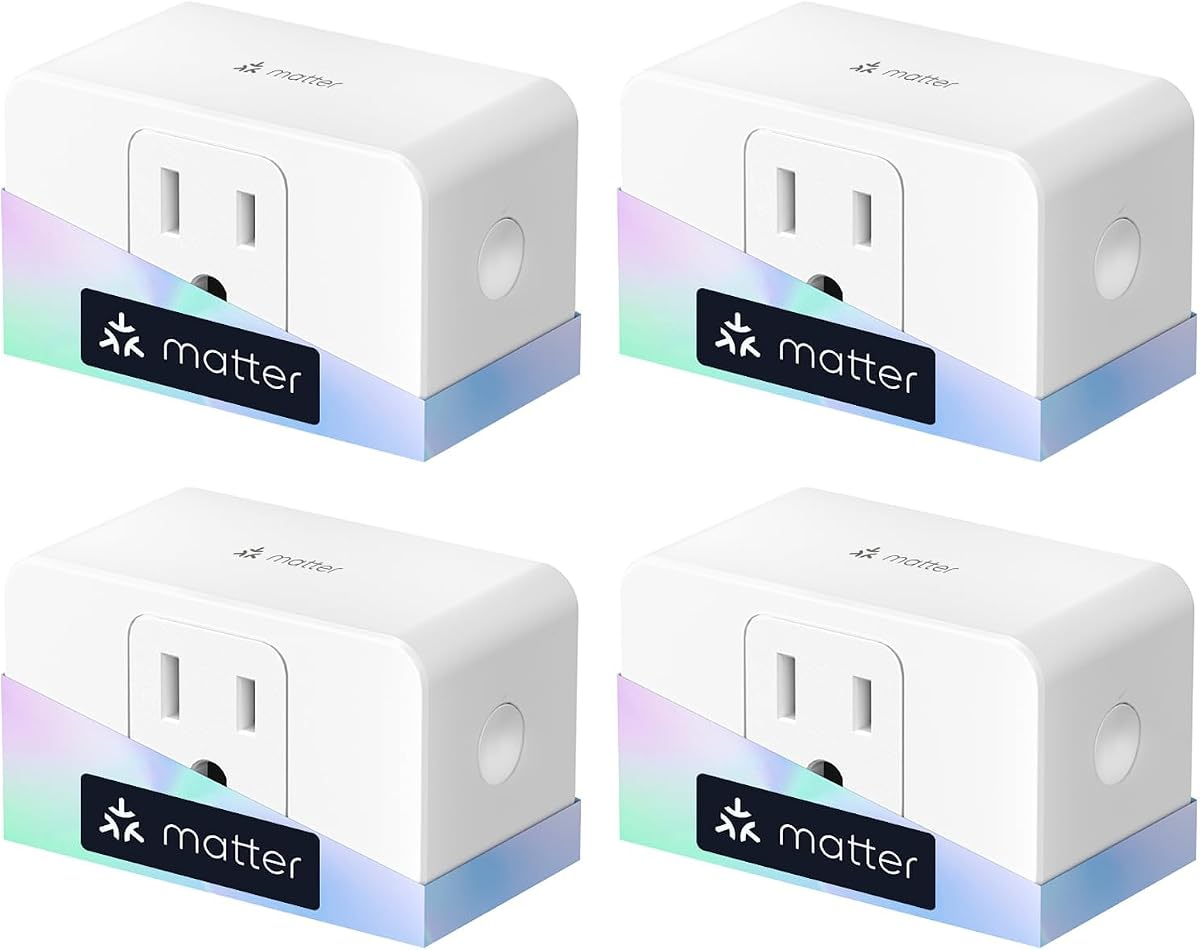
The Kasa Matter Smart Plug KP125MP4 has a 4.3 rating and serves as a strong four-pack choice for users who want Matter compatibility, local control, and energy history. It works with Apple Home, Amazon Alexa, Google Home, and Samsung SmartThings, giving it broader platform flexibility than plugs tied to a single manufacturer.
We may earn a commission when you buy through this link, at no additional cost to you.
Matter's local network support is a meaningful distinction. Once configured, compatible devices can communicate directly on the LAN, allowing a supported switch or sensor to control a compatible bulb even if the home internet is unavailable. The Kasa plug also tracks energy usage over time, helping users understand consumption patterns and make better-informed decisions.
Its compact construction is designed to avoid blocking adjacent outlets. A UL-certified flame-retardant design and two-year limited warranty add confidence. However, the supplied information does not mention an automatic overload shutoff, so users who want the plug itself to disconnect at a threshold should examine those protections more closely.
The KP125MP4 is ideal for households with mixed smart-home brands or those planning to build a Matter-centered home. The four-pack reduces the need to buy separate plugs for multiple rooms, while LAN control improves resilience when internet service is interrupted. Users should ensure their selected platform supports the relevant Matter device type and functions.
Compatibility with Apple Home, Alexa, Google Home, and SmartThings helps reduce platform lock-in. Matter support also creates a clearer path for combining accessories from different brands.
Matter's LAN communication can keep compatible devices operating without a cloud connection or internet service. This is useful for routines that should remain available even when the network is disrupted.
We may earn a commission when you buy through this link, at no additional cost to you.
The two-pack Tapo P115 holds a 4.5 rating and offers the same feature-rich energy management as the larger four-pack configuration. It is a practical option for households that want to monitor and automate only a few devices without purchasing a larger set.
We may earn a commission when you buy through this link, at no additional cost to you.
The Tapo app presents energy statistics and intuitive charts while supporting bill estimation for single and periodic readings. Programmable schedules can operate high-consumption appliances during periods associated with lower rates, adding a cost-management dimension beyond simple on-and-off automation.
Smart charging can stop power when a device reaches the user-defined low-battery limit. An automatic shutoff feature also responds when a connected device uses too much power, helping prevent electrical overload. Voice commands through Alexa and Google Assistant and remote app access cover the main remote-control needs.
The P115 is well suited to buyers who value cost estimates and automatic protections in a straightforward Tapo ecosystem. Its limitation is that Matter support is not listed, so it is less attractive for users seeking cross-platform standardization. It ranks as a strong choice for focused energy monitoring rather than a whole-home mixed-brand deployment.
Periodic bill estimates give appliance usage a financial context. Users can compare readings and schedules to see which devices account for the greatest estimated consumption cost.
Configurable charging cutoffs help avoid leaving a rechargeable device connected longer than intended. Automatic overload shutoff adds another layer of protection for suitable connected appliances.
We may earn a commission when you buy through this link, at no additional cost to you.
The Kasa KP125MP2 is a well-rounded two-pack option for users who want Matter compatibility and energy tracking without buying four plugs. Its 4.3 rating reflects a favorable balance of features, compact construction, and broad smart-home platform support.
We may earn a commission when you buy through this link, at no additional cost to you.
It works with Apple Home, Amazon Alexa, Google Home, and Samsung SmartThings, making it suitable for mixed-device homes. Through Matter's local communication features, compatible accessories can interact directly on the network and continue working when the internet is unavailable. This makes the plug more useful for dependable local routines than a cloud-only design.
Energy monitoring tracks consumption over time, while the Kasa App provides remote switching. Siri, Alexa, Google Assistant, and SmartThings voice control are also listed. The outlet has a compact flame-retardant design, UL certification, a 15A/1800W maximum, and a two-year limited warranty.
This is one of the most balanced recommendations for users who want a moderate number of plugs and strong platform flexibility. Its main limitation is pack size: households monitoring several rooms may find the four-pack more convenient. Buyers should also confirm that their chosen platform supports Matter control for the specific device category.
The two-pack fills the gap between a single-outlet starter and a larger home deployment. It lets users introduce Matter to selected appliances without committing to a room-by-room rollout immediately.
Local Matter communication supports control without a constant cloud dependency. When internet access is interrupted, supported local device-to-device actions may continue to work.
We may earn a commission when you buy through this link, at no additional cost to you.
The TOPELER 15A Smart Plug with Energy Monitor has a 4.1 rating and is notable for supporting both 2.4GHz WiFi and Bluetooth. The Bluetooth connection provides local control even when the WiFi connection is unavailable, making it a useful option for users who value setup resilience.
We may earn a commission when you buy through this link, at no additional cost to you.
The Smartlife App displays real-time power, current, and voltage, along with daily, weekly, and monthly reports. Timers and remote switching help eliminate forgotten standby loads, while Alexa and Google Assistant support provides hands-free control after linking the appropriate third-party service.
The plug is ETL and FCC certified, uses fire-resistant materials, and is rated for 15A and 1800W. Its compact design is intended to avoid blocking adjacent outlets. The constraints are the lack of listed Matter support and the requirement to use a 2.4GHz network rather than 5GHz.
TOPELER works well for a household seeking detailed reports and dependable local Bluetooth control without investing in a hub. It is especially relevant in areas where WiFi reliability varies. Users committed to Matter or Apple Home as their primary environment may prefer one of the certified options instead.
Local Bluetooth control can remain available when WiFi is temporarily offline. This is helpful for basic switching and reduces reliance on a functioning home network for immediate outlet control.
Real-time power, current, and voltage information is supplemented by daily, weekly, and monthly reports. The organized history helps users identify devices with unnecessary background consumption.
We may earn a commission when you buy through this link, at no additional cost to you.
The Kasa KP125MP4 is a versatile four-pack for users who want to monitor several appliances while adopting Matter-compatible equipment. It combines a 15A/1800W maximum, time-based energy tracking, a compact flame-retardant enclosure, and local-network control within a familiar Kasa design.
We may earn a commission when you buy through this link, at no additional cost to you.
Compatibility with Apple Home, Amazon Alexa, Google Home, and Samsung SmartThings gives users flexibility in choosing a control platform. Matter's direct LAN communication can preserve supported local device interactions when internet access is unavailable, an important advantage for routines involving switches, sensors, and compatible bulbs.
The four plugs are useful for monitoring an office, entertainment area, laundry room, or several lamps around the home. Remote app control and voice support through Siri, Alexa, Google Assistant, or SmartThings make the devices convenient for everyday operation. UL certification and a two-year limited warranty support confidence in the design.
This Kasa model is best for a coordinated household that wants a moderate-to-large group of Matter-compatible outlets without managing several unrelated ecosystems. It is less suitable for users specifically seeking automatic overload disconnection or explicit bill estimation, as those functions are not stated for this model.
A four-pack simplifies installation across several high-use locations. Keeping every outlet within the Kasa and Matter ecosystem can make grouping, naming, and routine management more consistent.
The outlet is designed to avoid taking up unnecessary space beside another plug. That makes it easier to place monitored devices where they are needed without creating a crowded power strip.
We may earn a commission when you buy through this link, at no additional cost to you.
The meross Matter Smart Plug earns a 4.4 rating and stands out for privacy-focused control. It offers real-time power consumption and historical data through the Meross app while stating that no registration or data tracking is required, reducing the account commitment associated with many cloud-connected products.
We may earn a commission when you buy through this link, at no additional cost to you.
Matter compatibility supports Apple Home, Alexa, Google Home, and SmartThings. Its Zero Touch Setup offers an Echo-based connection route, though the purchase account must match the Echo account for that method. A traditional Matter pairing route remains available for setups that do not meet that requirement.
Direct LAN access and no-cloud operation allow the plug to remain useful during an internet outage. It also includes short-circuit and overload protection, uses V0-rated fire-retardant materials, and has a compact design. These characteristics make it attractive for privacy-conscious users who still want voice, app, and automation control.
The setup requirements are more demanding than those of many competing plugs. Matter over WiFi requires a 2.4GHz IPv6 network, Thread is unsupported, and a Matter-compatible hub is required for the selected platform. The meross is therefore best for technically prepared buyers who prioritize local control and minimal data registration.
No registration and stated freedom from data tracking distinguish this plug from cloud-first alternatives. Direct LAN access also allows supported routines to continue when internet service is unavailable.
The standby-control focus is useful for eliminating small but persistent background consumption. Combined with energy history, it helps users decide which connected devices should be switched off automatically.
We may earn a commission when you buy through this link, at no additional cost to you.
Choosing the right energy-monitoring plug requires balancing data depth, electrical capacity, connectivity, safety features, app quality, and compatibility with the smart-home equipment already in your home.
A useful energy monitor should provide more than a binary on-and-off status. Look for real-time power readings and, when possible, current and voltage measurements. Historical views add another layer because daily, weekly, monthly, and annual reports can reveal standby loads, recurring runtime, and changes in appliance behavior. The Govee model supports history extending to one year, while Tapo and Kasa also track consumption over time but describe their reporting more generally.
Choose the deepest history available within your preferred app. More data is helpful when comparing two similar appliances or determining whether a schedule changes total consumption.
The maximum current rating must match the connected device's normal and startup demands. A 15A plug gives more flexibility than the Emporia's 10A continuous-load limit, while the Kasa, TOPELER, Govee, Tapo, and AiSeek options are described as 15A or 1800W models. Pay close attention to how manufacturers distinguish continuous from peak loads. A 15A peak rating that lasts only part of the day is not equivalent to a plug designed for sustained 15A operation.
Check the appliance nameplate and any manufacturer guidance before connecting high-draw equipment. When uncertain, choose the highest rated model appropriate for the outlet and device.
Matter compatibility is valuable for shoppers who want freedom from a single-brand ecosystem. Tapo P110M is Matter-certified, while Kasa KP125MP4, Kasa KP125MP2, and the meross plug support Matter platforms. Apple Home, Amazon Alexa, Google Home, and Samsung SmartThings appear across the Matter-capable selections. Non-Matter models can still be controlled through Alexa or Google Assistant, but the exact voice ecosystem and linking process vary.
Verify that the selected platform supports the functions you care about, especially historical energy data. Voice switching may work even when detailed graphs remain in the manufacturer's app.
Most listed plugs require a 2.4GHz WiFi network and do not support 5GHz. That requirement is common, but it can complicate setup on modern routers that combine bands under one name. Govee and TOPELER add Bluetooth, and TOPELER specifically describes local Bluetooth control when WiFi is offline. Matter-based Kasa products emphasize LAN operation after configuration, while meross requires 2.4GHz IPv6 and a compatible hub.
Check your router settings and smartphone requirements before installation. A dedicated 2.4GHz network, adequate IPv6 configuration, or the required hub can determine whether the product fits your home.
Scheduling is one of the main reasons to use a smart plug instead of a basic remote-controlled outlet. Every featured option offers on-and-off automation, but the controls differ in depth. Tapo supports off-peak scheduling and bill estimates, Emporia emphasizes scheduled appliance routines, and AiSeek offers timers, automatic shutdowns, and group control. Govee provides minute-level schedules with shared group management. The best choice is the one whose app makes your most common routines easy to create and revisit.
Prioritize simple recurring schedules if you want dependable automation. More advanced routines are useful only when their triggers and exceptions are intuitive enough to maintain.
Safety is especially important because these plugs sit between high-capacity electrical circuits and everyday appliances. Look for recognized certifications such as ETL, FCC, or UL, along with fire-resistant materials. Govee is described as ETL and FCC certified, AiSeek has FCC certification plus short-circuit and overload protection, TOPELER has ETL and FCC certification, and Kasa uses a UL-certified flame-retardant design. Tapo P110M and P115 add automatic cutoff behavior for defined charging or power thresholds.
Certification does not eliminate the need to use suitable loads. Match the device, avoid extensions that could exceed local electrical guidance, and never treat a smart plug as a substitute for a dedicated circuit when the appliance requires one.
The app determines how often users will actually consult the plug. Tapo is praised through its feature set for clear charts and bill visualization, Govee offers detailed daily through annual reporting, Kasa provides straightforward consumption tracking, and meross combines real-time data with historical records. Group control is especially useful when several rooms or device types are monitored.
Consider whether you want one app for all outlets or prefer manufacturer-specific tools. Also check whether energy data remains accessible locally, whether history requires a cloud account, and whether the app supports the voice ecosystem already in use.
Four-pack configurations offer the easiest way to monitor several appliances without purchasing each outlet separately. Two-packs are more appropriate for focused use, and the Govee, Emporia, AiSeek, and Kasa options provide four plugs. Compact housings are especially helpful when the outlet is already crowded. Kasa highlights a design intended to avoid blocking adjacent outlets, while Govee, AiSeek, TOPELER, and meross also describe compact construction.
Match the pack size to the number of devices and rooms you genuinely need to monitor. Extra plugs are useful for expansion, but a smaller bundle can be easier to distribute and configure.
Begin by confirming that the connected appliance fits the plug's electrical rating. Check the appliance's normal consumption, startup demand, and any instructions about dedicated circuits. Plug the smart outlet into a suitable wall receptacle, then install the manufacturer or SmartLife app and connect the plug according to its setup instructions.
Most models require a 2.4GHz WiFi network, while the meross additionally requires IPv6 and a compatible Matter hub. If the app cannot locate the plug, confirm the phone is on the same network, disable any troublesome network restrictions, and follow the manufacturer's pairing guidance. Link Alexa, Google Assistant, Apple Home, Siri, or SmartThings only after the plug works in its primary app.
Create clearly named groups for rooms or appliance types, then add simple schedules for lights, fans, chargers, and other suitable devices. Review historical energy reports periodically, compare consumption before and after scheduling, and adjust limits to match each appliance. Avoid repeatedly unplugging the smart plug to reset it, and keep it dry, unobstructed, and within its stated electrical and environmental specifications.
The main benefit is a clearer view of how much electricity a connected device uses over time. That information can reveal standby waste, support scheduling decisions, and show whether an appliance is consuming more power than expected. The plug also adds remote, voice, and automated on-and-off control.
No. The Tapo P110M is Matter-certified, while the Kasa KP125MP4, Kasa KP125MP2, and meross plug support Matter platforms. Other products emphasize their manufacturer's app and selected voice assistants instead. Check the platform list carefully if your home already includes Apple Home, SmartThings, Alexa, or Google Home devices.
No. A 15A label is only one part of the safety calculation. The appliance's running current, startup surge, duty cycle, and manufacturer instructions all matter. Some products distinguish continuous and peak limits, so buyers should verify those details rather than assuming every 15A outlet can handle every high-draw device.
Most of the listed models require a 2.4GHz WiFi network and explicitly do not support 5GHz. Bluetooth is available on the Govee and TOPELER models, while Matter-based options add local-network control after configuration. The meross model requires 2.4GHz IPv6 and does not support Thread.
Yes, if the connected device is suitable for switching and does not need to remain continuously powered. Scheduling the outlet to turn off can eliminate standby consumption from televisions, chargers, game consoles, and similar equipment. Avoid schedules for refrigerators, medical equipment, network gear, or other appliances that require uninterrupted power.
It depends on the model. Matter-compatible Kasa plugs support local LAN communication after configuration, and the meross plug emphasizes direct LAN access without cloud reliance. TOPELER also lists Bluetooth control when WiFi is offline. Non-Matter models may still offer basic local control, but remote access and cloud features generally require internet connectivity.
A four-pack is more convenient when monitoring several rooms, lamps, or appliance categories. It also makes it easier to group related devices under one routine. A two-pack is generally sufficient for a single room or a small set of high-use devices and can be less demanding to configure.
Only when the plug's rating and the appliance's requirements both support that use. Several models are rated for 15A, and Govee specifically mentions suitability for a coffee maker, but startup demands and continuous use still matter. Check both the smart plug and appliance instructions, and consult an electrician if a dedicated circuit is required.
The Govee Energy Monitor is the strongest all-around recommendation for detailed reporting, real-time electrical readings, long history, flexible scheduling, and dual-mode connectivity. For premium smart-home integration, the Tapo P110M adds Matter certification, bill estimation, and configurable power cutoffs. The Kasa KP125MP2 stands out as a balanced Matter option for buyers who want two outlets rather than a larger bundle.
Prioritize the factors that affect daily use: adequate electrical capacity, an app with understandable energy history, dependable scheduling, and compatibility with your existing ecosystem. Matter is worthwhile for mixed-brand homes, while Bluetooth and local LAN support can improve resilience. Users should also match automatic protection features to the appliances they intend to connect.
Configurations, software behavior, and promotions can change, so verify the current specifications before ordering. Compare current prices across the options, confirm network and hub requirements, and read recent customer feedback to confirm that the model's app experience and features still align with your needs.