
Eightwood RG58 BNC Connector
4.5Editor score
Fits RG58 coax cable
Includes heat-shrink tubes
Brass connector construction
Discover the best BNC male crimp connectors for RG58, RG8X, RG59, and other coax cables, with expert comparisons of fit, materials, and applications.
BNC male crimp connectors create secure, reusable terminations for coaxial cable, making them essential for antennas, radios, scanners, surveillance systems, and RF test equipment. A worthwhile connector must match the cable diameter, preserve 50-ohm signal performance, and provide a dependable mechanical connection.
We compared the listed connectors by cable compatibility, impedance, construction, signal-loss or VSWR claims, included installation components, and intended applications. The guide covers general-purpose RG58 options, higher-capacity RG8X and LMR240 models, and dedicated RG59 connectors for coaxial video installations.
Each review explains the connector's strongest attributes, practical limitations, and ideal buyer profile. Product details and ratings reflect the supplied listings, while availability and pricing can change, so check the current listing and cable specifications before making a final purchasing decision.
4.5Editor score
4.9Editor score

4.5Editor score
The comparison below organizes all ten connectors by supported cable, electrical design, construction, and practical use. The differences matter because a connector rated for one coaxial cable diameter may not produce a dependable termination on another.


This MOOKEERF set is a strong choice for installers who need a dependable BNC male termination on RG8X or LMR240 coaxial cable. It carries a 4.9 customer rating, the highest among the listed products, and presents unusually specific electrical information. The stated 50-ohm impedance and frequency range of 0 to 1000MHz make it especially relevant to serious RF cable work.
We may earn a commission when you buy through this link, at no additional cost to you.
The connector uses gold-plated brass pins, Teflon insulators, and a copper shell with nickel plating. According to the product data, signal attenuation is less than 0.1dB at 500MHz and VSWR remains below 1.15. Those figures are useful for evaluating a termination intended for low-loss jumpers, although actual installed performance also depends on the cable, crimp process, connector seating, and installation environment.
Compatibility extends beyond RG8X and LMR240 to KMR240, 4D-FB, CNT240, and RG8 Mini low-loss coaxial cable. That makes the set more specialized than an RG58 connector. Its higher-frequency claims also mean it is better suited to amateur radio, CB, two-way radio, scanners, receiver antennas, and antenna extension work than to a basic short CCTV jumper.
Choose this option when the cable in your project is one of the larger RG8X-class types and you need the listed low-loss design characteristics. It is not the right choice for an RG58 installation simply because both products use the BNC interface. For matching cable and disciplined crimping, this is the strongest all-around RF-oriented pick in the group.
The stated attenuation and VSWR figures make this connector attractive for antenna jumpers, receiver feeds, and two-way radio installations. Matching the connector to the cable's impedance category is the first step toward preserving those performance characteristics.
Gold-plated brass pins and nickel-plated copper components are intended to support conductivity and resist oxidation. Teflon insulation provides a stable dielectric element around the center contact.
We may earn a commission when you buy through this link, at no additional cost to you.
The ENS package is built around a specific need: terminating RG59 coaxial cable with male BNC connectors. It contains 50 pieces and holds a 4.6 customer rating. That combination makes it appealing to professional CCTV installers or consumers completing many camera and recorder connections at once.
We may earn a commission when you buy through this link, at no additional cost to you.
Its two-piece crimp-on construction is intended to provide a secure and precise termination. The listing emphasizes durable construction and dependable signal transmission, with minimized signal loss presented as a key benefit. Those goals are particularly relevant in surveillance systems where multiple runs must maintain consistent connections between cameras, cables, recorders, and displays.
The primary limitation is cable specialization. This connector is designed for RG59 rather than the RG58, RG8X, LMR195, or other families represented elsewhere in the guide. The supplied information also does not mention individual heat-shrink tubes, a connector key, or a dedicated crimping die, so installers should verify their tooling and environmental sealing requirements separately.
Buy this set when you are working with RG59 and have several terminations ahead. It is less suitable as an all-purpose drawer of mixed coax connectors. For a sizable surveillance installation, the bulk quantity and clear application focus make it a practical premium choice over smaller assorted packs.
A fifty-piece pack reduces the need for repeated purchases while one cable type remains in use. It is particularly useful for installers standardizing multiple surveillance runs around RG59.
The two-piece design is intended to simplify crimping and create a secure fit. Consistent cable preparation and tool pressure remain essential for reliable results.
We may earn a commission when you buy through this link, at no additional cost to you.
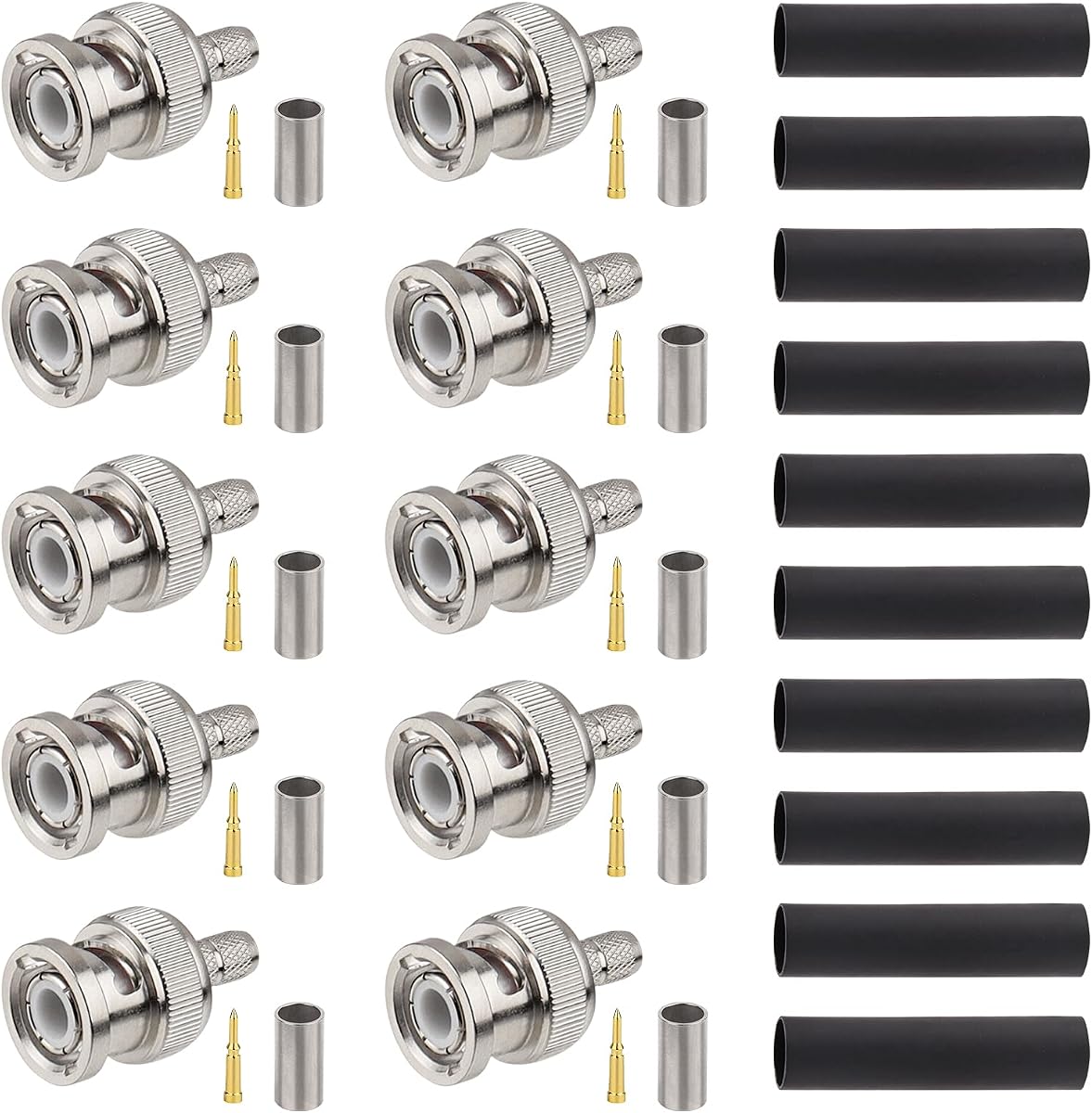
The Eightwood pack is a straightforward choice for common 50-ohm coax terminations. It supports RG58, RG142, and LMR195 cable and carries a 4.5 rating. Its practical appeal comes from the included heat-shrink tubes and the use of brass for the connector body.
We may earn a commission when you buy through this link, at no additional cost to you.
That construction detail is useful for buyers comparing the listing with products made from alloys. Brass is described as providing mechanical durability and a solid connection, while the package contains ten connectors and ten individual heat-shrink tubes. The connector can be used for antennas, VHF and UHF radio, CB, amateur radio, scanners, security cameras, oscilloscopes, spectrum analyzers, cable testers, and wireless sensors.
The trade-off is that the supplied information gives fewer detailed electrical figures than some competing listings. It states 50-ohm impedance but does not provide a specific attenuation or VSWR value. For routine antenna and radio work, the broad use-case description and accessory inclusion may be more useful than a technical performance claim.
This is an attractive option for a small batch of standard RG58-class terminations. Buy it when you want brass construction and heat-shrink without moving to a larger RG8X connector. Verify the physical fit for RG142 or LMR195 and use the correct crimp die for your cable before completing an installation.
Ten matching heat-shrink tubes add a practical finishing layer around each termination. They can help protect the joint from separation, moisture, and mechanical strain when installed correctly.
The listed applications range from amateur radio and scanners to security cameras and test equipment. This broad scope makes the pack useful for a mixed collection of standard coax projects.
We may earn a commission when you buy through this link, at no additional cost to you.
The XRDS RG58 set combines a strong 4.6 rating with compatibility across five named coaxial cable types: RG58, LMR195, RG400, RG142, and 3D-FB. That makes it a flexible option for projects that may involve several common RF or communication cables rather than one standardized run.
We may earn a commission when you buy through this link, at no additional cost to you.
Construction details center on a nickel-plated copper outer shell and a gold-plated brass center needle. The product data describes these choices as supporting corrosion resistance and conductivity. Its BNC locking mechanism also provides a practical advantage because a completed BNC joint can be secured without relying solely on friction.
The listing claims low loss, high signal integrity, and minimal VSWR, but it does not provide the specific numerical values offered by some other connectors in this guide. Those general claims should be treated as feature descriptions rather than a substitute for matching the connector to the cable and verifying the finished installation.
Consider this product for telecommunications, video surveillance, RF systems, and antenna connections where the cable falls within the stated compatibility list. It is a particularly sensible choice for a mixed toolkit. Be cautious with RG8X or larger cables, however, because the listing does not identify them as supported.
Supporting RG58, LMR195, RG400, RG142, and 3D-FB can simplify stocking for varied installations. Always confirm that the connector's crimp profile is correct for the specific cable and tool.
The locking BNC interface helps prevent accidental separation after installation. It remains important to seat the connector fully and inspect the crimp for movement.
We may earn a commission when you buy through this link, at no additional cost to you.
This MOOKEERF pack is aimed at users who need one connector family across several types of 50-ohm coaxial cable. Its title names RG58, RG142, RG400, LMR195, KSR195, and 3D-FB, while the detailed product information confirms RG58, RG142, RG400, LMR195, and 3D-FB compatibility.
We may earn a commission when you buy through this link, at no additional cost to you.
The center pin is described as gold-plated brass, the outer shell as nickel-plated copper, and the insulator as Teflon, or PTFE. The listing also gives a stated attenuation of 0.15dB and SWR below 1.2. Those numerical claims make it easier to compare this option with other connectors, although they represent the listed product specifications rather than independent testing.
Its 4.3 rating is lower than those of the leading products, but rating alone does not make it unsuitable. Cable fit, connector construction, included parts, and the user's crimping process all influence the outcome. The pack is also useful when custom lengths are needed, provided the installer selects the correct connector variant and compression sleeve.
Choose this set for flexible 50-ohm coax work across the confirmed cable list. It is a practical option for scanners, antennas, radio equipment, and custom jumpers. Check the cable diameter and required crimp die carefully, particularly for KSR195 because that designation appears in the title rather than the detailed compatibility bullets.
The published 0.15dB attenuation and SWR below 1.2 give buyers concrete technical information to weigh. Real results still depend on correct cable preparation, connector seating, and installation quality.
The connector is intended for building cables to a desired length rather than purchasing a fixed jumper. A matching compression sleeve and correctly sized crimp die are necessary for a sound termination.
We may earn a commission when you buy through this link, at no additional cost to you.
This XRDS model focuses on larger coaxial cables, including RG8X, LMR240, CNT240, KMR240, Mini8, Belden 9258, and 4D-FB. It is therefore a closer match to higher-power radio and antenna installations than the smaller RG58 products in this roundup.
We may earn a commission when you buy through this link, at no additional cost to you.
Its center needle uses gold-plated brass, the outer shell uses nickel-plated copper, and the dielectric is Teflon. The listing also highlights shielding, impedance matching, and low signal loss. These are appropriate design priorities for RF jumpers feeding CB radios, amateur radio equipment, and antennas, provided the coax and connector are properly matched.
The package includes compression sleeves and heat-shrink tubes, which gives the installer important finishing components. The included materials do not, by themselves, guarantee a proper termination. The cable must still be stripped to the connector's dimensions, the ferrule or sleeve must be positioned correctly, and the correct crimp die must be used.
Its 4.2 rating is among the lower scores in the guide, so buyers should compare available details and customer feedback on the current listing. Even so, it is a logical pick for someone using one of the named larger coax types and needing an installation kit with sleeves and heat-shrink.
The supported family includes RG8X, LMR240, CNT240, KMR240, Mini8, Belden 9258, and 4D-FB. This concentration makes the connector more appropriate for substantial RF jumpers than for lightweight RG58 runs.
Compression sleeves and individual heat-shrink tubes support a more complete installation. They should be installed according to the connector instructions and the cable manufacturer's guidance.
We may earn a commission when you buy through this link, at no additional cost to you.
The Anina kit stands out with a 4.7 customer rating and a 50-ohm design for RG58, RG142, RG400, and LMR195 coax. It combines connectors with individual gold pins, sleeves, tubing, and a reinforced alloy lock ring, making it a comparatively complete assembly kit.
We may earn a commission when you buy through this link, at no additional cost to you.
Its most distinctive feature is the integrated heat-shrink tubing. According to the listing, this helps prevent connector separation and provides a seal against moisture and strain. That matters for outdoor CB radio work, security camera cabling, and other installations where a terminated cable may encounter movement or changing environmental conditions.
The construction combines an alloy locking ring with a brass body and copper contacts to maintain stable 50-ohm conductivity. The product data also says the connectors have no measurable effect on SWR or power loss, but it provides no numerical test values for those claims. Buyers should therefore consider those statements alongside the stated materials, cable fit, and correct installation process.
This kit is a good fit for installers who want the necessary finishing components included, particularly for exposed or handheld RF leads. It may be less compelling for someone who only needs a small number of connectors and already owns suitable heat-shrink and termination parts.
Properly shrunk tubing covers the transition between connector and cable, adding mechanical protection and helping resist moisture intrusion. It should be installed only after the connector is fully seated and crimped.
The alloy lock ring is intended to withstand repeated engagement and removal. This is useful for test leads, radio connections, and camera cables that may be handled regularly.
We may earn a commission when you buy through this link, at no additional cost to you.
The Fanbalunke set is distinguished by its 16-piece quantity, the largest pack among the ten products compared. It is a 50-ohm cable-mount male crimp connector intended for RG58, RG142, and LMR195 coaxial cable, making it suitable for projects requiring several standard terminations.
We may earn a commission when you buy through this link, at no additional cost to you.
The product information says the connectors are made by Fanbalunke for mechanical durability and solid connections. It also gives a broad range of possible uses, including antennas, VHF and UHF radio, CB, amateur radio, scanners, oscilloscopes, spectrum analyzers, cable testers, and wireless sensors. This makes the pack versatile for a bench full of different equipment.
Its 4.0 rating is the lowest among the ten products, and the supplied description contains fewer performance details than many competing options. No numerical attenuation, VSWR figure, material breakdown, or included heat-shrink tubing is listed. Those omissions do not automatically prevent use, but they mean buyers should pay closer attention to manufacturer instructions and their own termination process.
Choose this connector when quantity and a straightforward RG58-class design are your priorities. It may be especially useful for maintenance work involving multiple similar cables. For a demanding permanent RF installation, one of the listings with clearer electrical specifications and included environmental protection may offer more support for the decision.
The larger quantity is helpful when building several jumpers or maintaining a collection of compatible cables. It can also provide a reserve for damaged connectors.
The design attaches directly to the specified coax types as a male BNC plug. Confirm that the cable diameter and crimp profile match before beginning a batch of terminations.
We may earn a commission when you buy through this link, at no additional cost to you.
This 10-piece set is the most budget-oriented option in the guide and carries a 3.7 customer rating. It specifies 50-ohm impedance, a total connector length of 23.6mm, nickel plating, and compatibility with RG58, RG142, and LMR195 cable.
We may earn a commission when you buy through this link, at no additional cost to you.
The housing is described as aluminum alloy, while the contact is pure copper. That combination differs from many brass-bodied alternatives and may still provide useful conductivity if the connector is properly terminated. The product data also claims installation requires no tools, describing the connector as ready to use by plugging it in.
That tool-free statement is unusual for a connector explicitly identified as a crimp connector. A genuine crimp installation normally requires the correct crimping tool to compress the ferrule or sleeve securely. Because the supplied information does not clearly reconcile these points, installers should follow the manufacturer's instructions rather than assuming the connector can be attached without a crimp operation.
This product may be attractive for simple 50-ohm cable assemblies where the intended attachment method is clear. It is best suited to antenna, VHF, UHF, CB, scanner, security camera, and test-equipment applications only when its installation process matches the user's equipment. Given its rating and limited detail, careful review of the listing is advisable.
At a stated length of 23.6mm, the connector is suited to compact assemblies. Its aluminum alloy housing distinguishes it from brass-body alternatives in this comparison.
Because the listing combines a crimp designation with a tool-free claim, users should verify the included parts and required process. A secure, correctly sized termination should take priority over installation speed.
We may earn a commission when you buy through this link, at no additional cost to you.
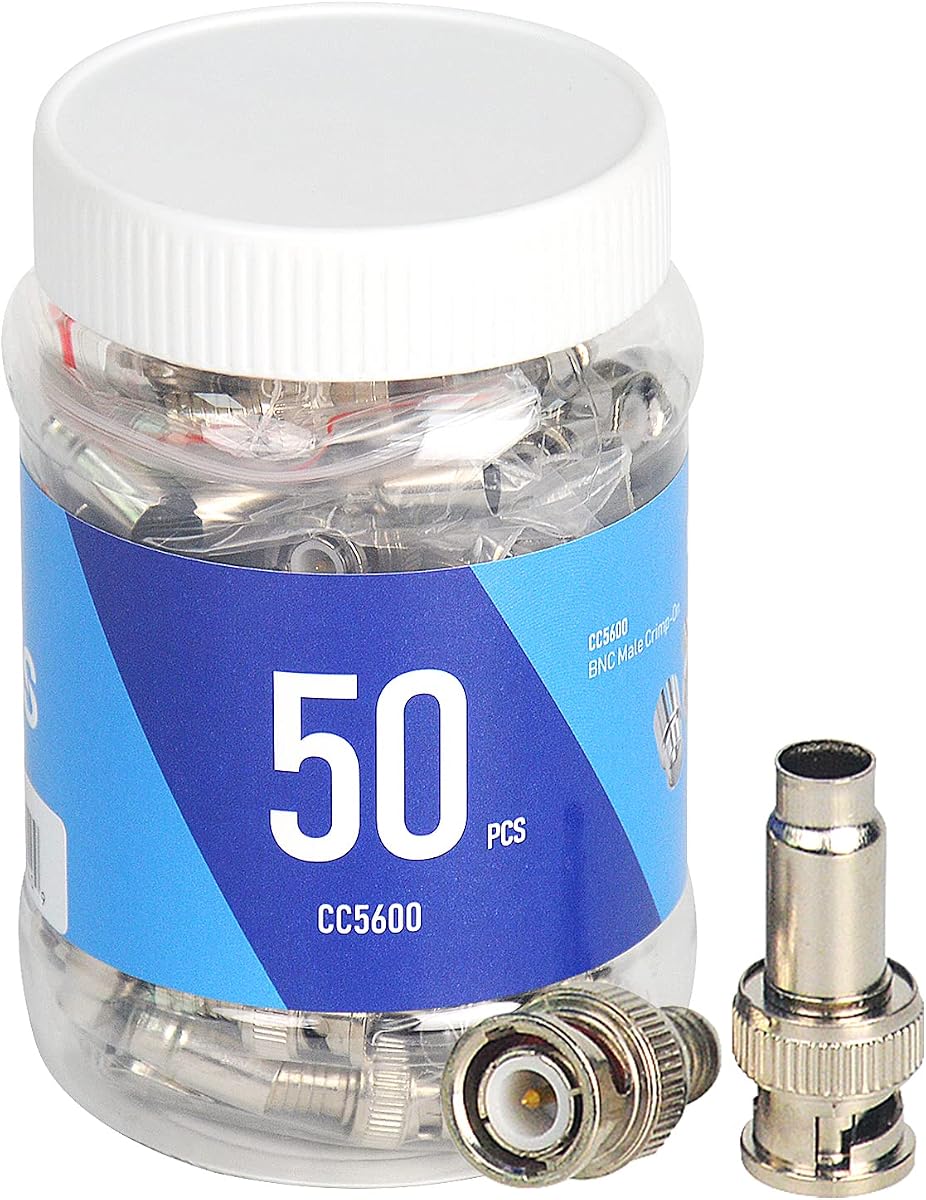
The DIYSecuritycameraworld listing is a focused RG59 solution with 50 male crimp-on BNC connectors. It carries a 4.5 rating and is aimed particularly at installers who need a dependable supply of standard coaxial video terminations.
We may earn a commission when you buy through this link, at no additional cost to you.
The product data is concise: quantity 50, use with RG59 coax, male crimp-on construction, and BNC interface type. It also explicitly states that an RG59 or RG6 crimping tool is required. That tool requirement makes the product less convenient for beginners, but it is an important reminder that connector strength depends on the correct crimp profile.
The absence of detailed impedance, attenuation, VSWR, and material specifications limits direct technical comparison with the other listings. Its main advantage is scale: fifty dedicated connectors offer a practical supply for camera installations, repair work, or a professional stock of consumables without mixing cable types.
Choose this product for dedicated RG59 work, particularly when numerous standard terminations are needed and the correct crimping tool is already available. It is not a general-purpose answer for RG58 or RG8X cables. Review the current listing carefully for dimensions, included hardware, and any updates beyond the supplied summary.
Specifying the intended cable helps reduce the chance of using a mismatched connector profile. RG59 applications commonly include coaxial video, making this pack especially relevant to CCTV work.
The listing specifies an RG59 or RG6 crimping tool. Using the correct die and applying consistent pressure is essential for creating a secure center-contact and ferrule termination.
We may earn a commission when you buy through this link, at no additional cost to you.
The best connector is the one whose cable profile, impedance, construction, and installation components align with your equipment and working method. Compare the technical requirements before focusing on pack size or customer rating.
Cable diameter and construction determine whether the connector can compress the ferrule correctly without damaging the dielectric or center conductor. RG58, RG59, RG142, LMR195, RG400, and 3D-FB appear across these listings, but one connector should not be assumed to fit all of them. RG8X and LMR240 are larger cable families and are addressed by products designed specifically for them. Always confirm the manufacturer's named cable list and, when possible, compare the connector's rear profile with the cable diameter.
Most of the products are intended for 50-ohm RF systems. Matching connector and cable impedance helps minimize reflections and unwanted signal behavior. Some listings publish more useful figures than others: the MOOKEERF RG8X set states less than 0.1dB attenuation at 500MHz and VSWR below 1.15, while the multi-cable MOOKEERF model states 0.15dB attenuation and SWR below 1.2. These values are product claims rather than results from independent testing, and installed performance also depends on crimp quality and cable condition.
Brass bodies are highlighted in the Eightwood and Anina listings, while copper alloys and aluminum alloy housings appear elsewhere. Gold-plated brass center contacts are common because the center conductor handles the electrical signal. Nickel plating on an outer shell can help resist oxidation. Material descriptions are useful, but they do not replace mechanical testing: check for smooth crimping, full sleeve compression, and a center contact that does not move.
Heat-shrink tubes, compression sleeves, pins, and crimp tooling determine whether a package supports a complete assembly. Eightwood includes ten heat-shrink tubes, Anina includes tubing and other components, and the XRDS RG8X kit includes compression sleeves and heat-shrink tubes. Other listings do not provide the same level of detail. If your toolkit is incomplete, verify that you have the correct ferrule, sleeve, die, stripping dimensions, and environmental protection before starting.
A BNC connector can be physically recognizable while still using a different rear profile for its cable. The RG59 listing explicitly requires an RG59 or RG6 crimping tool. Larger RG8X connectors often need distinct dies and ferrule sizes as well. Using a similar-looking but incorrectly sized die can leave the ferrule loose or deform the connector body. Follow the crimp instructions supplied with the connector rather than relying only on the BNC designation.
Outdoor antennas, security cameras, radio equipment, and mobile sensor installations may expose terminations to moisture, flexing, and strain. Heat-shrink tubing can protect the back of a connector when it is correctly sized and installed. Weatherproofing requirements also depend on the cable, enclosure, entry point, and overall installation design. A connector should not be treated as a complete environmental seal unless the manufacturer states that it is.
The RG8X and LMR240 options are aimed at larger RF jumpers, CB radios, and amateur radio equipment. The RG59 products concentrate on coaxial video and CCTV installations. RG58-class connectors are more common for scanners, cameras, antennas, and general test equipment. The MOOKEERF RG8X listing provides a frequency range up to 1000MHz, which may be relevant for high-frequency work, but the absence of a frequency statement elsewhere does not automatically make a connector unsuitable.
Pack sizes range from 10 to 50 pieces. Ten-piece and 16-piece packs suit maintenance, custom jumpers, and small installations, while 50-piece packs are useful for professional camera work or repeated repairs. Buy enough for the current project plus a small contingency because a failed or damaged termination may require a replacement. Avoid purchasing a large quantity before confirming cable compatibility.
Begin by identifying the coaxial cable and checking it against the connector's supported list. Use the connector manufacturer's strip dimensions, and prepare the cable without twisting the braid or nicking the center conductor. Verify that the ferrule, sleeve, or other rear component is the correct size for that cable before placing it inside the connector body.
Slide the connector onto the prepared cable and position the ferrule where the instructions specify. Place the assembly in the correct crimp die and compress it with a suitable BNC crimping tool. Inspect the finished connector for a firmly seated sleeve, a straight center pin, an intact dielectric, and a secure connection to the cable. Add heat-shrink tubing after crimping when it is not intended to be installed beforehand.
For care, keep completed terminations free of excessive bending, pulling, and impact. Do not use pliers to tighten the BNC locking interface; finger-tightening is normally sufficient. Outdoor connections should receive appropriate strain relief and weather protection. Periodically inspect exposed connectors for corrosion, loose braiding, damaged insulation, or movement, and replace a termination that no longer seats securely.
RG58 and RG59 BNC connectors may look similar, but they are designed for different coaxial cable dimensions and crimp profiles. RG58 products are intended for 50-ohm applications such as radio equipment and scanners, while the listed RG59 products are made for RG59 coaxial video cable. Always follow the connector's named cable compatibility and use the matching crimp die.
No, not simply because RG8X and RG58 use the same BNC interface. RG8X is a larger coax family and requires a connector with a matching rear profile, ferrule, and crimp die. For RG8X, LMR240, and similar cables, choose a listing that explicitly names those cable types.
The tool must use the correct die for the connector and coaxial cable, so a general-purpose tool is not enough by itself. The RG59 listing specifically calls for an RG59 or RG6 crimping tool. For other cables, check the connector instructions for the required die and crimp sleeve or ferrule.
Heat-shrink tubing is not necessarily required for every indoor connector, but it can protect the cable-to-connector transition from moisture, strain, and separation. It is especially useful for outdoor antennas, security camera cables, mobile radio leads, and other exposed or frequently handled installations. Use correctly sized tubing and shrink it only after the connector is fully crimped.
They can be used on suitable outdoor antenna cables when the connector is designed for that cable and properly crimped. The installation also needs strain relief and appropriate moisture protection because a connector alone may not provide a complete weather seal. For permanent outdoor work, secure the cable so its weight and movement do not stress the termination.
A secure termination should have a firmly compressed sleeve, a straight center contact, intact insulation, and no visible cable movement where it enters the connector. The BNC locking mechanism should engage cleanly with a compatible female connector. A loose ferrule, bent pin, or connector that rotates or pulls away should be replaced.
It indicates that the connector is intended for use with 50-ohm coaxial cable and compatible 50-ohm RF systems. Matching impedance helps reduce reflections and unwanted signal behavior. The connector should still match the cable's physical size, and installed results also depend on correct crimping and sound cable construction.
Count the number of cable ends that need terminations, then add a small reserve for mistakes or future repairs. Packs of 10 suit smaller projects, while packs of 50 are useful for professional CCTV work or frequent maintenance. Confirm the cable type and tooling before buying a large quantity.
The MOOKEERF RG8X set is the leading pick for low-loss RF work because it combines a 4.9 rating with specific RG8X and LMR240 compatibility, detailed attenuation and VSWR claims, and plated brass components. The Eightwood pack offers the best value for common RG58-class cable, while the DIYSecuritycameraworld and ENS options stand out for dedicated, bulk RG59 installations.
Prioritize cable compatibility before any other feature. Confirm the connector's rear profile, required ferrule, and crimp die; then consider center-contact materials, plated body construction, included sleeves or heat-shrink, and the electrical details relevant to your frequency. A connector that fits and is installed correctly is more valuable than one with a larger specification list but an uncertain match.
Product availability, ratings, and pricing can change over time, so review the current listing before purchasing. Compare the included parts against the tools and materials you already own, and purchase a modest spare allowance if future repairs are likely. These steps help turn a suitable BNC connector into a dependable finished coax termination.