
24V 10A IP67 Lithium Battery Charger
4.5Editor score
Compact 2.8-pound housing
IP67 waterproof construction
Three-stage smart charging
This 24V Lithium Battery Charger guide compares charging speed, safety, connectivity, waterproofing, portability, and battery activation across ten leading
A 24V lithium battery charger must do more than deliver adequate current. It must match the battery chemistry, use the correct charging voltage, provide dependable protection, and fit the environment where RV, marine, solar, or mobile equipment is stored. The best choices balance charging speed, installation flexibility, diagnostic visibility, and long-term battery care.
The products in this guide were compared using their stated specifications and listed customer ratings. We examined output voltage and current, charging stages, activation functions, safety systems, connector choices, cable lengths, environmental ratings, cooling, certifications, and intended applications. The list includes indoor, outdoor, portable, and permanently installed models.
Each review explains where a charger stands out and where its compromises may matter. The top selections highlight strong overall performance, practical value, and specialized outdoor capability. Product configurations and availability can change, so readers should verify the current listing, included accessories, and technical details before buying.
4.5Editor score

4.6Editor score

4.5Editor score
This side-by-side comparison highlights each charger's output, charging profile, environmental resistance, connection options, and most important practical distinction.



This compact 29.2V 10A charger combines a straightforward charging profile with broad compatibility for 24V and 25.6V lithium batteries. Its 4.6 rating places it among the strongest customer-rated options in this guide. The two-stage process moves from constant current to constant voltage, giving users a familiar and efficient way to replenish compatible LiFePO4 packs.
We may earn a commission when you buy through this link, at no additional cost to you.
The charger supports battery capacities from 30Ah to 150Ah, making it useful across a wider assortment than chargers designed only for small packs. At 10A, it can reportedly charge a 50Ah battery in around five hours and a 100Ah battery in around ten hours. The Anderson connector and LED indicator also simplify routine setup and status checks.
Its main limitation is charging speed relative to the 20A and 30A alternatives. It also lacks a stated waterproof rating, making it less attractive for exposed marine installations or dusty outdoor work areas. Nevertheless, its compact construction, clear charging stages, and safety protections provide a balanced package for RV, boat, and general mobile applications.
This is a strong choice for owners who want a dependable charger without moving to the largest model available. It suits medium and large 24V lithium battery packs where moderate output, portability, and straightforward connection matter more than maximum charging speed. It is our top general-purpose selection for those reasons.
The 10A output provides a practical balance between charging speed and portability. Its stated 30Ah–150Ah support makes it useful for deeper-cycle installations, while two-stage charging helps manage the final portion of the charge.
Protection against overcharging, overheating, and short circuits reduces common charging risks. The Anderson connector and visible LED indicator also make it easier to confirm a secure setup without repeatedly disconnecting the battery.
We may earn a commission when you buy through this link, at no additional cost to you.
LiTime's 20A model is a technically comprehensive indoor charger with a 4.6 rating, matching the highest rating in this guide. It outputs 29.2V for compatible 24V and 25.6V lithium batteries, supports up to 20A, and automatically transitions through pre-charge, constant-current, and constant-voltage stages.
We may earn a commission when you buy through this link, at no additional cost to you.
Its 0V activation feature is particularly useful when a battery's BMS has entered cut-off protection after a long period without charging. The charger also includes protections for short circuits, overcurrent, reverse polarity, overvoltage, undervoltage, and excessive temperature. An aluminum alloy housing and built-in fan support heat dissipation.
The manufacturer clearly states that this version is not waterproof and is unsuitable for boats, ships, yachts, and trolling motor environments. It also calls for approximately 14 by 4 inches of installation space, which may be restrictive in a compact compartment. Cable lengths are 47.24 inches for both the AC and DC leads.
Choose this model for a garage, workshop, shed, cabin, or protected installation where charging control, monitoring, and safety features are priorities. It is less suitable for a damp or exposed location. For owners needing 0V recovery and refined three-stage charging in a protected environment, it remains one of the most compelling selections.
The 0V charging function is designed to wake a compatible lithium battery after its BMS has shut off because of deep discharge. This can be helpful for seasonal equipment, but it is not a substitute for diagnosing an actually damaged or aged battery.
The aluminum housing, active fan, and automatic charging stages suggest attention to both thermal management and unattended use. LED indicators make the state of the process easier to understand during a regular charging routine.
We may earn a commission when you buy through this link, at no additional cost to you.
This 30A charger is the most powerful model in the guide, designed for high-output charging of 24V LiFePO4 batteries. It has a 4.5 rating and combines 29.2V output, smart three-stage charging, 0V activation, and an IP67 waterproof enclosure for RV, marine, trolling motor, solar, and off-grid applications.
We may earn a commission when you buy through this link, at no additional cost to you.
A built-in temperature sensor adjusts charging voltage to ambient conditions, while an aluminum housing, vortex-style airflow arrangement, and cooling fan help manage heat. The maker states that a 150Ah battery can be fully charged in about five hours. Protection systems cover overvoltage, overcurrent, overheating, short circuit, reverse connection, overcharge, and timing.
Installation flexibility is another advantage. It supports SB-50 Anderson, M8 terminals, and alligator clips, allowing users to select the connection that suits the battery. As the highest-current option, it requires a suitable outlet, wiring, ventilation, and more attention to thermal conditions than a 10A charger.
This is the best choice for demanding mobile or stationary systems where charging speed and weather resistance are both important. It is especially relevant for large battery banks, marine equipment, and outdoor installations. Buyers should confirm that their battery, cables, and electrical infrastructure can safely support the 30A output.
The 30A output substantially shortens charging time for large LiFePO4 batteries. That makes the model more suitable for frequently used equipment than lower-current alternatives when power infrastructure and battery condition are appropriate.
The IP67 enclosure, temperature compensation, and multiple connection methods suit exposed installations. Marine users should still follow electrical safety practices, secure connections, and the charger manufacturer's placement and ventilation guidance.
We may earn a commission when you buy through this link, at no additional cost to you.
This 29.2V 30A charger is a straightforward high-current option for 24V LiFePO4 batteries. It carries a 4.4 rating and is intended for power packs used with cars, trucks, motorcycles, lawn equipment, RVs, and boats. Its smart chip manages charging while helping preserve long-term battery health.
We may earn a commission when you buy through this link, at no additional cost to you.
The charger includes soft-start, overcurrent, overvoltage, and short-circuit protection. It is certified to CE, FCC, and RoHS standards and is specified to operate from -13°F to 104°F. Those certifications and a stated broad temperature range make it appealing for mobile use in varied conditions.
It is explicitly designed for LiFePO4 chemistry and is not compatible with lead-acid, AGM, or other battery types. That limitation improves specialization but requires buyers to confirm battery chemistry before purchase. It also has no stated IP waterproof rating, so protected placement is important in wet environments.
This model suits users who prioritize fast current, straightforward construction, and broad environmental tolerance over elaborate status displays or multiple connector formats. Verify the battery polarity, wiring, and electrical capacity before operating a 30A charger, particularly in older vehicles or crowded storage compartments.
The 30A rating and smart control chip provide the core benefits sought by most high-output buyers. The feature set focuses on charging performance and essential protection rather than a large collection of installation accessories.
A stated operating range of -13°F to 104°F supports use in garages, vehicles, and outdoor work areas where temperatures can shift. The housing still needs protection from standing water and physical damage.
We may earn a commission when you buy through this link, at no additional cost to you.
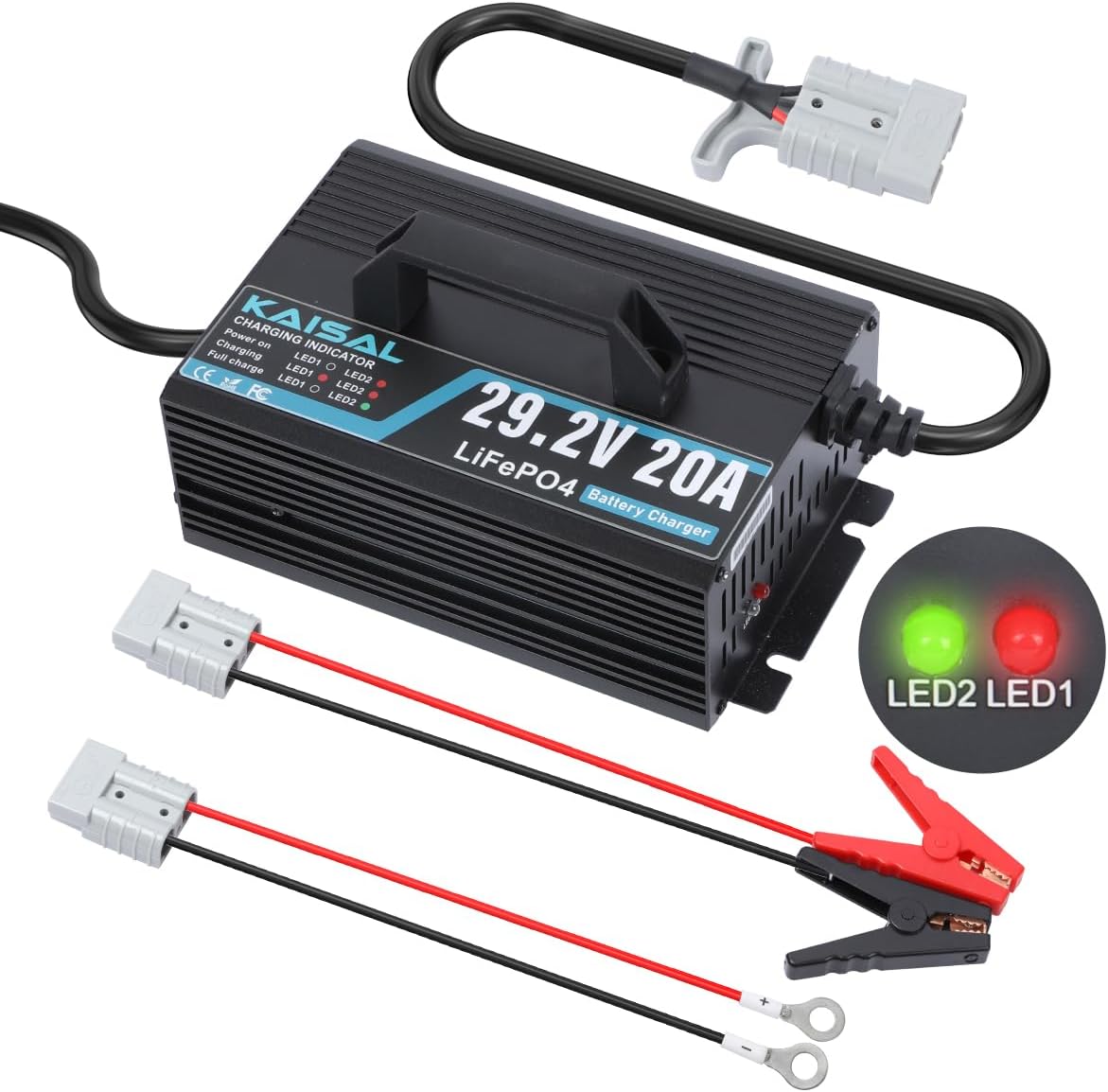
The KAISAL 20A model combines an IP67-rated die-cast aluminum enclosure with a detailed 29.2V charging profile. Its 4.5 rating reflects a well-rounded package for RVs, boats, trucks, solar systems, energy storage, trolling motors, and off-grid applications. The 20A output sits neatly between compact 10A chargers and maximum-output 30A models.
We may earn a commission when you buy through this link, at no additional cost to you.
A three-color indicator clearly separates standby or wake-up mode, normal charging, reduced-current charging, and full charge. The charger uses pre-charge, constant-current, and constant-voltage stages, with an automatic reduction in current as the battery approaches capacity. Up to 94% charging efficiency and a stated five-hour charge time for a 100Ah battery are also highlighted.
Eight protection functions cover overvoltage, overcurrent, overheating, no-load conditions, short circuit, reverse connection, overcharge, and charging time. A 15-hour maximum operating period provides another layer of unattended-use protection. M8 terminals and alligator clips cover both permanent and temporary connection needs.
This is a strong option for outdoor users who want clearer status feedback and more connection versatility than a basic charger. Its main trade-offs are the 20A charging rate and a 9.5-foot cable that may not reach an ideal installation in every layout. It is especially compelling for mobile use where portability and sealed construction both matter.
The three-color LED system provides more information than a simple on-off light. Users can distinguish full charging from reduced-current charging and standby or activation mode without inspecting a separate meter.
The sealed aluminum body and IP67 cable rating suit outdoor and marine use. M8 ring terminals support a more permanent arrangement, while alligator clips make temporary charging and testing easier.
We may earn a commission when you buy through this link, at no additional cost to you.
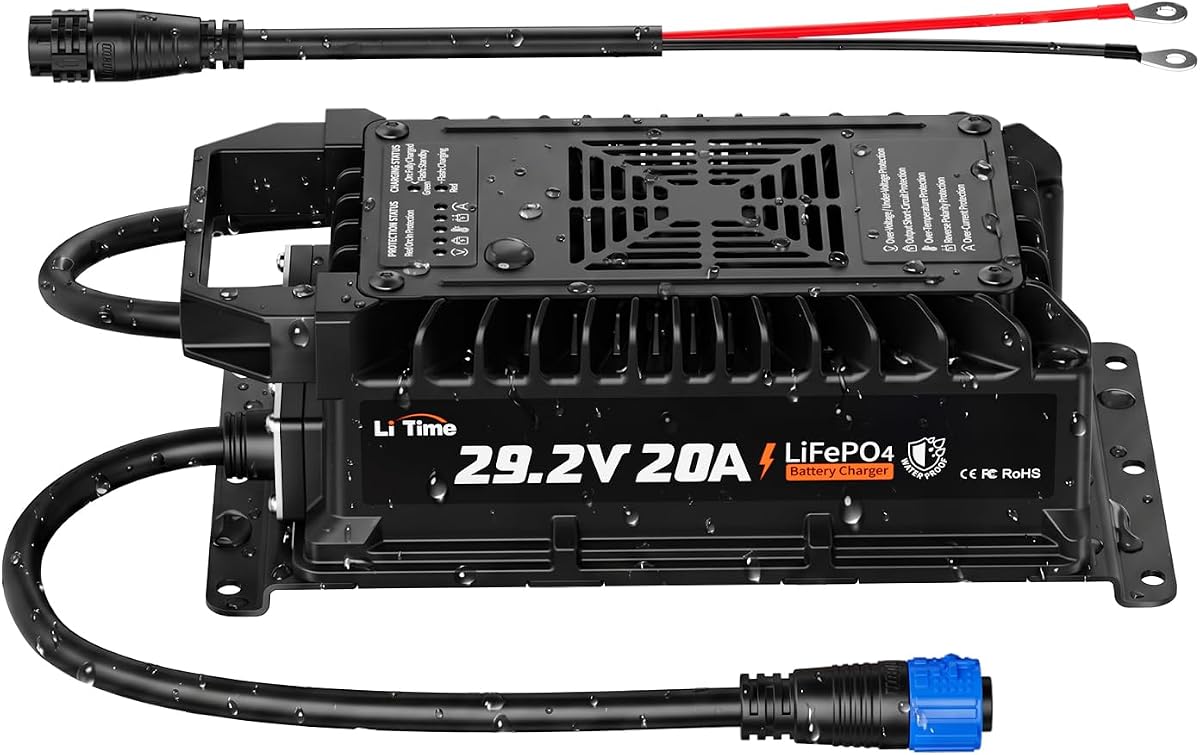
This LiTime model is designed for owners who want a 20A charger suitable for outdoor and permanent installation. It outputs 29.2V, uses three-stage charging, supports 0V activation, and carries an IP67 rating. Its 4.0 rating is the lowest among the ten products, making the specification set and included installation hardware especially important to evaluate.
We may earn a commission when you buy through this link, at no additional cost to you.
The package includes a waterproof adapter cable, OT M8 terminal cable, AC power cord, user manual, and mounting bracket. The integrated handle adds portability, while the bracket allows the unit to be secured in a garage, cabin, boat, camper, or energy-storage environment. A cooling fan supports stable operation.
Protections cover excessive temperature, short circuit, overcurrent, reverse polarity, and both overvoltage and undervoltage. LED indicators report charging status and specific protection conditions, which can help with troubleshooting. The AC and DC cables are listed at 1,200 millimeters, while the M8 adapter adds a 250-millimeter lead and 500 millimeters of terminal spacing.
The main reason to choose it is its combination of IP67 construction and installation accessories. The lower rating and relatively compact cable lengths make it less compelling for setups where extended reach or extensive evidence of broad customer satisfaction matters most. Verify that the supplied cable lengths fit the intended position.
The included bracket and OT M8 terminal cable make this a convenient option for a fixed setup. The carrying handle preserves some flexibility when the charger needs to be repositioned.
Individual LEDs indicate faults such as reverse polarity, overcurrent, overvoltage, undervoltage, and short circuit. That visibility can shorten diagnosis when a charging cycle does not proceed normally.
We may earn a commission when you buy through this link, at no additional cost to you.
This 20A charger is built around connection flexibility, offering SB-50 Anderson, M8 terminal, and alligator clip options. It has a 4.4 rating and uses 29.2V output for 24V and 25.6V LiFePO4 batteries. The three-stage profile covers pre-charge, constant current, and constant voltage.
We may earn a commission when you buy through this link, at no additional cost to you.
Its two-color indicators show standby or wake-up mode, active charging, reduced-current charging, and full charge. A 0V activation mode is intended to wake batteries whose BMS has cut off after prolonged storage. The listed efficiency reaches 90%, and a 100Ah battery is said to charge in about five hours.
Eight protections address voltage, current, temperature, no-load operation, short circuit, reverse connection, overcharge, and excessive charging time. The unit automatically resumes after a fault is corrected and shuts down after 15 hours. A 9-foot cable, aluminum enclosure, and cooling fan support practical outdoor use.
The lack of a stated IP rating makes it less obviously suited to exposed marine locations than several alternatives. Even so, the three connector types make this model appealing to RV, truck, boat, solar, and energy-storage users who want one charger to suit different battery arrangements.
Anderson plugs suit batteries with matching ports, M8 terminals can remain attached, and alligator clips offer quick access. This variety is useful when working across multiple packs or changing installation plans.
The activation function can recover a battery stopped by normal BMS protection, while the maximum charging-time control reduces long-term overcharge risk. Neither feature should be used to revive a physically faulty battery.
We may earn a commission when you buy through this link, at no additional cost to you.
This specialized 4A charger is built around a three-pin male XLR connection rather than the ring terminals or clips found on most general-purpose models. It has a 4.5 rating, accepts 100–240V AC input, and outputs up to 29.4V and 4A for compatible 24V lithium battery packs.
We may earn a commission when you buy through this link, at no additional cost to you.
Its compact ABS shell is described as drop-resistant and heat-resistant, while a built-in fan supports cooling. The LED sequence is easy to follow: green when connected to AC, alternating red and green while connected and charging, and steady green at completion. Automatic shutdown occurs when the battery is fully charged.
The primary limitation is speed. A 4A maximum is well below the 10A, 20A, and 30A options, so it is better suited to smaller packs, light equipment, or users who value a compact specialized adapter. The fixed XLR connector also means the battery must have a compatible port or a correctly wired adapter.
Choose this model only when its connector precisely matches the intended battery and moderate output is sufficient. It can be useful for specialized portable equipment or space-conscious setups. For large RVs, solar banks, or frequently used marine batteries, one of the higher-current models will be more practical.
The three-pin male XLR provides a defined connection for equipment designed around that interface. Buyers should confirm both the physical connector and the pin arrangement rather than relying on shape alone.
The alternating LED pattern clearly communicates active charging, while steady green signals completion. A built-in fan helps remove heat from the compact enclosure during operation.
We may earn a commission when you buy through this link, at no additional cost to you.
The RALBIL 10A charger stands out for portability and environmental protection. At 2.8 pounds, it is the lightest model highlighted here, yet its aluminum housing carries an IP67 rating for water, dust, and shock resistance. Its 4.5 rating reflects a favorable balance of features for RV, marine, solar, and off-grid users.
We may earn a commission when you buy through this link, at no additional cost to you.
It outputs up to 29.4V and 10A, using pre-charge, constant-current, and constant-voltage stages. The maker reports charging a 50Ah lithium battery in approximately five hours and efficiency up to 94%. M8 ring terminals and alligator clips cover permanent and temporary connections, while four mounting holes support fixed installation.
Seven protections cover overheating, reverse polarity, overvoltage, overcurrent, short circuit, no-load operation, and maximum charging time. The 15-hour shutdown limit and automatic shutdown after full charging reduce unattended-use concerns. A three-color indicator communicates charge progress, and the stated operating range extends from -22°F to 149°F.
Its main trade-off is output speed, particularly with large battery banks. It is best for moderate charging needs and users who value low weight and rugged construction. The maker also correctly notes that wake-up mode cannot recover a battery that is faulty or aged below the recoverable voltage threshold.
The compact 2.8-pound housing is easy to carry between a vehicle, campsite, garage, or boat. Its IP67 rating and mounting holes allow the same unit to support both mobile and installed charging.
Pre-charge, constant-current, and constant-voltage stages allow the charger to adapt to battery condition. The multi-level indicator and automatic full-charge shutdown make the process easy to monitor and reduce unnecessary manual intervention.
We may earn a commission when you buy through this link, at no additional cost to you.
This LiTime 20A charger is a capable indoor model for protected garage, workshop, and storage applications. It shares a 29.2V output and 20A maximum current with the related AC-DC version, earns a 4.5 rating, and includes a dedicated 0V wake-up mode for batteries whose BMS has shut off after deep discharge.
We may earn a commission when you buy through this link, at no additional cost to you.
The charging process moves automatically through pre-charge, constant-current, and constant-voltage stages. The description also notes that a suitable LiFePO4 charger can bring a battery to 100% capacity instead of stopping around 90% as some non-LiFePO4 chargers do. LED indicators provide basic real-time status information.
Protections cover short circuit, overcurrent, reverse polarity, overvoltage, undervoltage, and over temperature. An aluminum alloy shell and built-in fan aid heat dissipation. LiTime lists CE and RoHS certification and a two-year quality warranty for this charger.
The manufacturer explicitly says the product is not waterproof and should not be used in marine environments. Both the AC and DC cables measure 47.24 inches, while the Anderson connection lead is 9.84 inches, which may require an extension or closer placement. It is best for a dry, protected installation.
The dedicated activation mode is useful when a seasonal battery has entered BMS cut-off after sitting without a charge. It can restore normal operating voltage when the battery remains recoverable but cannot replace a damaged or severely aged pack.
The aluminum housing and active cooling fan balance durability with manageable size. Because the unit is not waterproof, it should be mounted in a dry area with ventilation and protection from moisture.
We may earn a commission when you buy through this link, at no additional cost to you.
The right charger depends on battery chemistry, capacity, connector layout, installation environment, and how quickly the pack needs to recharge. These factors matter more than headline current alone.
Most products in this guide are designed specifically for 24V or 25.6V lithium iron phosphate batteries, with charging outputs around 29.2V to 29.4V. A charger marketed for generic lithium batteries may still be tailored to a particular chemistry, connector, or battery-management protocol. Some listings explicitly exclude lead-acid, AGM, and other battery types. Check the battery label, manual, and terminals before ordering, and never assume that the nominal 24V designation guarantees compatibility.
In short, match both nominal voltage and chemistry. Use only a charger whose listed output is explicitly approved for your battery.
A charger's current affects how quickly a battery can replenish energy. The guide includes 4A, 10A, 20A, and 30A options, each suited to different pack sizes and duty cycles. Higher current is not automatically better: it requires compatible wiring, adequate power supply capacity, ventilation, and a battery capable of accepting that rate. Published charge times are most useful when compared with the same battery capacity, but real charging time also varies with starting state of charge and the charger's final reduced-current stage.
Choose a current that meets your timing needs without exceeding the battery, wiring, or installation limits.
A quality charger should move through pre-charge, constant-current, and constant-voltage stages, especially when recovering a deeply discharged pack. Pre-charge supplies a controlled low current, constant current handles the main replenishment, and constant voltage tapers the current as capacity is reached. Some products use only two stages, while others automatically reduce output or power off when full. Understanding the sequence helps with both battery care and troubleshooting.
In short, a controlled multi-stage profile is generally more informative and battery-friendly than a simple uncontrolled output.
A 0V or wake-up function can be valuable for lithium batteries that have entered BMS cut-off protection after long storage. It attempts to restore a compatible battery to a normal operating voltage. It does not fix damaged cells, charging faults, or batteries whose voltage has fallen because of age. Activation should therefore be treated as a recovery aid, not a substitute for testing an old battery. Users with frequently stored equipment will benefit most from this feature.
In short, choose activation for recoverable BMS-protected batteries, not as a cure for a physically defective pack.
An IP67 rating indicates protection against dust ingress and temporary water immersion under specified test conditions. It is valuable for marine, RV, camping, and off-grid use, but it is not permission to submerge the charger or ignore connector care. Several products in this guide are explicitly not waterproof. Always distinguish the charger body, cable rating, and connector rating, and follow the manufacturer's placement guidance. A waterproof charger still needs safe wiring and dependable connections.
In short, match environmental protection to the actual installation site and preserve every connection during charging.
Anderson plugs, M8 ring terminals, and alligator clips each serve different uses. Anderson connections are common in mobile and recreational power setups, M8 terminals can support a more permanent arrangement, and alligator clips are convenient for temporary service. The XLR-equipped model is specialized and should be selected only when the battery interface matches. Cable length is equally important: shorter leads may require a closer outlet or an extension, while longer leads add convenience but can introduce more voltage drop if inadequately rated.
In short, choose the connector your battery already supports and verify that the full cable length reaches without straining the connection.
Look for protection against overcharge, overvoltage, overcurrent, short circuit, reverse polarity, overheating, and excessive charging duration. A maximum-time cutoff adds another layer of protection when a battery remains connected. Status lights are useful, but detailed fault indicators can be even more helpful when a charge does not begin. Pre-charge, automatic recovery after fault correction, temperature adjustment, and full-charge shutdown are also useful signs of a thoughtfully controlled charger.
In short, prioritize essential electrical protections first, then consider indicators and automatic recovery features for easier maintenance.
Higher-current chargers produce more heat, making airflow and active cooling especially important. Models with aluminum housings and built-in fans are well suited to sustained charging, while compact lower-current units may be easier to transport. Permanent installations should allow the stated clearance, secure the unit away from combustible surfaces, and keep connections accessible for inspection. Portable designs benefit from a handle and lightweight construction; fixed designs benefit from mounting brackets and cable strain relief.
In short, provide stable mounting and adequate cooling, and never seal a charger in a compartment where heat cannot dissipate.
Before connecting anything, identify the battery chemistry, nominal voltage, polarity, capacity, and required charging profile. Read the charger's instructions and compare those details with the battery manufacturer recommendations. Inspect the charger, cables, connectors, and battery terminals for damage, corrosion, or exposed conductors. Use a grounded outlet and an extension or power connection rated for the charger's full current draw.
Connect the charger to the battery before applying AC power, observing positive and negative polarity. The listed status lights should show standby, activation, or charging once the battery is detected. If a fault indicator remains on, disconnect AC power, check polarity and connections, and confirm that the battery is compatible. Do not repeatedly reset a charger while a serious fault remains unresolved.
Allow the charger to complete its automatic charging stages and monitor it during the first cycle, especially with an older battery. Do not interrupt charging routinely, and do not use activation mode on a physically damaged pack. After charging, disconnect AC power before removing the battery connection. Keep the unit dry, clean, and unobstructed, and inspect connectors regularly for looseness, corrosion, or heat damage.
Only if the charger is explicitly approved for lead-acid charging and its voltage and profile match the battery. Most models in this guide are designed specifically for 24V or 25.6V LiFePO4 batteries, and some explicitly exclude lead-acid, AGM, and other chemistries. Using the wrong profile can cause damage, overheating, or an unsafe charge, so verify compatibility in both the battery and charger documentation.
A 24V LiFePO4 battery is commonly made from 24 cells with a nominal voltage near 25.6V, while 29.2V is the higher charging voltage used to bring those cells to full capacity. The charger must support the battery's specified charging voltage and management requirements. Do not connect a 29.2V charger to a different lithium chemistry without confirmation from the battery manufacturer.
A 20A charger may be suitable if the battery manufacturer permits that current and the wiring, connectors, and power source are appropriately rated. Capacity alone does not determine safe charging current, and battery age, temperature, and internal condition also matter. Always follow the battery maker's recommended charge rate and use a properly fused installation.
It attempts to wake a compatible battery whose BMS has disconnected output after deep discharge or prolonged storage. The charger provides a controlled recovery attempt so the BMS can resume normal operation. It cannot repair failed cells or recover a battery that has aged or deteriorated below a safe voltage, so persistent problems require battery testing or replacement.
An IP67 charger is designed to tolerate demanding outdoor conditions and offers useful protection for marine installations, but it is not a guarantee against every possible failure. It should still be mounted according to the instructions, with secure connectors, appropriate wiring, ventilation, and protection from direct immersion. Products explicitly labeled as not waterproof should never be placed in a marine environment.
The answer depends on charger output, the battery's starting charge, and the charging profile. Listed examples range from about five hours with certain 20A or 30A models to roughly ten hours with a 10A charger under ideal conditions. The final constant-voltage stage is slower and naturally extends the total time, so a complete charge may take longer than a simple capacity calculation suggests.
A charger with automatic full-charge shutdown, overcharge protection, and a maximum charging-time cutoff can remain connected when those functions are properly implemented. Periodic monitoring is still sensible, particularly during the first charge or when using an older battery. Unplugging after completion is a conservative approach, especially if the battery is stored for long periods.
Large systems generally benefit from a higher-current model, but the correct charger must also match the battery bank's chemistry, total capacity, wiring, and charging profile. The 30A IP67 model is designed for high-output RV, marine, solar, and off-grid use, while 20A models offer a more moderate balance. A qualified electrical calculation is advisable for unusually large or professionally installed banks.
The 24V 10A Anderson charger is the strongest all-around selection because it combines a 4.6 rating, broad 30Ah–150Ah support, a two-stage profile, useful protections, and portable construction. The RALBIL 10A IP67 model is the best budget-oriented outdoor option, while the 30A IP67 charger leads the premium group for high-output charging, temperature adjustment, and marine-oriented construction.
Prioritize chemistry compatibility first, followed by charging current, charging stages, protection features, and environmental needs. A waterproof model and 20A or 30A output make sense for large outdoor systems, while a 4A XLR charger is appropriate only for its specific interface. A protected installation can be served well by a non-waterproof 20A unit with detailed monitoring.
Before purchasing, verify the current listing, included cables, connector type, warranty terms, certifications, and the latest manufacturer instructions. Prices, configurations, and availability can change, so current product pages should be used to confirm the final choice and make sure the charger is appropriate for the battery and installation.