
IIWEY N6 360° Dash Cam
4.4Editor score
Four-channel 360° coverage
Infrared night vision
Included 128GB memory card
Our Dash CAM for Off Roading guide compares 10 top-rated models for trail visibility, night recording, rugged durability, parking protection, and easier
A dash cam for off-roading must do more than record ordinary roads. It should capture rough trails, changing terrain, wildlife, sudden obstacles, and low-light routes while remaining easy to power and position in a rugged vehicle. Resolution, wide-angle coverage, night performance, heat resistance, and secure mounting are the most important considerations.
We compared the supplied ten models by examining their recording channels, sensors, viewing angles, night-vision features, parking modes, storage support, GPS, wireless connectivity, and installation requirements. The list includes front-and-rear systems, three-camera rigs, and four-channel 360-degree designs, giving off-roaders several practical configurations to consider.
Each review explains where a model fits best and where its compromises may matter on rough routes. The top three selections emphasize overall coverage, value, and specialized hardware, while the remaining products provide alternatives for cabins, fleets, nighttime travel, or large vehicles. Product availability and pricing can change, so verify current details before purchasing.
4.4Editor score

4.5Editor score

4.4Editor score
This side-by-side comparison highlights each dash cam's channel count, resolution, low-light capabilities, connectivity, and practical off-road considerations. It includes front-and-rear, cabin, side-view, 360-degree, and premium three-camera configurations.


The ROVE R2-4K Dual combines a two-camera arrangement with a Sony STARVIS 2 IMX675 sensor in the front unit. It holds a 4.5 rating and stands out for balancing detailed road recording, low-light performance, GPS data, and straightforward smartphone access. That combination makes it especially useful for off-roaders traveling on unlit trails or remote routes.
We may earn a commission when you buy through this link, at no additional cost to you.
Its front camera records at 2.5K and upscales to 4K for playback, while the rear camera records at 1080P. The wide F1.5 front aperture, HDR, and STARVIS 2 sensor help preserve useful detail in dim conditions. A built-in IPS screen displays speed and compass direction, while dual-band Wi-Fi supports fast app transfers. The included 128GB card makes the package ready for loop recording without an immediate extra purchase.
The main qualification is that its 4K front output is upscaled rather than native. A trail driver should understand that the underlying 2.5K image supplies the captured detail. Parking surveillance also requires a separately sold hardwire kit. Even so, the ROVE offers a balanced feature set, thermal protection, a supercapacitor, emergency locking, motion detection, and support for large memory cards.
Choose the ROVE R2-4K Dual if you want a dependable front-and-rear setup without moving to a more complicated multi-camera installation. It is a particularly strong match for weekend off-roaders who also drive long paved routes, need a usable cabin display, and value navigation evidence. The included accessories and integrated GPS make it an easy, well-rounded recommendation.
The STARVIS 2 front sensor, broad aperture, and HDR processing make this model more useful on dusk trails than a basic high-resolution unit. Those qualities help preserve vehicle shapes, trail markers, and other details when ambient light is limited.
Built-in GPS stamps routes, locations, and speed into recordings and displays a live compass on the screen. That context is valuable when reviewing an unfamiliar trail, explaining a route, or documenting how an incident unfolded.
We may earn a commission when you buy through this link, at no additional cost to you.
The IIWEY N6 provides true four-channel coverage, recording the front, rear, and both sides at the same time. Its 4.4 rating reflects a versatile feature set at a value-focused position. For off-road vehicles, wide cabin views can reveal passengers, cargo shifts, nearby rocks, or trail activity outside the conventional forward-facing field.
We may earn a commission when you buy through this link, at no additional cost to you.
The front and rear cameras use ultra-wide fields of view, while the side cameras can be adjusted. Eight infrared lights support low-light and cabin capture, and Vision Enhance processing is intended to improve the visibility of plates and lanes. Dual-band Wi-Fi 6 enables app preview and transfers, built-in GPS records route and speed information, and the included 128GB card supports immediate loop recording.
This is a wired system with no built-in battery, which is sensible for sustained use and reduces concerns about lithium-battery degradation in a hot vehicle. Daily operation works with the included car charger, but parking surveillance requires a separate hardwire kit. The automatic Wi-Fi shutoff and adjustable time-lapse or impact-detection modes can help manage power consumption and storage.
The N6 is a compelling choice for off-roaders who want near-360-degree awareness without paying for a premium triple-sensor flagship. Its extra channels are especially useful for large SUVs, trucks, and heavily utilized family vehicles. Install it carefully, configure the side angles, and remove the lens protective film before recording.
Four synchronized cameras can show activity beside or behind the vehicle on narrow trails. This wider perspective is useful when another vehicle approaches from a blind corner or when cargo moves during a demanding section.
A compatible hardwire kit enables time-lapse or impact-triggered surveillance after the vehicle is parked. Because the camera has no internal battery, hardwiring is also the more practical choice for continuous operation.
We may earn a commission when you buy through this link, at no additional cost to you.
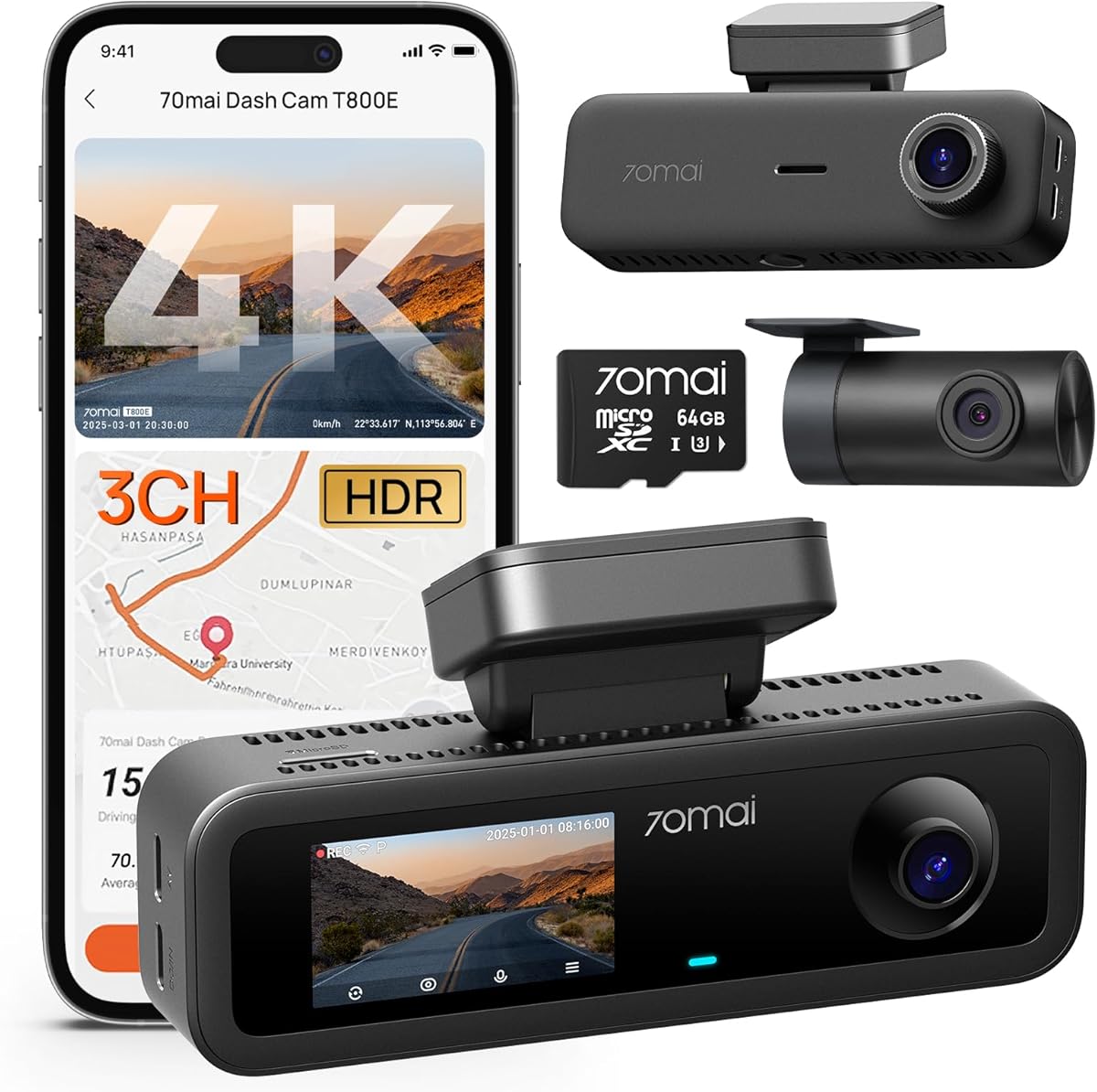
The 70mai T800E records through three channels: 4K at the front, 1080P inside the cabin, and 1080P at the rear. With a 4.5 rating, it offers an effective mix of high-resolution trail evidence and interior coverage. The three-camera layout is well suited to off-road family trips, work vehicles, and anyone who wants visibility into the cabin as well as the route.
We may earn a commission when you buy through this link, at no additional cost to you.
HDR, three-dimensional noise reduction, F1.55 apertures, and ultra-wide lenses support visibility in changing light. The cabin camera has switchable infrared, useful at night without requiring the driver to leave an exterior light on. Built-in GPS records speed, location, and route, while Wi-Fi 6 supports app transfers at stated speeds of up to 10 MB/s. Voice control can take photos, initiate recording, and lock clips.
A supercapacitor is specified for operation from 14°F to 140°F, reducing reliance on a lithium battery and making the unit better suited to temperature extremes. The included 64GB card supports loop recording, and the system accepts cards up to 512GB. Parking monitoring is available through a compatible hardwire kit, while 4G cellular connectivity is not supported.
The T800E is ideal for buyers who want front, rear, and cabin records without moving to a four-camera system. Its main compromise is that the rear and interior feeds are 1080P rather than 4K, so the 4K designation applies to the front camera. For trail security, that is a sensible priority, and the 18-month warranty adds ownership support.
The supercapacitor and specified operating range make this system a sensible choice for hot desert trails or cold-weather outings. It avoids relying on a conventional internal battery as the primary source of operational resilience.
Switchable infrared illumination gives the interior camera useful nighttime visibility. It can help document passenger behavior, pets, or shifting cargo without washing out the rest of the scene.
We may earn a commission when you buy through this link, at no additional cost to you.
The REDTIGER F7NP is a front-and-rear camera system with a STARVIS 2 sensor, 4K front recording, and 1080P rear coverage. It carries a 4.1 rating, placing it below several competitors, but its core recording hardware remains well suited to off-road use where sharp forward detail and a broad field of view are priorities.
We may earn a commission when you buy through this link, at no additional cost to you.
The front camera combines a 170-degree lens with WDR and HDR, while the rear offers a 140-degree perspective. A six-layer optical lens and large aperture support low-light performance, and 5.8GHz Wi-Fi enables app transfers at stated speeds of up to 20 MB/s. GPS information is available through the Redtiger Cam app, which also handles previewing, downloading, settings, and route review.
Its supercapacitor is preferable to a lithium battery for long parking periods and high ambient temperatures. Seamless loop recording, event locking, time-lapse parking mode, and collision detection create a solid protection package. The hardwire kit is not included, and the comparatively modest 4.1 rating means buyers should examine the latest customer feedback before deciding.
The F7NP is a strong alternative when a dual-camera system with genuine 4K front capture is enough. It may appeal to off-roaders who want fewer cables and cameras than a three-channel setup. Avoid non-original charging accessories, route the rear cable securely, and allow the unit to cool if it becomes excessively hot during operation.
The wide 170-degree front view captures much of the road, trail shoulder, and nearby obstacles. Combined with 4K detail, it can help when a trail bends sharply or another vehicle approaches from an unusual angle.
The supercapacitor is designed for better heat resistance and longer service life than a typical internal lithium battery. That design remains useful when a vehicle is parked in direct sun for extended periods.
We may earn a commission when you buy through this link, at no additional cost to you.
The AProX HD three-channel system records 4K from the front, 4K from the rear, and 1080P inside the cabin. It has the highest supplied rating in this group at 4.8, and its uncommon 4K rear feed is a major advantage for off-roaders who want detailed evidence behind the vehicle after tight turns or difficult climbs.
We may earn a commission when you buy through this link, at no additional cost to you.
Wide views cover 170 degrees at the front, 150 degrees at the rear, and 150 degrees inside. HD night vision, WDR, and four infrared lights support difficult lighting, while a laminated 3.18-inch screen offers a relatively clear on-device view. Dual-band Wi-Fi 6 supports transfers up to 20 MB/s, and the TERUNSOUL app provides settings, previews, downloads, and firmware updates.
The included 128GB card is appropriate for a multi-camera setup, and the system supports larger cards up to 512GB. GPS embeds speed and location data, while loop recording and emergency locking help preserve relevant clips. Parking monitoring includes time-lapse and collision detection, but a hardwire kit is required. The product also carries a three-year guarantee, which is unusually substantial for this category.
This camera is best for buyers who prioritize rear-image resolution and comprehensive directional coverage. It offers 4K at both ends, something several more expensive-looking systems do not offer in their standard configuration. Consider the installation complexity of three channels and confirm that the supplied cables and mounts suit your vehicle before mounting everything permanently.
A detailed rear recording can reveal a passing vehicle, trail obstacle, or wildlife encounter during a tight maneuver. It also provides useful context when a vehicle reverses or when another driver approaches from behind on a single-lane route.
Dual-band Wi-Fi 6 and app-based OTA updates make the stored recordings easier to review without repeatedly removing the memory card. The combination is useful after a demanding off-road day when several events may need rapid review.
We may earn a commission when you buy through this link, at no additional cost to you.
The REDTIGER F7N TOUCH is a two-camera system that records 4K at the front and 1080P at the rear. Its 4.3 rating and user-facing features make it practical for off-road drivers who want straightforward physical controls without moving to a more complex three-camera installation.
We may earn a commission when you buy through this link, at no additional cost to you.
A STARVIS 2 sensor, 170-degree front lens, HDR, WDR, and enhanced night vision support front-image clarity. The rear camera uses a 140-degree lens for 1080P capture. Voice commands reduce menu interaction, while the touchscreen can lock emergency footage, toggle Wi-Fi, and take still images. Physical buttons remain available for users who prefer more direct control.
The included 128GB card supports seamless loop recording, and the G-sensor protects clips associated with sudden movement or impact. Built-in GPS records location, speed, and route. Stated 5.8GHz transfer speeds reach up to 20 MB/s through the REDTIGER Cam app. Parking monitoring provides time-lapse and collision modes, although a separate hardwire kit is required.
This is a good fit for people who want front-and-rear coverage and value a screen-based interface. Compared with a three-channel model, it leaves less cabin coverage and keeps installation simpler. Use the included mounting and trim tool, route cables away from sharp trim edges, and avoid low-quality charging accessories that could destabilize the connection.
A touchscreen can be handy when checking status or protecting a clip immediately after a rough section. Voice commands and retained buttons provide alternative methods for controlling the camera without navigating every option.
The front captures high-resolution forward evidence while the rear provides contextual footage. G-sensor locking keeps both perspectives together when sudden braking or an impact registers.
We may earn a commission when you buy through this link, at no additional cost to you.
The REDTIGER F17 is a three-channel camera with a STARVIS 2 IMX675 front sensor, a 1080P cabin camera, and a 1080P rear camera. Its 4.4 rating reflects a capable sensor and flexible recording setup, both of which are useful when off-road priorities change from trip footage to vehicle security.
We may earn a commission when you buy through this link, at no additional cost to you.
The front offers a 150-degree view, the cabin a 160-degree view, and the rear a 155-degree view. WDR, HDR, and the larger-pixel STARVIS 2 sensor improve brightness and dynamic range in dim locations. Dual-band Wi-Fi supports app access, while built-in GPS supplies route, speed, and live location information. The included 64GB card is useful for immediate setup.
Its most interesting feature is the choice between 2.5K dual-channel recording with the front and rear active, or 4K front and 1080P rear recording with the cabin disabled. That lets a driver prioritize forward detail or comprehensive coverage. A supercapacitor supports temperature resilience, and parking options include time-lapse and collision detection, but they require an extra hardwire kit.
The F17 is a strong recommendation for off-roaders who want the option to change configurations. Choose 4K when distant trail details matter and the three-camera mode when cabin or rear awareness is more valuable. Its main limitation is that only the front camera reaches 4K, so buyers wanting 4K throughout should consider the AProX system.
The 2.5K dual mode can provide more balanced front-and-rear recording, while 4K front mode prioritizes distant terrain detail. This flexibility helps owners avoid paying for three active perspectives when only two are necessary.
The IMX675 sensor's larger pixel structure is designed to improve brightness and reduce image noise in dim scenes. That is particularly relevant when leaving a developed road before dawn or returning after sunset.
We may earn a commission when you buy through this link, at no additional cost to you.
The PRUVEEO records with four 1080P cameras aimed toward the front, rear, left, and right. Its 4.2 rating is modest compared with the leading models, but the adjustable viewpoints and full-surround layout make this a practical option for off-road vehicles that need visibility in several directions simultaneously.
We may earn a commission when you buy through this link, at no additional cost to you.
The front three cameras can be adjusted to focus more precisely on a chosen area, including the cabin. Integrated GPS records speed, location, and route on a map, while built-in Wi-Fi supports phone downloads and sharing. An F1.8 cabin lens and four infrared lights help the interior camera work in darkness. The package includes a 128GB card for immediate use.
The parking system offers time-lapse recording, compressing an hour into a shorter clip, along with automatic stationary recording. An ACC hardwire kit is sold separately. Loop recording overwrites older files, while collision locking preserves incident footage. The unit has no internal battery, reducing battery-related heat and reliability concerns, but it also means continuous operation requires an appropriate power connection.
Choose the PRUVEEO when broad, adjustable coverage matters more than 4K resolution. It is a good match for large off-road vehicles, trailer-towing setups, or drivers who want to keep an eye on multiple sides while maneuvering. Review the supplied 4.2 rating and installation requirements carefully, especially if parking surveillance is a major goal.
Adjustable front and side camera angles let the installer focus coverage on a trail shoulder, cabin, or nearby blind area. Fine-tuning after installation can prevent valuable peripheral details from falling outside the frame.
Operating without an internal battery limits one class of heat and charging issues inside a hot vehicle. The trade-off is that parking surveillance and other extended functions require proper hardwire installation.
We may earn a commission when you buy through this link, at no additional cost to you.
The Vantrue N4 Pro S is a flagship three-channel system with triple STARVIS 2 sensors, 4K front recording, 2.5K rear recording, and 1080P cabin coverage. Its 4.4 rating reflects a highly capable package aimed at drivers who prioritize sensor performance, flexible viewpoints, and dependable low-light capture.
We may earn a commission when you buy through this link, at no additional cost to you.
Wide lenses cover 155 degrees at the front, 160 degrees at the rear, and 165 degrees inside. PlatePix technology and triple HDR are designed to improve plate recognition and balance exposure against headlights. The rear camera rotates through 360 degrees, allowing it to monitor traffic, the cargo area, or interior activity. A front-and-rear mode uses 4K and 2.5K and is stated to reduce heat and power use by 30 percent.
Buffered parking mode captures ten seconds before motion or impact, while all three cameras can remain active. A hardwire kit is required. Five GHz Wi-Fi, precision GPS, and voice control support review, navigation, and hands-free operation. Loop recording works in selectable segments, a supercapacitor handles temperature exposure, and cards up to 1TB are supported. A suitable high-endurance memory card is not included.
This is the premium recommendation for an enthusiast who wants the most adaptable system in the list. Its rotating rear camera, selectable channel modes, and extensive storage support are particularly valuable on long off-road trips. Be aware that premium hardware, a separate hardwire kit, and a quality memory card can add to the total ownership cost.
The 360-degree rotating rear module can record directly behind the vehicle or pivot into the cabin. That flexibility makes the same system useful for trail traffic, cargo monitoring, and passenger awareness.
Three STARVIS 2 sensors, HDR balancing, and PlatePix processing work together to preserve details in dark roads and tunnels. The system is particularly compelling for off-road travel that continues beyond well-lit areas.
We may earn a commission when you buy through this link, at no additional cost to you.
The Vantrue N4S records 2.7K at the front and 1440P from both the cabin and rear cameras. Its 4.3 rating reflects a balanced three-channel system, while the use of three STARVIS 2 sensors makes it a credible choice for off-roaders who value consistent low-light performance across every perspective.
We may earn a commission when you buy through this link, at no additional cost to you.
The lenses provide 158-degree front, 165-degree cabin, and 160-degree rear views. HDR and PlatePix technology support detail and plate recognition in difficult lighting, while a supercapacitor is specified to withstand temperatures from -4°F to 140°F. The rear camera rotates 360 degrees, allowing it to monitor rear traffic or pivot toward cargo, luggage, or pets.
Four parking modes give owners flexibility for motion detection, collision locking, and lower-bitrate or lower-frame-rate recording. Five GHz Wi-Fi allows quick app access, and support for cards up to 1TB suits extended trips and continuous loop recording. Quad-GPS with BeiDou positioning records speed, location, and time. The memory card is sold separately.
The N4S is a strong all-around choice for remote travel because it combines detailed channels with a particularly broad temperature specification. It lacks the N4 Pro S's 4K front resolution, but offers higher rear and cabin resolutions than many three-channel alternatives. Its magnetic mounting system and hidden-routing accessories help produce a cleaner installation.
The stated -4°F to 140°F operating range and supercapacitor design suit owners who explore across changing climates. The design avoids dependence on a standard lithium battery for core recording functions.
The rotating rear camera can look toward traffic or turn inward to watch the cargo area. That adjustment is useful when carrying pets, equipment, or passengers on long off-road routes.
We may earn a commission when you buy through this link, at no additional cost to you.
The best off-road dash cam should combine dependable recording with hardware that tolerates vibration, changing temperatures, dust, and complex wiring. Coverage, sensor quality, mounting security, power requirements, and storage are more important than marketing labels alone.
A front-and-rear camera is the simplest useful configuration for most off-road vehicles, while a three-channel system adds cabin visibility. Four-channel models can cover both sides, which may be valuable on wide trucks, crowded campgrounds, or trails with blind corners. Consider whether the extra cameras solve a real problem for your routes rather than adding unnecessary wiring and heat.
Choose two channels for simplicity, three for cabin oversight, or four for broad situational awareness.
Resolution alone does not determine low-light clarity. STARVIS 2 sensors, wider apertures, HDR, WDR, noise reduction, and infrared illumination can have a greater effect when trails are dark. The ROVE, REDTIGER, and Vantrue models use STARVIS 2 sensors, while cabin-focused systems may add infrared lights for illuminating passengers and cargo.
Prioritize a capable sensor, balanced exposure, and genuine night features for nighttime off-road travel.
Wide-angle lenses help capture obstacles and approaching vehicles at the sides of the vehicle, but excessive distortion can make objects look farther away or closer than they are. A balanced range from roughly 150 to 170 degrees is common. Check the viewing angles of every installed camera, especially if the vehicle has roof racks, large mirrors, or unusual windshield geometry.
Favor wide coverage that still preserves recognizable proportions and useful forward detail.
Off-road vehicles can become extremely hot inside, especially when parked in the sun. A supercapacitor is preferable to a conventional lithium battery because it is designed around charge storage and thermal resilience. Some multi-camera systems also offer a lower-power recording mode. For parking surveillance, verify whether a hardwire kit is required and whether it is included.
Favor supercapacitor designs, ventilated placement, reduced-power modes, and reliable hardwire support.
Three and four-channel systems generate more data than a basic front-and-rear setup. Loop recording overwrites the oldest files when the card fills, while G-sensor locking protects event clips. Check the included card capacity, maximum supported capacity, and recommended card speed. High-resolution continuous recording also requires a dependable, high-endurance microSD card.
Match card capacity to trip length, use a recommended high-endurance card, and verify emergency locking.
Off-road vibration makes mounting stability essential. Adhesive, suction, and magnetic systems offer different levels of security and convenience. Suction cups may be convenient but can loosen on rough roads, while adhesive mounts require a clean, prepared surface. Long rear cables should be secured with clips, routed away from sharp edges, and checked for strain.
Use a rigid mount, secure every cable, leave service loops, and inspect connections after the first rough drive.
Built-in GPS adds route, speed, and location context that can help explain how an incident or trail encounter occurred. Wi-Fi makes footage easier to preview, download, and share without removing the card. Parking modes vary from time-lapse to motion and collision detection, and many require a separate hardwire kit. Verify app compatibility and the manufacturer's file-management process.
Prioritize built-in GPS, responsive app transfers, buffered event capture, and clearly documented parking requirements.
Cabin cameras can document passengers, pets, or shifting cargo, and infrared improves night recordings inside the vehicle. If the vehicle is left at trailheads or campsites, parking detection and buffered pre-event video are more important than a large display. The most capable systems keep all cameras active in parking mode while still offering lower-consumption recording options.
Choose cabin infrared and buffered parking capture when unattended vehicle security is a priority.
Begin by identifying the main purpose of the installation: forward trail documentation, rear evidence, cabin monitoring, side awareness, or parking protection. Mount the cameras where they do not obstruct the driver's view, interfere with airbags, or contact moving suspension components. Clean the glass and mounting surface before attaching any bracket or adhesive mount.
Route the rear and cabin cables along trim panels, leaving enough slack for suspension movement. Keep connectors fully seated, avoid pinching cables, and secure them with clips at regular intervals. Install the recommended memory card, format it if the app requires it, and confirm that the live preview, date, time, GPS data, and channel assignments are correct before leaving the trailhead.
Before a long trip, record a short test clip in daylight and another in darkness, then check them on the phone or computer. After off-road use, inspect mounts and connectors for loosening, remove dust with a soft cloth, and review storage levels. If parking mode is enabled, test it before relying on it, and disconnect the camera if it becomes unusually hot.
Not always. A front-and-rear system is usually sufficient when the priority is documenting the trail and traffic behind the vehicle. A three-channel setup adds useful cabin evidence, especially for passengers, pets, or cargo. Four-channel systems go further by covering both sides, which can help with wide vehicles, blind corners, and crowded campsites. Choose complexity only when it matches a real need.
Yes, particularly in hot climates. A supercapacitor is better suited to repeated recording and extended parking operation than a conventional lithium battery because it avoids some of the battery-related heat and degradation concerns. It does not make the camera immune to overheating, so placement, airflow, and power management still matter.
4K front recording can help capture distant terrain details and nearby license plates, but sensor quality and low-light processing also affect the result. A 2.5K or 2.7K camera with a strong sensor may produce more useful night footage than a higher-resolution unit with weaker low-light performance. Consider both the resolution and the stated imaging technology.
It depends on where you leave the vehicle. Parking mode is useful at trailheads, campsites, and unattended parking areas, particularly for theft, vandalism, or wildlife incidents. Most parking surveillance requires a hardwire kit, and continuous multi-camera recording consumes more power and storage than normal driving mode.
The required capacity depends on resolution, channel count, frame rate, and trip length. A 64GB card can work for shorter journeys, while an included 128GB card provides more room for three-channel systems. Extensive off-road trips or parking surveillance may justify 256GB, 512GB, or 1TB support. Use a reputable high-endurance card rather than an unverified low-quality card.
Most of these systems are designed for owner installation and include mounts, cable clips, and trim tools. Front-and-rear units are usually straightforward, while three- and four-channel systems require more careful cable routing. Follow the instructions, avoid airbag areas, secure the cables, and test every camera and parking function before relying on the installation.
No camera can be guaranteed to survive every trail, but a rigid mount, secure wiring, and a model with thermal protection will improve reliability. Recheck the mount after the first rough outing, inspect connectors for looseness, and use the supplied or manufacturer-recommended power accessories. Avoid leaving the suction cup exposed to excessive heat when alternatives are available.
Yes. GPS can record the route, location, and speed, providing context for a trail incident or showing where footage was captured. It does not replace offline navigation, but it helps when reviewing unfamiliar paths and documenting a vehicle's movements. Confirm that GPS data appears in the app or playback software you plan to use.
The ROVE R2-4K Dual is the best-balanced choice for most buyers because it combines front-and-rear coverage, a capable STARVIS 2 front sensor, GPS, and fast wireless access. The IIWEY N6 is the strongest value option for full-surround visibility, while the Vantrue N4 Pro S offers the most premium, flexible imaging package.
Prioritize the coverage you actually need, then focus on low-light performance, secure mounting, temperature resistance, and reliable power. Three and four-channel systems add useful perspectives but also create more cables and heat. Confirm hardwire-kit requirements, memory-card support, and the included storage before installation.
Ratings and product availability can change, and current prices should be checked on the linked Amazon listings. Compare the latest customer feedback, warranty terms, and installation accessories at the time of purchase, then select the system that best matches your trails, vehicle, and recording priorities.