
Upgraded 48 Amp Level 2 EV Charger
4.8Editor score
48 amp hardwired charging
Adjustable 10-to-48 amp output
Smart scheduling and monitoring
IP65 weather-resistant enclosure
Our guide compares the best hardwired 48 amp EV chargers for speed, connector compatibility, smart controls, safety, installation, and weather resistance.
Hardwired 48 amp EV chargers provide one of the fastest and most dependable ways to charge an electric vehicle at home. Unlike plug-in units, they connect directly to a dedicated 240-volt circuit, reducing connector wear while supporting demanding daily schedules, larger batteries, and vehicles with high-capacity onboard chargers.
The chargers in this guide were compared using their stated output, connector type, cable length, installation requirements, safety certifications, app capabilities, adjustable current, weather protection, warranty, and overall feature set. The list includes primarily J1772 models for broad North American compatibility, along with a native NACS option designed specifically for Tesla vehicles and newer NACS-equipped EVs.
Each review explains where a charger stands out, what trade-offs come with it, and who is most likely to benefit. Ratings reflect the supplied marketplace feedback, while practical recommendations also depend on your vehicle, electrical panel, parking location, Wi-Fi network, and local installation requirements. Product prices and availability can change, so confirm current details before ordering.
4.8Editor score

4.7Editor score

4.7Editor score
This side-by-side comparison covers the charger format, maximum output, connector, cable length, connectivity, and weather protection of all ten models, making it easier to match a charger to your vehicle and installation site.




The EVIQO Level 2 EV Charger J1772 48A is a well-rounded hardwired charger with a 4.7 rating and a feature set aimed at daily home charging. Its native J1772 connector supports Ford, Chevrolet, Hyundai, Kia, Nissan, BMW, Volkswagen, Audi, Rivian, Lucid, and other J1772-equipped vehicles, while Tesla drivers can use the adapter supplied with their car.
We may earn a commission when you buy through this link, at no additional cost to you.
Maximum output reaches 48 amps on a dedicated 60-amp, 240-volt circuit, and the unit can also be configured for 50 amps on a dedicated 70-amp circuit. The 25-foot cable provides ample reach across a garage, driveway, or carport. App controls include remote start and stop, adjustable output from 6 to 48 amps, reminders, energy monitoring, cost tracking, and scheduled off-peak charging.
The enclosure is sealed to IP66 and NEMA 4 standards for indoor or outdoor use. The product information also lists UL, ETL, FCC, and Energy Star certification, along with internal steel shielding. The main trade-offs are inherent to hardwired equipment: installation requires a licensed electrician, and Tesla owners need to account for an adapter rather than a native NACS connection.
This is an excellent general recommendation for a J1772-equipped EV owner who wants strong overnight charging, remote scheduling, detailed energy reporting, and outdoor-ready construction. It is particularly suitable for people with reliable 2.4 GHz Wi-Fi who want the charger integrated into a broader home-energy routine rather than used as a simple plug-in unit.
The app can begin and stop sessions, change the charging current, schedule off-peak charging, and report energy use and estimated cost. That visibility makes it easier to balance an overnight charge around utility rates while retaining control over everyday charging.
A stronger antenna is intended to maintain a connection in garages and basements, while the IP66 and NEMA 4 housing provides protection from rain, snow, heat, and dust. The included illuminated holster also improves connector visibility at night.
We may earn a commission when you buy through this link, at no additional cost to you.
The Tesla Level 2 Charger NACS 48A combines a native NACS plug with hardwired 48-amp performance, making it a compelling premium choice for Tesla Model S, 3, X, and Y owners. It also supports other vehicles that use a NACS port without requiring an adapter for everyday charging.
We may earn a commission when you buy through this link, at no additional cost to you.
Its integrated NACS plug includes a button to open the vehicle's charge port, while the 25-foot cable gives owners flexibility in garage and driveway layouts. The app can start and stop charging, adjust output from 6 to 48 amps, create reminders and schedules, and report energy and cost information. The enhanced antenna is designed to preserve connectivity in garages and basements.
This model shares many strengths of the EVIQO J1772 charger, including a sealed IP66 and NEMA 4 enclosure, internal steel shielding, a three-year warranty, and listed UL, ETL, FCC, and Energy Star certifications. Its limitation is equally clear: a J1772 vehicle owner must obtain a NACS-to-J1772 adapter, which is not included.
Choose this charger when you own a Tesla or another NACS-equipped EV and want a direct, permanent connection with no adapter in the daily routine. It is less convenient for a mixed fleet with older J1772 vehicles, but for a compatible vehicle it offers one of the cleanest installation and charging experiences in this group.
Because the NACS connector is built into the cable, Tesla owners can approach the vehicle and charge without handling a separate adapter. The plug-opening button adds convenience without changing the charger's 48-amp hardwired design.
Remote session controls, adjustable current, scheduled charging, and energy and cost tracking bring useful visibility to a permanently installed home charger. A dedicated 60-amp circuit supports the stated maximum output.
We may earn a commission when you buy through this link, at no additional cost to you.
The EMPORIA Level 2 EV Charger with J1772 Connector offers unusual installation flexibility for a 48-amp model. It can deliver up to 48 amps when hardwired or operate as a NEMA 14-50 plug-in charger at up to 40 amps, giving owners a useful fallback if a hardwired installation is not immediately available.
We may earn a commission when you buy through this link, at no additional cost to you.
The product information estimates up to 46 miles of range added per hour through a hardwired connection and up to 38 miles per hour through the NEMA plug. Its 25-foot SAE J1772 cable works with North American EVs, including Tesla vehicles when the appropriate adapter is used, plus models from Chevrolet, Volkswagen, Nissan, Ford, Hyundai, BMW, Audi, and Jeep.
Smart features are accessible through a 2.4 GHz Wi-Fi connection and include real-time energy data, mobile charging management, and session scheduling. The charger is UL listed and Energy Star certified, with the stated compliance list covering NEC 625, SAE J1772, UL 817, UL 991, UL 2231, UL 2251, and UL 2594.
EMPORIA is a practical choice for someone who values a future hardwired upgrade but wants a plug-in charger in the meantime. If your electrical service and vehicle support the full installation, converting the unit to hardwired 48-amp operation is the better long-term choice for speed and permanence.
The NEMA 14-50 configuration provides up to 40 amps without hardwiring, while the hardwired path unlocks the full 48-amp output. That makes the charger adaptable to different stages in a home-electrical upgrade plan.
The connected app supports scheduled sessions and real-time energy data, helping owners coordinate charging with time-of-use rates. It connects over 2.4 GHz Wi-Fi, which should be available on the home network before installation.
We may earn a commission when you buy through this link, at no additional cost to you.
The Upgraded 48 Amp Level 2 EV Charger combines a 4.8 rating with a strong set of charging and monitoring features, making it an attractive value among hardwired 48-amp options. It is designed around a dedicated 240-volt, 60-amp circuit and professional installation by a licensed electrician.
We may earn a commission when you buy through this link, at no additional cost to you.
At maximum output, the charger is rated at 48 amps and 11.5 kilowatts, with the stated ability to add up to 46 miles of range per hour. Current can be adjusted from 10 to 48 amps in one-amp increments through the app. Owners can also monitor voltage, current, power, energy use, charging history, and costs, as well as remotely start or stop sessions and create schedules across midnight.
Safety features address overcurrent, overvoltage, overheating, overcharging, and other electrical faults. The enclosure carries an IP65 weatherproof rating for indoor or outdoor installation, and the product information lists UL 2594 and CSA C22.2 No. 280 compliance along with ETL, FCC, and CSA status. The 25-foot cable provides useful placement flexibility.
This charger is a strong recommendation for a J1772 vehicle owner who wants meaningful app control, granular current adjustment, and robust fault protection without paying for extra premium branding. Tesla owners can use a J1772-to-NACS adapter, although it is not included, so the connector must match your actual vehicle.
One-amp adjustments from 10 to 48 amps give owners more precise control than fixed-current units. This can help align the charger with a vehicle's accepted rate, available electrical capacity, or an established charging plan.
Live electrical readings, energy-use history, cost tracking, and schedule management make the app more than a basic start-and-stop control. The 25-foot cable and IP65 enclosure support flexible installation in garages, carports, and outdoor spaces.
We may earn a commission when you buy through this link, at no additional cost to you.
The Grasside Level 2 EV Charger carries a 4.9 rating, the highest in this roundup, and combines 48-amp hardwired charging with several ways to authorize access. It supports plug-and-charge, RFID card authentication, and app control, making it particularly interesting for shared garages or households concerned about unauthorized use.
We may earn a commission when you buy through this link, at no additional cost to you.
The current can be adjusted continuously from 10 to 48 amps through the app, with 16-, 24-, 32-, 40-, and 48-amp choices on the screen. App users can also schedule charging, review live status and historical records, and restrict or unlock charging remotely. A built-in GFCI protection system supports the stated safety design.
The metal case, rubberized handle, and UL-listed 25-foot cable emphasize durability. The unit is ETL listed to UL 2594 and CSA C22.2 No. 280 standards, rated IP65 for indoor and outdoor use, and FCC compliant. Installation still needs a licensed electrician and a 60-amp-or-higher circuit breaker, with 48-amp operation recommended for full performance.
This is an excellent fit for J1772 owners who value access control or want the highest rating in the group. It works with major North American brands, including BMW, Mercedes-Benz, Ford, Chevrolet, Hyundai, Kia, Nissan, Rivian, and Volkswagen, while Tesla vehicles require an adapter that is not included.
Plug-and-charge offers everyday convenience, RFID can limit access to recognized cards, and app unlocking provides remote control. This range of options is more useful in a shared or publicly accessible location than a simple on-off charger.
A metal enclosure, rubberized charging handle, and 25-foot listed cable support repeated daily use. The IP65 rating also makes the unit suitable for outdoor mounting where exposure to rain and dust is a concern.
We may earn a commission when you buy through this link, at no additional cost to you.
The IYILO Level 2 EV Charger is differentiated by smart power-management features, including power sharing and dynamic load balancing. It can deliver 48 amps and 11.5 kilowatts through a hardwired installation and lets users adjust current from 6 to 48 amps in one-amp increments.
We may earn a commission when you buy through this link, at no additional cost to you.
Power sharing allows two compatible chargers to operate on one circuit breaker without overloading it. When paired with the separately available energy meter bundle, dynamic load balancing can further optimize home energy use without upgrading the electrical panel. The breaker threshold must be configured in the app for this function to work as intended.
The charging connector includes an NTC temperature sensor. If its temperature rises above 221 degrees Fahrenheit, the system can stop charging automatically and display the condition in the app. Other smart features include time-of-use rates, energy and cost tracking, multiple user accounts, scheduled charging, RFID access, and over-the-air upgrades.
The product is listed as ETL and Energy Star certified, with additional stated test-report and CSA credentials. Its 25-foot J1772 cable, built-in GFCI breaker, and NEMA 4 weather protection make it versatile for North American EVs. This is a particularly compelling choice for a household that expects to add a second charger or wants detailed energy-rate management.
Power sharing can help households operate two compatible chargers from one breaker while reducing the risk of exceeding its capacity. The optional energy meter bundle extends the concept to dynamic load balancing across the home.
An NTC sensor monitors connector temperature and can stop charging if the connector becomes excessively hot. Time-of-use rates and scheduled sessions further help coordinate charging with periods that suit the household's routine.
We may earn a commission when you buy through this link, at no additional cost to you.
The Lectron NEXUS is a purpose-built, hardwired-only charger focused on uncomplicated 48-amp performance. It supports J1772-equipped vehicles, delivers up to 48 amps at 240 volts and 11.5 kilowatts, and is advertised to add as much as 46 miles of range per hour.
We may earn a commission when you buy through this link, at no additional cost to you.
Its 23-foot cable is slightly shorter than the 25-foot cables offered by many alternatives, but it remains long enough for common garage, driveway, and carport arrangements. The included J1772 holder improves cable management and gives the connector a dedicated resting place when it is not attached to a vehicle.
Safety is a central selling point. The unit is ETL listed to UL 2594 and also carries UL 2231 and UL 2251 certification, Energy Star, and FCC status. The listed protections include overheating, overcurrent, voltage-fault, and ground-fault handling, while an IP66 enclosure supports indoor and outdoor use.
Choose the Lectron NEXUS if you want strong hardwired charging without paying for app-based energy management. It is especially suitable for a single J1772 vehicle owner with straightforward charging needs. Tesla drivers need a compatible NACS adapter, and anyone who wants remote scheduling should choose a connected model instead.
By removing the plug-in option, the design concentrates on reliable hardwired operation at up to 48 amps. That makes the Lectron NEXUS a straightforward choice for owners with an available dedicated circuit.
The IP66 enclosure is designed for indoor or outdoor installation, while the supplied holder keeps the connector secure and accessible. Its 23-foot cable provides reach across most standard two-car garage layouts.
We may earn a commission when you buy through this link, at no additional cost to you.
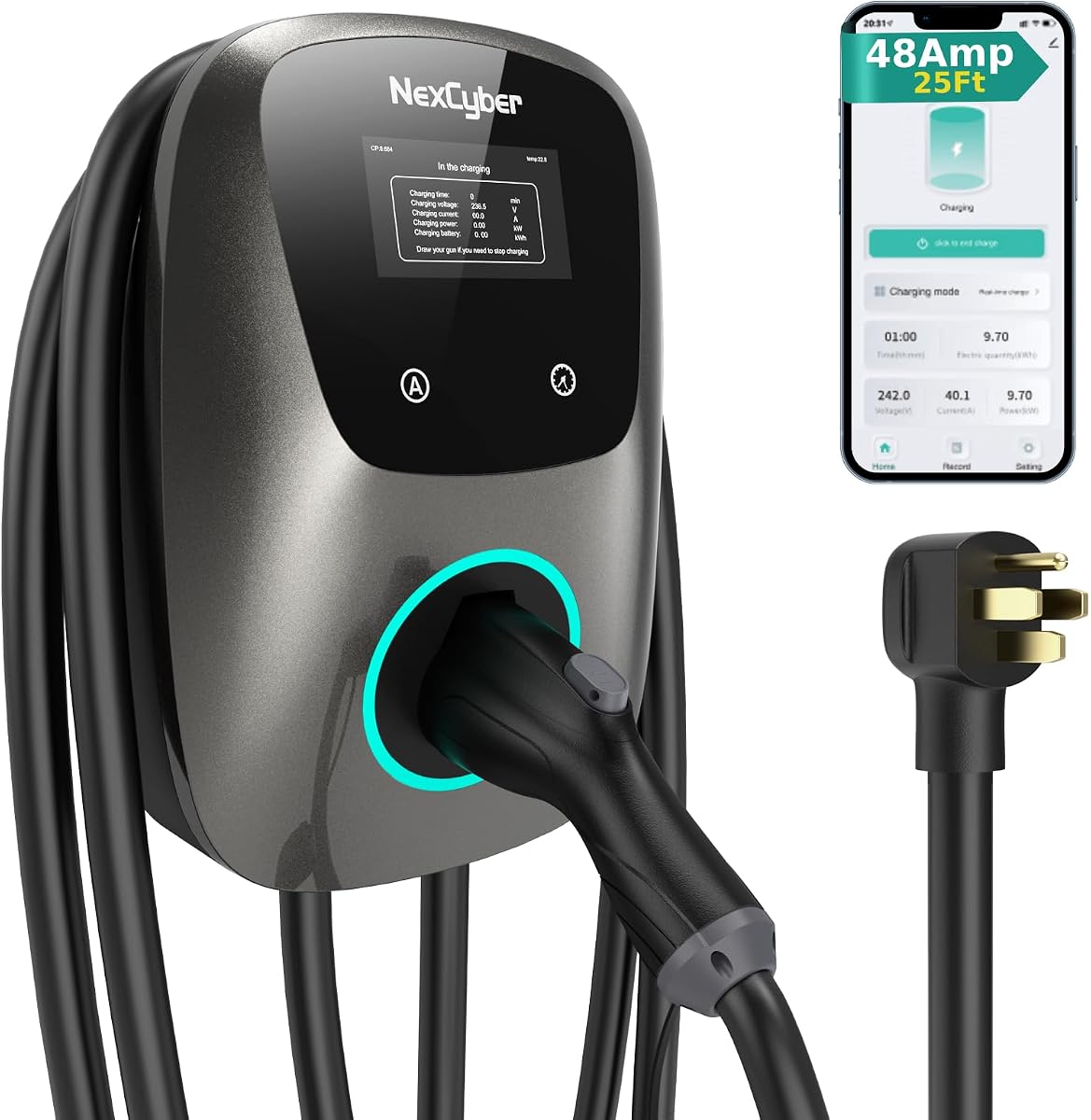
The NexCyber Level 2 EV Charger gives owners both local touchscreen controls and optional app management. It can provide up to 48 amps through a hardwired connection or 40 amps through its NEMA 14-50 plug, making it another flexible alternative when a dedicated installation is being planned.
We may earn a commission when you buy through this link, at no additional cost to you.
The default plug-and-charge mode works without an app, and the display presents amperage, charging speed, input voltage, and delay information. When connected over Wi-Fi, the app can show charging cost, history, status, and completed-session notifications while supporting scheduled charging. The current is adjustable from 16 to 48 amps through the local controls.
The charger is ETL and FCC certified, with a stated compliance list that includes SAE J1772, UL 2231, UL 2251, UL 991, UL 1998, and UL 2594. It includes a 25-foot cable and an emergency-stop control. A 4.5 rating is solid, though it is the lowest among the closely rated connected models in this list.
This charger is a good match for someone who wants app features but does not want the device to depend on an app for basic operation. It suits J1772-equipped vehicles across many North American brands. Tesla and some newer NACS-equipped models need an adapter, and the manufacturer advises against direct sunlight or installation on exposed rainy days despite the stated weather protection.
The touchscreen exposes core information and current controls, while plug-and-charge serves as the default mode. This is convenient for households where one driver charges but not every user wants to manage an app account.
Owners can use the NEMA 14-50 plug for up to 40 amps or convert the charger to a hardwired 48-amp installation. The manufacturer recommends appropriate conductor sizing and professional electrical work.
We may earn a commission when you buy through this link, at no additional cost to you.
The Romaa Level 2 EV Charger provides hardwired 48-amp charging and an unusually prominent three-inch color touchscreen. The display shows charging status, power level, session duration, delivered energy, and error codes, making it easier to understand what the unit is doing without opening an app.
We may earn a commission when you buy through this link, at no additional cost to you.
It can charge at up to 11.5 kilowatts, and the product information illustrates a 65-kWh battery going from 10 to 80 percent in about four hours. Actual time depends on the vehicle's onboard charger and selected settings, so that example should be treated as a general illustration rather than a guarantee.
Wi-Fi features include remote monitoring, energy history, schedules, and completion notifications. Safety protections cover ground faults, temperature, overvoltage, undervoltage, overcurrent, and short circuits. The NEMA 4 and IP66 enclosure is suitable for indoor or outdoor use, and the 25-foot cable supports flexible vehicle positioning.
The main advantages are its readable display, broad compatibility, and installation package, which includes a mounting plate, screws, tools, and a manual. The 4.3 rating trails most competitors, and the stated two-year warranty is shorter than the three-year coverage offered by many alternatives, but the feature set remains competitive.
The color touchscreen presents power, elapsed session time, energy delivered, and error codes directly on the unit. That visibility can be especially helpful when diagnosing a stopped or interrupted session.
The standard J1772 connector supports an extensive list of EV and crossover models from Chevrolet, Ford, Hyundai, Honda, BMW, Volkswagen, Nissan, Cadillac, Audi, Toyota, Subaru, Mercedes-Benz, Kia, Rivian, Acura, and Porsche. Tesla and NACS vehicles require an adapter.
We may earn a commission when you buy through this link, at no additional cost to you.
The Hardwired Level 2 EV Charger 48 Amp J1772 is a rugged option for drivers who want a permanent home installation with strong outdoor suitability. It delivers 48 amps, 11.5 kilowatts, and 240 volts, with the product information estimating up to 44 miles of range added per hour.
We may earn a commission when you buy through this link, at no additional cost to you.
Its aluminum housing has a corrosion-resistant coating, and the NEMA 4 and IP66 enclosure is specified for rain, snow, ice, dust, and operating temperatures from minus 22 to 122 degrees Fahrenheit. A 25-foot cable gives the charger enough reach for garage, driveway, or carport arrangements without requiring a very short lead.
The Wi-Fi app supports remote start and stop, scheduled sessions, real-time charging information, energy-use monitoring, and session history. Scheduling can help owners use lower-cost off-peak periods. The charger is ETL Listed and certified to UL 2594, UL 2231-1, UL 2231-2, and FCC Part 15 standards.
The main consideration is connector compatibility. This model is designed for J1772 ports, so owners of vehicles transitioning to native NACS should confirm the port before purchasing. For a J1772 vehicle and an exposed outdoor mounting location, the enclosure and operating-temperature specification make it a compelling straightforward option.
The aluminum body, protective coating, and IP66 and NEMA 4 ratings target exposed installations. Its stated temperature range covers severe cold and high heat, although the connector and installation conditions should still be handled appropriately.
The app can start, stop, and schedule charging while reporting speed, consumption, and session history. Those functions cover the essentials for a home charger without requiring a separate energy meter.
We may earn a commission when you buy through this link, at no additional cost to you.
Choosing a hardwired 48-amp EV charger requires matching connector standards, electrical capacity, vehicle limits, and installation conditions. The most important first step is confirming that your EV can accept 48 amps on a properly installed dedicated circuit.
In short, match the connector before considering any other feature.
In short, have the electrical panel assessed before buying or installing the charger.
In short, buy for the vehicle you own now and your likely future charging needs.
In short, prioritize the controls you will actually use rather than paying for unnecessary complexity.
In short, favor documented safety certification and professional installation over ambiguous claims.
In short, match the enclosure rating and placement to the actual exposure of the site.
In short, measure the parking area and cable route before selecting the mounting position.
In short, read the warranty terms and support policy rather than relying only on the stated duration.
Before installation, identify the charger's required circuit, conductor sizes, breaker rating, mounting position, and local electrical requirements. Have a licensed electrician complete the hardwired connection and verify that the circuit is de-energized before work begins. Follow the product's installation guide, including torque requirements, grounding, conduit, and environmental instructions. Do not attempt to modify the wiring or exceed the charger's stated current limits.
After installation, pair the connected model with the appropriate app and 2.4 GHz home Wi-Fi network. Set the current according to your vehicle's accepted rate, configure any time-of-use schedule, and establish notification preferences. If the charger includes RFID cards or user controls, register them before sharing the system. Always inspect the connector and inlet for moisture, debris, damage, or heat before inserting or attaching them.
For routine care, keep the cable supported rather than dragging it across sharp edges, and replace the connector in its holster when not in use. Clean the exterior with a soft, damp cloth and avoid harsh chemicals or high-pressure water. Respond to error messages, unexpected stops, unusual heat, or physical damage by consulting the manual and contacting qualified support. Never work on energized wiring, and arrange a safety inspection if the outlet, breaker, or charger shows damage.
A dedicated 60-amp, 240-volt circuit is the typical requirement for the listed 48-amp hardwired models, subject to the charger's manual and an electrician's assessment. Some products can also be configured for 50 amps on a dedicated 70-amp circuit. Proper conductor size, breaker type, grounding, and local code must be determined by a qualified installer. Do not use an existing general-purpose outlet unless it has been specifically evaluated and installed for this load.
No. The vehicle's onboard charger usually determines the maximum accepted charging rate. If the vehicle accepts only 16, 24, 32, or 40 amps, the session will normally run below the charger's maximum. Most listed chargers offer adjustable current, allowing the installation to be set appropriately for the vehicle and the home electrical plan.
They can be, because a dedicated hardwired installation commonly supports 48 amps, while many plug-in Level 2 units use a NEMA 14-50 outlet and operate at up to 40 amps. The practical difference depends on the vehicle's charging limit. A plug-in charger may still charge a vehicle just as quickly when the vehicle itself cannot accept the hardwired unit's higher maximum.
Many Tesla vehicles can use a J1772 charger with the appropriate J1772-to-NACS adapter, and one of the featured products specifically notes compatibility with the adapter supplied with the car. A native NACS charger avoids that adapter for Tesla and other NACS-equipped vehicles. Always verify the connector and any adapter's compatibility before purchase or use.
Most of the listed connected chargers state that they require a 2.4 GHz home Wi-Fi network. Many modern routers combine 2.4 and 5 GHz bands under one network name, so the router may need separate band settings or compatible smart-router configuration. If the charger cannot be discovered, confirming 2.4 GHz connectivity is a useful first troubleshooting step.
It can be safe when the exact charger has an appropriate weather-resistance rating, the installation follows the manual and electrical code, and the unit is mounted within its environmental specifications. Models with IP65 or IP66 and NEMA 4 ratings are intended for suitable outdoor use. Covering the charger, protecting it from direct sun, keeping connections dry, and following manufacturer guidance can further improve longevity.
At 240 volts, 48 amps represents 11.5 kilowatts of maximum charging power, while 40 amps represents 9.6 kilowatts. The real-world difference depends on the vehicle's onboard charger and battery behavior. Some vehicles accept 48 amps and benefit from the higher rate, while others remain limited to 40 amps and see little practical difference.
Normal connector care is usually sufficient. Keep the connector's locking mechanism, electrical contacts, and strain relief clean and dry, and never force it into an incompatible port. Park the cable where tires or doors will not cross it, and return the plug to its holster after charging. If the connector or cable shows cracking, discoloration, heat damage, or intermittent faults, stop using it and seek qualified support.
The EVIQO J1772 48A stands out as the most balanced overall recommendation, combining 48-amp hardwired performance, strong app controls, a 25-foot cable, and an IP66 and NEMA 4 enclosure. The Upgraded 48 Amp J1772 offers strong value and granular one-amp adjustment, while the native NACS Tesla model is the premium choice for compatible vehicles.
Before choosing, prioritize connector type, your vehicle's maximum charging rate, and the electrical capacity of the installation site. Then consider smart features according to how many drivers will use the charger, whether schedules matter, and whether RFID or power sharing could prevent overloads. Weather resistance, warranty length, and app support are also useful differentiators.
Marketplace ratings, product details, availability, and prices can change, so review the current listing before purchasing. Confirm the exact model, connector, required circuit, installation guide, certification information, and warranty terms. A qualified electrician should complete all hardwired work, and the charger should always be matched to the vehicle's accepted current for safe, efficient charging.