
PRV Audio QS400.4
4.4Editor score
Four true RMS channels
Compact Class D design
Two-channel bridging available
This Mini Amp for Motorcycle guide compares ten compact amplifiers by power, channel count, efficiency, weather resistance, mounting ease, and features.
A mini amp for motorcycle can turn a limited storage area into a powerful audio system without forcing oversized electronics into the frame or saddlebag. The right amplifier should deliver enough clean output for your speakers while resisting vibration, heat, and the limited electrical headroom of a motorcycle.
The products in this guide were compared using their published specifications and supplied features, with particular attention to RMS power, channel flexibility, efficiency, physical dimensions, protection, and motorcycle-specific suitability. The list covers compact four-channel, two-channel, marine, and powersports designs suitable for different speaker configurations.
Each review identifies the amplifier's strongest use case, practical advantages, and important limitations. Ratings reflect the available customer feedback, while unrated products are identified accordingly. Product availability and pricing can change, so verify the latest listing, dimensions, and electrical requirements before purchasing.
4.4Editor score

4.7Editor score

4.0Editor score
This side-by-side comparison highlights each mini amplifier's channel configuration, rated output, physical scale, and motorcycle-oriented features, helping you compare compact systems before checking the full reviews.



The Timpano TPT-500.4 is a compact four-channel Class D amplifier designed for installations where space is at a premium. It is rated to deliver 500 watts of dynamic RMS power, with four channels rated at 125 watts each into two ohms. A customer rating is not currently available, so the published specifications are the best basis for judging its fit.
We may earn a commission when you buy through this link, at no additional cost to you.
Its mini heatsink integrates a high-speed MOSFET power supply with premium transistors, allowing the amplifier to remain physically small without abandoning efficiency. The stated 87 percent efficiency rate is particularly relevant to motorcycles, where compact charging systems and limited electrical capacity can make heat and wasted energy important concerns.
The amplifier can also be bridged to produce 225 watts RMS per joined channel pair at a minimum four-ohm load, provided the wiring and speakers are configured correctly. A two-way protection system guards against overheating and speaker short circuits. These are meaningful strengths, but the absence of customer feedback and the need for exact impedance matching should temper expectations.
This is a sensible choice for riders seeking four-channel flexibility in a small footprint, especially when separate front and rear speaker zones are planned. It is less attractive for buyers who prioritize established customer feedback or need a confirmed waterproof rating. Confirm speaker impedance, grounding, and mounting clearance before finalizing the installation.
The compact Class D design aims to produce useful output while limiting waste and heat. That balance makes the TPT-500.4 relevant to motorcycles with tight compartments and limited room for cooling hardware.
Four independent channels suit conventional front-and-rear layouts, while bridging increases available output for a two-channel arrangement. Users should follow the minimum impedance requirements carefully.
We may earn a commission when you buy through this link, at no additional cost to you.
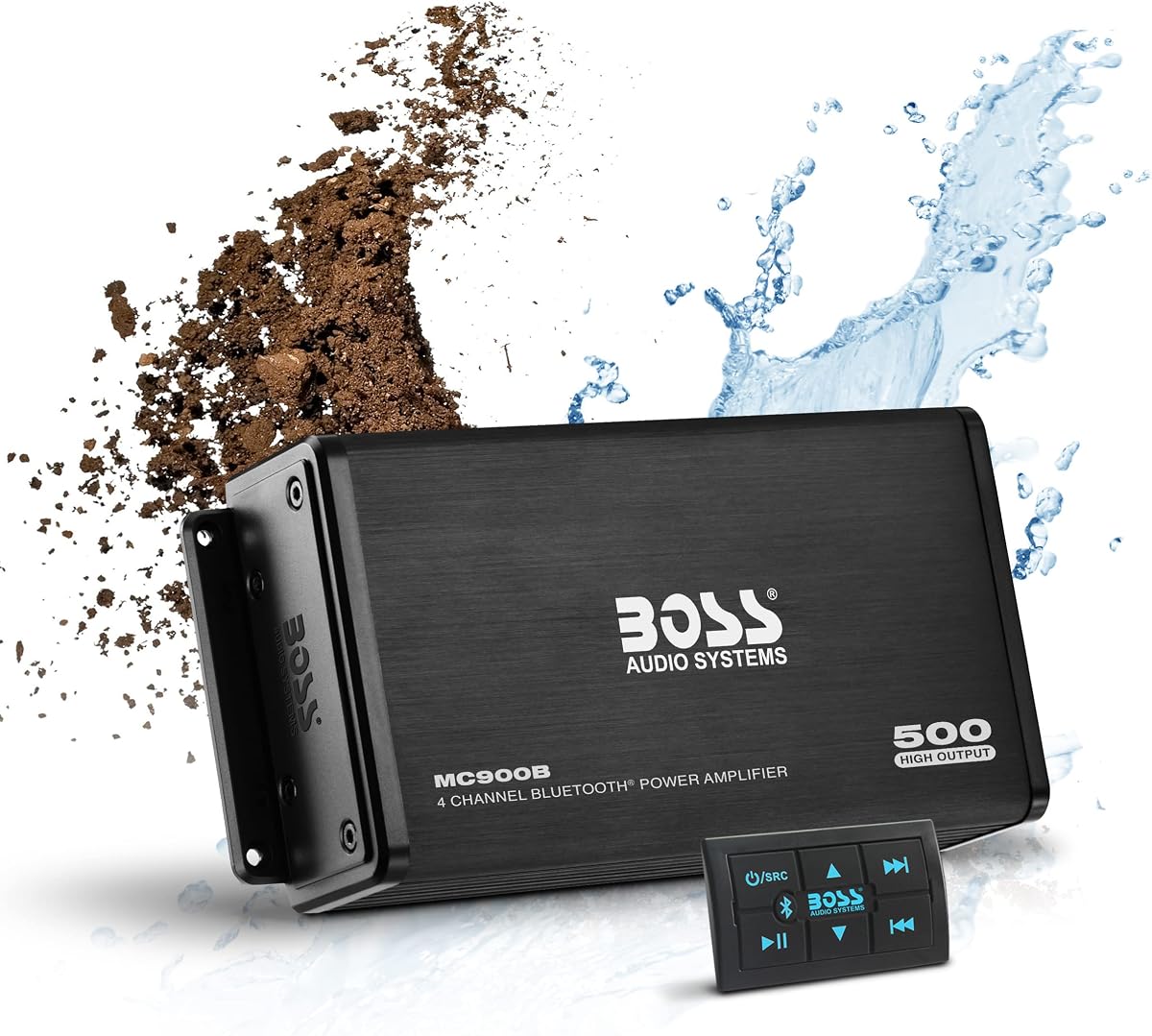
The BOSS Audio Systems MC900B combines a four-channel marine amplifier with built-in wireless convenience, giving it unusual appeal for motorcycle builds that do not want to rely entirely on a conventional head unit. It has a 4.2 rating and produces 94 watts RMS across four channels at four ohms, with 125 watts maximum per channel.
We may earn a commission when you buy through this link, at no additional cost to you.
Its strongest distinguishing feature is the included Bluetooth remote. Once the amplifier is powered and connected to speakers, riders can stream from compatible phones and services such as Spotify and Pandora, change music without reaching toward a source unit, and use the auxiliary connection for other audio players. A USB charging port adds another practical function during a ride.
The enclosure measures 1.75 by 6.6 by 1.75 inches and weighs 2.9 pounds, making it reasonably compact. It is designed for light weather exposure and is suitable for ATVs and boats. However, its Class AB architecture can produce more heat than a compact Class D unit, and weatherproof should not be interpreted as safe for direct rain or immersion.
Choose the MC900B when Bluetooth control, simple phone integration, and marine-oriented construction matter more than maximum thermal efficiency. It is particularly convenient for riders seeking a compact all-in-one audio hub. For exposed installations, use a protected location and verify all terminals are sealed against moisture and road spray.
The separate Bluetooth remote puts common playback functions within reach and can sit on a handlebar or other accessible control point. This reduces dependence on a dashboard-mounted source device.
Marine and powersports-oriented construction makes the amplifier more practical for outdoor vehicles than a basic automotive model. Nevertheless, light weather resistance still calls for sheltered placement and secure connections.
We may earn a commission when you buy through this link, at no additional cost to you.
The SounDigital 800.4 EVO 4.0 is a compact four-channel amplifier aimed at motorcycles, cars, powersports vehicles, and other constrained installations. It carries a 4.4 rating and is described as delivering 800 watts of RMS power across four channels, giving users more control than a basic two-channel mini amplifier.
We may earn a commission when you buy through this link, at no additional cost to you.
Built-in high-pass and low-pass filters, adjustable gain, and bridging options distinguish it from simpler models. Those controls let a rider separate tweeters from midrange speakers or reconfigure the amplifier for subwoofer use. Conformal-coated components, vibration-resistant construction, and an aluminum heatsink are especially relevant to motorcycles exposed to road impacts and changing weather.
The supplied product title contains some inconsistencies between the model naming and the wording of the award claim, so buyers should consult the current listing and manual for exact model details. Its 800-watt headline output should also be interpreted with care: actual channel power depends on impedance and configuration. A high-output design can place additional demands on the motorcycle's charging system.
This amplifier fits riders who want compact installation, built-in system tuning, and four-channel versatility. It is less ideal for a simple two-speaker setup where those features would remain unused, but it offers a strong all-around platform for carefully planned four-speaker or mixed systems. Verify load compatibility and available electrical capacity before installation.
Integrated high-pass and low-pass filters allow speakers to receive appropriate frequency ranges. This can simplify a custom motorcycle audio layout and reduce the need for separate crossover boxes.
Conformal-coated components and a durable aluminum chassis are useful qualities in an environment where road vibration and occasional moisture exposure are common. They do not eliminate the need for sensible placement.
We may earn a commission when you buy through this link, at no additional cost to you.
The PRV Audio MDX1200.4 is a high-output, four-channel mini amplifier explicitly marketed for powersports vehicles and motorcycles. Its 4.6 rating reflects generally favorable customer feedback, while its headline specifications show four channels capable of 300 watts RMS each at two ohms.
We may earn a commission when you buy through this link, at no additional cost to you.
Its total four-channel output is 1,200 watts RMS, but the more useful detail is its configuration flexibility. Two channel pairs can be bridged for 600 watts RMS per joined pair at a minimum four-ohm impedance. That allows an installer to create either a balanced four-speaker system or a more powerful two-channel arrangement without changing amplifiers.
The unit measures 6.75 inches wide by 5.90 inches long and 2.60 inches high, so it is compact relative to its power level. Nevertheless, the electrical demands of this class of amplifier are substantial. A motorcycle's charging system, battery, wiring, and fusing must all be evaluated before drawing on the stated output.
The MDX1200.4 is best suited to riders with loud speakers, multiple zones, or a serious custom build where channel power matters more than the smallest possible enclosure. It is less sensible for modest factory-style speakers that cannot benefit from high amplification. Accurate speaker loading and a robust power installation are essential to extracting its performance safely.
The high RMS specification gives the amplifier room to drive demanding speakers while maintaining four-channel flexibility. The enclosure remains considerably smaller than many conventional high-power units.
Maximum output is only realistic when the source, battery, charging system, cable sizes, and protection are all appropriate. Planning prevents low-voltage operation, excessive heat, and compromised reliability.
We may earn a commission when you buy through this link, at no additional cost to you.
The BOSS Audio Systems CE102 is a straightforward two-channel car amplifier aimed at uncomplicated audio upgrades. It has a 3.7 rating, the lowest customer feedback score among the rated products in this guide, and the supplied information provides less detail than the specifications available for the other models.
We may earn a commission when you buy through this link, at no additional cost to you.
Its two-channel format makes it relevant to a motorcycle with a front speaker pair, a compact handlebar system, or a straightforward rear-speaker installation. The 100-output designation indicates its intended class, but buyers should check the current listing and manual for exact RMS power, impedance stability, dimensions, and controls before comparing it with higher-powered alternatives.
The central trade-off is simplicity rather than advanced functionality. There is no supplied indication of waterproofing, sophisticated crossover controls, wireless streaming, or extensive motorcycle-specific protection. Professional installation is strongly advised in the product information, and following every instruction precisely is particularly important on a two-wheeled vehicle where wiring faults and loose components can create serious problems.
The CE102 makes sense for a rider who wants a familiar, uncomplicated amplifier and does not need four-channel control or high power. It is less suitable for demanding speakers, complex audio routing, or exposed installations without additional protection. Treat the limited specifications as a reason to verify fitment rather than assume feature parity with the more fully documented amplifiers.
Two channels are often exactly what a simple motorcycle system needs. The CE102 can serve a conventional speaker pair without requiring a more complex amplifier.
Because the supplied feature information is limited, current power ratings, controls, and physical measurements should be confirmed. A sound installation depends on matching the amplifier to the speakers and vehicle.
We may earn a commission when you buy through this link, at no additional cost to you.
The PRV Audio MDX2000.4 is the highest-output amplifier in this group, with four channels rated at 500 watts RMS each into two ohms and a total output of 2,000 watts RMS. Its 4.6 rating indicates strong customer reception, but its capabilities are intended for serious custom motorcycle and powersports installations.
We may earn a commission when you buy through this link, at no additional cost to you.
The amplifier can be bridged to deliver 1,000 watts RMS per joined channel pair at a minimum four-ohm impedance. This creates a path to a very powerful two-speaker or subwoofer configuration. Alternatively, all four channels can operate independently for a multi-speaker stage. The mini heavy-duty heatsink supports the power class while preserving a relatively compact profile.
Its dimensions are 9 inches wide, 5.90 inches long, and 2.60 inches high. Although smaller than many high-output alternatives, it is the widest model listed here and may not suit extremely constrained fairings or tightly packed electrical compartments. The real limitation is electrical: delivering this much clean power requires careful attention to battery condition, alternator output, cable gauge, grounding, fusing, and speaker compatibility.
Choose the MDX2000.4 when maximum channel power, bridgeability, and a large custom stage are the priorities. It offers less practical value for ordinary speakers or a modest two-speaker system, where unused power becomes unnecessary heat and added complexity. Professional installation is strongly advisable for any build approaching this output level.
The extreme four-channel rating makes this model appropriate for high-volume custom systems. Pair it with efficient, properly rated speakers that can take advantage of the available power.
The mini heatsink keeps the amplifier smaller than traditional high-power designs, but its width and power requirements can still challenge a compact motorcycle installation.
We may earn a commission when you buy through this link, at no additional cost to you.
The PRV Audio MDX800.4 combines a 4.7 customer rating with one of the most compact four-channel layouts in the guide. It produces 800 watts RMS across four channels, rated at 200 watts each into two ohms, making it an unusually convincing all-around option for motorcycle audio.
We may earn a commission when you buy through this link, at no additional cost to you.
Its enclosure measures just 4.25 inches wide, 4.50 inches long, and 2.10 inches high. That low profile makes it easier to place beneath a seat, inside a fairing, or within a compact electronics area where larger amplifiers cannot fit. Four channels also permit independent front and rear zones, separate tweeter and midrange channels, or other symmetrical configurations.
The amplifier uses surface-mount components intended to perform well in vibration-prone environments. It can be bridged for 400 watts RMS per joined pair at a minimum four-ohm load, giving installers a useful path toward more power. Eight-gauge power inputs and 14-gauge speaker outputs are also listed, though the proper cable and terminal sizes must still match the amplifier and installation method.
This is our Editor's Choice because it balances compact dimensions, useful output, channel flexibility, and strong customer feedback without asking riders to choose between a two-channel and four-channel architecture. It is particularly well suited to custom motorcycles, powerwheels, ATVs, and Slingshots. Ensure the power system can support the intended output and protect the amplifier from direct moisture exposure.
The unusually small footprint creates more placement options than many four-channel amplifiers. It can make a custom audio system practical on motorcycles with limited internal volume.
Independent four-channel operation and pair bridging offer flexibility for front and rear speakers, dedicated tweeters, or a high-power two-speaker arrangement.
We may earn a commission when you buy through this link, at no additional cost to you.
The PRV Audio QS400.4 is a compact, efficient four-channel amplifier that delivers 400 watts RMS in total, with 100 watts per channel into two ohms. Its 4.4 rating suggests broadly positive customer feedback, and it stands out as one of the more approachable options in this guide.
We may earn a commission when you buy through this link, at no additional cost to you.
Its Class D design emphasizes efficient operation, which is valuable when every watt of electrical capacity matters. The four-channel configuration can power two front and two rear speakers, or it can be divided among separate speaker zones. Pairing channels also produces 200 watts RMS per joined pair at a minimum four-ohm impedance for a more powerful two-channel layout.
The chassis measures 4 inches wide, 5.40 inches long, and 2 inches high, which is easy to accommodate in many compact installations. Its trade-off is output: it cannot match the MDX series for per-channel power. It is best suited to efficient speakers and riders who value four-channel flexibility and efficiency more than extreme volume.
The QS400.4 is our Best Budget pick because it combines a useful feature set, a compact enclosure, and strong rated output without moving into the footprint of higher-power models. It offers particularly good value for a four-speaker motorcycle system. Correct load matching, secure mounting, and a fused power feed remain essential regardless of the installation's simplicity.
Four channels at 100 watts RMS provide ample flexibility for standard motorcycle speaker systems while keeping the enclosure easy to place and the amplifier efficient.
This amplifier is most compelling when a rider wants independent zones and bridgeable output without carrying the size or electrical requirements of a much larger amplifier.
We may earn a commission when you buy through this link, at no additional cost to you.
The NVX MVPA4 is a micro Class D amplifier built for marine, powersports, and motorcycle environments. It carries an IPX67 waterproof rating and is described as roughly postcard-sized, making it the strongest dedicated choice here for installations where moisture exposure is a central concern.
We may earn a commission when you buy through this link, at no additional cost to you.
The amplifier delivers 50 watts per channel at four ohms and 100 watts per channel at two ohms, for 400 watts true RMS in total. Four channels and bridgeability allow several system arrangements, including separate speaker zones or higher power for fewer channels. Although the output is modest beside the larger PRV and SounDigital models, efficient motorcycle speakers can produce excellent results without extreme amplification.
Its Class D architecture supports compactness and efficient operation, while the marine-oriented enclosure and IPX67 rating provide meaningful environmental protection. The product is better suited to exposed or splash-prone locations than amplifiers without a stated water-resistance rating. Even so, connectors, wiring terminations, and mounting orientation should be handled carefully.
The MVPA4 earns the Best Premium designation because its environmental protection and micro size form a distinctive package rather than simply offering greater wattage. It is a strong choice for touring bikes, exposed builds, and riders who prioritize resilience. Check the current manual for exact controls, crossover options, and bridge settings before finalizing the installation.
The IPX67 rating makes the MVPA4 especially appealing where splash, rain, or damp storage areas are unavoidable. It offers greater environmental assurance than a conventional indoor automotive amplifier.
Despite its tiny enclosure, the amplifier provides four channels and bridging flexibility. That makes it easier to build a multi-zone system in a very constrained space.
We may earn a commission when you buy through this link, at no additional cost to you.
The DS18 X2 is an ultra-compact, two-channel Class D amplifier that combines a 4.7 customer rating with useful built-in filtering. It delivers 140 watts RMS per channel at four ohms and can reach 230 watts RMS per channel at two ohms, giving it ample power for a well-matched pair of motorcycle speakers.
We may earn a commission when you buy through this link, at no additional cost to you.
Its most useful feature is the adjustable LPF, FLAT, and HPF control. A high-pass filter can remove low-frequency content from small front speakers, a low-pass filter can suit subwoofers, and the flat setting provides a conventional full-range choice. That flexibility reduces the need to add separate crossover modules in a crowded installation.
The four-layer PCB and surface-mount technology are intended to improve stability and durability, while the compact Class D enclosure limits heat and physical space. Its main limitation is channel count: riders planning front and rear zones, separate tweeter channels, or more complex routing may need a four-channel model instead.
The DS18 X2 is best for a clean, thoughtfully configured two-channel system where filters and strong per-channel power matter. It is less suitable for large multi-speaker layouts, and the lack of a stated waterproof rating means it should be installed in a protected location. Verify exact dimensions, controls, and current requirements in the manual before ordering.
Selectable high-pass, low-pass, and flat modes make the X2 more versatile than a basic fixed-response amplifier. These controls simplify matching it to different speaker types.
The ultra-small Class D chassis and surface-mount circuit design suit space-constrained installations. They do not, however, replace protected wiring or correct load matching.
We may earn a commission when you buy through this link, at no additional cost to you.
Choosing a compact motorcycle amplifier involves balancing speaker requirements, electrical limitations, environmental exposure, mounting space, and system flexibility. The most important step is matching the amplifier to the planned speakers and the motorcycle's electrical system.
RMS power indicates the amplifier's continuous output under stated test conditions, making it more useful for comparison than a maximum or peak number. Begin with the power rating recommended for each speaker and add enough amplifier headroom for clean, controlled output. An amplifier that is too small may distort at high volume, while excessive power is not automatically beneficial and can create thermal and electrical strain. Always check the required minimum speaker impedance.
Choose an amplifier whose output and impedance rating align with the speaker system. Match at least the speakers' power needs without overwhelming their construction, and verify whether the speakers are 2-ohm or 4-ohm models.
A two-channel amplifier is usually enough for a front speaker pair or a compact handlebar setup. Four channels allow front and rear zones, independent tweeter and midrange channels, and other flexible arrangements. Bridging combines channel pairs for more output, but it reduces system flexibility and imposes minimum load requirements. Think about the final speaker layout before paying for additional channels.
Use two channels for a simple paired system and four channels for multi-zone or component-speaker builds. Verify that the amplifier supports every bridging and impedance arrangement you intend to use.
Compact does not mean universally small. Published dimensions may include protruding terminals, while the usable area inside a fairing or saddlebag can be limited by brackets, wiring, and structural components. Measure the intended location before ordering, and compare width, length, and height rather than relying on a marketing term. Low-profile models are especially useful beneath a seat, but clearance for airflow and service access still matters.
Measure the actual mounting cavity and leave room for cables and airflow. A slightly larger chassis with easier cooling may be preferable to the smallest possible unit.
Motorcycles have less electrical capacity than many cars, especially when a compact charging system is already supporting lights, instrumentation, and accessories. Efficient Class D amplifiers can reduce waste, but high-output models still require an appropriate battery, alternator or charging system, cable gauge, ground point, and fuse. Low system voltage can also limit the amplifier's ability to reach its advertised output.
Calculate the likely current draw and confirm the motorcycle's charging capacity. Use appropriately sized power cables, a correctly rated fuse near the battery, and a clean, secure ground connection.
A motorcycle experiences rain, spray, dust, temperature changes, and continuous vibration. An amplifier with conformal-coated components or a formal IPX67 rating offers additional confidence, especially in an exposed saddlebag or underbody installation. Weather-resistant is not the same as waterproof, so the listing and manual should be checked carefully. Terminal orientation, cable sealing, and the amplifier's position can be as important as the enclosure rating.
Choose an IPX67 model for exposed locations when available. Otherwise, use a sheltered location, protect connections, and secure every cable so vibration cannot loosen a terminal.
Full-range amplifiers may include high-pass, low-pass, and flat filters. High-pass filters are useful for small door or fairing speakers that should not reproduce very low frequencies, while low-pass filters suit subwoofers. Gain controls set the match between the amplifier and source unit; they are not a general volume control. A properly adjusted gain reduces clipping and distortion while preserving headroom.
Look for filters that match the intended speakers, especially in component audio builds. Set gain with test tones or an oscilloscope rather than by ear alone whenever possible.
Compact Class D amplifiers run efficiently, but sustained high output still creates heat. A metal heatsink and compact enclosure are useful, yet airflow around the unit should not be completely blocked. Built-in short-circuit, thermal, or speaker-protection circuits add resilience but do not excuse poor wiring. Secure the amplifier to a rigid surface using vibration-resistant hardware and avoid mounting it where water or road debris can collect.
Prioritize a sturdy heatsink, accessible mounting points, and documented protection features. Leave adequate clearance around the enclosure and inspect connections after the first longer ride.
A conventional motorcycle head unit provides source selection, volume, and playback control, but it consumes space and requires a clean dashboard installation. The BOSS MC900B adds Bluetooth and a handheld remote, while some other amps depend entirely on an external source. If a phone will handle music, consider whether a wired auxiliary connection, USB charging port, or Bluetooth remote is more useful in the rider's preferred control position.
Choose the amplifier that fits the existing source system. Do not overlook control accessibility, charging needs, and whether the motorcycle's electrical system can support the intended device.
Begin by planning the complete signal path. Match the amplifier's input method to the head unit, phone, or other source, and confirm that speaker impedance agrees with the manufacturer's requirements. Connect the amplifier's ground to a clean chassis point or another approved solid connection, run a suitably sized fused power cable to the battery, and route speaker wires away from sharp edges and moving components.
Set the amplifier's crossover and gain controls before adding substantial volume. Use a familiar recording and an SPL meter or oscilloscope if available, advancing gain in small increments while watching for clipping. Configure any Bluetooth or remote functions after the hardwired connections are secure. In a bridged arrangement, follow the terminal labels exactly and never treat a bridged pair as two independent channels.
After the first ride, inspect the mounting hardware, fuse, terminals, and cable routing. Moisture can collect even around a compact amplifier, so check connectors and dry any exposed water before powering the system again. Keep the heatsink clear of luggage, covers, and debris, and avoid operating the amplifier at maximum output while it is fully enclosed. Periodically checking vibration, corrosion, and connector tightness will help preserve reliable operation.
Yes, a compact amplifier can provide ample power for efficient motorcycle speakers when its RMS rating and impedance match the chosen speakers. The source, wiring, and charging system must also support the intended output. Speakers rated well below the amplifier's maximum are usually more appropriate than choosing a high-power model without regard to load.
A two-channel model is generally sufficient for a single front or handlebar speaker pair. Four channels are preferable for front and rear zones, separate tweeters, or other independently controlled systems. Consider bridging only if you need more power for fewer speakers and can satisfy the higher minimum impedance requirement.
It is highly desirable if the amplifier will be mounted in an exposed saddlebag, underbody, or other area exposed to rain and road spray. An amplifier with an IPX67 rating provides the clearest documented protection. A product described only as weather-resistant should still be installed in a sheltered location with protected connections whenever possible.
Amplifier draw depends on output level, efficiency, source volume, and the duration of use. An efficient Class D design wastes less energy as heat than some alternatives, but high-volume listening can still place meaningful demand on the charging system. For frequent or powerful use, confirm that the battery and alternator or DC-DC charging arrangement are adequate.
The correct impedance is determined by the speaker or speakers connected to each channel and the amplifier's minimum load rating. Many compact Class D amplifiers are stable at two ohms, while bridged configurations commonly require at least four ohms per joined pair. Never connect a lower-impedance load than the manual permits.
Yes, provided it is securely mounted, appropriately protected, and matched to the motorcycle's electrical system. Compact Class D models are generally easier to manage because they produce less heat and require less space. Careful fusing, grounding, cable routing, and vibration protection are especially important on a two-wheeled vehicle.
They can by ensuring that each speaker receives an appropriate range of frequencies. A high-pass filter helps protect small front speakers from excessive bass, while a low-pass filter is useful for a dedicated subwoofer. Filter settings should match the speaker design rather than being selected solely by preference.
Mount it to a rigid surface with vibration-resistant hardware while leaving clearance around the heatsink. Protect terminals from moisture and orient the enclosure according to its instructions. Secure wiring so it cannot contact moving parts, sharp edges, hot exhaust components, or the wheel and suspension assemblies.
The PRV Audio QS400.4 stands out as the Best Budget choice for riders seeking four-channel flexibility in a compact, efficient enclosure. The MDX800.4 takes the Editor's Choice for its stronger 4.7 rating, very small dimensions, 200-watt-per-channel capability, and versatile four-channel or bridged layouts. For premium environmental protection, the NVX MVPA4 stands apart with its IPX67 rating and postcard-style housing.
The rest of the guide covers distinct needs. The Timpano TPT-500.4 offers a compact four-channel design with protection and efficiency, while the SounDigital 800.4 EVO 4.0 adds built-in crossover controls and moisture-resistant components. The PRV MDX1200.4 and MDX2000.4 serve higher-output custom builds, the BOSS MC900B prioritizes Bluetooth convenience, and the CE102 and DS18 X2 suit simpler two-speaker systems.
Before purchasing, compare the amplifier with your exact speaker impedance, mounting space, wiring plan, and charging-system capacity. Check the current listing for updated specifications, availability, and pricing, since both product details and market conditions can change. A carefully matched amplifier and a secure installation will matter more than headline wattage alone.